HOUSING OF ANIMALS
Dr. Rameswar Panda
Mvsc
Bombay Veterinary College
INTRODUCTION
Housing of animals, now-a-days is becoming essential due to
o intensification of animal farming
o large conglomeration of animals in a small area
o due to adverse climatic conditions
o To protect the animals from predators
o For better production performance of animals.
TYPES OF ANIMAL HOUSING
1- Conventional Barns
2- Loose Housing
3- Free Ranges
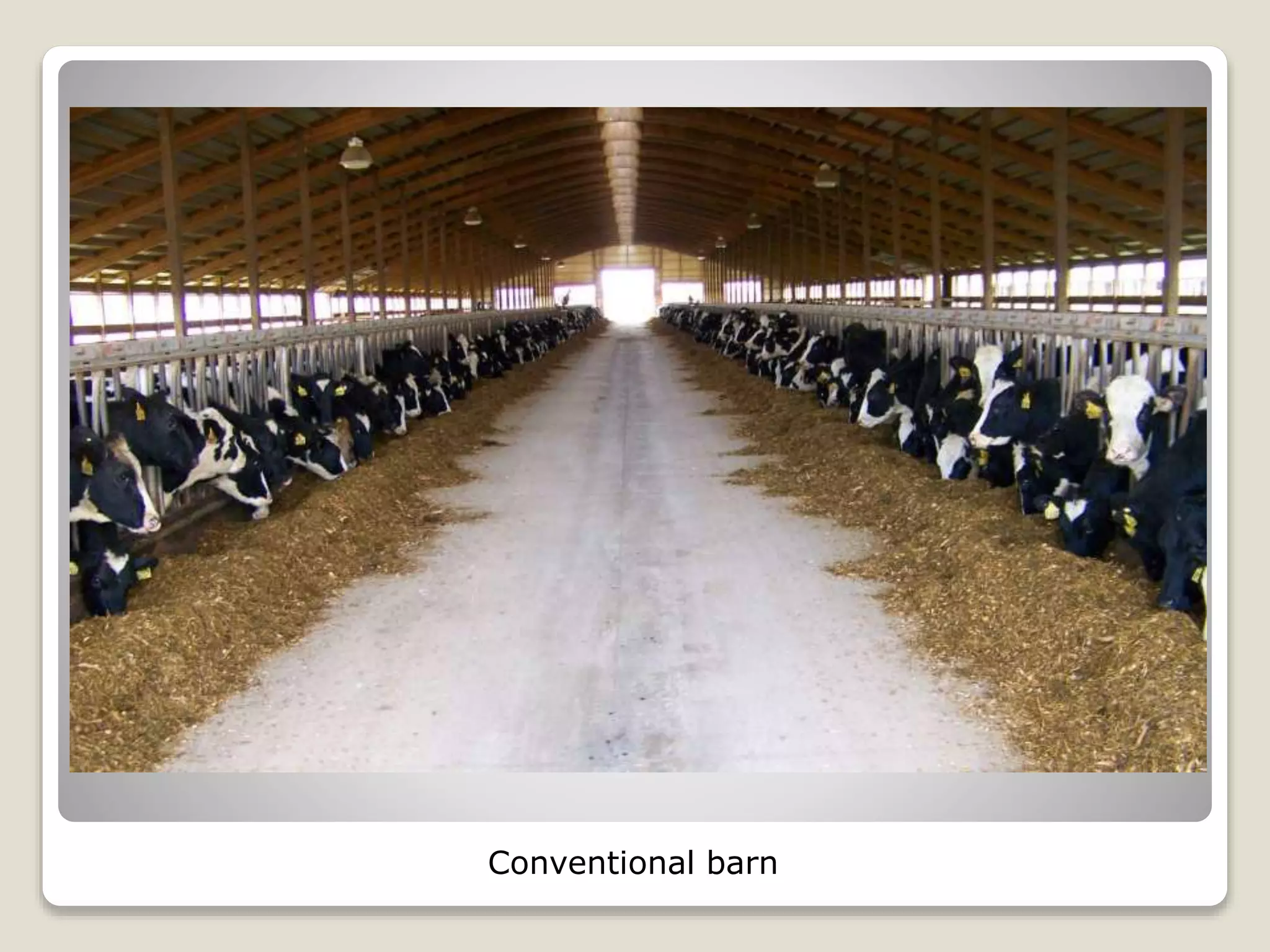
CONVENTIONAL BARNS
 Also called as stanchion barn.
 cows are confined together on a platform and kept
tight by a stanchion or neck chain.
 The swine are not kept confined in a barn, rather
they are let free.
 animals and men caring for animals for animals
are less exposed to adverse weather conditions.
 Barns remain hygiene and disease prevalence is
less.
 Conventional barns are recommended in
temperate Himalayan regions.
Conventional barn
LOOSE HOUSING
 Keeping animals close in an open paddock or
pasture throughout day and night except at
milking time.
 The open paddock is provided with shelter along
one side.
 A common watering tank is provided and fodder
is fed in common mangers.
 Concentrates are fed at the time of milking,
which is done in separate milking barn.
 Self feeding is practiced in loose system of
housing.
 The open paddock is enclosed by means of half
walls or plain wire fences of convenient height.
 All types of livestock can be housed and managed
under loose housing.
 The housing system is suitable in all parts of the
country except in temperate Himalayan region and
heavy rainfall areas.
 However, slight modification of extra fittings may
be necessary.
 The loose houses are cheaper to construct, easier
to expand and flexible in utility.
 Feeding and management of stock is easier
because of common feeding and watering
management.
 Animals feel comfortable.
 About 10 to 15% more stock can be
accommodated in loss housing for short duration
of time.
Loose housing of cattle and buffalo
Loose housing for sheep and goats
FREE RANGES
 Otherwise called as ranches indicate a type of
management.
 Leaving stock free in a large estimate.
 The area is natural or cultivated pasture land with
watering points and shelters.
 This housing is suitable for the animals that are
not handled daily like beef cattle or sheep.
 There is a scope of rearing of sheep on ranch
conditions in north western and hilly regions of
the country
Sheep reared on ranch system
Beef cattle reared on ranch system
References
 Livestock production management by
Thomas and shashtry
 www.google.in
THANK YOU

Different types of housing of animals

  • 1.
    HOUSING OF ANIMALS Dr.Rameswar Panda Mvsc Bombay Veterinary College
  • 2.
    INTRODUCTION Housing of animals,now-a-days is becoming essential due to o intensification of animal farming o large conglomeration of animals in a small area o due to adverse climatic conditions o To protect the animals from predators o For better production performance of animals.
  • 3.
    TYPES OF ANIMALHOUSING 1- Conventional Barns 2- Loose Housing 3- Free Ranges
  • 4.
    CONVENTIONAL BARNS  Alsocalled as stanchion barn.  cows are confined together on a platform and kept tight by a stanchion or neck chain.  The swine are not kept confined in a barn, rather they are let free.  animals and men caring for animals for animals are less exposed to adverse weather conditions.  Barns remain hygiene and disease prevalence is less.  Conventional barns are recommended in temperate Himalayan regions.
  • 5.
  • 6.
    LOOSE HOUSING  Keepinganimals close in an open paddock or pasture throughout day and night except at milking time.  The open paddock is provided with shelter along one side.  A common watering tank is provided and fodder is fed in common mangers.  Concentrates are fed at the time of milking, which is done in separate milking barn.  Self feeding is practiced in loose system of housing.
  • 7.
     The openpaddock is enclosed by means of half walls or plain wire fences of convenient height.  All types of livestock can be housed and managed under loose housing.  The housing system is suitable in all parts of the country except in temperate Himalayan region and heavy rainfall areas.  However, slight modification of extra fittings may be necessary.  The loose houses are cheaper to construct, easier to expand and flexible in utility.  Feeding and management of stock is easier because of common feeding and watering management.
  • 8.
     Animals feelcomfortable.  About 10 to 15% more stock can be accommodated in loss housing for short duration of time.
  • 10.
    Loose housing ofcattle and buffalo
  • 11.
    Loose housing forsheep and goats
  • 12.
    FREE RANGES  Otherwisecalled as ranches indicate a type of management.  Leaving stock free in a large estimate.  The area is natural or cultivated pasture land with watering points and shelters.  This housing is suitable for the animals that are not handled daily like beef cattle or sheep.  There is a scope of rearing of sheep on ranch conditions in north western and hilly regions of the country
  • 13.
    Sheep reared onranch system
  • 14.
    Beef cattle rearedon ranch system
  • 15.
    References  Livestock productionmanagement by Thomas and shashtry  www.google.in
  • 16.