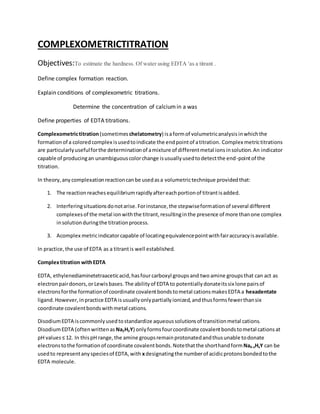
COMPLEXOMETRICTITRATION
Objectives:To estimate the hardness. Of water using EDTA 'as a titrant .
Define complex formation reaction.
Explain conditions of complexometric titrations.
Determine the concentration of calciumin a was
Define properties of EDTA titrations.
Complexometrictitration(sometimes chelatometry) isaformof volumetricanalysis inwhichthe
formationof a coloredcomplex isusedtoindicate the endpointof atitration. Complex metrictitrations
are particularlyusefulforthe determinationof amixture of differentmetal ionsinsolution.An indicator
capable of producingan unambiguouscolorchange isusuallyusedtodetectthe end-pointof the
titration.
In theory,anycomplexationreactioncanbe usedasa volumetrictechnique providedthat:
1. The reactionreaches equilibriumrapidlyaftereachportionof titrantisadded.
2. Interferingsituationsdonotarise.Forinstance,the stepwiseformationof several different
complexesof the metal ionwiththe titrant,resultinginthe presence of more thanone complex
insolutionduringthe titrationprocess.
3. Acomplex metricindicatorcapable of locatingequivalencepointwithfairaccuracyisavailable.
In practice,the use of EDTA as a titrantis well established.
Complextitration withEDTA
EDTA, ethylenediaminetetraaceticacid,hasfour carboxyl groupsand two amine groupsthat can act as
electronpairdonors,orLewisbases.The abilityof EDTA to potentiallydonateitssix lone pairsof
electronsforthe formationof coordinate covalentbondstometal cationsmakesEDTA a hexadentate
ligand.However,inpractice EDTA isusuallyonlypartiallyionized,andthusformsfewerthansix
coordinate covalentbondswithmetal cations.
DisodiumEDTA iscommonlyusedtostandardize aqueoussolutionsof transitionmetal cations.
DisodiumEDTA (oftenwrittenas Na2H2Y) onlyformsfourcoordinate covalentbondstometal cationsat
pH values≤ 12. In thispH range,the amine groupsremainprotonatedandthusunable todonate
electronstothe formationof coordinate covalentbonds.Notethatthe shorthandformNa4-xHxY can be
usedto representanyspeciesof EDTA,with xdesignatingthe numberof acidicprotonsbondedtothe
EDTA molecule.
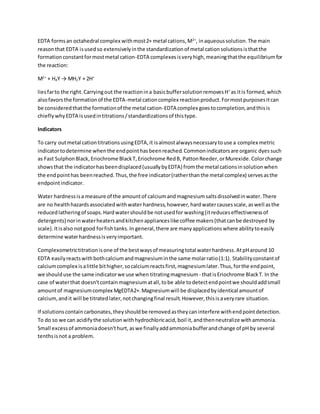
EDTA formsan octahedral complex withmost2+ metal cations,M2+
, inaqueoussolution.The main
reasonthat EDTA isusedso extensivelyinthe standardizationof metal cationsolutionsisthatthe
formationconstantformostmetal cation-EDTA complexesisveryhigh,meaningthatthe equilibriumfor
the reaction:
M2+
+ H4Y → MH2Y + 2H+
liesfarto the right.Carryingout the reactionina basicbuffersolutionremovesH+
as itis formed,which
alsofavorsthe formationof the EDTA-metal cationcomplex reactionproduct.Formostpurposesitcan
be consideredthatthe formationof the metal cation-EDTA complex goestocompletion,andthisis
chieflywhyEDTA isusedintitrations/standardizationsof thistype.
Indicators
To carry outmetal cationtitrationsusingEDTA,it isalmostalwaysnecessarytouse a complex metric
indicatortodetermine whenthe endpointhasbeenreached.Commonindicatorsare organic dyessuch
as Fast SulphonBlack,Eriochrome BlackT,Eriochrome RedB, PattonReeder,orMurexide.Colorchange
showsthat the indicatorhasbeendisplaced(usuallybyEDTA) fromthe metal cationsinsolutionwhen
the endpointhas beenreached.Thus,the free indicator(ratherthanthe metal complex) servesasthe
endpointindicator.
Water hardnessisa measure of the amountof calciumandmagnesiumsaltsdissolvedinwater.There
are no healthhazardsassociatedwithwater hardness,however,hardwatercausesscale,aswell asthe
reducedlatheringof soaps.Hardwatershouldbe notusedfor washing(itreduceseffectivenessof
detergents) norinwaterheatersandkitchenapplianceslike coffee makers(thatcanbe destroyed by
scale).Itisalso notgood forfishtanks.In general,there are manyapplicationswhere abilitytoeasily
determine waterhardnessisveryimportant.
Complexometrictitrationisone of the bestwaysof measuringtotal waterhardness.AtpHaround 10
EDTA easilyreactswithbothcalciumandmagnesiuminthe same molarratio(1:1). Stabilityconstantof
calciumcomplex isalittle bithigher,socalciumreactsfirst,magnesiumlater.Thus,forthe endpoint,
we shoulduse the same indicatorwe use when titratingmagnesium - thatisEriochrome BlackT. In the
case of waterthat doesn'tcontainmagnesiumatall,tobe able todetectendpointwe shouldaddsmall
amountof magnesiumcomplex MgEDTA2+.Magnesiumwill be displacedbyidentical amountof
calcium,andit will be titratedlater,notchangingfinal result.However,thisisaveryrare situation.
If solutionscontain carbonates,theyshouldbe removedastheycaninterfere withendpointdetection.
To do so we can acidifythe solutionwithhydrochloricacid,boil it,andthenneutralize withammonia.
Small excessof ammoniadoesn'thurt,aswe finallyaddammoniabufferandchange of pH by several
tenthsisnot a problem.
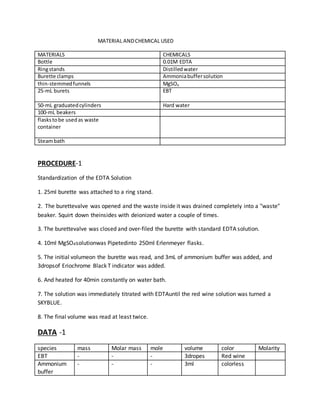
MATERIAL ANDCHEMICAL USED
MATERIALS CHEMICALS
Bottle 0.01M EDTA
Ringstands Distilledwater
Burette clamps Ammoniabuffersolution
thin-stemmedfunnels MgSO4
25-mL burets EBT
50-mL graduatedcylinders Hard water
100-mL beakers
flaskstobe usedas waste
container
Steambath
PROCEDURE-1
Standardization of the EDTA Solution
1. 25ml burette was attached to a ring stand.
2. The burettevalve was opened and the waste inside it was drained completely into a "waste"
beaker. Squirt down theinsides with deionized water a couple of times.
3. The burettevalve was closed and over-filed the burette with standard EDTA solution.
4. 10ml MgSO4solutionwas Pipetedinto 250ml Erlenmeyer flasks.
5. The initial volumeon the burette was read, and 3mL of ammonium buffer was added, and
3dropsof Eriochrome Black T indicator was added.
6. And heated for 40min constantly on water bath.
7. The solution was immediately titrated with EDTAuntil the red wine solution was turned a
SKYBLUE.
8. The final volume was read at least twice.
DATA -1
species mass Molar mass mole volume color Molarity
EBT - - - 3dropes Red wine
Ammonium
buffer
- - - 3ml colorless
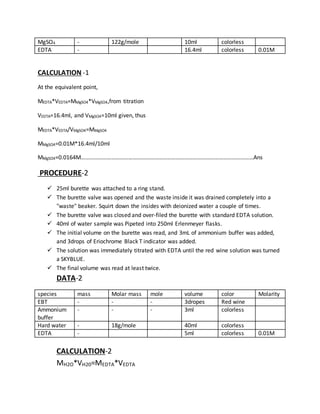
MgSO4 - 122g/mole 10ml colorless
EDTA - 16.4ml colorless 0.01M
CALCULATION -1
At the equivalent point,
MEDTA*VEDTA=MMgSO4*VMgSO4,from titration
VEDTA=16.4ml, and VMgSO4=10ml given, thus
MEDTA*VEDTA/VMgSO4=MMgSO4
MMgSO4=0.01M*16.4ml/10ml
MMgSO4=0.0164M…………………………………………………………………………………………………………Ans
PROCEDURE-2
 25ml burette was attached to a ring stand.
 The burette valve was opened and the waste inside it was drained completely into a
"waste" beaker. Squirt down the insides with deionized water a couple of times.
 The burette valve was closed and over-filed the burette with standard EDTA solution.
 40ml of water sample was Pipeted into 250ml Erlenmeyer flasks.
 The initial volume on the burette was read, and 3mL of ammonium buffer was added,
and 3drops of Eriochrome Black T indicator was added.
 The solution was immediately titrated with EDTA until the red wine solution was turned
a SKYBLUE.
 The final volume was read at least twice.
DATA-2
species mass Molar mass mole volume color Molarity
EBT - - - 3dropes Red wine
Ammonium
buffer
- - - 3ml colorless
Hard water - 18g/mole 40ml colorless
EDTA - 5ml colorless 0.01M
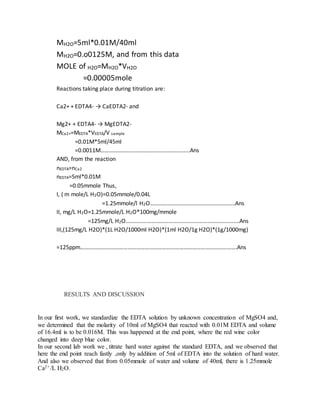
CALCULATION-2
MH2O*VH20=MEDTA*VEDTA
MH2O=5ml*0.01M/40ml
MH2O=0.o0125M, and from this data
MOLE of H2O=MH2O*VH2O
=0.00005mole
Reactions taking place during titration are:
Ca2+ + EDTA4- → CaEDTA2- and
Mg2+ + EDTA4- → MgEDTA2-
MCa2+=MEDTA*VEDTA/V sample
=0.01M*5ml/45ml
=0.0011M……………………………………………………..Ans
AND, from the reaction
nEDTA=nCa2
nEDTA=5ml*0.01M
=0.05mmole Thus,
I, ( m mole/L H2O)=0.05mmole/0.04L
=1.25mmole/l H2O…………………………………………………..Ans
II, mg/L H2O=1.25mmole/L H2O*100mg/mmole
=125mg/L H2O…………………………………………………………………….Ans
III,(125mg/L H2O)*(1L H2O/1000ml H2O)*(1ml H2O/1g H2O)*(1g/1000mg)
=125ppm……………………………………………………………………………………………….Ans
RESULTS AND DISCUSSION
In our first work, we standardize the EDTA solution by unknown concentration of MgSO4 and,
we determined that the molarity of 10ml of MgSO4 that reacted with 0.01M EDTA and volume
of 16.4ml is to be 0.016M. This was happened at the end point, where the red wine color
changed into deep blue color.
In our second lab work we , titrate hard water against the standard EDTA, and we observed that
here the end point reach fastly ,only by addition of 5ml of EDTA into the solution of hard water.
And also we observed that from 0.05mmole of water and volume of 40ml, there is 1.25mmole
Ca2+ /L H2O.
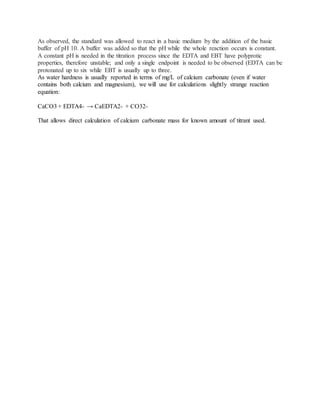
As observed, the standard was allowed to react in a basic medium by the addition of the basic
buffer of pH 10. A buffer was added so that the pH while the whole reaction occurs is constant.
A constant pH is needed in the titration process since the EDTA and EBT have polyprotic
properties, therefore unstable; and only a single endpoint is needed to be observed (EDTA can be
protonated up to six while EBT is usually up to three.
As water hardness is usually reported in terms of mg/L of calcium carbonate (even if water
contains both calcium and magnesium), we will use for calculations slightly strange reaction
equation:
CaCO3 + EDTA4- → CaEDTA2- + CO32-
That allows direct calculation of calcium carbonate mass for known amount of titrant used.

Complexometric titration

  • 1.
    COMPLEXOMETRICTITRATION Objectives:To estimate thehardness. Of water using EDTA 'as a titrant . Define complex formation reaction. Explain conditions of complexometric titrations. Determine the concentration of calciumin a was Define properties of EDTA titrations. Complexometrictitration(sometimes chelatometry) isaformof volumetricanalysis inwhichthe formationof a coloredcomplex isusedtoindicate the endpointof atitration. Complex metrictitrations are particularlyusefulforthe determinationof amixture of differentmetal ionsinsolution.An indicator capable of producingan unambiguouscolorchange isusuallyusedtodetectthe end-pointof the titration. In theory,anycomplexationreactioncanbe usedasa volumetrictechnique providedthat: 1. The reactionreaches equilibriumrapidlyaftereachportionof titrantisadded. 2. Interferingsituationsdonotarise.Forinstance,the stepwiseformationof several different complexesof the metal ionwiththe titrant,resultinginthe presence of more thanone complex insolutionduringthe titrationprocess. 3. Acomplex metricindicatorcapable of locatingequivalencepointwithfairaccuracyisavailable. In practice,the use of EDTA as a titrantis well established. Complextitration withEDTA EDTA, ethylenediaminetetraaceticacid,hasfour carboxyl groupsand two amine groupsthat can act as electronpairdonors,orLewisbases.The abilityof EDTA to potentiallydonateitssix lone pairsof electronsforthe formationof coordinate covalentbondstometal cationsmakesEDTA a hexadentate ligand.However,inpractice EDTA isusuallyonlypartiallyionized,andthusformsfewerthansix coordinate covalentbondswithmetal cations. DisodiumEDTA iscommonlyusedtostandardize aqueoussolutionsof transitionmetal cations. DisodiumEDTA (oftenwrittenas Na2H2Y) onlyformsfourcoordinate covalentbondstometal cationsat pH values≤ 12. In thispH range,the amine groupsremainprotonatedandthusunable todonate electronstothe formationof coordinate covalentbonds.Notethatthe shorthandformNa4-xHxY can be usedto representanyspeciesof EDTA,with xdesignatingthe numberof acidicprotonsbondedtothe EDTA molecule.
  • 2.
    EDTA formsan octahedralcomplex withmost2+ metal cations,M2+ , inaqueoussolution.The main reasonthat EDTA isusedso extensivelyinthe standardizationof metal cationsolutionsisthatthe formationconstantformostmetal cation-EDTA complexesisveryhigh,meaningthatthe equilibriumfor the reaction: M2+ + H4Y → MH2Y + 2H+ liesfarto the right.Carryingout the reactionina basicbuffersolutionremovesH+ as itis formed,which alsofavorsthe formationof the EDTA-metal cationcomplex reactionproduct.Formostpurposesitcan be consideredthatthe formationof the metal cation-EDTA complex goestocompletion,andthisis chieflywhyEDTA isusedintitrations/standardizationsof thistype. Indicators To carry outmetal cationtitrationsusingEDTA,it isalmostalwaysnecessarytouse a complex metric indicatortodetermine whenthe endpointhasbeenreached.Commonindicatorsare organic dyessuch as Fast SulphonBlack,Eriochrome BlackT,Eriochrome RedB, PattonReeder,orMurexide.Colorchange showsthat the indicatorhasbeendisplaced(usuallybyEDTA) fromthe metal cationsinsolutionwhen the endpointhas beenreached.Thus,the free indicator(ratherthanthe metal complex) servesasthe endpointindicator. Water hardnessisa measure of the amountof calciumandmagnesiumsaltsdissolvedinwater.There are no healthhazardsassociatedwithwater hardness,however,hardwatercausesscale,aswell asthe reducedlatheringof soaps.Hardwatershouldbe notusedfor washing(itreduceseffectivenessof detergents) norinwaterheatersandkitchenapplianceslike coffee makers(thatcanbe destroyed by scale).Itisalso notgood forfishtanks.In general,there are manyapplicationswhere abilitytoeasily determine waterhardnessisveryimportant. Complexometrictitrationisone of the bestwaysof measuringtotal waterhardness.AtpHaround 10 EDTA easilyreactswithbothcalciumandmagnesiuminthe same molarratio(1:1). Stabilityconstantof calciumcomplex isalittle bithigher,socalciumreactsfirst,magnesiumlater.Thus,forthe endpoint, we shoulduse the same indicatorwe use when titratingmagnesium - thatisEriochrome BlackT. In the case of waterthat doesn'tcontainmagnesiumatall,tobe able todetectendpointwe shouldaddsmall amountof magnesiumcomplex MgEDTA2+.Magnesiumwill be displacedbyidentical amountof calcium,andit will be titratedlater,notchangingfinal result.However,thisisaveryrare situation. If solutionscontain carbonates,theyshouldbe removedastheycaninterfere withendpointdetection. To do so we can acidifythe solutionwithhydrochloricacid,boil it,andthenneutralize withammonia. Small excessof ammoniadoesn'thurt,aswe finallyaddammoniabufferandchange of pH by several tenthsisnot a problem.
  • 3.
    MATERIAL ANDCHEMICAL USED MATERIALSCHEMICALS Bottle 0.01M EDTA Ringstands Distilledwater Burette clamps Ammoniabuffersolution thin-stemmedfunnels MgSO4 25-mL burets EBT 50-mL graduatedcylinders Hard water 100-mL beakers flaskstobe usedas waste container Steambath PROCEDURE-1 Standardization of the EDTA Solution 1. 25ml burette was attached to a ring stand. 2. The burettevalve was opened and the waste inside it was drained completely into a "waste" beaker. Squirt down theinsides with deionized water a couple of times. 3. The burettevalve was closed and over-filed the burette with standard EDTA solution. 4. 10ml MgSO4solutionwas Pipetedinto 250ml Erlenmeyer flasks. 5. The initial volumeon the burette was read, and 3mL of ammonium buffer was added, and 3dropsof Eriochrome Black T indicator was added. 6. And heated for 40min constantly on water bath. 7. The solution was immediately titrated with EDTAuntil the red wine solution was turned a SKYBLUE. 8. The final volume was read at least twice. DATA -1 species mass Molar mass mole volume color Molarity EBT - - - 3dropes Red wine Ammonium buffer - - - 3ml colorless
  • 4.
    MgSO4 - 122g/mole10ml colorless EDTA - 16.4ml colorless 0.01M CALCULATION -1 At the equivalent point, MEDTA*VEDTA=MMgSO4*VMgSO4,from titration VEDTA=16.4ml, and VMgSO4=10ml given, thus MEDTA*VEDTA/VMgSO4=MMgSO4 MMgSO4=0.01M*16.4ml/10ml MMgSO4=0.0164M…………………………………………………………………………………………………………Ans PROCEDURE-2  25ml burette was attached to a ring stand.  The burette valve was opened and the waste inside it was drained completely into a "waste" beaker. Squirt down the insides with deionized water a couple of times.  The burette valve was closed and over-filed the burette with standard EDTA solution.  40ml of water sample was Pipeted into 250ml Erlenmeyer flasks.  The initial volume on the burette was read, and 3mL of ammonium buffer was added, and 3drops of Eriochrome Black T indicator was added.  The solution was immediately titrated with EDTA until the red wine solution was turned a SKYBLUE.  The final volume was read at least twice. DATA-2 species mass Molar mass mole volume color Molarity EBT - - - 3dropes Red wine Ammonium buffer - - - 3ml colorless Hard water - 18g/mole 40ml colorless EDTA - 5ml colorless 0.01M CALCULATION-2 MH2O*VH20=MEDTA*VEDTA
  • 5.
    MH2O=5ml*0.01M/40ml MH2O=0.o0125M, and fromthis data MOLE of H2O=MH2O*VH2O =0.00005mole Reactions taking place during titration are: Ca2+ + EDTA4- → CaEDTA2- and Mg2+ + EDTA4- → MgEDTA2- MCa2+=MEDTA*VEDTA/V sample =0.01M*5ml/45ml =0.0011M……………………………………………………..Ans AND, from the reaction nEDTA=nCa2 nEDTA=5ml*0.01M =0.05mmole Thus, I, ( m mole/L H2O)=0.05mmole/0.04L =1.25mmole/l H2O…………………………………………………..Ans II, mg/L H2O=1.25mmole/L H2O*100mg/mmole =125mg/L H2O…………………………………………………………………….Ans III,(125mg/L H2O)*(1L H2O/1000ml H2O)*(1ml H2O/1g H2O)*(1g/1000mg) =125ppm……………………………………………………………………………………………….Ans RESULTS AND DISCUSSION In our first work, we standardize the EDTA solution by unknown concentration of MgSO4 and, we determined that the molarity of 10ml of MgSO4 that reacted with 0.01M EDTA and volume of 16.4ml is to be 0.016M. This was happened at the end point, where the red wine color changed into deep blue color. In our second lab work we , titrate hard water against the standard EDTA, and we observed that here the end point reach fastly ,only by addition of 5ml of EDTA into the solution of hard water. And also we observed that from 0.05mmole of water and volume of 40ml, there is 1.25mmole Ca2+ /L H2O.
  • 6.
    As observed, thestandard was allowed to react in a basic medium by the addition of the basic buffer of pH 10. A buffer was added so that the pH while the whole reaction occurs is constant. A constant pH is needed in the titration process since the EDTA and EBT have polyprotic properties, therefore unstable; and only a single endpoint is needed to be observed (EDTA can be protonated up to six while EBT is usually up to three. As water hardness is usually reported in terms of mg/L of calcium carbonate (even if water contains both calcium and magnesium), we will use for calculations slightly strange reaction equation: CaCO3 + EDTA4- → CaEDTA2- + CO32- That allows direct calculation of calcium carbonate mass for known amount of titrant used.