Potassium Permanganate
Titrations
Mr. Hardeep Kaur
Assistant Professor of chemistry
Chandigarh University ,Gharuan, Mohali ,
Punjab.
Hardeepbiotech.cgc@gmail.com
Introduction to potassium
permanganate
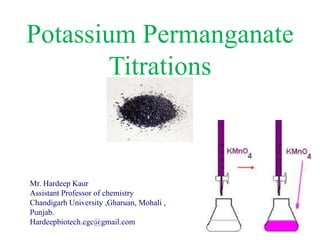
• Potassium permanganate is an inorganic chemical
compound with the formula KMnO₄. It is a salt
consisting of K⁺ and MnO− 4 ions. Formerly known as
permanganate of potash or Condy's crystals, it is a
strong oxidizing agent.
• Formula: KMnO4
• Molar mass: 158.034 g/mol
• Density: 2.70 g/cm³
• Melting point: 240 °C
• IUPAC ID: Potassium mangnate(VII)
• Soluble in: Water
1. Potassium permanganate (KMnO4) is used primarily to
control taste and odors, remove color, control biological
growth in treatment plants, and remove iron and
manganese.
2. Potassium permanganate is a mild antiseptic with astringent
properties. It is used in dermatology to treat weeping skin
conditions. Potassium permanganate tablets are commonly used
in clinical practice.
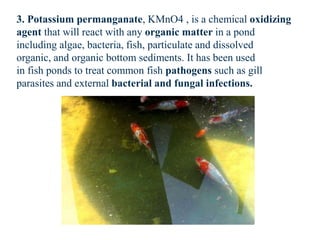
3. Potassium permanganate, KMnO4 , is a chemical oxidizing
agent that will react with any organic matter in a pond
including algae, bacteria, fish, particulate and dissolved
organic, and organic bottom sediments. It has been used
in fish ponds to treat common fish pathogens such as gill
parasites and external bacterial and fungal infections.
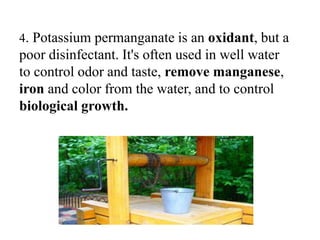
4. Potassium permanganate is an oxidant, but a
poor disinfectant. It's often used in well water
to control odor and taste, remove manganese,
iron and color from the water, and to control
biological growth.
Why is potassium permanganate
soluble in water?
• Almost all potassium-salts are soluble in water. KMnO4 is
a network solid consisting of alternating K atoms and
MnO4 radicals. The bonds holding K to the MnO4- are
weak enough to be easily broken by the hydration of water
molecules.
Self indicator ???
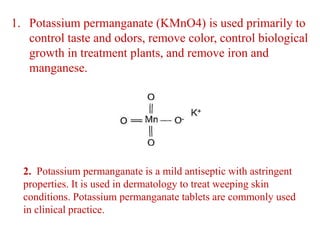
As we all know that the potassium
permanganate (KMnO4) is the dark purple
color solution ..and in titration it become
colorless ..so when the titration is completed
...and the other single drop of KMnO4 solution
produce pinkish color in a beaker ...which
indicate that the reaction was completed just a
single drop before .. we use indicator in a
reaction in order to indicate ..but we don't used
indicator in titration with KMnO4 because it
also indicate us by changing its color
...colorless to pink
Oxidizing Agent
Potassium permanganate is used in organic
chemistry in the form of an alkaline or neutral
solution. Oxidation involves the gain of oxygen
and an oxidizing agent is a chemical that
oxidizes something else. The permanganate in
potassium permanganate has the anion MnO4-
that is the reason for its strong oxidizing
properties.
Oxidation with potassium
permanganate
• KMnO4 is a strong oxidant with an
intense violet color. In strongly acidic
solutions (pH < 1), it is reduced to Mn2+.
• In neutral or alkaline solution, it is
reduced to brown solid MnO2.
• In strongly alkaline solution ( 2 M
NaOH), green manganate ion (MnO4
2-) is
produced.
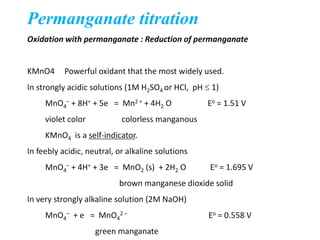
Permanganate titration
Oxidation with permanganate : Reduction of permanganate
KMnO4 Powerful oxidant that the most widely used.
In strongly acidic solutions (1M H2SO4 or HCl, pH  1)
MnO4
– + 8H+ + 5e = Mn2 + + 4H2 O Eo = 1.51 V
violet color colorless manganous
KMnO4 is a self-indicator.
In feebly acidic, neutral, or alkaline solutions
MnO4
– + 4H+ + 3e = MnO2 (s) + 2H2 O Eo = 1.695 V
brown manganese dioxide solid
In very strongly alkaline solution (2M NaOH)
MnO4
– + e = MnO4
2 – Eo = 0.558 V
green manganate
Primary standard ????
NO
Standardization by titration of sodium oxalate
(primary standard)
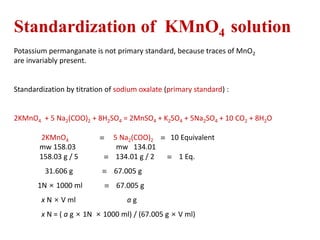
Standardization of KMnO4 solution
Potassium permanganate is not primary standard, because traces of MnO2
are invariably present.
Standardization by titration of sodium oxalate (primary standard) :
2KMnO4 + 5 Na2(COO)2 + 8H2SO4 = 2MnSO4 + K2SO4 + 5Na2SO4 + 10 CO2 + 8H2O
2KMnO4  5 Na2(COO)2  10 Equivalent
mw 158.03 mw 134.01
158.03 g / 5  134.01 g / 2  1 Eq.
31.606 g  67.005 g
1N × 1000 ml  67.005 g
x N × V ml a g
x N = ( a g × 1N × 1000 ml) / (67.005 g × V ml)
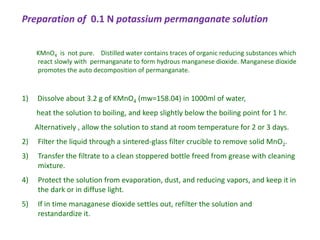
Preparation of 0.1 N potassium permanganate solution
KMnO4 is not pure. Distilled water contains traces of organic reducing substances which
react slowly with permanganate to form hydrous manganese dioxide. Manganese dioxide
promotes the auto decomposition of permanganate.
1) Dissolve about 3.2 g of KMnO4 (mw=158.04) in 1000ml of water,
heat the solution to boiling, and keep slightly below the boiling point for 1 hr.
Alternatively , allow the solution to stand at room temperature for 2 or 3 days.
2) Filter the liquid through a sintered-glass filter crucible to remove solid MnO2.
3) Transfer the filtrate to a clean stoppered bottle freed from grease with cleaning
mixture.
4) Protect the solution from evaporation, dust, and reducing vapors, and keep it in
the dark or in diffuse light.
5) If in time managanese dioxide settles out, refilter the solution and
restandardize it.
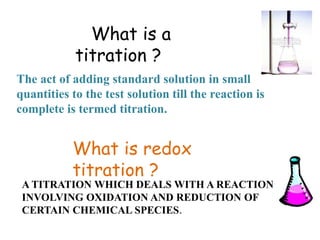
What is redox
titration ?
A TITRATION WHICH DEALS WITH A REACTION
INVOLVING OXIDATION AND REDUCTION OF
CERTAIN CHEMICAL SPECIES.
What is a
titration ?
The act of adding standard solution in small
quantities to the test solution till the reaction is
complete is termed titration.
What is a standard solution?
A standard solution is one whose concentration is
precisely known.
What is a test solution?
A test solution is one whose concentration is to be
estimated.
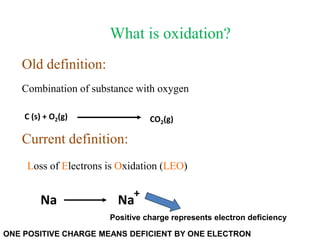
What is oxidation?
Old definition:
Combination of substance with oxygen
C (s) + O2(g) CO2(g)
Current definition:
Loss of Electrons is Oxidation (LEO)
Na Na
+
Positive charge represents electron deficiency
ONE POSITIVE CHARGE MEANS DEFICIENT BY ONE ELECTRON
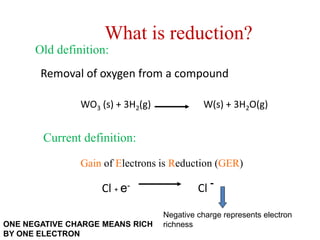
What is reduction?
Old definition:
Removal of oxygen from a compound
WO3 (s) + 3H2(g) W(s) + 3H2O(g)
Current definition:
Gain of Electrons is Reduction (GER)
Cl + e- Cl -
Negative charge represents electron
richnessONE NEGATIVE CHARGE MEANS RICH
BY ONE ELECTRON
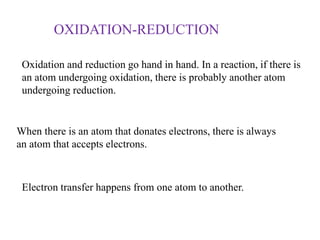
OXIDATION-REDUCTION
Oxidation and reduction go hand in hand. In a reaction, if there is
an atom undergoing oxidation, there is probably another atom
undergoing reduction.
When there is an atom that donates electrons, there is always
an atom that accepts electrons.
Electron transfer happens from one atom to another.
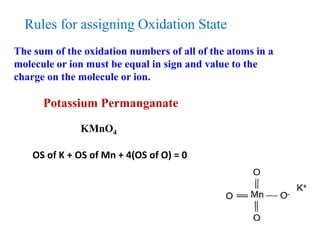
Rules for assigning Oxidation State
The sum of the oxidation numbers of all of the atoms in a
molecule or ion must be equal in sign and value to the
charge on the molecule or ion.
Potassium Permanganate
KMnO4
OS of K + OS of Mn + 4(OS of O) = 0
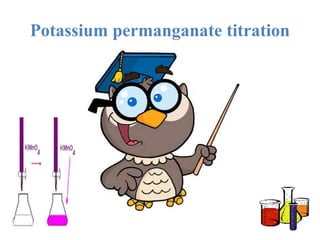
Potassium permanganate titration
Permanganate titration
• Permanganometry is one of the techniques used
in quantitative analysis in Chemistry.
• It is a redox titration and involves the use
of permanganates and is used to measure the
amount of analyte present in unknown chemical
samples.
• It involves two steps, namely the titration of the
analyte with potassium permanganate solution
and then the standardization of potassium
permanganate solution with standard sodium
oxalate solution.
• Depending on how the titration is performed,
the permanganate ion can be reduced to Mnx, where
x is +2, +3, +4 and +6.
• Using permanganometry we can estimate the
quantitative presence of Fe+2, Mn+2, Fe+2 and
Mn+2 when they are both present in a mixture,
C2O4
2-, NO2
-, H2O2 etc.
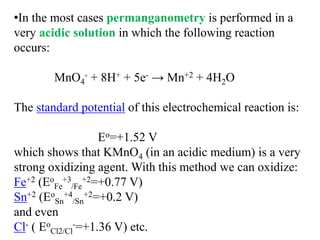
•In the most cases permanganometry is performed in a
very acidic solution in which the following reaction
occurs:
MnO4
- + 8H+ + 5e- → Mn+2 + 4H2O
The standard potential of this electrochemical reaction is:
Eo=+1.52 V
which shows that KMnO4 (in an acidic medium) is a very
strong oxidizing agent. With this method we can oxidize:
Fe+2 (Eo
Fe
+3
/Fe
+2=+0.77 V)
Sn+2 (Eo
Sn
+4
/Sn
+2=+0.2 V)
and even
Cl- ( Eo
Cl2/Cl
-=+1.36 V) etc.
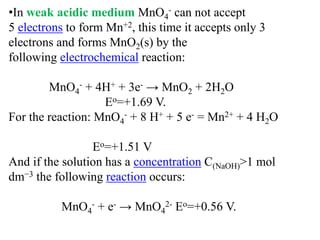
•In weak acidic medium MnO4
- can not accept
5 electrons to form Mn+2, this time it accepts only 3
electrons and forms MnO2(s) by the
following electrochemical reaction:
MnO4
- + 4H+ + 3e- → MnO2 + 2H2O
Eo=+1.69 V.
For the reaction: MnO4
- + 8 H+ + 5 e- = Mn2+ + 4 H2O
Eo=+1.51 V
And if the solution has a concentration C(NaOH)>1 mol
dm−3 the following reaction occurs:
MnO4
- + e- → MnO4
2- Eo=+0.56 V.
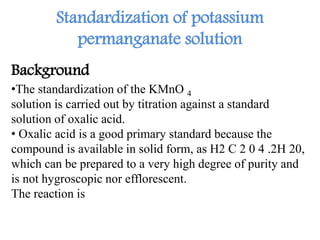
Standardization of potassium
permanganate solution
Background
•The standardization of the KMnO 4
solution is carried out by titration against a standard
solution of oxalic acid.
• Oxalic acid is a good primary standard because the
compound is available in solid form, as H2 C 2 0 4 .2H 20,
which can be prepared to a very high degree of purity and
is not hygroscopic nor efflorescent.
The reaction is
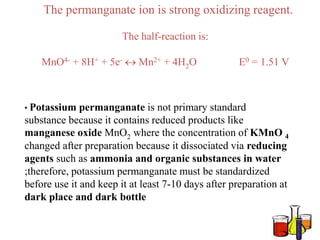
The permanganate ion is strong oxidizing reagent.
The half-reaction is:
MnO4- + 8H+ + 5e-  Mn2+ + 4H2O E0 = 1.51 V
• Potassium permanganate is not primary standard
substance because it contains reduced products like
manganese oxide MnO2 where the concentration of KMnO 4
changed after preparation because it dissociated via reducing
agents such as ammonia and organic substances in water
;therefore, potassium permanganate must be standardized
before use it and keep it at least 7-10 days after preparation at
dark place and dark bottle
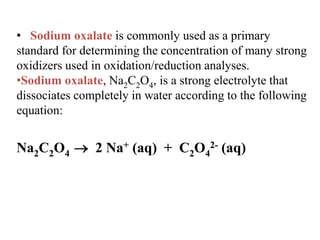
• Sodium oxalate is commonly used as a primary
standard for determining the concentration of many strong
oxidizers used in oxidation/reduction analyses.
•Sodium oxalate, Na2C2O4, is a strong electrolyte that
dissociates completely in water according to the following
equation:
Na2C2O4  2 Na+ (aq) + C2O4
2- (aq)
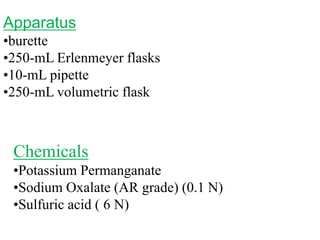
Apparatus
•burette
•250-mL Erlenmeyer flasks
•10-mL pipette
•250-mL volumetric flask
Chemicals
•Potassium Permanganate
•Sodium Oxalate (AR grade) (0.1 N)
•Sulfuric acid ( 6 N)
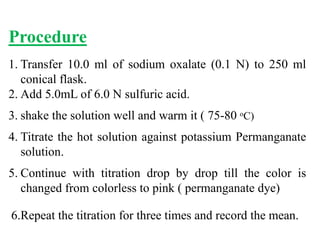
Procedure
1. Transfer 10.0 ml of sodium oxalate (0.1 N) to 250 ml
conical flask.
2. Add 5.0mL of 6.0 N sulfuric acid.
3. shake the solution well and warm it ( 75-80 oC)
4. Titrate the hot solution against potassium Permanganate
solution.
5. Continue with titration drop by drop till the color is
changed from colorless to pink ( permanganate dye)
6.Repeat the titration for three times and record the mean.
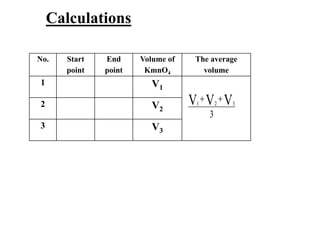
The average
volume
Volume of
KmnO4
End
point
Start
point
No.
V1
1
V2
2
V3
3
Calculations
3
VVV 321
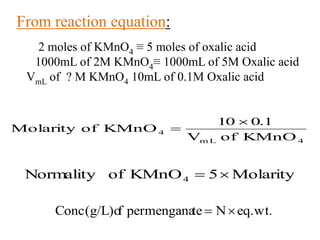

4m L
4
KMnOofV
0.110
KMnOofMolarity


Molarity5KMnOofNormality 4 
eq.wt.NtepermenganafConc(g/L)o 
From reaction equation:
2 moles of KMnO4 ≡ 5 moles of oxalic acid
1000mL of 2M KMnO4≡ 1000mL of 5M Oxalic acid
VmL of ? M KMnO4 10mL of 0.1M Oxalic acid

Potassium permanganate titrations

  • 1.
    Potassium Permanganate Titrations Mr. HardeepKaur Assistant Professor of chemistry Chandigarh University ,Gharuan, Mohali , Punjab. Hardeepbiotech.cgc@gmail.com
  • 2.
    Introduction to potassium permanganate •Potassium permanganate is an inorganic chemical compound with the formula KMnO₄. It is a salt consisting of K⁺ and MnO− 4 ions. Formerly known as permanganate of potash or Condy's crystals, it is a strong oxidizing agent. • Formula: KMnO4 • Molar mass: 158.034 g/mol • Density: 2.70 g/cm³ • Melting point: 240 °C • IUPAC ID: Potassium mangnate(VII) • Soluble in: Water
  • 3.
    1. Potassium permanganate(KMnO4) is used primarily to control taste and odors, remove color, control biological growth in treatment plants, and remove iron and manganese. 2. Potassium permanganate is a mild antiseptic with astringent properties. It is used in dermatology to treat weeping skin conditions. Potassium permanganate tablets are commonly used in clinical practice.
  • 4.
    3. Potassium permanganate,KMnO4 , is a chemical oxidizing agent that will react with any organic matter in a pond including algae, bacteria, fish, particulate and dissolved organic, and organic bottom sediments. It has been used in fish ponds to treat common fish pathogens such as gill parasites and external bacterial and fungal infections.
  • 5.
    4. Potassium permanganateis an oxidant, but a poor disinfectant. It's often used in well water to control odor and taste, remove manganese, iron and color from the water, and to control biological growth.
  • 6.
    Why is potassiumpermanganate soluble in water? • Almost all potassium-salts are soluble in water. KMnO4 is a network solid consisting of alternating K atoms and MnO4 radicals. The bonds holding K to the MnO4- are weak enough to be easily broken by the hydration of water molecules.
  • 7.
  • 8.
    As we allknow that the potassium permanganate (KMnO4) is the dark purple color solution ..and in titration it become colorless ..so when the titration is completed ...and the other single drop of KMnO4 solution produce pinkish color in a beaker ...which indicate that the reaction was completed just a single drop before .. we use indicator in a reaction in order to indicate ..but we don't used indicator in titration with KMnO4 because it also indicate us by changing its color ...colorless to pink
  • 9.
    Oxidizing Agent Potassium permanganateis used in organic chemistry in the form of an alkaline or neutral solution. Oxidation involves the gain of oxygen and an oxidizing agent is a chemical that oxidizes something else. The permanganate in potassium permanganate has the anion MnO4- that is the reason for its strong oxidizing properties.
  • 10.
    Oxidation with potassium permanganate •KMnO4 is a strong oxidant with an intense violet color. In strongly acidic solutions (pH < 1), it is reduced to Mn2+. • In neutral or alkaline solution, it is reduced to brown solid MnO2. • In strongly alkaline solution ( 2 M NaOH), green manganate ion (MnO4 2-) is produced.
  • 11.
    Permanganate titration Oxidation withpermanganate : Reduction of permanganate KMnO4 Powerful oxidant that the most widely used. In strongly acidic solutions (1M H2SO4 or HCl, pH  1) MnO4 – + 8H+ + 5e = Mn2 + + 4H2 O Eo = 1.51 V violet color colorless manganous KMnO4 is a self-indicator. In feebly acidic, neutral, or alkaline solutions MnO4 – + 4H+ + 3e = MnO2 (s) + 2H2 O Eo = 1.695 V brown manganese dioxide solid In very strongly alkaline solution (2M NaOH) MnO4 – + e = MnO4 2 – Eo = 0.558 V green manganate
  • 12.
  • 13.
    NO Standardization by titrationof sodium oxalate (primary standard)
  • 14.
    Standardization of KMnO4solution Potassium permanganate is not primary standard, because traces of MnO2 are invariably present. Standardization by titration of sodium oxalate (primary standard) : 2KMnO4 + 5 Na2(COO)2 + 8H2SO4 = 2MnSO4 + K2SO4 + 5Na2SO4 + 10 CO2 + 8H2O 2KMnO4  5 Na2(COO)2  10 Equivalent mw 158.03 mw 134.01 158.03 g / 5  134.01 g / 2  1 Eq. 31.606 g  67.005 g 1N × 1000 ml  67.005 g x N × V ml a g x N = ( a g × 1N × 1000 ml) / (67.005 g × V ml)
  • 15.
    Preparation of 0.1N potassium permanganate solution KMnO4 is not pure. Distilled water contains traces of organic reducing substances which react slowly with permanganate to form hydrous manganese dioxide. Manganese dioxide promotes the auto decomposition of permanganate. 1) Dissolve about 3.2 g of KMnO4 (mw=158.04) in 1000ml of water, heat the solution to boiling, and keep slightly below the boiling point for 1 hr. Alternatively , allow the solution to stand at room temperature for 2 or 3 days. 2) Filter the liquid through a sintered-glass filter crucible to remove solid MnO2. 3) Transfer the filtrate to a clean stoppered bottle freed from grease with cleaning mixture. 4) Protect the solution from evaporation, dust, and reducing vapors, and keep it in the dark or in diffuse light. 5) If in time managanese dioxide settles out, refilter the solution and restandardize it.
  • 16.
    What is redox titration? A TITRATION WHICH DEALS WITH A REACTION INVOLVING OXIDATION AND REDUCTION OF CERTAIN CHEMICAL SPECIES. What is a titration ? The act of adding standard solution in small quantities to the test solution till the reaction is complete is termed titration.
  • 17.
    What is astandard solution? A standard solution is one whose concentration is precisely known. What is a test solution? A test solution is one whose concentration is to be estimated.
  • 18.
    What is oxidation? Olddefinition: Combination of substance with oxygen C (s) + O2(g) CO2(g) Current definition: Loss of Electrons is Oxidation (LEO) Na Na + Positive charge represents electron deficiency ONE POSITIVE CHARGE MEANS DEFICIENT BY ONE ELECTRON
  • 19.
    What is reduction? Olddefinition: Removal of oxygen from a compound WO3 (s) + 3H2(g) W(s) + 3H2O(g) Current definition: Gain of Electrons is Reduction (GER) Cl + e- Cl - Negative charge represents electron richnessONE NEGATIVE CHARGE MEANS RICH BY ONE ELECTRON
  • 20.
    OXIDATION-REDUCTION Oxidation and reductiongo hand in hand. In a reaction, if there is an atom undergoing oxidation, there is probably another atom undergoing reduction. When there is an atom that donates electrons, there is always an atom that accepts electrons. Electron transfer happens from one atom to another.
  • 21.
    Rules for assigningOxidation State The sum of the oxidation numbers of all of the atoms in a molecule or ion must be equal in sign and value to the charge on the molecule or ion. Potassium Permanganate KMnO4 OS of K + OS of Mn + 4(OS of O) = 0
  • 22.
  • 23.
    Permanganate titration • Permanganometryis one of the techniques used in quantitative analysis in Chemistry. • It is a redox titration and involves the use of permanganates and is used to measure the amount of analyte present in unknown chemical samples. • It involves two steps, namely the titration of the analyte with potassium permanganate solution and then the standardization of potassium permanganate solution with standard sodium oxalate solution.
  • 24.
    • Depending onhow the titration is performed, the permanganate ion can be reduced to Mnx, where x is +2, +3, +4 and +6. • Using permanganometry we can estimate the quantitative presence of Fe+2, Mn+2, Fe+2 and Mn+2 when they are both present in a mixture, C2O4 2-, NO2 -, H2O2 etc.
  • 25.
    •In the mostcases permanganometry is performed in a very acidic solution in which the following reaction occurs: MnO4 - + 8H+ + 5e- → Mn+2 + 4H2O The standard potential of this electrochemical reaction is: Eo=+1.52 V which shows that KMnO4 (in an acidic medium) is a very strong oxidizing agent. With this method we can oxidize: Fe+2 (Eo Fe +3 /Fe +2=+0.77 V) Sn+2 (Eo Sn +4 /Sn +2=+0.2 V) and even Cl- ( Eo Cl2/Cl -=+1.36 V) etc.
  • 26.
    •In weak acidicmedium MnO4 - can not accept 5 electrons to form Mn+2, this time it accepts only 3 electrons and forms MnO2(s) by the following electrochemical reaction: MnO4 - + 4H+ + 3e- → MnO2 + 2H2O Eo=+1.69 V. For the reaction: MnO4 - + 8 H+ + 5 e- = Mn2+ + 4 H2O Eo=+1.51 V And if the solution has a concentration C(NaOH)>1 mol dm−3 the following reaction occurs: MnO4 - + e- → MnO4 2- Eo=+0.56 V.
  • 27.
    Standardization of potassium permanganatesolution Background •The standardization of the KMnO 4 solution is carried out by titration against a standard solution of oxalic acid. • Oxalic acid is a good primary standard because the compound is available in solid form, as H2 C 2 0 4 .2H 20, which can be prepared to a very high degree of purity and is not hygroscopic nor efflorescent. The reaction is
  • 28.
    The permanganate ionis strong oxidizing reagent. The half-reaction is: MnO4- + 8H+ + 5e-  Mn2+ + 4H2O E0 = 1.51 V • Potassium permanganate is not primary standard substance because it contains reduced products like manganese oxide MnO2 where the concentration of KMnO 4 changed after preparation because it dissociated via reducing agents such as ammonia and organic substances in water ;therefore, potassium permanganate must be standardized before use it and keep it at least 7-10 days after preparation at dark place and dark bottle
  • 29.
    • Sodium oxalateis commonly used as a primary standard for determining the concentration of many strong oxidizers used in oxidation/reduction analyses. •Sodium oxalate, Na2C2O4, is a strong electrolyte that dissociates completely in water according to the following equation: Na2C2O4  2 Na+ (aq) + C2O4 2- (aq)
  • 30.
    Apparatus •burette •250-mL Erlenmeyer flasks •10-mLpipette •250-mL volumetric flask Chemicals •Potassium Permanganate •Sodium Oxalate (AR grade) (0.1 N) •Sulfuric acid ( 6 N)
  • 31.
    Procedure 1. Transfer 10.0ml of sodium oxalate (0.1 N) to 250 ml conical flask. 2. Add 5.0mL of 6.0 N sulfuric acid. 3. shake the solution well and warm it ( 75-80 oC) 4. Titrate the hot solution against potassium Permanganate solution. 5. Continue with titration drop by drop till the color is changed from colorless to pink ( permanganate dye) 6.Repeat the titration for three times and record the mean.
  • 32.
  • 33.
    4m L 4 KMnOofV 0.110 KMnOofMolarity   Molarity5KMnOofNormality 4 eq.wt.NtepermenganafConc(g/L)o  From reaction equation: 2 moles of KMnO4 ≡ 5 moles of oxalic acid 1000mL of 2M KMnO4≡ 1000mL of 5M Oxalic acid VmL of ? M KMnO4 10mL of 0.1M Oxalic acid