Communication E ffective communication techniques
The paradox of communication “ We communicate more and more, but we understand less and less .”
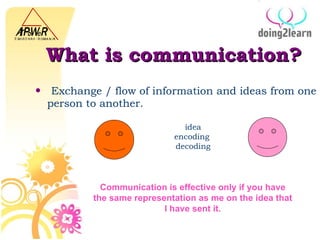
What is communication?   Exchange / flow of information and ideas from one person to another. id ea encoding  decoding Communication is effective only if you have the same representation as me on the idea that I have sent it.
Types of Communication Non-verbal communication BODY ORIENTATION, POSTURE FACE and EYES SMILE BODY POSTURE DISTANCE
Types of Communication Verbal communication Every individual must be prepared both for proper role of transmitter, as well as for the receiver Any receiver should autoeduce order to "actively listen"
Types of Communication Written Communication Written message characteristics are: To be  designed explicitly To involve a strict control on information, facts and arguments used Can be expressed in various forms Is judged by fund and text
Effects of color R ed Increases blood pressure, raised muscle tone, active breathing, is caloric Color warm, stimulating, feeling close, disturbing
Effects of color Orange  Increase heart rate, maintaining blood pressure, promote secretion of gastric Very warm color, very strong feeling of close, stimulating, sociable
Effects of color Yellow   Affects the normal functioning of the cardiovascular system, eyes and nerves stimulates Very warm color, dynamic, feeling of close, calm
Effects of color Green   Decreases blood pressures, dilates capillaries, hypnotic Very cool color, very calm, a feeling of remoteness, facilitates nerve disconnection
Effects of color Blue Decreases blood pressure, decreased muscle tone, calm breathing and pulse frequency Cold color, restful, calm, feeling distant, disconnected facilitate nerve
Effects of color Violet  Increase cardiovascular strength, increases lung resistance Cold color, stimulating, disturbing, disappointing, feeling very strong near
Communication styles Communication style is fundamentally determined by  three elements 1.atitude , as method of constant reporting on social life and self sow 2 .learned communication  models - assertive, non-assertive, aggressive (with option to passive-aggressive), manipulative 3. temp erament ,  the type of nerve cell reactivity
Communication styles NON-ASERTIV STYLE (atitudinea de fugă pasivă)   AGRESIVE STYLE (attitude of attack)  MANIPULATIVE STYLE   ( attitude manipulative )  ASERTIV STYLE (constructive attitude)
Communication barriers 1.External barriers Physical Semantic 2.Internal barriers Positive involvement Negative involvement Hidden agenda Imaginary world
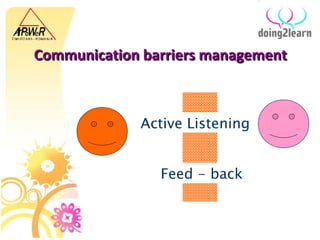
C ommunication barriers  m anagement Active Listening Feed - back
Active Listening Clever talk, the wise obey Listening means not only hearing sound signals, decoding and interpretation but also their integration into their system of thought. Barriers to good listening: Overload message and focus  on all data lack of attention
Features  of  a good listener relaxed posture of the body, but betraying interest d irect eye contact verbal and non verbal signals indicating hearing and understanding the message feedback through comments, reformulations A good listener should avoid: to make judgments to comment on personal experience to interrupt the flow of discussion to give advice
Feedback   describe the behavior of a person and what this behavior aroused the emotion to give feedback Effective feedback: Help us realize what we do and how we operate Enable us to change our behavior Must be offered in a gentle and supportive way
Feedback characteristics SPECIFIC n o   general DESCRIPTIVE n o   evaluativ e GIFT n o    relief
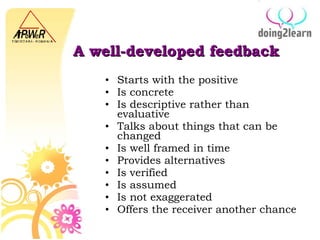
A well-developed feedback Start s  with the positive Is  concrete Is descriptive rather than evaluative Talks about things that can be changed Is well framed in time Provides alternative s I s verified I s assumed I s not exaggerated O ffers  the r eceiver another chance
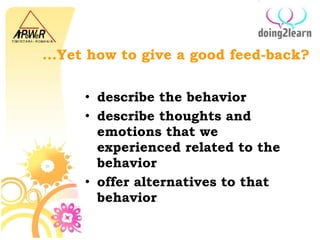
... Yet how to give a good feed-back ? describe  the  behavior describe thoughts and emotions that we experienced related to the behavior offer alternatives to that behavior
Thank you!

Communication workshop

  • 1.
    Communication E ffectivecommunication techniques
  • 2.
    The paradox ofcommunication “ We communicate more and more, but we understand less and less .”
  • 3.
    What is communication? Exchange / flow of information and ideas from one person to another. id ea encoding decoding Communication is effective only if you have the same representation as me on the idea that I have sent it.
  • 4.
    Types of CommunicationNon-verbal communication BODY ORIENTATION, POSTURE FACE and EYES SMILE BODY POSTURE DISTANCE
  • 5.
    Types of CommunicationVerbal communication Every individual must be prepared both for proper role of transmitter, as well as for the receiver Any receiver should autoeduce order to "actively listen"
  • 6.
    Types of CommunicationWritten Communication Written message characteristics are: To be designed explicitly To involve a strict control on information, facts and arguments used Can be expressed in various forms Is judged by fund and text
  • 7.
    Effects of colorR ed Increases blood pressure, raised muscle tone, active breathing, is caloric Color warm, stimulating, feeling close, disturbing
  • 8.
    Effects of colorOrange Increase heart rate, maintaining blood pressure, promote secretion of gastric Very warm color, very strong feeling of close, stimulating, sociable
  • 9.
    Effects of colorYellow Affects the normal functioning of the cardiovascular system, eyes and nerves stimulates Very warm color, dynamic, feeling of close, calm
  • 10.
    Effects of colorGreen Decreases blood pressures, dilates capillaries, hypnotic Very cool color, very calm, a feeling of remoteness, facilitates nerve disconnection
  • 11.
    Effects of colorBlue Decreases blood pressure, decreased muscle tone, calm breathing and pulse frequency Cold color, restful, calm, feeling distant, disconnected facilitate nerve
  • 12.
    Effects of colorViolet Increase cardiovascular strength, increases lung resistance Cold color, stimulating, disturbing, disappointing, feeling very strong near
  • 13.
    Communication styles Communicationstyle is fundamentally determined by three elements 1.atitude , as method of constant reporting on social life and self sow 2 .learned communication models - assertive, non-assertive, aggressive (with option to passive-aggressive), manipulative 3. temp erament , the type of nerve cell reactivity
  • 14.
    Communication styles NON-ASERTIVSTYLE (atitudinea de fugă pasivă) AGRESIVE STYLE (attitude of attack) MANIPULATIVE STYLE ( attitude manipulative ) ASERTIV STYLE (constructive attitude)
  • 15.
    Communication barriers 1.Externalbarriers Physical Semantic 2.Internal barriers Positive involvement Negative involvement Hidden agenda Imaginary world
  • 16.
    C ommunication barriers m anagement Active Listening Feed - back
  • 17.
    Active Listening Clevertalk, the wise obey Listening means not only hearing sound signals, decoding and interpretation but also their integration into their system of thought. Barriers to good listening: Overload message and focus on all data lack of attention
  • 18.
    Features of a good listener relaxed posture of the body, but betraying interest d irect eye contact verbal and non verbal signals indicating hearing and understanding the message feedback through comments, reformulations A good listener should avoid: to make judgments to comment on personal experience to interrupt the flow of discussion to give advice
  • 19.
    Feedback describe the behavior of a person and what this behavior aroused the emotion to give feedback Effective feedback: Help us realize what we do and how we operate Enable us to change our behavior Must be offered in a gentle and supportive way
  • 20.
    Feedback characteristics SPECIFICn o general DESCRIPTIVE n o evaluativ e GIFT n o relief
  • 21.
    A well-developed feedbackStart s with the positive Is concrete Is descriptive rather than evaluative Talks about things that can be changed Is well framed in time Provides alternative s I s verified I s assumed I s not exaggerated O ffers the r eceiver another chance
  • 22.
    ... Yet howto give a good feed-back ? describe the behavior describe thoughts and emotions that we experienced related to the behavior offer alternatives to that behavior
  • 23.