Unit 1 Business Communication
What is Communication
• Communication is simply the act of transferring information
from one place to another.
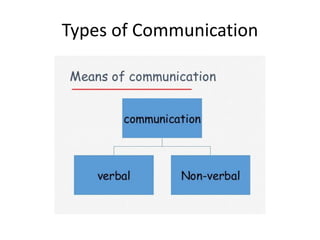
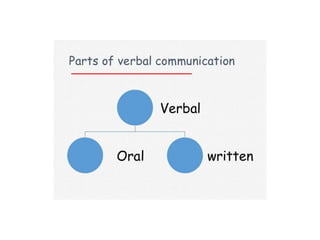
Spoken or Verbal Communication: face-to-face, telephone,
radio or television and other media.
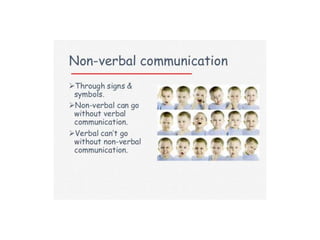
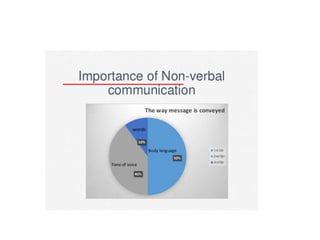
• Non-Verbal Communication: body language, gestures, how
we dress or act - even our scent
• .Written Communication: letters, e-mails, books,
magazines, the Internet or via other media.
• Visualizations: graphs and charts, maps, logos and other
visualizations can communicate messages.
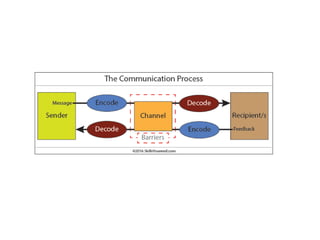
• The Communication Process
• A message or communication is sent by the sender through a communication channel to a
receiver, or to multiple receivers.
• The sender must encode the message (the information being conveyed) into a form that is
appropriate to the communication channel, and the receiver(s) then decodes the message to
understand its meaning and significance.
• Misunderstanding can occur at any stage of the communication process.
• Effective communication involves minimising potential misunderstanding and overcoming any
barriers to communication at each stage in the communication process.
• An effective communicator understands their audience, chooses an appropriate communication
channel, hones their message to this channel and encodes the message to reduce
misunderstanding by the receiver(s).
• They will also seek out feedback from the receiver(s) as to how the message is understood and
attempt to correct any misunderstanding or confusion as soon as possible.
• Receivers can use techniques such as Clarification and Reflection as effective ways to ensure that
the message sent has been understood correctly.
Types of Communication
Characteristics of Successful
Communication
• Today we're exploring the 7 characteristics of
effective communication, as outlined
by University of Wisconsin professor Scott M.
Cutlip in his book Effective Public
Relations (1953). Over time, his listing of
features of effective communication has
become one of the key concepts in advertising
and PR theories, and is now known as the 7
C's of communication
• #1 COMPLETENESS
To be effective, communication should be complete, i.e. it should
include all the information the recipient needs to evaluate its
content, solve a problem or make a decision. Complete
communication reduces the need for follow-up questions and
answers, and improves the quality of the overall communication
process.
#2 CONCISENESS
Conciseness is not about keeping the message short, but rather
about keeping it to a point. Conciseness in communication happens
when the message does not include any redundant or irrelevant
information. Concise communication prompts a better
understanding of the message, because the recipient can focus on
the key points and does not get distracted by a wealth of minor
details.
• #3 CONSIDERATION
When engaging in communication, a sender should always consider
and value the recipient's needs, moods and points of view. Tailoring
the contents and style of your messages based on their target
audience strengthens the key points delivered within, as the sender
can use argumentations and examples relevant to the recipient's
experience, thus catering for a more thorough understanding of the
message.
• #4 CONCRETENESS
Effective communication happens when the message is supported
by facts and figures. Concreteness in communication is also about
answering to questions timely and consistently, and developing
your argumentations based on real-life examples and situations
rather than on general scenarios or theories. Concreteness fosters
effectiveness in communication, as the recipient gets a more
comprehensive overview of the message and its implications.

• #5 COURTESY
Courtesy in communication implies being respectful of the recipient's culture,
values and beliefs. Also, it involves the need to adopt a register your audience can
easily relate to and understand. Courteous communication has a positive impact
on the overall communication, as it prompts a more positive and constructive
approach to the conversation.
#6 CLEARNESS
To be effective, communication has also to be clear and specific. To achieve
clearness, the message should focus on a single objective, thus emphasising its
importance and catering for a prompt understanding of its contents. Clear
communication also requires the adoption of the relevant terminology, thus
reducing ambiguities and confusion in the communication process.
#7 CORRECTNESS
Using grammar and syntax correctly vouches for increased effectiveness and
credibility of the message. In fact, grammar and syntax mistakes make it harder for
the recipient to decode the message and understand its contents. Also, they have
a negative impact on the overall communication, as they show that the sender
hasn't taken his time to craft his messages more carefully.
Importance of Communication in
Management
• Communication promotes motivation by informing and clarifying the employees
about the task to be done, the manner they are performing the task, and how to
improve their performance if it is not up to the mark.
• Communication is a source of information to the organizational members for
decision-making process as it helps identifying and assessing alternative course of
actions.

• Communication also plays a crucial role in altering individual’s attitudes, i.e., a
well informed individual will have better attitude than a less-informed individual.
Organizational magazines, journals, meetings and various other forms of oral and
written communication help in moulding employee’s attitudes.
• Communication also helps in socializing. In todays life the only presence of
another individual fosters communication. It is also said that one cannot survive
without communication.
• As discussed earlier, communication also assists in controlling process. It helps
controlling organizational member’s behaviour in various ways. There are various
levels of hierarchy and certain principles and guidelines that employees must
follow in an organization. They must comply with organizational policies, perform
their job role efficiently and communicate any work problem and grievance to
their superiors. Thus, communication helps in controlling function of management.
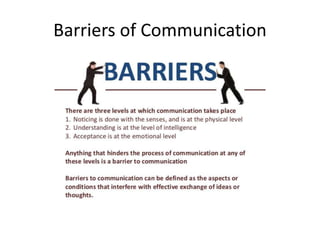
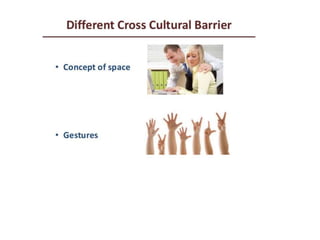
Barriers of Communication
Unit 1 Business Communication

Unit 1 Business Communication

  • 1.
    Unit 1 BusinessCommunication
  • 2.
    What is Communication •Communication is simply the act of transferring information from one place to another. Spoken or Verbal Communication: face-to-face, telephone, radio or television and other media. • Non-Verbal Communication: body language, gestures, how we dress or act - even our scent • .Written Communication: letters, e-mails, books, magazines, the Internet or via other media. • Visualizations: graphs and charts, maps, logos and other visualizations can communicate messages.
  • 3.
    • The CommunicationProcess • A message or communication is sent by the sender through a communication channel to a receiver, or to multiple receivers. • The sender must encode the message (the information being conveyed) into a form that is appropriate to the communication channel, and the receiver(s) then decodes the message to understand its meaning and significance. • Misunderstanding can occur at any stage of the communication process. • Effective communication involves minimising potential misunderstanding and overcoming any barriers to communication at each stage in the communication process. • An effective communicator understands their audience, chooses an appropriate communication channel, hones their message to this channel and encodes the message to reduce misunderstanding by the receiver(s). • They will also seek out feedback from the receiver(s) as to how the message is understood and attempt to correct any misunderstanding or confusion as soon as possible. • Receivers can use techniques such as Clarification and Reflection as effective ways to ensure that the message sent has been understood correctly.
  • 5.
  • 12.
    Characteristics of Successful Communication •Today we're exploring the 7 characteristics of effective communication, as outlined by University of Wisconsin professor Scott M. Cutlip in his book Effective Public Relations (1953). Over time, his listing of features of effective communication has become one of the key concepts in advertising and PR theories, and is now known as the 7 C's of communication
  • 13.
    • #1 COMPLETENESS Tobe effective, communication should be complete, i.e. it should include all the information the recipient needs to evaluate its content, solve a problem or make a decision. Complete communication reduces the need for follow-up questions and answers, and improves the quality of the overall communication process. #2 CONCISENESS Conciseness is not about keeping the message short, but rather about keeping it to a point. Conciseness in communication happens when the message does not include any redundant or irrelevant information. Concise communication prompts a better understanding of the message, because the recipient can focus on the key points and does not get distracted by a wealth of minor details.
  • 14.
    • #3 CONSIDERATION Whenengaging in communication, a sender should always consider and value the recipient's needs, moods and points of view. Tailoring the contents and style of your messages based on their target audience strengthens the key points delivered within, as the sender can use argumentations and examples relevant to the recipient's experience, thus catering for a more thorough understanding of the message. • #4 CONCRETENESS Effective communication happens when the message is supported by facts and figures. Concreteness in communication is also about answering to questions timely and consistently, and developing your argumentations based on real-life examples and situations rather than on general scenarios or theories. Concreteness fosters effectiveness in communication, as the recipient gets a more comprehensive overview of the message and its implications.

  • 15.
    • #5 COURTESY Courtesyin communication implies being respectful of the recipient's culture, values and beliefs. Also, it involves the need to adopt a register your audience can easily relate to and understand. Courteous communication has a positive impact on the overall communication, as it prompts a more positive and constructive approach to the conversation. #6 CLEARNESS To be effective, communication has also to be clear and specific. To achieve clearness, the message should focus on a single objective, thus emphasising its importance and catering for a prompt understanding of its contents. Clear communication also requires the adoption of the relevant terminology, thus reducing ambiguities and confusion in the communication process. #7 CORRECTNESS Using grammar and syntax correctly vouches for increased effectiveness and credibility of the message. In fact, grammar and syntax mistakes make it harder for the recipient to decode the message and understand its contents. Also, they have a negative impact on the overall communication, as they show that the sender hasn't taken his time to craft his messages more carefully.
  • 16.
    Importance of Communicationin Management • Communication promotes motivation by informing and clarifying the employees about the task to be done, the manner they are performing the task, and how to improve their performance if it is not up to the mark. • Communication is a source of information to the organizational members for decision-making process as it helps identifying and assessing alternative course of actions. • Communication also plays a crucial role in altering individual’s attitudes, i.e., a well informed individual will have better attitude than a less-informed individual. Organizational magazines, journals, meetings and various other forms of oral and written communication help in moulding employee’s attitudes. • Communication also helps in socializing. In todays life the only presence of another individual fosters communication. It is also said that one cannot survive without communication. • As discussed earlier, communication also assists in controlling process. It helps controlling organizational member’s behaviour in various ways. There are various levels of hierarchy and certain principles and guidelines that employees must follow in an organization. They must comply with organizational policies, perform their job role efficiently and communicate any work problem and grievance to their superiors. Thus, communication helps in controlling function of management.

  • 17.