Cultural
Sensitivity
Mohit Mittal (73) Aaditya Bagrola(71)
Jainaam Jain (72) Jeevan Bhargav (74)
WHAT IS CULTURAL SENSITIVITY ?
Cultural sensitivity is being aware that cultural differences and
similarities between people exist ,without assigning them a value –
positive or negative, better or worse, right or wrong.
ARE YOU CULTURALLY SENSITIVE OR INSENSITIVE?
Questions to ask ourselves ?
• Do we make assumptions about people based on their race or ethnicity ?
• Do we try to learn the names of those from other cultures ?
• Are we patient with their attempts to use a common language ?
• Do you acknowledge and accept that different cultures have
different manner and etiquettes ?
OR, do you use such phrases as :
• People from ______ country are ______.
• It’s really very hard to work with ______ people.
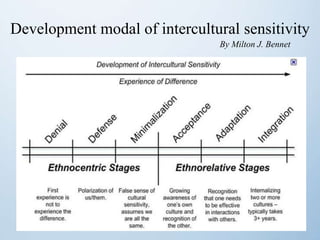
Development modal of intercultural sensitivity
By Milton J. Bennet
Ethnocentric Stage :
It often involves the belief that one's own ethnic group is the most important,
or that some or all aspects of our culture are superior to those of other
cultures.
Stages of Ethnocentrism :
1. Denial
2. Defense
3. Minimization
Ethnorelative Stage :
It is a learned skill, where a person consciously recognizes values and
behaviors as a cultural matter
Stages of Ethnorelative :
1.Acceptance
2. Adaption
3. Integration
Tips to Develop Cultural Sensitivity
1. Understanding and learning new culture
2. Feeling different from the rest of the group
3. Differences are more evident than
similarities
4. Stereotyping
5. Variety
6. Interaction
7. Change with the time
8. Respecting other religion and culture
Importance of cultural sensitivity in Business
1. One on One Cultural Sensitivity
Companies courting employees or executives from countries with
other social norms or beliefs would do well to respect those beliefs.
2. Cultural Sensitivity and products
Being sensitive to cultural considerations is also essential to selling
products in other countries. Many firms have lost money when selling
their products in other countries based on their failure to understand
the culture.
3. Cultural Sensitivity and Language
When businesses need to sell products or produce advertisements in
foreign countries, often these use the host country's own language. Being
insensitive to the nuances of a foreign language can create real cultural
relations problems for companies.
4. Cultural Sensitivity and Employees
As globalization has companies frequently outsourcing work or
recruiting global professionals from a range of countries, many firms
have instituted cultural sensitivity training and expanded the range of
languages into which their sales aids and brochures are translated
Cultural sensitivity

Cultural sensitivity

  • 1.
    Cultural Sensitivity Mohit Mittal (73)Aaditya Bagrola(71) Jainaam Jain (72) Jeevan Bhargav (74)
  • 2.
    WHAT IS CULTURALSENSITIVITY ? Cultural sensitivity is being aware that cultural differences and similarities between people exist ,without assigning them a value – positive or negative, better or worse, right or wrong.
  • 3.
    ARE YOU CULTURALLYSENSITIVE OR INSENSITIVE? Questions to ask ourselves ? • Do we make assumptions about people based on their race or ethnicity ? • Do we try to learn the names of those from other cultures ? • Are we patient with their attempts to use a common language ? • Do you acknowledge and accept that different cultures have different manner and etiquettes ? OR, do you use such phrases as : • People from ______ country are ______. • It’s really very hard to work with ______ people.
  • 4.
    Development modal ofintercultural sensitivity By Milton J. Bennet
  • 5.
    Ethnocentric Stage : Itoften involves the belief that one's own ethnic group is the most important, or that some or all aspects of our culture are superior to those of other cultures. Stages of Ethnocentrism : 1. Denial 2. Defense 3. Minimization Ethnorelative Stage : It is a learned skill, where a person consciously recognizes values and behaviors as a cultural matter Stages of Ethnorelative : 1.Acceptance 2. Adaption 3. Integration
  • 6.
    Tips to DevelopCultural Sensitivity 1. Understanding and learning new culture 2. Feeling different from the rest of the group 3. Differences are more evident than similarities 4. Stereotyping
  • 7.
    5. Variety 6. Interaction 7.Change with the time 8. Respecting other religion and culture
  • 8.
    Importance of culturalsensitivity in Business 1. One on One Cultural Sensitivity Companies courting employees or executives from countries with other social norms or beliefs would do well to respect those beliefs. 2. Cultural Sensitivity and products Being sensitive to cultural considerations is also essential to selling products in other countries. Many firms have lost money when selling their products in other countries based on their failure to understand the culture.
  • 9.
    3. Cultural Sensitivityand Language When businesses need to sell products or produce advertisements in foreign countries, often these use the host country's own language. Being insensitive to the nuances of a foreign language can create real cultural relations problems for companies. 4. Cultural Sensitivity and Employees As globalization has companies frequently outsourcing work or recruiting global professionals from a range of countries, many firms have instituted cultural sensitivity training and expanded the range of languages into which their sales aids and brochures are translated