Effective Communication
Ground Rules
• Please switch off your mobiles.
• Make it an interactive session.
• Brainstorming session

• Above all
•           Lets    agree to Disagree
Index
 •   Effective Communication
 •   Verbal and Non-Verbal Communication
 •   Facial Expression
 •   Body Language
 •   Listening Skills
 •   Dressing Sense
 •   Managing the conflict
 •   10 positive interactivity
Communication

• Find Out what your Listener wants
• Know what you want to say
 ▫   Control Fear
 ▫   Stop Talking and Listen
 ▫   Think before you talk
 ▫   Believe in your message
 ▫   Repeat Major Points
 ▫   Find Out what your Listener wants
• Communication: A Definition

 Communication is the process of exchanging
 information by the use of words, letters,
 symbols, or nonverbal behavior.
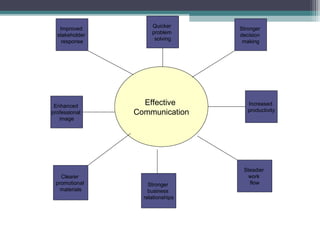
Quicker
   Improved                       Stronger
                     problem
  stakeholder                     decision
                      solving
    response                       making


 Enhanced         Effective          Increased
                                     productivity
professional    Communication
   image


                                   Steadier
   Clearer                           work
 promotional        Stronger         flow
   materials        business
                  relationships
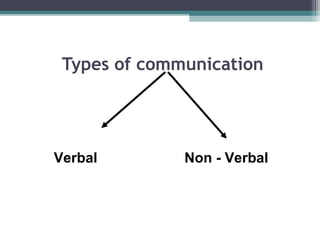
Types of communication


Verbal        Non - Verbal
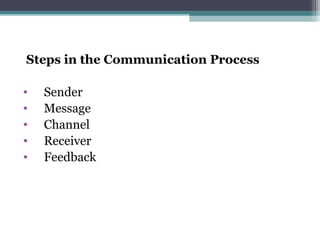
Steps in the Communication Process

•   Sender
•   Message
•   Channel
•   Receiver
•   Feedback
Basics of Effective Communication


  It matters not so much what you say as it does how
    you say it.
• Your communication style is a SET of various
  behaviors and methods of relaying information
  that impact all facets of life.
Basics of Effective Communication


  It matters not so much what you say as it does how
    you say it.
• Your communication style is a SET of various
  behaviors and methods of relaying information
  that impact all facets of life.
Basics of Effective Communication

• Learning all communication styles is important in order
  to avoid communicating in less effective ways and in
  order to recognize those styles in others so as to be able
  to deal with them.
• People are not difficult. They only seem difficult to the
  extent that we do not have the skills to deal with what
  they bring to the table. It is our lack of knowledge that
  makes the situation difficult.
Passive, Aggressive, and Assertive
Communication


Understanding Verbal
Communication Styles
Passive Communication
• Allowing our own rights to be violated by failing to
  express our honest feelings.
• The goal of being a passive communicator is to avoid
  conflict no matter what.
• Little risk involved – very safe.
• Little eye contact, often defers to others’ opinions,
  usually quiet tone, may suddenly explode after being
  passive too long.
Examples of Passive Communication
•   “I don’t know.”
•   “Whatever you think.”
•   “You have more experience than I. You decide.”
•   “I’ll go with whatever the group decides.”
•   “I don’t care. It doesn’t matter to me.”
•   “Yes, yes, yes, yes, yes, yes, yes. . . NO!”
Aggressive Communication
• Protecting one’s own rights at the expense of others’ rights –
  no exceptions.
• The goal of the aggressor is to win at all costs; to be right.
• Does not consider actions a risk because this person thinks
  they will always get their way. It is risky in terms of
  relationships
• Eye contact is angry and intimidating; lots of energy; loud and
  belittling; never defers to others, or at least does not admit to;
  manipulative and controlling. Often uses violence or verbal
  abuse.
Examples of Aggressive Communication

• “I don’t know why you can’t see that this is the right way
  to do it.”
• “It’s going to be my way or not at all.”
• “You’re just stupid if you think that will work.”
• “ “Who cares what you feel. We’re talking about making
  things work here.”
Assertive Communication

• Protecting your own rights without violating the rights of
  others.
• The goal of the assertive person is to communicate with
  respect and to understand each other; to find a solution
  to the problem.
• Takes a risk with others in the short run, but in the long
  run relationships are much stronger.
• Eye contact maintained; listens and validates others;
  confident and strong, yet also flexible; objective and
  unemotional; presents wishes clearly and respectfully.
Examples of Assertive Communication
• “So what you’re saying is. . . .”
• “I can see that this is important to you, and it
  is also important to me. Perhaps we can talk
  more respectfully and try to solve the
  problem.”
• “I think. . . I feel. . . I believe that. . . .”
• “I would appreciate it if you. . .”
• Let me understand your thoughts on this…
Which is the Best Style?

• All styles have their proper place and use.
• Assertive communication is the healthiest.
  ▫ Boundaries of all parties are respected.
  ▫ Easier to problem-solve; fewer emotional
    outbursts.
  ▫ It requires skills and a philosophy change,
    as well as lots of practice and hard work.
  ▫ When both parties do it, no one is hurt in
    any way and all parties win on some level.
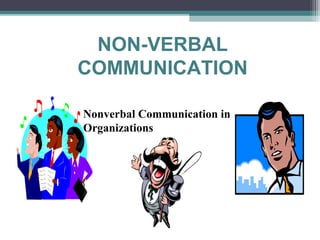
NON-VERBAL
COMMUNICATION

Nonverbal Communication in
Organizations
Thank You

2 effective communication

  • 1.
  • 2.
    Ground Rules • Pleaseswitch off your mobiles. • Make it an interactive session. • Brainstorming session • Above all • Lets agree to Disagree
  • 3.
    Index • Effective Communication • Verbal and Non-Verbal Communication • Facial Expression • Body Language • Listening Skills • Dressing Sense • Managing the conflict • 10 positive interactivity
  • 4.
    Communication • Find Outwhat your Listener wants • Know what you want to say ▫ Control Fear ▫ Stop Talking and Listen ▫ Think before you talk ▫ Believe in your message ▫ Repeat Major Points ▫ Find Out what your Listener wants
  • 5.
    • Communication: ADefinition Communication is the process of exchanging information by the use of words, letters, symbols, or nonverbal behavior.
  • 6.
    Quicker Improved Stronger problem stakeholder decision solving response making Enhanced Effective Increased productivity professional Communication image Steadier Clearer work promotional Stronger flow materials business relationships
  • 7.
  • 8.
    Steps in theCommunication Process • Sender • Message • Channel • Receiver • Feedback
  • 9.
    Basics of EffectiveCommunication It matters not so much what you say as it does how you say it. • Your communication style is a SET of various behaviors and methods of relaying information that impact all facets of life.
  • 10.
    Basics of EffectiveCommunication It matters not so much what you say as it does how you say it. • Your communication style is a SET of various behaviors and methods of relaying information that impact all facets of life.
  • 11.
    Basics of EffectiveCommunication • Learning all communication styles is important in order to avoid communicating in less effective ways and in order to recognize those styles in others so as to be able to deal with them. • People are not difficult. They only seem difficult to the extent that we do not have the skills to deal with what they bring to the table. It is our lack of knowledge that makes the situation difficult.
  • 12.
    Passive, Aggressive, andAssertive Communication Understanding Verbal Communication Styles
  • 13.
    Passive Communication • Allowingour own rights to be violated by failing to express our honest feelings. • The goal of being a passive communicator is to avoid conflict no matter what. • Little risk involved – very safe. • Little eye contact, often defers to others’ opinions, usually quiet tone, may suddenly explode after being passive too long.
  • 14.
    Examples of PassiveCommunication • “I don’t know.” • “Whatever you think.” • “You have more experience than I. You decide.” • “I’ll go with whatever the group decides.” • “I don’t care. It doesn’t matter to me.” • “Yes, yes, yes, yes, yes, yes, yes. . . NO!”
  • 15.
    Aggressive Communication • Protectingone’s own rights at the expense of others’ rights – no exceptions. • The goal of the aggressor is to win at all costs; to be right. • Does not consider actions a risk because this person thinks they will always get their way. It is risky in terms of relationships • Eye contact is angry and intimidating; lots of energy; loud and belittling; never defers to others, or at least does not admit to; manipulative and controlling. Often uses violence or verbal abuse.
  • 16.
    Examples of AggressiveCommunication • “I don’t know why you can’t see that this is the right way to do it.” • “It’s going to be my way or not at all.” • “You’re just stupid if you think that will work.” • “ “Who cares what you feel. We’re talking about making things work here.”
  • 17.
    Assertive Communication • Protectingyour own rights without violating the rights of others. • The goal of the assertive person is to communicate with respect and to understand each other; to find a solution to the problem. • Takes a risk with others in the short run, but in the long run relationships are much stronger. • Eye contact maintained; listens and validates others; confident and strong, yet also flexible; objective and unemotional; presents wishes clearly and respectfully.
  • 18.
    Examples of AssertiveCommunication • “So what you’re saying is. . . .” • “I can see that this is important to you, and it is also important to me. Perhaps we can talk more respectfully and try to solve the problem.” • “I think. . . I feel. . . I believe that. . . .” • “I would appreciate it if you. . .” • Let me understand your thoughts on this…
  • 19.
    Which is theBest Style? • All styles have their proper place and use. • Assertive communication is the healthiest. ▫ Boundaries of all parties are respected. ▫ Easier to problem-solve; fewer emotional outbursts. ▫ It requires skills and a philosophy change, as well as lots of practice and hard work. ▫ When both parties do it, no one is hurt in any way and all parties win on some level.
  • 20.
  • 21.