Developing a
communication strategy


                   Communication Workshop
Communication strategy
• To get the message right, the target audience
  right, the channel right, and the timing right
  frequently, consistently, accurately and
  distinctively – needs a purpose, a plan, a
  strategy, and skills

                   Knowledge Translation Toolkit
Understanding communication
• It is a two-way process
• Tools and channels must fit the message and
  the audience
• It is time- and skill-intensive work
• There is no ‘one size fits all’ approach
What is a communication strategy?
•   A cohesive plan...
•   To deliver specific information...
•   To a specific audience...
•   For a specific reason...
•   Within a limited timeframe...
•   With finite resources
Essential elements
1.   Review          6. Channels
2.   Objective       7. Resources
3.   Audience        8. Timing
4.   Message         9. Brand
5.   Products        10.Feedback
Target audiences
•   Policy makers
•   Parliamentarians
•   Health managers
•   Health care providers
•   Training institutions and trainers
•   Researchers and academia
•   Media
•   Civil society and non-government organisations
•   Families and communities
What are their information needs?
•The way people receive and absorb information is
shaped by many factors
   – Personal preferences and habits
   – Literacy and education levels
   – Level of understanding of the issue
   – Degree of access to information
• Need to use a variety of formats
   – Policy briefs, systematic reviews, newspaper articles
   – Newsletters, brochures, emails, video clips
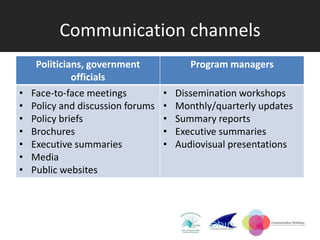
Communication channels
     Politicians, government              Program managers
              officials
•   Face-to-face meetings          •   Dissemination workshops
•   Policy and discussion forums   •   Monthly/quarterly updates
•   Policy briefs                  •   Summary reports
•   Brochures                      •   Executive summaries
•   Executive summaries            •   Audiovisual presentations
•   Media
•   Public websites
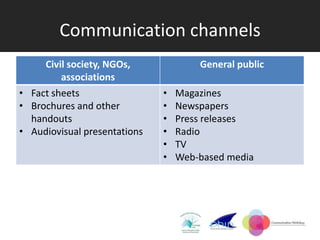
Communication channels
     Civil society, NGOs,             General public
         associations
• Fact sheets                 •   Magazines
• Brochures and other         •   Newspapers
  handouts                    •   Press releases
• Audiovisual presentations   •   Radio
                              •   TV
                              •   Web-based media
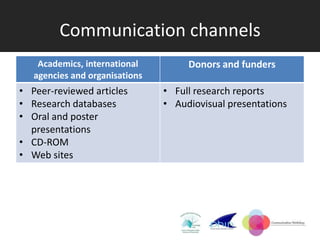
Communication channels
    Academics, international         Donors and funders
   agencies and organisations
• Peer-reviewed articles        • Full research reports
• Research databases            • Audiovisual presentations
• Oral and poster
  presentations
• CD-ROM
• Web sites
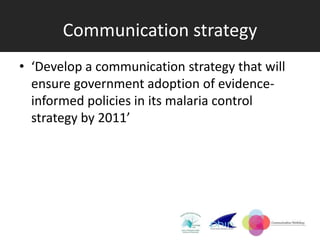
Communication strategy
• ‘Develop a communication strategy that will
  ensure government adoption of evidence-
  informed policies in its malaria control
  strategy by 2011’
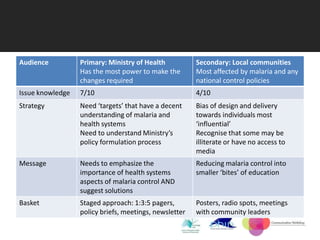
Audience          Primary: Ministry of Health           Secondary: Local communities
                  Has the most power to make the        Most affected by malaria and any
                  changes required                      national control policies
Issue knowledge   7/10                                  4/10
Strategy          Need ‘targets’ that have a decent     Bias of design and delivery
                  understanding of malaria and          towards individuals most
                  health systems                        ‘influential’
                  Need to understand Ministry’s         Recognise that some may be
                  policy formulation process            illiterate or have no access to
                                                        media
Message           Needs to emphasize the                Reducing malaria control into
                  importance of health systems          smaller ‘bites’ of education
                  aspects of malaria control AND
                  suggest solutions
Basket            Staged approach: 1:3:5 pagers,        Posters, radio spots, meetings
                  policy briefs, meetings, newsletter   with community leaders
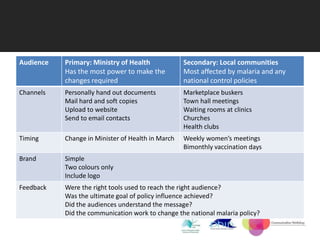
Audience   Primary: Ministry of Health             Secondary: Local communities
           Has the most power to make the          Most affected by malaria and any
           changes required                        national control policies
Channels   Personally hand out documents           Marketplace buskers
           Mail hard and soft copies               Town hall meetings
           Upload to website                       Waiting rooms at clinics
           Send to email contacts                  Churches
                                                   Health clubs
Timing     Change in Minister of Health in March   Weekly women’s meetings
                                                   Bimonthly vaccination days
Brand      Simple
           Two colours only
           Include logo
Feedback   Were the right tools used to reach the right audience?
           Was the ultimate goal of policy influence achieved?
           Did the audiences understand the message?
           Did the communication work to change the national malaria policy?
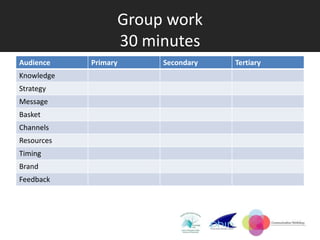
Group work
                  30 minutes
Audience    Primary    Secondary   Tertiary
Knowledge
Strategy
Message
Basket
Channels
Resources
Timing
Brand
Feedback
Further reading
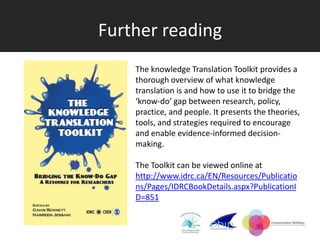
    The knowledge Translation Toolkit provides a
    thorough overview of what knowledge
    translation is and how to use it to bridge the
    ‘know-do’ gap between research, policy,
    practice, and people. It presents the theories,
    tools, and strategies required to encourage
    and enable evidence-informed decision-
    making.

    The Toolkit can be viewed online at
    http://www.idrc.ca/EN/Resources/Publicatio
    ns/Pages/IDRCBookDetails.aspx?PublicationI
    D=851

Communication Workshop: Developing a strategy

  • 1.
  • 2.
    Communication strategy • Toget the message right, the target audience right, the channel right, and the timing right frequently, consistently, accurately and distinctively – needs a purpose, a plan, a strategy, and skills Knowledge Translation Toolkit
  • 3.
    Understanding communication • Itis a two-way process • Tools and channels must fit the message and the audience • It is time- and skill-intensive work • There is no ‘one size fits all’ approach
  • 4.
    What is acommunication strategy? • A cohesive plan... • To deliver specific information... • To a specific audience... • For a specific reason... • Within a limited timeframe... • With finite resources
  • 5.
    Essential elements 1. Review 6. Channels 2. Objective 7. Resources 3. Audience 8. Timing 4. Message 9. Brand 5. Products 10.Feedback
  • 6.
    Target audiences • Policy makers • Parliamentarians • Health managers • Health care providers • Training institutions and trainers • Researchers and academia • Media • Civil society and non-government organisations • Families and communities
  • 7.
    What are theirinformation needs? •The way people receive and absorb information is shaped by many factors – Personal preferences and habits – Literacy and education levels – Level of understanding of the issue – Degree of access to information • Need to use a variety of formats – Policy briefs, systematic reviews, newspaper articles – Newsletters, brochures, emails, video clips
  • 8.
    Communication channels Politicians, government Program managers officials • Face-to-face meetings • Dissemination workshops • Policy and discussion forums • Monthly/quarterly updates • Policy briefs • Summary reports • Brochures • Executive summaries • Executive summaries • Audiovisual presentations • Media • Public websites
  • 9.
    Communication channels Civil society, NGOs, General public associations • Fact sheets • Magazines • Brochures and other • Newspapers handouts • Press releases • Audiovisual presentations • Radio • TV • Web-based media
  • 10.
    Communication channels Academics, international Donors and funders agencies and organisations • Peer-reviewed articles • Full research reports • Research databases • Audiovisual presentations • Oral and poster presentations • CD-ROM • Web sites
  • 11.
    Communication strategy • ‘Developa communication strategy that will ensure government adoption of evidence- informed policies in its malaria control strategy by 2011’
  • 12.
    Audience Primary: Ministry of Health Secondary: Local communities Has the most power to make the Most affected by malaria and any changes required national control policies Issue knowledge 7/10 4/10 Strategy Need ‘targets’ that have a decent Bias of design and delivery understanding of malaria and towards individuals most health systems ‘influential’ Need to understand Ministry’s Recognise that some may be policy formulation process illiterate or have no access to media Message Needs to emphasize the Reducing malaria control into importance of health systems smaller ‘bites’ of education aspects of malaria control AND suggest solutions Basket Staged approach: 1:3:5 pagers, Posters, radio spots, meetings policy briefs, meetings, newsletter with community leaders
  • 13.
    Audience Primary: Ministry of Health Secondary: Local communities Has the most power to make the Most affected by malaria and any changes required national control policies Channels Personally hand out documents Marketplace buskers Mail hard and soft copies Town hall meetings Upload to website Waiting rooms at clinics Send to email contacts Churches Health clubs Timing Change in Minister of Health in March Weekly women’s meetings Bimonthly vaccination days Brand Simple Two colours only Include logo Feedback Were the right tools used to reach the right audience? Was the ultimate goal of policy influence achieved? Did the audiences understand the message? Did the communication work to change the national malaria policy?
  • 14.
    Group work 30 minutes Audience Primary Secondary Tertiary Knowledge Strategy Message Basket Channels Resources Timing Brand Feedback
  • 15.
    Further reading The knowledge Translation Toolkit provides a thorough overview of what knowledge translation is and how to use it to bridge the ‘know-do’ gap between research, policy, practice, and people. It presents the theories, tools, and strategies required to encourage and enable evidence-informed decision- making. The Toolkit can be viewed online at http://www.idrc.ca/EN/Resources/Publicatio ns/Pages/IDRCBookDetails.aspx?PublicationI D=851

Editor's Notes

  • #3 Message must reach the right audience, capture their attention amid all the other messages invading their space, and persuade them to take specific actionCommunication doesn’t just ‘happen’
  • #5 Information must reach the audience and also catch their attentionInspire them to actionEffective communication is essential to achieving core goals (not just helpful)Do you have a communication strategy?...
  • #6 Expand based on notesItems 1-5 done in group work previously
  • #7 Who are your target audiences?Most important? Least?All audiences have no interest in your aims except in the context of their ownMust understand their needs to be able to tailor the message appropriately to themOne of the first steps – disaggregate and prioritize target audiences Must interact/communicate with: those with power to enable or prevent our objectives (those we are mandated to deal with) Should: can make the process easier or more difficult; other agencies Like: indirectly help or hinder; future spin-offs (general public)
  • #8 To communicate effectively we need to consider their needs and their preferencesNOT our abilities and desires
  • #9 What from this list do you do?What is missing? What wouldn’t work – why?
  • #12 Clear goal – first step
  • #13 Example of communication strategyClear SMART objective
  • #14 Timing: important eventsBrand: policyFeedback: some short- others long-term
  • #15 20 minutes for work – 10 minutes to present backDefine your objectiveDifferent communication strategies for each audience