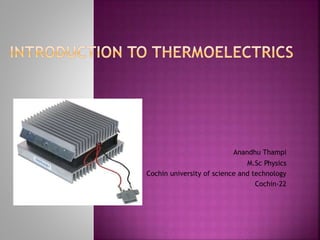
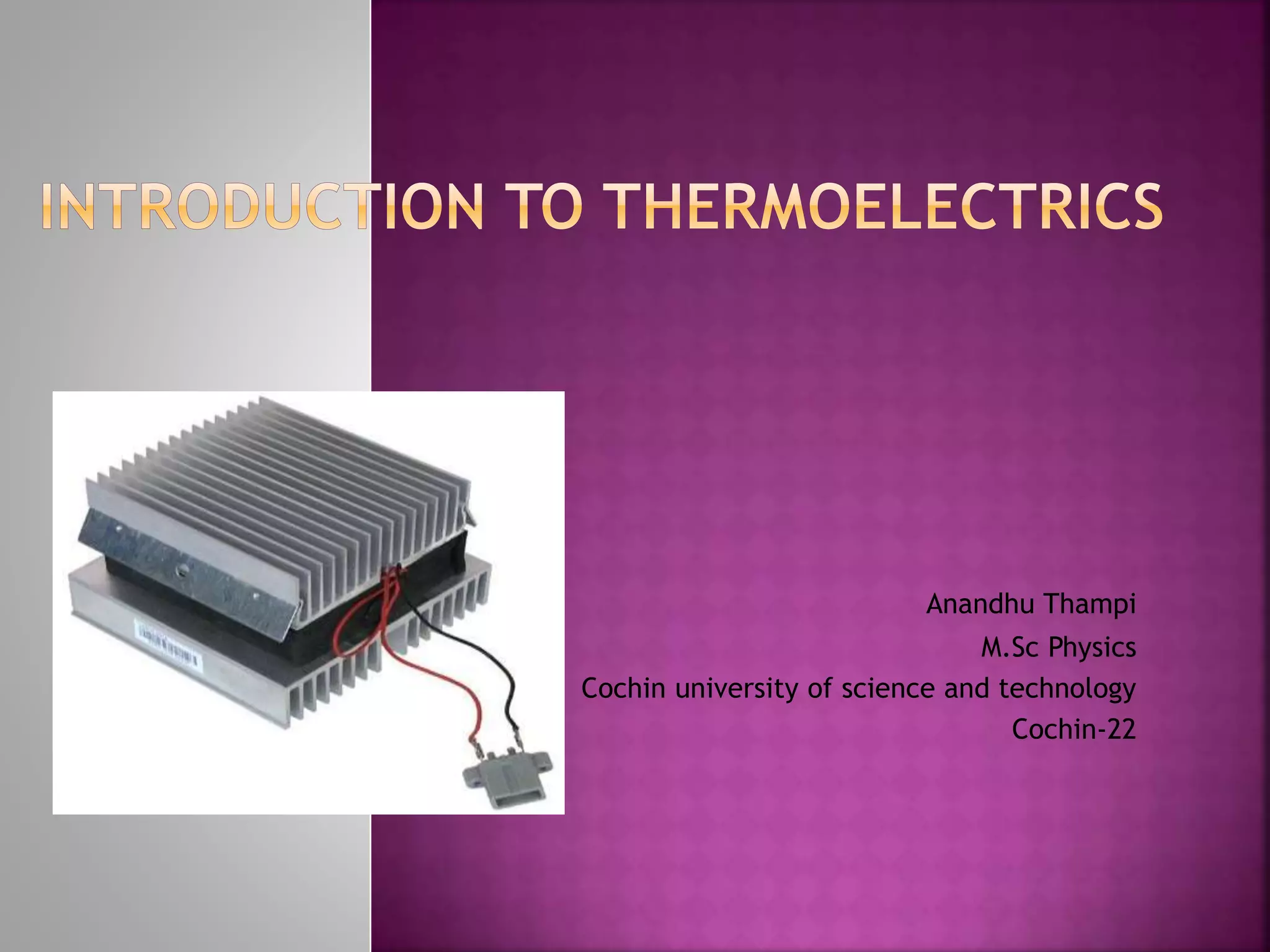
Anandhu Thampi
M.Sc Physics
Cochin university of science and technology
Cochin-22
 The thermoelectric effect is the direct conversion of
temperature difference into electric voltage and vise versa
 In a thermoelectric material there are free carriers which
carry both charge and heat.
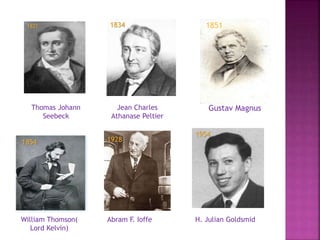
 In the 1820’s Thomas Seebeck (Germany) discovered that if
two metals at different temperatures were touching could
create an electric current.
 In 1834, Jean Peltier (France) discovered that an electrical
current would produce heating or cooling at the junction
of two dissimilar metals.
 In 1851, Lord Kelvin discovered that when the current
flows through the unequally heated conductor, heat is
evolved or absorbed through the conductor
Thomas Johann
Seebeck
Jean Charles
Athanase Peltier
William Thomson(
Lord Kelvin)
Abram F. Ioffe H. Julian Goldsmid
1821 1834
1854 1928
1954
1851
Gustav Magnus
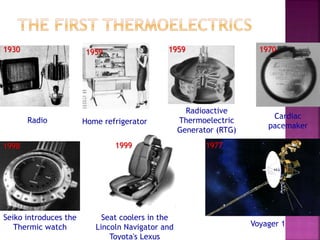
1930 1959 1959 1970
1998 1999
Radio Home refrigerator
Radioactive
Thermoelectric
Generator (RTG)
Cardiac
pacemaker
Seiko introduces the
Thermic watch
Seat coolers in the
Lincoln Navigator and
Toyota's Lexus
Voyager 1
1977
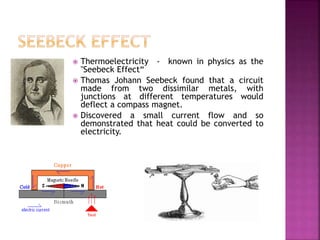
 Thermoelectricity - known in physics as the
"Seebeck Effect“
 Thomas Johann Seebeck found that a circuit
made from two dissimilar metals, with
junctions at different temperatures would
deflect a compass magnet.
 Discovered a small current flow and so
demonstrated that heat could be converted to
electricity.
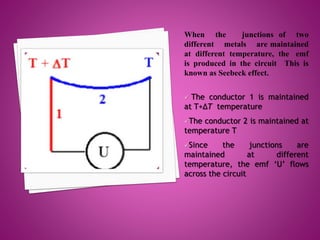
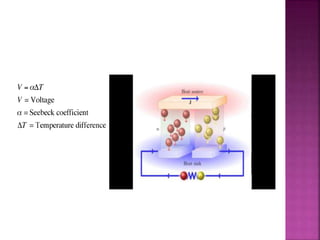
When the junctions of two
different metals are maintained
at different temperature, the emf
is produced in the circuit This is
known as Seebeck effect.
 The conductor 1 is maintained
at T+∆T temperature
The conductor 2 is maintained at
temperature T
Since the junctions are
maintained at different
temperature, the emf ‘U’ flows
across the circuit
 The heating or cooling at
an electrified junction of
two different conductors
 The Peltier heat
generated at the junction
per unit time
 The peltire coefficient
represents how much heat
is carried per unit charge
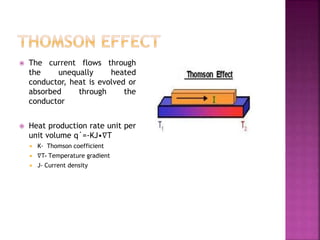
 The current flows through
the unequally heated
conductor, heat is evolved or
absorbed through the
conductor
 Heat production rate unit per
unit volume q´=-KJ•∇T
 K- Thomson coefficient
 ∇T- Temperature gradient
 J- Current density
 Positive Thomson effect
 Current flows from lower T to high T, heat is absorbed throughout
the conductor
 Eg:- Sn, Au, Ag, Zn, Cd, Sb
 Negative Thomson effect
 Current flows from lower T to high T heat is liberated throughout
the conductor
 Eg:- Bi, Ni, Pt, Co, Hg
 Nill Thomson effect
 Current flow from high T to Low T or Low T to high T heat is
neither liberated nor absorbed
 Eg:- Pb
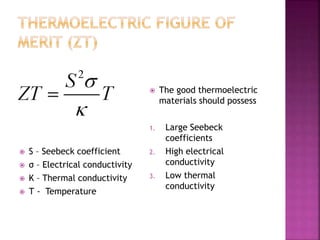
 The good thermoelectric
materials should possess
1. Large Seebeck
coefficients
2. High electrical
conductivity
3. Low thermal
conductivity
 Ѕ – Seebeck coefficient
 σ – Electrical conductivity
 Κ – Thermal conductivity
 Т - Temperature
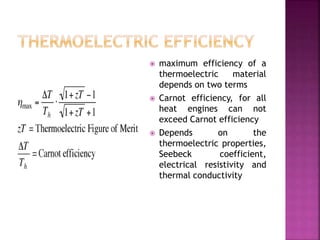
 maximum efficiency of a
thermoelectric material
depends on two terms
 Carnot efficiency, for all
heat engines can not
exceed Carnot efficiency
 Depends on the
thermoelectric properties,
Seebeck coefficient,
electrical resistivity and
thermal conductivity
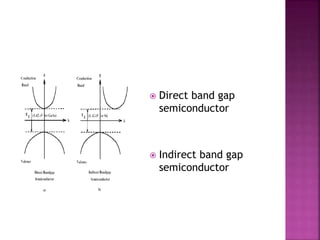
 Direct band gap
semiconductor
 Indirect band gap
semiconductor
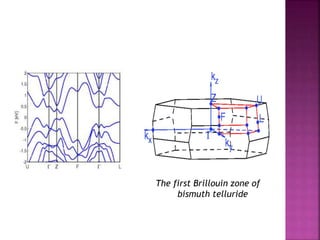
The first Brillouin zone of
bismuth telluride
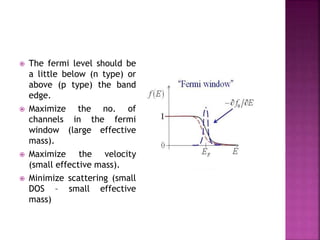
 The fermi level should be
a little below (n type) or
above (p type) the band
edge.
 Maximize the no. of
channels in the fermi
window (large effective
mass).
 Maximize the velocity
(small effective mass).
 Minimize scattering (small
DOS – small effective
mass)
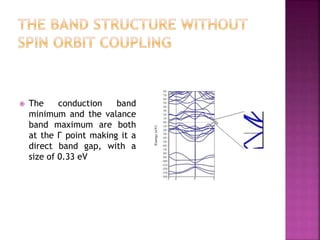
 The conduction band
minimum and the valance
band maximum are both
at the Γ point making it a
direct band gap, with a
size of 0.33 eV
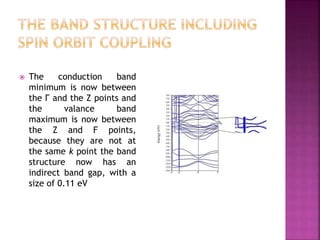
 The conduction band
minimum is now between
the Γ and the Z points and
the valance band
maximum is now between
the Z and F points,
because they are not at
the same k point the band
structure now has an
indirect band gap, with a
size of 0.11 eV
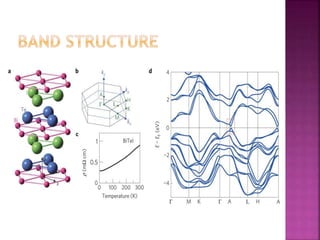
 Darbble et.al introduced six valley model
 Highest valence band and lowest conduction band have six
valleys
 Bands are described in terms of effective mass tensor
 All valleys with the extrema inside first brillouin zone
 Multi valley band structure shows good thermoelectric
properties
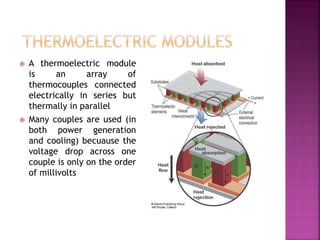
 A thermoelectric module
is an array of
thermocouples connected
electrically in series but
thermally in parallel
 Many couples are used (in
both power generation
and cooling) becuause the
voltage drop across one
couple is only on the order
of millivolts
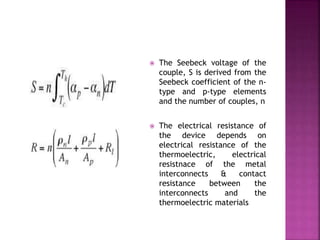
 The Seebeck voltage of the
couple, S is derived from the
Seebeck coefficient of the n-
type and p-type elements
and the number of couples, n
 The electrical resistance of
the device depends on
electrical resistance of the
thermoelectric, electrical
resistnace of the metal
interconnects & contact
resistance between the
interconnects and the
thermoelectric materials
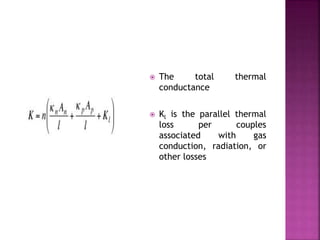
 The total thermal
conductance
 Kl is the parallel thermal
loss per couples
associated with gas
conduction, radiation, or
other losses
 Environmental friendly
 Recycles wasted heat energy
 Reliable source of energy
 scalability
 Lower production cost
 Silent in operation
 Simple, compact & safe
 Low energy conversion efficiency
 Requires relatively constant heat source
 Slow technology progression
 Thermoelectric generator
 Cooling Computers
 Drink Coolers
 Recharging Devices
 Space Probes
 Solar Power
 Low power remote controller system
 Nuclear power stations
 Automotive TEGs
1. H. Julian Goldsmid:, Introduction to Thermoelectricity,
Springer international publisher,2010
2. J.appl.phys.111,113707(2012)
3. M G Kanatzidis etal:, Chemistry,physics,and material
science of thermoelectric materialsn beyond bismuth
telluride, First edition, Springer international publisher,
2003
4. http://thermoelectrics.matsci.northwestern.edu/therm
oelectrics.html
5. Liouise Henderson:, Calculating crystal properties of
bismuth telluride using wien22, senior thesis,2014
THANK YOU

The thermo electric effect

  • 1.
    Anandhu Thampi M.Sc Physics Cochinuniversity of science and technology Cochin-22
  • 2.
     The thermoelectriceffect is the direct conversion of temperature difference into electric voltage and vise versa  In a thermoelectric material there are free carriers which carry both charge and heat.
  • 3.
     In the1820’s Thomas Seebeck (Germany) discovered that if two metals at different temperatures were touching could create an electric current.  In 1834, Jean Peltier (France) discovered that an electrical current would produce heating or cooling at the junction of two dissimilar metals.  In 1851, Lord Kelvin discovered that when the current flows through the unequally heated conductor, heat is evolved or absorbed through the conductor
  • 4.
    Thomas Johann Seebeck Jean Charles AthanasePeltier William Thomson( Lord Kelvin) Abram F. Ioffe H. Julian Goldsmid 1821 1834 1854 1928 1954 1851 Gustav Magnus
  • 5.
    1930 1959 19591970 1998 1999 Radio Home refrigerator Radioactive Thermoelectric Generator (RTG) Cardiac pacemaker Seiko introduces the Thermic watch Seat coolers in the Lincoln Navigator and Toyota's Lexus Voyager 1 1977
  • 6.
     Thermoelectricity -known in physics as the "Seebeck Effect“  Thomas Johann Seebeck found that a circuit made from two dissimilar metals, with junctions at different temperatures would deflect a compass magnet.  Discovered a small current flow and so demonstrated that heat could be converted to electricity.
  • 7.
    When the junctionsof two different metals are maintained at different temperature, the emf is produced in the circuit This is known as Seebeck effect.  The conductor 1 is maintained at T+∆T temperature The conductor 2 is maintained at temperature T Since the junctions are maintained at different temperature, the emf ‘U’ flows across the circuit
  • 9.
     The heatingor cooling at an electrified junction of two different conductors  The Peltier heat generated at the junction per unit time  The peltire coefficient represents how much heat is carried per unit charge
  • 10.
     The currentflows through the unequally heated conductor, heat is evolved or absorbed through the conductor  Heat production rate unit per unit volume q´=-KJ•∇T  K- Thomson coefficient  ∇T- Temperature gradient  J- Current density
  • 11.
     Positive Thomsoneffect  Current flows from lower T to high T, heat is absorbed throughout the conductor  Eg:- Sn, Au, Ag, Zn, Cd, Sb  Negative Thomson effect  Current flows from lower T to high T heat is liberated throughout the conductor  Eg:- Bi, Ni, Pt, Co, Hg  Nill Thomson effect  Current flow from high T to Low T or Low T to high T heat is neither liberated nor absorbed  Eg:- Pb
  • 12.
     The goodthermoelectric materials should possess 1. Large Seebeck coefficients 2. High electrical conductivity 3. Low thermal conductivity  Ѕ – Seebeck coefficient  σ – Electrical conductivity  Κ – Thermal conductivity  Т - Temperature
  • 13.
     maximum efficiencyof a thermoelectric material depends on two terms  Carnot efficiency, for all heat engines can not exceed Carnot efficiency  Depends on the thermoelectric properties, Seebeck coefficient, electrical resistivity and thermal conductivity
  • 15.
     Direct bandgap semiconductor  Indirect band gap semiconductor
  • 16.
    The first Brillouinzone of bismuth telluride
  • 17.
     The fermilevel should be a little below (n type) or above (p type) the band edge.  Maximize the no. of channels in the fermi window (large effective mass).  Maximize the velocity (small effective mass).  Minimize scattering (small DOS – small effective mass)
  • 18.
     The conductionband minimum and the valance band maximum are both at the Γ point making it a direct band gap, with a size of 0.33 eV
  • 19.
     The conductionband minimum is now between the Γ and the Z points and the valance band maximum is now between the Z and F points, because they are not at the same k point the band structure now has an indirect band gap, with a size of 0.11 eV
  • 20.
     Darbble et.alintroduced six valley model  Highest valence band and lowest conduction band have six valleys  Bands are described in terms of effective mass tensor  All valleys with the extrema inside first brillouin zone  Multi valley band structure shows good thermoelectric properties
  • 21.
     A thermoelectricmodule is an array of thermocouples connected electrically in series but thermally in parallel  Many couples are used (in both power generation and cooling) becuause the voltage drop across one couple is only on the order of millivolts
  • 22.
     The Seebeckvoltage of the couple, S is derived from the Seebeck coefficient of the n- type and p-type elements and the number of couples, n  The electrical resistance of the device depends on electrical resistance of the thermoelectric, electrical resistnace of the metal interconnects & contact resistance between the interconnects and the thermoelectric materials
  • 23.
     The totalthermal conductance  Kl is the parallel thermal loss per couples associated with gas conduction, radiation, or other losses
  • 24.
     Environmental friendly Recycles wasted heat energy  Reliable source of energy  scalability  Lower production cost  Silent in operation  Simple, compact & safe
  • 25.
     Low energyconversion efficiency  Requires relatively constant heat source  Slow technology progression
  • 26.
     Thermoelectric generator Cooling Computers  Drink Coolers  Recharging Devices  Space Probes  Solar Power  Low power remote controller system  Nuclear power stations  Automotive TEGs
  • 28.
    1. H. JulianGoldsmid:, Introduction to Thermoelectricity, Springer international publisher,2010 2. J.appl.phys.111,113707(2012) 3. M G Kanatzidis etal:, Chemistry,physics,and material science of thermoelectric materialsn beyond bismuth telluride, First edition, Springer international publisher, 2003 4. http://thermoelectrics.matsci.northwestern.edu/therm oelectrics.html 5. Liouise Henderson:, Calculating crystal properties of bismuth telluride using wien22, senior thesis,2014
  • 29.