UNIT-3
Mohammad Asif Iqbal
Assistant Professor,
Deptt of ECE,
JETGI, Barabanki
What is an Optic Source?
• The heart of a fiber optical data system
• A Hybrid Device
• Converts electrical signals into optical signals
• Launches these optical signals into an optical fiber for data transmission.
• Device consists of an interface circuit, drive circuit, and
components for optical source. (LEDs, ELEDs, SLEDs, LDs,
etc)
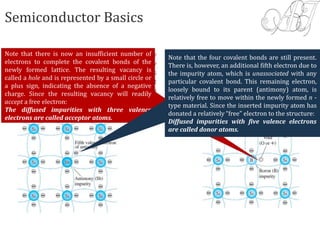
Both n -type and p -type materials are formed by
adding a predetermined number of impurity
atoms to a silicon base. An n -type material is
created by introducing impurity elements that
have five valence electrons ( pentavalent ), such
as antimony , arsenic , and phosphorus.
Semiconductor Basics
The p -type material is formed by
doping a pure germanium or silicon
crystal with impurity
atoms having three valence electrons.
Note that there is now an insufficient number of
electrons to complete the covalent bonds of the
newly formed lattice. The resulting vacancy is
called a hole and is represented by a small circle or
a plus sign, indicating the absence of a negative
charge. Since the resulting vacancy will readily
accept a free electron:
The diffused impurities with three valence
electrons are called acceptor atoms.
Note that the four covalent bonds are still present.
There is, however, an additional fifth electron due to
the impurity atom, which is unassociated with any
particular covalent bond. This remaining electron,
loosely bound to its parent (antimony) atom, is
relatively free to move within the newly formed n -
type material. Since the inserted impurity atom has
donated a relatively “free” electron to the structure:
Diffused impurities with five valence electrons
are called donor atoms.
Semiconductor Basics
n-type p-type
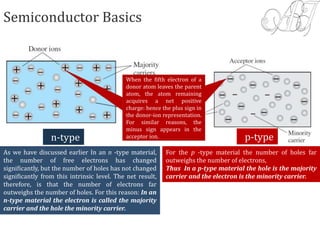
As we have discussed earlier In an n -type material,
the number of free electrons has changed
significantly, but the number of holes has not changed
significantly from this intrinsic level. The net result,
therefore, is that the number of electrons far
outweighs the number of holes. For this reason: In an
n-type material the electron is called the majority
carrier and the hole the minority carrier.
For the p -type material the number of holes far
outweighs the number of electrons,
Thus In a p-type material the hole is the majority
carrier and the electron is the minority carrier.
When the fifth electron of a
donor atom leaves the parent
atom, the atom remaining
acquires a net positive
charge: hence the plus sign in
the donor-ion representation.
For similar reasons, the
minus sign appears in the
acceptor ion.
NP
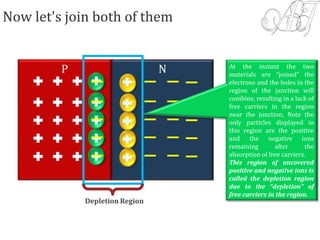
Now let's join both of them
Depletion Region
At the instant the two
materials are “joined” the
electrons and the holes in the
region of the junction will
combine, resulting in a lack of
free carriers in the region
near the junction, Note the
only particles displayed in
this region are the positive
and the negative ions
remaining after the
absorption of free carriers.
This region of uncovered
positive and negative ions is
called the depletion region
due to the “depletion” of
free carriers in the region.
LIGHT-EMITTING DIODES
• As the name implies, the light-emitting diode is a diode that gives off visible or invisible
(infrared) light when energized.
• In any forward-biased p – n junction there is, a recombination of holes and electrons within
the structure and primarily close to the junction.
• This recombination requires that the energy possessed by the unbound free electrons be
transferred to another state.
• In all semiconductor p – n junctions some of this energy is given off in the form of heat and
some in the form of photons.
• In Si and Ge diodes the greater percentage of the energy converted during recombination at
the junction is dissipated in the form of heat within the structure, and the emitted light is
insignificant.
• For this reason, silicon and germanium are not used in the construction of LED devices. On
the other hand
• Diodes constructed of GaAs emit light in the infrared (invisible) zone during the
recombination process at the p–n junction.
Even though the light is not visible,
infrared LEDs have numerous
applications where visible light is not
a desirable effect. These include
security systems, industrial
processing, optical coupling, safety
controls such as on garage door
openers, and in home entertainment
centers, where the infrared light of
the remote control is the controlling
element.
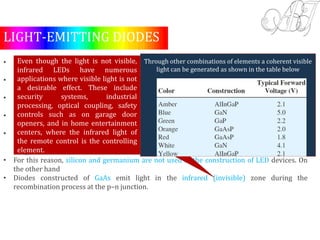
Through other combinations of elements a coherent visible
light can be generated as shown in the table below
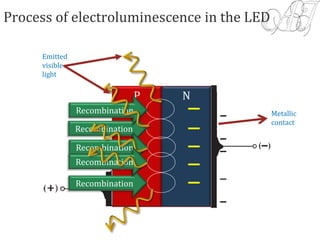
Process of electroluminescence in the LED
P N
Recombination
Recombination
Recombination
Recombination
Recombination
Emitted
visible
light
Metallic
contact
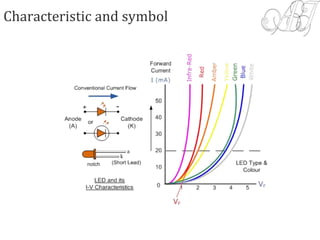
Characteristic and symbol
SLEDs – Surface Emitting LEDs
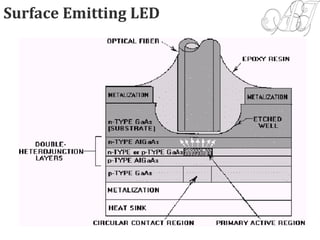
• Primary active region is a small circular area located
below the surface of the semiconductor substrate,
20-50µm diameter and up to 2.5µm thick.
• Emission is isotropic and in lambertian pattern.
• A well is etched in the substrate to allow the direct
coupling of emitted light to the optical fiber
• Emission area of substrate is perpendicular to axis
of optical fiber
• Coupling efficiency optimized by binding fiber to the
substrate surface by epoxy resin with matching
refractive index
Surface Emitting LED
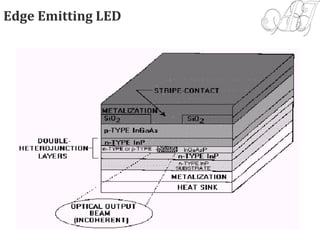
ELEDs – Edge Emitting LEDs
• Primary active region is a narrow strip that lies beneath the
semiconductor substrate
• Semiconductor is cut and polished so emission strip region
runs between front and back.
• Rear face of semiconductor is polished so it is highly
reflective while front face is coated with anti-reflective,
light will reflect from rear and emit through front face
• Active Regions are usually 100-150µm long and the strips
are 50-70µm wide which are designed to match typical core
fibers of 50-100µm.
• Emit light at narrower angle which allows for better
coupling and efficiency than SLEDs
Edge Emitting LED
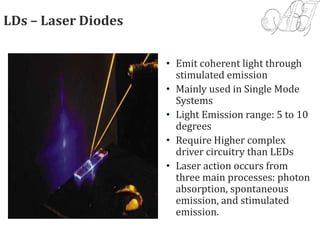
LDs – Laser Diodes
• Emit coherent light through
stimulated emission
• Mainly used in Single Mode
Systems
• Light Emission range: 5 to 10
degrees
• Require Higher complex
driver circuitry than LEDs
• Laser action occurs from
three main processes: photon
absorption, spontaneous
emission, and stimulated
emission.
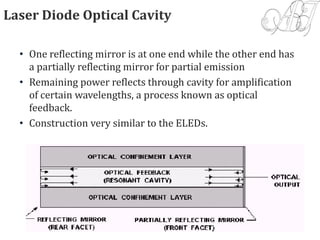
Laser Diode Optical Cavity
• One reflecting mirror is at one end while the other end has
a partially reflecting mirror for partial emission
• Remaining power reflects through cavity for amplification
of certain wavelengths, a process known as optical
feedback.
• Construction very similar to the ELEDs.
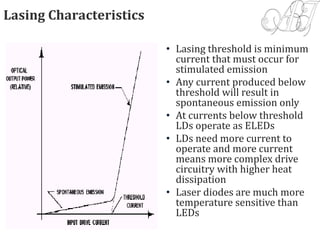
Lasing Characteristics
• Lasing threshold is minimum
current that must occur for
stimulated emission
• Any current produced below
threshold will result in
spontaneous emission only
• At currents below threshold
LDs operate as ELEDs
• LDs need more current to
operate and more current
means more complex drive
circuitry with higher heat
dissipation
• Laser diodes are much more
temperature sensitive than
LEDs
Tunable Laser
• Tunable Laser
• Employed in broad-band interconnections and broadcast
networks where the need for high power, narrow line
width, and a tunable single-frequency emission is a must.
• Laser that is able to produce controllable multiple
wavelengths within single cavity.
• Able to switch transmission of different wavelengths
without using multiplexer for transmission to many
different channels at by tuning the output frequency to
its designated channel.
Tunable Laser Cavity
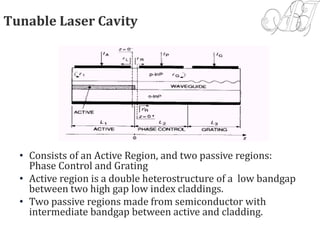
• Consists of an Active Region, and two passive regions:
Phase Control and Grating
• Active region is a double heterostructure of a low bandgap
between two high gap low index claddings.
• Two passive regions made from semiconductor with
intermediate bandgap between active and cladding.
Tunable Laser Operation
• Current is injected into the Active Region causing the entire
optical cavity to oscillate in a single longitudinal mode.
• A current is then injected into the grating control region
causing a refractive index decrease which induces a shift of
the Bragg wavelength and variation in the mode.
• The phase region with the injected phase current allows for
recovery in Bragg wavelength in order to keep the same
mode in the center of the filter band.
• This results in an output with variable wavelength.
Summary
• Optical light sources convert electrical signals into optical signals and
launch them.
• Commonly used light sources include LEDs, ELEDs, SLEDs, and LDs.
• LEDs produce nonlinear incoherent light whereas a Laser Diode
produces linear coherent light.
• Incoherent light sources used in multimode systems as where Laser
Diodes/Tunable Lasers in single mode systems
• Laser diodes must operate above their threshold region to produce
coherent light, otherwise operating as ELED.
• Laser diodes are much faster in switching response than LEDs
• Tunable laser is able to produce coherent light output with controlled
variable wavelength
• Tunable laser is used in multi wavelength systems by replacing a
system where many sources are coupled into a multiplexing device
system
THANK YOU!

optical communication Unit 3

  • 1.
    UNIT-3 Mohammad Asif Iqbal AssistantProfessor, Deptt of ECE, JETGI, Barabanki
  • 2.
    What is anOptic Source? • The heart of a fiber optical data system • A Hybrid Device • Converts electrical signals into optical signals • Launches these optical signals into an optical fiber for data transmission. • Device consists of an interface circuit, drive circuit, and components for optical source. (LEDs, ELEDs, SLEDs, LDs, etc)
  • 3.
    Both n -typeand p -type materials are formed by adding a predetermined number of impurity atoms to a silicon base. An n -type material is created by introducing impurity elements that have five valence electrons ( pentavalent ), such as antimony , arsenic , and phosphorus. Semiconductor Basics The p -type material is formed by doping a pure germanium or silicon crystal with impurity atoms having three valence electrons. Note that there is now an insufficient number of electrons to complete the covalent bonds of the newly formed lattice. The resulting vacancy is called a hole and is represented by a small circle or a plus sign, indicating the absence of a negative charge. Since the resulting vacancy will readily accept a free electron: The diffused impurities with three valence electrons are called acceptor atoms. Note that the four covalent bonds are still present. There is, however, an additional fifth electron due to the impurity atom, which is unassociated with any particular covalent bond. This remaining electron, loosely bound to its parent (antimony) atom, is relatively free to move within the newly formed n - type material. Since the inserted impurity atom has donated a relatively “free” electron to the structure: Diffused impurities with five valence electrons are called donor atoms.
  • 4.
    Semiconductor Basics n-type p-type Aswe have discussed earlier In an n -type material, the number of free electrons has changed significantly, but the number of holes has not changed significantly from this intrinsic level. The net result, therefore, is that the number of electrons far outweighs the number of holes. For this reason: In an n-type material the electron is called the majority carrier and the hole the minority carrier. For the p -type material the number of holes far outweighs the number of electrons, Thus In a p-type material the hole is the majority carrier and the electron is the minority carrier. When the fifth electron of a donor atom leaves the parent atom, the atom remaining acquires a net positive charge: hence the plus sign in the donor-ion representation. For similar reasons, the minus sign appears in the acceptor ion.
  • 5.
    NP Now let's joinboth of them Depletion Region At the instant the two materials are “joined” the electrons and the holes in the region of the junction will combine, resulting in a lack of free carriers in the region near the junction, Note the only particles displayed in this region are the positive and the negative ions remaining after the absorption of free carriers. This region of uncovered positive and negative ions is called the depletion region due to the “depletion” of free carriers in the region.
  • 6.
    LIGHT-EMITTING DIODES • Asthe name implies, the light-emitting diode is a diode that gives off visible or invisible (infrared) light when energized. • In any forward-biased p – n junction there is, a recombination of holes and electrons within the structure and primarily close to the junction. • This recombination requires that the energy possessed by the unbound free electrons be transferred to another state. • In all semiconductor p – n junctions some of this energy is given off in the form of heat and some in the form of photons. • In Si and Ge diodes the greater percentage of the energy converted during recombination at the junction is dissipated in the form of heat within the structure, and the emitted light is insignificant. • For this reason, silicon and germanium are not used in the construction of LED devices. On the other hand • Diodes constructed of GaAs emit light in the infrared (invisible) zone during the recombination process at the p–n junction. Even though the light is not visible, infrared LEDs have numerous applications where visible light is not a desirable effect. These include security systems, industrial processing, optical coupling, safety controls such as on garage door openers, and in home entertainment centers, where the infrared light of the remote control is the controlling element. Through other combinations of elements a coherent visible light can be generated as shown in the table below
  • 7.
    Process of electroluminescencein the LED P N Recombination Recombination Recombination Recombination Recombination Emitted visible light Metallic contact
  • 8.
  • 9.
    SLEDs – SurfaceEmitting LEDs • Primary active region is a small circular area located below the surface of the semiconductor substrate, 20-50µm diameter and up to 2.5µm thick. • Emission is isotropic and in lambertian pattern. • A well is etched in the substrate to allow the direct coupling of emitted light to the optical fiber • Emission area of substrate is perpendicular to axis of optical fiber • Coupling efficiency optimized by binding fiber to the substrate surface by epoxy resin with matching refractive index
  • 10.
  • 11.
    ELEDs – EdgeEmitting LEDs • Primary active region is a narrow strip that lies beneath the semiconductor substrate • Semiconductor is cut and polished so emission strip region runs between front and back. • Rear face of semiconductor is polished so it is highly reflective while front face is coated with anti-reflective, light will reflect from rear and emit through front face • Active Regions are usually 100-150µm long and the strips are 50-70µm wide which are designed to match typical core fibers of 50-100µm. • Emit light at narrower angle which allows for better coupling and efficiency than SLEDs
  • 12.
  • 13.
    LDs – LaserDiodes • Emit coherent light through stimulated emission • Mainly used in Single Mode Systems • Light Emission range: 5 to 10 degrees • Require Higher complex driver circuitry than LEDs • Laser action occurs from three main processes: photon absorption, spontaneous emission, and stimulated emission.
  • 14.
    Laser Diode OpticalCavity • One reflecting mirror is at one end while the other end has a partially reflecting mirror for partial emission • Remaining power reflects through cavity for amplification of certain wavelengths, a process known as optical feedback. • Construction very similar to the ELEDs.
  • 15.
    Lasing Characteristics • Lasingthreshold is minimum current that must occur for stimulated emission • Any current produced below threshold will result in spontaneous emission only • At currents below threshold LDs operate as ELEDs • LDs need more current to operate and more current means more complex drive circuitry with higher heat dissipation • Laser diodes are much more temperature sensitive than LEDs
  • 16.
    Tunable Laser • TunableLaser • Employed in broad-band interconnections and broadcast networks where the need for high power, narrow line width, and a tunable single-frequency emission is a must. • Laser that is able to produce controllable multiple wavelengths within single cavity. • Able to switch transmission of different wavelengths without using multiplexer for transmission to many different channels at by tuning the output frequency to its designated channel.
  • 17.
    Tunable Laser Cavity •Consists of an Active Region, and two passive regions: Phase Control and Grating • Active region is a double heterostructure of a low bandgap between two high gap low index claddings. • Two passive regions made from semiconductor with intermediate bandgap between active and cladding.
  • 18.
    Tunable Laser Operation •Current is injected into the Active Region causing the entire optical cavity to oscillate in a single longitudinal mode. • A current is then injected into the grating control region causing a refractive index decrease which induces a shift of the Bragg wavelength and variation in the mode. • The phase region with the injected phase current allows for recovery in Bragg wavelength in order to keep the same mode in the center of the filter band. • This results in an output with variable wavelength.
  • 19.
    Summary • Optical lightsources convert electrical signals into optical signals and launch them. • Commonly used light sources include LEDs, ELEDs, SLEDs, and LDs. • LEDs produce nonlinear incoherent light whereas a Laser Diode produces linear coherent light. • Incoherent light sources used in multimode systems as where Laser Diodes/Tunable Lasers in single mode systems • Laser diodes must operate above their threshold region to produce coherent light, otherwise operating as ELED. • Laser diodes are much faster in switching response than LEDs • Tunable laser is able to produce coherent light output with controlled variable wavelength • Tunable laser is used in multi wavelength systems by replacing a system where many sources are coupled into a multiplexing device system
  • 20.