1
By
Vivek Kumar Sharma
1RV13EE059
 Introduction
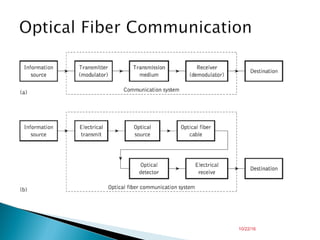
 Optical Fiber Communication
 Principle of Operation
 Optical Fiber
 Networking
 Applications
 Fiber Space Optic
10/22/16
2
 The light-guiding principle behind optical fibers was first demonstrated
by Daniel Colladon and Jaques Babinet
 Optical fibers are widely used in fiber-optic communication, which
permits transmission over longer distances and at higher data rates
than other forms of wired and wireless communications.
 Optical fibers are long, thin strands of very pure glass usually 120 µm
in diameter. They are arranged in bundles called optical cables and
used to transmit light signals over long distances.
10/22/16
3
10/22/16
4
10/22/16 5
10/22/16 6
Propagation of light wave through Optical
fiber
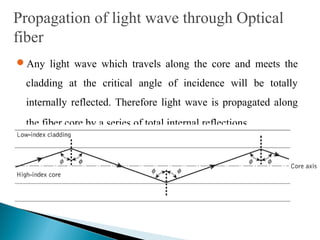
Any light wave which travels along the core and meets the
cladding at the critical angle of incidence will be totally
internally reflected. Therefore light wave is propagated along
the fiber core by a series of total internal reflections.
Acceptance Angle
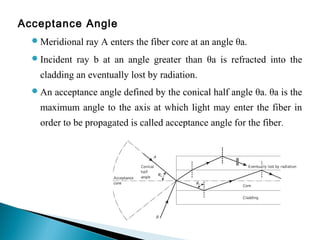
Meridional ray A enters the fiber core at an angle θa.
Incident ray b at an angle greater than θa is refracted into the
cladding an eventually lost by radiation.
An acceptance angle defined by the conical half angle θa. θa is the
maximum angle to the axis at which light may enter the fiber in
order to be propagated is called acceptance angle for the fiber.
Numerical Aperture (NA)
Numerical aperture of the fiber is the light collecting efficiency of
the fiber and is the measure of the amount of light rays that can be
accepted by the fiber. It is equal to the sine of acceptance.
NA = n0 sin θa = (n1
2
– n2
2
)1/2
where, n1 and n2 are the refractive indices of core and
cladding respectively.
Numerical aperture of step index fiber is given as
NA = n1 √2∆
10/22/16 10
Fiber Core Fiber Cladding
 The core of a conventional
optical fiber is a cylinder of
glass or plastic that runs along
the fiber's length. The core is
surrounded by a medium with
a lower index of refraction,
typically a cladding of a
different glass, or plastic
 Cladding is one or more
layers of materials of lower
refractive index, in intimate
contact with a core material of
higher refractive index. The
cladding causes light to be
confined to the core of the
fiber by total internal reflection
at the boundary between the
two.
10/22/16 11
10/22/16 12
 In practical fibers, the cladding is usually coated with a tough resin buffer
layer
 Buffer layer be further surrounded by a jacket layer, usually plastic
 These layers add strength to the fiber but do not contribute to its optical
wave guide properties.
 Rigid fiber assemblies sometimes put light-absorbing ("dark") glass between
the fibers, to prevent light that leaks out of one fiber from entering another.
This reduces cross-talk between the fibers
10/22/16
13
Types
Fiber Types
Classification on the basis of the refractive index of the material
 Step index fiber
 Refractive index of core is uniform throughout and
undergoes an abrupt change at the core cladding
boundary.
 In the graded index fiber, the refractive index of the core
is made to vary in the parabolic manner such that the
maximum value of refractive index is at the center of the
core.
Based on the modes propagating in optical fiber:
 Single mode fiber
 Multi mode fiber
Single mode fiber
Single mode fiber optic cable has a small diametric core that allows
only one mode of light to propagate.
Multi mode fiber
Multimode fiber optic cable has a large diametric core that allows
multiple modes of light to propagate
10/22/16 17
Comparison
Single mode fiber Multi mode fiber
► Core radius is small.
► Supports one mode of propagation.
► Optical source- LASER.
► The launching of optical power into
fiber is difficult as the core radius is
small.
► Supports larger bandwidth.
► Intermodal dispersion is absent.
► Used for long distance
communication.
► Core radius is large.
► Supports hundreds of modes.
► Optical source- LED.
► The launching of optical power into
fiber is easier as the core radius is
large.
► Supports lesser bandwidth.
► These fiber suffer from Intermodal
dispersion.
► Used for short distance
communication.
Networking
10/22/16 20
 Optical fibers are connected to terminal
equipment by optical fiber connectors
 Optical fibers may be connected to each other
by connectors or by splicing
 that is, joining two fibers together to form a
continuous optical waveguide
 For quicker fastening jobs, a "mechanical
splice" is used
10/22/16
21
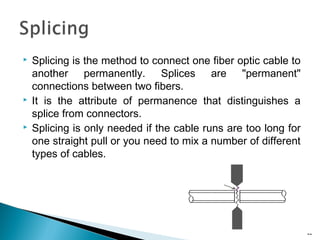
 Splicing is the method to connect one fiber optic cable to
another permanently. Splices are "permanent"
connections between two fibers.
 It is the attribute of permanence that distinguishes a
splice from connectors.
 Splicing is only needed if the cable runs are too long for
one straight pull or you need to mix a number of different
types of cables.
22
 An optical network unit (ONU) is a device that
transforms incoming optical signals into electronics at a
customer's premises in order to
provide telecommunications services over an optical
fiber network.
 ONU provides the subscribers with broadband Internet
access.
 It is used in combination with an optical line
terminal (OLT).
10/22/16 23
 Fiber optic couplers are used to split the input signals
into two or more outputs; they are called splitters in this
case. 
 On the other hand, some types of couplers can be used
to combine two or more inputs into one single output;
they are called combiners in this case.
10/22/16 24
10/22/16 25
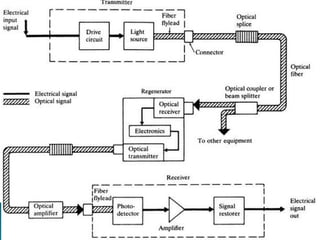
Optical fiber communication
 Optical fiber can be used as a medium for telecommunication and
networking because it is flexible and can be bundled as cables.
 It is especially advantageous for long-distance communications,
because light propagates through the fiber with little attenuation
 This allows long distances to be spanned with few repeaters.
10/22/16
26
Fiber optic sensors
 Optical fibers can be used as sensors to measure strain,
temperature, pressure and other parameters.
 The small size and the fact that no electrical power is
needed at the remote location gives the fiber optic
sensor advantages to conventional electrical sensor in
certain applications.
10/22/16
27
Other uses of optical fibers
• Fibers are widely used in
illumination applications.
• They are used as light guides in
medical and other applications In
some buildings
• optical fibers are used to route
sunlight from the roof to other parts
of the building
10/22/16
28
A frisbee illuminated by fiber optics
10/22/16 29
 FSO was initially developed by NASA and US Military.
 FSO is a line of sight technology which uses LASERS
and photo-detectors to provide optical connection
between two point without using optical fibers.
 Uses invisible beam of light to provide optical bandwidth
connections.
 FSO can transmit video ,data etc. at high speed capable
of reaching a speed of 1.25Gbps
10/22/16 30
 It's based on connectivity between FSO-based
optical wireless units.
 Provide full-duplex (bi-directional) capability.
 Each optical wireless unit uses an optical source,
plus a lens or telescope.
 Receiving lens or telescope connects to a high-
sensitivity receiver via optical fiber.
10/22/16 31
10/22/16 32
Advantages Disadvantages
 Ultra High Bandwidth
 Small size & weight
 Electrical Isolation
 Immune to electrical
Interference
 Signal security
 Low transmission loss
 Ruggedness , flexibility
 Point to Point
Communication
 High maintenance cost
 Expensive optical
transmitter & receiver
 Prone to corrosion
 Difficult to splice compare
to wires
 High optical power may
result in fiber fuse
10/22/16 33
10/22/16 34

Optical communication

  • 1.
  • 2.
     Introduction  OpticalFiber Communication  Principle of Operation  Optical Fiber  Networking  Applications  Fiber Space Optic 10/22/16 2
  • 3.
     The light-guidingprinciple behind optical fibers was first demonstrated by Daniel Colladon and Jaques Babinet  Optical fibers are widely used in fiber-optic communication, which permits transmission over longer distances and at higher data rates than other forms of wired and wireless communications.  Optical fibers are long, thin strands of very pure glass usually 120 µm in diameter. They are arranged in bundles called optical cables and used to transmit light signals over long distances. 10/22/16 3
  • 4.
  • 5.
  • 6.
  • 7.
    Propagation of lightwave through Optical fiber Any light wave which travels along the core and meets the cladding at the critical angle of incidence will be totally internally reflected. Therefore light wave is propagated along the fiber core by a series of total internal reflections.
  • 8.
    Acceptance Angle Meridional rayA enters the fiber core at an angle θa. Incident ray b at an angle greater than θa is refracted into the cladding an eventually lost by radiation. An acceptance angle defined by the conical half angle θa. θa is the maximum angle to the axis at which light may enter the fiber in order to be propagated is called acceptance angle for the fiber.
  • 9.
    Numerical Aperture (NA) Numericalaperture of the fiber is the light collecting efficiency of the fiber and is the measure of the amount of light rays that can be accepted by the fiber. It is equal to the sine of acceptance. NA = n0 sin θa = (n1 2 – n2 2 )1/2 where, n1 and n2 are the refractive indices of core and cladding respectively. Numerical aperture of step index fiber is given as NA = n1 √2∆
  • 10.
  • 11.
    Fiber Core FiberCladding  The core of a conventional optical fiber is a cylinder of glass or plastic that runs along the fiber's length. The core is surrounded by a medium with a lower index of refraction, typically a cladding of a different glass, or plastic  Cladding is one or more layers of materials of lower refractive index, in intimate contact with a core material of higher refractive index. The cladding causes light to be confined to the core of the fiber by total internal reflection at the boundary between the two. 10/22/16 11
  • 12.
  • 13.
     In practicalfibers, the cladding is usually coated with a tough resin buffer layer  Buffer layer be further surrounded by a jacket layer, usually plastic  These layers add strength to the fiber but do not contribute to its optical wave guide properties.  Rigid fiber assemblies sometimes put light-absorbing ("dark") glass between the fibers, to prevent light that leaks out of one fiber from entering another. This reduces cross-talk between the fibers 10/22/16 13
  • 14.
  • 15.
    Fiber Types Classification onthe basis of the refractive index of the material  Step index fiber  Refractive index of core is uniform throughout and undergoes an abrupt change at the core cladding boundary.
  • 16.
     In thegraded index fiber, the refractive index of the core is made to vary in the parabolic manner such that the maximum value of refractive index is at the center of the core.
  • 17.
    Based on themodes propagating in optical fiber:  Single mode fiber  Multi mode fiber Single mode fiber Single mode fiber optic cable has a small diametric core that allows only one mode of light to propagate. Multi mode fiber Multimode fiber optic cable has a large diametric core that allows multiple modes of light to propagate 10/22/16 17
  • 19.
    Comparison Single mode fiberMulti mode fiber ► Core radius is small. ► Supports one mode of propagation. ► Optical source- LASER. ► The launching of optical power into fiber is difficult as the core radius is small. ► Supports larger bandwidth. ► Intermodal dispersion is absent. ► Used for long distance communication. ► Core radius is large. ► Supports hundreds of modes. ► Optical source- LED. ► The launching of optical power into fiber is easier as the core radius is large. ► Supports lesser bandwidth. ► These fiber suffer from Intermodal dispersion. ► Used for short distance communication.
  • 20.
  • 21.
     Optical fibersare connected to terminal equipment by optical fiber connectors  Optical fibers may be connected to each other by connectors or by splicing  that is, joining two fibers together to form a continuous optical waveguide  For quicker fastening jobs, a "mechanical splice" is used 10/22/16 21
  • 22.
     Splicing isthe method to connect one fiber optic cable to another permanently. Splices are "permanent" connections between two fibers.  It is the attribute of permanence that distinguishes a splice from connectors.  Splicing is only needed if the cable runs are too long for one straight pull or you need to mix a number of different types of cables. 22
  • 23.
     An optical networkunit (ONU) is a device that transforms incoming optical signals into electronics at a customer's premises in order to provide telecommunications services over an optical fiber network.  ONU provides the subscribers with broadband Internet access.  It is used in combination with an optical line terminal (OLT). 10/22/16 23
  • 24.
     Fiber opticcouplers are used to split the input signals into two or more outputs; they are called splitters in this case.   On the other hand, some types of couplers can be used to combine two or more inputs into one single output; they are called combiners in this case. 10/22/16 24
  • 25.
  • 26.
    Optical fiber communication Optical fiber can be used as a medium for telecommunication and networking because it is flexible and can be bundled as cables.  It is especially advantageous for long-distance communications, because light propagates through the fiber with little attenuation  This allows long distances to be spanned with few repeaters. 10/22/16 26
  • 27.
    Fiber optic sensors Optical fibers can be used as sensors to measure strain, temperature, pressure and other parameters.  The small size and the fact that no electrical power is needed at the remote location gives the fiber optic sensor advantages to conventional electrical sensor in certain applications. 10/22/16 27
  • 28.
    Other uses ofoptical fibers • Fibers are widely used in illumination applications. • They are used as light guides in medical and other applications In some buildings • optical fibers are used to route sunlight from the roof to other parts of the building 10/22/16 28 A frisbee illuminated by fiber optics
  • 29.
  • 30.
     FSO wasinitially developed by NASA and US Military.  FSO is a line of sight technology which uses LASERS and photo-detectors to provide optical connection between two point without using optical fibers.  Uses invisible beam of light to provide optical bandwidth connections.  FSO can transmit video ,data etc. at high speed capable of reaching a speed of 1.25Gbps 10/22/16 30
  • 31.
     It's basedon connectivity between FSO-based optical wireless units.  Provide full-duplex (bi-directional) capability.  Each optical wireless unit uses an optical source, plus a lens or telescope.  Receiving lens or telescope connects to a high- sensitivity receiver via optical fiber. 10/22/16 31
  • 32.
  • 33.
    Advantages Disadvantages  UltraHigh Bandwidth  Small size & weight  Electrical Isolation  Immune to electrical Interference  Signal security  Low transmission loss  Ruggedness , flexibility  Point to Point Communication  High maintenance cost  Expensive optical transmitter & receiver  Prone to corrosion  Difficult to splice compare to wires  High optical power may result in fiber fuse 10/22/16 33
  • 34.