Photonic Sources
Contents
• Review of Semiconductor Physics
• Light Emitting Diode (LED)
- Structure, Material,Quantum efficiency, LED Power,
Modulation
• Laser Diodes
- structure, Modes, Rate Equation,Quantum efficiency,
Resonant frequencies, Radiation pattern
• Single-Mode Lasers
- DFB (Distributed-FeedBack) laser, Distributed-Bragg
Reflector, Modulation
• Light-source Linearity
• Noise in Lasers
Review of Semiconductor Physics
a) Energy level diagrams showing the excitation of an electron from the valence band to the conduction band.
The resultant free electron can freely move under the application of electric field.
b) Equal electron & hole concentrations in an intrinsic semiconductor created by the thermal excitation of
electrons across the band gap
-1
23
JK
10
38
.
1 


B
k
Optical Fiber communications, 3rd ed.,G.Keiser,McGrawHill, 2000
n-Type Semiconductor
a) Donor level in an n-type semiconductor.
b) The ionization of donor impurities creates an increased electron concentration distribution.
Optical Fiber communications, 3rd ed.,G.Keiser,McGrawHill, 2000
p-Type Semiconductor
a) Acceptor level in an p-type semiconductor.
b) The ionization of acceptor impurities creates an increased hole concentration distribution
Optical Fiber communications, 3rd ed.,G.Keiser,McGrawHill, 2000
Intrinsic & Extrinsic Materials
• Intrinsic material: A perfect material with no impurities.
• Extrinsic material: donor or acceptor type semiconductors.
• Majority carriers: electrons in n-type or holes in p-type.
• Minority carriers: holes in n-type or electrons in p-type.
• The operation of semiconductor devices is essentially based on
the injection and extraction of minority carriers.
)
2
exp(
T
k
E
n
p
n
B
g
i 



ly.
respective
ions
concentrat
intrinsic
&
hole
electron,
the
are
&
& i
n
p
n
e.
Temperatur
is
energy,
gap
the
is T
Eg
2
i
n
pn 
[4-1]
[4-2]
The pn Junction
Optical Fiber communications, 3rd ed.,G.Keiser,McGrawHill, 2000
Electron diffusion across a pn junction
creates a barrier potential (electric field)
in the depletion region.
Reverse-biased pn Junction
Optical Fiber communications, 3rd ed.,G.Keiser,McGrawHill, 2000
A reverse bias widens the depletion region, but allows minority carriers to move freely with the applied field.
Forward-biased pn Junction
Optical Fiber communications, 3rd ed.,G.Keiser,McGrawHill, 2000
Lowering the barrier potential with a forward bias allows majority carriers to diffuse across the junction.
Direct Band Gap Semiconductors
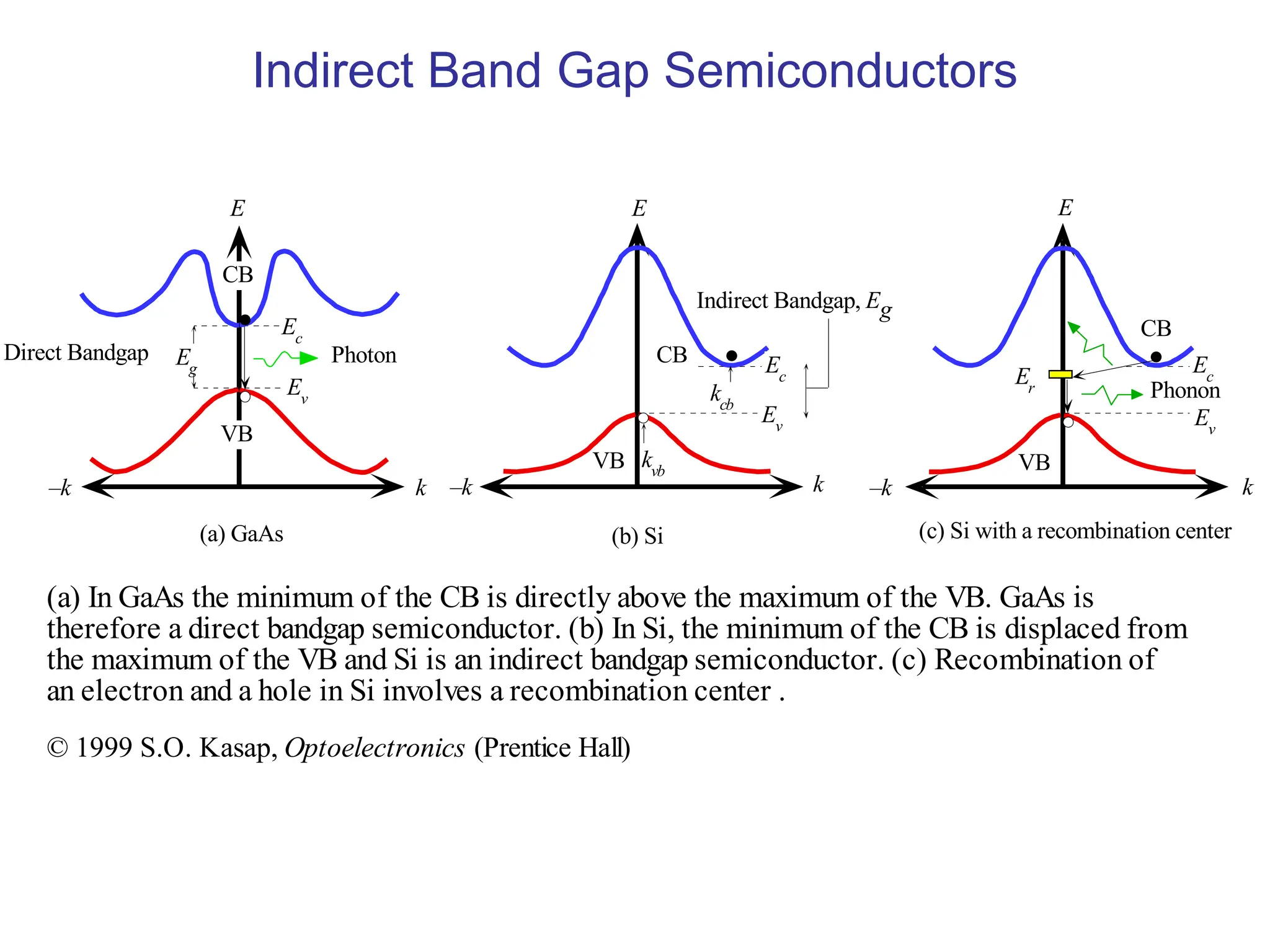
Indirect Band Gap Semiconductors
E
CB
k
–k
Direct Bandgap
(a) GaAs
E
CB
VB
Indirect Bandgap, Eg
k
–k
kcb
(b) Si
E
k
–k
Phonon
(c) Si with a recombination center
Eg
Ec
Ev
Ec
Ev
kvb VB
CB
Er
Ec
Ev
Photon
VB
(a) In GaAs the minimum of the CB is directly above the maximum of the VB. GaAs is
therefore a direct bandgap semiconductor. (b) In Si, the minimum of the CB is displaced from
the maximum of the VB and Si is an indirect bandgap semiconductor. (c) Recombination of
an electron and a hole in Si involves a recombination center .
© 1999 S.O. Kasap, Optoelectronics (Prentice Hall)
Light-Emitting Diodes (LEDs)
• For photonic communications requiring data rate 100-200 Mb/s
with multimode fiber with tens of microwatts, LEDs are usually
the best choice.
• LED configurations being used in photonic communications:
1- Surface Emitters (Front Emitters)
2- Edge Emitters
Optical Fiber communications, 3rd ed.,G.Keiser,McGrawHill, 2000
Cross-section drawing of a typical
GaAlAs double heterostructure light
emitter. In this structure, x>y to provide
for both carrier confinement and optical
guiding.
b) Energy-band diagram showing the
active region, the electron & hole
barriers which confine the charge carriers
to the active layer.
c) Variations in the refractive index; the
lower refractive index of the material in
regions 1 and 5 creates an optical barrier
around the waveguide because of the higher
band-gap energy of this material.
)
eV
(
240
.
1
m)
(
g
E


 [4-3]
Surface-Emitting LED
Optical Fiber communications, 3rd ed.,G.Keiser,McGrawHill, 2000
Schematic of high-radiance surface-emitting LED. The active region is limitted
to a circular cross section that has an area compatible with the fiber-core end face.
Edge-Emitting LED
Schematic of an edge-emitting double heterojunction LED. The output beam is
lambertian in the plane of junction and highly directional perpendicular to pn junction.
They have high quantum efficiency & fast response.
Optical Fiber communications, 3rd ed.,G.Keiser,McGrawHill, 2000
Light Source Material
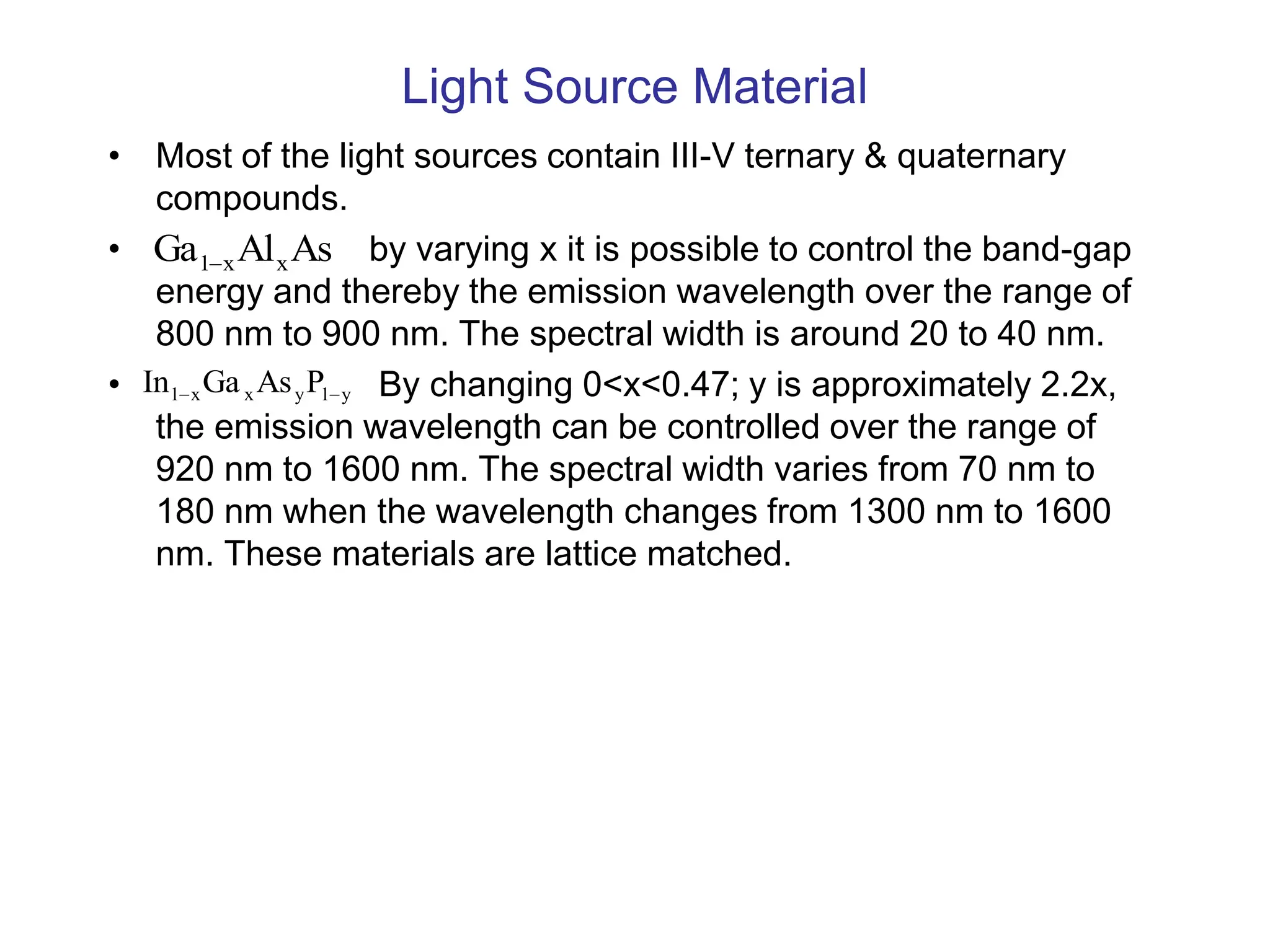
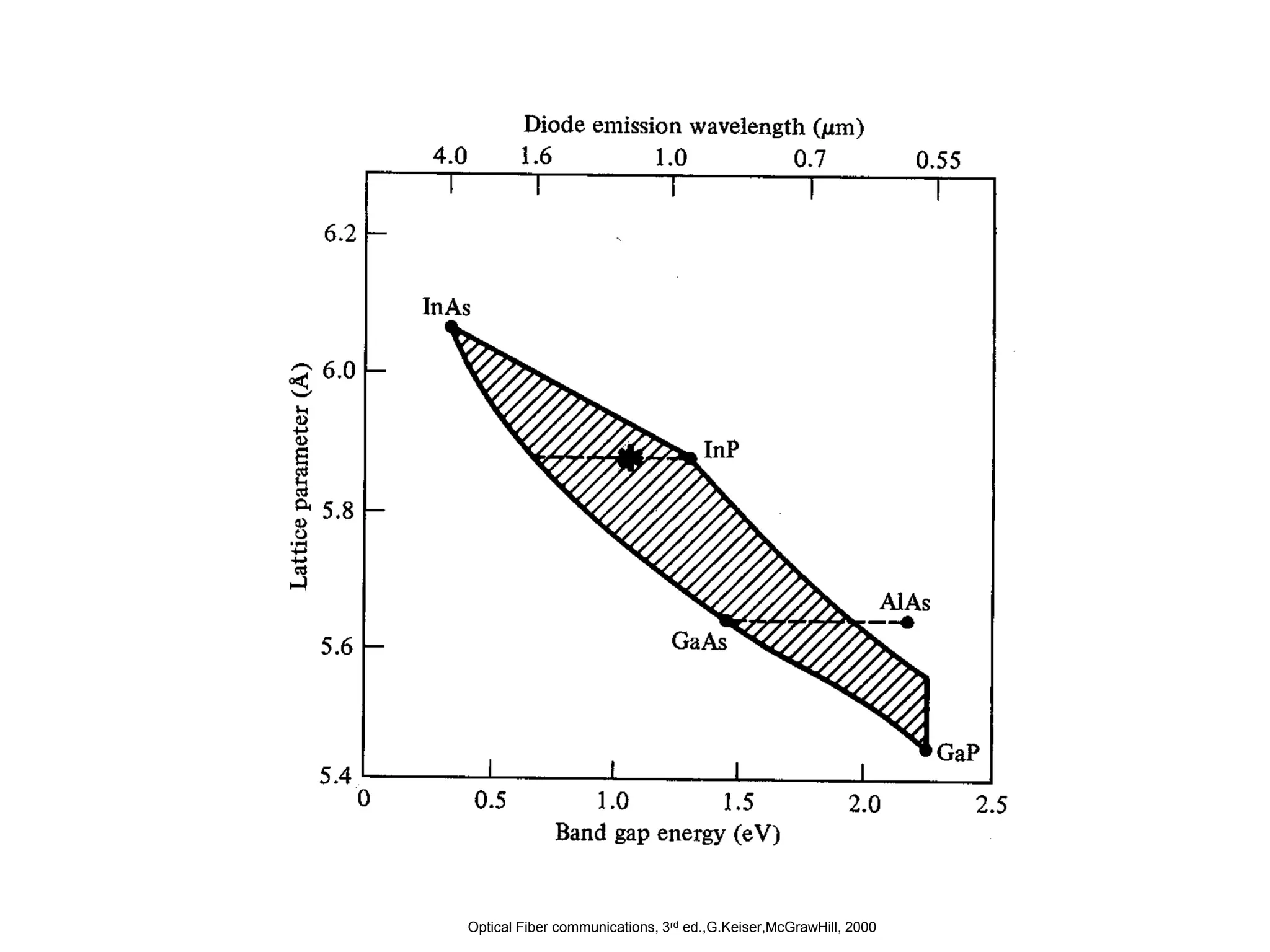
• Most of the light sources contain III-V ternary & quaternary
compounds.
• by varying x it is possible to control the band-gap
energy and thereby the emission wavelength over the range of
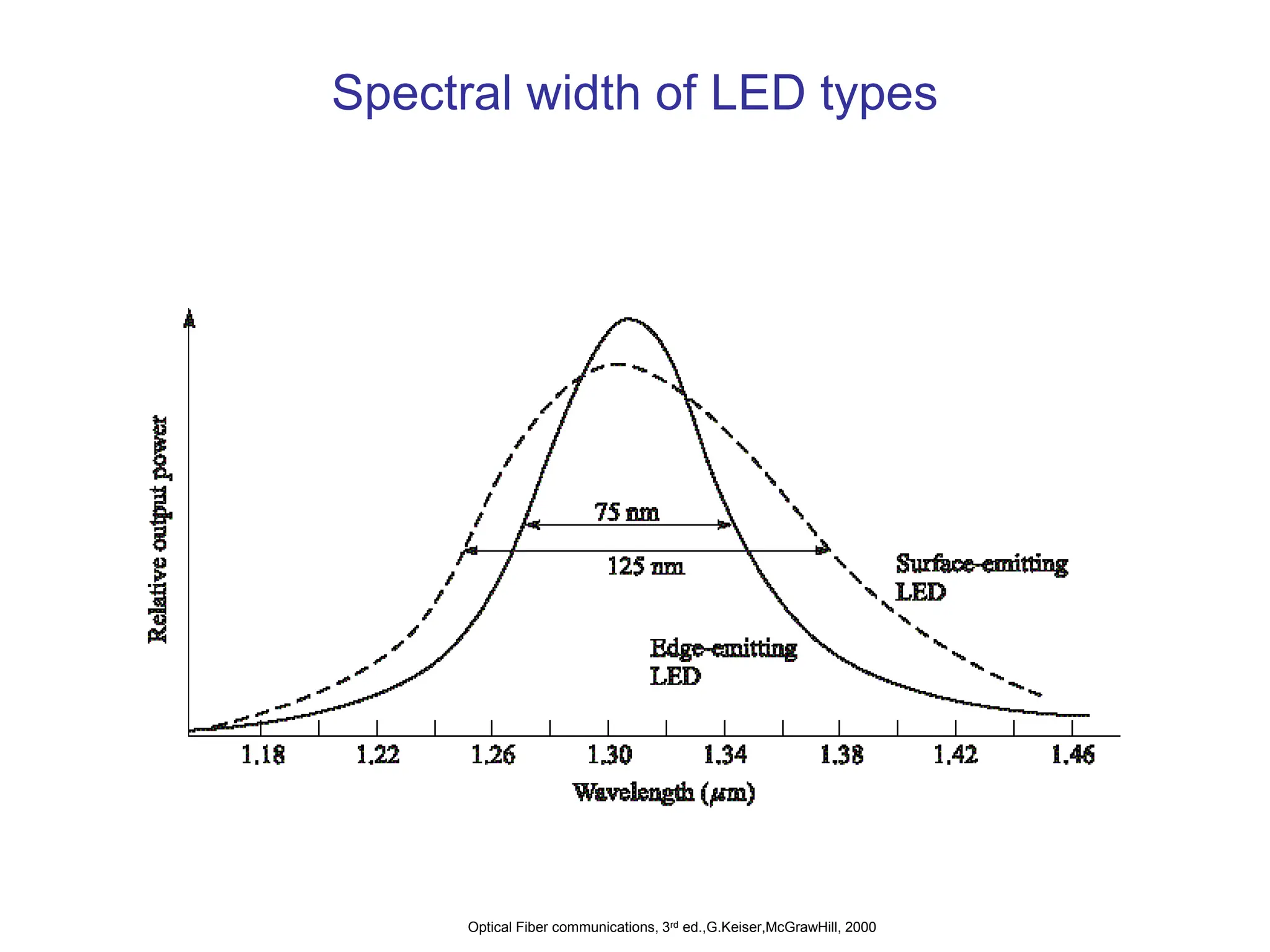
800 nm to 900 nm. The spectral width is around 20 to 40 nm.
• By changing 0<x<0.47; y is approximately 2.2x,
the emission wavelength can be controlled over the range of
920 nm to 1600 nm. The spectral width varies from 70 nm to
180 nm when the wavelength changes from 1300 nm to 1600
nm. These materials are lattice matched.
As
Al
Ga x
x
1
y
1
y
x
x
1 P
As
Ga
In 

Optical Fiber communications, 3rd ed.,G.Keiser,McGrawHill, 2000
Spectral width of LED types
Optical Fiber communications, 3rd ed.,G.Keiser,McGrawHill, 2000
Rate equations, Quantum Efficiency & Power of
LEDs
• When there is no external carrier injection, the excess density
decays exponentially due to electron-hole recombination.
• n is the excess carrier density,
• Bulk recombination rate R:
• Bulk recombination rate (R)=Radiative recombination rate +
nonradiative recombination rate

/
0
)
( t
e
n
t
n 
 [4-4]
lifetime.
carrier
:
density
electron
excess
injected
initial
:
0

n

n
dt
dn
R 

 [4-5]
)
1
rate(
ion
recombinat
ve
nonradiati
)
1
(
rate
ion
recombinat
radiative
)
1
(
rate
ion
recombinat
bulk
r nr
nr
r /τ
R
/τ
R
/τ
R





With an external supplied current density of J the rate equation for the electron-hole
recombination is:
region
ion
recombinat
of
thickness
:
electron;
the
of
charge
:
)
(
d
q
n
qd
J
dt
t
dn


 [4-6]
In equilibrium condition: dn/dt=0
qd
J
n

 [4-7]
r
nr
r
nr
nr
r
r
R
R
R





 




int
Internal Quantum Efficiency & Optical Power
[4-8]
region
active
in the
efficiency
quantum
internal
:
int

Optical power generated internally in the active region in the LED is:




q
hcI
h
q
I
P int
int
int 
 [4-9]
region
active
current to
Injected
:
power,
optical
Internal
:
int
I
P
External Quantum Eficiency
• In order to calculate the external quantum efficiency, we need to
consider the reflection effects at the surface of the LED. If we
consider the LED structure as a simple 2D slab waveguide, only
light falling within a cone defined by critical angle will be emitted
from an LED.
photons
generated
internally
LED
of
#
LED
from
emitted
photons
of
#
ext 
 [4-10]







d
T
c
)
sin
2
(
)
(
4
1
0
ext 
 [4-11]
2
2
1
2
1
)
(
4
)
0
(
t
Coefficien
on
Transmissi
Fresnel
:
)
(
n
n
n
n
T
T



 [4-12]
2
1
1
ext
2
)
1
(
1
1
If




n
n
n  [4-13]
2
1
1
int
int
ext
)
1
(
powr,
optical
emitted
LED



n
n
P
P
P  [4-14]
Modulation of LED
• The frequency response of an LED depends on:
1- Doping level in the active region
2- Injected carrier lifetime in the recombination region, .
3- Parasitic capacitance of the LED
• If the drive current of an LED is modulated at a frequency of
the output optical power of the device will vary as:
• Electrical current is directly proportional to the optical power,
thus we can define electrical bandwidth and optical bandwidth,
separately.

2
0
)
(
1
)
(
i
P
P



 [4-15]
i

current
electrical
:
power,
electrical
:
)
0
(
log
20
)
0
(
10log
BW
Electrical
I
p
I
)
I(
p
)
p(















 [4-16]














)
0
(
)
(
log
10
)
0
(
)
(
log
10
BW
Optical
I
I
P
P 
 [4-17]
Optical Fiber communications, 3rd ed.,G.Keiser,McGrawHill, 2000
LASER
(Light Amplification by the Stimulated Emission of Radiation)
• Laser is an optical oscillator. It comprises a resonant optical
amplifier whose output is fed back into its input with matching
phase. Any oscillator contains:
1- An amplifier with a gain-saturated mechanism
2- A feedback system
3- A frequency selection mechanism
4- An output coupling scheme
• In laser the amplifier is the pumped active medium, such as
biased semiconductor region, feedback can be obtained by
placing active medium in an optical resonator, such as Fabry-
Perot structure, two mirrors separated by a prescribed distance.
Frequency selection is achieved by resonant amplifier and by
the resonators, which admits certain modes. Output coupling is
accomplished by making one of the resonator mirrors partially
transmitting.
Pumped active medium
• Three main process for laser action:
1- Photon absorption
2- Spontaneous emission
3- Stimulated emission
Optical Fiber communications, 3rd ed.,G.Keiser,McGrawHill, 2000
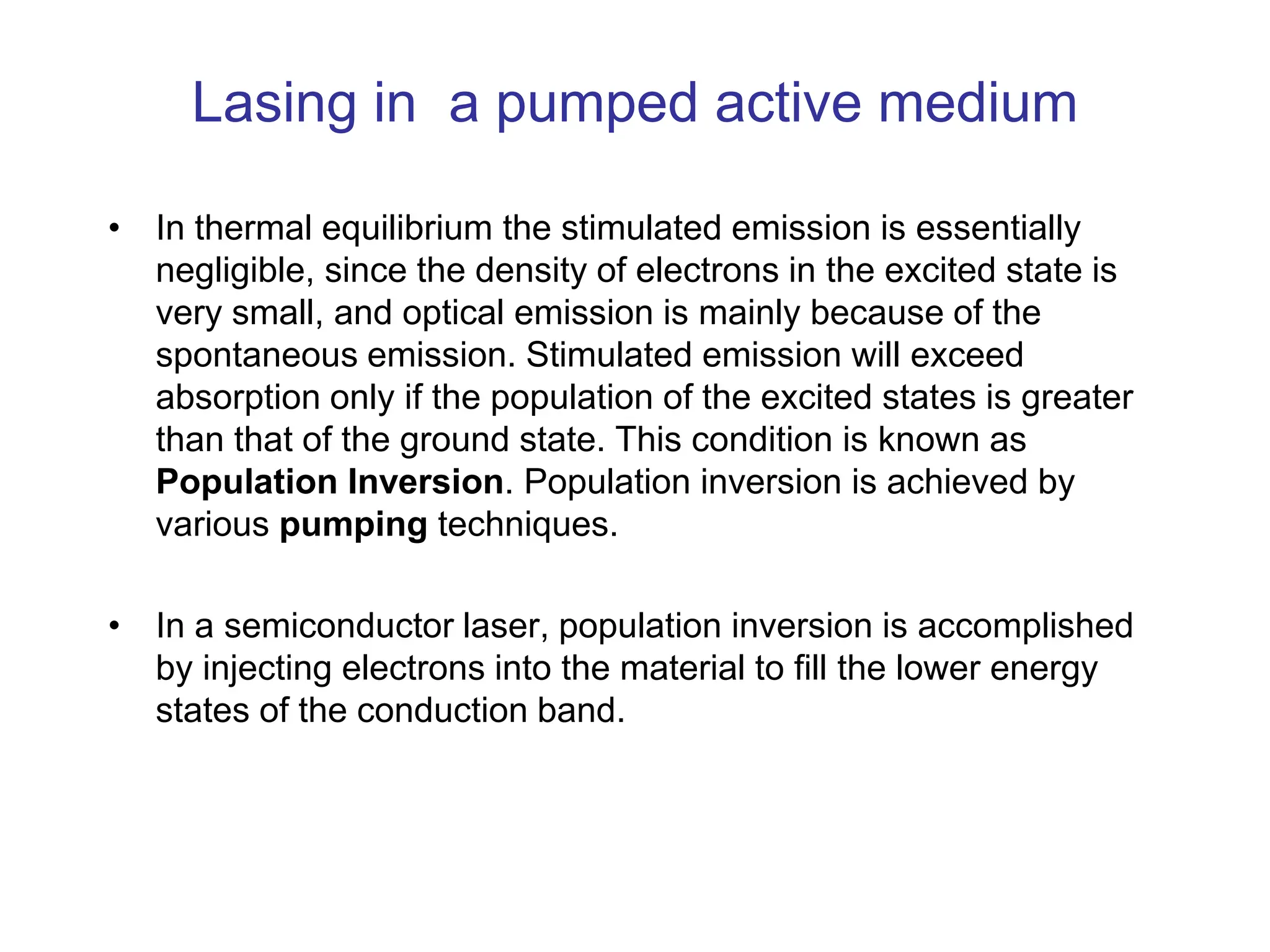
Lasing in a pumped active medium
• In thermal equilibrium the stimulated emission is essentially
negligible, since the density of electrons in the excited state is
very small, and optical emission is mainly because of the
spontaneous emission. Stimulated emission will exceed
absorption only if the population of the excited states is greater
than that of the ground state. This condition is known as
Population Inversion. Population inversion is achieved by
various pumping techniques.
• In a semiconductor laser, population inversion is accomplished
by injecting electrons into the material to fill the lower energy
states of the conduction band.
Fabry-Perot Resonator
A
B
L
M1 M2 m = 1
m = 2
m = 8
Relative intensity

m
m m + 1
m - 1
(a) (b) (c)
R ~ 0.4
R ~ 0.8
1 f
Schematic illustration of the Fabry-Perot optical cavity and its properties. (a) Reflected
waves interfere. (b) Only standing EM waves, modes, of certain wavelengths are allowed
in the cavity. (c) Intensity vs. frequency for various modes.R is mirror reflectance and
lower R means higher loss from the cavity.
© 1999 S.O. Kasap, Optoelectronics (Prentice Hall)
)
(
sin
4
)
1
(
)
1
(
2
2
2
kL
R
R
R
I
I inc
trans



 [4-18]
R: reflectance of the optical intensity, k: optical wavenumber
1,2,3,..
:
modes
Resonant 
 m
m
kL 
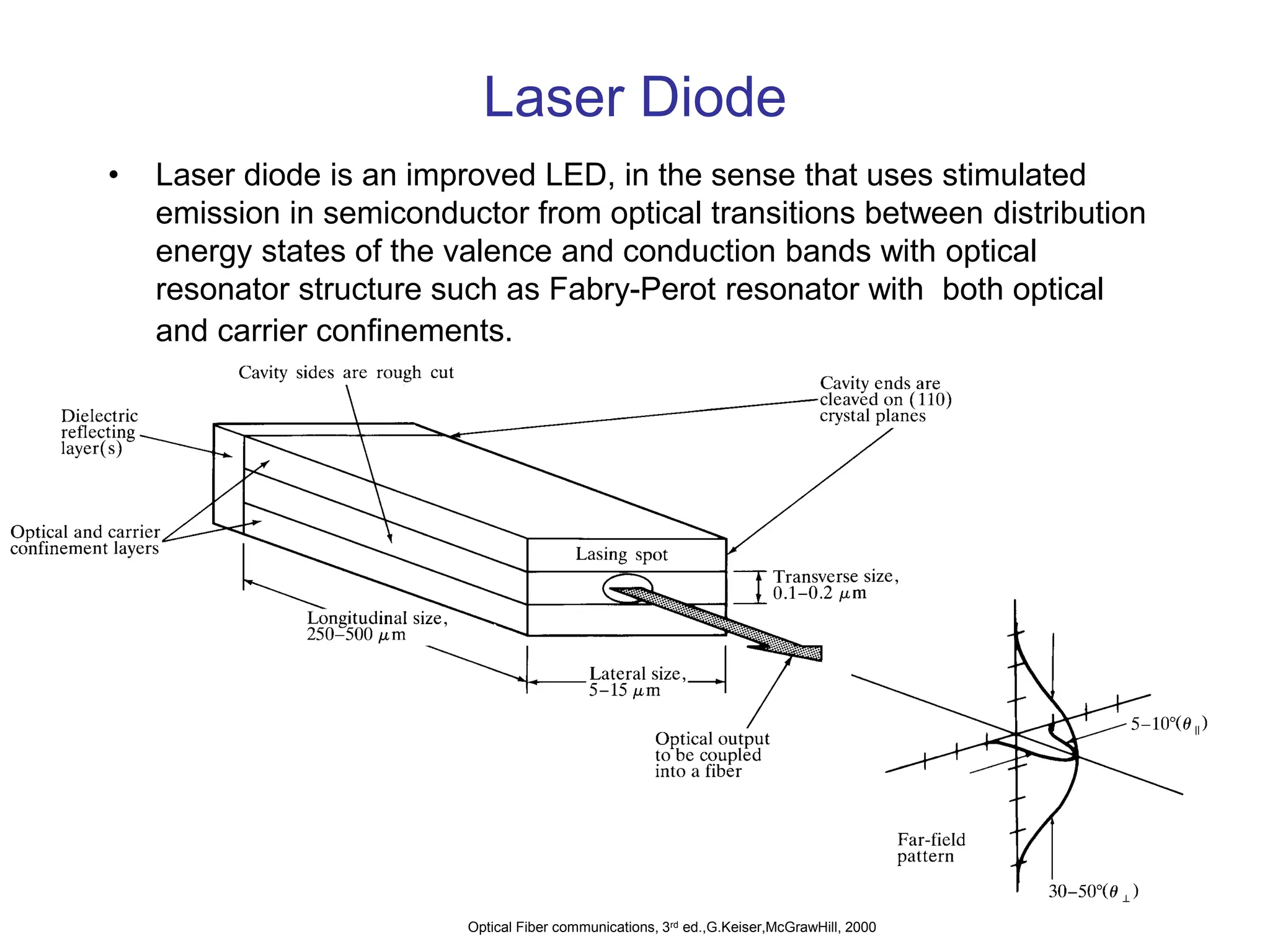
Laser Diode
• Laser diode is an improved LED, in the sense that uses stimulated
emission in semiconductor from optical transitions between distribution
energy states of the valence and conduction bands with optical
resonator structure such as Fabry-Perot resonator with both optical
and carrier confinements.
Optical Fiber communications, 3rd ed.,G.Keiser,McGrawHill, 2000
Laser Diode Characteristics
• Nanosecond & even picosecond response time (GHz BW)
• Spectral width of the order of nm or less
• High output power (tens of mW)
• Narrow beam (good coupling to single mode fibers)
• Laser diodes have three distinct radiation modes namely,
longitudinal, lateral and transverse modes.
• In laser diodes, end mirrors provide strong optical feedback in
longitudinal direction, so by roughening the edges and cleaving
the facets, the radiation can be achieved in longitudinal direction
rather than lateral direction.
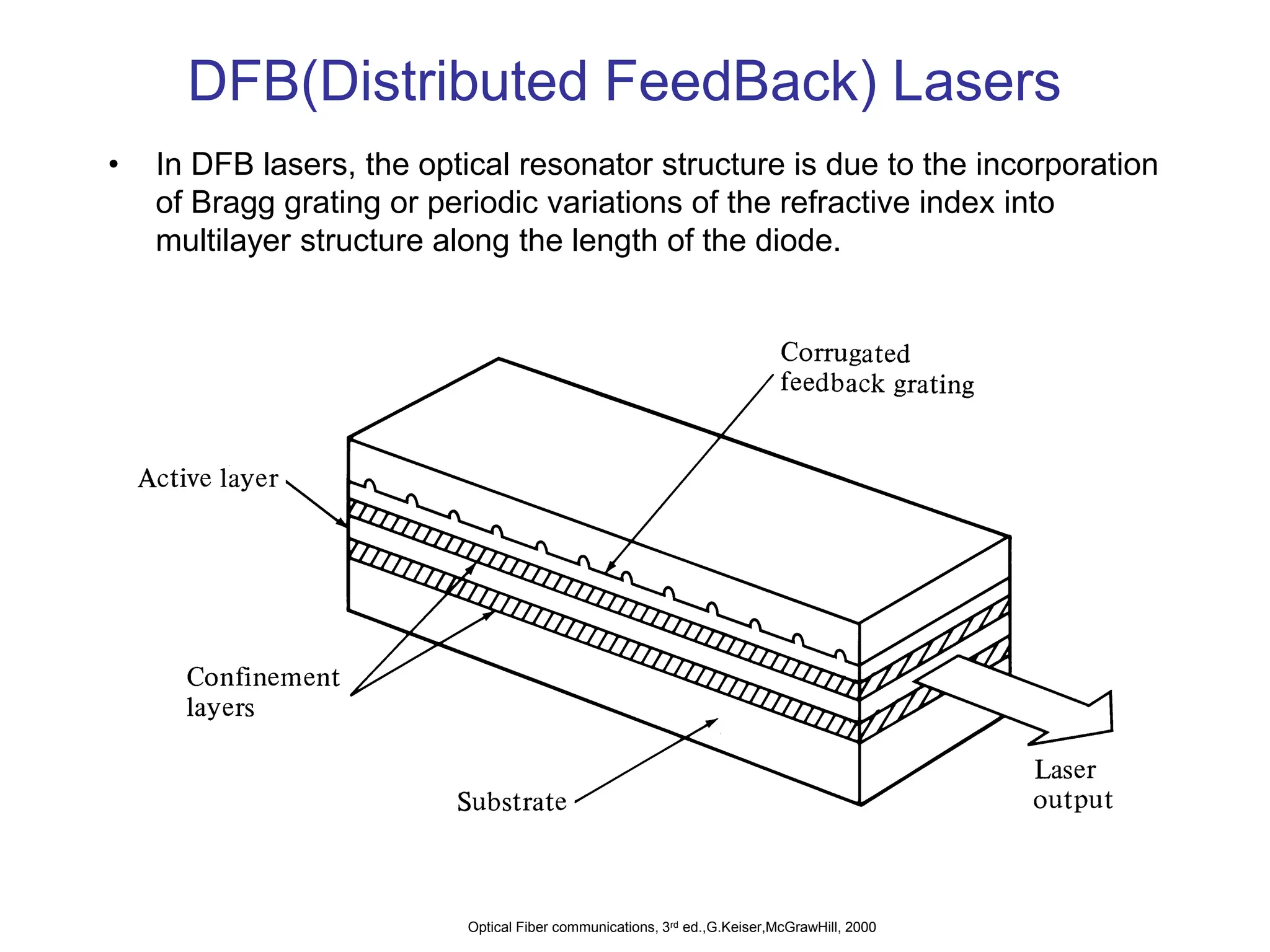
DFB(Distributed FeedBack) Lasers
• In DFB lasers, the optical resonator structure is due to the incorporation
of Bragg grating or periodic variations of the refractive index into
multilayer structure along the length of the diode.
Optical Fiber communications, 3rd ed.,G.Keiser,McGrawHill, 2000
Laser Operation & Lasing Condition
• To determine the lasing condition and resonant frequencies, we
should focus on the optical wave propagation along the
longitudinal direction, z-axis. The optical field intensity, I, can be
written as:
• Lasing is the condition at which light amplification becomes
possible by virtue of population inversion. Then, stimulated
emission rate into a given EM mode is proportional to the
intensity of the optical radiation in that mode. In this case, the
loss and gain of the optical field in the optical path determine the
lasing condition. The radiation intensity of a photon at energy
varies exponentially with a distance z amplified by factor g, and
attenuated by factor according to the following relationship:
)
(
)
(
)
,
( z
t
j
e
z
I
t
z
I 
 
 [4-19]

h

 
 
z
h
h
g
I
z
I )
(
)
(
exp
)
0
(
)
( 

 

 [4-20]
1
R 2
R
Z=0 Z=L
 
 
)
2
(
)
(
)
(
exp
)
0
(
)
2
( 2
1 L
h
h
g
R
R
I
L
I 

 

 [4-21]
2
2
1
2
1
t,
coefficien
absorption
effective
:
t
coefficien
gain
:
g
factor,
t
confinemen
Optical
:












n
n
n
n
R
α
1
n
2
n
Lasing Conditions:
1
)
2
exp(
)
0
(
)
2
(



L
j
I
L
I

[4-22]
Threshold gain & current density











2
1
1
ln
2
1
R
R
L
gth 
th
g
g 
:
iff
lase"
"
to
starts
Laser
[4-23]
For laser structure with strong carrier confinement, the threshold current
Density for stimulated emission can be well approximated by:
th
th J
g 
 [4-24]
on
constructi
device
specific
on
depends
constant
:

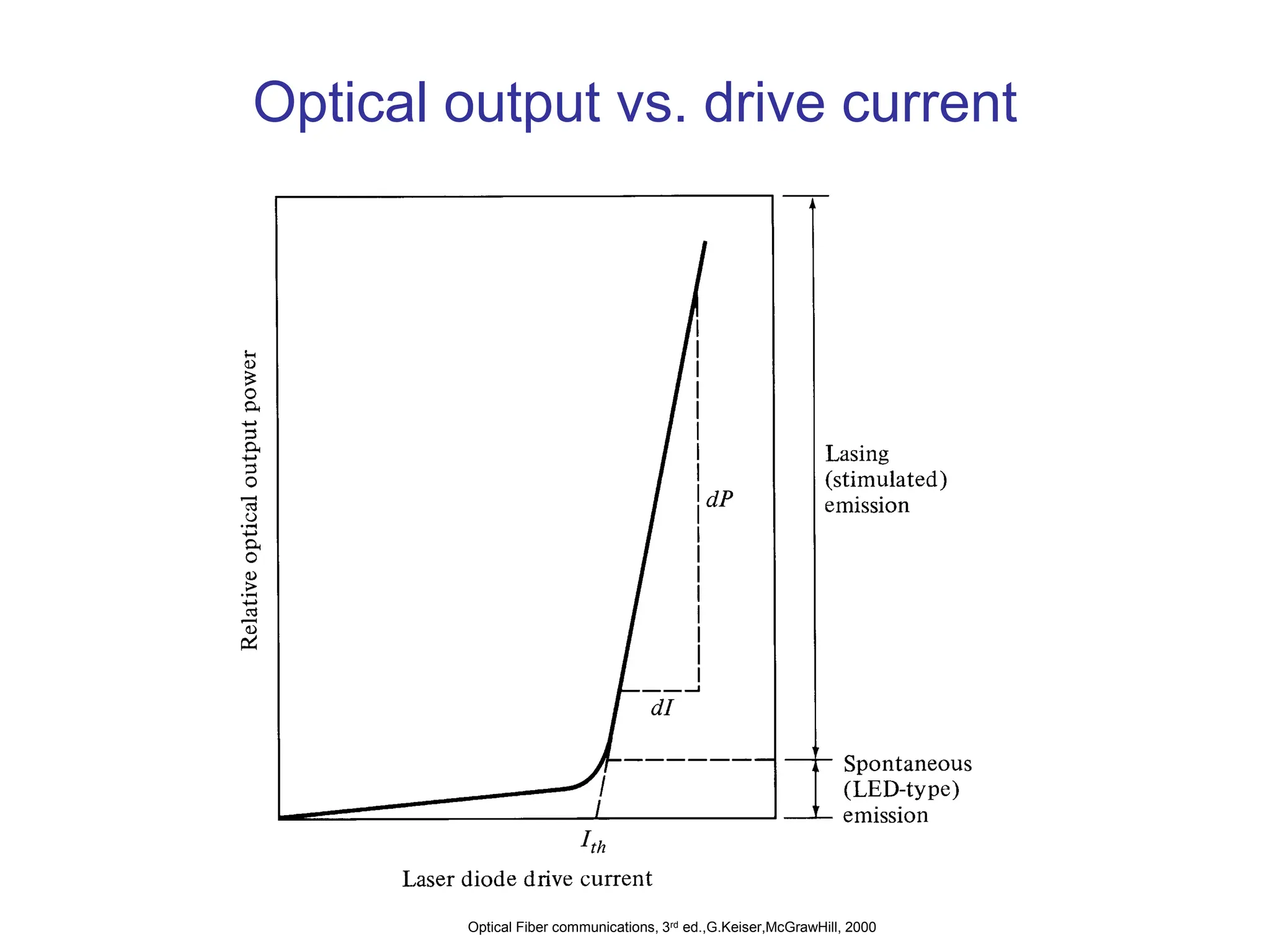
Optical output vs. drive current
Optical Fiber communications, 3rd ed.,G.Keiser,McGrawHill, 2000
Semiconductor laser rate equations
• Rate equations relate the optical output power, or # of photons per unit
volume, , to the diode drive current or # of injected electrons per
unit volume, n. For active (carrier confinement) region of depth d, the
rate equations are:

emission
stimulated
ion
recombinat
s
spontaneou
injection
rate
electron
loss
photon
emission
s
spontaneou
emission
stimulated
rate
Photon
















Cn
n
qd
J
dt
dn
R
Cn
dt
d
sp
ph
sp


[4-25]
density
current
Injection
time
life
photon
mode
lasing
the
into
emission
s
spontaneou
of
rate
process
absorption
&
emission
optical
the
of
intensity
the
expressing
t
Coefficien
:
:
:
:
J
R
C
ph
sp

Threshold current Density & excess electron density
• At the threshold of lasing:
• The threshold current needed to maintain a steady state threshold
concentration of the excess electron, is found from electron rate
equation under steady state condition dn/dt=0 when the laser is just
about to lase:
0
,
0
/
,
0 



 sp
R
dt
d
th
ph
ph n
C
n
Cn 









1
0
/
25]
-
[4
eq.
from [4-26]
sp
th
th
sp
th
th n
qd
J
n
qd
J






0 [4-27]
Laser operation beyond the threshold
• The solution of the rate equations [4-25] gives the steady state
photon density, resulting from stimulated emission and
spontaneous emission as follows:
th
J
J 
sp
ph
th
ph
s R
J
J
qd





 )
( [4-28]
External quantum efficiency
• Number of photons emitted per radiative electron-hole pair
recombination above threshold, gives us the external quantum
efficiency.
• Note that:
)
mA
(
)
mW
(
]
m
[
8065
.
0
)
(
dI
dP
dI
dP
E
q
g
g
g
th
th
i
ext









[4-29]
%
40
%
15
%;
70
%
60 


 ext
i 

Laser Resonant Frequencies
• Lasing condition, namely eq. [4-22]:
• Assuming the resonant frequency of the mth
mode is:
,...
3
,
2
,
1
,
2
L
2
1
)
2
exp( 



 m
m
L
j 





n
2

1,2,3,...
2

 m
Ln
mc
m

Ln
Ln
c
m
m
2
2
2
1




 





 
[4-30]
[4-31]
Spectrum from a laser Diode
width
spectral
:
2
)
(
exp
)
0
(
)
( 2
0




 




 

 g
g [4-32]
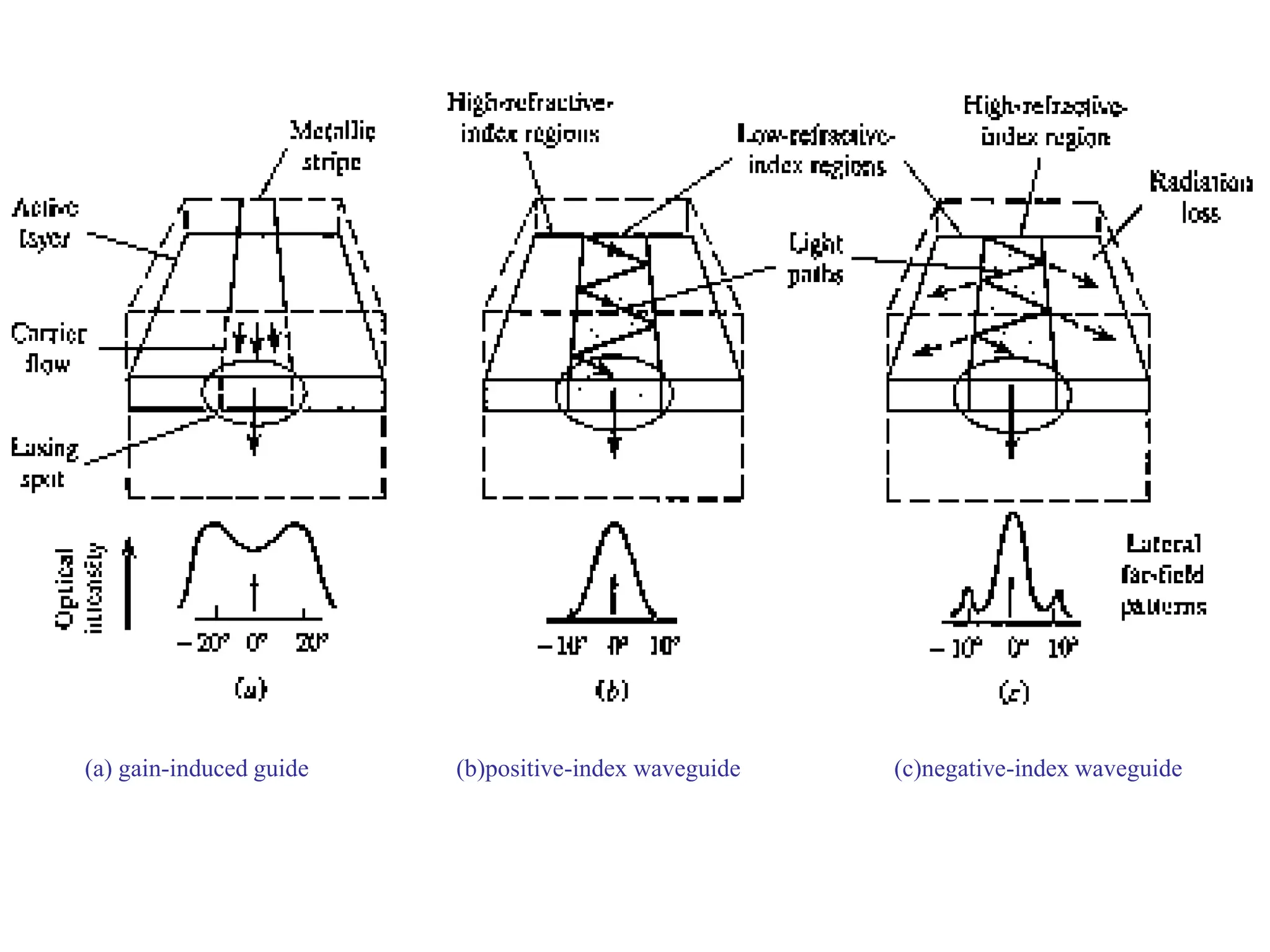
Laser Diode Structure & Radiation Pattern
• Efficient operation of a laser diode requires reducing the # of
lateral modes, stabilizing the gain for lateral modes as well as
lowering the threshold current. These are met by structures that
confine the optical wave, carrier concentration and current flow
in the lateral direction. The important types of laser diodes are:
gain-induced, positive index guided, and negative index
guided.
(a) gain-induced guide (b)positive-index waveguide (c)negative-index waveguide
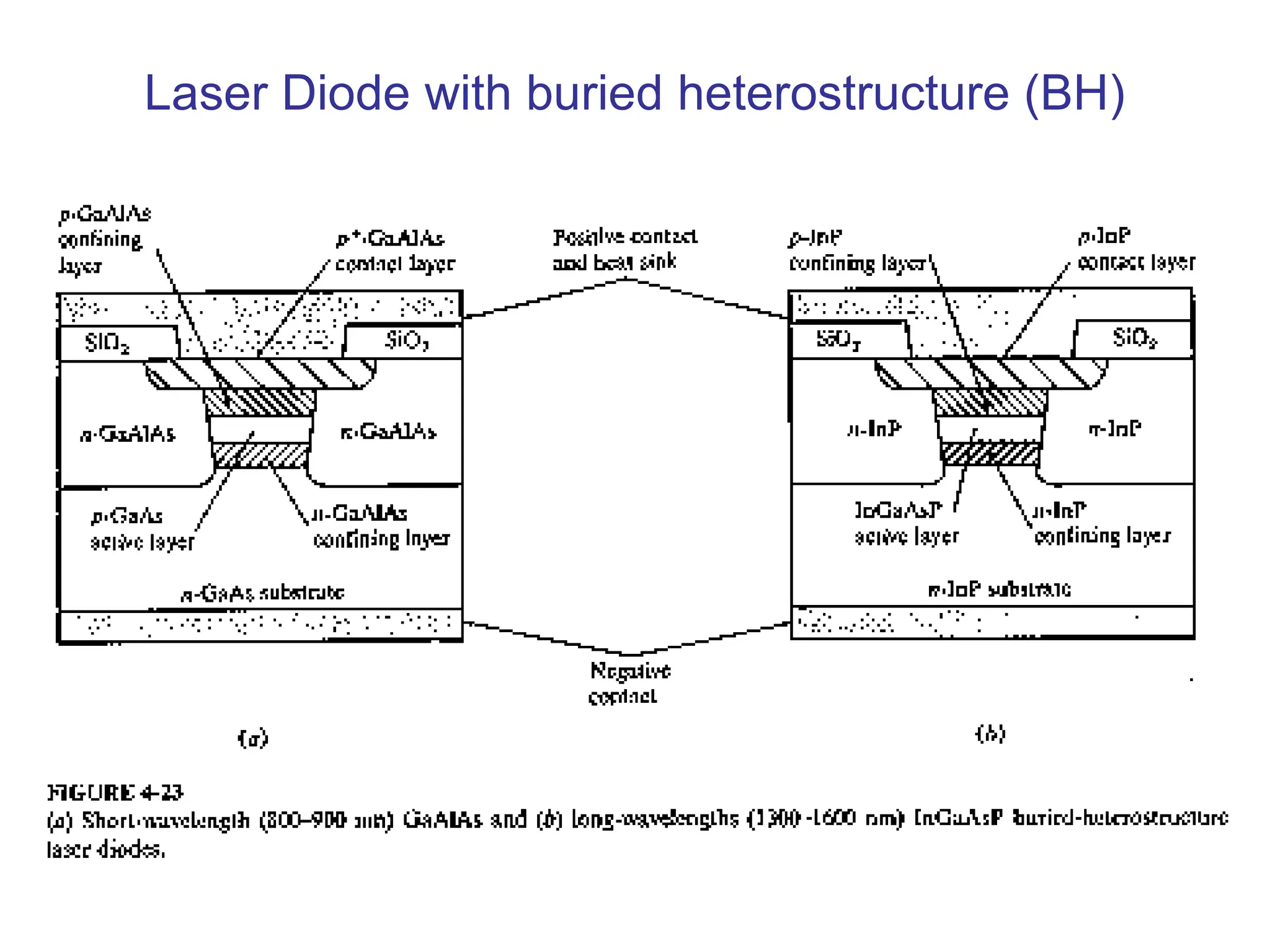
Laser Diode with buried heterostructure (BH)
Single Mode Laser
• Single mode laser is mostly based on the index-
guided structure that supports only the fundamental
transverse mode and the fundamental longitudinal
mode. In order to make single mode laser we have
four options:
1- Reducing the length of the cavity to the point
where the frequency separation given in eq[4-31] of
the adjacent modes is larger than the laser transition
line width. This is hard to handle for fabrication and
results in low output power.
2- Vertical-Cavity Surface Emitting laser (VCSEL)
3- Structures with built-in frequency selective grating
4- tunable laser diodes
.
VCSEL
Frequency-Selective laser Diodes:
Distributed Feedback (DFB) laser
k
ne
B


2
 [4-33]
Frequency-Selective laser Diodes:
Distributed Feedback Reflector (DBR) laser
Output spectrum symmetrically distributed around Bragg wavelength in an idealized DFB laser diode
)
2
1
(
2
2


 m
L
n e
e
B
B



[4-35]
Frequency-Selective laser Diodes:
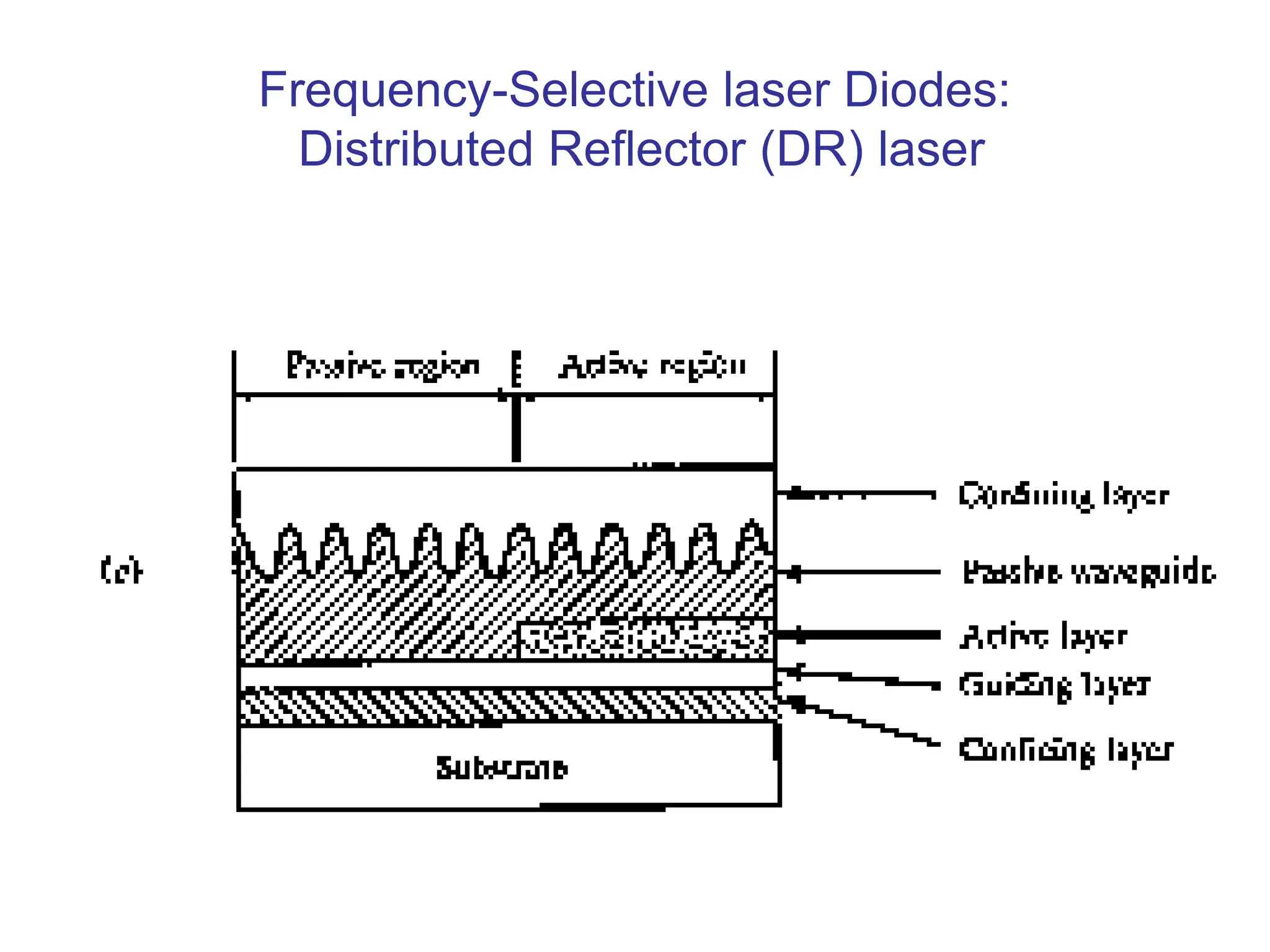
Distributed Reflector (DR) laser
Modulation of Laser Diodes
• Internal Modulation: Simple but suffers from non-linear effects.
• External Modulation: for rates greater than 2 Gb/s, more
complex, higher performance.
• Most fundamental limit for the modulation rate is set by the
photon life time in the laser cavity:
• Another fundamental limit on modulation frequency is the
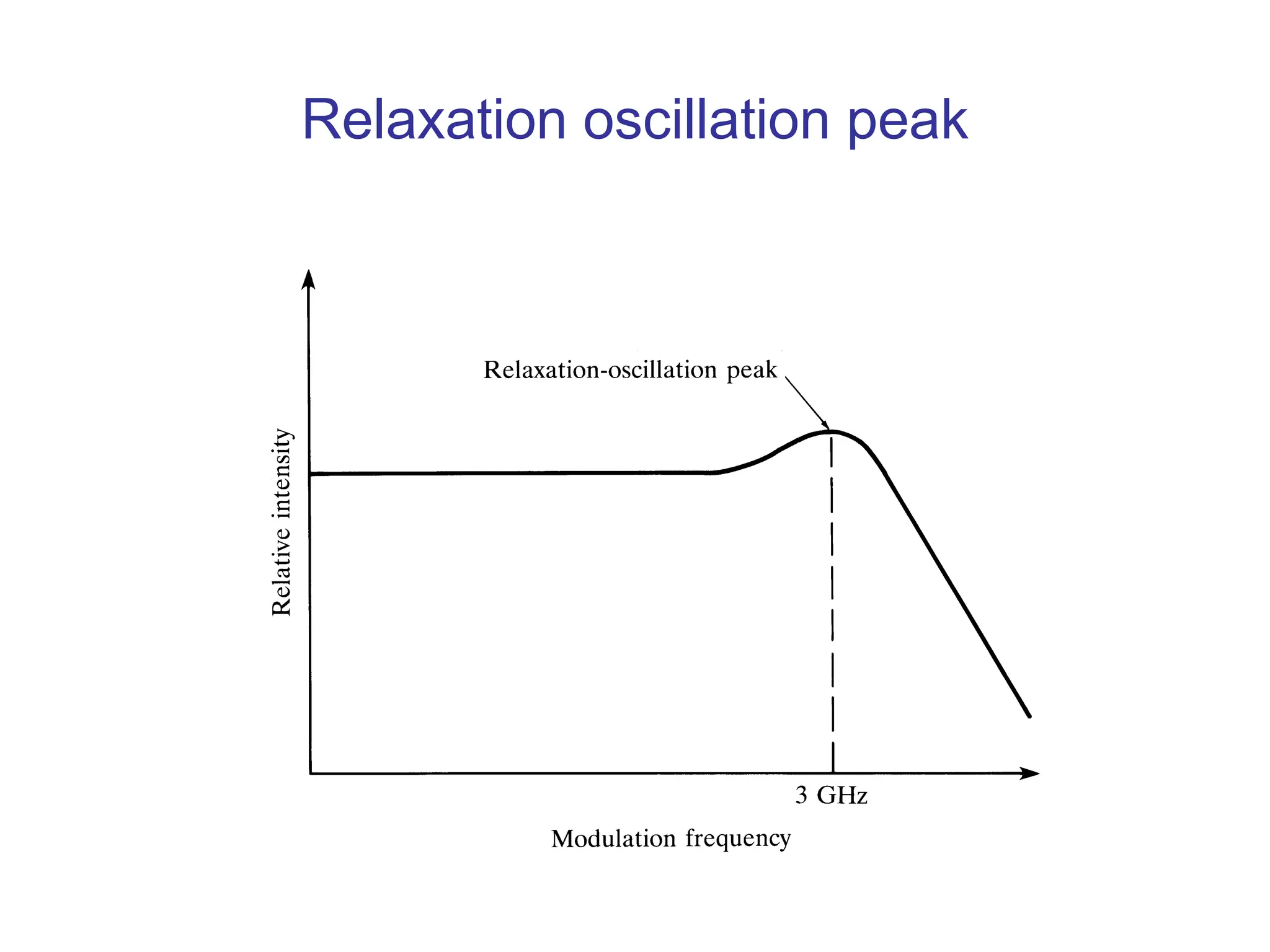
relaxation oscillation frequency given by:
th
ph
g
n
c
R
R
L
n
c











2
1
1
ln
2
1
1


[4-36]
2
/
1
1
1
2
1










th
ph
sp
I
I
f



[4-37]
Relaxation oscillation peak
Pulse Modulated laser
• In a pulse modulated laser, if the laser is completely turned off
after each pulse, after onset of the current pulse, a time delay,
given by:
d
t











)
(
ln
th
B
p
p
d
I
I
I
I
t 
current
Bias
:
amplitude
pulse
Current
:
time
life
carrier
:
B
p
I
I

[4-38]
Temperature variation of the threshold
current
0
/
)
( T
T
z
th e
I
T
I 
Linearity of Laser
Information carrying
electrical signal s(t)
LED or Laser diode
modulator
Optical putput power:
P(t)=P[1+ms(t)]
Nonlinearity
...
2
cos
cos
)
(
cos
)
(
2
1
0 




t
A
t
A
A
t
y
t
A
t
x



x(t) Nonlinear function y=f(x) y(t)
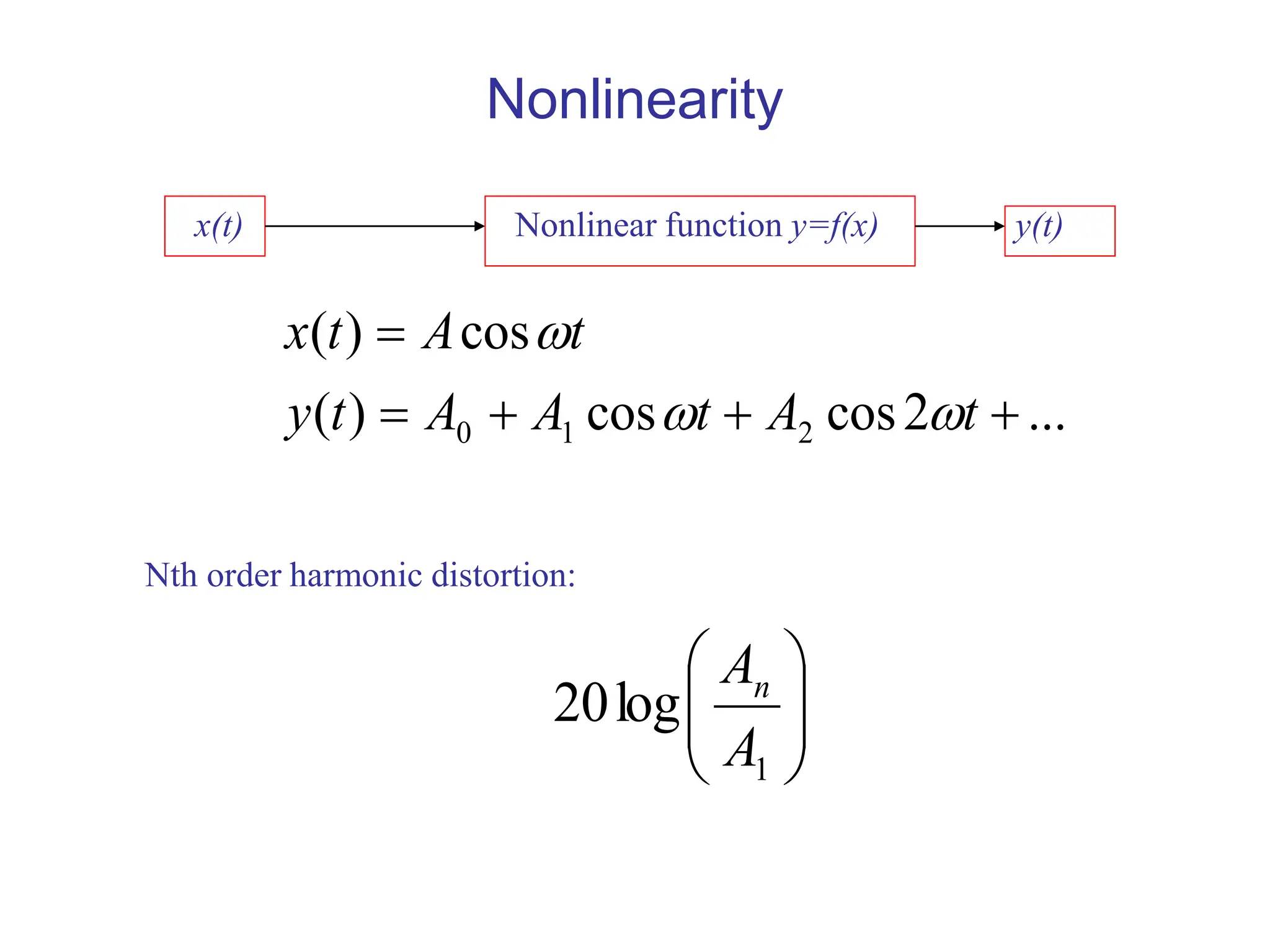
Nth order harmonic distortion:








1
log
20
A
An
Intermodulation Distortion
 







n
m
mn m,n
t
n
m
B
t
y
t
A
t
A
t
x
,
2
1
2
2
1
1
2,...
1,
0,
)
cos(
)
(
cos
cos
)
(




Harmonics:
2
1, 
 m
n
Intermodulated Terms:
,...
2
,
2
, 2
1
2
1
2
1 




 


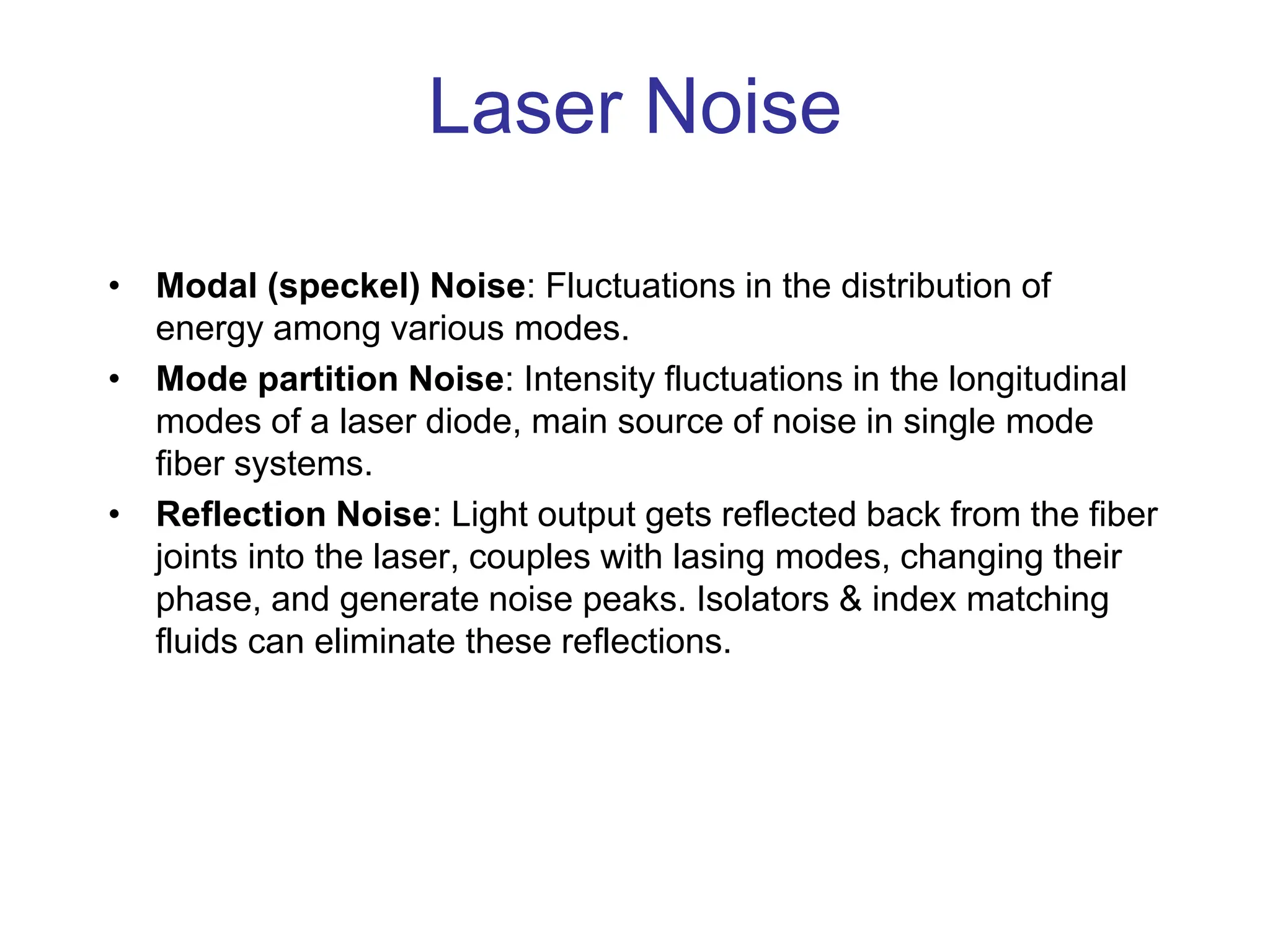
Laser Noise
• Modal (speckel) Noise: Fluctuations in the distribution of
energy among various modes.
• Mode partition Noise: Intensity fluctuations in the longitudinal
modes of a laser diode, main source of noise in single mode
fiber systems.
• Reflection Noise: Light output gets reflected back from the fiber
joints into the laser, couples with lasing modes, changing their
phase, and generate noise peaks. Isolators & index matching
fluids can eliminate these reflections.

37-.ocn_.ppt Optimizing slideshow... photodiiode

  • 1.
  • 2.
    Contents • Review ofSemiconductor Physics • Light Emitting Diode (LED) - Structure, Material,Quantum efficiency, LED Power, Modulation • Laser Diodes - structure, Modes, Rate Equation,Quantum efficiency, Resonant frequencies, Radiation pattern • Single-Mode Lasers - DFB (Distributed-FeedBack) laser, Distributed-Bragg Reflector, Modulation • Light-source Linearity • Noise in Lasers
  • 3.
    Review of SemiconductorPhysics a) Energy level diagrams showing the excitation of an electron from the valence band to the conduction band. The resultant free electron can freely move under the application of electric field. b) Equal electron & hole concentrations in an intrinsic semiconductor created by the thermal excitation of electrons across the band gap -1 23 JK 10 38 . 1    B k Optical Fiber communications, 3rd ed.,G.Keiser,McGrawHill, 2000
  • 4.
    n-Type Semiconductor a) Donorlevel in an n-type semiconductor. b) The ionization of donor impurities creates an increased electron concentration distribution. Optical Fiber communications, 3rd ed.,G.Keiser,McGrawHill, 2000
  • 5.
    p-Type Semiconductor a) Acceptorlevel in an p-type semiconductor. b) The ionization of acceptor impurities creates an increased hole concentration distribution Optical Fiber communications, 3rd ed.,G.Keiser,McGrawHill, 2000
  • 6.
    Intrinsic & ExtrinsicMaterials • Intrinsic material: A perfect material with no impurities. • Extrinsic material: donor or acceptor type semiconductors. • Majority carriers: electrons in n-type or holes in p-type. • Minority carriers: holes in n-type or electrons in p-type. • The operation of semiconductor devices is essentially based on the injection and extraction of minority carriers. ) 2 exp( T k E n p n B g i     ly. respective ions concentrat intrinsic & hole electron, the are & & i n p n e. Temperatur is energy, gap the is T Eg 2 i n pn  [4-1] [4-2]
  • 7.
    The pn Junction OpticalFiber communications, 3rd ed.,G.Keiser,McGrawHill, 2000 Electron diffusion across a pn junction creates a barrier potential (electric field) in the depletion region.
  • 8.
    Reverse-biased pn Junction OpticalFiber communications, 3rd ed.,G.Keiser,McGrawHill, 2000 A reverse bias widens the depletion region, but allows minority carriers to move freely with the applied field.
  • 9.
    Forward-biased pn Junction OpticalFiber communications, 3rd ed.,G.Keiser,McGrawHill, 2000 Lowering the barrier potential with a forward bias allows majority carriers to diffuse across the junction.
  • 10.
    Direct Band GapSemiconductors
  • 11.
    Indirect Band GapSemiconductors E CB k –k Direct Bandgap (a) GaAs E CB VB Indirect Bandgap, Eg k –k kcb (b) Si E k –k Phonon (c) Si with a recombination center Eg Ec Ev Ec Ev kvb VB CB Er Ec Ev Photon VB (a) In GaAs the minimum of the CB is directly above the maximum of the VB. GaAs is therefore a direct bandgap semiconductor. (b) In Si, the minimum of the CB is displaced from the maximum of the VB and Si is an indirect bandgap semiconductor. (c) Recombination of an electron and a hole in Si involves a recombination center . © 1999 S.O. Kasap, Optoelectronics (Prentice Hall)
  • 12.
    Light-Emitting Diodes (LEDs) •For photonic communications requiring data rate 100-200 Mb/s with multimode fiber with tens of microwatts, LEDs are usually the best choice. • LED configurations being used in photonic communications: 1- Surface Emitters (Front Emitters) 2- Edge Emitters
  • 13.
    Optical Fiber communications,3rd ed.,G.Keiser,McGrawHill, 2000 Cross-section drawing of a typical GaAlAs double heterostructure light emitter. In this structure, x>y to provide for both carrier confinement and optical guiding. b) Energy-band diagram showing the active region, the electron & hole barriers which confine the charge carriers to the active layer. c) Variations in the refractive index; the lower refractive index of the material in regions 1 and 5 creates an optical barrier around the waveguide because of the higher band-gap energy of this material. ) eV ( 240 . 1 m) ( g E    [4-3]
  • 14.
    Surface-Emitting LED Optical Fibercommunications, 3rd ed.,G.Keiser,McGrawHill, 2000 Schematic of high-radiance surface-emitting LED. The active region is limitted to a circular cross section that has an area compatible with the fiber-core end face.
  • 15.
    Edge-Emitting LED Schematic ofan edge-emitting double heterojunction LED. The output beam is lambertian in the plane of junction and highly directional perpendicular to pn junction. They have high quantum efficiency & fast response. Optical Fiber communications, 3rd ed.,G.Keiser,McGrawHill, 2000
  • 16.
    Light Source Material •Most of the light sources contain III-V ternary & quaternary compounds. • by varying x it is possible to control the band-gap energy and thereby the emission wavelength over the range of 800 nm to 900 nm. The spectral width is around 20 to 40 nm. • By changing 0<x<0.47; y is approximately 2.2x, the emission wavelength can be controlled over the range of 920 nm to 1600 nm. The spectral width varies from 70 nm to 180 nm when the wavelength changes from 1300 nm to 1600 nm. These materials are lattice matched. As Al Ga x x 1 y 1 y x x 1 P As Ga In  
  • 17.
    Optical Fiber communications,3rd ed.,G.Keiser,McGrawHill, 2000
  • 18.
    Spectral width ofLED types Optical Fiber communications, 3rd ed.,G.Keiser,McGrawHill, 2000
  • 19.
    Rate equations, QuantumEfficiency & Power of LEDs • When there is no external carrier injection, the excess density decays exponentially due to electron-hole recombination. • n is the excess carrier density, • Bulk recombination rate R: • Bulk recombination rate (R)=Radiative recombination rate + nonradiative recombination rate  / 0 ) ( t e n t n   [4-4] lifetime. carrier : density electron excess injected initial : 0  n  n dt dn R    [4-5]
  • 20.
    ) 1 rate( ion recombinat ve nonradiati ) 1 ( rate ion recombinat radiative ) 1 ( rate ion recombinat bulk r nr nr r /τ R /τ R /τ R      Withan external supplied current density of J the rate equation for the electron-hole recombination is: region ion recombinat of thickness : electron; the of charge : ) ( d q n qd J dt t dn    [4-6] In equilibrium condition: dn/dt=0 qd J n   [4-7]
  • 21.
    r nr r nr nr r r R R R            int Internal QuantumEfficiency & Optical Power [4-8] region active in the efficiency quantum internal : int  Optical power generated internally in the active region in the LED is:     q hcI h q I P int int int   [4-9] region active current to Injected : power, optical Internal : int I P
  • 22.
    External Quantum Eficiency •In order to calculate the external quantum efficiency, we need to consider the reflection effects at the surface of the LED. If we consider the LED structure as a simple 2D slab waveguide, only light falling within a cone defined by critical angle will be emitted from an LED. photons generated internally LED of # LED from emitted photons of # ext   [4-10]
  • 23.
           d T c ) sin 2 ( ) ( 4 1 0 ext   [4-11] 2 2 1 2 1 ) ( 4 ) 0 ( t Coefficien on Transmissi Fresnel : ) ( n n n n T T    [4-12] 2 1 1 ext 2 ) 1 ( 1 1 If     n n n  [4-13] 2 1 1 int int ext ) 1 ( powr, optical emitted LED    n n P P P  [4-14]
  • 24.
    Modulation of LED •The frequency response of an LED depends on: 1- Doping level in the active region 2- Injected carrier lifetime in the recombination region, . 3- Parasitic capacitance of the LED • If the drive current of an LED is modulated at a frequency of the output optical power of the device will vary as: • Electrical current is directly proportional to the optical power, thus we can define electrical bandwidth and optical bandwidth, separately.  2 0 ) ( 1 ) ( i P P     [4-15] i  current electrical : power, electrical : ) 0 ( log 20 ) 0 ( 10log BW Electrical I p I ) I( p ) p(                 [4-16]
  • 25.
  • 26.
    LASER (Light Amplification bythe Stimulated Emission of Radiation) • Laser is an optical oscillator. It comprises a resonant optical amplifier whose output is fed back into its input with matching phase. Any oscillator contains: 1- An amplifier with a gain-saturated mechanism 2- A feedback system 3- A frequency selection mechanism 4- An output coupling scheme • In laser the amplifier is the pumped active medium, such as biased semiconductor region, feedback can be obtained by placing active medium in an optical resonator, such as Fabry- Perot structure, two mirrors separated by a prescribed distance. Frequency selection is achieved by resonant amplifier and by the resonators, which admits certain modes. Output coupling is accomplished by making one of the resonator mirrors partially transmitting.
  • 27.
    Pumped active medium •Three main process for laser action: 1- Photon absorption 2- Spontaneous emission 3- Stimulated emission Optical Fiber communications, 3rd ed.,G.Keiser,McGrawHill, 2000
  • 28.
    Lasing in apumped active medium • In thermal equilibrium the stimulated emission is essentially negligible, since the density of electrons in the excited state is very small, and optical emission is mainly because of the spontaneous emission. Stimulated emission will exceed absorption only if the population of the excited states is greater than that of the ground state. This condition is known as Population Inversion. Population inversion is achieved by various pumping techniques. • In a semiconductor laser, population inversion is accomplished by injecting electrons into the material to fill the lower energy states of the conduction band.
  • 29.
    Fabry-Perot Resonator A B L M1 M2m = 1 m = 2 m = 8 Relative intensity  m m m + 1 m - 1 (a) (b) (c) R ~ 0.4 R ~ 0.8 1 f Schematic illustration of the Fabry-Perot optical cavity and its properties. (a) Reflected waves interfere. (b) Only standing EM waves, modes, of certain wavelengths are allowed in the cavity. (c) Intensity vs. frequency for various modes.R is mirror reflectance and lower R means higher loss from the cavity. © 1999 S.O. Kasap, Optoelectronics (Prentice Hall) ) ( sin 4 ) 1 ( ) 1 ( 2 2 2 kL R R R I I inc trans     [4-18] R: reflectance of the optical intensity, k: optical wavenumber 1,2,3,.. : modes Resonant   m m kL 
  • 30.
    Laser Diode • Laserdiode is an improved LED, in the sense that uses stimulated emission in semiconductor from optical transitions between distribution energy states of the valence and conduction bands with optical resonator structure such as Fabry-Perot resonator with both optical and carrier confinements. Optical Fiber communications, 3rd ed.,G.Keiser,McGrawHill, 2000
  • 31.
    Laser Diode Characteristics •Nanosecond & even picosecond response time (GHz BW) • Spectral width of the order of nm or less • High output power (tens of mW) • Narrow beam (good coupling to single mode fibers) • Laser diodes have three distinct radiation modes namely, longitudinal, lateral and transverse modes. • In laser diodes, end mirrors provide strong optical feedback in longitudinal direction, so by roughening the edges and cleaving the facets, the radiation can be achieved in longitudinal direction rather than lateral direction.
  • 32.
    DFB(Distributed FeedBack) Lasers •In DFB lasers, the optical resonator structure is due to the incorporation of Bragg grating or periodic variations of the refractive index into multilayer structure along the length of the diode. Optical Fiber communications, 3rd ed.,G.Keiser,McGrawHill, 2000
  • 33.
    Laser Operation &Lasing Condition • To determine the lasing condition and resonant frequencies, we should focus on the optical wave propagation along the longitudinal direction, z-axis. The optical field intensity, I, can be written as: • Lasing is the condition at which light amplification becomes possible by virtue of population inversion. Then, stimulated emission rate into a given EM mode is proportional to the intensity of the optical radiation in that mode. In this case, the loss and gain of the optical field in the optical path determine the lasing condition. The radiation intensity of a photon at energy varies exponentially with a distance z amplified by factor g, and attenuated by factor according to the following relationship: ) ( ) ( ) , ( z t j e z I t z I     [4-19]  h 
  • 34.
        z h h g I z I) ( ) ( exp ) 0 ( ) (       [4-20] 1 R 2 R Z=0 Z=L     ) 2 ( ) ( ) ( exp ) 0 ( ) 2 ( 2 1 L h h g R R I L I       [4-21] 2 2 1 2 1 t, coefficien absorption effective : t coefficien gain : g factor, t confinemen Optical :             n n n n R α 1 n 2 n Lasing Conditions: 1 ) 2 exp( ) 0 ( ) 2 (    L j I L I  [4-22]
  • 35.
    Threshold gain &current density            2 1 1 ln 2 1 R R L gth  th g g  : iff lase" " to starts Laser [4-23] For laser structure with strong carrier confinement, the threshold current Density for stimulated emission can be well approximated by: th th J g   [4-24] on constructi device specific on depends constant : 
  • 36.
    Optical output vs.drive current Optical Fiber communications, 3rd ed.,G.Keiser,McGrawHill, 2000
  • 37.
    Semiconductor laser rateequations • Rate equations relate the optical output power, or # of photons per unit volume, , to the diode drive current or # of injected electrons per unit volume, n. For active (carrier confinement) region of depth d, the rate equations are:  emission stimulated ion recombinat s spontaneou injection rate electron loss photon emission s spontaneou emission stimulated rate Photon                 Cn n qd J dt dn R Cn dt d sp ph sp   [4-25] density current Injection time life photon mode lasing the into emission s spontaneou of rate process absorption & emission optical the of intensity the expressing t Coefficien : : : : J R C ph sp 
  • 38.
    Threshold current Density& excess electron density • At the threshold of lasing: • The threshold current needed to maintain a steady state threshold concentration of the excess electron, is found from electron rate equation under steady state condition dn/dt=0 when the laser is just about to lase: 0 , 0 / , 0      sp R dt d th ph ph n C n Cn           1 0 / 25] - [4 eq. from [4-26] sp th th sp th th n qd J n qd J       0 [4-27]
  • 39.
    Laser operation beyondthe threshold • The solution of the rate equations [4-25] gives the steady state photon density, resulting from stimulated emission and spontaneous emission as follows: th J J  sp ph th ph s R J J qd       ) ( [4-28]
  • 40.
    External quantum efficiency •Number of photons emitted per radiative electron-hole pair recombination above threshold, gives us the external quantum efficiency. • Note that: ) mA ( ) mW ( ] m [ 8065 . 0 ) ( dI dP dI dP E q g g g th th i ext          [4-29] % 40 % 15 %; 70 % 60     ext i  
  • 41.
    Laser Resonant Frequencies •Lasing condition, namely eq. [4-22]: • Assuming the resonant frequency of the mth mode is: ,... 3 , 2 , 1 , 2 L 2 1 ) 2 exp(      m m L j       n 2  1,2,3,... 2   m Ln mc m  Ln Ln c m m 2 2 2 1              [4-30] [4-31]
  • 42.
    Spectrum from alaser Diode width spectral : 2 ) ( exp ) 0 ( ) ( 2 0               g g [4-32]
  • 43.
    Laser Diode Structure& Radiation Pattern • Efficient operation of a laser diode requires reducing the # of lateral modes, stabilizing the gain for lateral modes as well as lowering the threshold current. These are met by structures that confine the optical wave, carrier concentration and current flow in the lateral direction. The important types of laser diodes are: gain-induced, positive index guided, and negative index guided.
  • 44.
    (a) gain-induced guide(b)positive-index waveguide (c)negative-index waveguide
  • 45.
    Laser Diode withburied heterostructure (BH)
  • 46.
    Single Mode Laser •Single mode laser is mostly based on the index- guided structure that supports only the fundamental transverse mode and the fundamental longitudinal mode. In order to make single mode laser we have four options: 1- Reducing the length of the cavity to the point where the frequency separation given in eq[4-31] of the adjacent modes is larger than the laser transition line width. This is hard to handle for fabrication and results in low output power. 2- Vertical-Cavity Surface Emitting laser (VCSEL) 3- Structures with built-in frequency selective grating 4- tunable laser diodes .
  • 47.
  • 48.
    Frequency-Selective laser Diodes: DistributedFeedback (DFB) laser k ne B   2  [4-33]
  • 49.
    Frequency-Selective laser Diodes: DistributedFeedback Reflector (DBR) laser
  • 50.
    Output spectrum symmetricallydistributed around Bragg wavelength in an idealized DFB laser diode ) 2 1 ( 2 2    m L n e e B B    [4-35]
  • 51.
  • 52.
    Modulation of LaserDiodes • Internal Modulation: Simple but suffers from non-linear effects. • External Modulation: for rates greater than 2 Gb/s, more complex, higher performance. • Most fundamental limit for the modulation rate is set by the photon life time in the laser cavity: • Another fundamental limit on modulation frequency is the relaxation oscillation frequency given by: th ph g n c R R L n c            2 1 1 ln 2 1 1   [4-36] 2 / 1 1 1 2 1           th ph sp I I f    [4-37]
  • 53.
  • 54.
    Pulse Modulated laser •In a pulse modulated laser, if the laser is completely turned off after each pulse, after onset of the current pulse, a time delay, given by: d t            ) ( ln th B p p d I I I I t  current Bias : amplitude pulse Current : time life carrier : B p I I  [4-38]
  • 55.
    Temperature variation ofthe threshold current 0 / ) ( T T z th e I T I 
  • 56.
    Linearity of Laser Informationcarrying electrical signal s(t) LED or Laser diode modulator Optical putput power: P(t)=P[1+ms(t)]
  • 58.
    Nonlinearity ... 2 cos cos ) ( cos ) ( 2 1 0      t A t A A t y t A t x    x(t) Nonlinearfunction y=f(x) y(t) Nth order harmonic distortion:         1 log 20 A An
  • 59.
    Intermodulation Distortion          n m mnm,n t n m B t y t A t A t x , 2 1 2 2 1 1 2,... 1, 0, ) cos( ) ( cos cos ) (     Harmonics: 2 1,   m n Intermodulated Terms: ,... 2 , 2 , 2 1 2 1 2 1         
  • 60.
    Laser Noise • Modal(speckel) Noise: Fluctuations in the distribution of energy among various modes. • Mode partition Noise: Intensity fluctuations in the longitudinal modes of a laser diode, main source of noise in single mode fiber systems. • Reflection Noise: Light output gets reflected back from the fiber joints into the laser, couples with lasing modes, changing their phase, and generate noise peaks. Isolators & index matching fluids can eliminate these reflections.