Autistic Spectrum disorder
Definition (DSM 4 )
Autism spectrum disorders are life-long neurodevelopmental disabilities with onset before 36 months and
characterised by:
Characterized by Leo Kanner (1943)
Impairments in reciprocal social interactions.
Impairments in verbal and non-verbal communication skills.
Stereotyped behaviour, interests and activities.
(APA)
NOTE: changes have been made recently to the diagnostic criteria (DSM 5, 2013) Changes include:
The diagnosis will be called Autism Spectrum Disorder (ASD), and there no longer will be sub diagnoses (Autistic
Disorder, Asperger Syndrome, Pervasive Developmental Disorder Not Otherwise Specified, Disintegrative
Disorder).
In DSM-IV, symptoms were divided into three areas (social reciprocity, communicative intent, restricted and
repetitive behaviours). The new diagnostic criteria have been rearranged into two areas: 1) social
communication/interaction, and 2) restricted and repetitive behaviours. The diagnosis will be based on
symptoms, currently or by history, in these two areas.
Symptoms must be present in early childhood but may not become fully manifest until social demands exceed
capacities. Symptoms need to be functionally impairing 
(Hyman, 2013)
All of the following symptoms describing persistent deficits in social communication/interaction
across contexts, not accounted for by general developmental delays, must be met:
Problems reciprocating social or emotional interaction, including difficulty establishing or
maintaining back-and-forth conversations and interactions, inability to initiate an interaction,
and problems with shared attention or sharing of emotions and interests with others.
Severe problems maintaining relationships — ranges from lack of interest in other people to
difficulties in pretend play and engaging in age-appropriate social activities, and problems
adjusting to different social expectations.
Nonverbal communication problems such as abnormal eye contact, posture, facial
expressions, tone of voice and gestures, as well as an inability to understand these.
Two of the four symptoms related to restricted and repetitive behaviour need to be present:
Stereotyped or repetitive speech, motor movements or use of objects.
Excessive adherence to routines, ritualized patters of verbal or nonverbal behaviour, or
excessive resistance to change.
Highly restricted interests that are abnormal in intensity or focus.
Hyper or hypo reactivity to sensory input or unusual interest in sensory aspects of the
environment.
(Hyman, 2013)
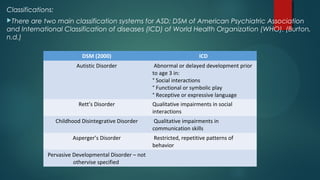
Classifications:
There are two main classification systems for ASD; DSM of American Psychiatric Association
and International Classification of diseases (ICD) of World Health Organization (WHO). (Burton,
n.d.)
DSM (2000) ICD
Autistic Disorder Abnormal or delayed development prior
to age 3 in:
° Social interactions
° Functional or symbolic play
° Receptive or expressive language
Rett’s Disorder Qualitative impairments in social
interactions
Childhood Disintegrative Disorder Qualitative impairments in
communication skills
Asperger’s Disorder Restricted, repetitive patterns of
behavior
Pervasive Developmental Disorder – not
othervise specified
Aetiology of Autism
 Autism is a neurobiological developmental disorder, which means it is
caused by disorders or impairments in the brain or central nervous system. In
general, neurodevelopmental disorders are associated with mental,
emotional, and physical impairments
 To date, the aetiology of autism is unknown
(Barton, n.d.)
 Research suggests the brains of children with autism grow at abnormal rates
(Courchesne et al., 2001).
 Kanner’s original description of autism noted an increased head
circumference in some of the children with autism (Minchew et al, 2005).
 Autopsy studies have revealed abnormalities in the amygdala, cerebellum,
brain stem, and temporal lobes of people with autism (Schultz & Robins,
2005).
 General consensus among autism researchers is that genetic factors are the
most predominant known causes of autism, although the exact genetic links
are complex and not well understood.
 Recent genetic research has demonstrated a greater than 60%
concordance rate among identical twins and an increased risk for siblings of
children with autism (Baron-Cohen, 2004; Popper et al, 2005).
Asperger’s Syndrome
 Asperger syndrome is a form of autism, which is a lifelong disability that affects how a
person makes sense of the world, processes information and relates to other people.
People with the condition have difficulties in:
 Social communication
 Social interaction
 Social imagination
 People with Asperger syndrome have fewer problems with speaking and are often of
average, or above average, intelligence.
 They do not usually have the accompanying learning disabilities associated with autism,
but they may have specific learning difficulties. These may include dyslexia and dyspraxia
or other conditions such as attention deficit hyperactivity disorder (ADHD) and epilepsy
(NHS, 2015)
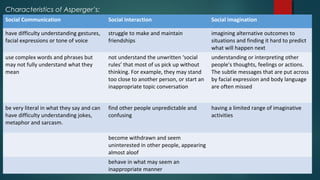
Characteristics of Asperger’s:
Social Communication Social Interaction Social imagination
have difficulty understanding gestures,
facial expressions or tone of voice
struggle to make and maintain
friendships
imagining alternative outcomes to
situations and finding it hard to predict
what will happen next
use complex words and phrases but
may not fully understand what they
mean
not understand the unwritten ‘social
rules’ that most of us pick up without
thinking. For example, they may stand
too close to another person, or start an
inappropriate topic conversation
understanding or interpreting other
people’s thoughts, feelings or actions.
The subtle messages that are put across
by facial expression and body language
are often missed
be very literal in what they say and can
have difficulty understanding jokes,
metaphor and sarcasm.
find other people unpredictable and
confusing
having a limited range of imaginative
activities
become withdrawn and seem
uninterested in other people, appearing
almost aloof
behave in what may seem an
inappropriate manner
Psychological Interventions
Behavioural Interventions:
Early Intensive behavioural Intervention (Lovaas, 1987)
Discrete trial training and pivotal response training
Communication Based Intervention:
Child Focused Intervention
Teaching and Education of Autistic and related Communication-handicapped Children
(TEACCH)
Signing and picture systems
Interventions focusing on parent–child interaction
Programmes focusing on social/emotional competence and understanding:
Joint attention and symbolic play
Theory of mind
Social Skills
Social Stories
General educational programmes
Interventions for mental health problems:
CBT
Comorbidity
 Mannion et al. (2013) found that 18% of children and adolescents with
autism spectrum disorder also had a comorbid diagnosis of AD/HD
 Also found that AD/HD was not a significant predictor of sleep
problems in children and adolescents with autism spectrum disorder
Studies on 2-16 yrs olds:
 AD/HD symptoms were common in autism
 Those with ASD and omorbid AD/HD symptoms showed more problems
in inhibitory performance than those with ASD alone
 Almost half (44.78%) of the ASD group met CBCL criteria for clinically
significant hyperactivity disorder
Studies on 18+ yrs olds:
 The dysfunctions of the ASD and comorbid AD/HD group cannot be
seen as a summary of the dysfunction found in the ASD and ADHD
groups
(Nyden, 2010)
With Down Syndrome:
children with Down syndrome and autism have a lack of social interest in peers and social withdrawal, very odd bizarre stereotypes and
anxiety.
Other symptoms such as a fascination for lights and spinning things like fans or wheels
need for extreme routine and repetitive behaviours such as finger twirling, hand flapping and repetitive play are also present.
extreme sensitivity to particular sounds, places, smells, leading to distress and anxiety often manifest as a temper tantrum or meltdown.
Children may not respond to their name being called and they may show little interest in playing with toys.
they may develop language, the functional use of language, such as to greet someone or to communicate with another in a two way
conversation is limited.
They may lose language (regression) or never develop any words.
Significant difficulty when routine is disrupted. Need for sameness and predictability
Hyperactivity, Inattention, impulsivity
Self injurious behaviour; skin picking, biting, head banging, eye poking
Lack of interest in toys or unusual use of toys, such as lining them up in strict order
Unusual reactions to certain sounds
Extreme food fussiness, sometimes gagging and refusal of certain foods, food texture, temperature are usual factors
History of regression, or loss of language skills and social interests
Severe sleep disturbance
Unusual vocalizations, such as barking, humming, grunting
Hand flapping, tooth grinding, rocking, spinning
(Marraffa, 2009)
Theory of Mind
 Is the ability to attribute mental states (Beliefs, intents, desires, pretending, knowledge) to
oneself and others and to understand that others beliefs, desires, intentions that are
different from one’s own (Baron- Cohen, 1991)
 Deficits occur in people with ASD, Schizophrenia, ADHD, alcohol abuse, neurotoxicity
 results strongly support the hypothesis that autistic children as a group fail to employ a
theory of mind. We wish to explain this failure as an inability to represent mental states. As a
result of this the autistic subjects are unable to impute beliefs to others and are thus at a
grave disadvantage when having to predict the behaviour of other people.
 There is, however, also a suggestion of a small subgroup of autistic children who
succeeded on the task and who thus may be able to employ a theory of mind.
(Baron- Cohen, 1985)
 It is difficult for individuals with ASD to access their own mental states
 high-functioning ASD can often perform conceptual ToM tasks at various levels of
complexity. found to perform better when they were motivated to respond adequately
and in structured social interactions
(Ponnet et al, 2005).

Autistic spectrum disorder

  • 1.
    Autistic Spectrum disorder Definition(DSM 4 ) Autism spectrum disorders are life-long neurodevelopmental disabilities with onset before 36 months and characterised by: Characterized by Leo Kanner (1943) Impairments in reciprocal social interactions. Impairments in verbal and non-verbal communication skills. Stereotyped behaviour, interests and activities. (APA) NOTE: changes have been made recently to the diagnostic criteria (DSM 5, 2013) Changes include: The diagnosis will be called Autism Spectrum Disorder (ASD), and there no longer will be sub diagnoses (Autistic Disorder, Asperger Syndrome, Pervasive Developmental Disorder Not Otherwise Specified, Disintegrative Disorder). In DSM-IV, symptoms were divided into three areas (social reciprocity, communicative intent, restricted and repetitive behaviours). The new diagnostic criteria have been rearranged into two areas: 1) social communication/interaction, and 2) restricted and repetitive behaviours. The diagnosis will be based on symptoms, currently or by history, in these two areas. Symptoms must be present in early childhood but may not become fully manifest until social demands exceed capacities. Symptoms need to be functionally impairing  (Hyman, 2013)
  • 2.
    All of thefollowing symptoms describing persistent deficits in social communication/interaction across contexts, not accounted for by general developmental delays, must be met: Problems reciprocating social or emotional interaction, including difficulty establishing or maintaining back-and-forth conversations and interactions, inability to initiate an interaction, and problems with shared attention or sharing of emotions and interests with others. Severe problems maintaining relationships — ranges from lack of interest in other people to difficulties in pretend play and engaging in age-appropriate social activities, and problems adjusting to different social expectations. Nonverbal communication problems such as abnormal eye contact, posture, facial expressions, tone of voice and gestures, as well as an inability to understand these. Two of the four symptoms related to restricted and repetitive behaviour need to be present: Stereotyped or repetitive speech, motor movements or use of objects. Excessive adherence to routines, ritualized patters of verbal or nonverbal behaviour, or excessive resistance to change. Highly restricted interests that are abnormal in intensity or focus. Hyper or hypo reactivity to sensory input or unusual interest in sensory aspects of the environment. (Hyman, 2013)
  • 3.
    Classifications: There are twomain classification systems for ASD; DSM of American Psychiatric Association and International Classification of diseases (ICD) of World Health Organization (WHO). (Burton, n.d.) DSM (2000) ICD Autistic Disorder Abnormal or delayed development prior to age 3 in: ° Social interactions ° Functional or symbolic play ° Receptive or expressive language Rett’s Disorder Qualitative impairments in social interactions Childhood Disintegrative Disorder Qualitative impairments in communication skills Asperger’s Disorder Restricted, repetitive patterns of behavior Pervasive Developmental Disorder – not othervise specified
  • 4.
    Aetiology of Autism Autism is a neurobiological developmental disorder, which means it is caused by disorders or impairments in the brain or central nervous system. In general, neurodevelopmental disorders are associated with mental, emotional, and physical impairments  To date, the aetiology of autism is unknown (Barton, n.d.)  Research suggests the brains of children with autism grow at abnormal rates (Courchesne et al., 2001).  Kanner’s original description of autism noted an increased head circumference in some of the children with autism (Minchew et al, 2005).  Autopsy studies have revealed abnormalities in the amygdala, cerebellum, brain stem, and temporal lobes of people with autism (Schultz & Robins, 2005).  General consensus among autism researchers is that genetic factors are the most predominant known causes of autism, although the exact genetic links are complex and not well understood.  Recent genetic research has demonstrated a greater than 60% concordance rate among identical twins and an increased risk for siblings of children with autism (Baron-Cohen, 2004; Popper et al, 2005).
  • 5.
    Asperger’s Syndrome  Aspergersyndrome is a form of autism, which is a lifelong disability that affects how a person makes sense of the world, processes information and relates to other people. People with the condition have difficulties in:  Social communication  Social interaction  Social imagination  People with Asperger syndrome have fewer problems with speaking and are often of average, or above average, intelligence.  They do not usually have the accompanying learning disabilities associated with autism, but they may have specific learning difficulties. These may include dyslexia and dyspraxia or other conditions such as attention deficit hyperactivity disorder (ADHD) and epilepsy (NHS, 2015)
  • 6.
    Characteristics of Asperger’s: SocialCommunication Social Interaction Social imagination have difficulty understanding gestures, facial expressions or tone of voice struggle to make and maintain friendships imagining alternative outcomes to situations and finding it hard to predict what will happen next use complex words and phrases but may not fully understand what they mean not understand the unwritten ‘social rules’ that most of us pick up without thinking. For example, they may stand too close to another person, or start an inappropriate topic conversation understanding or interpreting other people’s thoughts, feelings or actions. The subtle messages that are put across by facial expression and body language are often missed be very literal in what they say and can have difficulty understanding jokes, metaphor and sarcasm. find other people unpredictable and confusing having a limited range of imaginative activities become withdrawn and seem uninterested in other people, appearing almost aloof behave in what may seem an inappropriate manner
  • 7.
    Psychological Interventions Behavioural Interventions: EarlyIntensive behavioural Intervention (Lovaas, 1987) Discrete trial training and pivotal response training Communication Based Intervention: Child Focused Intervention Teaching and Education of Autistic and related Communication-handicapped Children (TEACCH) Signing and picture systems Interventions focusing on parent–child interaction Programmes focusing on social/emotional competence and understanding: Joint attention and symbolic play Theory of mind Social Skills Social Stories General educational programmes Interventions for mental health problems: CBT
  • 8.
    Comorbidity  Mannion etal. (2013) found that 18% of children and adolescents with autism spectrum disorder also had a comorbid diagnosis of AD/HD  Also found that AD/HD was not a significant predictor of sleep problems in children and adolescents with autism spectrum disorder Studies on 2-16 yrs olds:  AD/HD symptoms were common in autism  Those with ASD and omorbid AD/HD symptoms showed more problems in inhibitory performance than those with ASD alone  Almost half (44.78%) of the ASD group met CBCL criteria for clinically significant hyperactivity disorder Studies on 18+ yrs olds:  The dysfunctions of the ASD and comorbid AD/HD group cannot be seen as a summary of the dysfunction found in the ASD and ADHD groups (Nyden, 2010)
  • 9.
    With Down Syndrome: childrenwith Down syndrome and autism have a lack of social interest in peers and social withdrawal, very odd bizarre stereotypes and anxiety. Other symptoms such as a fascination for lights and spinning things like fans or wheels need for extreme routine and repetitive behaviours such as finger twirling, hand flapping and repetitive play are also present. extreme sensitivity to particular sounds, places, smells, leading to distress and anxiety often manifest as a temper tantrum or meltdown. Children may not respond to their name being called and they may show little interest in playing with toys. they may develop language, the functional use of language, such as to greet someone or to communicate with another in a two way conversation is limited. They may lose language (regression) or never develop any words. Significant difficulty when routine is disrupted. Need for sameness and predictability Hyperactivity, Inattention, impulsivity Self injurious behaviour; skin picking, biting, head banging, eye poking Lack of interest in toys or unusual use of toys, such as lining them up in strict order Unusual reactions to certain sounds Extreme food fussiness, sometimes gagging and refusal of certain foods, food texture, temperature are usual factors History of regression, or loss of language skills and social interests Severe sleep disturbance Unusual vocalizations, such as barking, humming, grunting Hand flapping, tooth grinding, rocking, spinning (Marraffa, 2009)
  • 10.
    Theory of Mind Is the ability to attribute mental states (Beliefs, intents, desires, pretending, knowledge) to oneself and others and to understand that others beliefs, desires, intentions that are different from one’s own (Baron- Cohen, 1991)  Deficits occur in people with ASD, Schizophrenia, ADHD, alcohol abuse, neurotoxicity  results strongly support the hypothesis that autistic children as a group fail to employ a theory of mind. We wish to explain this failure as an inability to represent mental states. As a result of this the autistic subjects are unable to impute beliefs to others and are thus at a grave disadvantage when having to predict the behaviour of other people.  There is, however, also a suggestion of a small subgroup of autistic children who succeeded on the task and who thus may be able to employ a theory of mind. (Baron- Cohen, 1985)  It is difficult for individuals with ASD to access their own mental states  high-functioning ASD can often perform conceptual ToM tasks at various levels of complexity. found to perform better when they were motivated to respond adequately and in structured social interactions (Ponnet et al, 2005).