LEARNING DISABILITY:
PERVASIVE DEVELOPMENTAL DISORDER
(GROUP 8)
FCE3200
EDUCATION PSYCHOLOGY
Lecturer : Dr. Aini Marina Bt Ma’rof
MEMBERS
DEFINE LEARNING DISABILITIES
Learning Disabilities
A learning disability is a neurological disorder. in simple terms,
a learning disability results from a difference in a way person's
brain is “wired”. Children with disabilities are as smart or
smarter that their peers.
They have difficulty in learning speech, reading, calculation
and reasoning.
1.0 WHAT IS THE PERVASIVE
DEVELOPMENTAL
DISORDER (PDD)?
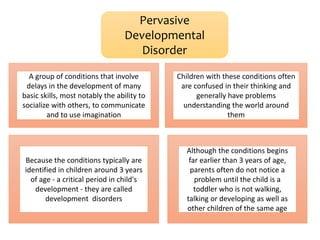
Pervasive
Developmental
Disorder
A group of conditions that involve
delays in the development of many
basic skills, most notably the ability to
socialize with others, to communicate
and to use imagination
Although the conditions begins
far earlier than 3 years of age,
parents often do not notice a
problem until the child is a
toddler who is not walking,
talking or developing as well as
other children of the same age
Because the conditions typically are
identified in children around 3 years
of age - a critical period in child's
development - they are called
development disorders
Children with these conditions often
are confused in their thinking and
generally have problems
understanding the world around
them
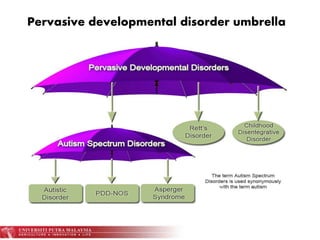
Pervasive developmental disorder umbrella
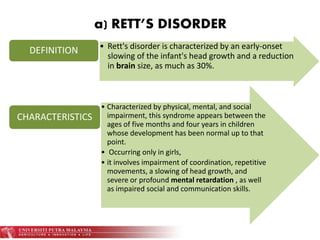
a) RETT’S DISORDER
• Rett's disorder is characterized by an early-onset
slowing of the infant's head growth and a reduction
in brain size, as much as 30%.
DEFINITION
• Characterized by physical, mental, and social
impairment, this syndrome appears between the
ages of five months and four years in children
whose development has been normal up to that
point.
• Occurring only in girls,
• it involves impairment of coordination, repetitive
movements, a slowing of head growth, and
severe or profound mental retardation , as well
as impaired social and communication skills.
CHARACTERISTICS
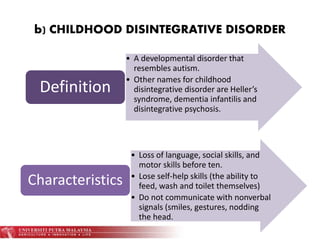
b) CHILDHOOD DISINTEGRATIVE DISORDER
• A developmental disorder that
resembles autism.
• Other names for childhood
disintegrative disorder are Heller’s
syndrome, dementia infantilis and
disintegrative psychosis.
Definition
• Loss of language, social skills, and
motor skills before ten.
• Lose self-help skills (the ability to
feed, wash and toilet themselves)
• Do not communicate with nonverbal
signals (smiles, gestures, nodding
the head.
Characteristics
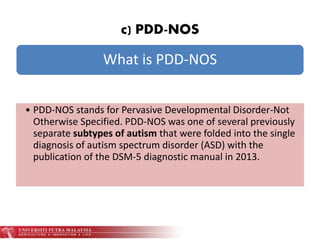
c) PDD-NOS
What is PDD-NOS
• PDD-NOS stands for Pervasive Developmental Disorder-Not
Otherwise Specified. PDD-NOS was one of several previously
separate subtypes of autism that were folded into the single
diagnosis of autism spectrum disorder (ASD) with the
publication of the DSM-5 diagnostic manual in 2013.
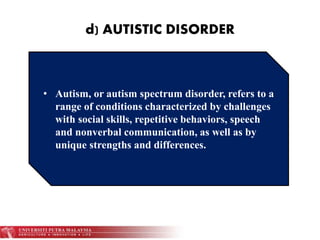
d) AUTISTIC DISORDER
• Autism, or autism spectrum disorder, refers to a
range of conditions characterized by challenges
with social skills, repetitive behaviors, speech
and nonverbal communication, as well as by
unique strengths and differences.
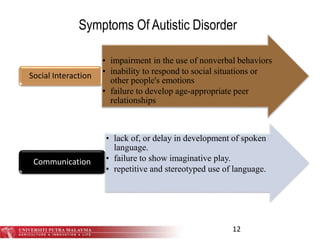
Symptoms Of Autistic Disorder
12
• impairment in the use of nonverbal behaviors
• inability to respond to social situations or
other people's emotions
• failure to develop age-appropriate peer
relationships
Social Interaction
• lack of, or delay in development of spoken
language.
• failure to show imaginative play.
• repetitive and stereotyped use of language.
Communication
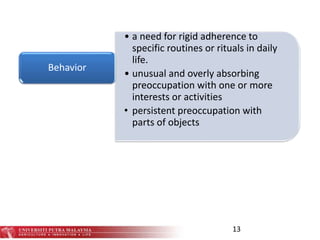
• a need for rigid adherence to
specific routines or rituals in daily
life.
• unusual and overly absorbing
preoccupation with one or more
interests or activities
• persistent preoccupation with
parts of objects
Behavior
13
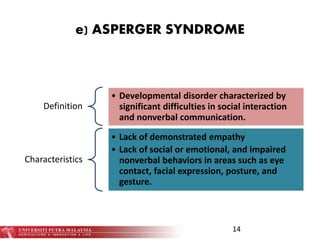
e) ASPERGER SYNDROME
Definition
• Developmental disorder characterized by
significant difficulties in social interaction
and nonverbal communication.
Characteristics
• Lack of demonstrated empathy
• Lack of social or emotional, and impaired
nonverbal behaviors in areas such as eye
contact, facial expression, posture, and
gesture.
14
2.0 COMMON CHARATERISTICS
/SYMPTOMS AND CAUSES
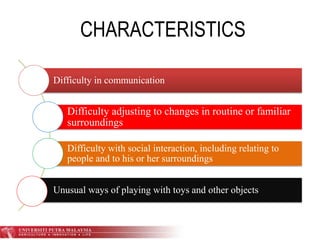
CHARACTERISTICS
Difficulty in communication
Difficulty adjusting to changes in routine or familiar
surroundings
Difficulty with social interaction, including relating to
people and to his or her surroundings
Unusual ways of playing with toys and other objects
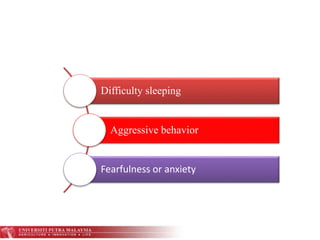
Difficulty sleeping
Aggressive behavior
Fearfulness or anxiety
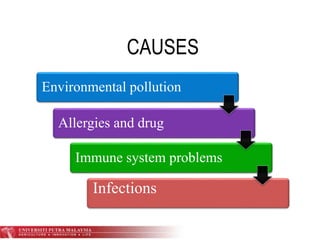
CAUSES
Environmental pollution
Allergies and drug
Immune system problems
Infections
3.0 ROLES OF PARENTS and
TEACHERS
PARENTS
• Parents should know that PDD-NOS can still allow for a broad
range of intellectual ability
• Specific diagnosis as they can begin intervention services that
can help a child with their developmental needs.
• Team Up With Your Child’s Teachers and
Physicians. Depending on the type of PDD-NOS your child
has, you may need to work with a large group of therapists and
teachers. In order to make things work out well for you, and
your child, being acquainted and working as a team is key.
Pay attention to your child's environment
and routine:
• Keep the environment predictable and familiar, and prepare your
child for changes. For example, count down the time until a
transition.
• Prime your child for new situations by explaining in advance what
you expect will happen, and prepare them for the “what if’s.” For
example, explain you are going to visit grandpa, but “what if”
grandpa doesn’t answer the door.
• Provide consistent structure and routine.
• Many children respond well to visual supports, such as
a daily schedule using pictures. Schedules help to give
information about what is happening in the day and
give a place for the child to check when needed (just
like you might check your planner or shopping list).
• Pay attention to sensory input from the environment,
like noise, temperature, smells, crowds, etc
When you talk to your child:
• Don’t assume that your child understands what you are saying.
• Communicate clearly. Be logical, organized, clear, concise and
concrete. Avoid jargon, double meanings, sarcasm, nicknames, and
teasing.
• Explain abstract concepts in concrete terms.
• Don't talk about your child in front of them, unless you include them
in the conversation.
• Be sure to tell your child what you want him to do, rather than what
you don’t want him to do. For example, say “put it on the table”
rather than, “don’t throw it on the floor.”
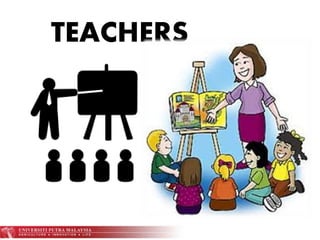
TEACHERS
• Sequenced and gradual integration of pupils’
into their reference classrooms assisting them
to participate safely and confidently in different
activities.
• Providing adult guidance through meaningful,
motivating, functional and contextualised
activities.
REFERENCES
1. https://www.ninds.nih.gov/Disorders/All-Disorders/Pervasive-
Developmental-Disorders-Information-Page
2. https://www.autismspeaks.org/what-autism/pdd-nos
3. https://scholar.google.com.my/scholar?q=psychosocial+characteristics+o
f+children+with+pervasive+developmental+disorder&hl=en&as_sdt=0&
as_vis=1&oi=scholart&sa=X&ved=0ahUKEwijvpP8yebXAhXJL48KHXuLBw
IQgQMIJjAA
TERIMA KASIH / THANK YOU
www.upm.edu.my

Pervasive developmental disorder

  • 1.
    LEARNING DISABILITY: PERVASIVE DEVELOPMENTALDISORDER (GROUP 8) FCE3200 EDUCATION PSYCHOLOGY Lecturer : Dr. Aini Marina Bt Ma’rof
  • 2.
  • 3.
    DEFINE LEARNING DISABILITIES LearningDisabilities A learning disability is a neurological disorder. in simple terms, a learning disability results from a difference in a way person's brain is “wired”. Children with disabilities are as smart or smarter that their peers. They have difficulty in learning speech, reading, calculation and reasoning.
  • 4.
    1.0 WHAT ISTHE PERVASIVE DEVELOPMENTAL DISORDER (PDD)?
  • 6.
    Pervasive Developmental Disorder A group ofconditions that involve delays in the development of many basic skills, most notably the ability to socialize with others, to communicate and to use imagination Although the conditions begins far earlier than 3 years of age, parents often do not notice a problem until the child is a toddler who is not walking, talking or developing as well as other children of the same age Because the conditions typically are identified in children around 3 years of age - a critical period in child's development - they are called development disorders Children with these conditions often are confused in their thinking and generally have problems understanding the world around them
  • 7.
  • 8.
    a) RETT’S DISORDER •Rett's disorder is characterized by an early-onset slowing of the infant's head growth and a reduction in brain size, as much as 30%. DEFINITION • Characterized by physical, mental, and social impairment, this syndrome appears between the ages of five months and four years in children whose development has been normal up to that point. • Occurring only in girls, • it involves impairment of coordination, repetitive movements, a slowing of head growth, and severe or profound mental retardation , as well as impaired social and communication skills. CHARACTERISTICS
  • 9.
    b) CHILDHOOD DISINTEGRATIVEDISORDER • A developmental disorder that resembles autism. • Other names for childhood disintegrative disorder are Heller’s syndrome, dementia infantilis and disintegrative psychosis. Definition • Loss of language, social skills, and motor skills before ten. • Lose self-help skills (the ability to feed, wash and toilet themselves) • Do not communicate with nonverbal signals (smiles, gestures, nodding the head. Characteristics
  • 10.
    c) PDD-NOS What isPDD-NOS • PDD-NOS stands for Pervasive Developmental Disorder-Not Otherwise Specified. PDD-NOS was one of several previously separate subtypes of autism that were folded into the single diagnosis of autism spectrum disorder (ASD) with the publication of the DSM-5 diagnostic manual in 2013.
  • 11.
    d) AUTISTIC DISORDER •Autism, or autism spectrum disorder, refers to a range of conditions characterized by challenges with social skills, repetitive behaviors, speech and nonverbal communication, as well as by unique strengths and differences.
  • 12.
    Symptoms Of AutisticDisorder 12 • impairment in the use of nonverbal behaviors • inability to respond to social situations or other people's emotions • failure to develop age-appropriate peer relationships Social Interaction • lack of, or delay in development of spoken language. • failure to show imaginative play. • repetitive and stereotyped use of language. Communication
  • 13.
    • a needfor rigid adherence to specific routines or rituals in daily life. • unusual and overly absorbing preoccupation with one or more interests or activities • persistent preoccupation with parts of objects Behavior 13
  • 14.
    e) ASPERGER SYNDROME Definition •Developmental disorder characterized by significant difficulties in social interaction and nonverbal communication. Characteristics • Lack of demonstrated empathy • Lack of social or emotional, and impaired nonverbal behaviors in areas such as eye contact, facial expression, posture, and gesture. 14
  • 16.
  • 17.
    CHARACTERISTICS Difficulty in communication Difficultyadjusting to changes in routine or familiar surroundings Difficulty with social interaction, including relating to people and to his or her surroundings Unusual ways of playing with toys and other objects
  • 18.
  • 19.
    CAUSES Environmental pollution Allergies anddrug Immune system problems Infections
  • 20.
    3.0 ROLES OFPARENTS and TEACHERS
  • 21.
  • 22.
    • Parents shouldknow that PDD-NOS can still allow for a broad range of intellectual ability • Specific diagnosis as they can begin intervention services that can help a child with their developmental needs. • Team Up With Your Child’s Teachers and Physicians. Depending on the type of PDD-NOS your child has, you may need to work with a large group of therapists and teachers. In order to make things work out well for you, and your child, being acquainted and working as a team is key.
  • 23.
    Pay attention toyour child's environment and routine: • Keep the environment predictable and familiar, and prepare your child for changes. For example, count down the time until a transition. • Prime your child for new situations by explaining in advance what you expect will happen, and prepare them for the “what if’s.” For example, explain you are going to visit grandpa, but “what if” grandpa doesn’t answer the door. • Provide consistent structure and routine.
  • 24.
    • Many childrenrespond well to visual supports, such as a daily schedule using pictures. Schedules help to give information about what is happening in the day and give a place for the child to check when needed (just like you might check your planner or shopping list). • Pay attention to sensory input from the environment, like noise, temperature, smells, crowds, etc
  • 25.
    When you talkto your child: • Don’t assume that your child understands what you are saying. • Communicate clearly. Be logical, organized, clear, concise and concrete. Avoid jargon, double meanings, sarcasm, nicknames, and teasing. • Explain abstract concepts in concrete terms. • Don't talk about your child in front of them, unless you include them in the conversation. • Be sure to tell your child what you want him to do, rather than what you don’t want him to do. For example, say “put it on the table” rather than, “don’t throw it on the floor.”
  • 26.
  • 27.
    • Sequenced andgradual integration of pupils’ into their reference classrooms assisting them to participate safely and confidently in different activities. • Providing adult guidance through meaningful, motivating, functional and contextualised activities.
  • 28.
    REFERENCES 1. https://www.ninds.nih.gov/Disorders/All-Disorders/Pervasive- Developmental-Disorders-Information-Page 2. https://www.autismspeaks.org/what-autism/pdd-nos 3.https://scholar.google.com.my/scholar?q=psychosocial+characteristics+o f+children+with+pervasive+developmental+disorder&hl=en&as_sdt=0& as_vis=1&oi=scholart&sa=X&ved=0ahUKEwijvpP8yebXAhXJL48KHXuLBw IQgQMIJjAA
  • 29.
    TERIMA KASIH /THANK YOU www.upm.edu.my