1
Teaching Learners with
Difficulty in Communication
MYLENE P. DAQUIOAG T-III
CAROLINE R. SINGSON T-III
Presenters
STO. NIÑO NATIONAL HIGH SCHOOL
Department of Education
OBJECTIVES:
After the session, the participants will be able to:
1)Understand the different types of
communication disorders.
2)Identify the accommodation for learners
with communication disorders.
3)Apply strategies for teaching learners with
difficulty in communication.
Department of Education
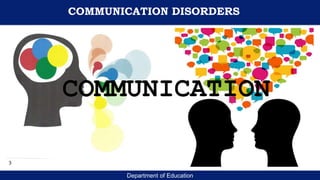
COMMUNICATION
COMMUNICATION DISORDERS
3
Department of Education
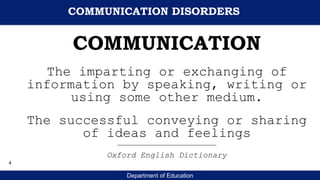
COMMUNICATION
The imparting or exchanging of
information by speaking, writing or
using some other medium.
The successful conveying or sharing
of ideas and feelings
_________________________________
Oxford English Dictionary
COMMUNICATION DISORDERS
4
Department of Education
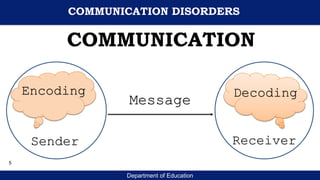
COMMUNICATION
Sender Receiver
Message
Encoding Decoding
COMMUNICATION DISORDERS
5
Department of Education
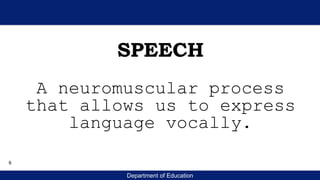
SPEECH
A neuromuscular process
that allows us to express
language vocally.
6
Department of Education
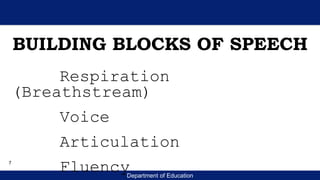
BUILDING BLOCKS OF SPEECH
Respiration
(Breathstream)
Voice
Articulation
Fluency
7
Department of Education
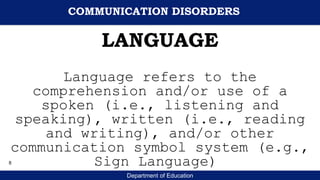
LANGUAGE
Language refers to the
comprehension and/or use of a
spoken (i.e., listening and
speaking), written (i.e., reading
and writing), and/or other
communication symbol system (e.g.,
Sign Language)
COMMUNICATION DISORDERS
8
Department of Education
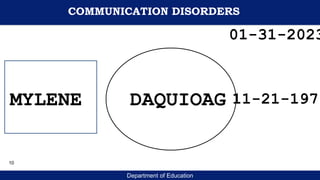
Exercise
FOLLOWING DIRECTIONS
TEST
COMMUNICATION DISORDERS
9
Department of Education
MYLENE DAQUIOAG
01-31-2023
11-21-1979
COMMUNICATION DISORDERS
10
Department of Education
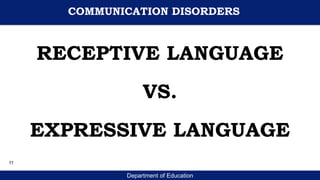
RECEPTIVE LANGUAGE
VS.
EXPRESSIVE LANGUAGE
COMMUNICATION DISORDERS
11
Department of Education
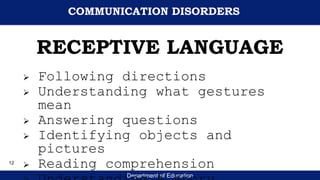
RECEPTIVE LANGUAGE
 Following directions
 Understanding what gestures
mean
 Answering questions
 Identifying objects and
pictures
 Reading comprehension
COMMUNICATION DISORDERS
12
Department of Education
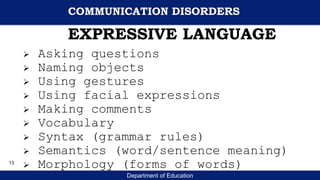
EXPRESSIVE LANGUAGE
 Asking questions
 Naming objects
 Using gestures
 Using facial expressions
 Making comments
 Vocabulary
 Syntax (grammar rules)
 Semantics (word/sentence meaning)
 Morphology (forms of words)
COMMUNICATION DISORDERS
13
Department of Education
Session Guide
COMMUNICATION DISORDERS
What is a
Communication Disorder?
14
Department of Education
15
Department of Education
15
Department of Education
16
Department of Education
16
Department of Education
Session Guide
COMMUNICATION DISORDERS
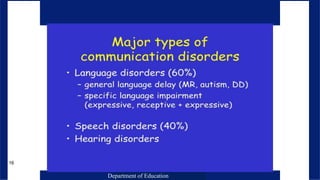
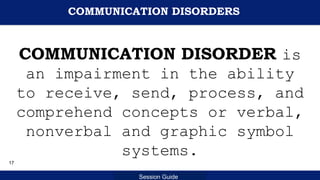
COMMUNICATION DISORDER is
an impairment in the ability
to receive, send, process, and
comprehend concepts or verbal,
nonverbal and graphic symbol
systems.
17
Department of Education
Session Guide
COMMUNICATION DISORDERS
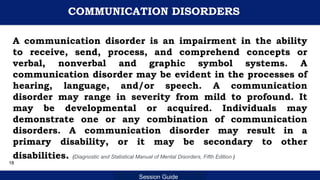
A communication disorder is an impairment in the ability
to receive, send, process, and comprehend concepts or
verbal, nonverbal and graphic symbol systems. A
communication disorder may be evident in the processes of
hearing, language, and/or speech. A communication
disorder may range in severity from mild to profound. It
may be developmental or acquired. Individuals may
demonstrate one or any combination of communication
disorders. A communication disorder may result in a
primary disability, or it may be secondary to other
disabilities. (Diagnostic and Statistical Manual of Mental Disorders, Fifth Edition )
18
Department of Education
Session Guide
COMMUNICATION DISORDERS
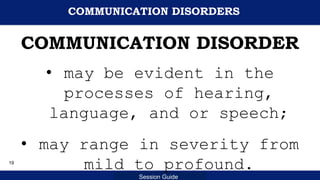
COMMUNICATION DISORDER
• may be evident in the
processes of hearing,
language, and or speech;
• may range in severity from
mild to profound.
19
Department of Education
Session Guide
COMMUNICATION DISORDERS
COMMUNICATION DISORDER
• may be developmental or
acquired;
• may result in a primary
disability or it may be
secondary to other
https://www.quotemast
er.org/communication+
disorders#&gid=1&pid
=1
20
Department of Education
Session Guide
COMMUNICATION DISORDERS
COMMUNICATION DISORDER
 significant difficulty in one
or more of formulation,
transmission, reception, and
comprehension.
 Must adversely impact school,
work, home, social, and/or
21
Department of Education
http://clipart-library.com/images/6ir5bkMKT.gif
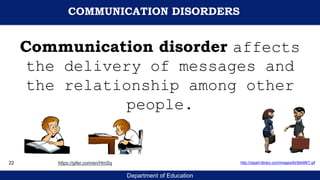
Communication disorder affects
the delivery of messages and
the relationship among other
people.
COMMUNICATION DISORDERS
https://gifer.com/en/HmSq
22
Department of Education
Session Guide
COMMUNICATION DISORDERS
What might Communication
Disorders look like in the
classroom?
23
Department of Education
Session Guide
COMMUNICATION DISORDERS
What are the characteristics
of Students with
Communication Disorders?
Department of Education
Session Guide
COMMUNICATION DISORDERS
• Difficulty following instructions.
• Being slow to respond and needing extra processing time.
• Giving incorrect or off-topic responses to questions or
appearing blank and unable to respond.
• Difficulty learning and understanding new vocabulary,
often requiring several more exposures when learning new
words.
• Difficulty remembering what you tell them.
• They may have become used to not understanding and do
not ask for help.
Understanding
Department of Education
Session Guide
COMMUNICATION DISORDERS
• Using immature or less sophisticated vocabulary.
• Using non-specific language (thing or stuff).
• Displaying word-finding difficulties: having trouble
retrieving the word they want to use.
• Having trouble explaining things that have happened to
them or telling a story.
• Being difficult to understand, or it might be difficult to
make sense of what they tell you.
• Mistakes in pronunciation of words, particularly longer or
more complex words.
Talking / Expressive Language
Department of Education
Session Guide
COMMUNICATION DISORDERS
• Displaying poor attention, presenting as not listening or daydreaming.
• Being disruptive or ‘getting into trouble’.
• Alternatively, being quiet and well behaved – so they fly under the
radar.
• Getting into conflicts with peers but having difficulty describing the
incident.
• Difficulty understanding the rules of a game or understanding jokes.
• Difficulty negotiating with peers.
• Difficulty making and maintaining friendships.
• Using an inappropriate language style with teachers.
• Struggling to remember names of teachers and peers.
• Difficulty managing and expressing emotions.
• May become frustrated, displaying verbal or physical outbursts.
Behavior and Social Skills
Department of Education
Session Guide
COMMUNICATION DISORDERS
• Difficulties with reading and writing.
• May be able to decode and read fluently but struggle with reading
comprehension (making sense of what they read).
• Completing work incorrectly or not at all or taking much longer to
complete a task than their peers.
• Watching and copying what others do as a strategy to make sense
of what is going on.
• Difficulty with language-based math problems.
• Difficulty understanding math concepts.
• Difficulty learning, remembering, and using new subject
vocabulary.
Academic Work
Department of Education
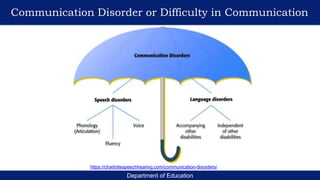
Communication Disorder or Difficulty in Communication
https://charlottespeechhearing.com/communication-disorders/
Department of Education
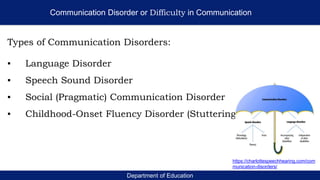
Types of Communication Disorders:
▪ Language Disorder
▪ Speech Sound Disorder
▪ Social (Pragmatic) Communication Disorder
▪ Childhood-Onset Fluency Disorder (Stuttering)
Communication Disorder or Difficulty in Communication
https://charlottespeechhearing.com/com
munication-disorders/
Department of Education
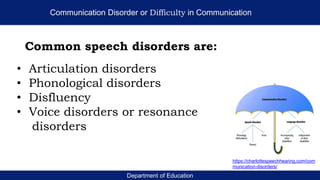
Common speech disorders are:
• Articulation disorders
• Phonological disorders
• Disfluency
• Voice disorders or resonance
disorders
Communication Disorder or Difficulty in Communication
https://charlottespeechhearing.com/com
munication-disorders/
Department of Education
Communication Disorder or Difficulty in Communication
Examples of specific speech delays
 may pronounce car as tar or gas as das;
 shop becomes sop and chair becomes
tair;
 duck as du or ball as ba (final
consonant deletion)
 duck becomes uck (initial consonant
deletion)
 spoon becomes poon, stop becomes top,
green becomes geen, nest becomes nes
Department of Education
Communication Disorder or Difficulty in Communication
Examples of specific speech delays
 yellow becomes lellow (assimilation)
 Telephone is tefone (weak syllable
deletion)
 Spaghetti becomes pasketti
(metathesis)
 Wabbit for rabbit or wamp for lamp or
lemon becomes yemon (gliding)
 Sun becomes tun, thumb becomes dum
Department of Education
Disturbances in the normal speech fluency are characterized by
one or more of the following:
▪ Sound and syllable repetitions (example: ba – baby)
▪ Sound prolongations (S>>>>sometimes)
▪ Broken words (pauses within a word) (Ta – table)
▪ Audible or silent blocking (filled or unfilled pauses in speech)
(I like to – go home)
• Circumlocutions (word substitutions to avoid a problematic
• word)
▪ Words pronounced with an excess of physical tension
▪ Monosyllabic whole-word repetitions (“I-I-I see him”)
Communication Disorder or Difficulty in Communication
Source: DSM-V
Department of Education
Communication Disorder or Difficulty in Communication
Can be caused by:
▪ Cleft lip or palate
▪ Cerebral palsy
▪ Autism Spectrum Disorder
▪ Learning Disability
▪ Intellectual Disability
▪ Or have no other caused
https://www.pngfuel.com/free-png/gdmzk
Department of Education
Session Guide
COMMUNICATION DISORDERS
How can we provide support
to the Learners with
Communication Disorders?
Department of Education
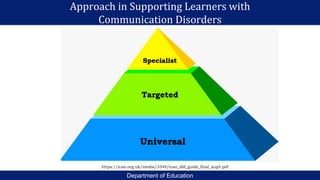
Approach in Supporting Learners with
Communication Disorders
Specialist
Targeted
Universal
https://ican.org.uk/media/3349/ican_dld_guide_final_aug4.pdf
Department of Education
Supporting Learners with Communication Disorders
Universal Support
1. Create a communication-supportive environment.
2. Adapt your language.
3. Explicitly teach vocabulary.
4. Encourage all children and young people to monitor
their own understanding and ask for help.
5. Plan opportunities to develop and use communication
skills.
Department of Education
Supporting Learners with Communication Disorders
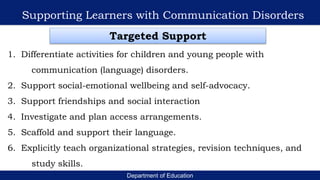
Targeted Support
1. Differentiate activities for children and young people with
communication (language) disorders.
2. Support social-emotional wellbeing and self-advocacy.
3. Support friendships and social interaction
4. Investigate and plan access arrangements.
5. Scaffold and support their language.
6. Explicitly teach organizational strategies, revision techniques, and
study skills.
Department of Education
As a TEACHER…..
Please REMEMBER
Department of Education
THANK YOU!
GOD BLESS US ALL!

DIFFICULTY-IN-COMMUNICATING.pptx

  • 1.
    1 Teaching Learners with Difficultyin Communication MYLENE P. DAQUIOAG T-III CAROLINE R. SINGSON T-III Presenters STO. NIÑO NATIONAL HIGH SCHOOL Department of Education
  • 2.
    Department of Education OBJECTIVES: Afterthe session, the participants will be able to: 1)Understand the different types of communication disorders. 2)Identify the accommodation for learners with communication disorders. 3)Apply strategies for teaching learners with difficulty in communication.
  • 3.
  • 4.
    Department of Education COMMUNICATION Theimparting or exchanging of information by speaking, writing or using some other medium. The successful conveying or sharing of ideas and feelings _________________________________ Oxford English Dictionary COMMUNICATION DISORDERS 4
  • 5.
    Department of Education COMMUNICATION SenderReceiver Message Encoding Decoding COMMUNICATION DISORDERS 5
  • 6.
    Department of Education SPEECH Aneuromuscular process that allows us to express language vocally. 6
  • 7.
    Department of Education BUILDINGBLOCKS OF SPEECH Respiration (Breathstream) Voice Articulation Fluency 7
  • 8.
    Department of Education LANGUAGE Languagerefers to the comprehension and/or use of a spoken (i.e., listening and speaking), written (i.e., reading and writing), and/or other communication symbol system (e.g., Sign Language) COMMUNICATION DISORDERS 8
  • 9.
    Department of Education Exercise FOLLOWINGDIRECTIONS TEST COMMUNICATION DISORDERS 9
  • 10.
    Department of Education MYLENEDAQUIOAG 01-31-2023 11-21-1979 COMMUNICATION DISORDERS 10
  • 11.
    Department of Education RECEPTIVELANGUAGE VS. EXPRESSIVE LANGUAGE COMMUNICATION DISORDERS 11
  • 12.
    Department of Education RECEPTIVELANGUAGE  Following directions  Understanding what gestures mean  Answering questions  Identifying objects and pictures  Reading comprehension COMMUNICATION DISORDERS 12
  • 13.
    Department of Education EXPRESSIVELANGUAGE  Asking questions  Naming objects  Using gestures  Using facial expressions  Making comments  Vocabulary  Syntax (grammar rules)  Semantics (word/sentence meaning)  Morphology (forms of words) COMMUNICATION DISORDERS 13
  • 14.
    Department of Education SessionGuide COMMUNICATION DISORDERS What is a Communication Disorder? 14
  • 15.
  • 16.
  • 17.
    Department of Education SessionGuide COMMUNICATION DISORDERS COMMUNICATION DISORDER is an impairment in the ability to receive, send, process, and comprehend concepts or verbal, nonverbal and graphic symbol systems. 17
  • 18.
    Department of Education SessionGuide COMMUNICATION DISORDERS A communication disorder is an impairment in the ability to receive, send, process, and comprehend concepts or verbal, nonverbal and graphic symbol systems. A communication disorder may be evident in the processes of hearing, language, and/or speech. A communication disorder may range in severity from mild to profound. It may be developmental or acquired. Individuals may demonstrate one or any combination of communication disorders. A communication disorder may result in a primary disability, or it may be secondary to other disabilities. (Diagnostic and Statistical Manual of Mental Disorders, Fifth Edition ) 18
  • 19.
    Department of Education SessionGuide COMMUNICATION DISORDERS COMMUNICATION DISORDER • may be evident in the processes of hearing, language, and or speech; • may range in severity from mild to profound. 19
  • 20.
    Department of Education SessionGuide COMMUNICATION DISORDERS COMMUNICATION DISORDER • may be developmental or acquired; • may result in a primary disability or it may be secondary to other https://www.quotemast er.org/communication+ disorders#&gid=1&pid =1 20
  • 21.
    Department of Education SessionGuide COMMUNICATION DISORDERS COMMUNICATION DISORDER  significant difficulty in one or more of formulation, transmission, reception, and comprehension.  Must adversely impact school, work, home, social, and/or 21
  • 22.
    Department of Education http://clipart-library.com/images/6ir5bkMKT.gif Communicationdisorder affects the delivery of messages and the relationship among other people. COMMUNICATION DISORDERS https://gifer.com/en/HmSq 22
  • 23.
    Department of Education SessionGuide COMMUNICATION DISORDERS What might Communication Disorders look like in the classroom? 23
  • 24.
    Department of Education SessionGuide COMMUNICATION DISORDERS What are the characteristics of Students with Communication Disorders?
  • 25.
    Department of Education SessionGuide COMMUNICATION DISORDERS • Difficulty following instructions. • Being slow to respond and needing extra processing time. • Giving incorrect or off-topic responses to questions or appearing blank and unable to respond. • Difficulty learning and understanding new vocabulary, often requiring several more exposures when learning new words. • Difficulty remembering what you tell them. • They may have become used to not understanding and do not ask for help. Understanding
  • 26.
    Department of Education SessionGuide COMMUNICATION DISORDERS • Using immature or less sophisticated vocabulary. • Using non-specific language (thing or stuff). • Displaying word-finding difficulties: having trouble retrieving the word they want to use. • Having trouble explaining things that have happened to them or telling a story. • Being difficult to understand, or it might be difficult to make sense of what they tell you. • Mistakes in pronunciation of words, particularly longer or more complex words. Talking / Expressive Language
  • 27.
    Department of Education SessionGuide COMMUNICATION DISORDERS • Displaying poor attention, presenting as not listening or daydreaming. • Being disruptive or ‘getting into trouble’. • Alternatively, being quiet and well behaved – so they fly under the radar. • Getting into conflicts with peers but having difficulty describing the incident. • Difficulty understanding the rules of a game or understanding jokes. • Difficulty negotiating with peers. • Difficulty making and maintaining friendships. • Using an inappropriate language style with teachers. • Struggling to remember names of teachers and peers. • Difficulty managing and expressing emotions. • May become frustrated, displaying verbal or physical outbursts. Behavior and Social Skills
  • 28.
    Department of Education SessionGuide COMMUNICATION DISORDERS • Difficulties with reading and writing. • May be able to decode and read fluently but struggle with reading comprehension (making sense of what they read). • Completing work incorrectly or not at all or taking much longer to complete a task than their peers. • Watching and copying what others do as a strategy to make sense of what is going on. • Difficulty with language-based math problems. • Difficulty understanding math concepts. • Difficulty learning, remembering, and using new subject vocabulary. Academic Work
  • 29.
    Department of Education CommunicationDisorder or Difficulty in Communication https://charlottespeechhearing.com/communication-disorders/
  • 30.
    Department of Education Typesof Communication Disorders: ▪ Language Disorder ▪ Speech Sound Disorder ▪ Social (Pragmatic) Communication Disorder ▪ Childhood-Onset Fluency Disorder (Stuttering) Communication Disorder or Difficulty in Communication https://charlottespeechhearing.com/com munication-disorders/
  • 31.
    Department of Education Commonspeech disorders are: • Articulation disorders • Phonological disorders • Disfluency • Voice disorders or resonance disorders Communication Disorder or Difficulty in Communication https://charlottespeechhearing.com/com munication-disorders/
  • 32.
    Department of Education CommunicationDisorder or Difficulty in Communication Examples of specific speech delays  may pronounce car as tar or gas as das;  shop becomes sop and chair becomes tair;  duck as du or ball as ba (final consonant deletion)  duck becomes uck (initial consonant deletion)  spoon becomes poon, stop becomes top, green becomes geen, nest becomes nes
  • 33.
    Department of Education CommunicationDisorder or Difficulty in Communication Examples of specific speech delays  yellow becomes lellow (assimilation)  Telephone is tefone (weak syllable deletion)  Spaghetti becomes pasketti (metathesis)  Wabbit for rabbit or wamp for lamp or lemon becomes yemon (gliding)  Sun becomes tun, thumb becomes dum
  • 34.
    Department of Education Disturbancesin the normal speech fluency are characterized by one or more of the following: ▪ Sound and syllable repetitions (example: ba – baby) ▪ Sound prolongations (S>>>>sometimes) ▪ Broken words (pauses within a word) (Ta – table) ▪ Audible or silent blocking (filled or unfilled pauses in speech) (I like to – go home) • Circumlocutions (word substitutions to avoid a problematic • word) ▪ Words pronounced with an excess of physical tension ▪ Monosyllabic whole-word repetitions (“I-I-I see him”) Communication Disorder or Difficulty in Communication Source: DSM-V
  • 35.
    Department of Education CommunicationDisorder or Difficulty in Communication Can be caused by: ▪ Cleft lip or palate ▪ Cerebral palsy ▪ Autism Spectrum Disorder ▪ Learning Disability ▪ Intellectual Disability ▪ Or have no other caused https://www.pngfuel.com/free-png/gdmzk
  • 36.
    Department of Education SessionGuide COMMUNICATION DISORDERS How can we provide support to the Learners with Communication Disorders?
  • 37.
    Department of Education Approachin Supporting Learners with Communication Disorders Specialist Targeted Universal https://ican.org.uk/media/3349/ican_dld_guide_final_aug4.pdf
  • 38.
    Department of Education SupportingLearners with Communication Disorders Universal Support 1. Create a communication-supportive environment. 2. Adapt your language. 3. Explicitly teach vocabulary. 4. Encourage all children and young people to monitor their own understanding and ask for help. 5. Plan opportunities to develop and use communication skills.
  • 39.
    Department of Education SupportingLearners with Communication Disorders Targeted Support 1. Differentiate activities for children and young people with communication (language) disorders. 2. Support social-emotional wellbeing and self-advocacy. 3. Support friendships and social interaction 4. Investigate and plan access arrangements. 5. Scaffold and support their language. 6. Explicitly teach organizational strategies, revision techniques, and study skills.
  • 40.
    Department of Education Asa TEACHER….. Please REMEMBER
  • 41.
  • 42.
  • 43.
    Department of Education THANKYOU! GOD BLESS US ALL!