Grievance Management
What is a Grievance
• A workplace violation
• A dispute between the union or a unit
member and management
Is it a Gripe or A Grievance
• Grounds for a grievance
– The contract
– The Law & Education Codes
– District Rules and policies
– Past Practices
Why do grievances arise?
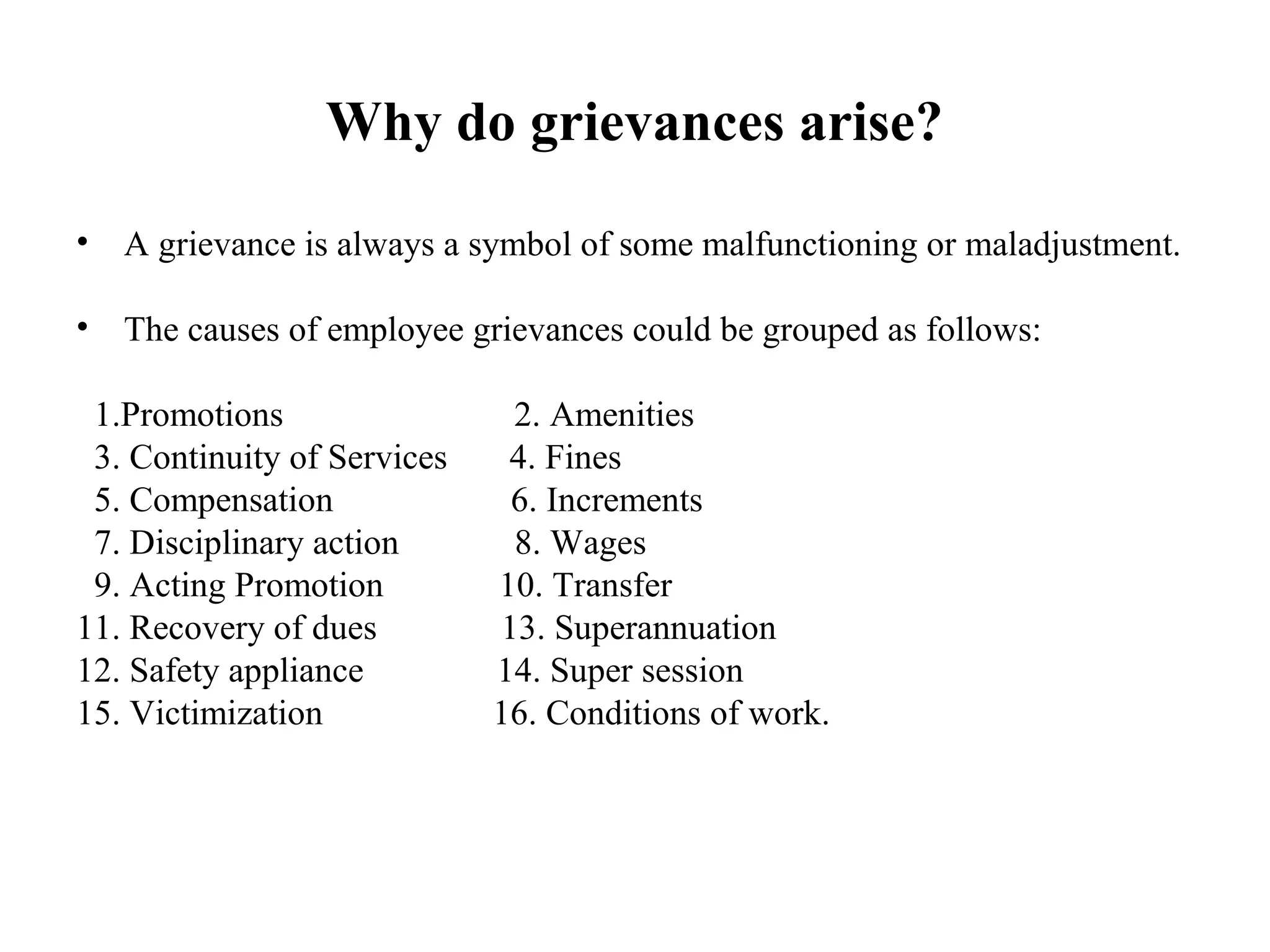
• A grievance is always a symbol of some malfunctioning or maladjustment.
• The causes of employee grievances could be grouped as follows:
1.Promotions 2. Amenities
3. Continuity of Services 4. Fines
5. Compensation 6. Increments
7. Disciplinary action 8. Wages
9. Acting Promotion 10. Transfer
11. Recovery of dues 13. Superannuation
12. Safety appliance 14. Super session
15. Victimization 16. Conditions of work.
Guidelines for writing Grievances
• The Situation
– Who, what, when & where
• The Contention
– Why is it grievable
• The Remedy
– What is needed to remedy the situation
Grievance Levels
Informal
• An initial attempt to solve the problem at
the lowest level.
• Usually consists of an informal meeting with
the grievant,steward and management.
Grievance Levels
Formal
• Usually steps 1 thru 4 (depending on
contract).
• Must be in writing.
• Includes through the Board level.
Characteristics of Grievances
 Grievances arise out of the perceived injustice or unfair
treatment felt by the aggrieved employee.
It is the state or feeling of discontent or dissatisfaction
about any aspect of an organization.
The cause of a grievance may be real or imaginary, serious
or inconsequential, genuine or fake, legitimate or
irrational.
A Grievance may be voiced or unvoiced. But it should be
expressed in some form, normally in written form.
It must arise only out of the job of the employee in the
company and not out of family or personal issues.
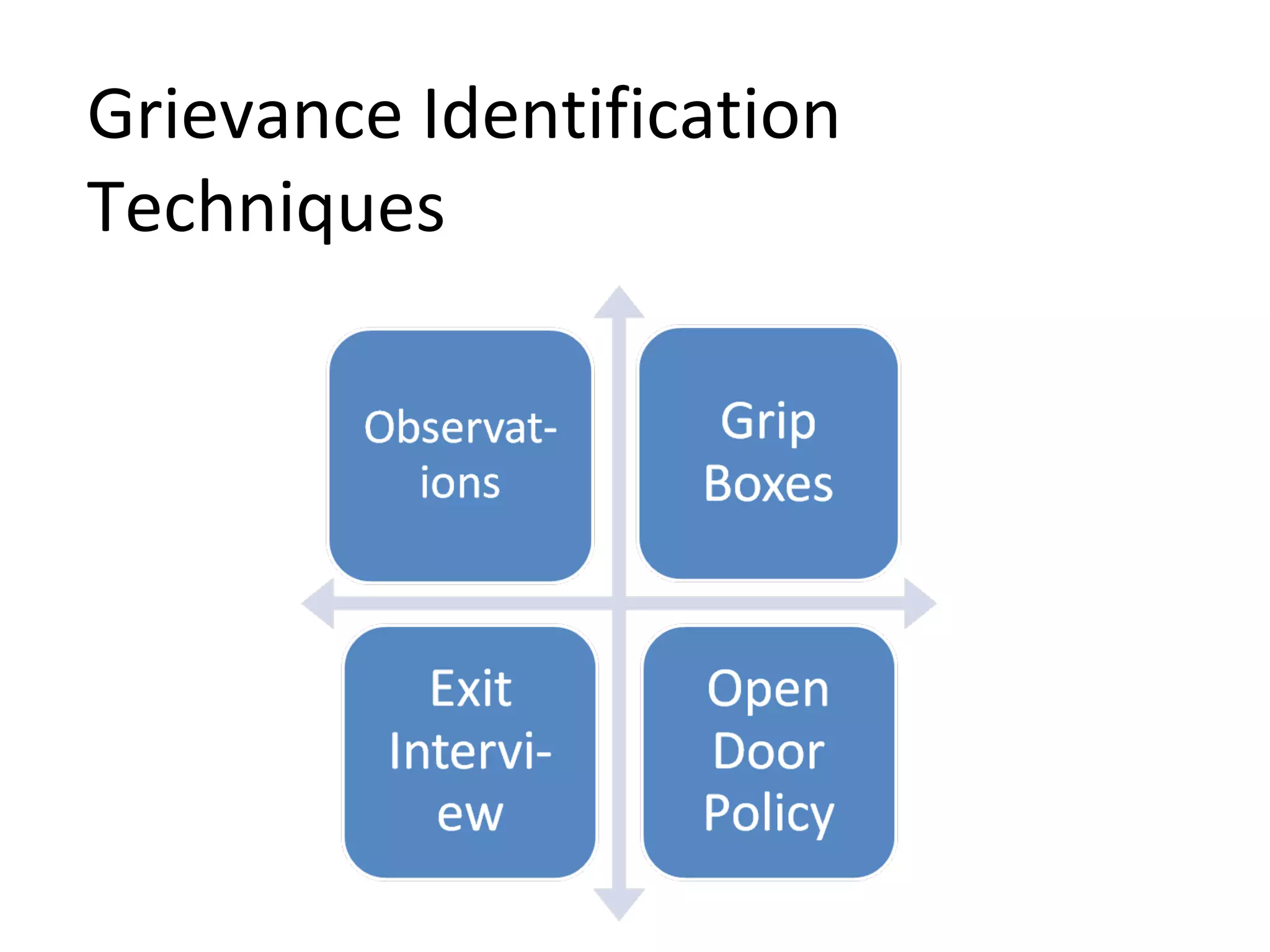
Grievance Identification
Techniques
1. OBSERVATION
• Knowledge of human behavior is requisite
quality of good manager. From the changed
behavior of any employee , he should snuff
the causes of grievances, without its
knowledge to the employee.
2. GRIP BOXES
• The suggestion boxes, for instance are
placed at easily accessible spots to most
employees in the organization. The
employees can file anonymous complaints
about their dissatisfaction in these boxes.
• 3. OPEN DOOR POLICY
• Most of the organizations still don’t practice
this but open door policy demands that the
employees, even at the lowest rank, should
have easy access to the Chief Executive to get
his grievances redressed.
•
• 4. EXIT INTERVIEW
• These interviews are conducted to know the
reasons for leaving the job. Properly conducted
exit interviews can provide significant
information about the strengths and
weaknesses of the organization and can pave
way for further improvements.
Directions help in handling a grievance
1. Receive and define the nature of the
dissatisfaction
2. Get the facts
3. Analyze and divide
4. Apply the answer
5. Follow up
Errors in processing of Grievance
1. Stopping too soon in the search of facts
2. Expressing a management opinion prior to the time when all
pertinent facts have been discovered
3. Failing to maintain proper records
4. Resorting to executive fiat or orders instead of discussion
and conference to change minds
5. Setting the wrong grievance a mistake which may in turn produce a second
new grievance. Follow up is the step in the procedure that tells us when a
mistake in handling has been made.
Principles of Grievance handling
• Principles suggested by the Indian Institute of Personnel Management for
addressing the grievance are as follows:
a) A grievance should be dealt within the limits of the first line supervisor.
b) The appellate authority should be made clear to the employee so that if he
cannot get satisfaction from his immediate supervisor, he should know the next
step.
c) The grievance should be dealt with speedily.
d) In establishing a grievance procedure, if the grievance is against an instruction
given by a superior in the interest of order and discipline, the instructions must
be carried out first and then only employee can register his protest
Grievance Machinery
• Usually thought of in connection with a company that
deals with a labour union.
• Whether unionized or not, should have established and
known methods of processing grievances.
• Representatives from each department/shift can constitute
a new machinery.
• Agreed list of names from Union as per any existing
agreement.
• A satisfactorily running Works Committee member shall
act as the departmental representative
Grievance Handling Procedure
Grievance procedure vary
from industry to industry
and
from trade union to trade union
because of the
variations in the size of organizations,
trade union strength,
the management philosophy,
the company traditions,
industrial practices
and
in the cost factor.
Grievance Handling
Procedure
• Initial step
• Intermediate step
• Final Company union step
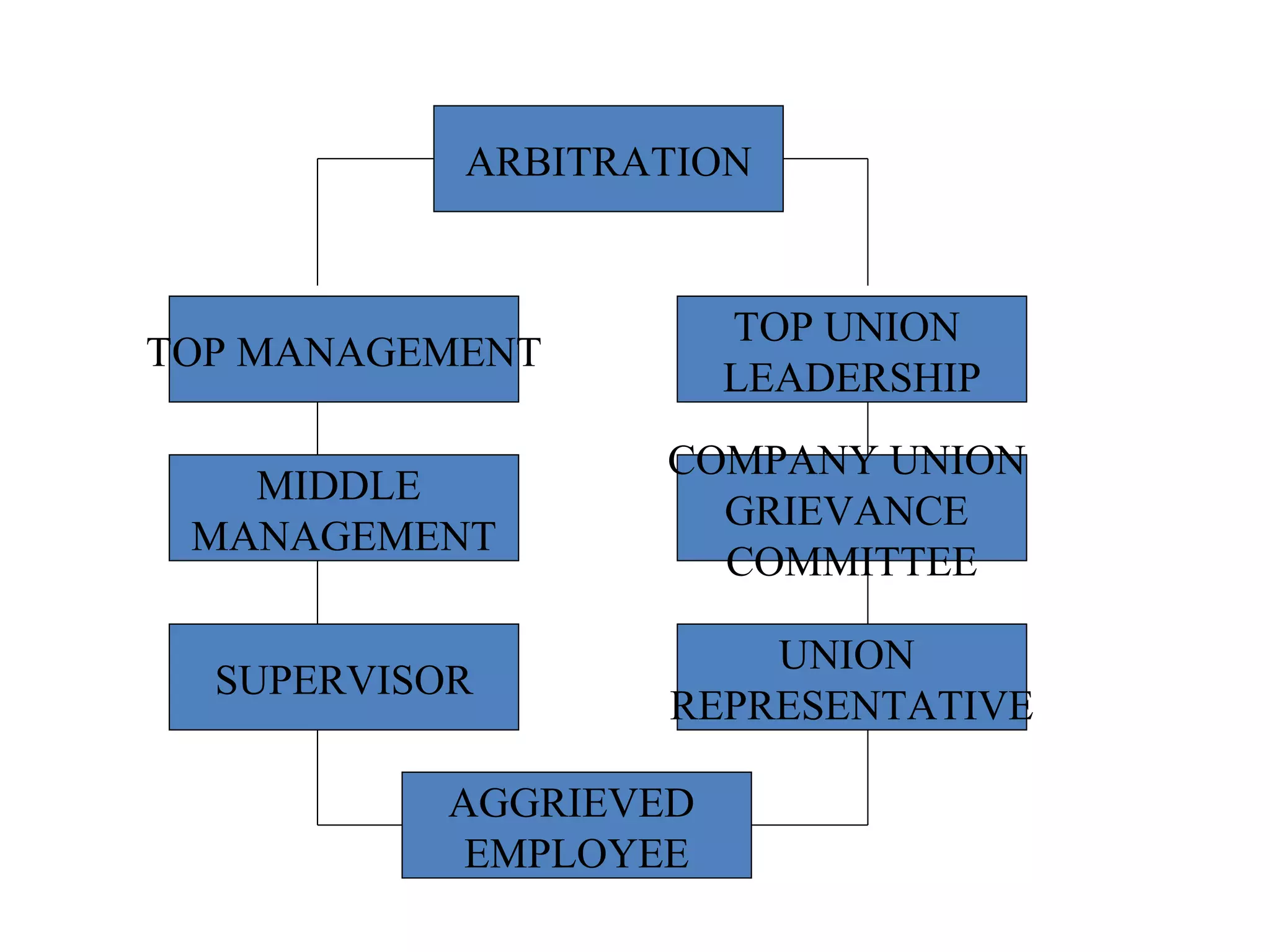
ARBITRATION
AGGRIEVED
EMPLOYEE
TOP UNION
LEADERSHIP
COMPANY UNION
GRIEVANCE
COMMITTEE
TOP MANAGEMENT
MIDDLE
MANAGEMENT
UNION
REPRESENTATIVE
SUPERVISOR
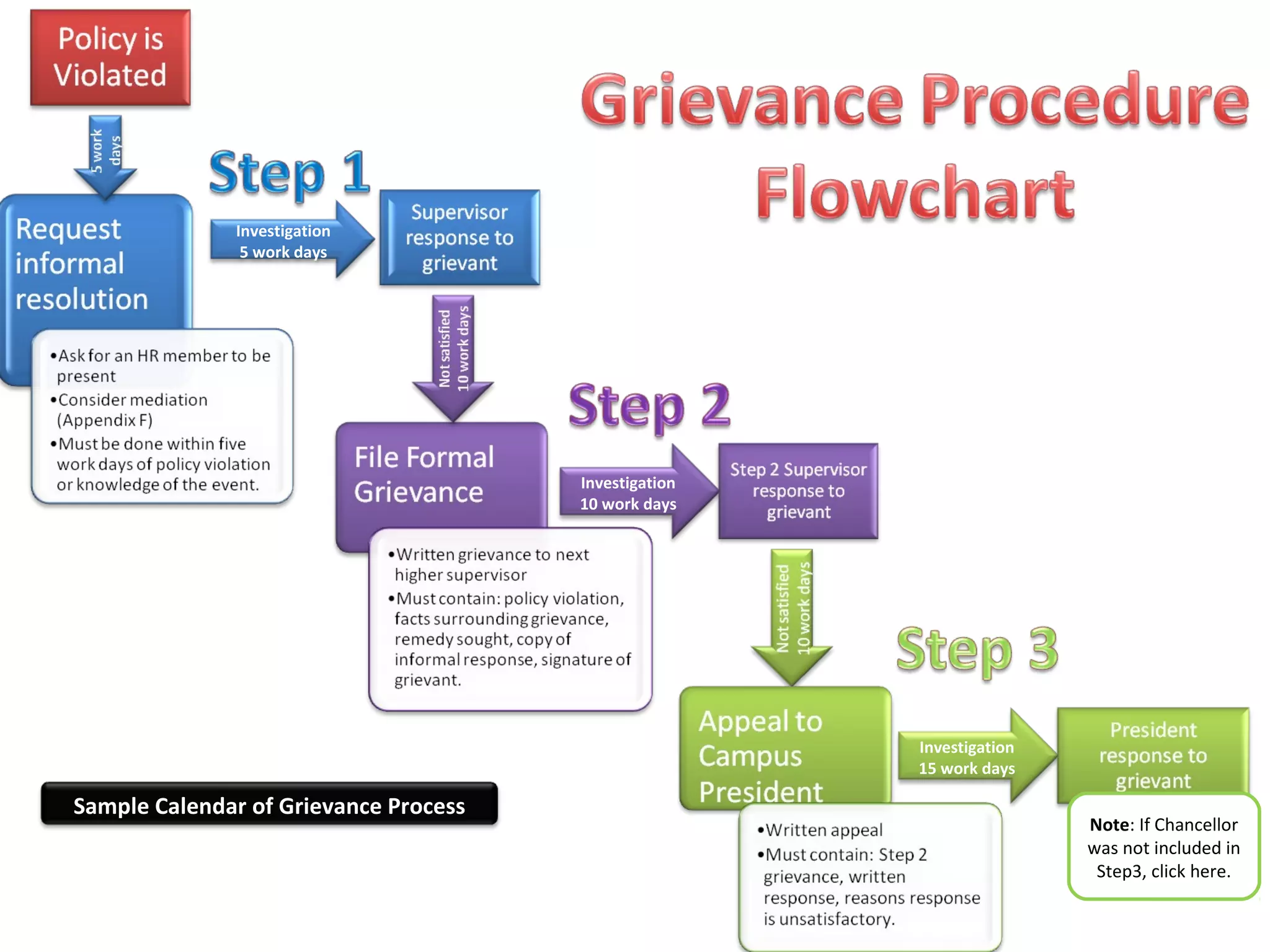
Investigation
5 work days
Investigation
10 work days
Investigation
15 work days
Sample Calendar of Grievance Process
Note: If Chancellor
was not included in
Step3, click here.
Guidelines for Handling Grievances
• DO :-
 Investigate and handle each case very promptly.
 Talk with the employee, give the person a full hearing.
 Require the union to identify specific contractual provisions
allegedly violated.
 Comply with the contractual time limits for handling the
grievance.
 Visit the work area of the grievance.
 Determine whether there were any witnesses.
 Examine the grievant personal record.
 Fully examine prior grievance records.
 Hold your grievance discussions privately.
 Fully inform your own superiors.
• DON’T :-
 Discuss the case with the union steward alone.
 Hold back the remedy if the company is wrong.
 Admit to the binding effect of a past practice.
 Relinquish (to give up) to the union your rights as a
manager.
 Settle grievances based on what is fair. Instead,
stick to the labor agreement.
 Bargain over items now covered by the contract.
 Give long written grievance answers.
 Trade a grievance settlement for a grievance
withdrawal.
 Deny grievances because of management
pressures.
 Agree to informal amendments in the contract.
Benefits
 Enables the management to know the pulse of
its employees.
 Provides a channel to the aggrieved to express
their grievances.
 Provides clues about the behavior and attitude
of the managers and supervisors towards their
subordinates.
 Gives an assurance to the employees about the
existence of a mechanism for the prompt
redressal of their grievance.
 Keep up the morale of the employees.
Concept of Arbitration
• The union can temporarily or permanently
drop the issue.
• The union can call a strike if the contract
permits.
• The case may be submitted to an impartial
arbitrator.
Arbitrator
• Arbitration is usually handled by either a single individual or a panel of
three, consisting of a representative of labour, one of management,
and an impartial third person.
• An arbitrator is an outside third party who is brought in to settle a
dispute, and he or she has the authority to make a decision.
• The arbitrator may be hired for a particular case or may be appointed
as a permanent official for the industry or the company and the union.
• Generally, the person may be acceptable to both union and
management.
Grievance handling(jaya)upload

Grievance handling(jaya)upload

  • 1.
  • 2.
    What is aGrievance • A workplace violation • A dispute between the union or a unit member and management
  • 3.
    Is it aGripe or A Grievance • Grounds for a grievance – The contract – The Law & Education Codes – District Rules and policies – Past Practices
  • 4.
    Why do grievancesarise? • A grievance is always a symbol of some malfunctioning or maladjustment. • The causes of employee grievances could be grouped as follows: 1.Promotions 2. Amenities 3. Continuity of Services 4. Fines 5. Compensation 6. Increments 7. Disciplinary action 8. Wages 9. Acting Promotion 10. Transfer 11. Recovery of dues 13. Superannuation 12. Safety appliance 14. Super session 15. Victimization 16. Conditions of work.
  • 5.
    Guidelines for writingGrievances • The Situation – Who, what, when & where • The Contention – Why is it grievable • The Remedy – What is needed to remedy the situation
  • 6.
    Grievance Levels Informal • Aninitial attempt to solve the problem at the lowest level. • Usually consists of an informal meeting with the grievant,steward and management.
  • 7.
    Grievance Levels Formal • Usuallysteps 1 thru 4 (depending on contract). • Must be in writing. • Includes through the Board level.
  • 8.
    Characteristics of Grievances Grievances arise out of the perceived injustice or unfair treatment felt by the aggrieved employee. It is the state or feeling of discontent or dissatisfaction about any aspect of an organization. The cause of a grievance may be real or imaginary, serious or inconsequential, genuine or fake, legitimate or irrational. A Grievance may be voiced or unvoiced. But it should be expressed in some form, normally in written form. It must arise only out of the job of the employee in the company and not out of family or personal issues.
  • 9.
  • 10.
    1. OBSERVATION • Knowledgeof human behavior is requisite quality of good manager. From the changed behavior of any employee , he should snuff the causes of grievances, without its knowledge to the employee. 2. GRIP BOXES • The suggestion boxes, for instance are placed at easily accessible spots to most employees in the organization. The employees can file anonymous complaints about their dissatisfaction in these boxes.
  • 11.
    • 3. OPENDOOR POLICY • Most of the organizations still don’t practice this but open door policy demands that the employees, even at the lowest rank, should have easy access to the Chief Executive to get his grievances redressed. • • 4. EXIT INTERVIEW • These interviews are conducted to know the reasons for leaving the job. Properly conducted exit interviews can provide significant information about the strengths and weaknesses of the organization and can pave way for further improvements.
  • 12.
    Directions help inhandling a grievance 1. Receive and define the nature of the dissatisfaction 2. Get the facts 3. Analyze and divide 4. Apply the answer 5. Follow up
  • 13.
    Errors in processingof Grievance 1. Stopping too soon in the search of facts 2. Expressing a management opinion prior to the time when all pertinent facts have been discovered 3. Failing to maintain proper records 4. Resorting to executive fiat or orders instead of discussion and conference to change minds 5. Setting the wrong grievance a mistake which may in turn produce a second new grievance. Follow up is the step in the procedure that tells us when a mistake in handling has been made.
  • 14.
    Principles of Grievancehandling • Principles suggested by the Indian Institute of Personnel Management for addressing the grievance are as follows: a) A grievance should be dealt within the limits of the first line supervisor. b) The appellate authority should be made clear to the employee so that if he cannot get satisfaction from his immediate supervisor, he should know the next step. c) The grievance should be dealt with speedily. d) In establishing a grievance procedure, if the grievance is against an instruction given by a superior in the interest of order and discipline, the instructions must be carried out first and then only employee can register his protest
  • 15.
    Grievance Machinery • Usuallythought of in connection with a company that deals with a labour union. • Whether unionized or not, should have established and known methods of processing grievances. • Representatives from each department/shift can constitute a new machinery. • Agreed list of names from Union as per any existing agreement. • A satisfactorily running Works Committee member shall act as the departmental representative
  • 16.
    Grievance Handling Procedure Grievanceprocedure vary from industry to industry and from trade union to trade union because of the variations in the size of organizations, trade union strength, the management philosophy, the company traditions, industrial practices and in the cost factor.
  • 17.
    Grievance Handling Procedure • Initialstep • Intermediate step • Final Company union step
  • 18.
    ARBITRATION AGGRIEVED EMPLOYEE TOP UNION LEADERSHIP COMPANY UNION GRIEVANCE COMMITTEE TOPMANAGEMENT MIDDLE MANAGEMENT UNION REPRESENTATIVE SUPERVISOR
  • 19.
    Investigation 5 work days Investigation 10work days Investigation 15 work days Sample Calendar of Grievance Process Note: If Chancellor was not included in Step3, click here.
  • 20.
    Guidelines for HandlingGrievances • DO :-  Investigate and handle each case very promptly.  Talk with the employee, give the person a full hearing.  Require the union to identify specific contractual provisions allegedly violated.  Comply with the contractual time limits for handling the grievance.  Visit the work area of the grievance.  Determine whether there were any witnesses.  Examine the grievant personal record.  Fully examine prior grievance records.  Hold your grievance discussions privately.  Fully inform your own superiors.
  • 21.
    • DON’T :- Discuss the case with the union steward alone.  Hold back the remedy if the company is wrong.  Admit to the binding effect of a past practice.  Relinquish (to give up) to the union your rights as a manager.  Settle grievances based on what is fair. Instead, stick to the labor agreement.  Bargain over items now covered by the contract.  Give long written grievance answers.  Trade a grievance settlement for a grievance withdrawal.  Deny grievances because of management pressures.  Agree to informal amendments in the contract.
  • 22.
    Benefits  Enables themanagement to know the pulse of its employees.  Provides a channel to the aggrieved to express their grievances.  Provides clues about the behavior and attitude of the managers and supervisors towards their subordinates.  Gives an assurance to the employees about the existence of a mechanism for the prompt redressal of their grievance.  Keep up the morale of the employees.
  • 23.
    Concept of Arbitration •The union can temporarily or permanently drop the issue. • The union can call a strike if the contract permits. • The case may be submitted to an impartial arbitrator.
  • 24.
    Arbitrator • Arbitration isusually handled by either a single individual or a panel of three, consisting of a representative of labour, one of management, and an impartial third person. • An arbitrator is an outside third party who is brought in to settle a dispute, and he or she has the authority to make a decision. • The arbitrator may be hired for a particular case or may be appointed as a permanent official for the industry or the company and the union. • Generally, the person may be acceptable to both union and management.