Communication M Zeeshan Khan
Communication COMMUNICATION IS ONE OF THE MOST IMPORTANT SKILLS ANYONE CAN HAVE, IN BUSINESS AND IN LIFE. AS INDIVIDUALS AND AS A SPECIES, WE WILL BE HAPPIER AND MORE PRODUCTIVE IF WE CAN IMPROVE OUR ABILITY TO COMMUNICATE.
Communication Transference of meaning among a group But it is merely not imparting meaning, it must also be understood.
Communication Research indicates that poor communication is the most frequently cited source of interpersonal conflicts. Because individuals spend 70% of their waking hours communicating---writing, reading , speaking or listening.
Functions of Communication It serves four major functions within a group or organization. Control Motivation Emotional Expression Information
Functions of Communication Control:- It acts to control member behavior in several ways . Organizations have authority hierarchies and formal guidelines that employees are required to follow. It has a controlling function when they are required to  Communicate job related grievances. To follow job description To comply with company policy .
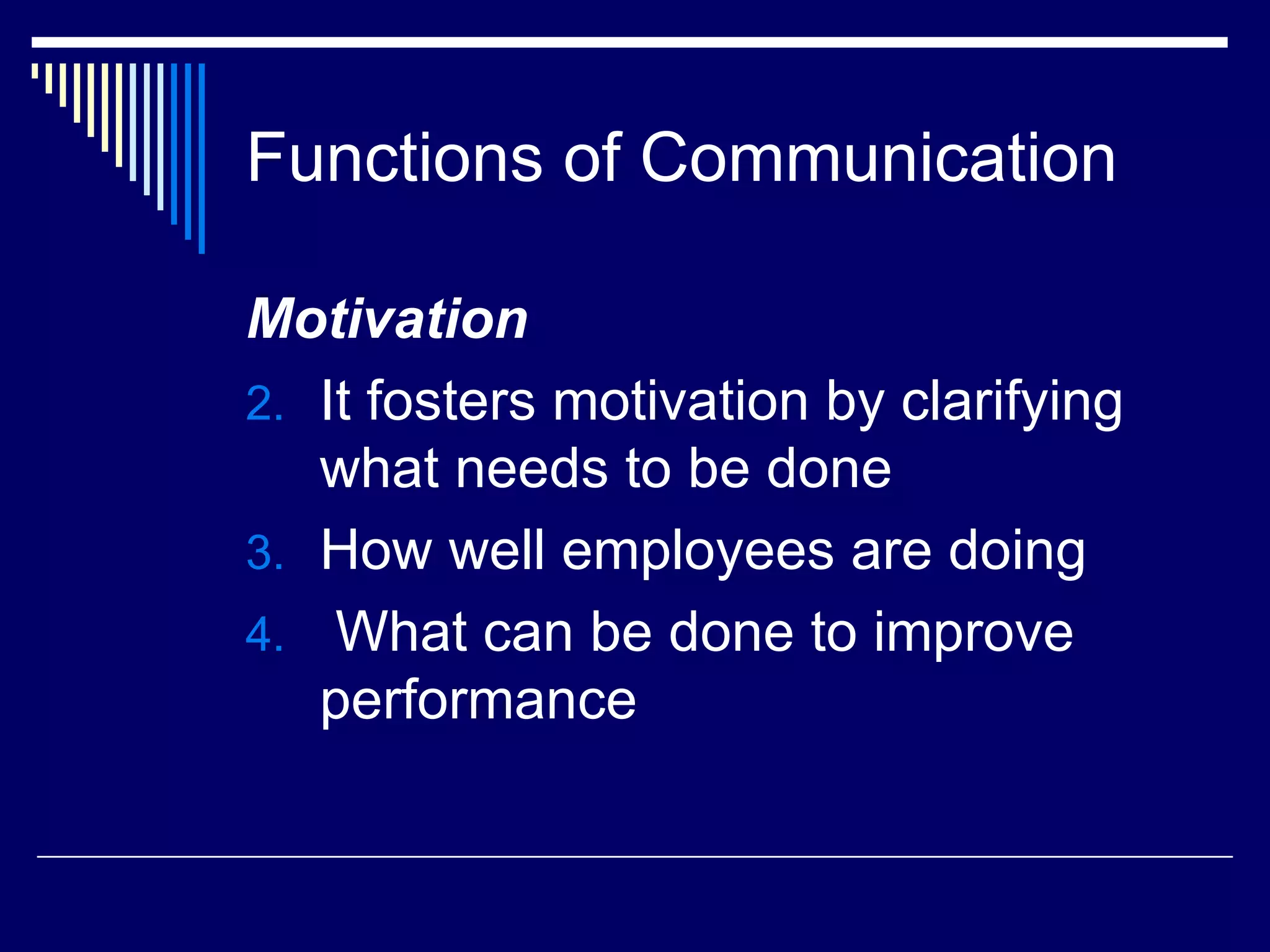
Functions of Communication Motivation It fosters motivation by clarifying what needs to be done How well employees are doing  What can be done to improve performance
Functions of Communication Emotional Expression   For many employees the work group[ is a primary source of social interaction . They share their feelings of frustration and satisfaction with each other
Functions of Communication Information Primary role relating to decision making by transmitting data and evaluating different choices.
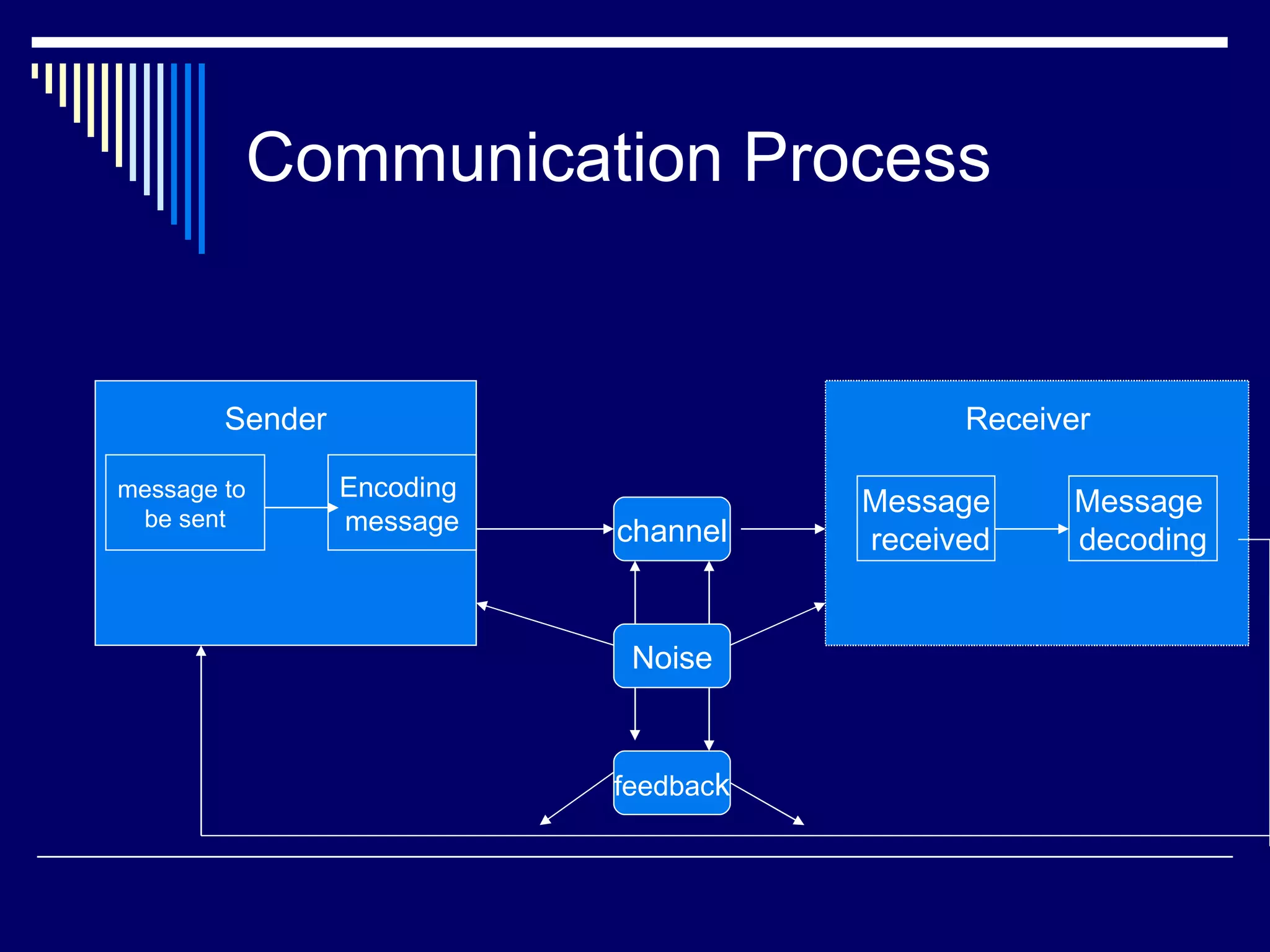
Communication Process channel Noise feedbac k message to  be sent Encoding  message Message received Message  decoding Sender Receiver
Direction of Communication Communication can flow vertically or laterally. Vertical is further divided into  Upward communication  Downward communication
Direction of Communication Downward  Communication that flows from one level of a group or organization to a lower level. it is used to  Assign goals  provide job instructions Informing about policies and procedures Point out problems that need attention Offer feedback about performance
Direction of Communication Upward Communication It flows to a higher level in the group or organization It is used to provide feedback to higher ups Inform them of progress towards goals Relay current problems
Direction of Communication Lateral Communication When it takes place among members of the same group  or managers at same level or among any horizontally equivalent personnel. It is important to Save time Facilitate coordination
Interpersonal Communication People essentially  rely on oral ,written and nonverbal communication. Oral Communication: Speeches formal one-on-one Group discussions Informal rumor mill and grapevine
Interpersonal Communication Advantages of Oral Communication are  Speed  Feedback  The major disadvantage of oral communication surfaces in organization whenever the message has to be passed through a number of people
Interpersonal Communication Written Communication  -- any communication transmitted via written words or symbols It includes  Memos Letters  Fax transmissions Electronic mail Instant messaging  Organizational periodicals , etc.
Interpersonal Communication Non Verbal Communication When we give a message to anyone we impart non verbal message as well. Such as  Lift an eyebrow for disbelief Rub your nose for puzzlement Shrug shoulders for indifference Slap our forehead for forgetfulness Tap our fingers for impatience
Organizational communication Formal organizational networks can be very complicated  as they may include hundreds of people and few hierarchical levels. To simplify these are condensed into three common small groups of five people. These are chain , wheel and all- channel
Organizational communication Chain  Wheel  All channel
Organizational communication Grapevine It is informal Yet an important source of information It is not controlled by the management It is perceived more believable It is largely used to serve the self interests of the people within it
Organizational communication Computer aided Communication E- mail Instant messaging Intranet and extranet links Videoconferencing
Barriers to effective Communication Filtering It refers to a sender’s purposely manipulating information so it will be seen more favorably by the receiver. It happens where there are lots of vertical levels in hierarchy.
Barriers to effective Communication Selective Perception The receivers in communication process selectively see and hear based on their needs, motivations, experience , background and other personal characteristics.
Barriers to effective Communication Information Overload Individuals have a finite capacity to process data and when it exceeds our processing capacity  the result is information load. Then people tend to select out, ignore, pass over or forget information.
Barriers to effective Communication Emotions Extreme emotions like jubilation or depression are more likely to hinder effective communication
Barriers to effective Communication Language Communication apprehensions
Seven C's of communication design  Do you design your communications or do they just kind of happen? When your communication is important -- that is, when you want it to be remembered -- you need to think carefully and design it to resonate with your intended audience.
Seven C's of communication design Designing your communication is an interactive process. It begins at a high level, with good questions and  good listening ; and ends in details; constructing a presentation, document, system or user experience.
The Seven C’s The seven C's lay out a simple sequence which can help you start broadly and work your way down to specifics. 1. Context. What's going on? Do you understand the situation?  Ask good questions . You'll need a clear goal before you begin to design any communication. Ask:  who are you talking to and what do you want them to do?
The Seven C’s 2. Content. Based on your goal, define  a single question  that your communication is designed to answer. This is the best possible measure of communication effectiveness. What do you want your audience to walk away with and remember? Once you have defined your prime question, set out to answer it. What information is required? Do you have the answer already, or do you need to search it out?
The Seven C’s 3. Components. Before you build anything, break down your content into basic "building blocks" of content. Formulate the information into clusters and groups. What patterns emerge? How can you make the information more modular? Given your goal, what is the most fundamental unit of information? You can use  index cards  to break down information into modules.
The Seven C’s 4. Cuts. This is one of the hardest parts of the process and most often neglected. People's attention will quickly drift -- they expect you to get to the point.  Learn to edit .
The Seven C’s 5. Composition. Now it's time to design the way you will tell your story. Think in terms of both written and visual composition. When writing; who are your main characters? How will you set up the scene? What are the goals and conflicts that will develop? How will the story reach resolution? In visual terms; where will the reader begin? How will you lead the eye around the page? In  all  your compositional thinking; how will you engage your audience? How will you keep them engaged?  Writing it down forces you to think it through .
The Seven C’s 6. Contrast. What are the differences that matter? Use contrast to highlight them: Big vs. little; rough vs. smooth; black vs. white. When making any point, ask, "in comparison with what?" Contrast is a trigger to the brain that says "pay attention!"
The Seven C’s 7. Consistency. Unless you're highlighting differences, keep things like color, fonts, spacing and type sizes consistent to avoid distracting people. Research shows that any extraneous information will detract from people's ability to assimilate and learn.

communication

  • 1.
  • 2.
    Communication COMMUNICATION ISONE OF THE MOST IMPORTANT SKILLS ANYONE CAN HAVE, IN BUSINESS AND IN LIFE. AS INDIVIDUALS AND AS A SPECIES, WE WILL BE HAPPIER AND MORE PRODUCTIVE IF WE CAN IMPROVE OUR ABILITY TO COMMUNICATE.
  • 3.
    Communication Transference ofmeaning among a group But it is merely not imparting meaning, it must also be understood.
  • 4.
    Communication Research indicatesthat poor communication is the most frequently cited source of interpersonal conflicts. Because individuals spend 70% of their waking hours communicating---writing, reading , speaking or listening.
  • 5.
    Functions of CommunicationIt serves four major functions within a group or organization. Control Motivation Emotional Expression Information
  • 6.
    Functions of CommunicationControl:- It acts to control member behavior in several ways . Organizations have authority hierarchies and formal guidelines that employees are required to follow. It has a controlling function when they are required to Communicate job related grievances. To follow job description To comply with company policy .
  • 7.
    Functions of CommunicationMotivation It fosters motivation by clarifying what needs to be done How well employees are doing What can be done to improve performance
  • 8.
    Functions of CommunicationEmotional Expression For many employees the work group[ is a primary source of social interaction . They share their feelings of frustration and satisfaction with each other
  • 9.
    Functions of CommunicationInformation Primary role relating to decision making by transmitting data and evaluating different choices.
  • 10.
    Communication Process channelNoise feedbac k message to be sent Encoding message Message received Message decoding Sender Receiver
  • 11.
    Direction of CommunicationCommunication can flow vertically or laterally. Vertical is further divided into Upward communication Downward communication
  • 12.
    Direction of CommunicationDownward Communication that flows from one level of a group or organization to a lower level. it is used to Assign goals provide job instructions Informing about policies and procedures Point out problems that need attention Offer feedback about performance
  • 13.
    Direction of CommunicationUpward Communication It flows to a higher level in the group or organization It is used to provide feedback to higher ups Inform them of progress towards goals Relay current problems
  • 14.
    Direction of CommunicationLateral Communication When it takes place among members of the same group or managers at same level or among any horizontally equivalent personnel. It is important to Save time Facilitate coordination
  • 15.
    Interpersonal Communication Peopleessentially rely on oral ,written and nonverbal communication. Oral Communication: Speeches formal one-on-one Group discussions Informal rumor mill and grapevine
  • 16.
    Interpersonal Communication Advantagesof Oral Communication are Speed Feedback The major disadvantage of oral communication surfaces in organization whenever the message has to be passed through a number of people
  • 17.
    Interpersonal Communication WrittenCommunication -- any communication transmitted via written words or symbols It includes Memos Letters Fax transmissions Electronic mail Instant messaging Organizational periodicals , etc.
  • 18.
    Interpersonal Communication NonVerbal Communication When we give a message to anyone we impart non verbal message as well. Such as Lift an eyebrow for disbelief Rub your nose for puzzlement Shrug shoulders for indifference Slap our forehead for forgetfulness Tap our fingers for impatience
  • 19.
    Organizational communication Formalorganizational networks can be very complicated as they may include hundreds of people and few hierarchical levels. To simplify these are condensed into three common small groups of five people. These are chain , wheel and all- channel
  • 20.
  • 21.
    Organizational communication GrapevineIt is informal Yet an important source of information It is not controlled by the management It is perceived more believable It is largely used to serve the self interests of the people within it
  • 22.
    Organizational communication Computeraided Communication E- mail Instant messaging Intranet and extranet links Videoconferencing
  • 23.
    Barriers to effectiveCommunication Filtering It refers to a sender’s purposely manipulating information so it will be seen more favorably by the receiver. It happens where there are lots of vertical levels in hierarchy.
  • 24.
    Barriers to effectiveCommunication Selective Perception The receivers in communication process selectively see and hear based on their needs, motivations, experience , background and other personal characteristics.
  • 25.
    Barriers to effectiveCommunication Information Overload Individuals have a finite capacity to process data and when it exceeds our processing capacity the result is information load. Then people tend to select out, ignore, pass over or forget information.
  • 26.
    Barriers to effectiveCommunication Emotions Extreme emotions like jubilation or depression are more likely to hinder effective communication
  • 27.
    Barriers to effectiveCommunication Language Communication apprehensions
  • 28.
    Seven C's ofcommunication design Do you design your communications or do they just kind of happen? When your communication is important -- that is, when you want it to be remembered -- you need to think carefully and design it to resonate with your intended audience.
  • 29.
    Seven C's ofcommunication design Designing your communication is an interactive process. It begins at a high level, with good questions and good listening ; and ends in details; constructing a presentation, document, system or user experience.
  • 30.
    The Seven C’sThe seven C's lay out a simple sequence which can help you start broadly and work your way down to specifics. 1. Context. What's going on? Do you understand the situation? Ask good questions . You'll need a clear goal before you begin to design any communication. Ask: who are you talking to and what do you want them to do?
  • 31.
    The Seven C’s2. Content. Based on your goal, define a single question that your communication is designed to answer. This is the best possible measure of communication effectiveness. What do you want your audience to walk away with and remember? Once you have defined your prime question, set out to answer it. What information is required? Do you have the answer already, or do you need to search it out?
  • 32.
    The Seven C’s3. Components. Before you build anything, break down your content into basic "building blocks" of content. Formulate the information into clusters and groups. What patterns emerge? How can you make the information more modular? Given your goal, what is the most fundamental unit of information? You can use index cards to break down information into modules.
  • 33.
    The Seven C’s4. Cuts. This is one of the hardest parts of the process and most often neglected. People's attention will quickly drift -- they expect you to get to the point. Learn to edit .
  • 34.
    The Seven C’s5. Composition. Now it's time to design the way you will tell your story. Think in terms of both written and visual composition. When writing; who are your main characters? How will you set up the scene? What are the goals and conflicts that will develop? How will the story reach resolution? In visual terms; where will the reader begin? How will you lead the eye around the page? In all your compositional thinking; how will you engage your audience? How will you keep them engaged? Writing it down forces you to think it through .
  • 35.
    The Seven C’s6. Contrast. What are the differences that matter? Use contrast to highlight them: Big vs. little; rough vs. smooth; black vs. white. When making any point, ask, "in comparison with what?" Contrast is a trigger to the brain that says "pay attention!"
  • 36.
    The Seven C’s7. Consistency. Unless you're highlighting differences, keep things like color, fonts, spacing and type sizes consistent to avoid distracting people. Research shows that any extraneous information will detract from people's ability to assimilate and learn.