Communication Skills
Vikas Gupta
Junior Resident
Contents
• Introduction
• Communication
– Definitions
– Communication cycle
– Channels of communication
– Types of communication
• Communication skills
– Transmission skills
– Reception skills
• Communication barriers
• Importance of communication skills in public health
• Conclusion
Introduction
• I'm a great believer that any tool that enhances
communication has profound effects in terms
of how people can learn from each other, and
how they can achieve the kind of freedoms that
they're interested in.” - Bill Gates
Introduction
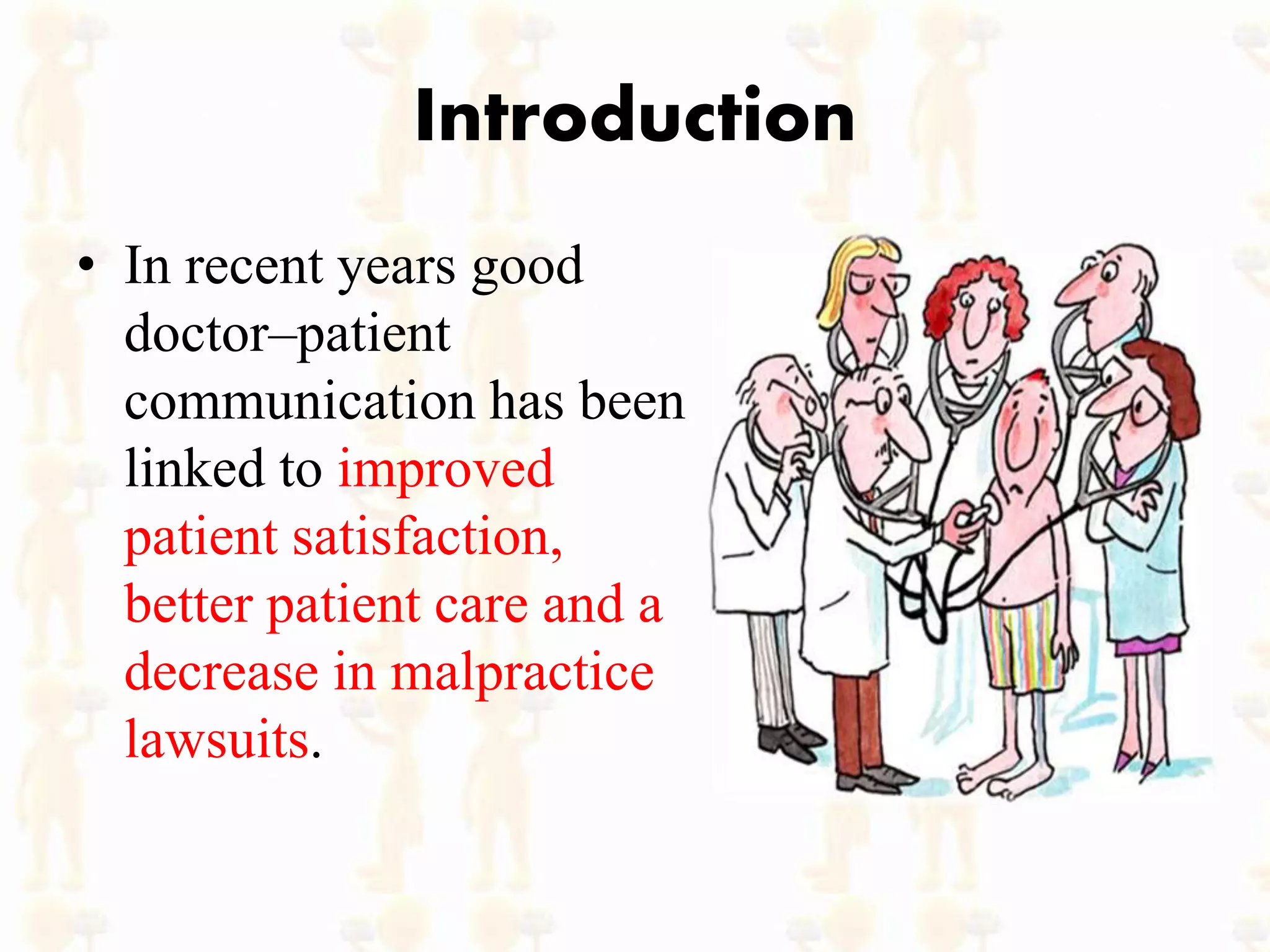
• In recent years good
doctor–patient
communication has been
linked to improved
patient satisfaction,
better patient care and a
decrease in malpractice
lawsuits.
Introduction
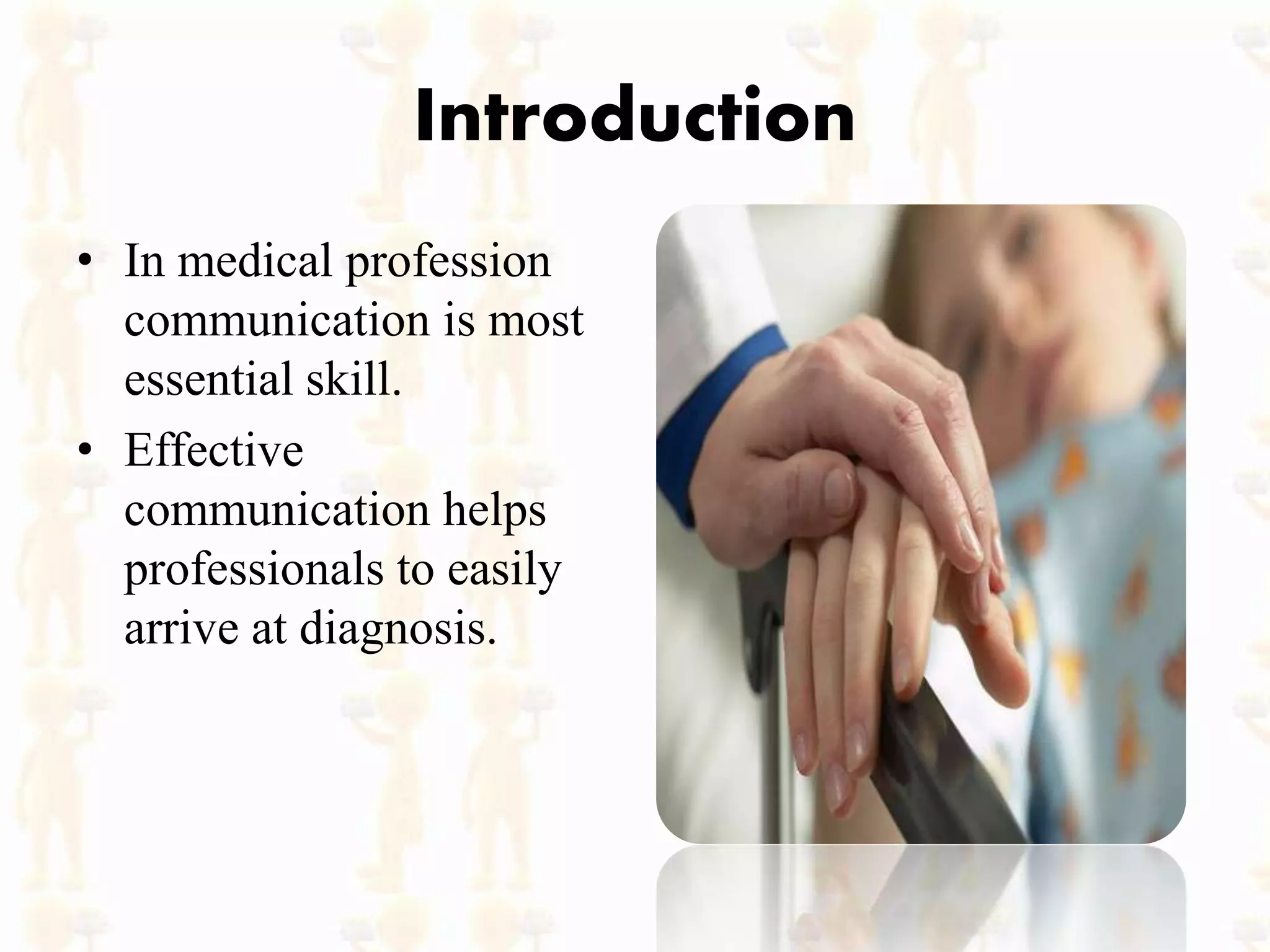
• In medical profession
communication is most
essential skill.
• Effective
communication helps
professionals to easily
arrive at diagnosis.
Introduction
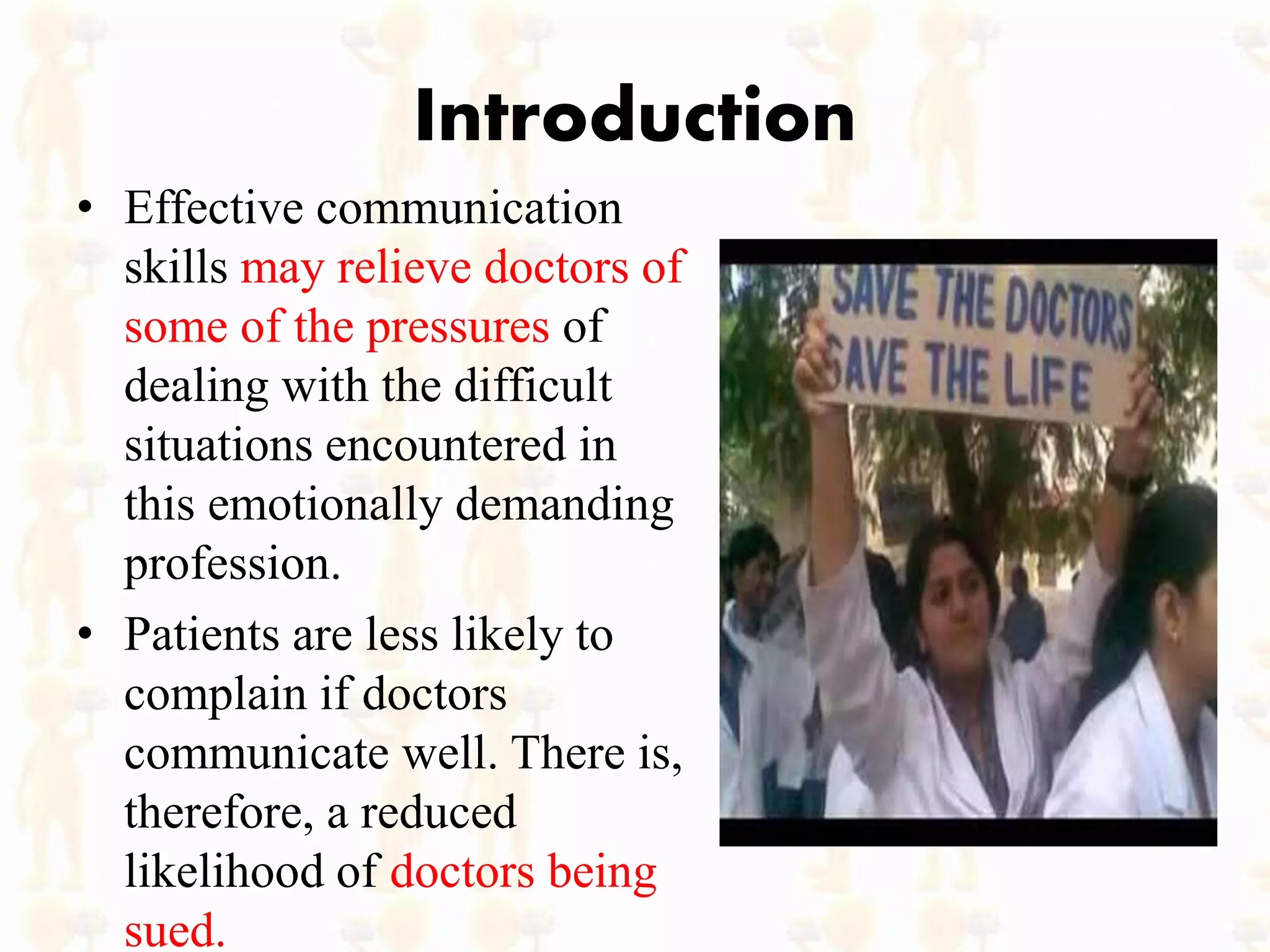
• Effective communication
skills may relieve doctors of
some of the pressures of
dealing with the difficult
situations encountered in
this emotionally demanding
profession.
• Patients are less likely to
complain if doctors
communicate well. There is,
therefore, a reduced
likelihood of doctors being
sued.
DEFINITIONS
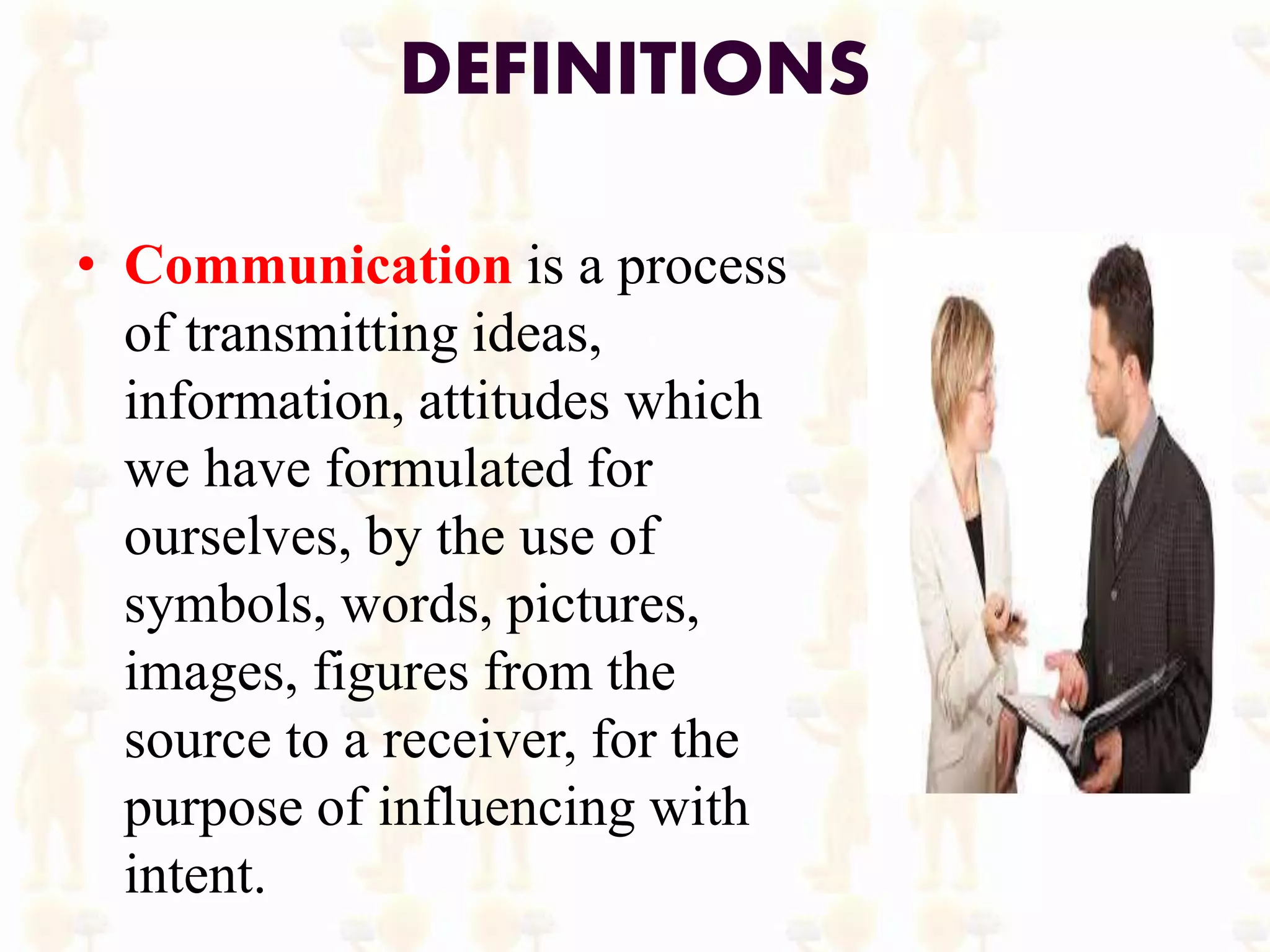
• Communication is a process
of transmitting ideas,
information, attitudes which
we have formulated for
ourselves, by the use of
symbols, words, pictures,
images, figures from the
source to a receiver, for the
purpose of influencing with
intent.
DEFINITIONS
• Health communication is the study and practice
of communicating promotional health
information, such as in public health campaigns,
health education, and between doctor and patient.
• Public health communication is the scientific
development, strategic dissemination, and critical
evaluation of relevant, accurate, accessible, and
understandable health information communicated
to and from intended audiences to advance the
health of the public.
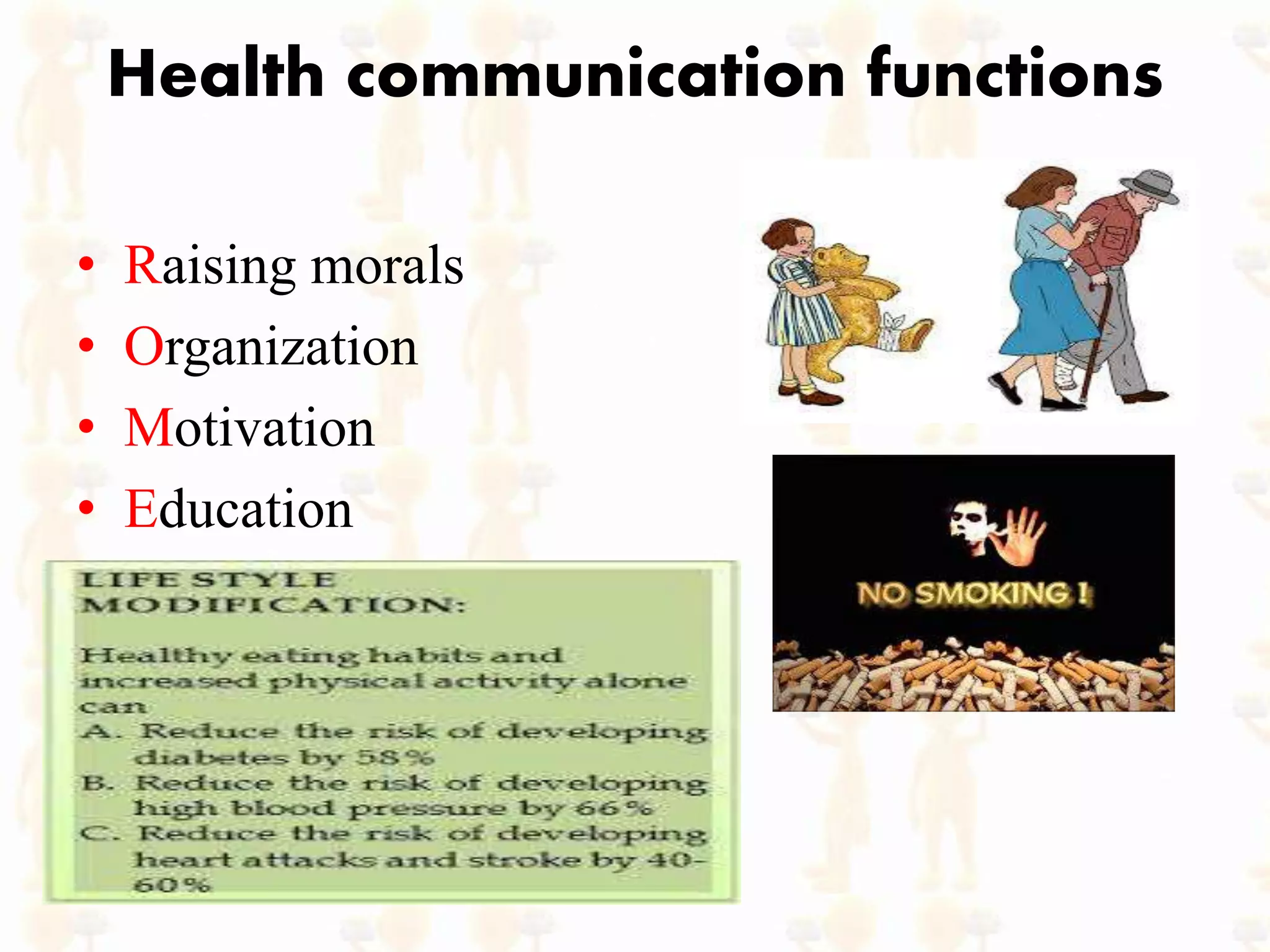
Health communication functions
• Raising morals
• Organization
• Motivation
• Education
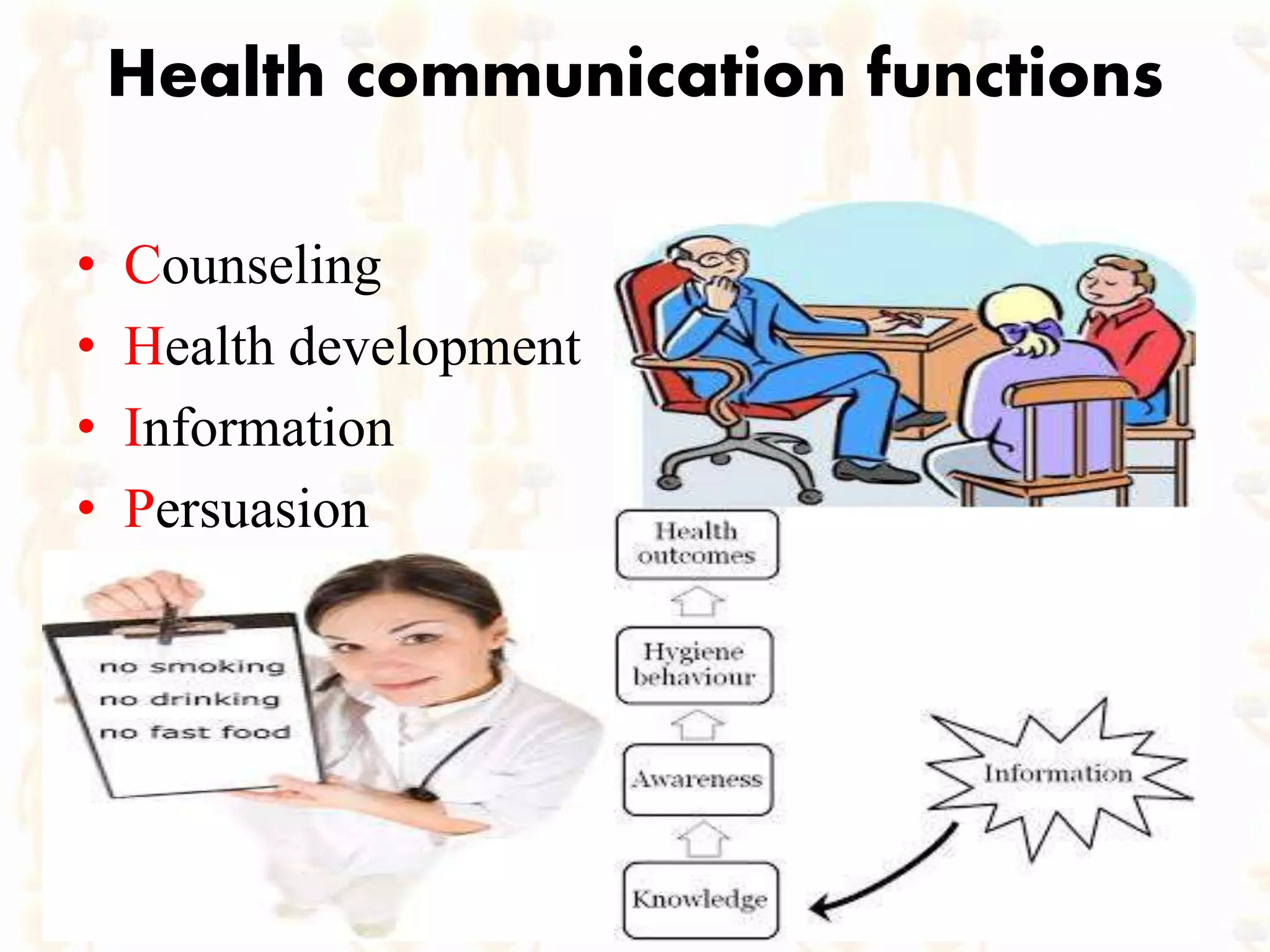
Health communication functions
• Counseling
• Health development
• Information
• Persuasion
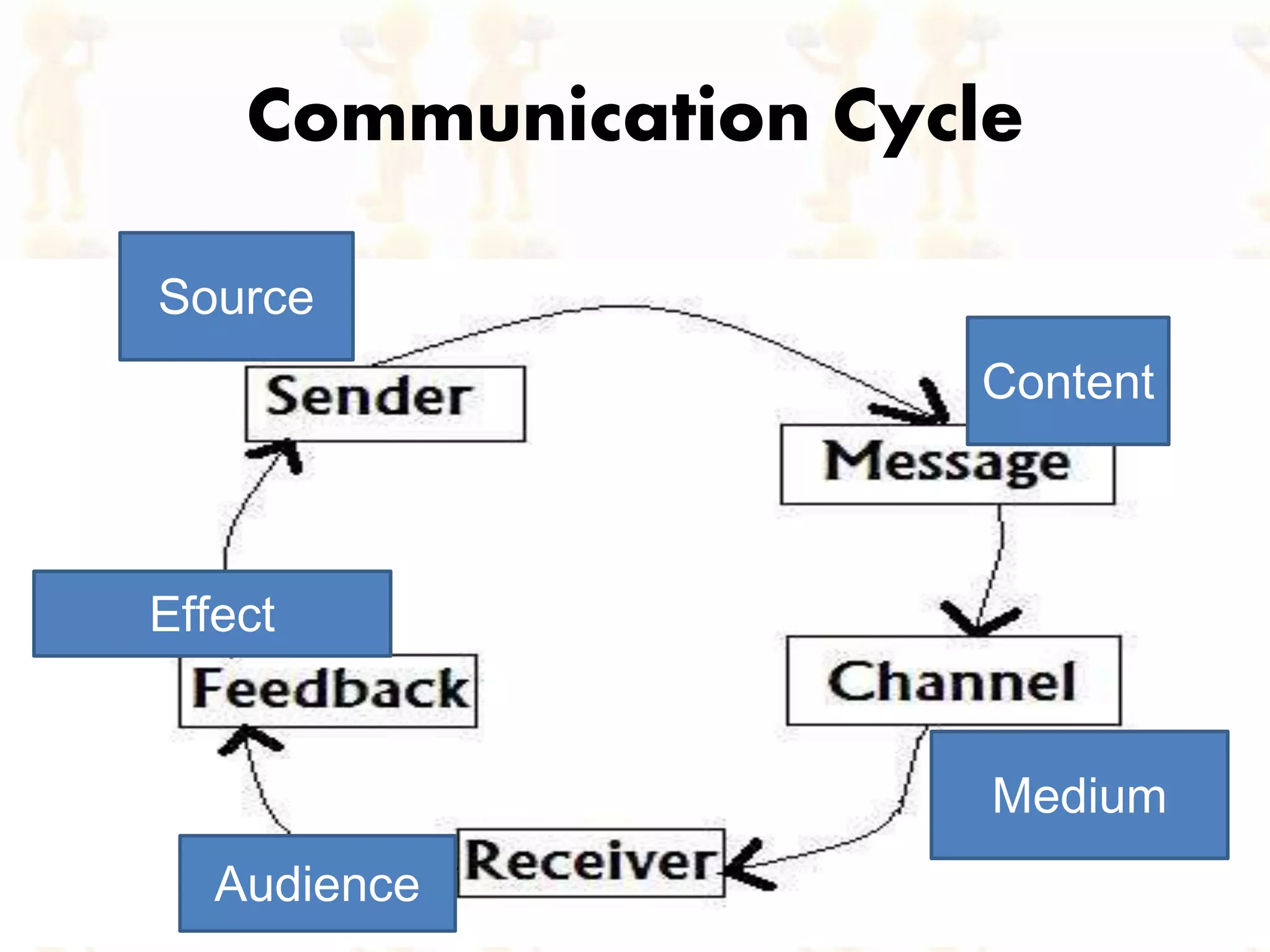
Communication Cycle
Source
Content
Medium
Audience
Effect
Communication Cycle
A good message :
• Must be in line of objectives, meaningful,
based on felt needs, clear and understandable,
specific and accurate, timely and adequate,
fitting the audience, interesting, culturally and
socially appropriate
Channels of communication
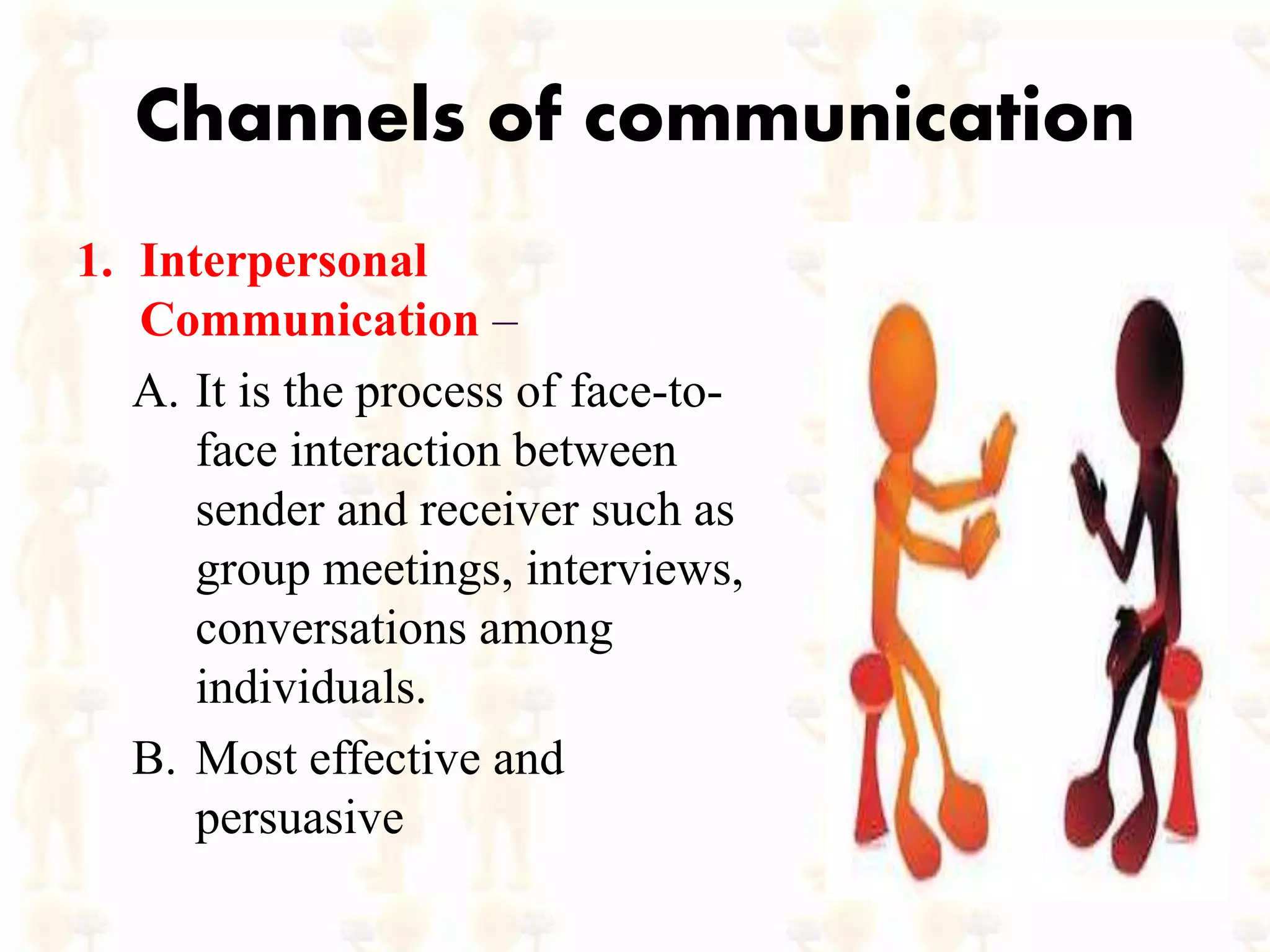
1. Interpersonal
Communication –
A. It is the process of face-to-
face interaction between
sender and receiver such as
group meetings, interviews,
conversations among
individuals.
B. Most effective and
persuasive
Channels of communication
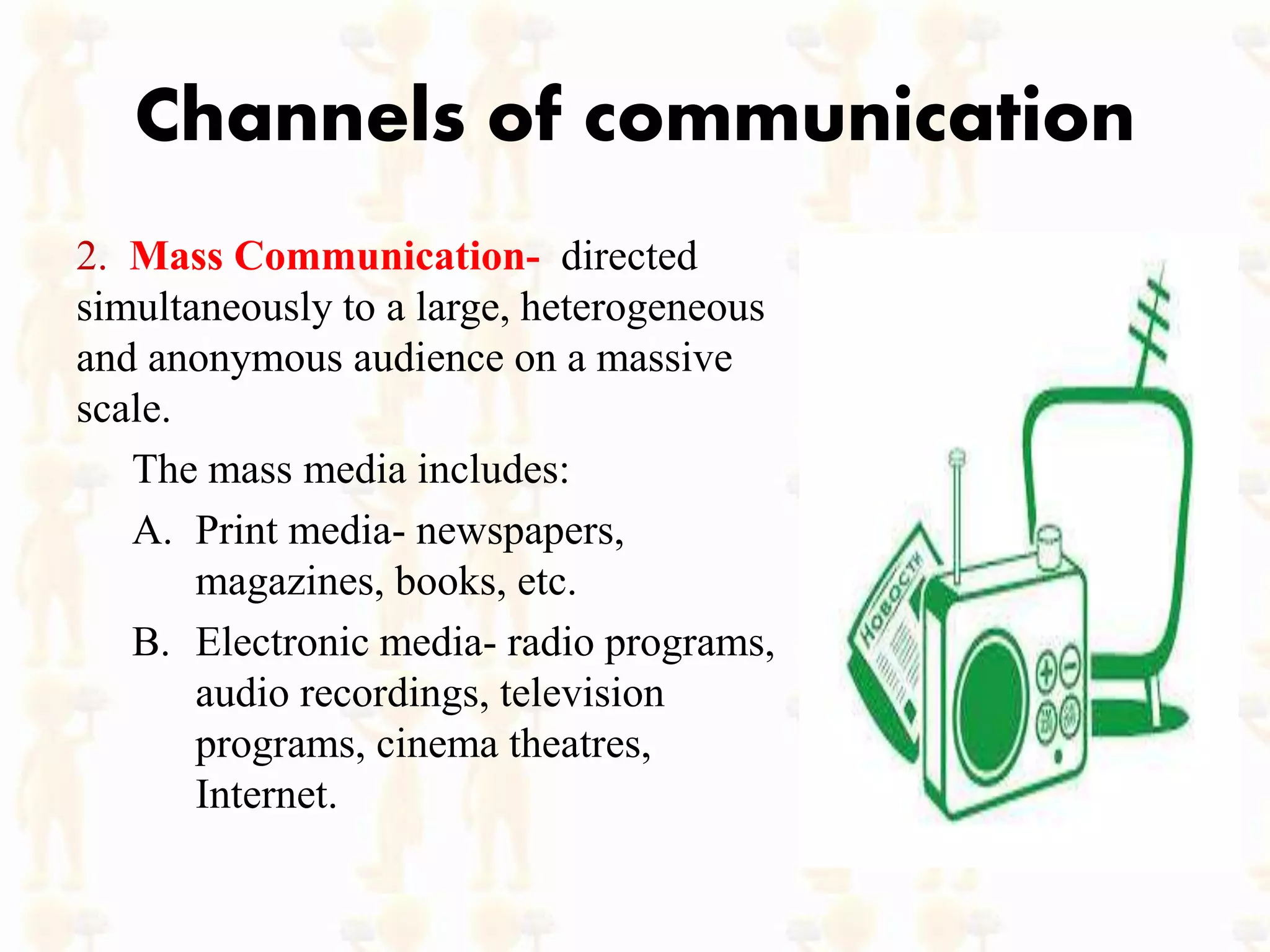
2. Mass Communication- directed
simultaneously to a large, heterogeneous
and anonymous audience on a massive
scale.
The mass media includes:
A. Print media- newspapers,
magazines, books, etc.
B. Electronic media- radio programs,
audio recordings, television
programs, cinema theatres,
Internet.
Channels of communication
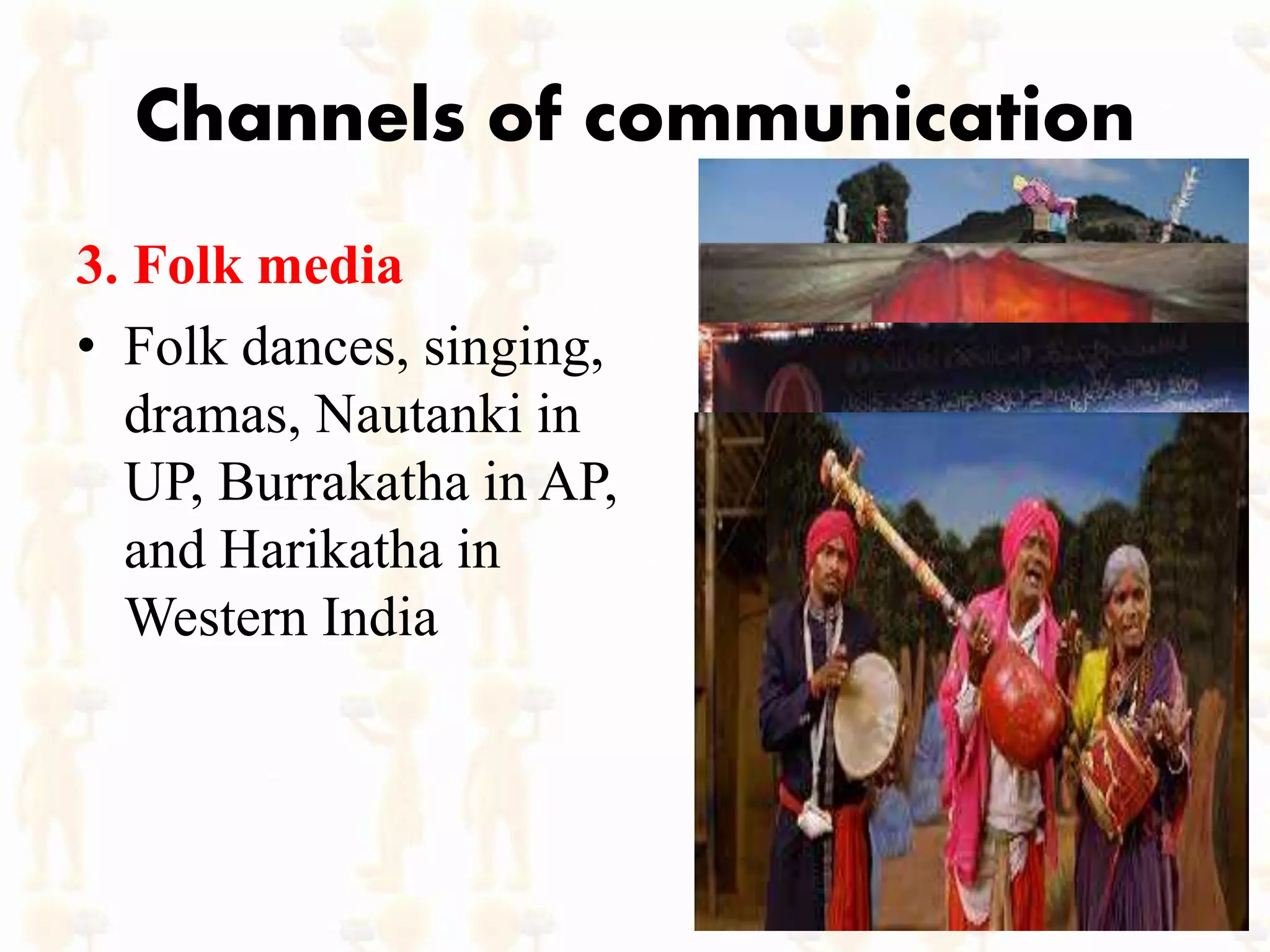
3. Folk media
• Folk dances, singing,
dramas, Nautanki in
UP, Burrakatha in AP,
and Harikatha in
Western India
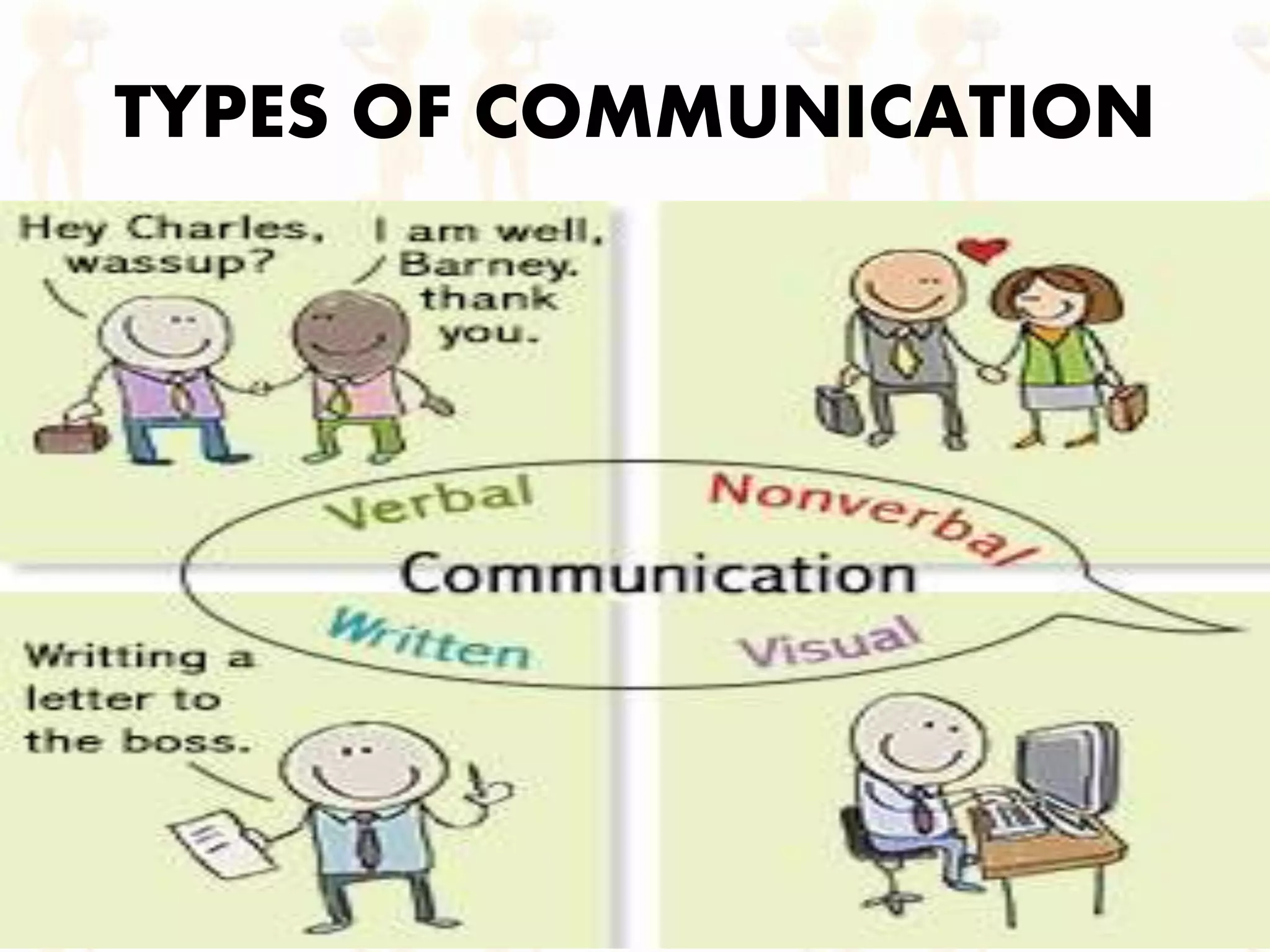
TYPES OF COMMUNICATION
Types of Communication
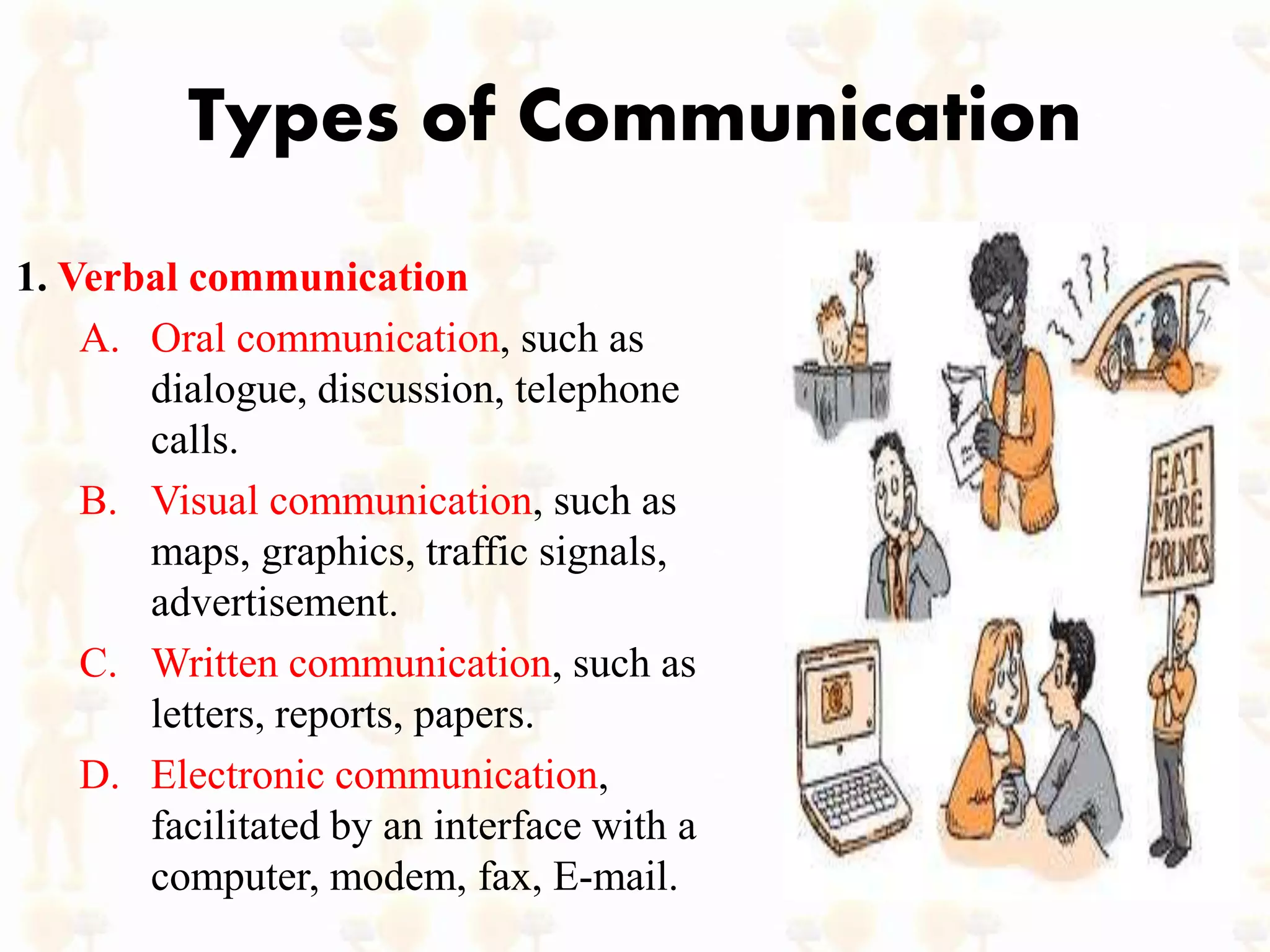
1. Verbal communication
A. Oral communication, such as
dialogue, discussion, telephone
calls.
B. Visual communication, such as
maps, graphics, traffic signals,
advertisement.
C. Written communication, such as
letters, reports, papers.
D. Electronic communication,
facilitated by an interface with a
computer, modem, fax, E-mail.
Types of Communication
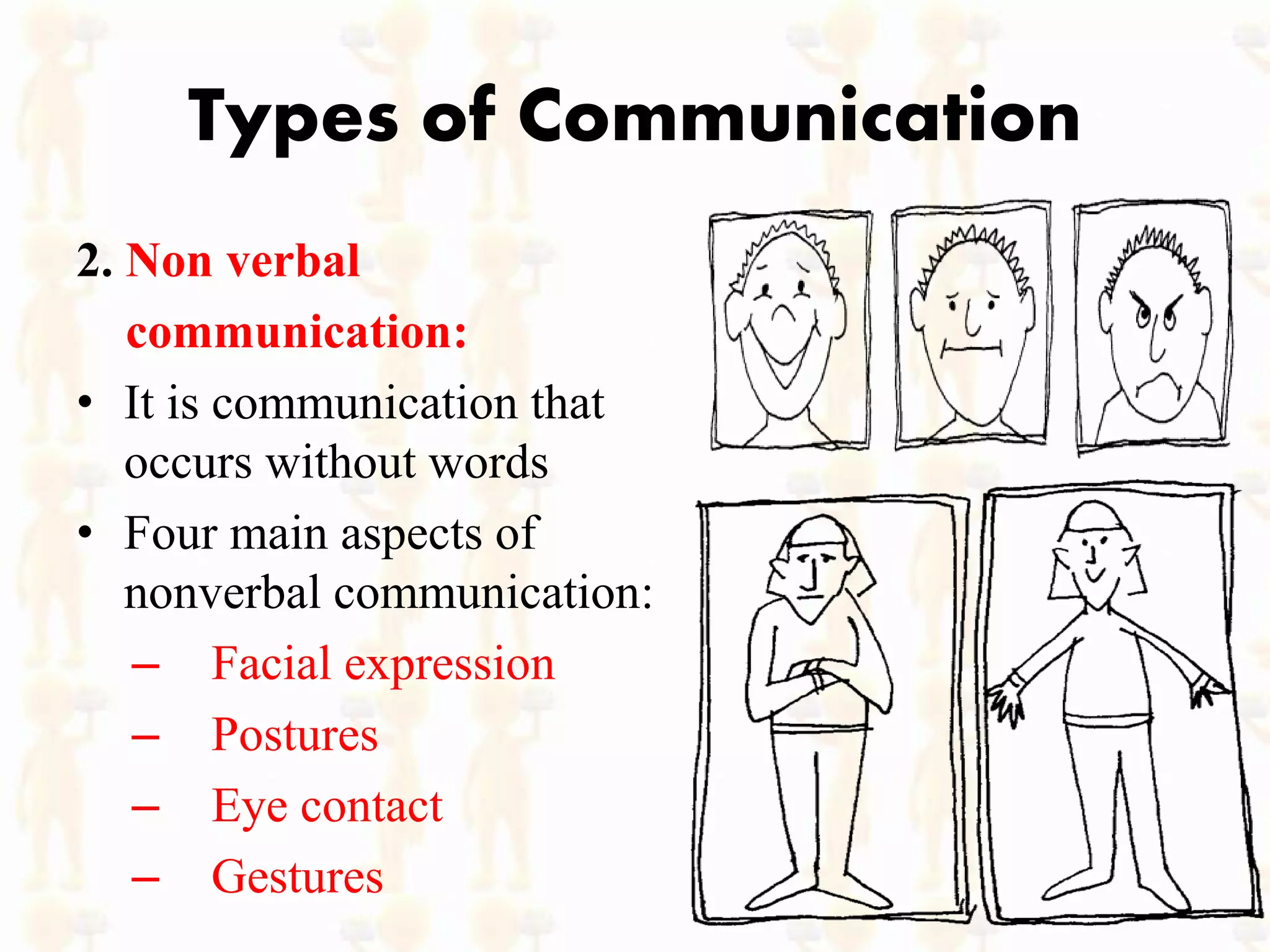
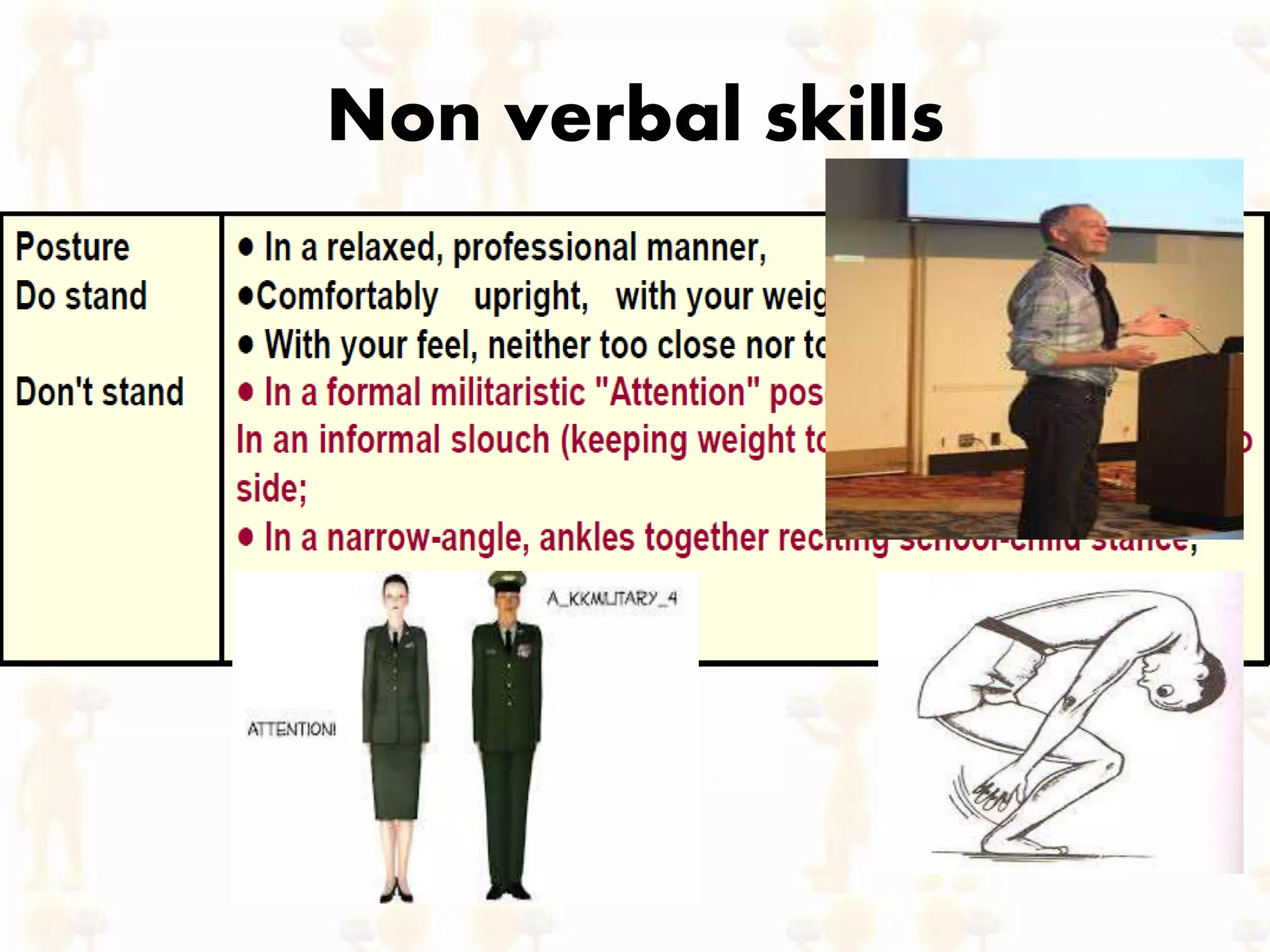
2. Non verbal
communication:
• It is communication that
occurs without words
• Four main aspects of
nonverbal communication:
– Facial expression
– Postures
– Eye contact
– Gestures
Types of Communication
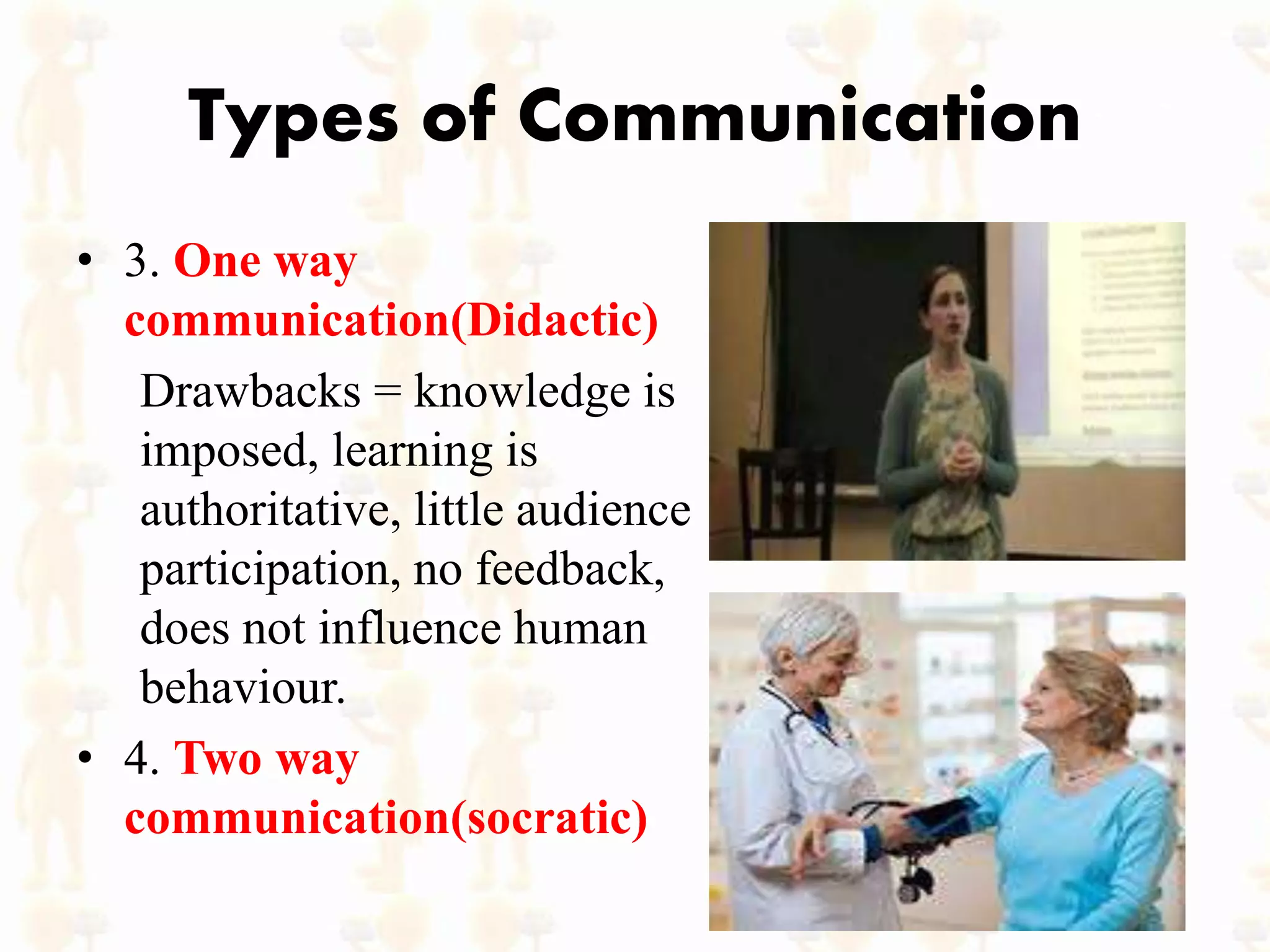
• 3. One way
communication(Didactic)
Drawbacks = knowledge is
imposed, learning is
authoritative, little audience
participation, no feedback,
does not influence human
behaviour.
• 4. Two way
communication(socratic)
Types of Communication
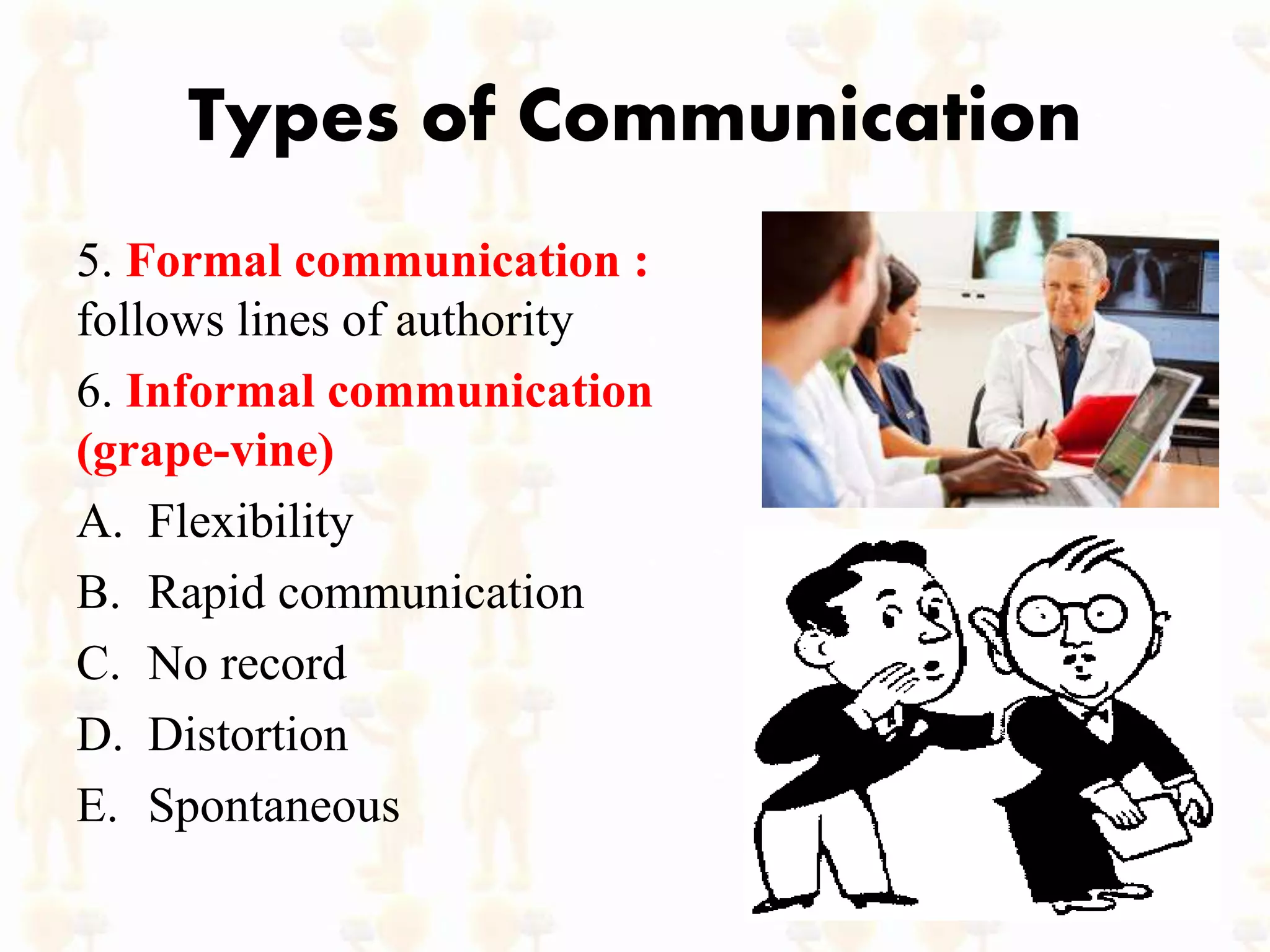
5. Formal communication :
follows lines of authority
6. Informal communication
(grape-vine)
A. Flexibility
B. Rapid communication
C. No record
D. Distortion
E. Spontaneous
Communication skills
1. Transmission Skills
– Presentation Skills
• Verbal Skills
• Non verbal Skills
2. Reception Skills
– Listening
– Feedback
• Verbal
• Nonverbal
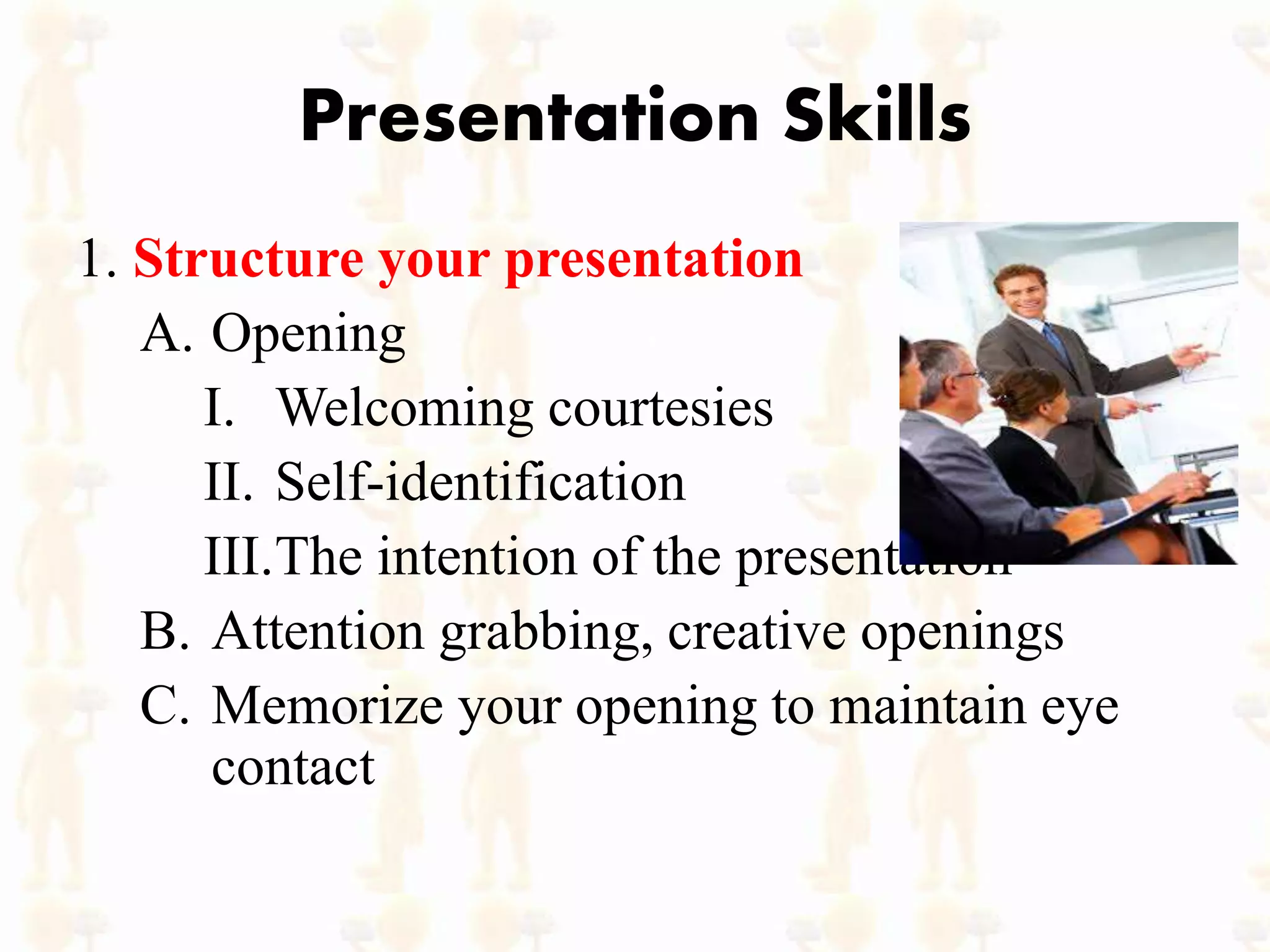
Presentation Skills
1. Structure your presentation
A. Opening
I. Welcoming courtesies
II. Self-identification
III.The intention of the presentation
B. Attention grabbing, creative openings
C. Memorize your opening to maintain eye
contact
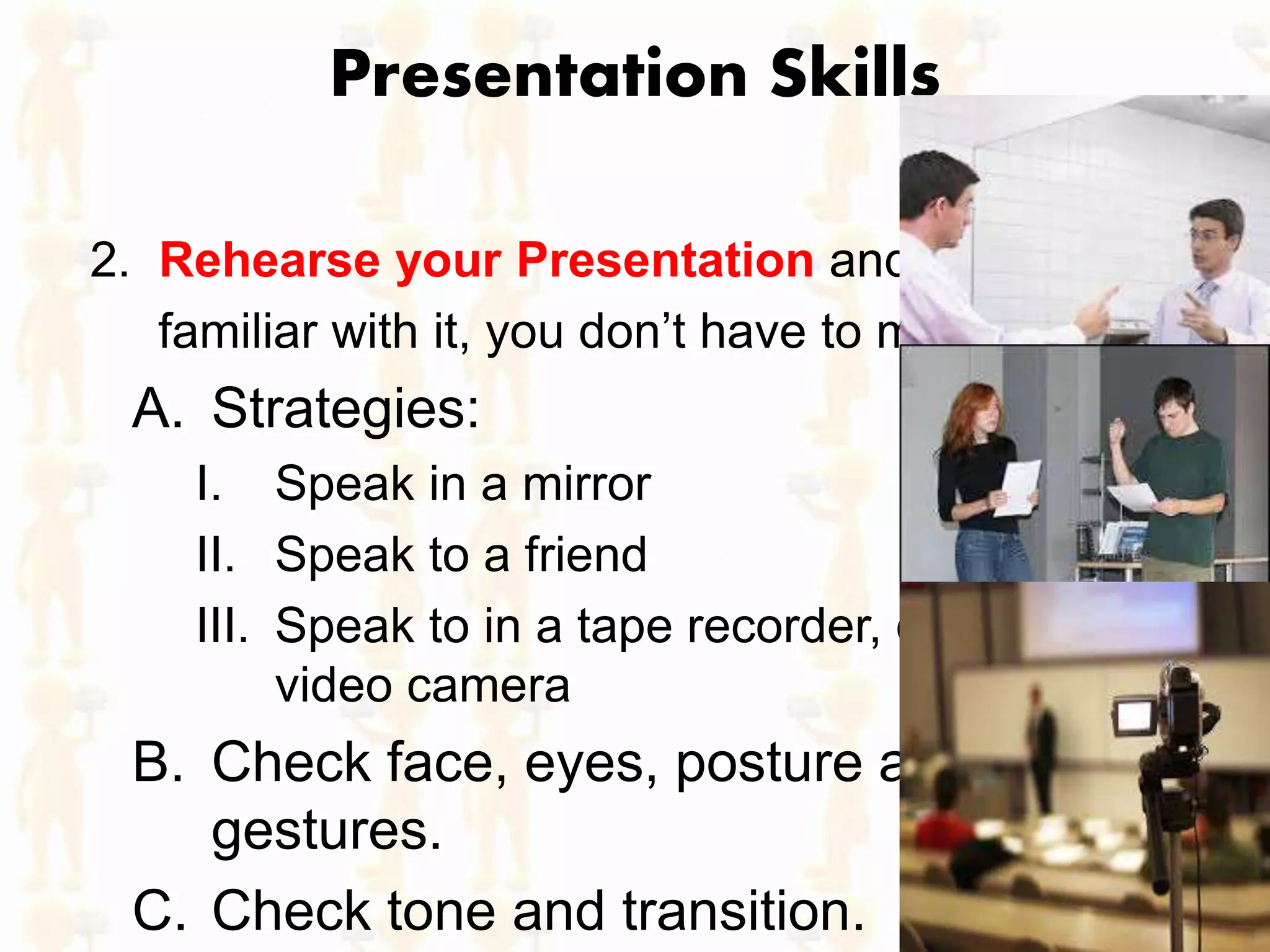
Presentation Skills
2. Rehearse your Presentation and get
familiar with it, you don’t have to memorize it
A. Strategies:
I. Speak in a mirror
II. Speak to a friend
III. Speak to in a tape recorder, or better a
video camera
B. Check face, eyes, posture and
gestures.
C. Check tone and transition.
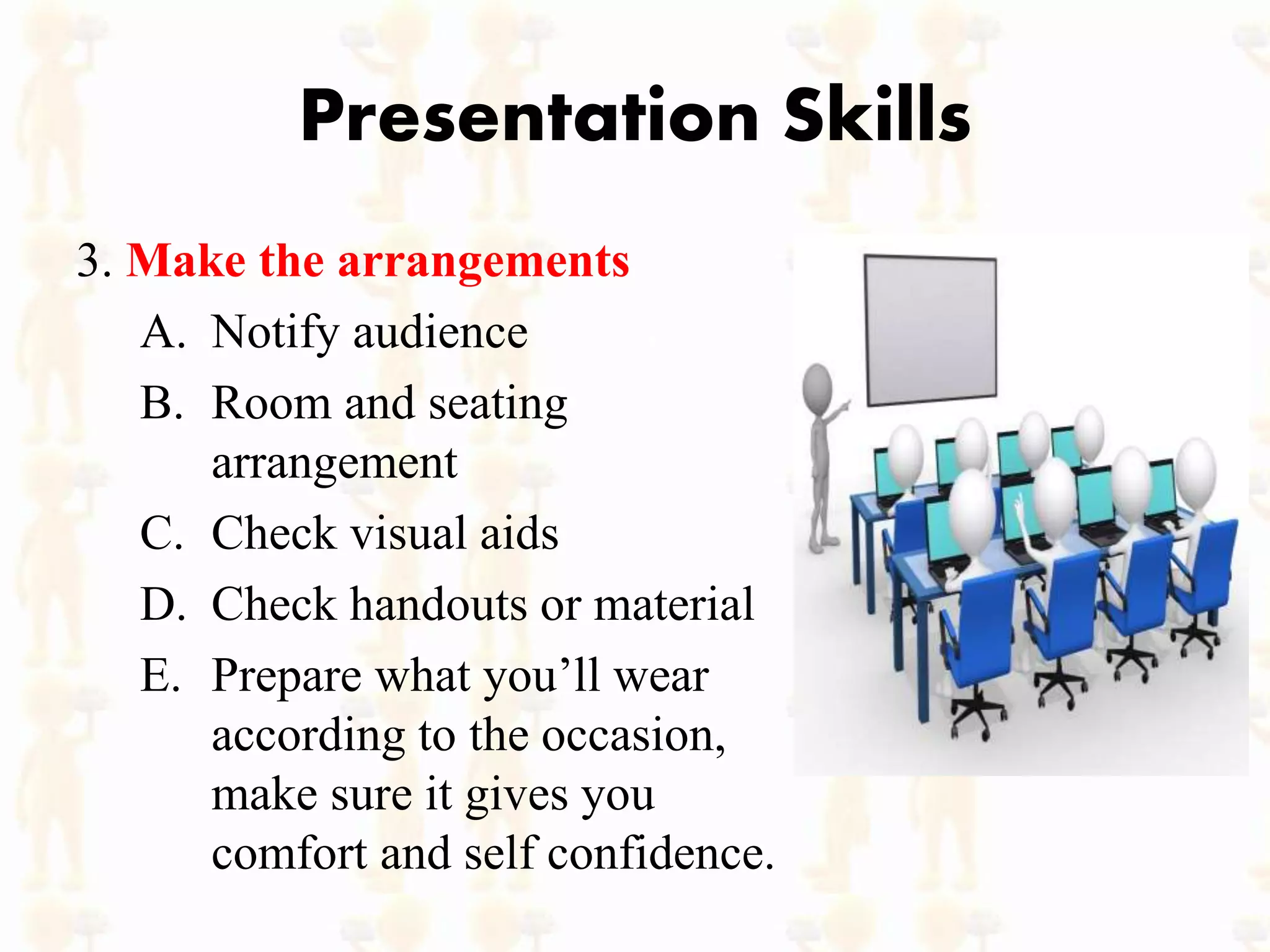
Presentation Skills
3. Make the arrangements
A. Notify audience
B. Room and seating
arrangement
C. Check visual aids
D. Check handouts or material
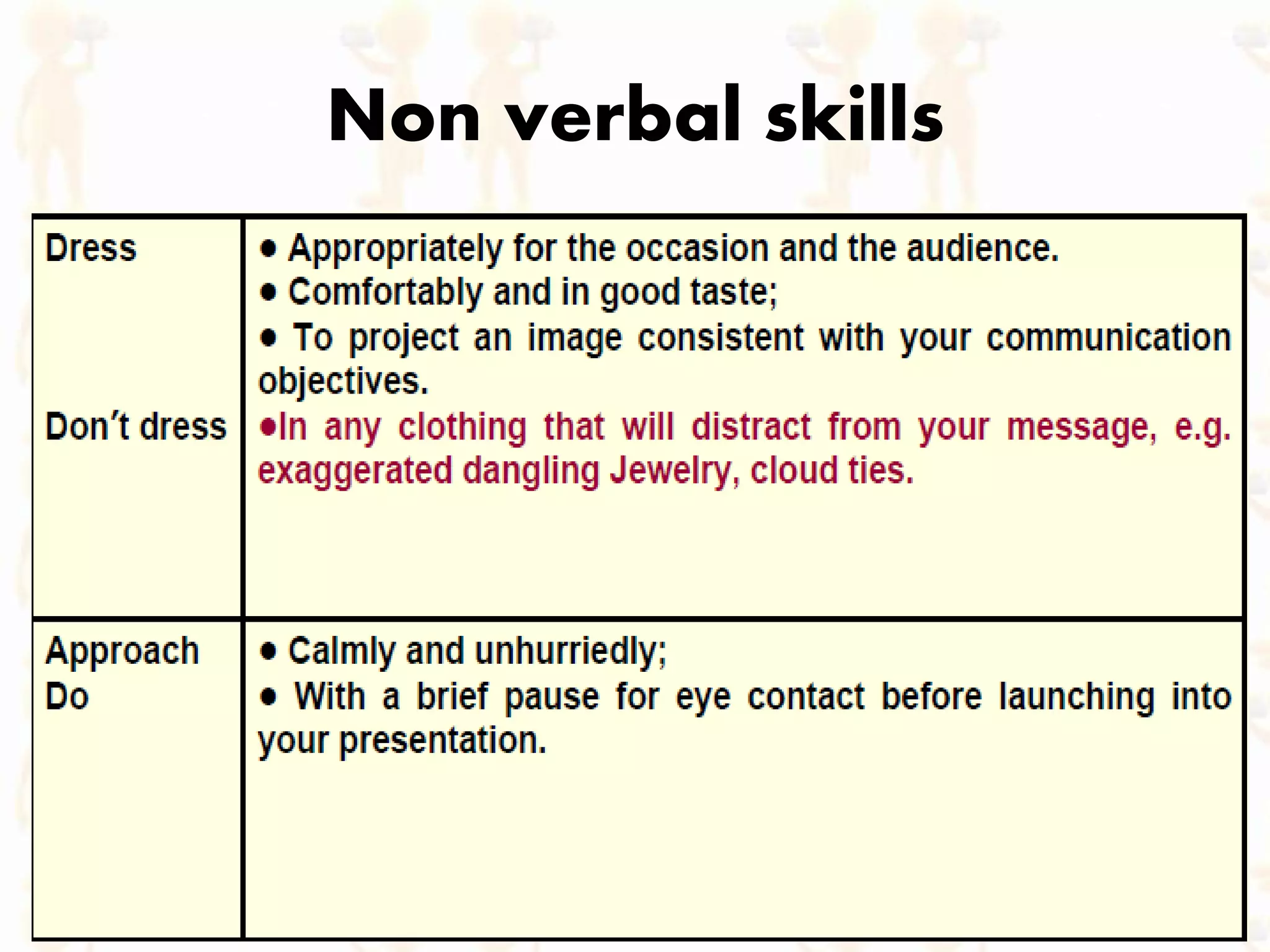
E. Prepare what you’ll wear
according to the occasion,
make sure it gives you
comfort and self confidence.
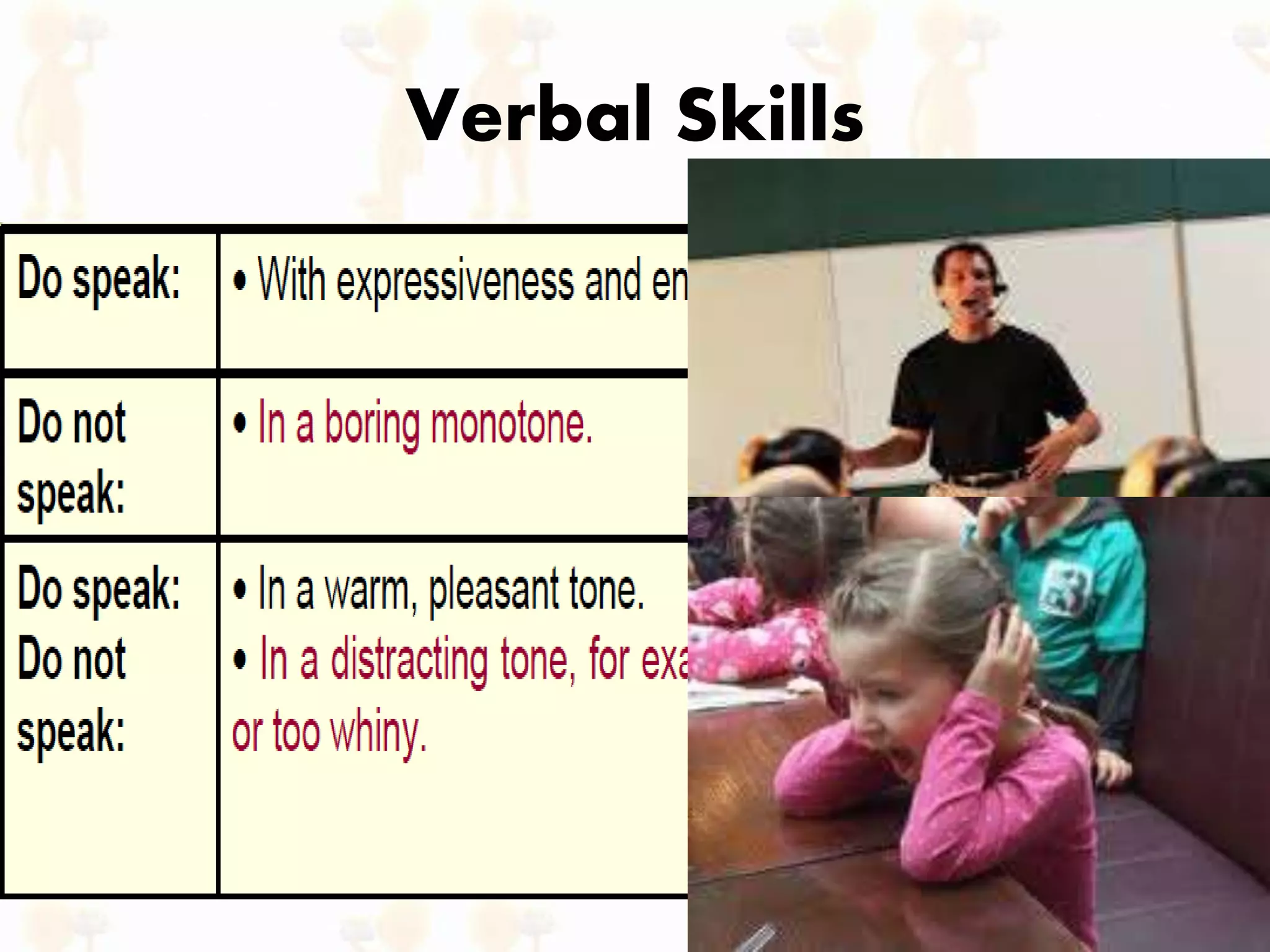
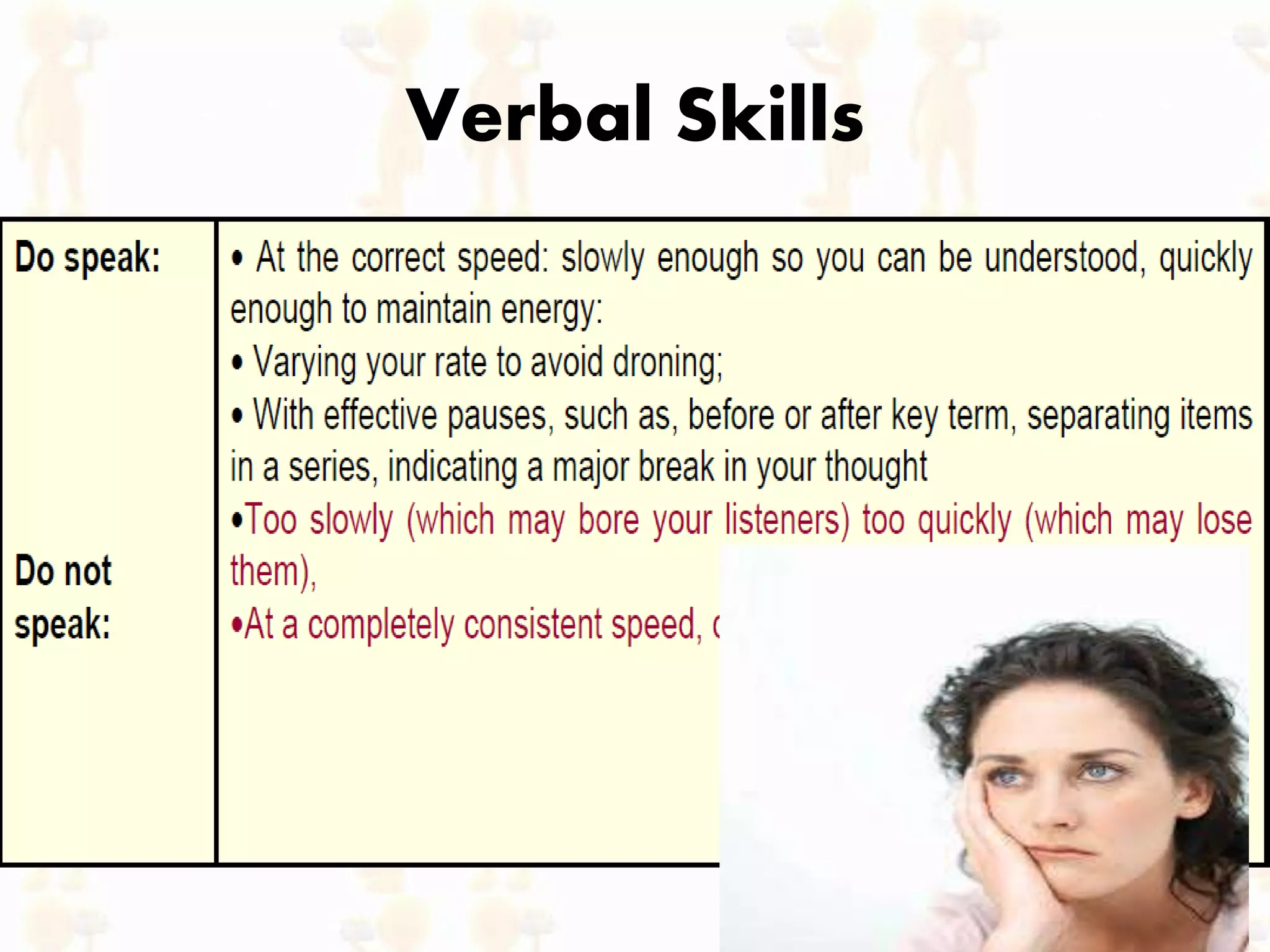
Verbal Skills
Verbal Skills
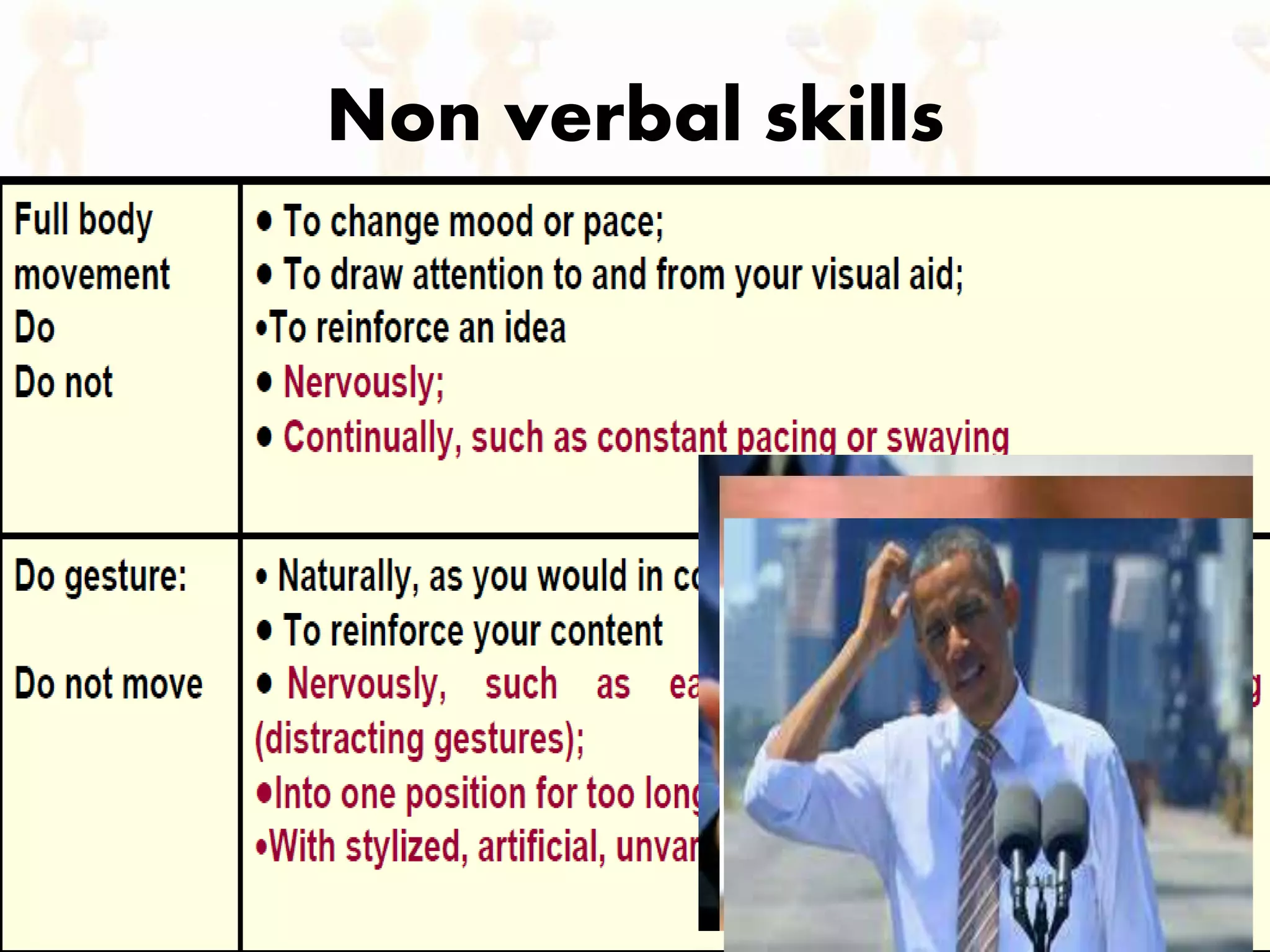
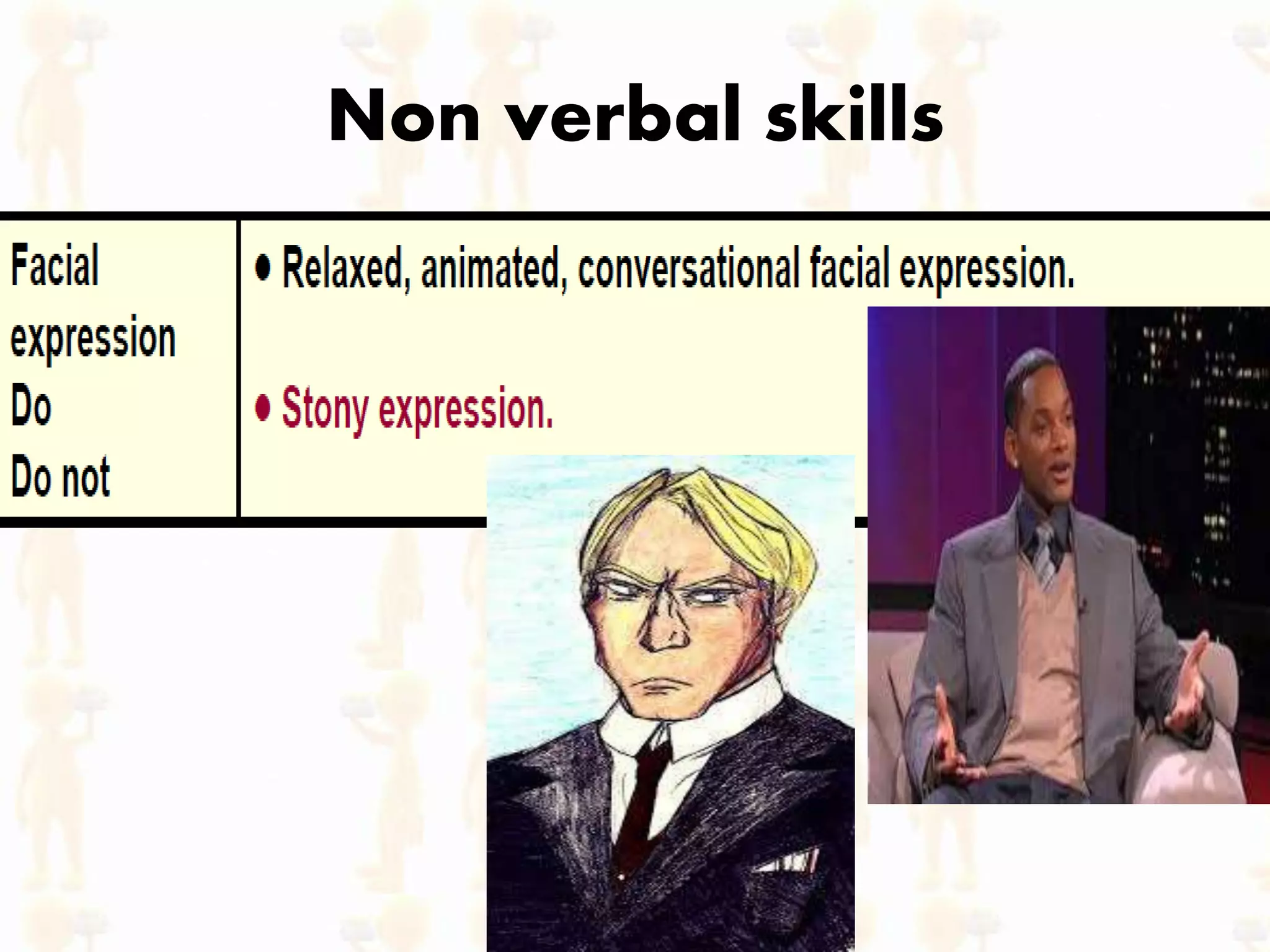
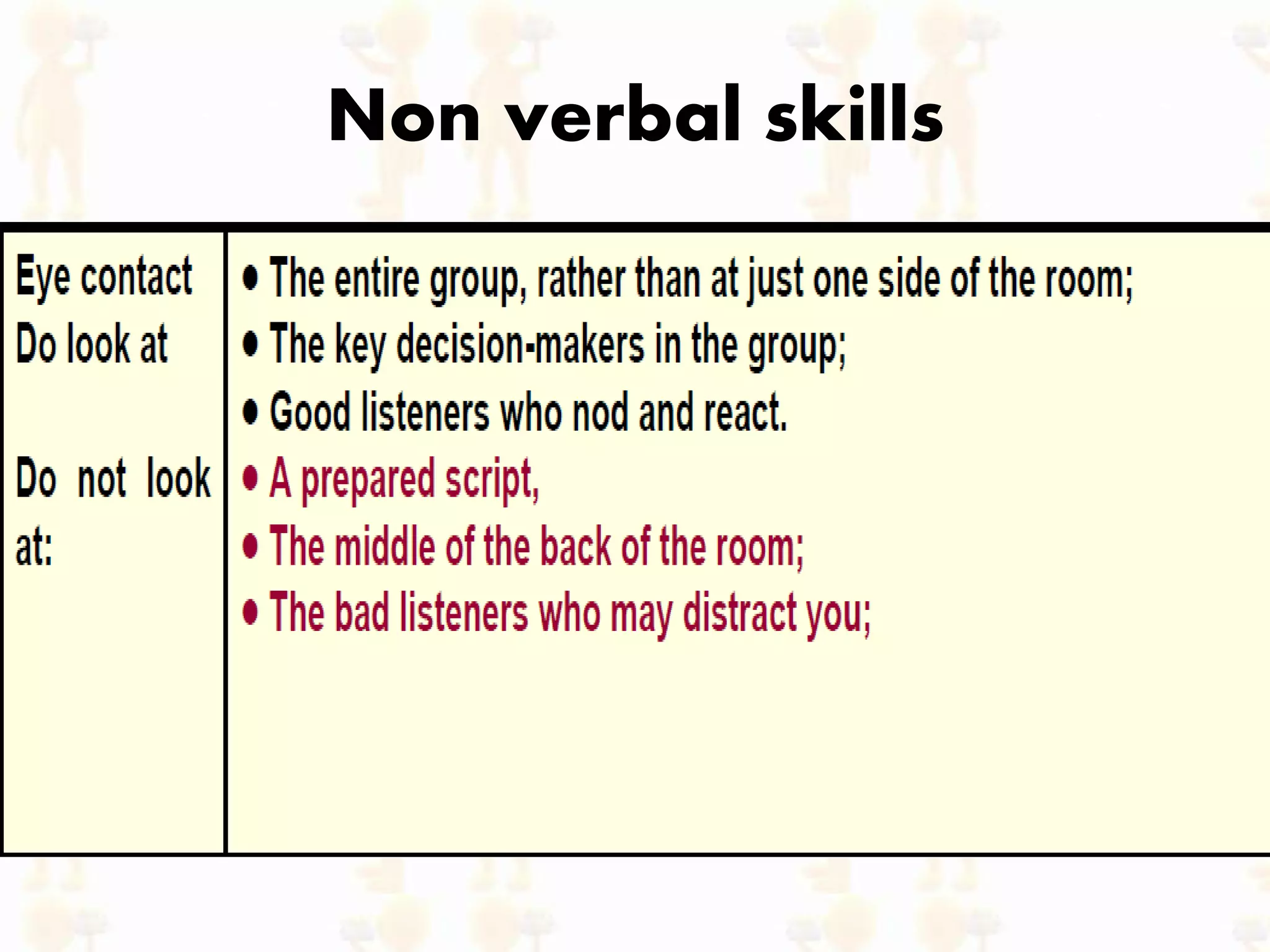
Non verbal skills
Non verbal skills
Non verbal skills
Non verbal skills
Non verbal skills
Reception Skills
Listening
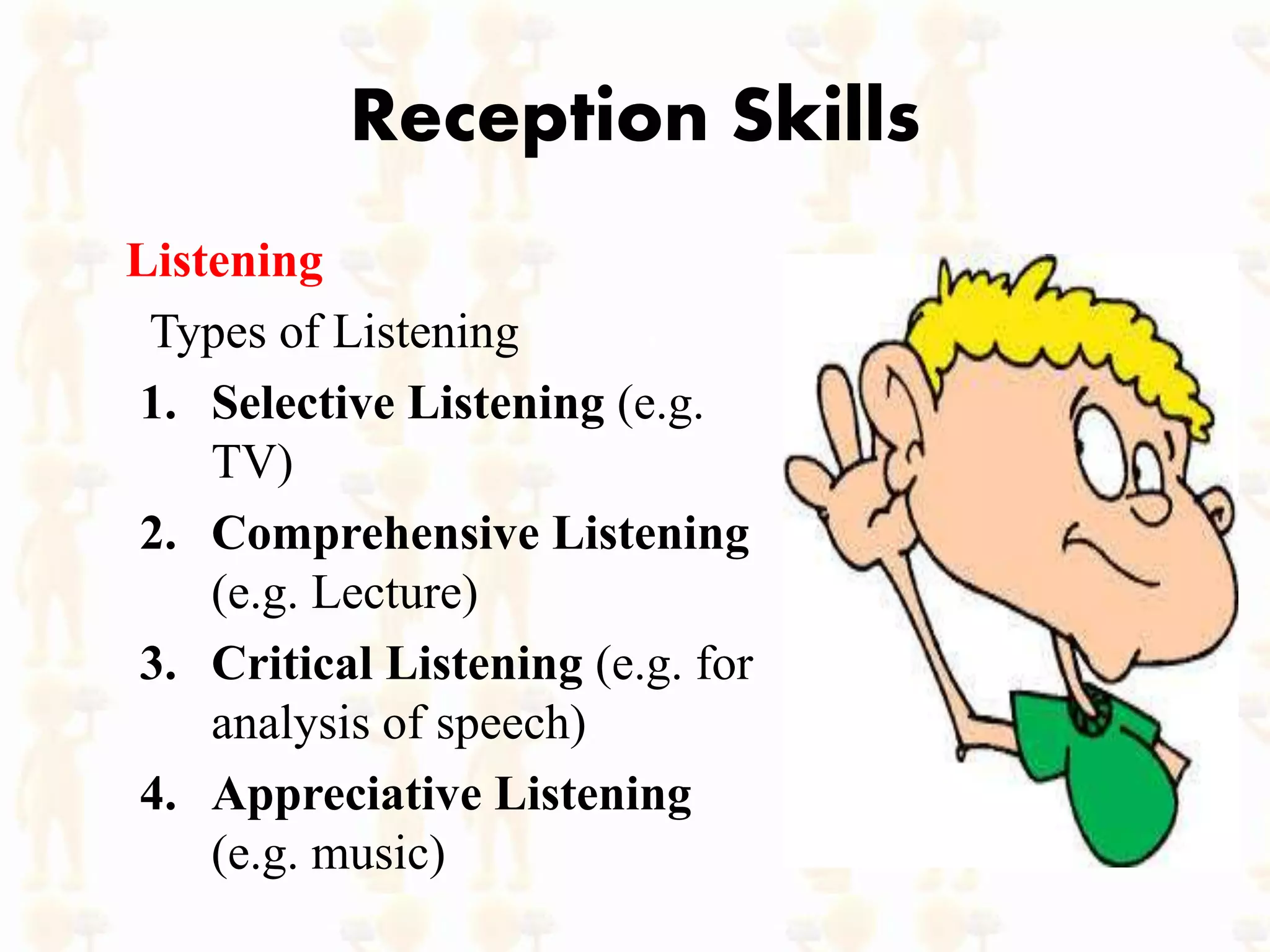
Types of Listening
1. Selective Listening (e.g.
TV)
2. Comprehensive Listening
(e.g. Lecture)
3. Critical Listening (e.g. for
analysis of speech)
4. Appreciative Listening
(e.g. music)
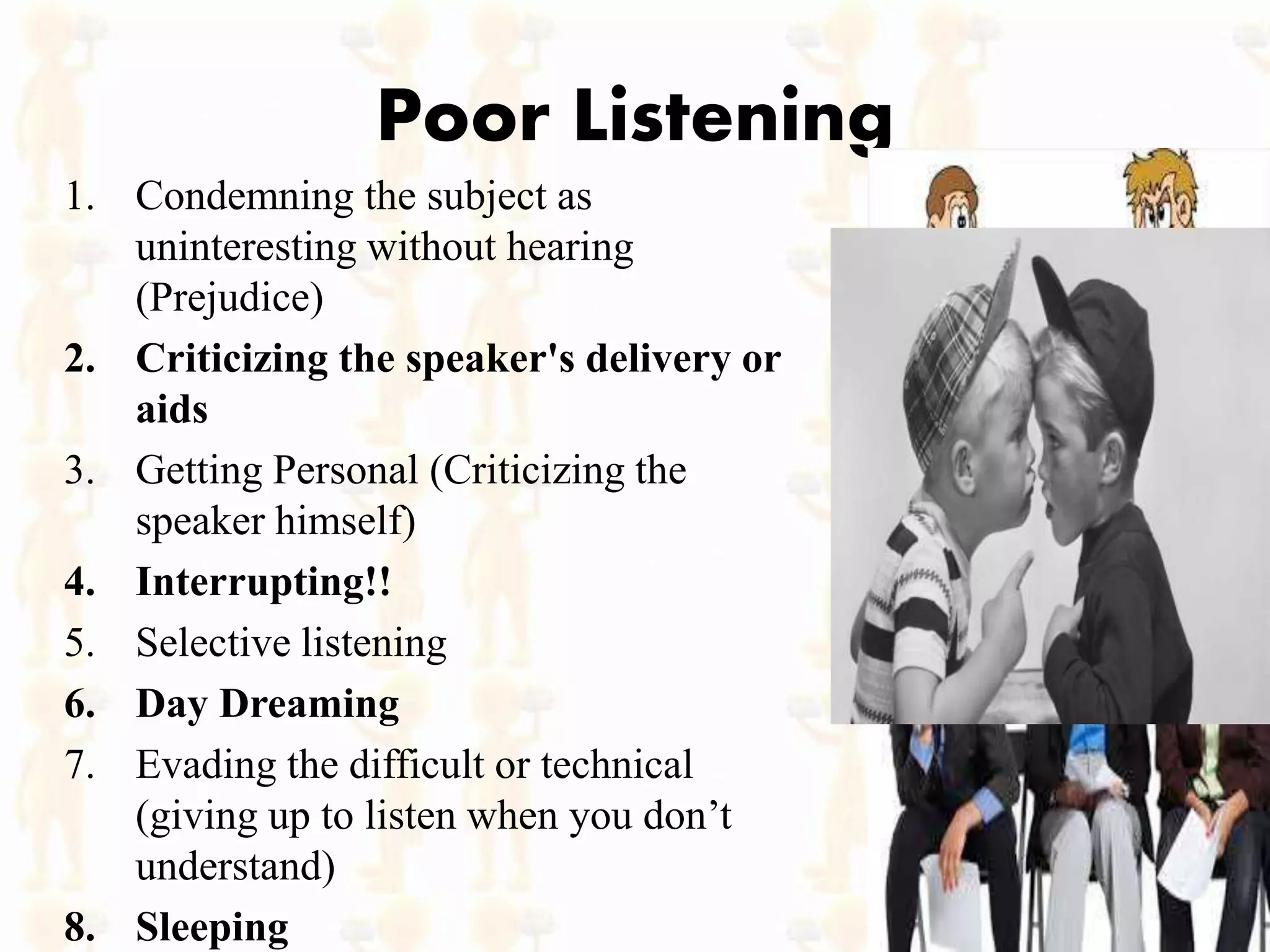
Poor Listening
1. Condemning the subject as
uninteresting without hearing
(Prejudice)
2. Criticizing the speaker's delivery or
aids
3. Getting Personal (Criticizing the
speaker himself)
4. Interrupting!!
5. Selective listening
6. Day Dreaming
7. Evading the difficult or technical
(giving up to listen when you don’t
understand)
8. Sleeping
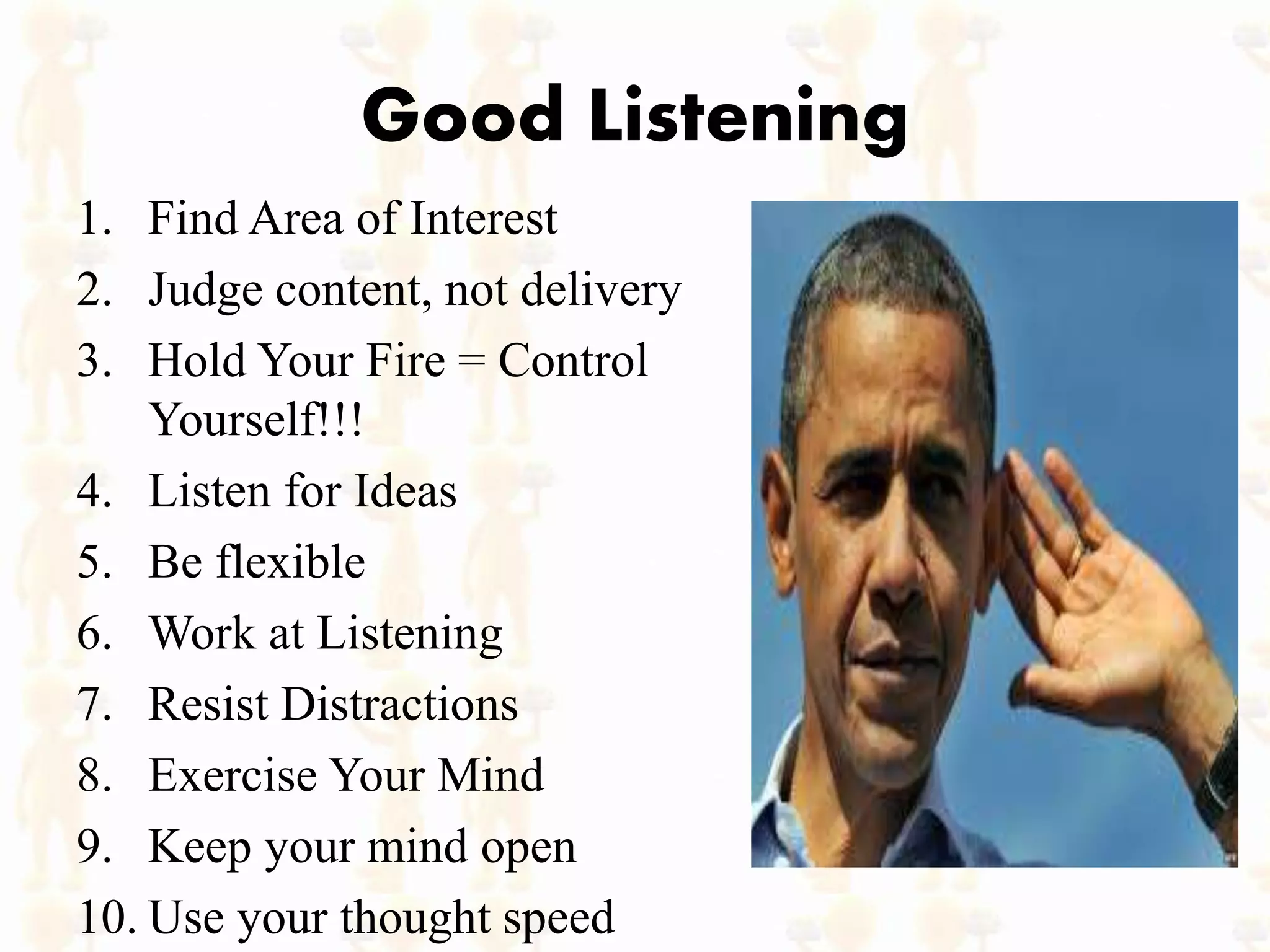
Good Listening
1. Find Area of Interest
2. Judge content, not delivery
3. Hold Your Fire = Control
Yourself!!!
4. Listen for Ideas
5. Be flexible
6. Work at Listening
7. Resist Distractions
8. Exercise Your Mind
9. Keep your mind open
10. Use your thought speed
Feedback
• It tells us if we are on track or not
• Feedback gives us indications to what extent
did receivers understand our messages
• Communicators should always encourage the
audience to give their feedback (by questions)
• It can be verbal and non verbal
Verbal Feedback
1. Productive
Interruptions
– Clarification.
– Elaboration.
– Bringing to focus.
– Reinforcement,
encouragement.
– Questions
2. Non-Productive
Interruptions
– Put-Downs.
– Objection.
– Joking.
– Corrections.
– Judgments.
– Jumping to
conclusions
– Changing the subject
Nonverbal Feedback
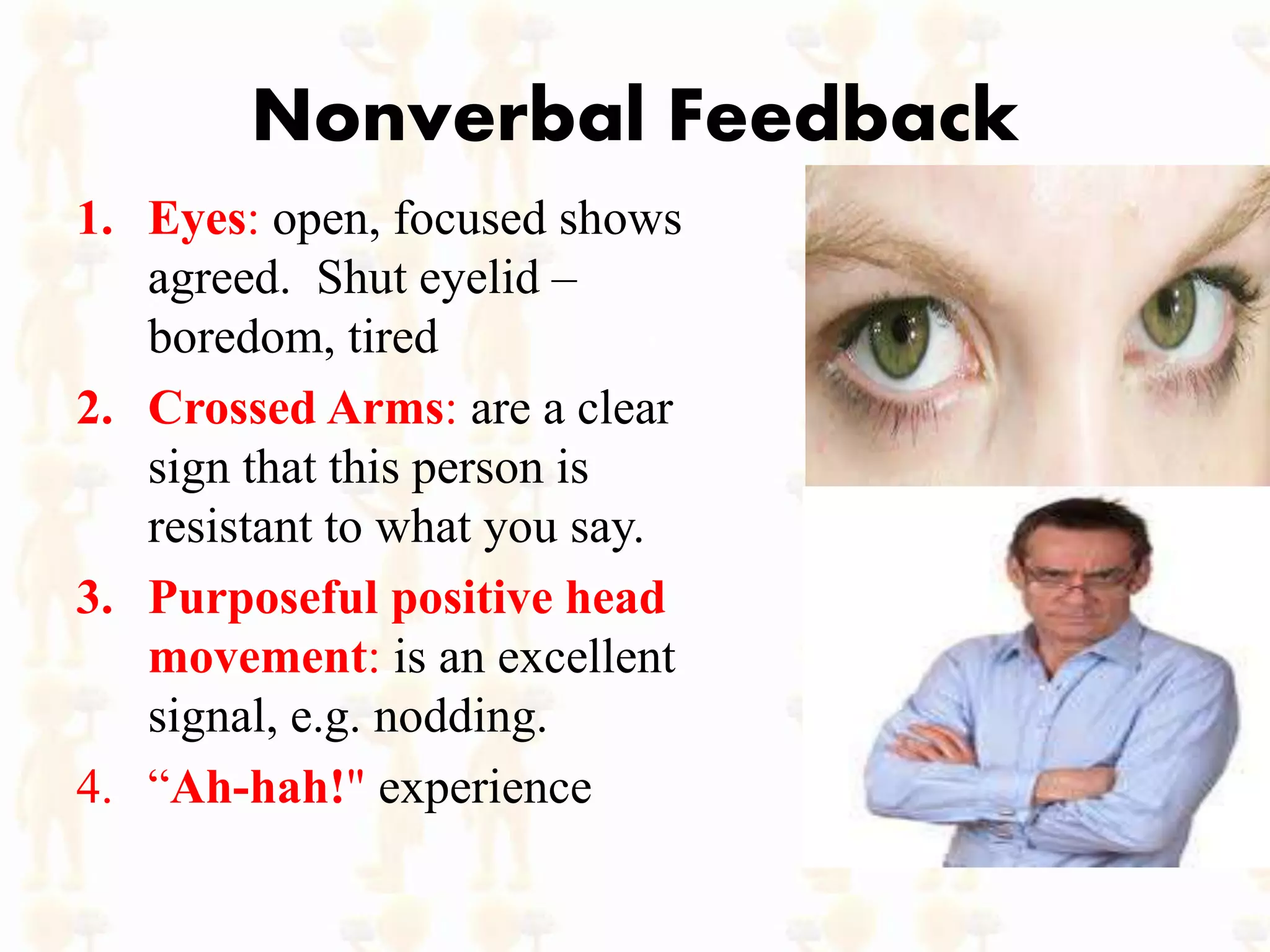
1. Eyes: open, focused shows
agreed. Shut eyelid –
boredom, tired
2. Crossed Arms: are a clear
sign that this person is
resistant to what you say.
3. Purposeful positive head
movement: is an excellent
signal, e.g. nodding.
4. “Ah-hah!" experience
Nonverbal Feedback
5. Shaking heads: It's OK,
but a bad thing to disagree on
all points.
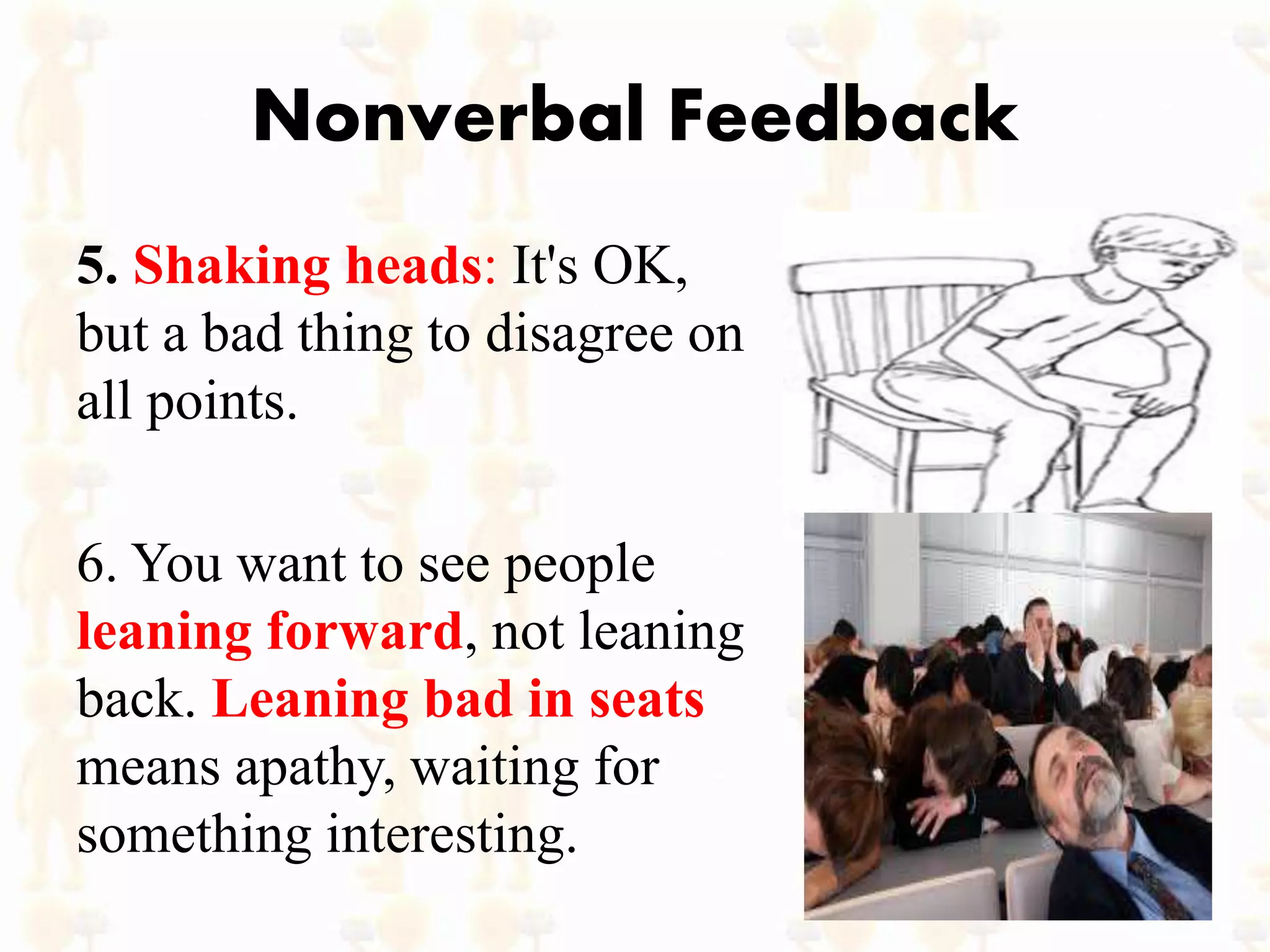
6. You want to see people
leaning forward, not leaning
back. Leaning bad in seats
means apathy, waiting for
something interesting.
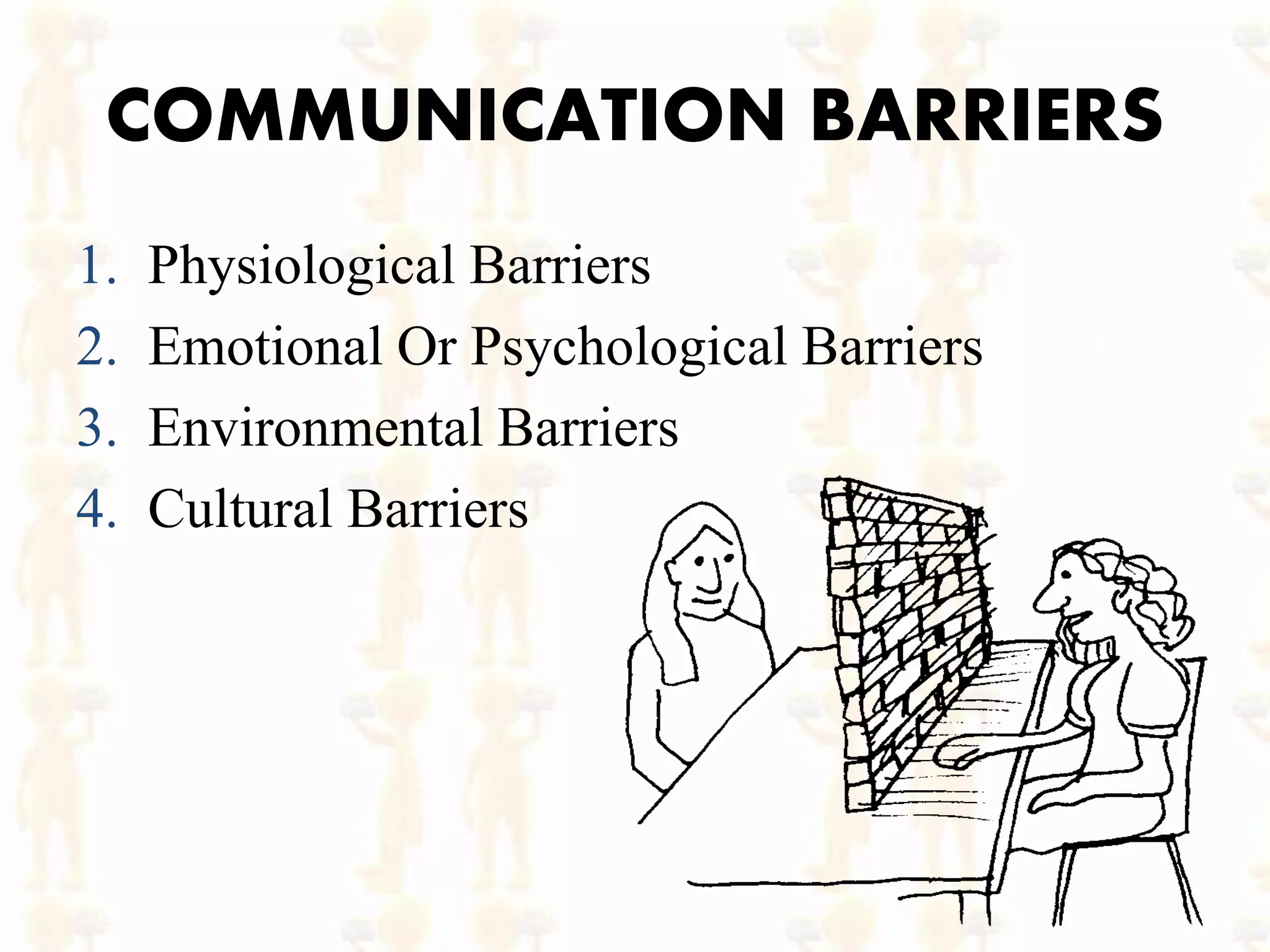
COMMUNICATION BARRIERS
1. Physiological Barriers
2. Emotional Or Psychological Barriers
3. Environmental Barriers
4. Cultural Barriers
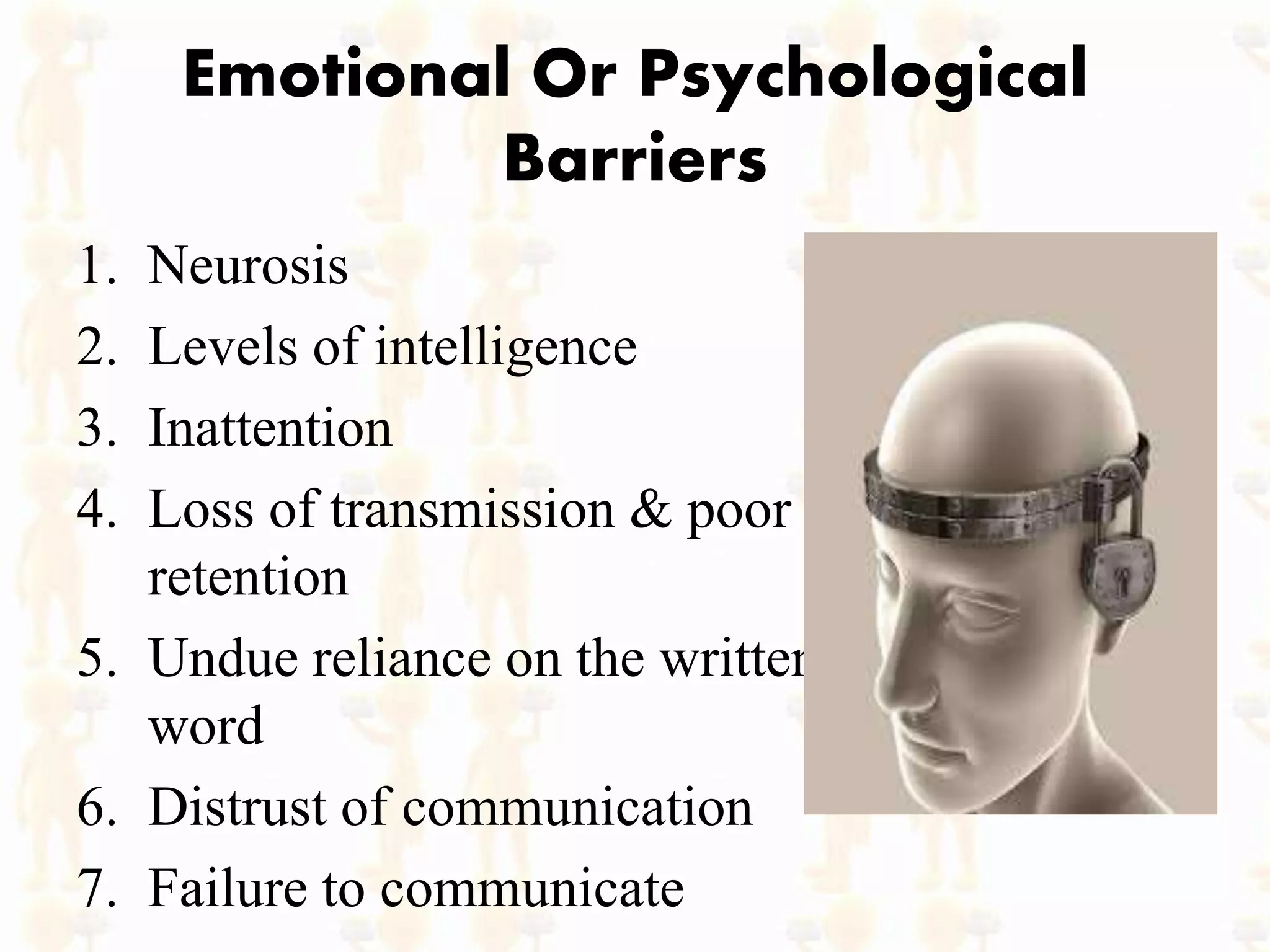
Emotional Or Psychological
Barriers
1. Neurosis
2. Levels of intelligence
3. Inattention
4. Loss of transmission & poor
retention
5. Undue reliance on the written
word
6. Distrust of communication
7. Failure to communicate
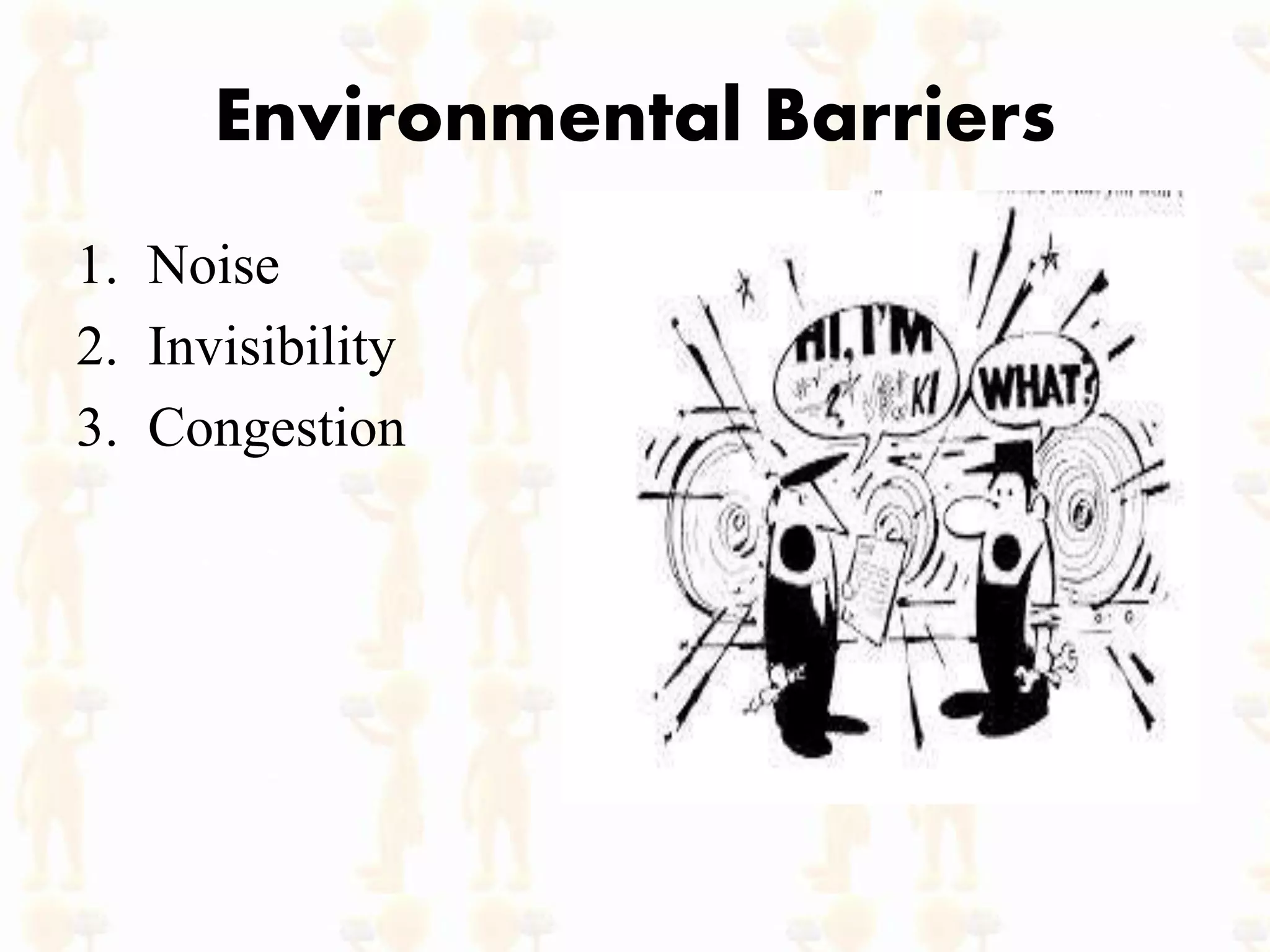
Environmental Barriers
1. Noise
2. Invisibility
3. Congestion
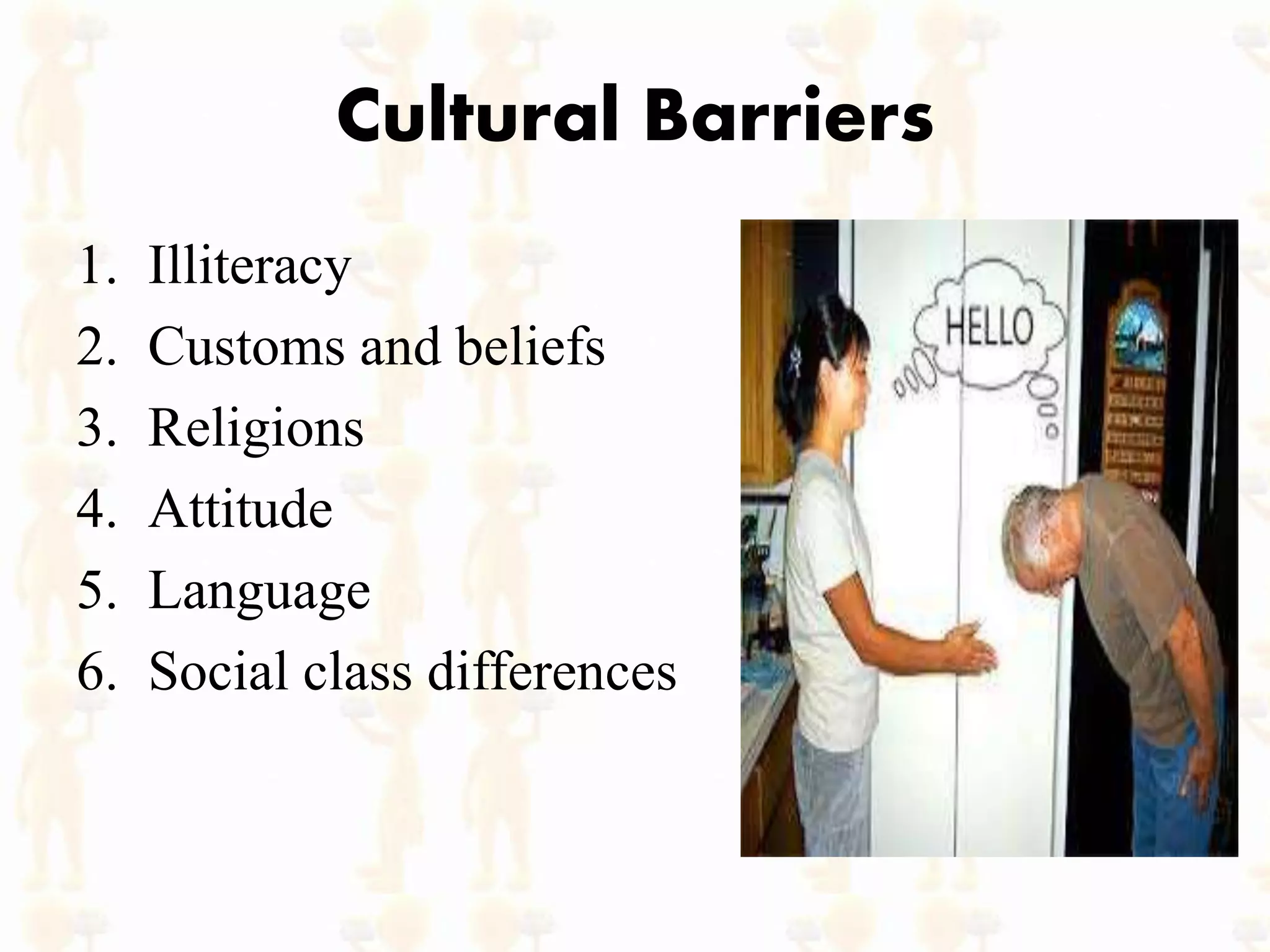
Cultural Barriers
1. Illiteracy
2. Customs and beliefs
3. Religions
4. Attitude
5. Language
6. Social class differences
Importance of Communication
Skills in Public health
• Delivery of health education
1. Supportive supervision
2. School health program
3. Training of health care professionals
4. IEC activities for outbreak and epidemics
5. Behavior change communication
Importance of Communication
Skills in Public health
• Academically
1. Conferences- national/ international
2. Thesis/ Publications
3. Key speaker in conferences
• Socially
1. Reviewing maternal and infant deaths
2. Population surveys(NFHS)
3. Program implementation
Conclusion
• Communication is important not only to
professional-patient interaction but also within the
healthcare team.
• The benefits of effective communication include
good working relationships and increased patient
satisfaction.
• Effective communication may increase patient
understanding of treatment, improve compliance
and, in some cases, lead to improved health.
Conclusion
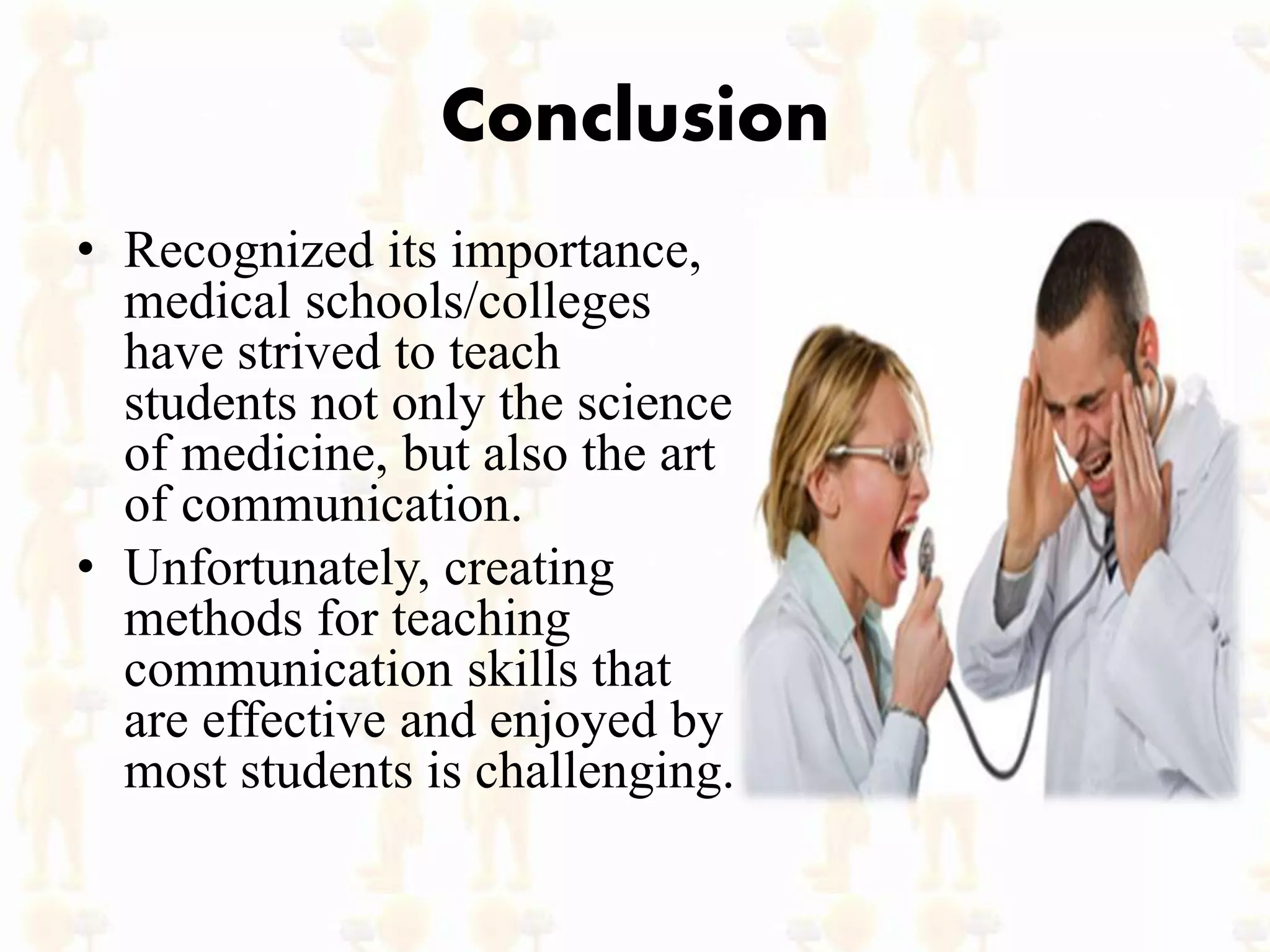
• Recognized its importance,
medical schools/colleges
have strived to teach
students not only the science
of medicine, but also the art
of communication.
• Unfortunately, creating
methods for teaching
communication skills that
are effective and enjoyed by
most students is challenging.
Conclusion
• Students must have opportunities to practice
communicating in different ways, including spoken,
written and electronic methods.
• There should also be guidance about how to cope in
various circumstances.
• Some examples are listed below:
a. during house visit/ survey
b. breaking bad news
c. dealing with difficult and violent patients, mental
illness
d. helping vulnerable patients
Conclusion
• Communication skills are now regarded as a
core competence. Assessment of
communication skills will be necessary as part
of the doctors appraisal and personal
development plans.
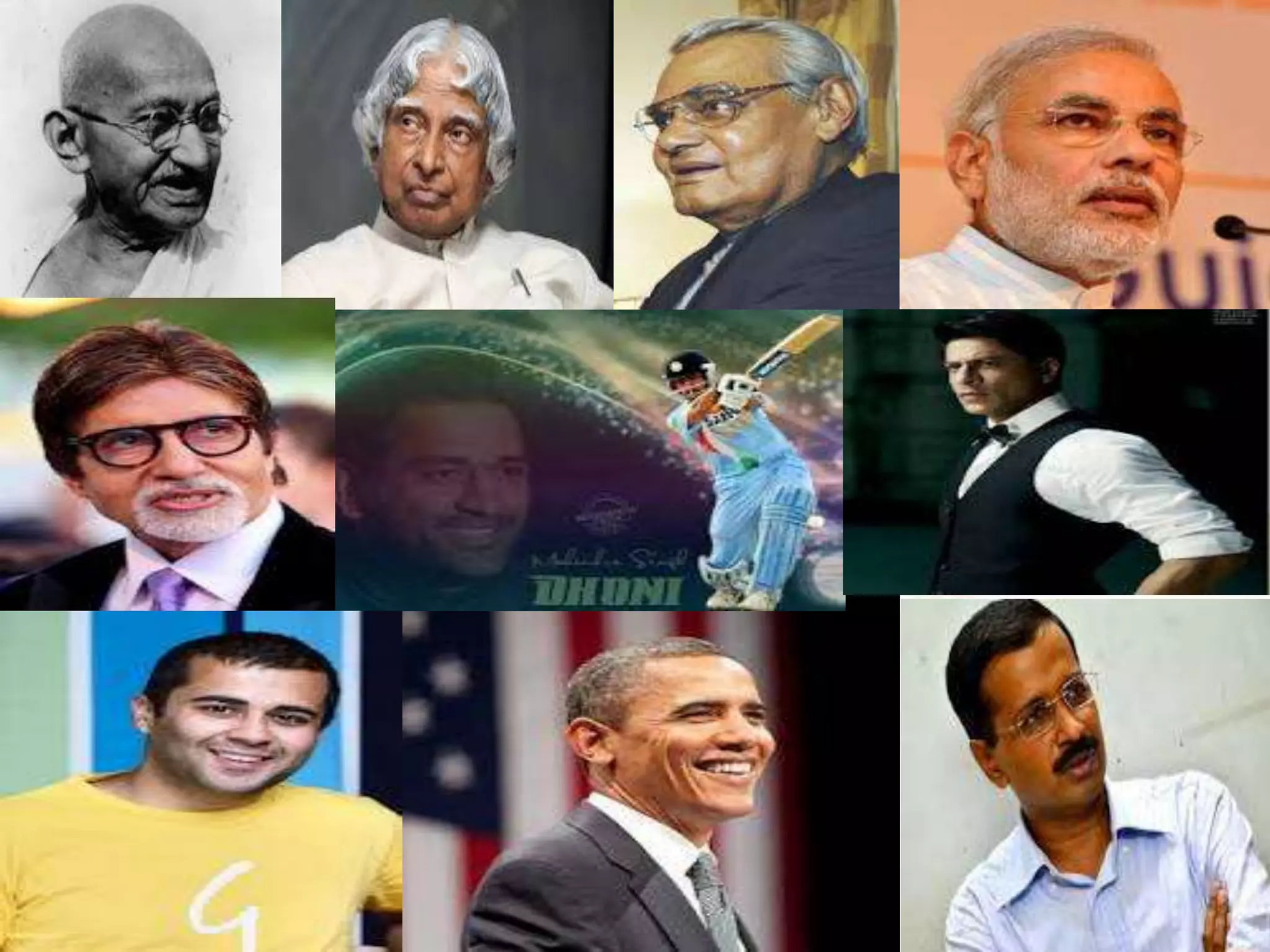
Communication skills " the importance can not be just told"

Communication skills " the importance can not be just told"

  • 1.
  • 2.
    Contents • Introduction • Communication –Definitions – Communication cycle – Channels of communication – Types of communication • Communication skills – Transmission skills – Reception skills • Communication barriers • Importance of communication skills in public health • Conclusion
  • 3.
    Introduction • I'm agreat believer that any tool that enhances communication has profound effects in terms of how people can learn from each other, and how they can achieve the kind of freedoms that they're interested in.” - Bill Gates
  • 4.
    Introduction • In recentyears good doctor–patient communication has been linked to improved patient satisfaction, better patient care and a decrease in malpractice lawsuits.
  • 5.
    Introduction • In medicalprofession communication is most essential skill. • Effective communication helps professionals to easily arrive at diagnosis.
  • 6.
    Introduction • Effective communication skillsmay relieve doctors of some of the pressures of dealing with the difficult situations encountered in this emotionally demanding profession. • Patients are less likely to complain if doctors communicate well. There is, therefore, a reduced likelihood of doctors being sued.
  • 8.
    DEFINITIONS • Communication isa process of transmitting ideas, information, attitudes which we have formulated for ourselves, by the use of symbols, words, pictures, images, figures from the source to a receiver, for the purpose of influencing with intent.
  • 9.
    DEFINITIONS • Health communicationis the study and practice of communicating promotional health information, such as in public health campaigns, health education, and between doctor and patient. • Public health communication is the scientific development, strategic dissemination, and critical evaluation of relevant, accurate, accessible, and understandable health information communicated to and from intended audiences to advance the health of the public.
  • 10.
    Health communication functions •Raising morals • Organization • Motivation • Education
  • 11.
    Health communication functions •Counseling • Health development • Information • Persuasion
  • 12.
  • 13.
    Communication Cycle A goodmessage : • Must be in line of objectives, meaningful, based on felt needs, clear and understandable, specific and accurate, timely and adequate, fitting the audience, interesting, culturally and socially appropriate
  • 14.
    Channels of communication 1.Interpersonal Communication – A. It is the process of face-to- face interaction between sender and receiver such as group meetings, interviews, conversations among individuals. B. Most effective and persuasive
  • 15.
    Channels of communication 2.Mass Communication- directed simultaneously to a large, heterogeneous and anonymous audience on a massive scale. The mass media includes: A. Print media- newspapers, magazines, books, etc. B. Electronic media- radio programs, audio recordings, television programs, cinema theatres, Internet.
  • 16.
    Channels of communication 3.Folk media • Folk dances, singing, dramas, Nautanki in UP, Burrakatha in AP, and Harikatha in Western India
  • 17.
  • 18.
    Types of Communication 1.Verbal communication A. Oral communication, such as dialogue, discussion, telephone calls. B. Visual communication, such as maps, graphics, traffic signals, advertisement. C. Written communication, such as letters, reports, papers. D. Electronic communication, facilitated by an interface with a computer, modem, fax, E-mail.
  • 19.
    Types of Communication 2.Non verbal communication: • It is communication that occurs without words • Four main aspects of nonverbal communication: – Facial expression – Postures – Eye contact – Gestures
  • 21.
    Types of Communication •3. One way communication(Didactic) Drawbacks = knowledge is imposed, learning is authoritative, little audience participation, no feedback, does not influence human behaviour. • 4. Two way communication(socratic)
  • 22.
    Types of Communication 5.Formal communication : follows lines of authority 6. Informal communication (grape-vine) A. Flexibility B. Rapid communication C. No record D. Distortion E. Spontaneous
  • 24.
    Communication skills 1. TransmissionSkills – Presentation Skills • Verbal Skills • Non verbal Skills 2. Reception Skills – Listening – Feedback • Verbal • Nonverbal
  • 25.
    Presentation Skills 1. Structureyour presentation A. Opening I. Welcoming courtesies II. Self-identification III.The intention of the presentation B. Attention grabbing, creative openings C. Memorize your opening to maintain eye contact
  • 26.
    Presentation Skills 2. Rehearseyour Presentation and get familiar with it, you don’t have to memorize it A. Strategies: I. Speak in a mirror II. Speak to a friend III. Speak to in a tape recorder, or better a video camera B. Check face, eyes, posture and gestures. C. Check tone and transition.
  • 27.
    Presentation Skills 3. Makethe arrangements A. Notify audience B. Room and seating arrangement C. Check visual aids D. Check handouts or material E. Prepare what you’ll wear according to the occasion, make sure it gives you comfort and self confidence.
  • 28.
  • 29.
  • 30.
  • 31.
  • 32.
  • 33.
  • 34.
  • 35.
    Reception Skills Listening Types ofListening 1. Selective Listening (e.g. TV) 2. Comprehensive Listening (e.g. Lecture) 3. Critical Listening (e.g. for analysis of speech) 4. Appreciative Listening (e.g. music)
  • 36.
    Poor Listening 1. Condemningthe subject as uninteresting without hearing (Prejudice) 2. Criticizing the speaker's delivery or aids 3. Getting Personal (Criticizing the speaker himself) 4. Interrupting!! 5. Selective listening 6. Day Dreaming 7. Evading the difficult or technical (giving up to listen when you don’t understand) 8. Sleeping
  • 37.
    Good Listening 1. FindArea of Interest 2. Judge content, not delivery 3. Hold Your Fire = Control Yourself!!! 4. Listen for Ideas 5. Be flexible 6. Work at Listening 7. Resist Distractions 8. Exercise Your Mind 9. Keep your mind open 10. Use your thought speed
  • 38.
    Feedback • It tellsus if we are on track or not • Feedback gives us indications to what extent did receivers understand our messages • Communicators should always encourage the audience to give their feedback (by questions) • It can be verbal and non verbal
  • 39.
    Verbal Feedback 1. Productive Interruptions –Clarification. – Elaboration. – Bringing to focus. – Reinforcement, encouragement. – Questions 2. Non-Productive Interruptions – Put-Downs. – Objection. – Joking. – Corrections. – Judgments. – Jumping to conclusions – Changing the subject
  • 40.
    Nonverbal Feedback 1. Eyes:open, focused shows agreed. Shut eyelid – boredom, tired 2. Crossed Arms: are a clear sign that this person is resistant to what you say. 3. Purposeful positive head movement: is an excellent signal, e.g. nodding. 4. “Ah-hah!" experience
  • 41.
    Nonverbal Feedback 5. Shakingheads: It's OK, but a bad thing to disagree on all points. 6. You want to see people leaning forward, not leaning back. Leaning bad in seats means apathy, waiting for something interesting.
  • 42.
    COMMUNICATION BARRIERS 1. PhysiologicalBarriers 2. Emotional Or Psychological Barriers 3. Environmental Barriers 4. Cultural Barriers
  • 43.
    Emotional Or Psychological Barriers 1.Neurosis 2. Levels of intelligence 3. Inattention 4. Loss of transmission & poor retention 5. Undue reliance on the written word 6. Distrust of communication 7. Failure to communicate
  • 44.
    Environmental Barriers 1. Noise 2.Invisibility 3. Congestion
  • 45.
    Cultural Barriers 1. Illiteracy 2.Customs and beliefs 3. Religions 4. Attitude 5. Language 6. Social class differences
  • 46.
    Importance of Communication Skillsin Public health • Delivery of health education 1. Supportive supervision 2. School health program 3. Training of health care professionals 4. IEC activities for outbreak and epidemics 5. Behavior change communication
  • 47.
    Importance of Communication Skillsin Public health • Academically 1. Conferences- national/ international 2. Thesis/ Publications 3. Key speaker in conferences • Socially 1. Reviewing maternal and infant deaths 2. Population surveys(NFHS) 3. Program implementation
  • 48.
    Conclusion • Communication isimportant not only to professional-patient interaction but also within the healthcare team. • The benefits of effective communication include good working relationships and increased patient satisfaction. • Effective communication may increase patient understanding of treatment, improve compliance and, in some cases, lead to improved health.
  • 49.
    Conclusion • Recognized itsimportance, medical schools/colleges have strived to teach students not only the science of medicine, but also the art of communication. • Unfortunately, creating methods for teaching communication skills that are effective and enjoyed by most students is challenging.
  • 50.
    Conclusion • Students musthave opportunities to practice communicating in different ways, including spoken, written and electronic methods. • There should also be guidance about how to cope in various circumstances. • Some examples are listed below: a. during house visit/ survey b. breaking bad news c. dealing with difficult and violent patients, mental illness d. helping vulnerable patients
  • 51.
    Conclusion • Communication skillsare now regarded as a core competence. Assessment of communication skills will be necessary as part of the doctors appraisal and personal development plans.