Organizational Change
Prepared by
Jaya dev Sahoo
Mihir ketan Barik
Abhishek Rout
Lesson Plan
 Objectives
 Introduction
 Concept of organizational change
 forces for change
 levels of change
 Types of change
 Steps in managed change
 Resistance to change
 Implementing change successfully
 Methods of introducing change
Organisation
 Organization is a social system.
 All parts of organization affect all other parts
 Anything happening at one end is transmitted to
the other end
 Interrelationship between the elements &
environment
 Orderly behaviour – equilibrium
 Becomes an established way of life
 Disturbance to this naturally exercises pressure
 Evokes a reaction – acceptance/rejection
External & Internal forces
 External Forces
 Macro environment (PEST factors)
 Micro Environment (Consumers, Suppliers,
Stake Holders)
 Opportunities & Threats (SWOT)
 Internal Forces
 Internal Environment (Men, Money,
Machinery, Materials, Minutes)
 Strengths & Weaknesses (SWOT)
Change In an Organization
 It is in a constant interactional and interdependent
relationship with its environment
 Change in its external environment, such as changes
in consumer tastes and preferences, competition,
economic policies of the Government, etc., make it
imperative for an organisation to make changes in
its internal system
 Composed of a number of subsystems which are also in a
dynamic relationship of interaction and interdependence
with one another
 Any change in a subsystem creates a chain of
changes throughout the entire system
CONCEPT OF ORGANISATIONAL CHANGE
 ‘Organisational change’ implies the creation of
imbalances in the existing pattern of situation
 Operations & Functions for a long time establishes
structural set-up
 Members evolve a tentative set of relations with the
environment, adjustment with job, working
conditions, friends and colleagues etc.
 Change requires individuals to make new
adjustments. Hence the fear of adjustment gives
rise to the problem of change and resistance to
change
FORCES FOR CHANGE
External Forces
 Demographic characteristics,
 Technological advances,
 Market changes, and
 Social and political pressures
Internal Forces
 Human resource problems and Prospects
 Managerial behavior/decisions
LEVELS OF CHANGE
 (a) Individual Level Change
 Job assignment, physical Move, Change in maturity of a person
 Not significant on organisation, but significant on group
 b) Group Level Changes
 Major effect because organizational activities are done in groups
like departments or informal groups
 affect workflows, job design, social organisation, influence and
status systems, and communication patterns.
 Managers must consider group factors
 (c) Organization Level Changes
 involves major programs that affect both individuals and groups
 Decisions regarding these changes are generally made by senior
management and are seldom implemented by only a single manager
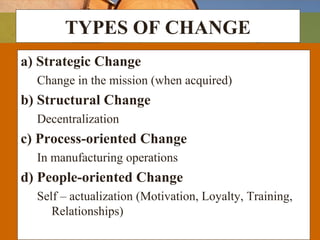
TYPES OF CHANGE
a) Strategic Change
Change in the mission (when acquired)
b) Structural Change
Decentralization
c) Process-oriented Change
In manufacturing operations
d) People-oriented Change
Self – actualization (Motivation, Loyalty, Training,
Relationships)
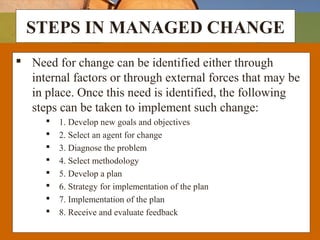
STEPS IN MANAGED CHANGE
 Need for change can be identified either through
internal factors or through external forces that may be
in place. Once this need is identified, the following
steps can be taken to implement such change:
 1. Develop new goals and objectives
 2. Select an agent for change
 3. Diagnose the problem
 4. Select methodology
 5. Develop a plan
 6. Strategy for implementation of the plan
 7. Implementation of the plan
 8. Receive and evaluate feedback
RESISTANCE TO CHANGE
 Resistance to change - a natural phenomenon
 Not all change is resisted
 In organisation changes are accepted than resisted
 Acceptance to change is Adaption
 Resistance to change is Unnatural behavior
 Failure to understand this characteristic of
resistance can cause many managers to attempt to
run through changes rather than try to understand
the sources of the resistance.
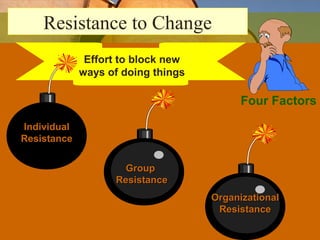
Resistance to Change
Four Factors
OrganizationalOrganizational
ResistanceResistance
GroupGroup
ResistanceResistance
Effort to block new
ways of doing things
IndividualIndividual
ResistanceResistance
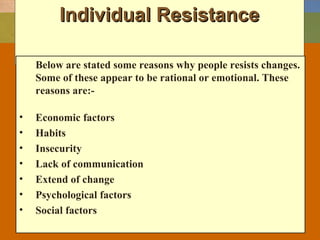
Individual ResistanceIndividual Resistance
Below are stated some reasons why people resists changes.
Some of these appear to be rational or emotional. These
reasons are:-
• Economic factors
• Habits
• Insecurity
• Lack of communication
• Extend of change
• Psychological factors
• Social factors
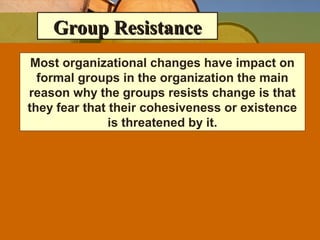
Group ResistanceGroup Resistance
Most organizational changes have impact on
formal groups in the organization the main
reason why the groups resists change is that
they fear that their cohesiveness or existence
is threatened by it.
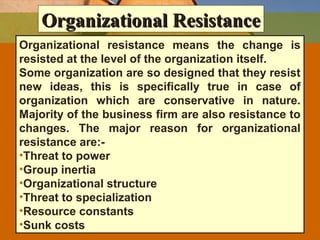
Organizational ResistanceOrganizational Resistance
Organizational resistance means the change is
resisted at the level of the organization itself.
Some organization are so designed that they resist
new ideas, this is specifically true in case of
organization which are conservative in nature.
Majority of the business firm are also resistance to
changes. The major reason for organizational
resistance are:-
•Threat to power
•Group inertia
•Organizational structure
•Threat to specialization
•Resource constants
•Sunk costs
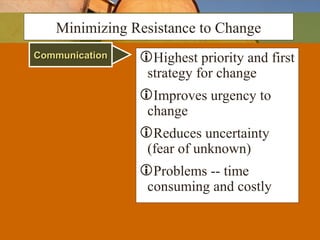
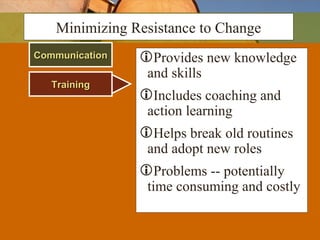
CommunicationCommunication Highest priority and first
strategy for change
Improves urgency to
change
Reduces uncertainty
(fear of unknown)
Problems -- time
consuming and costly
Minimizing Resistance to Change
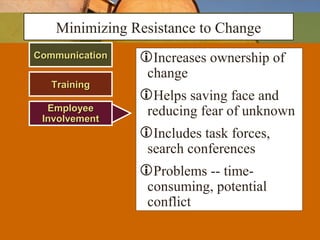
CommunicationCommunication Provides new knowledge
and skills
Includes coaching and
action learning
Helps break old routines
and adopt new roles
Problems -- potentially
time consuming and costly
Minimizing Resistance to Change
TrainingTraining
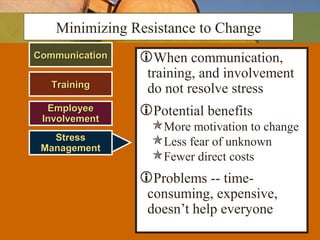
CommunicationCommunication Increases ownership of
change
Helps saving face and
reducing fear of unknown
Includes task forces,
search conferences
Problems -- time-
consuming, potential
conflict
Minimizing Resistance to Change
TrainingTraining
EmployeeEmployee
InvolvementInvolvement
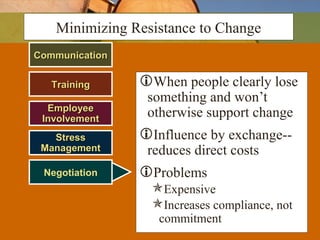
CommunicationCommunication When communication,
training, and involvement
do not resolve stress
Potential benefits
More motivation to change
Less fear of unknown
Fewer direct costs
Problems -- time-
consuming, expensive,
doesn’t help everyone
Minimizing Resistance to Change
TrainingTraining
EmployeeEmployee
InvolvementInvolvement
StressStress
ManagementManagement
CommunicationCommunication
When people clearly lose
something and won’t
otherwise support change
Influence by exchange--
reduces direct costs
Problems
Expensive
Increases compliance, not
commitment
Minimizing Resistance to Change
TrainingTraining
EmployeeEmployee
InvolvementInvolvement
StressStress
ManagementManagement
Negotiation
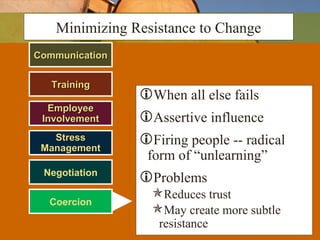
CommunicationCommunication
When all else fails
Assertive influence
Firing people -- radical
form of “unlearning”
Problems
Reduces trust
May create more subtle
resistance
Minimizing Resistance to Change
TrainingTraining
EmployeeEmployee
InvolvementInvolvement
StressStress
ManagementManagement
Negotiation
Coercion
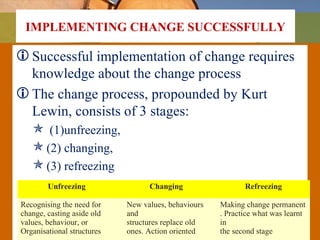
IMPLEMENTING CHANGE SUCCESSFULLY
Successful implementation of change requires
knowledge about the change process
The change process, propounded by Kurt
Lewin, consists of 3 stages:
 (1)unfreezing,
 (2) changing,
 (3) refreezing
Unfreezing Changing Refreezing
Recognising the need for
change, casting aside old
values, behaviour, or
Organisational structures
New values, behaviours
and
structures replace old
ones. Action oriented
Making change permanent
. Practice what was learnt
in
the second stage
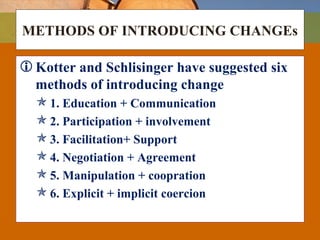
METHODS OF INTRODUCING CHANGEs
Kotter and Schlisinger have suggested six
methods of introducing change
 1. Education + Communication
 2. Participation + involvement
 3. Facilitation+ Support
 4. Negotiation + Agreement
 5. Manipulation + coopration
 6. Explicit + implicit coercion
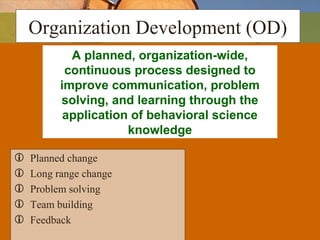
Organization Development (OD)
 Planned change
 Long range change
 Problem solving
 Team building
 Feedback
A planned, organization-wide,
continuous process designed to
improve communication, problem
solving, and learning through the
application of behavioral science
knowledge
Organizationalchange 120113214516-phpapp02

Organizationalchange 120113214516-phpapp02

  • 1.
    Organizational Change Prepared by Jayadev Sahoo Mihir ketan Barik Abhishek Rout
  • 2.
    Lesson Plan  Objectives Introduction  Concept of organizational change  forces for change  levels of change  Types of change  Steps in managed change  Resistance to change  Implementing change successfully  Methods of introducing change
  • 3.
    Organisation  Organization isa social system.  All parts of organization affect all other parts  Anything happening at one end is transmitted to the other end  Interrelationship between the elements & environment  Orderly behaviour – equilibrium  Becomes an established way of life  Disturbance to this naturally exercises pressure  Evokes a reaction – acceptance/rejection
  • 4.
    External & Internalforces  External Forces  Macro environment (PEST factors)  Micro Environment (Consumers, Suppliers, Stake Holders)  Opportunities & Threats (SWOT)  Internal Forces  Internal Environment (Men, Money, Machinery, Materials, Minutes)  Strengths & Weaknesses (SWOT)
  • 5.
    Change In anOrganization  It is in a constant interactional and interdependent relationship with its environment  Change in its external environment, such as changes in consumer tastes and preferences, competition, economic policies of the Government, etc., make it imperative for an organisation to make changes in its internal system  Composed of a number of subsystems which are also in a dynamic relationship of interaction and interdependence with one another  Any change in a subsystem creates a chain of changes throughout the entire system
  • 6.
    CONCEPT OF ORGANISATIONALCHANGE  ‘Organisational change’ implies the creation of imbalances in the existing pattern of situation  Operations & Functions for a long time establishes structural set-up  Members evolve a tentative set of relations with the environment, adjustment with job, working conditions, friends and colleagues etc.  Change requires individuals to make new adjustments. Hence the fear of adjustment gives rise to the problem of change and resistance to change
  • 7.
    FORCES FOR CHANGE ExternalForces  Demographic characteristics,  Technological advances,  Market changes, and  Social and political pressures Internal Forces  Human resource problems and Prospects  Managerial behavior/decisions
  • 8.
    LEVELS OF CHANGE (a) Individual Level Change  Job assignment, physical Move, Change in maturity of a person  Not significant on organisation, but significant on group  b) Group Level Changes  Major effect because organizational activities are done in groups like departments or informal groups  affect workflows, job design, social organisation, influence and status systems, and communication patterns.  Managers must consider group factors  (c) Organization Level Changes  involves major programs that affect both individuals and groups  Decisions regarding these changes are generally made by senior management and are seldom implemented by only a single manager
  • 9.
    TYPES OF CHANGE a)Strategic Change Change in the mission (when acquired) b) Structural Change Decentralization c) Process-oriented Change In manufacturing operations d) People-oriented Change Self – actualization (Motivation, Loyalty, Training, Relationships)
  • 10.
    STEPS IN MANAGEDCHANGE  Need for change can be identified either through internal factors or through external forces that may be in place. Once this need is identified, the following steps can be taken to implement such change:  1. Develop new goals and objectives  2. Select an agent for change  3. Diagnose the problem  4. Select methodology  5. Develop a plan  6. Strategy for implementation of the plan  7. Implementation of the plan  8. Receive and evaluate feedback
  • 11.
    RESISTANCE TO CHANGE Resistance to change - a natural phenomenon  Not all change is resisted  In organisation changes are accepted than resisted  Acceptance to change is Adaption  Resistance to change is Unnatural behavior  Failure to understand this characteristic of resistance can cause many managers to attempt to run through changes rather than try to understand the sources of the resistance.
  • 12.
    Resistance to Change FourFactors OrganizationalOrganizational ResistanceResistance GroupGroup ResistanceResistance Effort to block new ways of doing things IndividualIndividual ResistanceResistance
  • 13.
    Individual ResistanceIndividual Resistance Beloware stated some reasons why people resists changes. Some of these appear to be rational or emotional. These reasons are:- • Economic factors • Habits • Insecurity • Lack of communication • Extend of change • Psychological factors • Social factors
  • 14.
    Group ResistanceGroup Resistance Mostorganizational changes have impact on formal groups in the organization the main reason why the groups resists change is that they fear that their cohesiveness or existence is threatened by it.
  • 15.
    Organizational ResistanceOrganizational Resistance Organizationalresistance means the change is resisted at the level of the organization itself. Some organization are so designed that they resist new ideas, this is specifically true in case of organization which are conservative in nature. Majority of the business firm are also resistance to changes. The major reason for organizational resistance are:- •Threat to power •Group inertia •Organizational structure •Threat to specialization •Resource constants •Sunk costs
  • 16.
    CommunicationCommunication Highest priorityand first strategy for change Improves urgency to change Reduces uncertainty (fear of unknown) Problems -- time consuming and costly Minimizing Resistance to Change
  • 17.
    CommunicationCommunication Provides newknowledge and skills Includes coaching and action learning Helps break old routines and adopt new roles Problems -- potentially time consuming and costly Minimizing Resistance to Change TrainingTraining
  • 18.
    CommunicationCommunication Increases ownershipof change Helps saving face and reducing fear of unknown Includes task forces, search conferences Problems -- time- consuming, potential conflict Minimizing Resistance to Change TrainingTraining EmployeeEmployee InvolvementInvolvement
  • 19.
    CommunicationCommunication When communication, training,and involvement do not resolve stress Potential benefits More motivation to change Less fear of unknown Fewer direct costs Problems -- time- consuming, expensive, doesn’t help everyone Minimizing Resistance to Change TrainingTraining EmployeeEmployee InvolvementInvolvement StressStress ManagementManagement
  • 20.
    CommunicationCommunication When people clearlylose something and won’t otherwise support change Influence by exchange-- reduces direct costs Problems Expensive Increases compliance, not commitment Minimizing Resistance to Change TrainingTraining EmployeeEmployee InvolvementInvolvement StressStress ManagementManagement Negotiation
  • 21.
    CommunicationCommunication When all elsefails Assertive influence Firing people -- radical form of “unlearning” Problems Reduces trust May create more subtle resistance Minimizing Resistance to Change TrainingTraining EmployeeEmployee InvolvementInvolvement StressStress ManagementManagement Negotiation Coercion
  • 22.
    IMPLEMENTING CHANGE SUCCESSFULLY Successfulimplementation of change requires knowledge about the change process The change process, propounded by Kurt Lewin, consists of 3 stages:  (1)unfreezing,  (2) changing,  (3) refreezing Unfreezing Changing Refreezing Recognising the need for change, casting aside old values, behaviour, or Organisational structures New values, behaviours and structures replace old ones. Action oriented Making change permanent . Practice what was learnt in the second stage
  • 23.
    METHODS OF INTRODUCINGCHANGEs Kotter and Schlisinger have suggested six methods of introducing change  1. Education + Communication  2. Participation + involvement  3. Facilitation+ Support  4. Negotiation + Agreement  5. Manipulation + coopration  6. Explicit + implicit coercion
  • 24.
    Organization Development (OD) Planned change  Long range change  Problem solving  Team building  Feedback A planned, organization-wide, continuous process designed to improve communication, problem solving, and learning through the application of behavioral science knowledge

Editor's Notes

  • #13 Banner stretches across on mouse click and hides on next mouse click. Man with four factors dissolves in on mouse click. Time bombs zoom in automatically at one second intervals. Resistance to change – Efforts to block the introduction of new approaches. Some of these efforts are passive in nature, involving such tactics as verbally supporting the change while continuing to work in the old ways; other efforts are active in nature, involving tactics such as organized protests and sabotage. Lack of understanding – Communicate clearly what the change entails. Different assessments – Include potential or actual resisters in the decision-making process. Self-interest – Reason with resistors, transfer or coerce them. Low tolerance for change – Offer or assure support for the resistors during the learning process.