PRESENTED BY:PRESENTED TO:
PIMG
COMMUNICATION
“Communication is the sum total of all the things one
person does when he wants to create understanding in
the mind of another. It is a bridge of meaning. It
involves a systematic and continuous process of telling,
listening and understanding.”
 The process of exchanging information and meaning between or
among individuals through a common system of symbols, signs,
and behavior.
 The process of creating and exchanging meaning through
symbolic interaction.
• Business communicators create and exchange knowledge that are
critical to fostering innovation. This act of exchanging information is
executed by communicating internally and externally.
COMMUNICATING IN ORGANISATIONS
The process of establishing a
common understanding between or
among people within business
environment
Definition of Business Communication
• Most managers and executives in today’s business
setting now write their own email, memos and letters
on their computer as it is faster and more efficient.
• As such, the requisition and skill in business
communication has become the essential for all to
acquire.
Business Communication
• In the challenging world of business, a company must
always remain competitive.
• To keep it in line with others, the ability to create and
exchange innovative knowledge is crucial.
• The act of exchanging information is mediated
through communication – by means of internal or
external
Business Communication
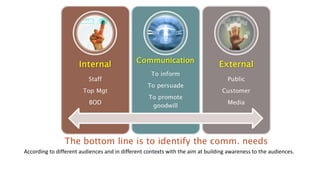
According to different audiences and in different contexts with the aim at building awareness to the audiences.
8
Importance & Difference Of Business
Communication
• Time is money & time has a cost
• Time is limited with project,workhours
• Business people are not our family or friends
• Business is not a game or joke but serious
• It is a half-diplomatic environment
• We may need any person in our career path with the nice memories
about us.
• Business Communication is regulated by certain rules and norms. In
early times, business communication was limited to paper-work,
telephone calls etc. But now with advent of technology, we have cell
phones, video conferencing, emails, satellite communication to support
business communication. Effective business communication helps in
building goodwill of an organization.

• Promotions, salary increases and productivity relate directly to
communication competence.
Importance Of Business Communication
1. Convey Messages
• communication allows a process to take place. The sender sends a
message through a medium. The receiver receives it, processes it
and then gives a feedback which completes the communication
process.
• Without this process, no two people could ever communicate
effectively. There would be no information dispatched and hence
no work done
Need of Business Communication
2. Clarity of Ideas
• When one communicates with another in a business
scenario, it is important to understand that the message has
to be conveyed in such a way that there is complete clarity
in what is being said. The message should be so clear that all
doubts and vague and unclear thoughts will be dispelled.
• The communication process also allows for the person who
has received the message to give a feedback and therefore
the communication format achieves a 360 degree solution.
3. Get Work Done
• It is only through the adaption of the varied communication
processes like speech, body language, gestures and other
feedback mediums that any work can be expected to get
done.
• An instruction, for example, that is given by a boss to his
subordinate needs to be carried through till the final stage of
execution. If the process of communication and feedback is
missing, an end result is never possible.
4. Avoid Misunderstandings
• When two people work together, there is bound to be
miscommunication at times, which can lead to
misunderstandings and other problems in the workplace.
Which naturally affects the work adversely and the business
suffers.
• Communication offers a platform whereby all the
misunderstandings can get cleared and one can hope for
solutions. This is crucial if there has to be a success made of
the plan.
5. Increase Productivity and Efficiency
• When there is a proper communication process taking place
then the productivity and efficiency of the employees
increases.
• This is because the right information is dispelled and the
correct action executed. Therefore there is no, or very less
scope for mistakes to happen.
6. Employee Job Satisfaction
• When there is scope for open communication at the
work place.
• There is a clear path provided, whereby the seniors
and subordinates can talk and solve workplace
conflicts amongst themselves.
• To exchange information: The main objective of business communication is to
exchange information with internal and external parties.
• To develop plans: Plan is the blueprint of future courses of actions. The plan
must be formulated for attaining organizational goals. In order to develop a
plan, management requires information. In this regard, the objective of
communication is to supply required information to the concerned managers.
• To implement the plan: Once a plan is prepared, it is to be implemented.
Implementation of a plan requires timely communication with the concerned
parties. Thus, communication aims at transmitting a plan throughout the
organization for its successful implementation.
Purpose/Objective of Business Communication
• To facilitate policy formulation: Policies are guidelines for performing
organizational activities. Policies are also termed as standing decisions to recurring
problems. Every organization needs to develop a set of policies to guide its operation.
Preparing policies also require information from various sources. Therefore, the
objective of communication is to collect necessary information for policy formulation.
• To achieve organizational goal: Collective efforts of both managers and workers are
essential for achieving organizational goals. Communication coordinates and
synchronizes the efforts of employees at various levels to achieve the stated goals of
the organization.
• To organize resources: Various kinds of resources are available in an organization
such as human resources, material resources, financial resources and so on. In
organizing these resources in an effective and efficient way is a key challenge to the
managers. Communication is the vehicle to overcome this challenge.
• To coordinate: Coordination is a basic management function. It involves
linking the various functional departments of large organizations. Without
proper and timely coordination, an achievement of organizational goals is
impossible. Therefore, the objective of communication is to coordinate the
functions of various departments for the easy attainment of organizational goals.
• To direct the subordinates: The job of a manager is to get the things done by
others. In order to get the things done, management needs to lead, direct and
control the employees. The performance of these managerial functions depends
on effective communication with subordinates.
• To motivate employees: A pre-requisite of employee motivation is the
satisfaction of their financial and non-financial needs. Financial needs are
fulfilled thorough monetary returns. However, in order to satisfy non-financial
needs, management must communicate with employees on a regular basis both
formally and informally.
• To create consciousness: Employees of an organization must be conscious
regarding their duties and responsibilities. Communication supplies necessary
information and makes them conscious about their duties and responsibilities.
• To increase efficiency: In order to increase employee efficiency, they should be
provided with necessary information and guidelines. Communication supplies such
information and guidelines for them.
• To orient employee: Communication orients the new employees with the
company’s policies, rules, regulations, procedures etc.
• To improve labor-management relationships: Harmonious relationship between
workers and management is a prerequisite for organizational success. In this regard,
the objective of communication is to ensure the free and fair flow of information
and to create good understanding between them.
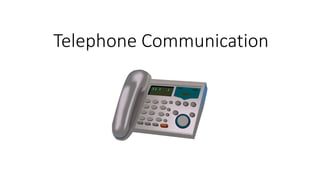
Telephone Communication
Impressions?
• How you conduct yourself on the telephone = face-to-face
interactions
Answering the phone?
HELLO
Guessing Game?
• Identify yourself, office or organization in as few words as possible
Tone
• Cheerful and considerate attitude toward each telephone caller.
• Smile when you answer or talk on the phone
• ***It will show on the other end.
Identification?
• Give your name when the telephone is answered, before asking for
the person you are requesting
Mumbo Jumbo!!
• Enunciate your words very carefully
Considerate
• Keep business conversations to the point
Holding???
• Do not keep someone on hold more than 30 seconds.
Leaving a message!
• Always leave your phone number if you ask someone to call you back
• Even if you think they have it
Listening Well!!
• Listening is essential whether in person or on the phone
Call Me Back!!!
• Always return your calls on the same day
Timing?
• Think about the time when making a phone call.
• Not acceptable to call someone before 7-8 a.m. and after 8:30-9
p.m..
• Avoid meal times
Oops!
• Never hang-up when you realize you have a wrong number
• Apologize and then hang up
Ring Time?
• When calling someone, let the telephone ring a reasonable length
of time
Call Times?
• Calling a business at or very near closing time = inconsiderate
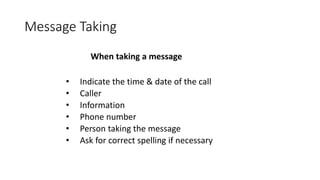
Message Taking
When taking a message
• Indicate the time & date of the call
• Caller
• Information
• Phone number
• Person taking the message
• Ask for correct spelling if necessary
Never – ever!
• Never – eat, drink or chew gum on the phone
Please leave a message!
• Leave a message when appropriate – especially with caller-ID,
people will see you called so they should not have to wonder what
you needed.
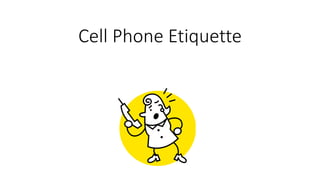
Cell Phone Etiquette
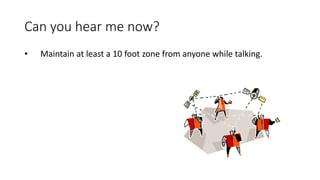
Can you hear me now?
• Maintain at least a 10 foot zone from anyone while talking.
Emotions
• Don’t have emotional conversations in public – ever.
Language – yes I can hear you too!
• Watch your language & tone of voice
• Others are watching and getting impressions of you
Ring Tones!!
• Don’t use loud and annoying ring tones
Personal vs. Business
• Never take a personal call during a business meeting.
If you have too
• If you must answer a cell phone in a public setting, answer and tell
the person to hold a minute while you remove yourself from the
room.
Manner Mode
• Always keep your phone on manner mode when in a public event
such as a convention or meeting.
BUSINESS COMMUNICATION ppt

BUSINESS COMMUNICATION ppt

  • 1.
  • 2.
    COMMUNICATION “Communication is thesum total of all the things one person does when he wants to create understanding in the mind of another. It is a bridge of meaning. It involves a systematic and continuous process of telling, listening and understanding.”  The process of exchanging information and meaning between or among individuals through a common system of symbols, signs, and behavior.  The process of creating and exchanging meaning through symbolic interaction.
  • 3.
    • Business communicatorscreate and exchange knowledge that are critical to fostering innovation. This act of exchanging information is executed by communicating internally and externally. COMMUNICATING IN ORGANISATIONS
  • 4.
    The process ofestablishing a common understanding between or among people within business environment Definition of Business Communication
  • 5.
    • Most managersand executives in today’s business setting now write their own email, memos and letters on their computer as it is faster and more efficient. • As such, the requisition and skill in business communication has become the essential for all to acquire. Business Communication
  • 6.
    • In thechallenging world of business, a company must always remain competitive. • To keep it in line with others, the ability to create and exchange innovative knowledge is crucial. • The act of exchanging information is mediated through communication – by means of internal or external Business Communication
  • 7.
    According to differentaudiences and in different contexts with the aim at building awareness to the audiences.
  • 8.
    8 Importance & DifferenceOf Business Communication • Time is money & time has a cost • Time is limited with project,workhours • Business people are not our family or friends • Business is not a game or joke but serious • It is a half-diplomatic environment • We may need any person in our career path with the nice memories about us.
  • 9.
    • Business Communicationis regulated by certain rules and norms. In early times, business communication was limited to paper-work, telephone calls etc. But now with advent of technology, we have cell phones, video conferencing, emails, satellite communication to support business communication. Effective business communication helps in building goodwill of an organization. • Promotions, salary increases and productivity relate directly to communication competence. Importance Of Business Communication
  • 10.
    1. Convey Messages •communication allows a process to take place. The sender sends a message through a medium. The receiver receives it, processes it and then gives a feedback which completes the communication process. • Without this process, no two people could ever communicate effectively. There would be no information dispatched and hence no work done Need of Business Communication
  • 11.
    2. Clarity ofIdeas • When one communicates with another in a business scenario, it is important to understand that the message has to be conveyed in such a way that there is complete clarity in what is being said. The message should be so clear that all doubts and vague and unclear thoughts will be dispelled. • The communication process also allows for the person who has received the message to give a feedback and therefore the communication format achieves a 360 degree solution.
  • 12.
    3. Get WorkDone • It is only through the adaption of the varied communication processes like speech, body language, gestures and other feedback mediums that any work can be expected to get done. • An instruction, for example, that is given by a boss to his subordinate needs to be carried through till the final stage of execution. If the process of communication and feedback is missing, an end result is never possible.
  • 13.
    4. Avoid Misunderstandings •When two people work together, there is bound to be miscommunication at times, which can lead to misunderstandings and other problems in the workplace. Which naturally affects the work adversely and the business suffers. • Communication offers a platform whereby all the misunderstandings can get cleared and one can hope for solutions. This is crucial if there has to be a success made of the plan.
  • 14.
    5. Increase Productivityand Efficiency • When there is a proper communication process taking place then the productivity and efficiency of the employees increases. • This is because the right information is dispelled and the correct action executed. Therefore there is no, or very less scope for mistakes to happen.
  • 15.
    6. Employee JobSatisfaction • When there is scope for open communication at the work place. • There is a clear path provided, whereby the seniors and subordinates can talk and solve workplace conflicts amongst themselves.
  • 16.
    • To exchangeinformation: The main objective of business communication is to exchange information with internal and external parties. • To develop plans: Plan is the blueprint of future courses of actions. The plan must be formulated for attaining organizational goals. In order to develop a plan, management requires information. In this regard, the objective of communication is to supply required information to the concerned managers. • To implement the plan: Once a plan is prepared, it is to be implemented. Implementation of a plan requires timely communication with the concerned parties. Thus, communication aims at transmitting a plan throughout the organization for its successful implementation. Purpose/Objective of Business Communication
  • 17.
    • To facilitatepolicy formulation: Policies are guidelines for performing organizational activities. Policies are also termed as standing decisions to recurring problems. Every organization needs to develop a set of policies to guide its operation. Preparing policies also require information from various sources. Therefore, the objective of communication is to collect necessary information for policy formulation. • To achieve organizational goal: Collective efforts of both managers and workers are essential for achieving organizational goals. Communication coordinates and synchronizes the efforts of employees at various levels to achieve the stated goals of the organization. • To organize resources: Various kinds of resources are available in an organization such as human resources, material resources, financial resources and so on. In organizing these resources in an effective and efficient way is a key challenge to the managers. Communication is the vehicle to overcome this challenge.
  • 18.
    • To coordinate:Coordination is a basic management function. It involves linking the various functional departments of large organizations. Without proper and timely coordination, an achievement of organizational goals is impossible. Therefore, the objective of communication is to coordinate the functions of various departments for the easy attainment of organizational goals. • To direct the subordinates: The job of a manager is to get the things done by others. In order to get the things done, management needs to lead, direct and control the employees. The performance of these managerial functions depends on effective communication with subordinates. • To motivate employees: A pre-requisite of employee motivation is the satisfaction of their financial and non-financial needs. Financial needs are fulfilled thorough monetary returns. However, in order to satisfy non-financial needs, management must communicate with employees on a regular basis both formally and informally.
  • 19.
    • To createconsciousness: Employees of an organization must be conscious regarding their duties and responsibilities. Communication supplies necessary information and makes them conscious about their duties and responsibilities. • To increase efficiency: In order to increase employee efficiency, they should be provided with necessary information and guidelines. Communication supplies such information and guidelines for them. • To orient employee: Communication orients the new employees with the company’s policies, rules, regulations, procedures etc. • To improve labor-management relationships: Harmonious relationship between workers and management is a prerequisite for organizational success. In this regard, the objective of communication is to ensure the free and fair flow of information and to create good understanding between them.
  • 20.
  • 21.
    Impressions? • How youconduct yourself on the telephone = face-to-face interactions
  • 22.
  • 23.
    Guessing Game? • Identifyyourself, office or organization in as few words as possible
  • 24.
    Tone • Cheerful andconsiderate attitude toward each telephone caller. • Smile when you answer or talk on the phone • ***It will show on the other end.
  • 25.
    Identification? • Give yourname when the telephone is answered, before asking for the person you are requesting
  • 26.
    Mumbo Jumbo!! • Enunciateyour words very carefully
  • 27.
    Considerate • Keep businessconversations to the point
  • 28.
    Holding??? • Do notkeep someone on hold more than 30 seconds.
  • 29.
    Leaving a message! •Always leave your phone number if you ask someone to call you back • Even if you think they have it
  • 30.
    Listening Well!! • Listeningis essential whether in person or on the phone
  • 31.
    Call Me Back!!! •Always return your calls on the same day
  • 32.
    Timing? • Think aboutthe time when making a phone call. • Not acceptable to call someone before 7-8 a.m. and after 8:30-9 p.m.. • Avoid meal times
  • 33.
    Oops! • Never hang-upwhen you realize you have a wrong number • Apologize and then hang up
  • 34.
    Ring Time? • Whencalling someone, let the telephone ring a reasonable length of time
  • 35.
    Call Times? • Callinga business at or very near closing time = inconsiderate
  • 36.
    Message Taking When takinga message • Indicate the time & date of the call • Caller • Information • Phone number • Person taking the message • Ask for correct spelling if necessary
  • 37.
    Never – ever! •Never – eat, drink or chew gum on the phone
  • 38.
    Please leave amessage! • Leave a message when appropriate – especially with caller-ID, people will see you called so they should not have to wonder what you needed.
  • 39.
  • 40.
    Can you hearme now? • Maintain at least a 10 foot zone from anyone while talking.
  • 41.
    Emotions • Don’t haveemotional conversations in public – ever.
  • 42.
    Language – yesI can hear you too! • Watch your language & tone of voice • Others are watching and getting impressions of you
  • 43.
    Ring Tones!! • Don’tuse loud and annoying ring tones
  • 44.
    Personal vs. Business •Never take a personal call during a business meeting.
  • 45.
    If you havetoo • If you must answer a cell phone in a public setting, answer and tell the person to hold a minute while you remove yourself from the room.
  • 46.
    Manner Mode • Alwayskeep your phone on manner mode when in a public event such as a convention or meeting.