LEADERSHIP
IS
SITUATIONAL
Preview
Leadership
Leadership Theory
Leadership Styles
Leaders in some
situational case
Conclusion
What is leadership?
Influencing people
Commanding people
Guiding people
Leading people
LEADERSHIP DEFN…
The ability to influence a
group toward the
achievement of a vision or
set of goals.
Leadership Theories
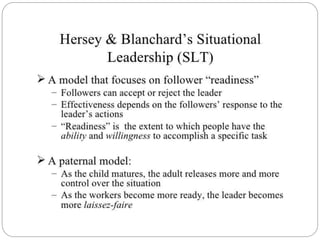
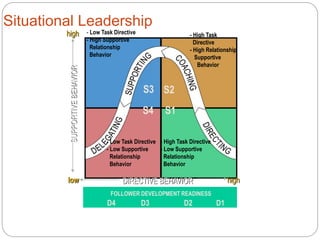
Situational Leadership Model (Hersey and
Blanchard)
- Focuses on amount of guidance given
- Relationship oriented behavior
- Readiness level of individuals to perform
tasks
- Forms 4 possible leadership styles
- Appropriate style depends on subordinate
readiness combined with leader’s view of
performance
Situational Leadership
S1
SUPPORTIVEBEHAVIOR
DIRECTIVE BEHAVIORlow
high
high
- High Task
Directive
- High Relationship
Supportive
Behavior
S2
- Low Task Directive
- High Supportive
Relationship
Behavior
S3
S4
- High Task Directive
- Low Supportive
Relationship
Behavior
- Low Task Directive
- Low Supportive
Relationship
Behavior
FOLLOWER DEVELOPMENT READINESS
D4 D3 D2 D1
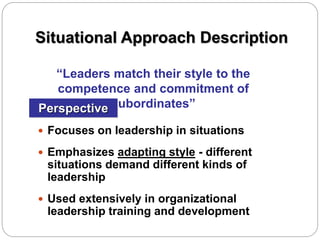
Situational Approach Description
 Focuses on leadership in situations
 Emphasizes adapting style - different
situations demand different kinds of
leadership
 Used extensively in organizational
leadership training and development
Perspective
“Leaders match their style to the
competence and commitment of
subordinates”
Selecting a Style
 Some people are motivated by reward .
 Some people are motivated by
punishment.
 Social systems work best with a chain
of command.
 When people have agreed to do a job, a
part of the deal is that they cede
authority to their leader.
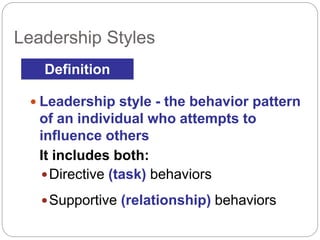
 Leadership style - the behavior pattern
of an individual who attempts to
influence others
It includes both:
Directive (task) behaviors
Supportive (relationship) behaviors
Definition
Leadership Styles
Leadership Styles, cont’d.
Dimension Definitions
 Directive behaviors - Help group
members in goal achievement via
one-way communication through:
 Giving directions
 Establishing goals & how to achieve them
 Methods of evaluation & time lines
 Defining roles
Leadership Styles, cont’d.
Dimension Definitions
 Supportive behaviors - Assist group
members via two-way
communication in feeling
comfortable with themselves, co-
workers, and situation
 Asking for input
 Problem solving
 Praising; listening
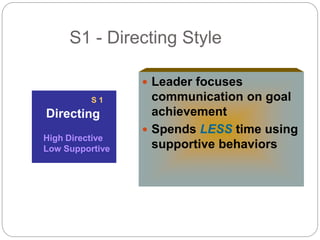
S1 - Directing Style
 Leader focuses
communication on goal
achievement
 Spends LESS time using
supportive behaviors
High Directive
Low Supportive
S 1
S2 - Coaching Style
 Leader focuses
communication on BOTH
goal achievement and
supporting subordinates’
socioemotional needs
 Requires leader involvement
through encouragement and
soliciting subordinate input
High Directive
High Supportive
S 2
S3 - Supporting Style
 Leader does NOT focus solely
on goals; rather the leader
uses supportive behaviors to
bring out employee skills in
accomplishing the task
 Leader delegates day-to-day
decision-making control, but
is available to facilitate
problem solving
High Supportive
Low Directive
S 3
S4 - Delegating Style
 Leader offers LESS task
input and social support;
facilitates subordinates’
confidence and motivation
in relation to the task
 Leader lessens involvement
in planning, control of
details, and goal
clarification
 Gives subordinates control
and refrains from
intervention and unneeded
social support
Low Supportive
Low Directive
S 4
Leadership Styles
 Autocratic (Authoritarian)
 Bureaucratic
 Democratic
 Coercive
 Transactional
 Transformational
 Laissez-Faire
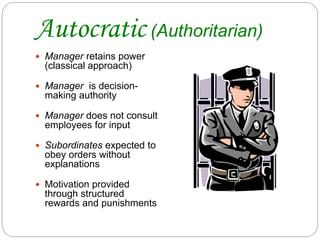
Autocratic (Authoritarian)
 Manager retains power
(classical approach)
 Manager is decision-
making authority
 Manager does not consult
employees for input
 Subordinates expected to
obey orders without
explanations
 Motivation provided
through structured
rewards and punishments
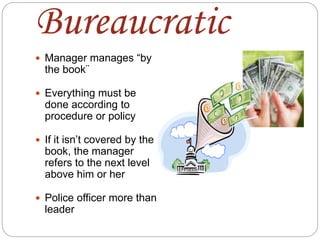
Bureaucratic
 Manager manages “by
the book¨
 Everything must be
done according to
procedure or policy
 If it isn’t covered by the
book, the manager
refers to the next level
above him or her
 Police officer more than
leader
Democratic
 Often referred to as
participative style
 Keeps employees
informed
 Shares decision
making and problem
solving responsibilities
 “Coach” who has the
final say, but…
 Gathers information
from staff members
before making
decisions
Coercive
 Power from a person’s
authority to punish
 Most obvious types of
power a leader has.
 Good leaders use
coercive power only as a
last resort:
 In today’s sophisticated
and complex workplace,
excessive use of
coercive power
unleashes unpredictable
and destabilizing forces
which can ultimately
undermine the leader
using it. You’re Fired!
Transactional
 Motivate followers by
appealing to their own
self-interest
 Motivate by the exchange
process.
 Focuses on the
accomplishment of tasks
& good worker
relationships in exchange
for desirable rewards.
 Encourage leader to
adapt their style and
behavior to meet
expectations of followers
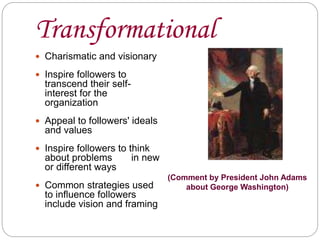
Transformational
 Charismatic and visionary
 Inspire followers to
transcend their self-
interest for the
organization
 Appeal to followers' ideals
and values
 Inspire followers to think
about problems in new
or different ways
 Common strategies used
to influence followers
include vision and framing
(Comment by President John Adams
about George Washington)
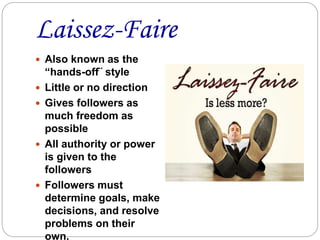
Laissez-Faire
 Also known as the
“hands-off¨ style
 Little or no direction
 Gives followers as
much freedom as
possible
 All authority or power
is given to the
followers
 Followers must
determine goals, make
decisions, and resolve
problems on their
own.
LEADER IN SOME SITUATION
 Political Situation
 Emergency Situation
 Bad Situation
 Good Situation
 Struggling situation
 Spiritual
CONCLUSION
Leadership is differ from person to person
and situation to situation. It depend
persons mentality activity. It is created
from person own desire. A literacy
people can’t be a good leader. For a
Successful leader no need to require a
good educational qualification Require
presence of mind.
leadership

leadership

  • 1.
  • 2.
  • 3.
    What is leadership? Influencingpeople Commanding people Guiding people Leading people
  • 4.
    LEADERSHIP DEFN… The abilityto influence a group toward the achievement of a vision or set of goals.
  • 6.
    Leadership Theories Situational LeadershipModel (Hersey and Blanchard) - Focuses on amount of guidance given - Relationship oriented behavior - Readiness level of individuals to perform tasks - Forms 4 possible leadership styles - Appropriate style depends on subordinate readiness combined with leader’s view of performance
  • 8.
    Situational Leadership S1 SUPPORTIVEBEHAVIOR DIRECTIVE BEHAVIORlow high high -High Task Directive - High Relationship Supportive Behavior S2 - Low Task Directive - High Supportive Relationship Behavior S3 S4 - High Task Directive - Low Supportive Relationship Behavior - Low Task Directive - Low Supportive Relationship Behavior FOLLOWER DEVELOPMENT READINESS D4 D3 D2 D1
  • 9.
    Situational Approach Description Focuses on leadership in situations  Emphasizes adapting style - different situations demand different kinds of leadership  Used extensively in organizational leadership training and development Perspective “Leaders match their style to the competence and commitment of subordinates”
  • 10.
    Selecting a Style Some people are motivated by reward .  Some people are motivated by punishment.  Social systems work best with a chain of command.  When people have agreed to do a job, a part of the deal is that they cede authority to their leader.
  • 11.
     Leadership style- the behavior pattern of an individual who attempts to influence others It includes both: Directive (task) behaviors Supportive (relationship) behaviors Definition Leadership Styles
  • 12.
    Leadership Styles, cont’d. DimensionDefinitions  Directive behaviors - Help group members in goal achievement via one-way communication through:  Giving directions  Establishing goals & how to achieve them  Methods of evaluation & time lines  Defining roles
  • 13.
    Leadership Styles, cont’d. DimensionDefinitions  Supportive behaviors - Assist group members via two-way communication in feeling comfortable with themselves, co- workers, and situation  Asking for input  Problem solving  Praising; listening
  • 14.
    S1 - DirectingStyle  Leader focuses communication on goal achievement  Spends LESS time using supportive behaviors High Directive Low Supportive S 1
  • 15.
    S2 - CoachingStyle  Leader focuses communication on BOTH goal achievement and supporting subordinates’ socioemotional needs  Requires leader involvement through encouragement and soliciting subordinate input High Directive High Supportive S 2
  • 16.
    S3 - SupportingStyle  Leader does NOT focus solely on goals; rather the leader uses supportive behaviors to bring out employee skills in accomplishing the task  Leader delegates day-to-day decision-making control, but is available to facilitate problem solving High Supportive Low Directive S 3
  • 17.
    S4 - DelegatingStyle  Leader offers LESS task input and social support; facilitates subordinates’ confidence and motivation in relation to the task  Leader lessens involvement in planning, control of details, and goal clarification  Gives subordinates control and refrains from intervention and unneeded social support Low Supportive Low Directive S 4
  • 18.
    Leadership Styles  Autocratic(Authoritarian)  Bureaucratic  Democratic  Coercive  Transactional  Transformational  Laissez-Faire
  • 19.
    Autocratic (Authoritarian)  Managerretains power (classical approach)  Manager is decision- making authority  Manager does not consult employees for input  Subordinates expected to obey orders without explanations  Motivation provided through structured rewards and punishments
  • 20.
    Bureaucratic  Manager manages“by the book¨  Everything must be done according to procedure or policy  If it isn’t covered by the book, the manager refers to the next level above him or her  Police officer more than leader
  • 21.
    Democratic  Often referredto as participative style  Keeps employees informed  Shares decision making and problem solving responsibilities  “Coach” who has the final say, but…  Gathers information from staff members before making decisions
  • 22.
    Coercive  Power froma person’s authority to punish  Most obvious types of power a leader has.  Good leaders use coercive power only as a last resort:  In today’s sophisticated and complex workplace, excessive use of coercive power unleashes unpredictable and destabilizing forces which can ultimately undermine the leader using it. You’re Fired!
  • 23.
    Transactional  Motivate followersby appealing to their own self-interest  Motivate by the exchange process.  Focuses on the accomplishment of tasks & good worker relationships in exchange for desirable rewards.  Encourage leader to adapt their style and behavior to meet expectations of followers
  • 24.
    Transformational  Charismatic andvisionary  Inspire followers to transcend their self- interest for the organization  Appeal to followers' ideals and values  Inspire followers to think about problems in new or different ways  Common strategies used to influence followers include vision and framing (Comment by President John Adams about George Washington)
  • 25.
    Laissez-Faire  Also knownas the “hands-off¨ style  Little or no direction  Gives followers as much freedom as possible  All authority or power is given to the followers  Followers must determine goals, make decisions, and resolve problems on their own.
  • 26.
    LEADER IN SOMESITUATION  Political Situation  Emergency Situation  Bad Situation  Good Situation  Struggling situation  Spiritual
  • 27.
    CONCLUSION Leadership is differfrom person to person and situation to situation. It depend persons mentality activity. It is created from person own desire. A literacy people can’t be a good leader. For a Successful leader no need to require a good educational qualification Require presence of mind.