BUSINESS COMMUNICATION  AN INTRODUCTION
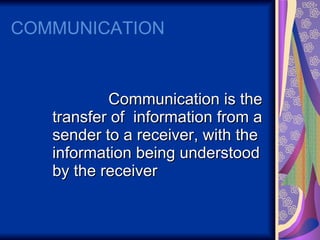
COMMUNICATION Communication is the transfer of  information from a sender to a receiver, with the information being understood by the receiver
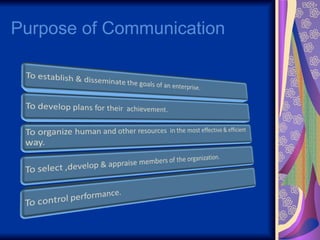
Purpose of Communication
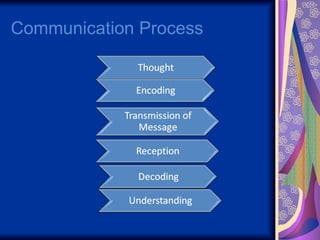
Communication Process
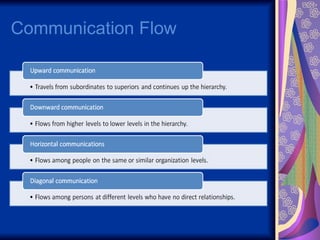
Communication Flow
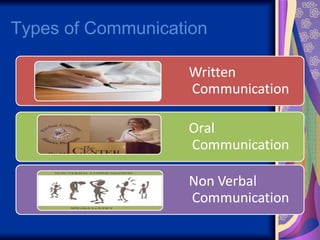
Types of Communication
Written Communication  Written communication can  promote uniformity in policy and procedures. It has the advantage of providing records , references and legal defenses.
Tips for Improving Written Communication  Use simple words and phrases. Use short and familiar words. Use personal pronouns whenever required. Give illustrations and examples. Use short sentences and paragraphs. Avoid unnecessary words
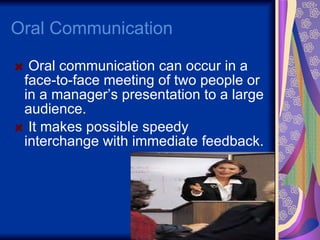
Oral Communication Oral communication can occur in a face-to-face meeting of two people or in a manager’s presentation to a large audience. It makes possible speedy interchange with immediate feedback.
Tips for Improving Oral Communication  Communicate with a large audience. Tell a story , an anecdote. Pause – do not rush. Use visuals aids. Communicate confidence and create trust through clear voice ,good posture and a smile.
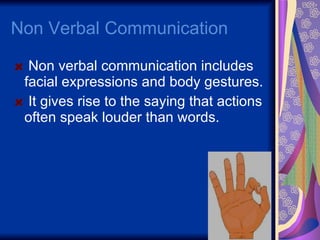
Non Verbal Communication Non verbal communication includes facial expressions and body gestures. It gives rise to the saying that actions often speak louder than words.
Tips for Improving Non Verbal Communication  Establish and maintain eye contact. Use posture to show interest. Improve your decoding skills. Appreciate the power of appearance. Avoid assigning nonverbal meanings out of  context.
Barriers in Communication  Lack of planning. Poorly expressed message. Inadequate feedback. Quantity of information. Not recognizing the receivers’ needs.
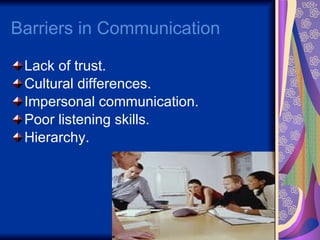
Barriers in Communication  Lack of trust. Cultural differences. Impersonal communication. Poor listening skills. Hierarchy.
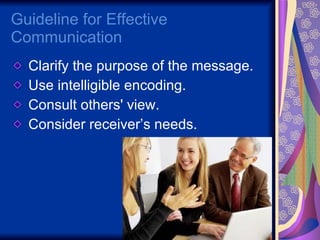
Guideline for Effective Communication Clarify the purpose of the message. Use intelligible encoding. Consult others' view. Consider receiver’s needs.
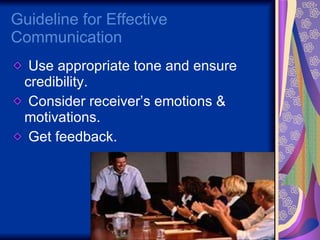
Guideline for Effective Communication Use appropriate tone and ensure credibility. Consider receiver’s emotions & motivations. Get feedback.
References Management (Heinz Weihrich,Mark V Cannice,Harold Koontz). Business Communication for managers (Penrose,Rasberry,Myers). PRESENTED  BY  BHOOPATHI RAJA KATAMA RAJU NAKUL YADAV RACHNA PANDA SOWJANYA

Business communication

  • 1.
    BUSINESS COMMUNICATION AN INTRODUCTION
  • 2.
    COMMUNICATION Communication isthe transfer of information from a sender to a receiver, with the information being understood by the receiver
  • 3.
  • 4.
  • 5.
  • 6.
  • 7.
    Written Communication Written communication can promote uniformity in policy and procedures. It has the advantage of providing records , references and legal defenses.
  • 8.
    Tips for ImprovingWritten Communication Use simple words and phrases. Use short and familiar words. Use personal pronouns whenever required. Give illustrations and examples. Use short sentences and paragraphs. Avoid unnecessary words
  • 9.
    Oral Communication Oralcommunication can occur in a face-to-face meeting of two people or in a manager’s presentation to a large audience. It makes possible speedy interchange with immediate feedback.
  • 10.
    Tips for ImprovingOral Communication Communicate with a large audience. Tell a story , an anecdote. Pause – do not rush. Use visuals aids. Communicate confidence and create trust through clear voice ,good posture and a smile.
  • 11.
    Non Verbal CommunicationNon verbal communication includes facial expressions and body gestures. It gives rise to the saying that actions often speak louder than words.
  • 12.
    Tips for ImprovingNon Verbal Communication Establish and maintain eye contact. Use posture to show interest. Improve your decoding skills. Appreciate the power of appearance. Avoid assigning nonverbal meanings out of context.
  • 13.
    Barriers in Communication Lack of planning. Poorly expressed message. Inadequate feedback. Quantity of information. Not recognizing the receivers’ needs.
  • 14.
    Barriers in Communication Lack of trust. Cultural differences. Impersonal communication. Poor listening skills. Hierarchy.
  • 15.
    Guideline for EffectiveCommunication Clarify the purpose of the message. Use intelligible encoding. Consult others' view. Consider receiver’s needs.
  • 16.
    Guideline for EffectiveCommunication Use appropriate tone and ensure credibility. Consider receiver’s emotions & motivations. Get feedback.
  • 17.
    References Management (HeinzWeihrich,Mark V Cannice,Harold Koontz). Business Communication for managers (Penrose,Rasberry,Myers). PRESENTED BY BHOOPATHI RAJA KATAMA RAJU NAKUL YADAV RACHNA PANDA SOWJANYA