Forest types in India
Prepared by:
Rasila Jambucha
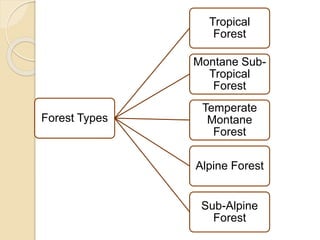
Forest Types
Tropical
Forest
Montane Sub-
Tropical
Forest
Temperate
Montane
Forest
Alpine Forest
Sub-Alpine
Forest
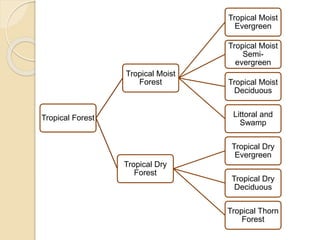
Tropical Forest
Tropical Moist
Forest
Tropical Moist
Evergreen
Tropical Moist
Semi-
evergreen
Tropical Moist
Deciduous
Littoral and
Swamp
Tropical Dry
Forest
Tropical Dry
Evergreen
Tropical Dry
Deciduous
Tropical Thorn
Forest
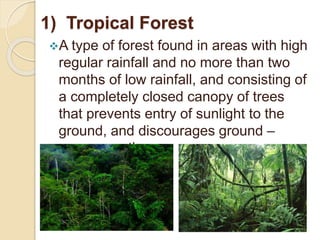
1) Tropical Forest
A type of forest found in areas with high
regular rainfall and no more than two
months of low rainfall, and consisting of
a completely closed canopy of trees
that prevents entry of sunlight to the
ground, and discourages ground –
cover growth.
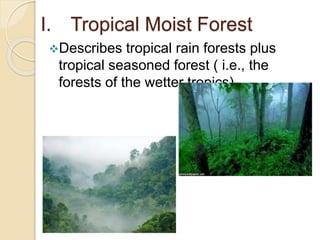
I. Tropical Moist Forest
Describes tropical rain forests plus
tropical seasoned forest ( i.e., the
forests of the wetter tropics)
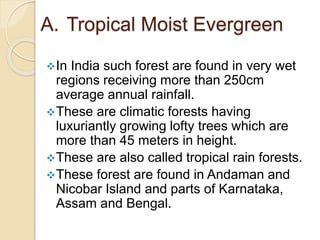
A. Tropical Moist Evergreen
In India such forest are found in very wet
regions receiving more than 250cm
average annual rainfall.
These are climatic forests having
luxuriantly growing lofty trees which are
more than 45 meters in height.
These are also called tropical rain forests.
These forest are found in Andaman and
Nicobar Island and parts of Karnataka,
Assam and Bengal.
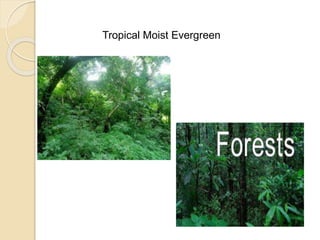
Tropical Moist Evergreen
B. Tropical Moist Semi-
evergreen
The annual rainfall of this type of
forest is between 200 and 250cm.
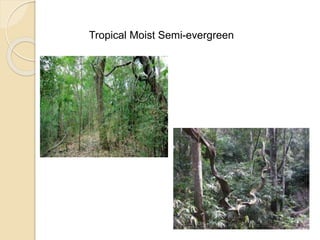
They are characterized by giant and
luxuriantly growing intermixed
deciduous and evergreen species of
trees and shrubs.
These forest are found in Eastern
Orissa and upper Assam.
Tropical Moist Semi-evergreen
C. Tropical Moist Deciduous
It receiving sufficiently rainfall between
100 to 200cm, spread over most of
years.
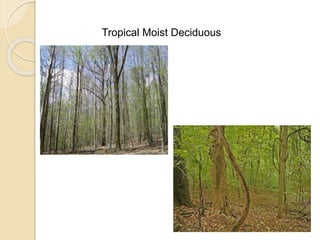
The dry periods are of short duration.
Many plants of such forest show leaf-
fall in hot summer.
This forest are found along the wet
Western side i.e., Mumbai, (N.E) –
Andhra.
Tropical Moist Deciduous
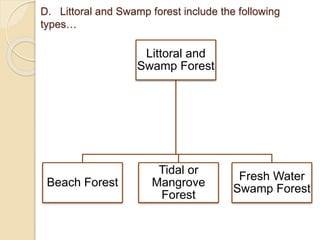
D. Littoral and Swamp forest include the following
types…
Littoral and
Swamp Forest
Beach Forest
Tidal or
Mangrove
Forest
Fresh Water
Swamp Forest
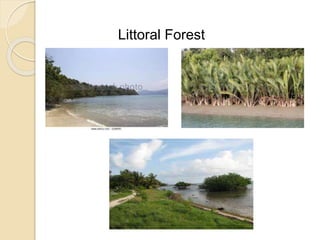
Littoral Forest
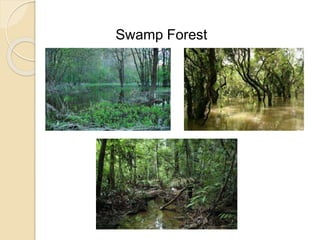
Swamp Forest
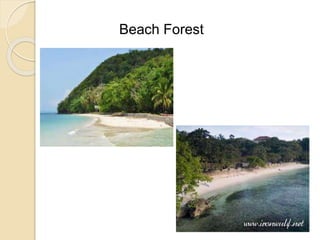
A. Beach Forest
It found all along the sea beaches and
river deltas.
The soil is sandy having large amount
of lime and salts but poor in nitrogen
and other mineral nutrients.
Water table is only few meters deep
and temperature is moderate.
The rainfall of this type of forest is
75cm to 500cm depending upon the
area.
Beach Forest
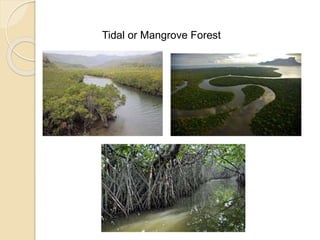
B. Tidal or Mangrove Forest
This forest grow near the deltas of
rivers, swampy margins of island and
along sea coasts.
The soil is formed of silt, silt-loam or silt-
clay and sand.
Tidal or Mangrove Forest
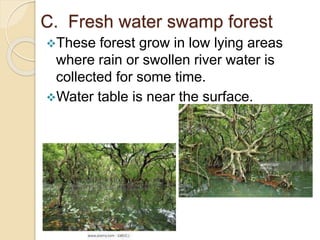
C. Fresh water swamp forest
These forest grow in low lying areas
where rain or swollen river water is
collected for some time.
Water table is near the surface.
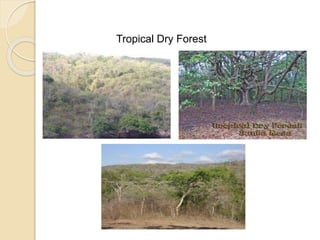
II. Tropical Dry Forest
Similar to Tropical Moist forest but
characterized by high temperatures
throughout the year.
Predominantly deciduous trees shed
their leaves to cope with it.
Here sunlight can reach the ground so,
the season that’s bad for the trees is
good for the forest floor.
Tropical Dry Forest
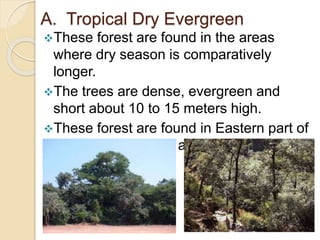
A. Tropical Dry Evergreen
These forest are found in the areas
where dry season is comparatively
longer.
The trees are dense, evergreen and
short about 10 to 15 meters high.
These forest are found in Eastern part of
Tamil Nadu, in east and west coasts.
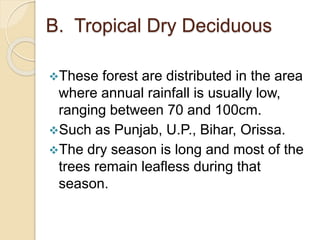
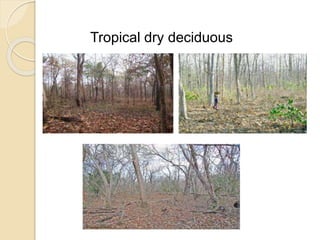
B. Tropical Dry Deciduous
These forest are distributed in the area
where annual rainfall is usually low,
ranging between 70 and 100cm.
Such as Punjab, U.P., Bihar, Orissa.
The dry season is long and most of the
trees remain leafless during that
season.
Tropical dry deciduous
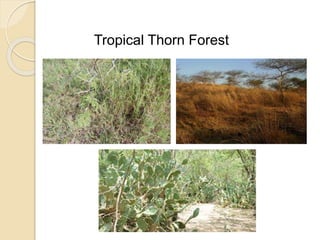
C. Tropical Thorn Forest
This forest found in the areas where
annual rainfall is between 20 to 70cm.
Dry season is hot and very long.
They are found in South Punjab and
Rajasthan.
The vegetation in these area occur only
along the rivers.
The land away from the rivers and devoid
of irrigation is mostly sandy and devoid of
trees.
The vegetation type consisting of small
Tropical Thorn Forest
2) Montane Subtropical Forest
Montane means – mountainous,
specifically, related to the cool, moist
upland slopes below the timberline
Subtropical means – pertaining to the
regions of the earth further from the
equator than the tropical regions
These forest are found in the region of
fairly high rainfall but where temperature
differences between winter and
summer.
Winter generally goes without rains.
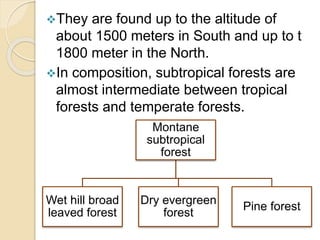
They are found up to the altitude of
about 1500 meters in South and up to t
1800 meter in the North.
In composition, subtropical forests are
almost intermediate between tropical
forests and temperate forests.
Montane
subtropical
forest
Wet hill broad
leaved forest
Dry evergreen
forest
Pine forest
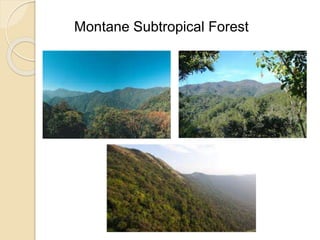
Montane Subtropical Forest
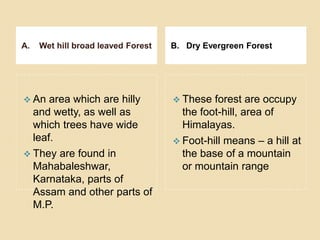
A. Wet hill broad leaved Forest B. Dry Evergreen Forest
 An area which are hilly
and wetty, as well as
which trees have wide
leaf.
 They are found in
Mahabaleshwar,
Karnataka, parts of
Assam and other parts of
M.P.
 These forest are occupy
the foot-hill, area of
Himalayas.
 Foot-hill means – a hill at
the base of a mountain
or mountain range
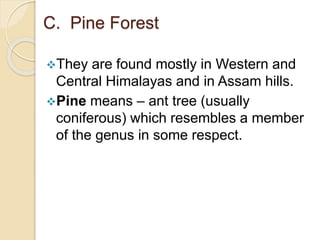
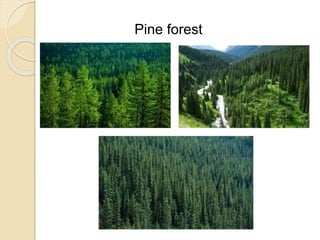
C. Pine Forest
They are found mostly in Western and
Central Himalayas and in Assam hills.
Pine means – ant tree (usually
coniferous) which resembles a member
of the genus in some respect.
Pine forest
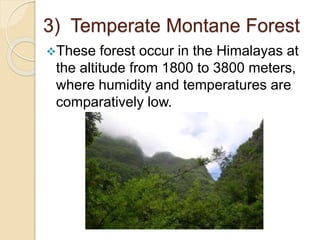
3) Temperate Montane Forest
These forest occur in the Himalayas at
the altitude from 1800 to 3800 meters,
where humidity and temperatures are
comparatively low.
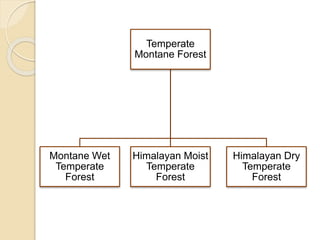
Temperate
Montane Forest
Montane Wet
Temperate
Forest
Himalayan Moist
Temperate
Forest
Himalayan Dry
Temperate
Forest
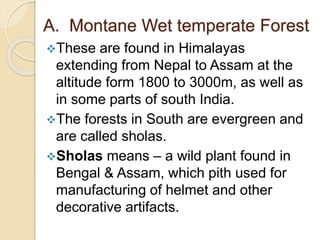
A. Montane Wet temperate Forest
These are found in Himalayas
extending from Nepal to Assam at the
altitude form 1800 to 3000m, as well as
in some parts of south India.
The forests in South are evergreen and
are called sholas.
Sholas means – a wild plant found in
Bengal & Assam, which pith used for
manufacturing of helmet and other
decorative artifacts.
B. Himalayan Moist Temperate
Forest
These forests develop in the areas of
lesser rainfall.
The trees are high, sometimes up to 45
meters tall.
C. Himalayan Dry Temperate Forest
These forests are found in the Western
Himalayas extending from a part of
Uttaranchal through Himachal Pradesh
and Punjab to Kashmir.
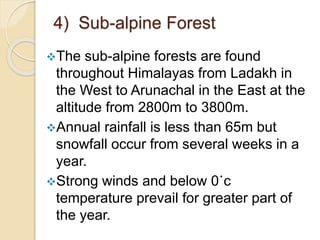
4) Sub-alpine Forest
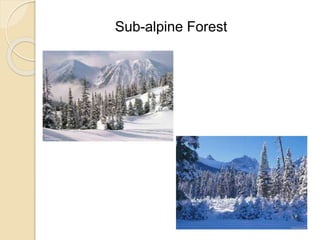
The sub-alpine forests are found
throughout Himalayas from Ladakh in
the West to Arunachal in the East at the
altitude from 2800m to 3800m.
Annual rainfall is less than 65m but
snowfall occur from several weeks in a
year.
Strong winds and below 0˙c
temperature prevail for greater part of
the year.
Sub-alpine Forest
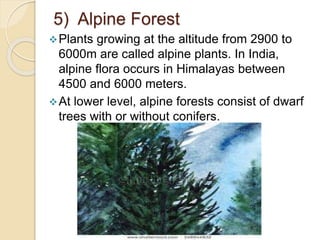
5) Alpine Forest
Plants growing at the altitude from 2900 to
6000m are called alpine plants. In India,
alpine flora occurs in Himalayas between
4500 and 6000 meters.
At lower level, alpine forests consist of dwarf
trees with or without conifers.
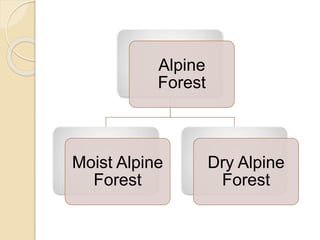
Alpine
Forest
Moist Alpine
Forest
Dry Alpine
Forest
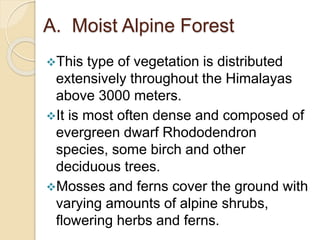
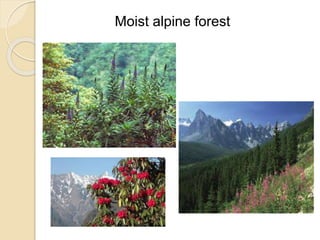
A. Moist Alpine Forest
This type of vegetation is distributed
extensively throughout the Himalayas
above 3000 meters.
It is most often dense and composed of
evergreen dwarf Rhododendron
species, some birch and other
deciduous trees.
Mosses and ferns cover the ground with
varying amounts of alpine shrubs,
flowering herbs and ferns.
Moist alpine forest
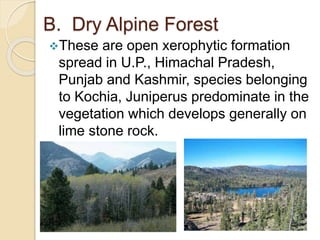
B. Dry Alpine Forest
These are open xerophytic formation
spread in U.P., Himachal Pradesh,
Punjab and Kashmir, species belonging
to Kochia, Juniperus predominate in the
vegetation which develops generally on
lime stone rock.

Forest Types

  • 1.
    Forest types inIndia Prepared by: Rasila Jambucha
  • 2.
  • 3.
    Tropical Forest Tropical Moist Forest TropicalMoist Evergreen Tropical Moist Semi- evergreen Tropical Moist Deciduous Littoral and Swamp Tropical Dry Forest Tropical Dry Evergreen Tropical Dry Deciduous Tropical Thorn Forest
  • 4.
    1) Tropical Forest Atype of forest found in areas with high regular rainfall and no more than two months of low rainfall, and consisting of a completely closed canopy of trees that prevents entry of sunlight to the ground, and discourages ground – cover growth.
  • 5.
    I. Tropical MoistForest Describes tropical rain forests plus tropical seasoned forest ( i.e., the forests of the wetter tropics)
  • 6.
    A. Tropical MoistEvergreen In India such forest are found in very wet regions receiving more than 250cm average annual rainfall. These are climatic forests having luxuriantly growing lofty trees which are more than 45 meters in height. These are also called tropical rain forests. These forest are found in Andaman and Nicobar Island and parts of Karnataka, Assam and Bengal.
  • 7.
  • 8.
    B. Tropical MoistSemi- evergreen The annual rainfall of this type of forest is between 200 and 250cm. They are characterized by giant and luxuriantly growing intermixed deciduous and evergreen species of trees and shrubs. These forest are found in Eastern Orissa and upper Assam.
  • 9.
  • 10.
    C. Tropical MoistDeciduous It receiving sufficiently rainfall between 100 to 200cm, spread over most of years. The dry periods are of short duration. Many plants of such forest show leaf- fall in hot summer. This forest are found along the wet Western side i.e., Mumbai, (N.E) – Andhra.
  • 11.
  • 12.
    D. Littoral andSwamp forest include the following types… Littoral and Swamp Forest Beach Forest Tidal or Mangrove Forest Fresh Water Swamp Forest
  • 13.
  • 14.
  • 15.
    A. Beach Forest Itfound all along the sea beaches and river deltas. The soil is sandy having large amount of lime and salts but poor in nitrogen and other mineral nutrients. Water table is only few meters deep and temperature is moderate. The rainfall of this type of forest is 75cm to 500cm depending upon the area.
  • 16.
  • 17.
    B. Tidal orMangrove Forest This forest grow near the deltas of rivers, swampy margins of island and along sea coasts. The soil is formed of silt, silt-loam or silt- clay and sand.
  • 18.
  • 19.
    C. Fresh waterswamp forest These forest grow in low lying areas where rain or swollen river water is collected for some time. Water table is near the surface.
  • 20.
    II. Tropical DryForest Similar to Tropical Moist forest but characterized by high temperatures throughout the year. Predominantly deciduous trees shed their leaves to cope with it. Here sunlight can reach the ground so, the season that’s bad for the trees is good for the forest floor.
  • 21.
  • 22.
    A. Tropical DryEvergreen These forest are found in the areas where dry season is comparatively longer. The trees are dense, evergreen and short about 10 to 15 meters high. These forest are found in Eastern part of Tamil Nadu, in east and west coasts.
  • 23.
    B. Tropical DryDeciduous These forest are distributed in the area where annual rainfall is usually low, ranging between 70 and 100cm. Such as Punjab, U.P., Bihar, Orissa. The dry season is long and most of the trees remain leafless during that season.
  • 24.
  • 25.
    C. Tropical ThornForest This forest found in the areas where annual rainfall is between 20 to 70cm. Dry season is hot and very long. They are found in South Punjab and Rajasthan. The vegetation in these area occur only along the rivers. The land away from the rivers and devoid of irrigation is mostly sandy and devoid of trees. The vegetation type consisting of small
  • 26.
  • 27.
    2) Montane SubtropicalForest Montane means – mountainous, specifically, related to the cool, moist upland slopes below the timberline Subtropical means – pertaining to the regions of the earth further from the equator than the tropical regions These forest are found in the region of fairly high rainfall but where temperature differences between winter and summer. Winter generally goes without rains.
  • 28.
    They are foundup to the altitude of about 1500 meters in South and up to t 1800 meter in the North. In composition, subtropical forests are almost intermediate between tropical forests and temperate forests. Montane subtropical forest Wet hill broad leaved forest Dry evergreen forest Pine forest
  • 29.
  • 30.
    A. Wet hillbroad leaved Forest B. Dry Evergreen Forest  An area which are hilly and wetty, as well as which trees have wide leaf.  They are found in Mahabaleshwar, Karnataka, parts of Assam and other parts of M.P.  These forest are occupy the foot-hill, area of Himalayas.  Foot-hill means – a hill at the base of a mountain or mountain range
  • 31.
    C. Pine Forest Theyare found mostly in Western and Central Himalayas and in Assam hills. Pine means – ant tree (usually coniferous) which resembles a member of the genus in some respect.
  • 32.
  • 33.
    3) Temperate MontaneForest These forest occur in the Himalayas at the altitude from 1800 to 3800 meters, where humidity and temperatures are comparatively low.
  • 34.
    Temperate Montane Forest Montane Wet Temperate Forest HimalayanMoist Temperate Forest Himalayan Dry Temperate Forest
  • 35.
    A. Montane Wettemperate Forest These are found in Himalayas extending from Nepal to Assam at the altitude form 1800 to 3000m, as well as in some parts of south India. The forests in South are evergreen and are called sholas. Sholas means – a wild plant found in Bengal & Assam, which pith used for manufacturing of helmet and other decorative artifacts.
  • 36.
    B. Himalayan MoistTemperate Forest These forests develop in the areas of lesser rainfall. The trees are high, sometimes up to 45 meters tall. C. Himalayan Dry Temperate Forest These forests are found in the Western Himalayas extending from a part of Uttaranchal through Himachal Pradesh and Punjab to Kashmir.
  • 37.
    4) Sub-alpine Forest Thesub-alpine forests are found throughout Himalayas from Ladakh in the West to Arunachal in the East at the altitude from 2800m to 3800m. Annual rainfall is less than 65m but snowfall occur from several weeks in a year. Strong winds and below 0˙c temperature prevail for greater part of the year.
  • 38.
  • 39.
    5) Alpine Forest Plantsgrowing at the altitude from 2900 to 6000m are called alpine plants. In India, alpine flora occurs in Himalayas between 4500 and 6000 meters. At lower level, alpine forests consist of dwarf trees with or without conifers.
  • 40.
  • 41.
    A. Moist AlpineForest This type of vegetation is distributed extensively throughout the Himalayas above 3000 meters. It is most often dense and composed of evergreen dwarf Rhododendron species, some birch and other deciduous trees. Mosses and ferns cover the ground with varying amounts of alpine shrubs, flowering herbs and ferns.
  • 42.
  • 43.
    B. Dry AlpineForest These are open xerophytic formation spread in U.P., Himachal Pradesh, Punjab and Kashmir, species belonging to Kochia, Juniperus predominate in the vegetation which develops generally on lime stone rock.