Communication Skill
Principles of
Communication
M.Vijayalakshmi
Assistant Professor
Unit – 1 :
Principles of Communication
1.1 Communication - Definition and concept - Theories
of communication - communication cycle.
1.2 Barriers to communication - causes of barriers to
communication and ways of overcoming them.
1.3 A four-fold analysis of Communication skills - Skill of
Listening, Speaking, Reading and writing.
1.4 Values of Communication skills in the modern
context - Visual and Multimedia Communication.
1.5 Importance of Communication skills for teachers -
Communication in the classroom - Teaching as
communication.
Unit I
Principles of Communication
1.1 Communication - Definition and
Concept - Theories of Communication
- Communication Cycle.
Communication?
• The activity of conveying information through the
exchange of
Thoughts
Messages
Information
Speech,
Visuals, signals, writing, or behavior.
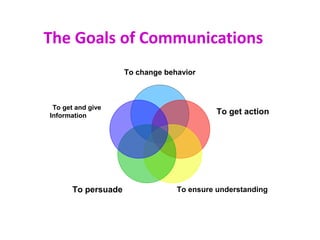
The Goals of Communications
To change behavior
To get action
To ensure understandingTo persuade
To get and give
Information
Meaning
• ‘Communis’ – Latin word – ‘to make
common’
• Having common experiences with
others
• Edgar Dale –
Communication is the sharing of ideas
and feelings in a mood of mutuality
• Communication Media
• Latin root word – ‘communicare’
• Means –
• ‘to make common’ – which is probably
derived from either 2 or 3
• cum + munus – having gifts to share in a
mutual donation
• Cum + munire – building together a
defense like the walls of a city
• Louis Allen –
• Communication is the sum of all
things a person does when he wants
to create an understanding in the
mind of another. It involves a
systematic and continuous process
of telling, listening and
understanding
• Keith Davis –
• It is the process of passing
information and understanding from
one person to another. It is
essentially a bridge of meaning
between people. By using this bridge
of meaning, a person can safely cross
the river of misunderstanding that
separates all the people
• Act of communicating
• Ideas, thoughts, feelings, etc. or transfer any
type of information and knowledge to others
• Instruments, appliances, devices
• Telephone, teleprinter, telegram, fax, e – mail,
radio broadcasting and telecasting
• Two-sided affair
• Sharing process
• Process of Exchange
• Verbal or non-verbal
• Mutual understanding of a fact, principle or
theory
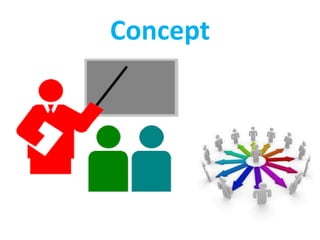
Concept
Concept
• Sharing of ideas and feelings in a mood of
mutuality
• Involving interaction which encourages give
and take
• A process of sharing of experiences till it
become common possession
• A two-way process including feed-back and
interaction
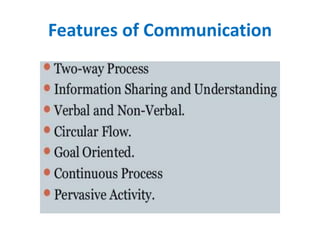
Features of Communication
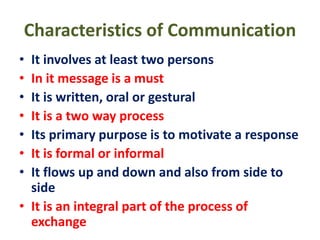
Characteristics of Communication
• It involves at least two persons
• In it message is a must
• It is written, oral or gestural
• It is a two way process
• Its primary purpose is to motivate a response
• It is formal or informal
• It flows up and down and also from side to
side
• It is an integral part of the process of
exchange
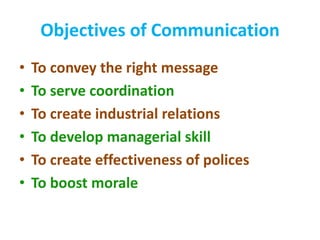
Objectives of Communication
• To convey the right message
• To serve coordination
• To create industrial relations
• To develop managerial skill
• To create effectiveness of polices
• To boost morale
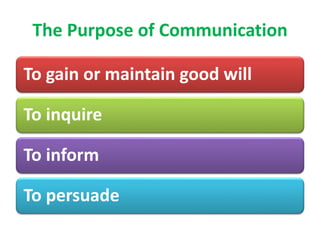
The Purpose of Communication
To gain or maintain good will
To inquire
To inform
To persuade
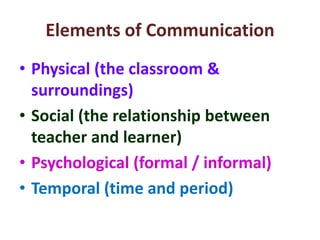
Elements of Communication
• Physical (the classroom &
surroundings)
• Social (the relationship between
teacher and learner)
• Psychological (formal / informal)
• Temporal (time and period)
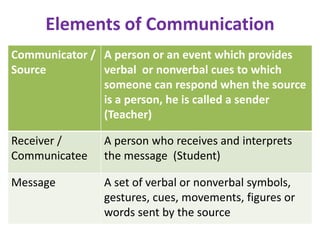
Elements of Communication
Communicator /
Source
A person or an event which provides
verbal or nonverbal cues to which
someone can respond when the source
is a person, he is called a sender
(Teacher)
Receiver /
Communicatee
A person who receives and interprets
the message (Student)
Message A set of verbal or nonverbal symbols,
gestures, cues, movements, figures or
words sent by the source
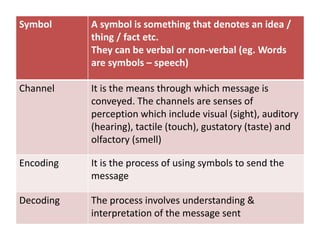
Symbol A symbol is something that denotes an idea /
thing / fact etc.
They can be verbal or non-verbal (eg. Words
are symbols – speech)
Channel It is the means through which message is
conveyed. The channels are senses of
perception which include visual (sight), auditory
(hearing), tactile (touch), gustatory (taste) and
olfactory (smell)
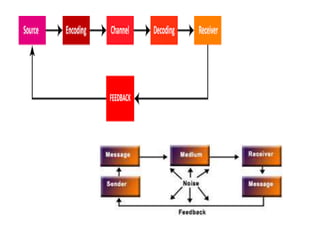
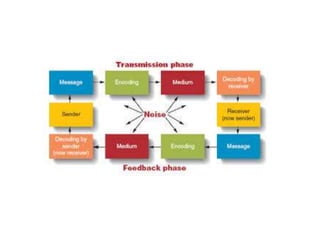
Encoding It is the process of using symbols to send the
message
Decoding The process involves understanding &
interpretation of the message sent
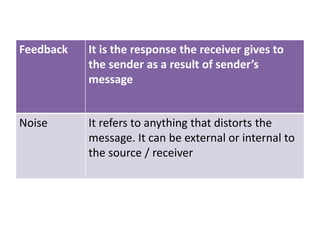
Feedback It is the response the receiver gives to
the sender as a result of sender’s
message
Noise It refers to anything that distorts the
message. It can be external or internal to
the source / receiver
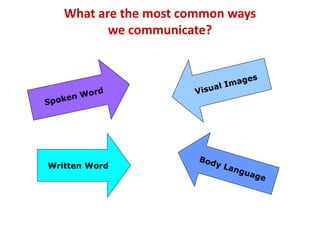
What are the most common ways
we communicate?
Written Word
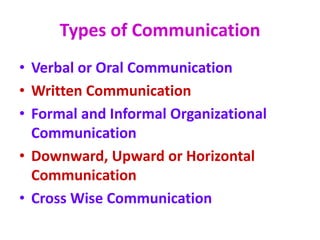
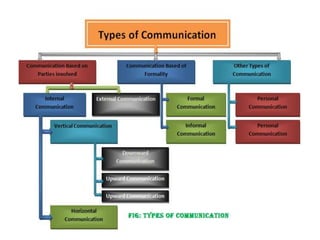
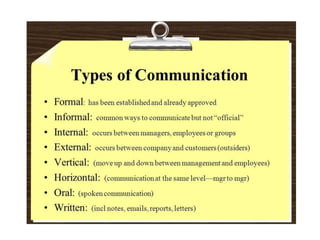
Types of Communication
• Verbal or Oral Communication
• Written Communication
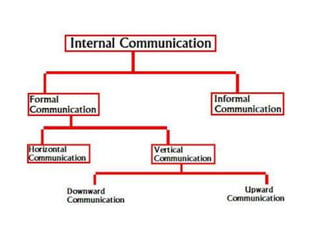
• Formal and Informal Organizational
Communication
• Downward, Upward or Horizontal
Communication
• Cross Wise Communication
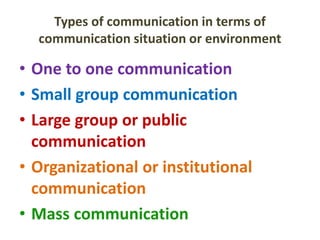
Types of communication in terms of
communication situation or environment
• One to one communication
• Small group communication
• Large group or public
communication
• Organizational or institutional
communication
• Mass communication
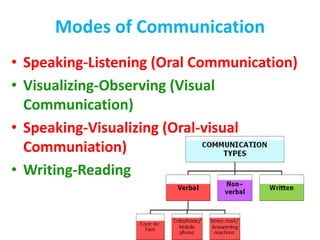
Modes of Communication
• Speaking-Listening (Oral Communication)
• Visualizing-Observing (Visual
Communication)
• Speaking-Visualizing (Oral-visual
Communiation)
• Writing-Reading
Theories of Communication
•Cognitive Dissonance
Theory
•Communication
Accommodation Theory
Cognitive Dissonance Theory
 It argues that the experience of dissonance
(or incompatible beliefs and actions) is
aversive and people are highly motivated to
avoid it.
 In their efforts to avoid feelings of
dissonance, people will avoid hearing views
that oppose their own, change their beliefs
to match their actions, and seek reassurance
after making a difficult decision.
Communication Accommodation Theory
• This theoretical perspective examines the
underlying motivations and consequences of
what happens when two speakers shift their
communication styles.
• Communication Accommodation theorists
argue that during communication, people will
try to accommodate or adjust their style of
speaking to others.
• This is done in two ways: divergence and
convergence.
• Groups with strong ethnic or racial pride
often use divergence to highlight group
identity.
• Convergence occurs when there is a strong
need for social approval, frequently from
powerless individuals.
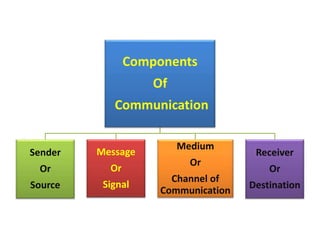
Components
Of
Communication
Sender
Or
Source
Message
Or
Signal
Medium
Or
Channel of
Communication
Receiver
Or
Destination
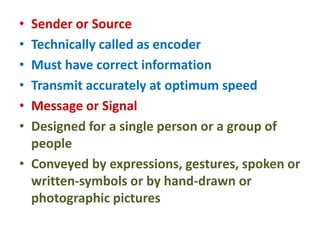
• Sender or Source
• Technically called as encoder
• Must have correct information
• Transmit accurately at optimum speed
• Message or Signal
• Designed for a single person or a group of
people
• Conveyed by expressions, gestures, spoken or
written-symbols or by hand-drawn or
photographic pictures
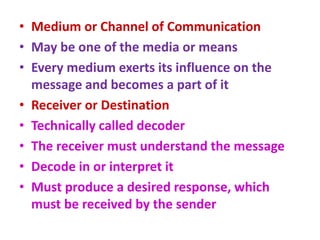
• Medium or Channel of Communication
• May be one of the media or means
• Every medium exerts its influence on the
message and becomes a part of it
• Receiver or Destination
• Technically called decoder
• The receiver must understand the message
• Decode in or interpret it
• Must produce a desired response, which
must be received by the sender
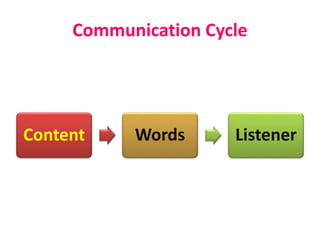
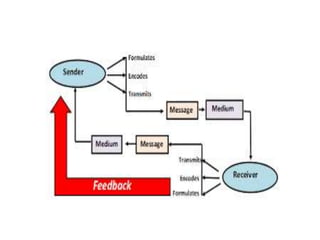
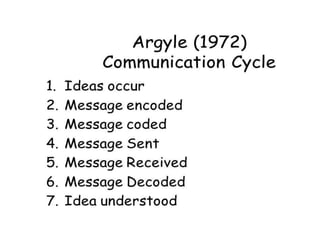
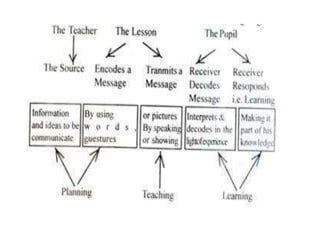
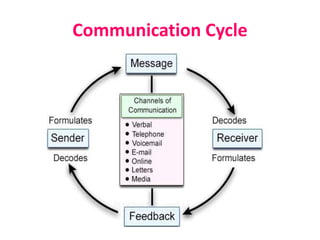
Communication Cycle
Communication Cycle
Content Words Listener
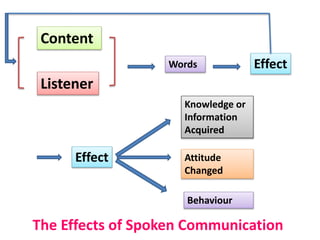
Content
Listener
Words Effect
Effect Attitude
Changed
Knowledge or
Information
Acquired
Behaviour
The Effects of Spoken Communication
The Process of Communication
• Message Concieved – (Sender’s Role)
• (Believe in mind)
• Decision to send a message comes out
as a result of an impulse (a push)
• It is a thought process or external
stimulus, you may call it “rouse to act”
• Possible problem areas
• Message ill conceived
• Message is vagne
• Message is affected by relationship
of sender with receiver
• Message Encoded – (Sender’s Role)
• One should choose appropriate
‘language’,
• Oral
• Written
• Words
• Picture
• Non-verbal communication
• Possible Problem Areas
• Message encoded in wrong
‘Language’
• Tone-inappropriate
• Selection of Medium – (Sender’s Role)
• You should select right medium to send
your message
• Letters
• Interviews
• Electronic Mail
• Telex
• Fax etc
• Possible problem areas
• Wrong medium selected
• Time wasted
• Expense incurred
• No written records
• Message Decoded – (Receiver’s Role)
• Language is decoded from the
knowledge of terms or vocabulary
• Possible problem areas –
• Receiver unable to understand sender’s
language
• Vocabulary too difficult
• Specialist terms puzzle layman
• Message Interpreted – (Receiver’s Role)
• Interpretation underlying as well as
distinct meaning
• Possible problem areas
• Message wrongly interpreted
• Effect of relationship of receiver with
sender
• Ambiguity (The word used has double
meaning)
• Feedback supplied – (Receiver’s Role)
• Signals are passed back to sender by –
• Written reply
• Oral (spoken words)
• Possible problem areas-
• Feedback not given
• Wrongly given feedback
• Misinterpretation by feedback sender
Sources are taken from
•Slideshare.net
•Web sources
Communication skill -Principles of Communication

Communication skill -Principles of Communication

  • 1.
  • 2.
    Unit – 1: Principles of Communication 1.1 Communication - Definition and concept - Theories of communication - communication cycle. 1.2 Barriers to communication - causes of barriers to communication and ways of overcoming them. 1.3 A four-fold analysis of Communication skills - Skill of Listening, Speaking, Reading and writing. 1.4 Values of Communication skills in the modern context - Visual and Multimedia Communication. 1.5 Importance of Communication skills for teachers - Communication in the classroom - Teaching as communication.
  • 3.
    Unit I Principles ofCommunication 1.1 Communication - Definition and Concept - Theories of Communication - Communication Cycle.
  • 4.
    Communication? • The activityof conveying information through the exchange of Thoughts Messages Information Speech, Visuals, signals, writing, or behavior.
  • 6.
    The Goals ofCommunications To change behavior To get action To ensure understandingTo persuade To get and give Information
  • 8.
    Meaning • ‘Communis’ –Latin word – ‘to make common’ • Having common experiences with others • Edgar Dale – Communication is the sharing of ideas and feelings in a mood of mutuality • Communication Media
  • 9.
    • Latin rootword – ‘communicare’ • Means – • ‘to make common’ – which is probably derived from either 2 or 3 • cum + munus – having gifts to share in a mutual donation • Cum + munire – building together a defense like the walls of a city
  • 11.
    • Louis Allen– • Communication is the sum of all things a person does when he wants to create an understanding in the mind of another. It involves a systematic and continuous process of telling, listening and understanding
  • 12.
    • Keith Davis– • It is the process of passing information and understanding from one person to another. It is essentially a bridge of meaning between people. By using this bridge of meaning, a person can safely cross the river of misunderstanding that separates all the people
  • 13.
    • Act ofcommunicating • Ideas, thoughts, feelings, etc. or transfer any type of information and knowledge to others • Instruments, appliances, devices • Telephone, teleprinter, telegram, fax, e – mail, radio broadcasting and telecasting • Two-sided affair • Sharing process • Process of Exchange • Verbal or non-verbal • Mutual understanding of a fact, principle or theory
  • 14.
  • 15.
    Concept • Sharing ofideas and feelings in a mood of mutuality • Involving interaction which encourages give and take • A process of sharing of experiences till it become common possession • A two-way process including feed-back and interaction
  • 16.
  • 17.
    Characteristics of Communication •It involves at least two persons • In it message is a must • It is written, oral or gestural • It is a two way process • Its primary purpose is to motivate a response • It is formal or informal • It flows up and down and also from side to side • It is an integral part of the process of exchange
  • 18.
    Objectives of Communication •To convey the right message • To serve coordination • To create industrial relations • To develop managerial skill • To create effectiveness of polices • To boost morale
  • 19.
    The Purpose ofCommunication To gain or maintain good will To inquire To inform To persuade
  • 20.
    Elements of Communication •Physical (the classroom & surroundings) • Social (the relationship between teacher and learner) • Psychological (formal / informal) • Temporal (time and period)
  • 21.
    Elements of Communication Communicator/ Source A person or an event which provides verbal or nonverbal cues to which someone can respond when the source is a person, he is called a sender (Teacher) Receiver / Communicatee A person who receives and interprets the message (Student) Message A set of verbal or nonverbal symbols, gestures, cues, movements, figures or words sent by the source
  • 22.
    Symbol A symbolis something that denotes an idea / thing / fact etc. They can be verbal or non-verbal (eg. Words are symbols – speech) Channel It is the means through which message is conveyed. The channels are senses of perception which include visual (sight), auditory (hearing), tactile (touch), gustatory (taste) and olfactory (smell) Encoding It is the process of using symbols to send the message Decoding The process involves understanding & interpretation of the message sent
  • 23.
    Feedback It isthe response the receiver gives to the sender as a result of sender’s message Noise It refers to anything that distorts the message. It can be external or internal to the source / receiver
  • 24.
    What are themost common ways we communicate? Written Word
  • 25.
    Types of Communication •Verbal or Oral Communication • Written Communication • Formal and Informal Organizational Communication • Downward, Upward or Horizontal Communication • Cross Wise Communication
  • 29.
    Types of communicationin terms of communication situation or environment • One to one communication • Small group communication • Large group or public communication • Organizational or institutional communication • Mass communication
  • 30.
    Modes of Communication •Speaking-Listening (Oral Communication) • Visualizing-Observing (Visual Communication) • Speaking-Visualizing (Oral-visual Communiation) • Writing-Reading
  • 31.
    Theories of Communication •CognitiveDissonance Theory •Communication Accommodation Theory
  • 32.
    Cognitive Dissonance Theory It argues that the experience of dissonance (or incompatible beliefs and actions) is aversive and people are highly motivated to avoid it.  In their efforts to avoid feelings of dissonance, people will avoid hearing views that oppose their own, change their beliefs to match their actions, and seek reassurance after making a difficult decision.
  • 33.
    Communication Accommodation Theory •This theoretical perspective examines the underlying motivations and consequences of what happens when two speakers shift their communication styles. • Communication Accommodation theorists argue that during communication, people will try to accommodate or adjust their style of speaking to others.
  • 34.
    • This isdone in two ways: divergence and convergence. • Groups with strong ethnic or racial pride often use divergence to highlight group identity. • Convergence occurs when there is a strong need for social approval, frequently from powerless individuals.
  • 35.
  • 36.
    • Sender orSource • Technically called as encoder • Must have correct information • Transmit accurately at optimum speed • Message or Signal • Designed for a single person or a group of people • Conveyed by expressions, gestures, spoken or written-symbols or by hand-drawn or photographic pictures
  • 37.
    • Medium orChannel of Communication • May be one of the media or means • Every medium exerts its influence on the message and becomes a part of it • Receiver or Destination • Technically called decoder • The receiver must understand the message • Decode in or interpret it • Must produce a desired response, which must be received by the sender
  • 38.
  • 39.
  • 40.
    Content Listener Words Effect Effect Attitude Changed Knowledgeor Information Acquired Behaviour The Effects of Spoken Communication
  • 46.
    The Process ofCommunication • Message Concieved – (Sender’s Role) • (Believe in mind) • Decision to send a message comes out as a result of an impulse (a push) • It is a thought process or external stimulus, you may call it “rouse to act”
  • 47.
    • Possible problemareas • Message ill conceived • Message is vagne • Message is affected by relationship of sender with receiver
  • 48.
    • Message Encoded– (Sender’s Role) • One should choose appropriate ‘language’, • Oral • Written • Words • Picture • Non-verbal communication
  • 49.
    • Possible ProblemAreas • Message encoded in wrong ‘Language’ • Tone-inappropriate
  • 50.
    • Selection ofMedium – (Sender’s Role) • You should select right medium to send your message • Letters • Interviews • Electronic Mail • Telex • Fax etc
  • 51.
    • Possible problemareas • Wrong medium selected • Time wasted • Expense incurred • No written records
  • 52.
    • Message Decoded– (Receiver’s Role) • Language is decoded from the knowledge of terms or vocabulary • Possible problem areas – • Receiver unable to understand sender’s language • Vocabulary too difficult • Specialist terms puzzle layman
  • 53.
    • Message Interpreted– (Receiver’s Role) • Interpretation underlying as well as distinct meaning • Possible problem areas • Message wrongly interpreted • Effect of relationship of receiver with sender • Ambiguity (The word used has double meaning)
  • 54.
    • Feedback supplied– (Receiver’s Role) • Signals are passed back to sender by – • Written reply • Oral (spoken words) • Possible problem areas- • Feedback not given • Wrongly given feedback • Misinterpretation by feedback sender
  • 55.
    Sources are takenfrom •Slideshare.net •Web sources