By
OUTLINE OF THE LECTURE
•Communication – Meaning
• Business Communication - Definition
• Importance
• Process
• Types –
One-way/Two-way, Verbal/Non- Verbal,
Oral/Written, Formal/Informal, Upward, Downward,
Lateral, Intrapersonal, Interpersonal, Organizational,
Mass Communication
• Models – SMCR, Shannon Weaver
• Communication Skills-Listening, Speaking, Reading,
Writing
What is Communication?
• Communication was a Latin root ‘communis’ which
means common
• Communication is the process of sharing information
thoughts or messages by observing, listening, speaking,
writing etc.
• People communicate in many ways.
• Without communication parents would not know what
their children need. Teachers could not help their
students learn. People could not share knowledge.
Definition
• Communication is the process by which two or more
people exchange ideas, facts, feelings or impressions in
ways that each gains a common understanding of the
meaning, intent and use of message (Leagans, 1960)
• Communication is the discriminatory response of an
organism to stimulus (Berlo 1966).
• Communication is the process by which the message is
transmitted from the source to the receiver (Rogers,
1983)
Business Communication
Business communication is the sharing of
information between people within an
organization that is performed for the
commercial benefit of the organization.
Importance of Business Communication
• In the professional world, communication and
related skills decide a person’s career curve - better
the communication skills, higher are the chances of
touching the zenith of success.
• The new global and diverse workplace requires
excellent spoken and written communication skills!
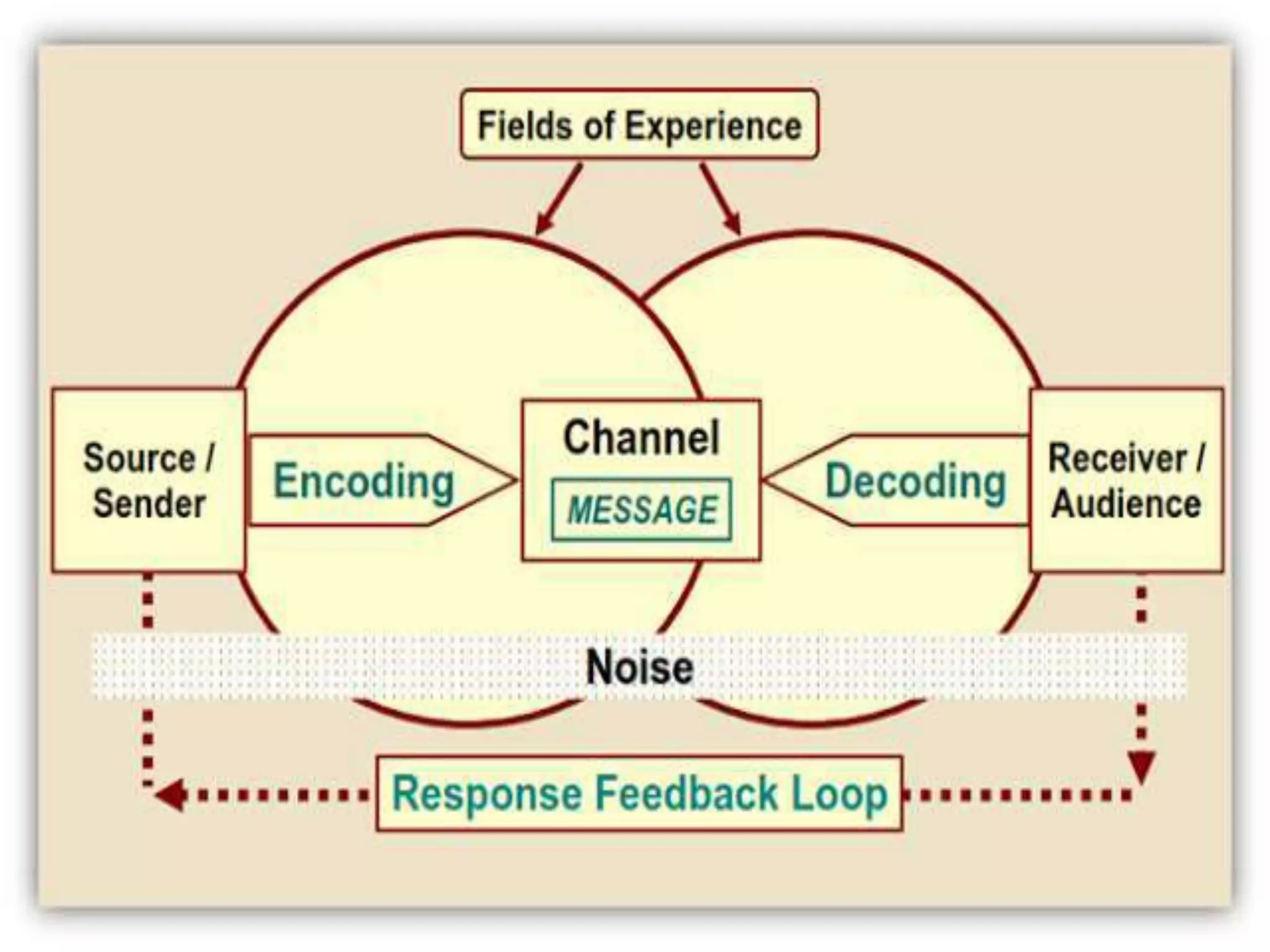
Process of communication
• Communication being a process, requires at least
two persons — a sender and a receiver.
• Communication is a process where by
information is encoded, channeled and sent by a
sender to a receiver via some medium.
• All forms of communication require a sender, a
channel, a message, a receiver and the
feedback.
• A hindrance in the communication process is
called noise
Components of Communication
• Sender - Initiates the communication process by
developing an idea into a message known as encoding.
• Message – It is the information shared by sender.
• Channel - The sender transmits the message through a
channel, or a method of delivery; eg. e-mail, phone
conversations, instant messages, face-to-face discussion
or even a text message.
Conti….
• Receiver – This message then moves through
the channel to the receiver, who completes the
communication process by interpreting and
assigning meaning to the message known as
decoding.
• Feedback - This is a critical component in the
communication process as it ensures a message
was properly received and interpreted.
Types of Communication
• One-way , Two-way
•Verbal(Oral & Written), Non-verbal
•Formal, Informal(Grapevine)
•Upward, Downward, Lateral
•Interpersonal, Intrapersonal, Organizational,
Mass Communication
One way Communication
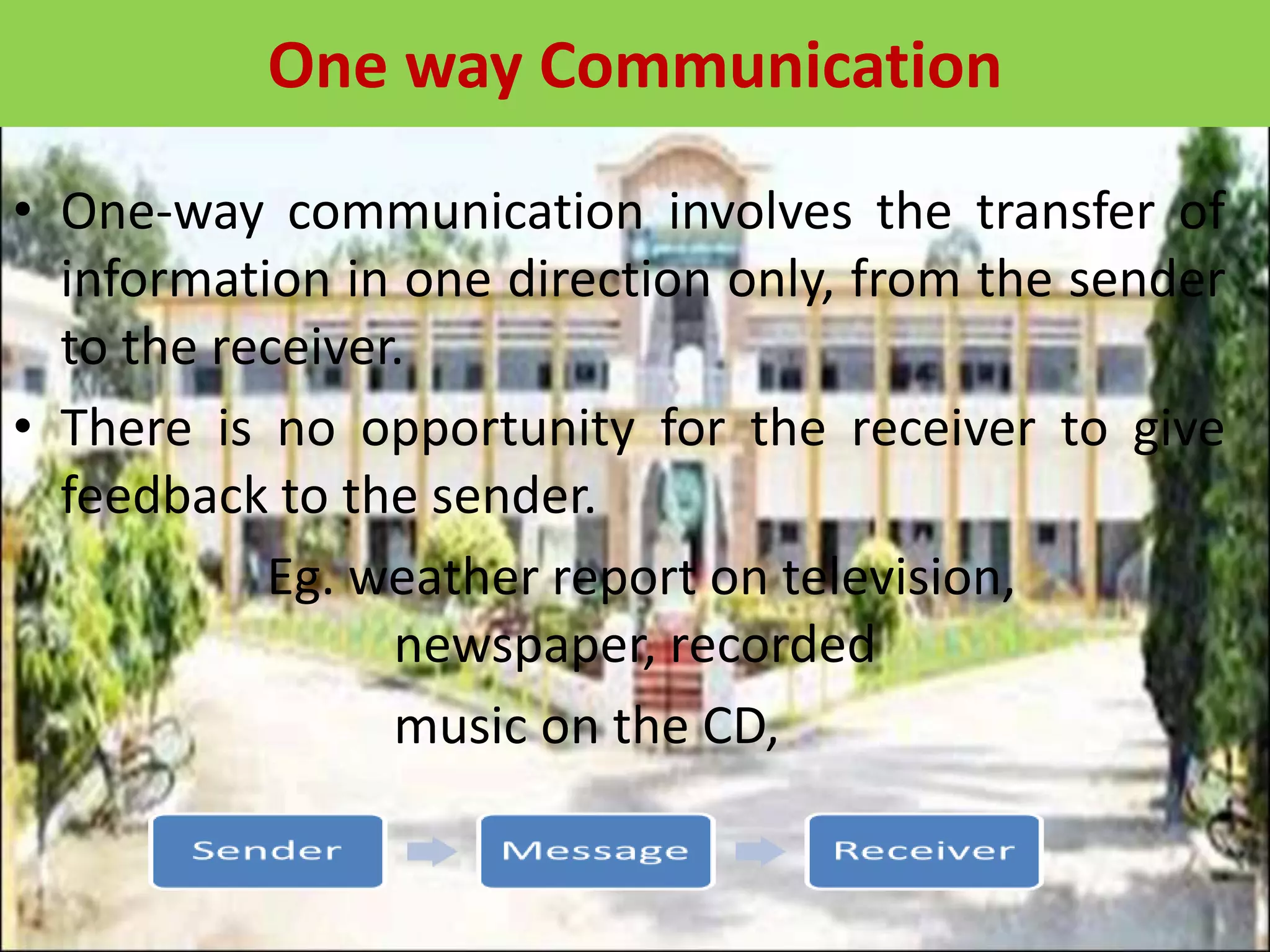
• One-way communication involves the transfer of
information in one direction only, from the sender
to the receiver.
• There is no opportunity for the receiver to give
feedback to the sender.
Eg. weather report on television,
newspaper, recorded
music on the CD,
Two-way Communication
• Two-way communication is a form of
transmission in which both parties involved,
transmit information.
• Two-Way communication has also been referred
to as interpersonal communication.
Eg. Chat rooms and Instant Messaging,
Telephone conversations,
classroom lectures etc.
• In this type of communication the professional
uses language as a vehicle of communication.
• Oral communication – A face-to-face interaction
between the sender and the receiver.
Eg. Making presentations and interviews etc.
• Written Communication – The sender uses the
written mode to transmit his/her messages.
Eg. Writing reports
emails etc.
Verbal Communication
• When a message is communicated without using a
word, the process requires non-verbal cues to be
transmitted and received.
Eg. facial expressions, posture, eye contact,
walk, person’s voice, sign language, body language
volume, pitch, voice modulation etc.
• Communication includes both verbal and non-
verbal forms.
Non-Verbal Communication
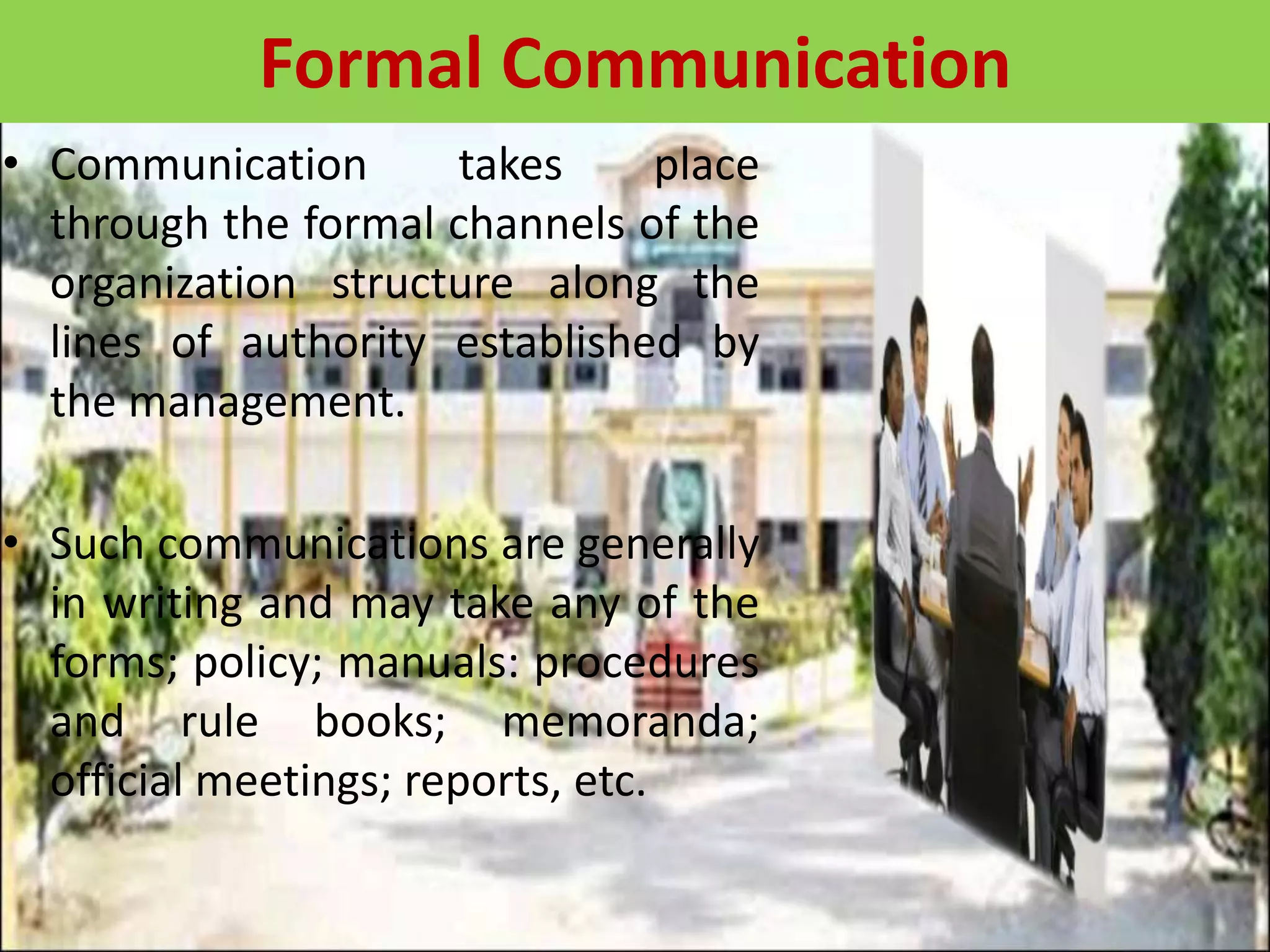
• Communication takes place
through the formal channels of the
organization structure along the
lines of authority established by
the management.
• Such communications are generally
in writing and may take any of the
forms; policy; manuals: procedures
and rule books; memoranda;
official meetings; reports, etc.
Formal Communication
• Communication arising out of all
those channels of communication
that fall outside the formal channels
is known as informal communication.
• Informal communication does not
follow lines of authority as is the case
of formal communication.
• Such communication is usually oral
and may be covered even by simple
glance, gesture or smile or silence.
Eg. Talking with friends
Informal Communication
• It is an informal type of
communication and is called so
because it stretches throughout
the organization in all directions
irrespective of the authority levels.
• It exists more at lower levels of
organization.
• Thus, grapevine spreads like fire
and it is not easy to trace the
cause of such communication at
times.
Grapevine Communication
• Communication in the first
place, flows downwards.
• All information in this medium
is usually in form of
instructions, directions and
orders.
• This direction of
communication strengthens
the authoritarian structure of
the organization.
Downward Communication
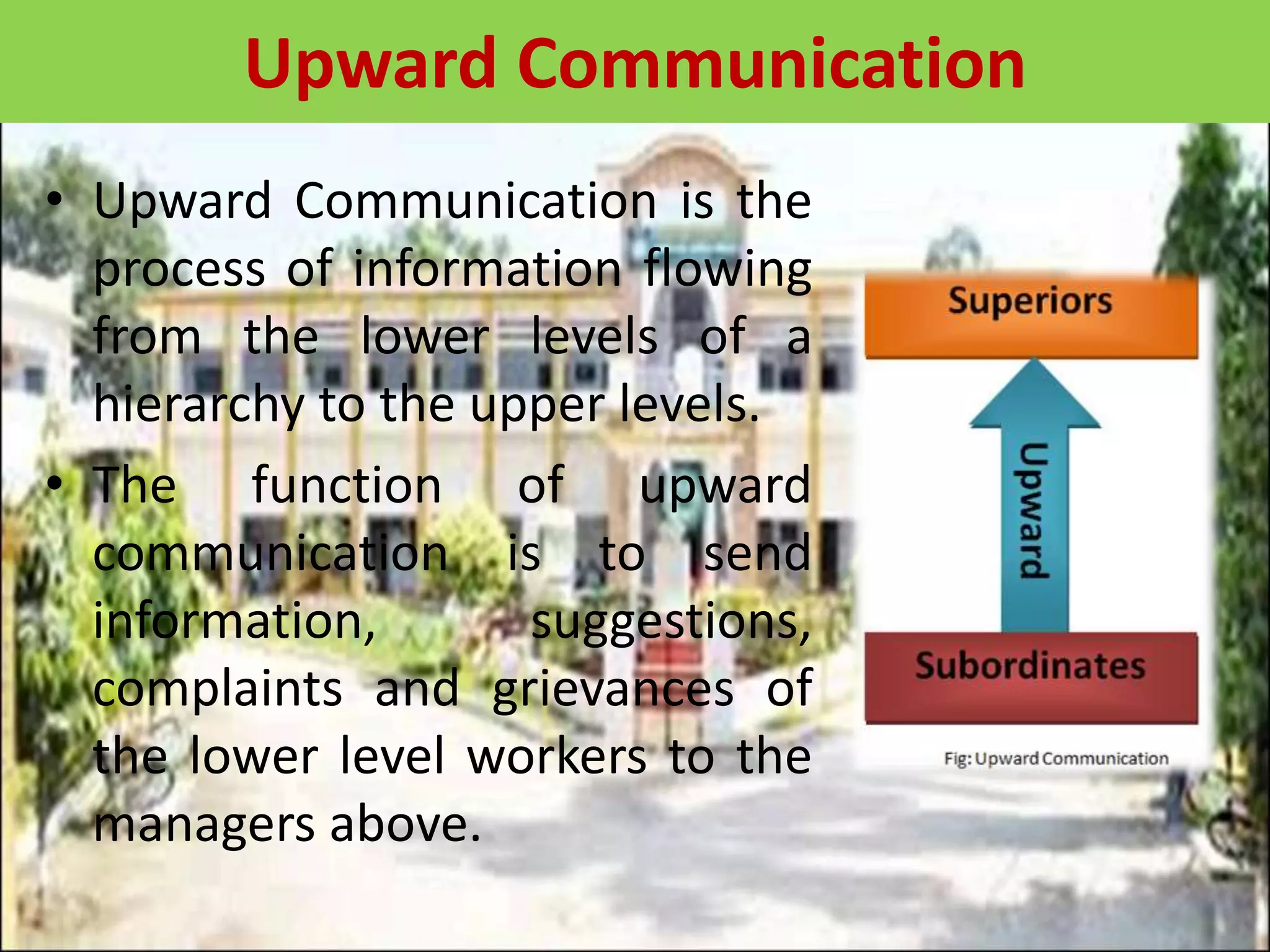
• Upward Communication is the
process of information flowing
from the lower levels of a
hierarchy to the upper levels.
• The function of upward
communication is to send
information, suggestions,
complaints and grievances of
the lower level workers to the
managers above.
Upward Communication
• This type of communication takes place between
persons at the same level or working under the
same executive.
• The main use of this is to maintain coordination
and review activities assigned to various
subordinates.
Lateral/Horizontal Communication
• Interpersonal communication
is an exchange of information
between two or more people.
• It is the process by which
people exchange information,
feelings, and meaning
through verbal and non-
verbal messages.
Interpersonal Communication
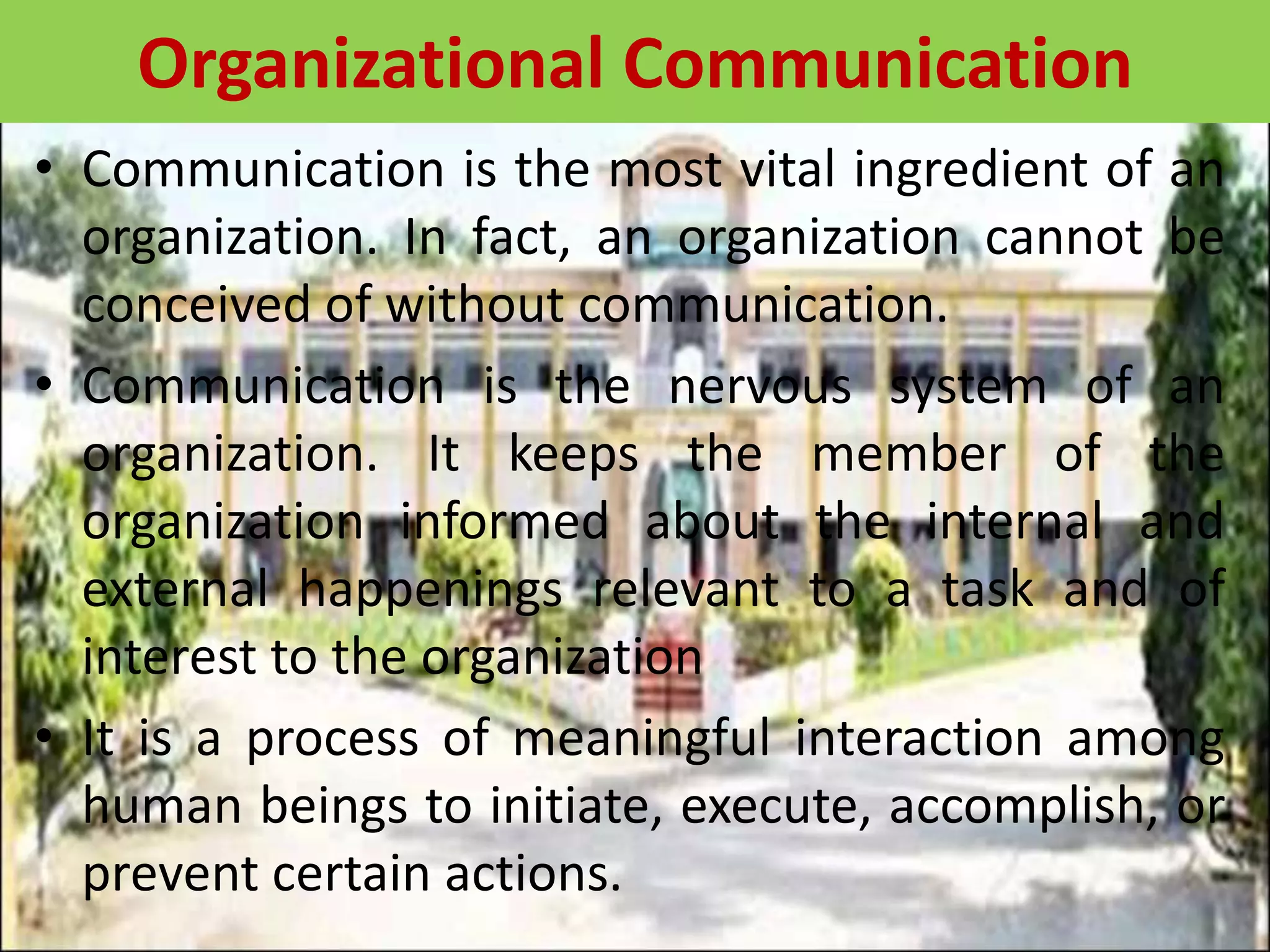
• It is the communication
which takes place within
one’s own self.
• This implies individual
reflection, contemplation
and meditation.
Intrapersonal Communication
• Communication is the most vital ingredient of an
organization. In fact, an organization cannot be
conceived of without communication.
• Communication is the nervous system of an
organization. It keeps the member of the
organization informed about the internal and
external happenings relevant to a task and of
interest to the organization
• It is a process of meaningful interaction among
human beings to initiate, execute, accomplish, or
prevent certain actions.
Organizational Communication
• It is a means of conveying messages to an entire
population.
• This is generally identified with tools of modern
mass media, which include books, the press,
cinema, television, radio, internet etc. It also
includes speeches delivered by leaders to a large
audience.
Mass Communication
• Models are symbolic representations of
structures, objects or operations.
• They may be used to show the size, shape or
relationship of various parts or components of
an object or process.
• A model may also be useful in explaining the
working of a system.
Models of Communication
• The SMCR (Source-Message-Channel-Receiver) Model is a
standard in communication studies.
• Given by – Berlo in1960.
SMCR MODEL
• No feedback / don’t know about the effect
• Does not mention barriers to communication
• No room for noise
• Needs people to be on same level for
communication to occur but not true in real
life.
Criticism of Berlo’s model of communication
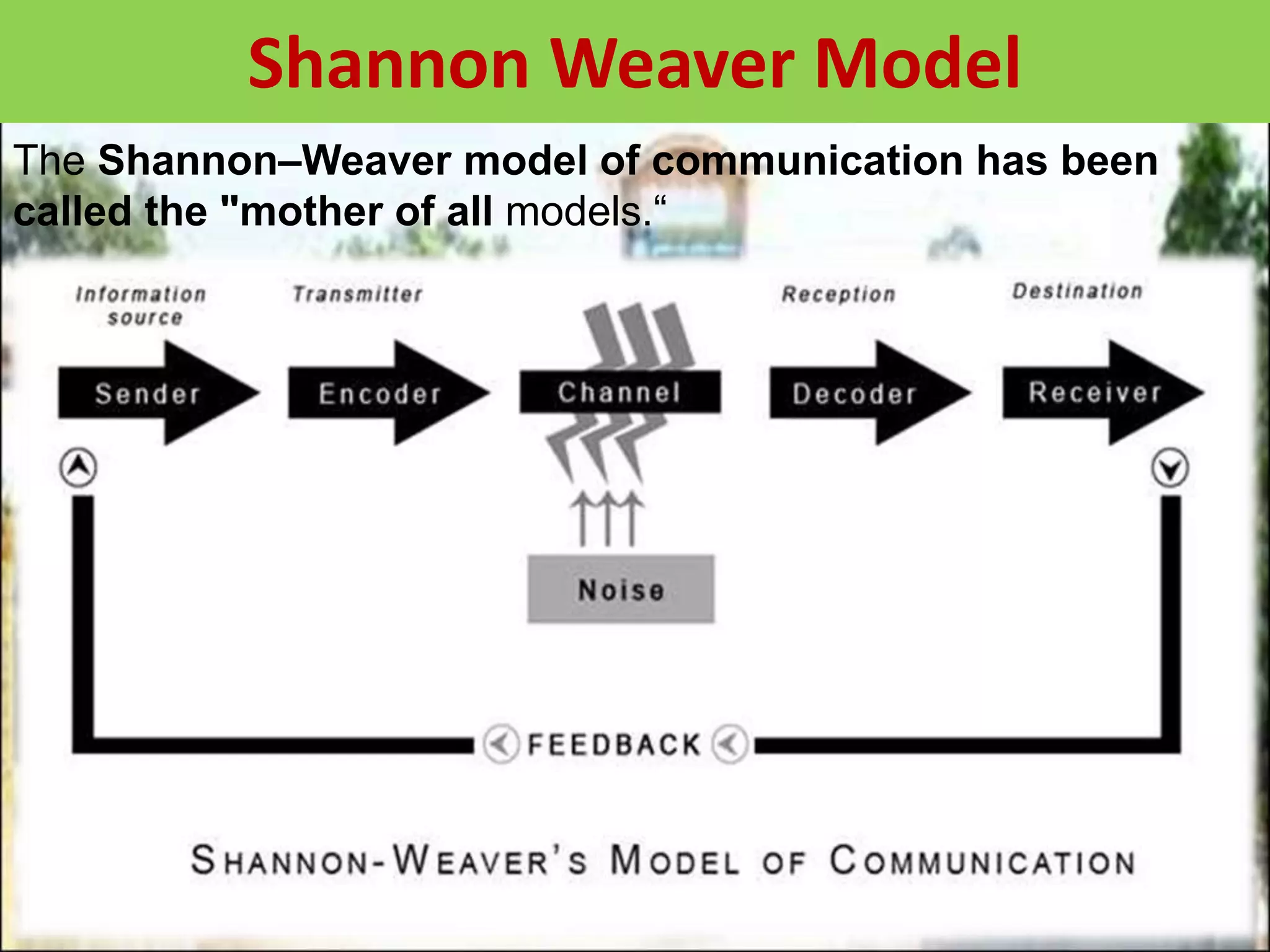
Shannon Weaver Model
The Shannon–Weaver model of communication has been
called the "mother of all models.“
Leagan’s model
This model was given by Leagans (1963)
Barriers to Communication
• When there is a problem which might cause
our communication to be distorted or
problematic, it is known as a barrier to
effective communication.
• There are 4 types of barriers to
communication
1. Physical barriers
2. Psychological barriers
3. Semantic blocks
4. Organizational Barriers
• Distance: – communication is found obstructed
in long distance. Like communication between
America and Nepal.
• Noise: – it is from external sources and affects
the communication process. Noise negatively
affects the accuracy
Physical Barriers
• Perception: – it is the process of accepting and
interpreting the information by the receiver.
People receive things differently for a various
number of reasons.
• Filtering:–In this process, knowingly or
unknowingly some valuable information may be
disposed.
• Emotions: – emotion also creates barriers to
effective communication like anger, hate,
mistrust, jealousy etc.
Psychological Barriers
• Viewpoint: – it also creates barriers to effective
communication. It the receiver doesn’t clear the
message and ignore without hearing, the
message may create obstructions.
• Defensiveness: – if the receiver receives the
message as threat and interprets that message
in the same way, it creates barriers to effective
communication.
• The use of difficult and multiple use of languages,
words, figures, symbols create semantic barriers.
• Language: – A meaning sent by the sender can be
quite different from the meaning understood by
the receiver. Long and complex sentences create
problem in communication process.
• Jargons: – Technical or unfamiliar language
creates barriers. The message should be simple
and condensed as far as possible so that no
confusion is created.
Semantic Barriers
• It is raised from the organizational goals, regulations,
structure and culture.
• Poor planning: – Refers to the designing, encoding,
channel selection and conflicting signals in the
organization.
• Structure complexities:- Difficult organizational
structure is a barrier for free flow of information
Organizational Barriers
• Status differences: – Superior provides information to
the subordinate about plans and policies. Different
information is provided by different subordinates who
create barrier in communication.
• Organizational distance:- Distance between sender and
receiver.
• Information overload: – If superior provides too much
information to the subordinate in short period receiver
suffers from information overload which creates barriers
to effective communication.
• Timing: – Communication can be obstructed if the
information is not provided in time.
• Interpersonal communication skills are much more
important than technical skills if you want to become a
good manager.
• Good communication is a very important aspect of
interpersonal relationships.
• Listening is one part of communication which sounds
fine in theory but is rare to find in practice.
• Empathy will help you to understand people and
respond to their needs more effectively.
• Experts maintain that, as much as 65 per cent of the
message communicated is non-verbal or body language
Communication Skills
LSRW Skills
We spend about 75 per cent of our waking hours in some form of
communication such as talking, listening, reading and writing.
• The average speaking rate is 175 words per minute, but
we think at about 400 words per minute.
• Listening is an everyday affair.
• We spend more time to listening than speaking
• It is a skill which is often taken for granted
• It is considered as a stressful task
• Successful listening is challenging and requires a lot of
Practice
• Effective listening is a dynamic activity that seeks out
the meaning intended in the messages sent by the
speaker.
Learning Skills
Listen to learn – learn to listen
Listening Vs Hearing
• Hearing is an involuntary act that happens
• automatically. Eg. A truck rolling by on the road in
front of our house.
• Listening –
voluntary activity,
demands perfect coordination between
the ears & the brain
very creative
Interactive and interpretive process.
Techniques for Effective Listening
• You should have an open mind.
• You should sit alert and look the speaker in the eye with a
view to establish your interest in him/her.
• Do not prejudge the speaker or his message.
• Summarize what the speaker is saying
• Take down notes
• Link what you are listening to what you already know.
• Do not interrupt the speaker unnecessarily.
• Ask relevant questions to yourself for clarity in your
• understanding.
• Reading skills are extremely important as they
improve one’s ability to communicate effectively.
• Listening and reading are strictly individual traits and
are often taken for granted.
• An average reader reads 250 words/minute, a very
good reader reads 500-600 words/minute and an
exceptional reader reads 1000 or more
words/minute.
Reading Skills
The styles or approaches of reading
• Skimming:
• Scanning
• Intensive Reading
• Extensive Reading
• Critical Reading
Tone
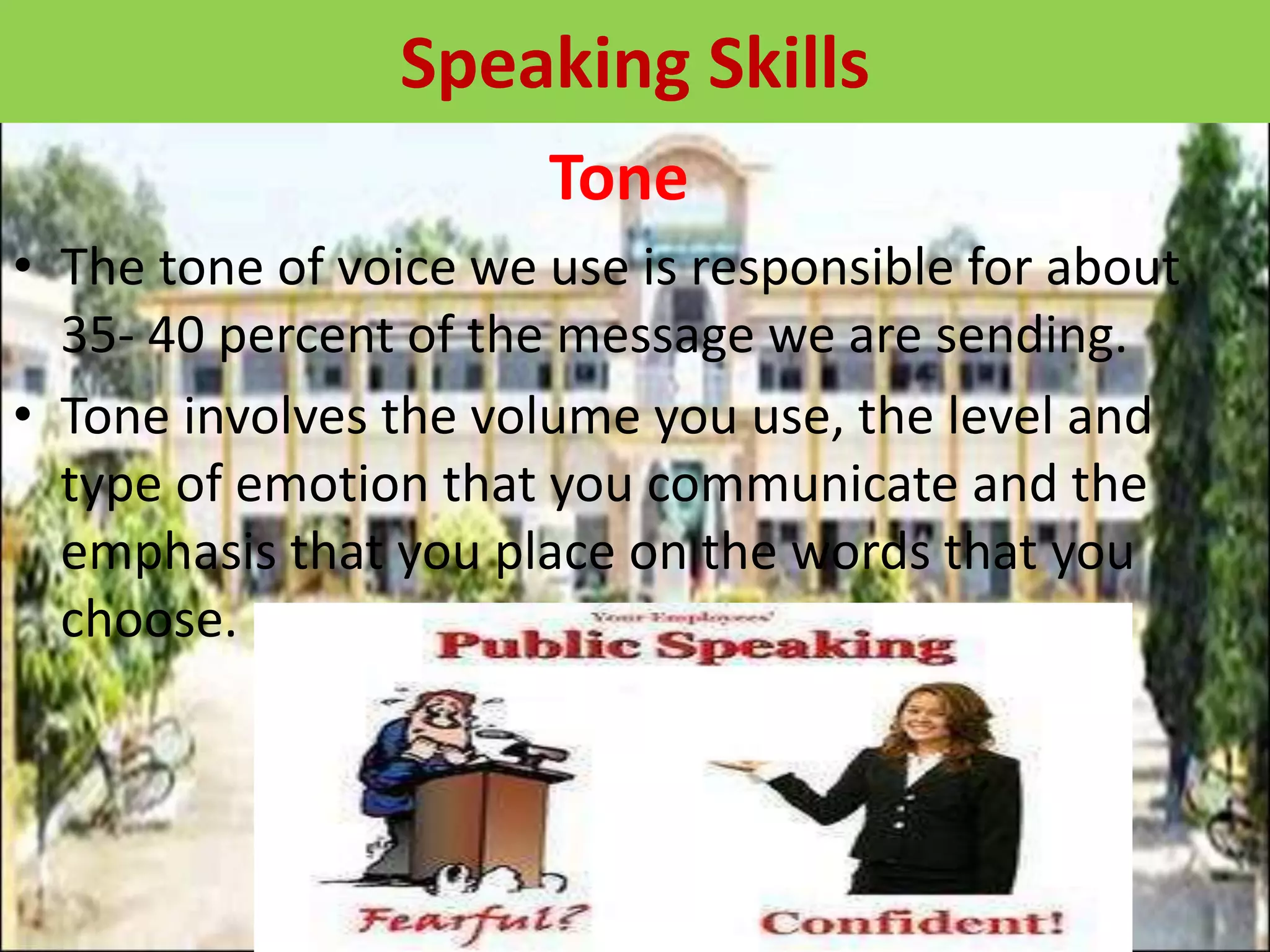
• The tone of voice we use is responsible for about
35- 40 percent of the message we are sending.
• Tone involves the volume you use, the level and
type of emotion that you communicate and the
emphasis that you place on the words that you
choose.
Speaking Skills
Pitch
• Pitch refers to the rise and fall in human voice. It
plays a crucial role in communication.
• Questions, for example, should end on a higher
note.
• Affirmative statements should end in a level or
slightly lower pitch. The ending of statements on a
high pitch can create doubt in your listeners.
• Vary your pitch throughout your presentation to
establish and reinforce your message.
Rhythm
• Rhythm is the pattern of the sounds you produce.
• Stressing and de-stressing syllables and words gives us
rhythm in English.
• Rhythm is the music of English Language – the ups and
downs and the linking of words, which together, change
how we say sentences.
• Use rhythm to carry meaning.
• Slow the pace to emphasize certain ideas.
• Quicken the pace to show excitement or humor.
• Pause to give listeners time to absorb a complex idea.
Pause also when you're about to transition to another
idea.
Intonation
• Correct intonation and stress are the key to
speaking English fluently with good
pronunciation.
• The entire variation of pitch while speaking is
called intonation.
• Words that are stressed are key to
understanding and using the correct intonation
brings out the meaning.
• English spends more time on specific stressed
words while quickly gliding over the other, less
important, words.
• Effective writing is not a gift that you’re born with,
rather it is a skill that you cultivate. Clear writing
means clear thinking.
• Think before you write: Before you put pen to paper
or hands to keyboard, consider what you want to say.
• Ask yourself: What should my audience know or
think after reading this email, proposal, or report?
• ABC of Writing – Accuracy, Brevity, Clarity
Writing Skills
Steps to Improve your Writing
Skills
• Be direct
• Avoid jargons
• Prefer to be objective than subjective
• Prefer specific to general words
• Read what you write
• Practice every day
• Coherence
Email. vetadesh87@gmail.com

Business communication

  • 1.
  • 3.
    OUTLINE OF THELECTURE •Communication – Meaning • Business Communication - Definition • Importance • Process • Types – One-way/Two-way, Verbal/Non- Verbal, Oral/Written, Formal/Informal, Upward, Downward, Lateral, Intrapersonal, Interpersonal, Organizational, Mass Communication • Models – SMCR, Shannon Weaver • Communication Skills-Listening, Speaking, Reading, Writing
  • 4.
    What is Communication? •Communication was a Latin root ‘communis’ which means common • Communication is the process of sharing information thoughts or messages by observing, listening, speaking, writing etc. • People communicate in many ways. • Without communication parents would not know what their children need. Teachers could not help their students learn. People could not share knowledge.
  • 5.
    Definition • Communication isthe process by which two or more people exchange ideas, facts, feelings or impressions in ways that each gains a common understanding of the meaning, intent and use of message (Leagans, 1960) • Communication is the discriminatory response of an organism to stimulus (Berlo 1966). • Communication is the process by which the message is transmitted from the source to the receiver (Rogers, 1983)
  • 6.
    Business Communication Business communicationis the sharing of information between people within an organization that is performed for the commercial benefit of the organization.
  • 7.
    Importance of BusinessCommunication • In the professional world, communication and related skills decide a person’s career curve - better the communication skills, higher are the chances of touching the zenith of success. • The new global and diverse workplace requires excellent spoken and written communication skills!
  • 8.
    Process of communication •Communication being a process, requires at least two persons — a sender and a receiver. • Communication is a process where by information is encoded, channeled and sent by a sender to a receiver via some medium. • All forms of communication require a sender, a channel, a message, a receiver and the feedback. • A hindrance in the communication process is called noise
  • 10.
    Components of Communication •Sender - Initiates the communication process by developing an idea into a message known as encoding. • Message – It is the information shared by sender. • Channel - The sender transmits the message through a channel, or a method of delivery; eg. e-mail, phone conversations, instant messages, face-to-face discussion or even a text message. Conti….
  • 11.
    • Receiver –This message then moves through the channel to the receiver, who completes the communication process by interpreting and assigning meaning to the message known as decoding. • Feedback - This is a critical component in the communication process as it ensures a message was properly received and interpreted.
  • 12.
    Types of Communication •One-way , Two-way •Verbal(Oral & Written), Non-verbal •Formal, Informal(Grapevine) •Upward, Downward, Lateral •Interpersonal, Intrapersonal, Organizational, Mass Communication
  • 13.
    One way Communication •One-way communication involves the transfer of information in one direction only, from the sender to the receiver. • There is no opportunity for the receiver to give feedback to the sender. Eg. weather report on television, newspaper, recorded music on the CD,
  • 14.
    Two-way Communication • Two-waycommunication is a form of transmission in which both parties involved, transmit information. • Two-Way communication has also been referred to as interpersonal communication. Eg. Chat rooms and Instant Messaging, Telephone conversations, classroom lectures etc.
  • 15.
    • In thistype of communication the professional uses language as a vehicle of communication. • Oral communication – A face-to-face interaction between the sender and the receiver. Eg. Making presentations and interviews etc. • Written Communication – The sender uses the written mode to transmit his/her messages. Eg. Writing reports emails etc. Verbal Communication
  • 16.
    • When amessage is communicated without using a word, the process requires non-verbal cues to be transmitted and received. Eg. facial expressions, posture, eye contact, walk, person’s voice, sign language, body language volume, pitch, voice modulation etc. • Communication includes both verbal and non- verbal forms. Non-Verbal Communication
  • 17.
    • Communication takesplace through the formal channels of the organization structure along the lines of authority established by the management. • Such communications are generally in writing and may take any of the forms; policy; manuals: procedures and rule books; memoranda; official meetings; reports, etc. Formal Communication
  • 18.
    • Communication arisingout of all those channels of communication that fall outside the formal channels is known as informal communication. • Informal communication does not follow lines of authority as is the case of formal communication. • Such communication is usually oral and may be covered even by simple glance, gesture or smile or silence. Eg. Talking with friends Informal Communication
  • 20.
    • It isan informal type of communication and is called so because it stretches throughout the organization in all directions irrespective of the authority levels. • It exists more at lower levels of organization. • Thus, grapevine spreads like fire and it is not easy to trace the cause of such communication at times. Grapevine Communication
  • 21.
    • Communication inthe first place, flows downwards. • All information in this medium is usually in form of instructions, directions and orders. • This direction of communication strengthens the authoritarian structure of the organization. Downward Communication
  • 22.
    • Upward Communicationis the process of information flowing from the lower levels of a hierarchy to the upper levels. • The function of upward communication is to send information, suggestions, complaints and grievances of the lower level workers to the managers above. Upward Communication
  • 23.
    • This typeof communication takes place between persons at the same level or working under the same executive. • The main use of this is to maintain coordination and review activities assigned to various subordinates. Lateral/Horizontal Communication
  • 24.
    • Interpersonal communication isan exchange of information between two or more people. • It is the process by which people exchange information, feelings, and meaning through verbal and non- verbal messages. Interpersonal Communication
  • 25.
    • It isthe communication which takes place within one’s own self. • This implies individual reflection, contemplation and meditation. Intrapersonal Communication
  • 26.
    • Communication isthe most vital ingredient of an organization. In fact, an organization cannot be conceived of without communication. • Communication is the nervous system of an organization. It keeps the member of the organization informed about the internal and external happenings relevant to a task and of interest to the organization • It is a process of meaningful interaction among human beings to initiate, execute, accomplish, or prevent certain actions. Organizational Communication
  • 27.
    • It isa means of conveying messages to an entire population. • This is generally identified with tools of modern mass media, which include books, the press, cinema, television, radio, internet etc. It also includes speeches delivered by leaders to a large audience. Mass Communication
  • 28.
    • Models aresymbolic representations of structures, objects or operations. • They may be used to show the size, shape or relationship of various parts or components of an object or process. • A model may also be useful in explaining the working of a system. Models of Communication
  • 29.
    • The SMCR(Source-Message-Channel-Receiver) Model is a standard in communication studies. • Given by – Berlo in1960. SMCR MODEL
  • 30.
    • No feedback/ don’t know about the effect • Does not mention barriers to communication • No room for noise • Needs people to be on same level for communication to occur but not true in real life. Criticism of Berlo’s model of communication
  • 31.
    Shannon Weaver Model TheShannon–Weaver model of communication has been called the "mother of all models.“
  • 32.
    Leagan’s model This modelwas given by Leagans (1963)
  • 33.
  • 34.
    • When thereis a problem which might cause our communication to be distorted or problematic, it is known as a barrier to effective communication. • There are 4 types of barriers to communication 1. Physical barriers 2. Psychological barriers 3. Semantic blocks 4. Organizational Barriers
  • 35.
    • Distance: –communication is found obstructed in long distance. Like communication between America and Nepal. • Noise: – it is from external sources and affects the communication process. Noise negatively affects the accuracy Physical Barriers
  • 36.
    • Perception: –it is the process of accepting and interpreting the information by the receiver. People receive things differently for a various number of reasons. • Filtering:–In this process, knowingly or unknowingly some valuable information may be disposed. • Emotions: – emotion also creates barriers to effective communication like anger, hate, mistrust, jealousy etc. Psychological Barriers
  • 37.
    • Viewpoint: –it also creates barriers to effective communication. It the receiver doesn’t clear the message and ignore without hearing, the message may create obstructions. • Defensiveness: – if the receiver receives the message as threat and interprets that message in the same way, it creates barriers to effective communication.
  • 38.
    • The useof difficult and multiple use of languages, words, figures, symbols create semantic barriers. • Language: – A meaning sent by the sender can be quite different from the meaning understood by the receiver. Long and complex sentences create problem in communication process. • Jargons: – Technical or unfamiliar language creates barriers. The message should be simple and condensed as far as possible so that no confusion is created. Semantic Barriers
  • 39.
    • It israised from the organizational goals, regulations, structure and culture. • Poor planning: – Refers to the designing, encoding, channel selection and conflicting signals in the organization. • Structure complexities:- Difficult organizational structure is a barrier for free flow of information Organizational Barriers
  • 40.
    • Status differences:– Superior provides information to the subordinate about plans and policies. Different information is provided by different subordinates who create barrier in communication. • Organizational distance:- Distance between sender and receiver. • Information overload: – If superior provides too much information to the subordinate in short period receiver suffers from information overload which creates barriers to effective communication. • Timing: – Communication can be obstructed if the information is not provided in time.
  • 41.
    • Interpersonal communicationskills are much more important than technical skills if you want to become a good manager. • Good communication is a very important aspect of interpersonal relationships. • Listening is one part of communication which sounds fine in theory but is rare to find in practice. • Empathy will help you to understand people and respond to their needs more effectively. • Experts maintain that, as much as 65 per cent of the message communicated is non-verbal or body language Communication Skills
  • 42.
    LSRW Skills We spendabout 75 per cent of our waking hours in some form of communication such as talking, listening, reading and writing.
  • 43.
    • The averagespeaking rate is 175 words per minute, but we think at about 400 words per minute. • Listening is an everyday affair. • We spend more time to listening than speaking • It is a skill which is often taken for granted • It is considered as a stressful task • Successful listening is challenging and requires a lot of Practice • Effective listening is a dynamic activity that seeks out the meaning intended in the messages sent by the speaker. Learning Skills Listen to learn – learn to listen
  • 44.
    Listening Vs Hearing •Hearing is an involuntary act that happens • automatically. Eg. A truck rolling by on the road in front of our house. • Listening – voluntary activity, demands perfect coordination between the ears & the brain very creative Interactive and interpretive process.
  • 45.
    Techniques for EffectiveListening • You should have an open mind. • You should sit alert and look the speaker in the eye with a view to establish your interest in him/her. • Do not prejudge the speaker or his message. • Summarize what the speaker is saying • Take down notes • Link what you are listening to what you already know. • Do not interrupt the speaker unnecessarily. • Ask relevant questions to yourself for clarity in your • understanding.
  • 46.
    • Reading skillsare extremely important as they improve one’s ability to communicate effectively. • Listening and reading are strictly individual traits and are often taken for granted. • An average reader reads 250 words/minute, a very good reader reads 500-600 words/minute and an exceptional reader reads 1000 or more words/minute. Reading Skills
  • 47.
    The styles orapproaches of reading • Skimming: • Scanning • Intensive Reading • Extensive Reading • Critical Reading
  • 48.
    Tone • The toneof voice we use is responsible for about 35- 40 percent of the message we are sending. • Tone involves the volume you use, the level and type of emotion that you communicate and the emphasis that you place on the words that you choose. Speaking Skills
  • 49.
    Pitch • Pitch refersto the rise and fall in human voice. It plays a crucial role in communication. • Questions, for example, should end on a higher note. • Affirmative statements should end in a level or slightly lower pitch. The ending of statements on a high pitch can create doubt in your listeners. • Vary your pitch throughout your presentation to establish and reinforce your message.
  • 50.
    Rhythm • Rhythm isthe pattern of the sounds you produce. • Stressing and de-stressing syllables and words gives us rhythm in English. • Rhythm is the music of English Language – the ups and downs and the linking of words, which together, change how we say sentences. • Use rhythm to carry meaning. • Slow the pace to emphasize certain ideas. • Quicken the pace to show excitement or humor. • Pause to give listeners time to absorb a complex idea. Pause also when you're about to transition to another idea.
  • 51.
    Intonation • Correct intonationand stress are the key to speaking English fluently with good pronunciation. • The entire variation of pitch while speaking is called intonation. • Words that are stressed are key to understanding and using the correct intonation brings out the meaning. • English spends more time on specific stressed words while quickly gliding over the other, less important, words.
  • 52.
    • Effective writingis not a gift that you’re born with, rather it is a skill that you cultivate. Clear writing means clear thinking. • Think before you write: Before you put pen to paper or hands to keyboard, consider what you want to say. • Ask yourself: What should my audience know or think after reading this email, proposal, or report? • ABC of Writing – Accuracy, Brevity, Clarity Writing Skills
  • 53.
    Steps to Improveyour Writing Skills • Be direct • Avoid jargons • Prefer to be objective than subjective • Prefer specific to general words • Read what you write • Practice every day • Coherence
  • 54.