Verbal and Non-Verbal
Communication

MBA – Sec-A

Presented By
Devanshu Betal
What Is Communication?
 The word communication has originated from a
Latin word “Communes” which means something
common.
 Communication is a process of exchanging
information, ideas, thoughts, feeling and
emotions through speech signals, writing or
behavior. In communication process, a sender
encodes a message and then using a medium and
send it to appropriate feedback using a medium.
Importance of communication
Express thought, ideas and feelings
Creating awareness
To fulfill a goal
Avoid isolated
Highlight issues
Process, development
Educating the masses etc.
ADVANTAGES OF VERBAL
COMMUNICATION








More personal and informal
Makes immediate impact
Provides opportunity for interaction and
feedback
Help us correct ourselves (our messages
according to the feedback and non-verbal cues
from the listener)
It is fastest and less expensive
DISADVANTAGES OF
VERBAL COMMUNICATION







It can be quickly forgotten.
A word once uttered cannot be taken back
There is no legal evidence of oral
communication
Impact may be short lived
Very difficult to be conscious of our body
language.
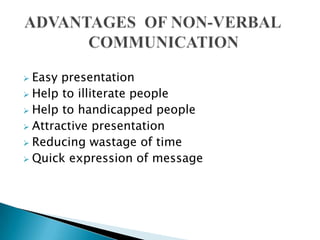
Easy presentation
 Help to illiterate people
 Help to handicapped people
 Attractive presentation
 Reducing wastage of time
 Quick expression of message

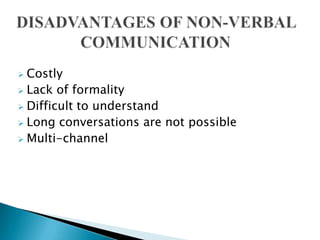
Costly
 Lack of formality
 Difficult to understand
 Long conversations are not possible
 Multi-channel

Verbal and Non-Verbal communication

Verbal and Non-Verbal communication

  • 1.
    Verbal and Non-Verbal Communication MBA– Sec-A Presented By Devanshu Betal
  • 2.
    What Is Communication? The word communication has originated from a Latin word “Communes” which means something common.  Communication is a process of exchanging information, ideas, thoughts, feeling and emotions through speech signals, writing or behavior. In communication process, a sender encodes a message and then using a medium and send it to appropriate feedback using a medium.
  • 3.
    Importance of communication Expressthought, ideas and feelings Creating awareness To fulfill a goal Avoid isolated Highlight issues Process, development Educating the masses etc.
  • 6.
    ADVANTAGES OF VERBAL COMMUNICATION      Morepersonal and informal Makes immediate impact Provides opportunity for interaction and feedback Help us correct ourselves (our messages according to the feedback and non-verbal cues from the listener) It is fastest and less expensive
  • 7.
    DISADVANTAGES OF VERBAL COMMUNICATION      Itcan be quickly forgotten. A word once uttered cannot be taken back There is no legal evidence of oral communication Impact may be short lived Very difficult to be conscious of our body language.
  • 13.
    Easy presentation  Helpto illiterate people  Help to handicapped people  Attractive presentation  Reducing wastage of time  Quick expression of message 
  • 14.
    Costly  Lack offormality  Difficult to understand  Long conversations are not possible  Multi-channel 