Communication Skills
FYBCA
Sem-I
Unit 1 Fundamentals of
Communication
Definition and over view of communication
• The process of communication involves
exchanging facts, ideas, opinions or emotions
between two or more people.
• Feedback is an essential components of
communication
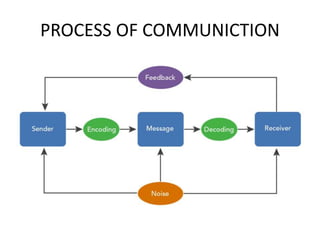
PROCESS OF COMMUNICTION
• Sender: The sender or the communicator is the
person who initiates the conversation and has
conceptualized the idea that he intends to convey
it to others.
• Encoding – The sender begins with the encoding
process wherein he/she uses certain words or
non-verbal methods such as symbols, signs, body
gestures, etc. to translate the information into a
message. The idea must be encoded into words,
symbols, and gestures that will convey meaning.
PROCESS OF COMMUNICTION
• Because no two people interpret information
in the exact same way, the sender must be
careful to choose words, symbols and gestures
that are commonly understood to reduce the
chances of misunderstanding. Therefore, a
sender must be aware of the receiver’s
communication skills, attitudes, skills,
experiences, and culture to ensure clear
communication.
PROCESS OF COMMUNICTION
• Message: Once the encoding is finished, the
sender gets the message that he intends to
convey. The message can be written, oral,
symbolic or non-verbal such as body gestures,
silence, sighs, sounds, etc. or any other signal
that triggers the response of a receiver.
PROCESS OF COMMUNICTION
• Communication Channel: The Sender chooses
the medium through which he/she wants to
convey his/her message to the recipient. It must
be selected carefully in order to make the
message effective and correctly interpreted by
the recipient. The choice of medium depends on
the interpersonal relationships between the
sender and the receiver and also on the urgency
of the message being sent. Oral, virtual, written,
sound, gesture, etc. are some of the commonly
used communication mediums.
PROCESS OF COMMUNICTION
• Receiver: The receiver is the person for whom the
message is intended or targeted. He tries to
comprehend it in the best possible manner such that
the communication objective is attained. The degree to
which the receiver decodes the message depends on
his knowledge of the subject matter, experience, trust
and relationship with the sender.
• Decoding: Here, the receiver interprets the sender’s
message and tries to understand it in the best possible
manner. An effective communication occurs only if the
receiver understands the message in exactly the same
way as it was intended by the sender.
PROCESS OF COMMUNICTION
• Feedback: The Feedback is the final step of the process
that ensures the receiver has received the message and
interpreted it correctly as it was intended by the
sender. It increases the effectiveness of the
communication as it permits the sender to know the
efficacy of his message. The response of the receiver
can be verbal or non-verbal.
• Noise: The Noise shows the barriers in
communications. There are chances when the message
sent by the sender is not received by the recipient.
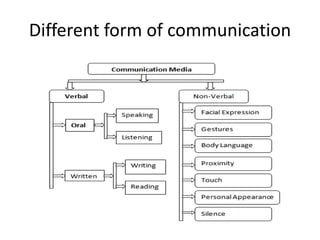
Different form of communication
Verbal communication
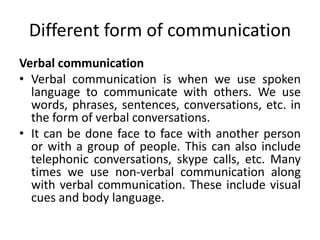
• Verbal communication is when we use spoken
language to communicate with others. We use
words, phrases, sentences, conversations, etc. in
the form of verbal conversations.
• It can be done face to face with another person
or with a group of people. This can also include
telephonic conversations, skype calls, etc. Many
times we use non-verbal communication along
with verbal communication. These include visual
cues and body language.
Different form of communication
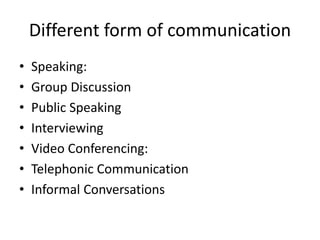
• Speaking:
• Group Discussion
• Public Speaking
• Interviewing
• Video Conferencing:
• Telephonic Communication
• Informal Conversations
Different form of communication
Listening:
• Listening is a surprisingly important part of
communication and in order to be a great
communicator, you must master the art of
listening. Remember that listening doesn’t just
mean hearing, or politely waiting for your turn to
speak.
• When others are speaking, you should practice
active listening, which means that you are
engaging your mind while the person speaks,
intently focusing on what they are saying.
Different form of communication
Written Communication
• Written communication is a form of verbal
communication, but it is so different than spoken
verbal communication that this form gets its own
separate type.
• Written communication can take the form of anything
you write or type such as letters, emails, notes, texts,
billboards, even a message written in the sky! With
written communication, it is important you know your
audience, your purpose, and maintain consistency
throughout your written message.
Different form of communication
Non-verbal Communication:
• Non-verbal communication includes any other communication that
is not verbal such as gestures, signs, facial expressions, etc. Verbal
communication is frequently supplemented by non-verbal
communication. It supplements it. However, it can be used as the
sole mode of communication as well such as sign languages. Using
sign language is a form of communication. There are various sign
languages such as:
• Indian Sign Language (ISL)
• British Sign Language(BSL)
• American Sign Language (ASL)
• Australian Sign Language (AUSLAN)
Non-verbal communication also consists of body posture, pointing, eye
contact, touch, and overall movements of the body. It also consists of
the tone, pitch, and quality of the voice.
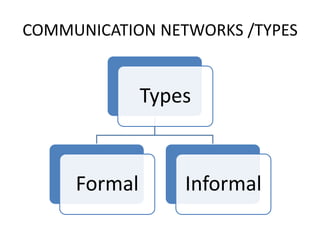
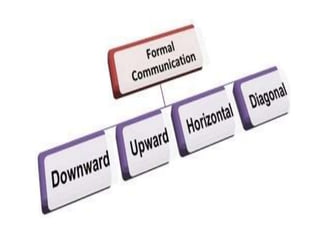
COMMUNICATION NETWORKS /TYPES
Types
Formal Informal
Formal communication
• The communication in which information flows
through proper and pre-defined solutions is
referred to as Formal Communication. It follows a
hierarchical chain that is generally established by
the organization itself.
• This type of communication is a must in the
workplace because employees are expected to
follow formal communication while performing
their duties. Some general examples of formal
communication are reports, commands, orders,
etc.
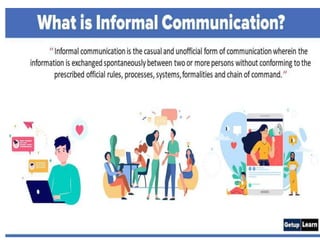
Informal communication
• Informal communication is multidimensional, it
flows freely in the organization without any
restraint of predefined channels or routes.
• It is comparatively very quick and relational.In
organizations it is often called the ‘grapevine’.
• It is also important for the growth of a company
because employees can discuss work-related
issues more openly which ultimately saves the
company’s time and money.Some general
examples are - chats between team members, a
private journal or diary, etc.
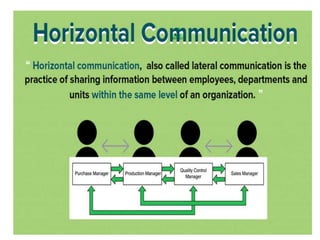
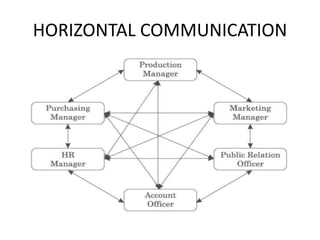
HORIZONTAL COMMUNICATION
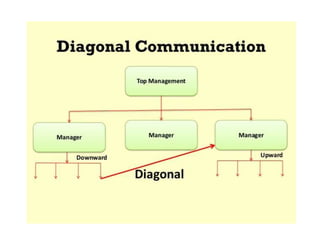
Diagonal Communication
• Diagonal communication makes it easier for
different departments to collaborate on
projects and complete work more efficiently. It
can also allow workers to get information
faster than if they talked to their supervisor
who in turn gets the necessary information
from the other team.
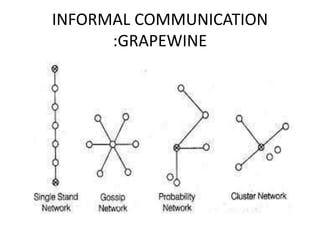
INFORMAL COMMUNICATION
:GRAPEWINE
Types of Informal Communication
• There are four different types of informal
communication:
• Single Strand: One person communicates with
one person and then they go and
communicate with another one person.
Communication is traveling from one person
to another one person.
• Gossip Chain: Group conversation where
everyone is talking to each other informally.
Types of Informal Communication
• Probability Chain: Each individual randomly tells
another individual the same message.
• Cluster Chain: One person shares information
with a group of selected individuals and in turn
each of those individuals shares that information
with others.
• All of these different types of informal
communication are all about how information
flows between employees outside of a
professional and formal meeting scenario.
BARRIERS TO COMMUNICATION
• A communication barrier is anything that
comes in the way of receiving and
understanding messages that one sends to
another to convey his ideas, thoughts, or any
other kind of information. These various
barriers of communication block or interfere
with the message that someone is trying to
send.
BARRIERS TO COMMUNICATION
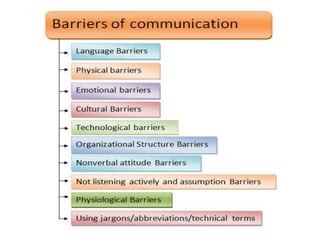
• Language Barriers: Differences in language,
dialects(બોલીઓ), or accents(ઉચ્ચારો) can lead to
misunderstandings and misinterpretations.
• Cultural Barriers: Diverse(વિવિધ) cultural backgrounds
may result in varying communication styles,
gestures(હાિભાિ), norms, and values that can lead to
confusion or offense(ગુનો).
• Perception(ધારણા)Barriers: People may interpret
information differently based on their individual
experiences, biases(પક્ષપાત), and perspectives, leading
to miscommunication.
BARRIERS TO COMMUNICATION
• Emotional Barriers: Emotional states like anger,
fear, or stress can impede(અિરોધિુું) effective
communication, making it difficult to convey
thoughts clearly or to listen attentively.
• Physical Barriers: Environmental factors such as
noise, distance, or poor visibility can interfere
with the transmission and reception of messages.
• Personal Barriers: Lack of confidence, low self-
esteem, shyness, or introversion can inhibit a
person from expressing themselves openly.
BARRIERS TO COMMUNICATION
• Information Overload: When there is an
excessive amount of information to process,
individuals may struggle to absorb and
understand the key points.
• Assumptions and Stereotypes: Preconceived
notions and stereotypes about others can hinder
open and unbiased communication.
• Listening Barriers: Poor listening skills, selective
listening, or interrupting can disrupt the flow of
communication.
BARRIERS TO COMMUNICATION
• Technological Barriers: Issues with communication
tools or technology, such as a bad internet connection
or malfunctioning equipment, can hinder effective
communication.
• Time Barriers: Communicating under time constraints
or with limited time to process information can lead to
incomplete or rushed messages.
• Hierarchy and Power Dynamics: Unequal power
distribution in a conversation can inhibit honest and
open communication, as individuals may be hesitant to
voice their opinions or concerns.
BARRIERS TO COMMUNICATION
• Lack of Feedback: Not receiving feedback or receiving
ambiguous feedback can prevent individuals from
understanding how their message was perceived.
• Semantic Barriers: Misunderstandings caused by the use of
jargon(શુદ્ધ ભાષા ), technical terms, or vague (અસ્પષ્ટ)
language.
• Different comprehension of reality is indeed a significant
barrier to effective communication. It refers to the fact that
individuals perceive and interpret the world around them
based on their unique experiences, beliefs, values, and
cultural backgrounds. As a result, two people may have
entirely different understandings of the same event or
information, leading to misunderstandings and
miscommunication.
Purpose of professional
communication
• Advising
• Counseling
• Giving orders
• Providing instruction
• Marketing
• Persuading
• Giving warnings
• Raising morale
• Staffing
• Projecting image
• Preparing advertisement
• Making decision
• Getting feedback
Role of critical and creative thinking in
effective communication
• Critical thinking is the active, persistent and
careful consideration of beliefs or knowledge
keeping in view the available evidence.
• Creative thinking is the generation of new
ideas.
Unit 2 - Developing Listening skill
• Listening v/s hearing
What is hearing ?
What is listening ?
What is the difference between hearing and
listening ?
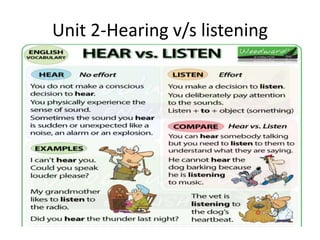
Unit 2-Hearing v/s listening
Effective listening
• Effective listening means fewer errors and less
wasted time.
Here are tips to bring effectiveness to your
Listening,
1. Face the speaker and maintain the eye
contact
2. Be attentive , but relaxed
3. Keep an open mind
4. Listen to the words and try to picture what
the speaker is saying
5. Wait for the speaker to pause to ask clarifying
questions
6. Try to feel what the speaker is feeling
7. Give the speaker regular feedback
8. Pay attention to what isn’t said- non verbal
cues.
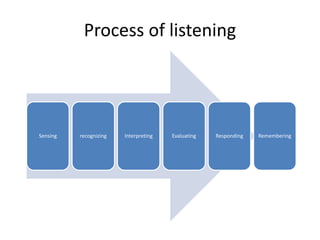
Process of listening
Sensing recognizing Interpreting Evaluating Responding Remembering
Types of listening
1. Content listening
2. Empathetic listening
3. Appreciative listening
4. Analytical listening
Barriers to effective listening
1. Forged attention
2. Premature evaluation of the subject matter and
speaker
3. Hard listening
4. Poor interpersonal relation
5. Over excitement
6. Different lug variety and accent
7. Distraction
8. Evading the difficult types
9. Non attentive state of mind
10. Different levels of perception
Unit 3 – speaking skills
Non-verbal communication
1 ) Body language (kinesics)r:- Personal
appearance posture, gesture and hand
movement, eye contact, facial expression
2)Paralinguistic features:- rate, pause, volume,
pitch , pronunciation
3) Proxemics:- intimate zone, personal zone,
social zone, public zone, haptics
Group discussion (oral practice)
A GD is a formal discussion which involves six to
fifteen participants who sit in a group to discuss
a topic or a case given for this purpose.
Personality traits to be evaluated in GD
• Reasoning ability
• Leadership
• Openness
• Assertiveness
• Initiative
• Motivation
• Attentive listening
• Awareness
Dynamics of Group
behaviour/etiquetts and manners
• Being friendly and approachable
• Encountering participation from co-
participation
• Not hurting anyone
• Not being dominating and dismissive
• Avoiding emotion
• Avoiding peer discussion
• Leadership
Types
1 topic based
2 case based
Topic based GDs,
A) factual topic (day to day ,economic situation )
B) Abstract topic (higher level)
C) Controversial topic (divided opinion)
Short note
• Opening of a GD
• Summarizing a discussion
Presentation
1 Combating Stage fright
2 Preparing PowerPoint slides for presentation
3 Describing objects/situation/people
4 individual and group presentation
5 Delivering just a minute(jam) Session
Public speaking
• Introduction
Storytelling
Elocution
Extempore
Home work : difference between story telling
vs elocution vs extempore
Appropriate pattern
1 chronological pattern
2 causal pattern
3 spatial pattern
4 topical pattern
5 psychological pattern
Appropriate method
1 speaking from memory
2 speaking for manuscript
3 speaking impromptu
4 speaking from notes
Short note: art of persuasion
Making speech interesting
1 make your beginnings catchy
2 use humor and wit
3 use body lug appropriately
4 proper voice modulation
5 use examples and instances
6 end emphatically
Types of speech
• Welcome/introductory speech
• Vote of thanks speeches
• Farewell speeches
Unit 4 reading skills
• Need for developing efficient reading skills
• Benefits of effective reading
STEPS
1. Figure out the purpose of reading particular
text
2 identify purpose and ignore the rest
3 strategy that choose your purpose
4 test comprehension
Types
1 skimming (gist or only important information )
2 scanning (piece of information )
3 Extensive reading (general information of the
subject )
4 intensive reading (extract detailed
information)
Reading comprehension
• Activity and theory 370 to 395
Unit 5 Writing skills
• Email writing – reason for popularity
1 emails are fast, cheap, east to operates
2 emails capture the spirit of the age
3 offer flexibility in tone and style
4 legal and valid
Some common pitfalls
• Privacy is lost
• Casualness creeps in
• Ambiguity impairs communication
• Virtue is sacrificed to convenience
• Junkyard is always full
Email writing- guiding principles for
composition
1. Avoid being abrupt
2. Use subject line effectively
3. Start courteously
4. Add a warm up sentence
5. Avoid all capital letters
6. Use proper spelling
7. Avoid acronyms
8. Use emoticons and smiley's sparingly
9. Take care of punctuation marks
10. Use salutation and complementary close
11. Identify yourself
Maintaining common etiquette
1. Reply immediately
2. Avoid circulating emails to everyone
3. Avoid attaching unnecessary files
4. Answer all queries
5. Avoid sexist lug
6. Be aware of email jargon
7. Keep your mail box uncluttered
8. Read and edit your mails
Blog writing
• Write a short note , 1 blog writing 2 tip for
successful blog
Art of condensation
• Précis
• Summary
• Abstract
• Synopsis
• Paraphrasing
Some working principle
• Be brief and precise
• Be complete
• Be choosy
• Be original
• Be coherent
• Be clear
Seven step ladder to write an effective
précis
• Read and compare
• Prepare a skeleton of the main idea
• Assimilate the essentials
• Think a title
• Prepare the first draft
• Review and compare
• Edit and revise
Activity
• Pg no 389 to 397
Business reports
Pg no 484 to 514 theory
Sample reports 514 to 524
Format/structure of business report
1. Front matter
2. Body matter
3. Back matter
Front matter
• Cover
• Title page
• Frontispiece
• Copyright notice
• Forwarding letter
• Preface
• Acknowledgement
• Table of contents
• List of illustration
• Abstract
• Executive summary
Main body
• Introduction
• Conclusion
• Discussion
• Recommendation
Back matter
• Appendices
• Documentation
• List of reference
• Footnotes
• Bibliography
• Glossary
• Index
Style of report
• Provide complete and accurate information
• Use plain, familiar and concrete word
• Avoid wordiness and redundancy
• Active and passive voice
• Follow emphatic word order
• Maintain parallelism in writing
• Prefer using verbs to long noun
• Carefully use acronyms/ abbreviation
• Avoid clichés
• Avoid circumlocution
• Maintain unity in paragraph
• Avoid punctuation and grammatical error
List of assignment
1 regular book of cs
2 ppt on unit topic
3 use of graphic aids and illustration
4 preparing and planning
5 preparing an outline
6 data collection

CS.pptx

  • 1.
  • 2.
    Unit 1 Fundamentalsof Communication Definition and over view of communication • The process of communication involves exchanging facts, ideas, opinions or emotions between two or more people. • Feedback is an essential components of communication
  • 3.
  • 4.
    PROCESS OF COMMUNICTION •Sender: The sender or the communicator is the person who initiates the conversation and has conceptualized the idea that he intends to convey it to others. • Encoding – The sender begins with the encoding process wherein he/she uses certain words or non-verbal methods such as symbols, signs, body gestures, etc. to translate the information into a message. The idea must be encoded into words, symbols, and gestures that will convey meaning.
  • 5.
    PROCESS OF COMMUNICTION •Because no two people interpret information in the exact same way, the sender must be careful to choose words, symbols and gestures that are commonly understood to reduce the chances of misunderstanding. Therefore, a sender must be aware of the receiver’s communication skills, attitudes, skills, experiences, and culture to ensure clear communication.
  • 6.
    PROCESS OF COMMUNICTION •Message: Once the encoding is finished, the sender gets the message that he intends to convey. The message can be written, oral, symbolic or non-verbal such as body gestures, silence, sighs, sounds, etc. or any other signal that triggers the response of a receiver.
  • 7.
    PROCESS OF COMMUNICTION •Communication Channel: The Sender chooses the medium through which he/she wants to convey his/her message to the recipient. It must be selected carefully in order to make the message effective and correctly interpreted by the recipient. The choice of medium depends on the interpersonal relationships between the sender and the receiver and also on the urgency of the message being sent. Oral, virtual, written, sound, gesture, etc. are some of the commonly used communication mediums.
  • 8.
    PROCESS OF COMMUNICTION •Receiver: The receiver is the person for whom the message is intended or targeted. He tries to comprehend it in the best possible manner such that the communication objective is attained. The degree to which the receiver decodes the message depends on his knowledge of the subject matter, experience, trust and relationship with the sender. • Decoding: Here, the receiver interprets the sender’s message and tries to understand it in the best possible manner. An effective communication occurs only if the receiver understands the message in exactly the same way as it was intended by the sender.
  • 9.
    PROCESS OF COMMUNICTION •Feedback: The Feedback is the final step of the process that ensures the receiver has received the message and interpreted it correctly as it was intended by the sender. It increases the effectiveness of the communication as it permits the sender to know the efficacy of his message. The response of the receiver can be verbal or non-verbal. • Noise: The Noise shows the barriers in communications. There are chances when the message sent by the sender is not received by the recipient.
  • 10.
    Different form ofcommunication
  • 11.
    Different form ofcommunication Verbal communication • Verbal communication is when we use spoken language to communicate with others. We use words, phrases, sentences, conversations, etc. in the form of verbal conversations. • It can be done face to face with another person or with a group of people. This can also include telephonic conversations, skype calls, etc. Many times we use non-verbal communication along with verbal communication. These include visual cues and body language.
  • 12.
    Different form ofcommunication • Speaking: • Group Discussion • Public Speaking • Interviewing • Video Conferencing: • Telephonic Communication • Informal Conversations
  • 13.
    Different form ofcommunication Listening: • Listening is a surprisingly important part of communication and in order to be a great communicator, you must master the art of listening. Remember that listening doesn’t just mean hearing, or politely waiting for your turn to speak. • When others are speaking, you should practice active listening, which means that you are engaging your mind while the person speaks, intently focusing on what they are saying.
  • 14.
    Different form ofcommunication Written Communication • Written communication is a form of verbal communication, but it is so different than spoken verbal communication that this form gets its own separate type. • Written communication can take the form of anything you write or type such as letters, emails, notes, texts, billboards, even a message written in the sky! With written communication, it is important you know your audience, your purpose, and maintain consistency throughout your written message.
  • 15.
    Different form ofcommunication Non-verbal Communication: • Non-verbal communication includes any other communication that is not verbal such as gestures, signs, facial expressions, etc. Verbal communication is frequently supplemented by non-verbal communication. It supplements it. However, it can be used as the sole mode of communication as well such as sign languages. Using sign language is a form of communication. There are various sign languages such as: • Indian Sign Language (ISL) • British Sign Language(BSL) • American Sign Language (ASL) • Australian Sign Language (AUSLAN) Non-verbal communication also consists of body posture, pointing, eye contact, touch, and overall movements of the body. It also consists of the tone, pitch, and quality of the voice.
  • 16.
  • 17.
    Formal communication • Thecommunication in which information flows through proper and pre-defined solutions is referred to as Formal Communication. It follows a hierarchical chain that is generally established by the organization itself. • This type of communication is a must in the workplace because employees are expected to follow formal communication while performing their duties. Some general examples of formal communication are reports, commands, orders, etc.
  • 18.
    Informal communication • Informalcommunication is multidimensional, it flows freely in the organization without any restraint of predefined channels or routes. • It is comparatively very quick and relational.In organizations it is often called the ‘grapevine’. • It is also important for the growth of a company because employees can discuss work-related issues more openly which ultimately saves the company’s time and money.Some general examples are - chats between team members, a private journal or diary, etc.
  • 23.
  • 25.
    Diagonal Communication • Diagonalcommunication makes it easier for different departments to collaborate on projects and complete work more efficiently. It can also allow workers to get information faster than if they talked to their supervisor who in turn gets the necessary information from the other team.
  • 27.
  • 28.
    Types of InformalCommunication • There are four different types of informal communication: • Single Strand: One person communicates with one person and then they go and communicate with another one person. Communication is traveling from one person to another one person. • Gossip Chain: Group conversation where everyone is talking to each other informally.
  • 29.
    Types of InformalCommunication • Probability Chain: Each individual randomly tells another individual the same message. • Cluster Chain: One person shares information with a group of selected individuals and in turn each of those individuals shares that information with others. • All of these different types of informal communication are all about how information flows between employees outside of a professional and formal meeting scenario.
  • 30.
    BARRIERS TO COMMUNICATION •A communication barrier is anything that comes in the way of receiving and understanding messages that one sends to another to convey his ideas, thoughts, or any other kind of information. These various barriers of communication block or interfere with the message that someone is trying to send.
  • 32.
    BARRIERS TO COMMUNICATION •Language Barriers: Differences in language, dialects(બોલીઓ), or accents(ઉચ્ચારો) can lead to misunderstandings and misinterpretations. • Cultural Barriers: Diverse(વિવિધ) cultural backgrounds may result in varying communication styles, gestures(હાિભાિ), norms, and values that can lead to confusion or offense(ગુનો). • Perception(ધારણા)Barriers: People may interpret information differently based on their individual experiences, biases(પક્ષપાત), and perspectives, leading to miscommunication.
  • 33.
    BARRIERS TO COMMUNICATION •Emotional Barriers: Emotional states like anger, fear, or stress can impede(અિરોધિુું) effective communication, making it difficult to convey thoughts clearly or to listen attentively. • Physical Barriers: Environmental factors such as noise, distance, or poor visibility can interfere with the transmission and reception of messages. • Personal Barriers: Lack of confidence, low self- esteem, shyness, or introversion can inhibit a person from expressing themselves openly.
  • 34.
    BARRIERS TO COMMUNICATION •Information Overload: When there is an excessive amount of information to process, individuals may struggle to absorb and understand the key points. • Assumptions and Stereotypes: Preconceived notions and stereotypes about others can hinder open and unbiased communication. • Listening Barriers: Poor listening skills, selective listening, or interrupting can disrupt the flow of communication.
  • 35.
    BARRIERS TO COMMUNICATION •Technological Barriers: Issues with communication tools or technology, such as a bad internet connection or malfunctioning equipment, can hinder effective communication. • Time Barriers: Communicating under time constraints or with limited time to process information can lead to incomplete or rushed messages. • Hierarchy and Power Dynamics: Unequal power distribution in a conversation can inhibit honest and open communication, as individuals may be hesitant to voice their opinions or concerns.
  • 36.
    BARRIERS TO COMMUNICATION •Lack of Feedback: Not receiving feedback or receiving ambiguous feedback can prevent individuals from understanding how their message was perceived. • Semantic Barriers: Misunderstandings caused by the use of jargon(શુદ્ધ ભાષા ), technical terms, or vague (અસ્પષ્ટ) language. • Different comprehension of reality is indeed a significant barrier to effective communication. It refers to the fact that individuals perceive and interpret the world around them based on their unique experiences, beliefs, values, and cultural backgrounds. As a result, two people may have entirely different understandings of the same event or information, leading to misunderstandings and miscommunication.
  • 37.
    Purpose of professional communication •Advising • Counseling • Giving orders • Providing instruction • Marketing • Persuading • Giving warnings • Raising morale • Staffing • Projecting image • Preparing advertisement • Making decision • Getting feedback
  • 38.
    Role of criticaland creative thinking in effective communication • Critical thinking is the active, persistent and careful consideration of beliefs or knowledge keeping in view the available evidence. • Creative thinking is the generation of new ideas.
  • 39.
    Unit 2 -Developing Listening skill • Listening v/s hearing What is hearing ? What is listening ? What is the difference between hearing and listening ?
  • 40.
  • 41.
    Effective listening • Effectivelistening means fewer errors and less wasted time. Here are tips to bring effectiveness to your Listening, 1. Face the speaker and maintain the eye contact 2. Be attentive , but relaxed 3. Keep an open mind
  • 42.
    4. Listen tothe words and try to picture what the speaker is saying 5. Wait for the speaker to pause to ask clarifying questions 6. Try to feel what the speaker is feeling 7. Give the speaker regular feedback 8. Pay attention to what isn’t said- non verbal cues.
  • 43.
    Process of listening Sensingrecognizing Interpreting Evaluating Responding Remembering
  • 44.
    Types of listening 1.Content listening 2. Empathetic listening 3. Appreciative listening 4. Analytical listening
  • 45.
    Barriers to effectivelistening 1. Forged attention 2. Premature evaluation of the subject matter and speaker 3. Hard listening 4. Poor interpersonal relation 5. Over excitement 6. Different lug variety and accent 7. Distraction 8. Evading the difficult types 9. Non attentive state of mind 10. Different levels of perception
  • 46.
    Unit 3 –speaking skills Non-verbal communication 1 ) Body language (kinesics)r:- Personal appearance posture, gesture and hand movement, eye contact, facial expression 2)Paralinguistic features:- rate, pause, volume, pitch , pronunciation 3) Proxemics:- intimate zone, personal zone, social zone, public zone, haptics
  • 47.
    Group discussion (oralpractice) A GD is a formal discussion which involves six to fifteen participants who sit in a group to discuss a topic or a case given for this purpose.
  • 48.
    Personality traits tobe evaluated in GD • Reasoning ability • Leadership • Openness • Assertiveness • Initiative • Motivation • Attentive listening • Awareness
  • 49.
    Dynamics of Group behaviour/etiquettsand manners • Being friendly and approachable • Encountering participation from co- participation • Not hurting anyone • Not being dominating and dismissive • Avoiding emotion • Avoiding peer discussion • Leadership
  • 50.
    Types 1 topic based 2case based Topic based GDs, A) factual topic (day to day ,economic situation ) B) Abstract topic (higher level) C) Controversial topic (divided opinion)
  • 51.
    Short note • Openingof a GD • Summarizing a discussion
  • 52.
    Presentation 1 Combating Stagefright 2 Preparing PowerPoint slides for presentation 3 Describing objects/situation/people 4 individual and group presentation 5 Delivering just a minute(jam) Session
  • 53.
    Public speaking • Introduction Storytelling Elocution Extempore Homework : difference between story telling vs elocution vs extempore
  • 54.
    Appropriate pattern 1 chronologicalpattern 2 causal pattern 3 spatial pattern 4 topical pattern 5 psychological pattern
  • 55.
    Appropriate method 1 speakingfrom memory 2 speaking for manuscript 3 speaking impromptu 4 speaking from notes
  • 56.
    Short note: artof persuasion Making speech interesting 1 make your beginnings catchy 2 use humor and wit 3 use body lug appropriately 4 proper voice modulation 5 use examples and instances 6 end emphatically
  • 57.
    Types of speech •Welcome/introductory speech • Vote of thanks speeches • Farewell speeches
  • 58.
    Unit 4 readingskills • Need for developing efficient reading skills • Benefits of effective reading
  • 59.
    STEPS 1. Figure outthe purpose of reading particular text 2 identify purpose and ignore the rest 3 strategy that choose your purpose 4 test comprehension
  • 60.
    Types 1 skimming (gistor only important information ) 2 scanning (piece of information ) 3 Extensive reading (general information of the subject ) 4 intensive reading (extract detailed information)
  • 61.
  • 62.
    Unit 5 Writingskills • Email writing – reason for popularity 1 emails are fast, cheap, east to operates 2 emails capture the spirit of the age 3 offer flexibility in tone and style 4 legal and valid
  • 63.
    Some common pitfalls •Privacy is lost • Casualness creeps in • Ambiguity impairs communication • Virtue is sacrificed to convenience • Junkyard is always full
  • 64.
    Email writing- guidingprinciples for composition 1. Avoid being abrupt 2. Use subject line effectively 3. Start courteously 4. Add a warm up sentence 5. Avoid all capital letters 6. Use proper spelling 7. Avoid acronyms 8. Use emoticons and smiley's sparingly 9. Take care of punctuation marks 10. Use salutation and complementary close 11. Identify yourself
  • 65.
    Maintaining common etiquette 1.Reply immediately 2. Avoid circulating emails to everyone 3. Avoid attaching unnecessary files 4. Answer all queries 5. Avoid sexist lug 6. Be aware of email jargon 7. Keep your mail box uncluttered 8. Read and edit your mails
  • 66.
    Blog writing • Writea short note , 1 blog writing 2 tip for successful blog
  • 67.
    Art of condensation •Précis • Summary • Abstract • Synopsis • Paraphrasing
  • 68.
    Some working principle •Be brief and precise • Be complete • Be choosy • Be original • Be coherent • Be clear
  • 69.
    Seven step ladderto write an effective précis • Read and compare • Prepare a skeleton of the main idea • Assimilate the essentials • Think a title • Prepare the first draft • Review and compare • Edit and revise
  • 70.
  • 71.
    Business reports Pg no484 to 514 theory Sample reports 514 to 524
  • 73.
    Format/structure of businessreport 1. Front matter 2. Body matter 3. Back matter
  • 74.
    Front matter • Cover •Title page • Frontispiece • Copyright notice • Forwarding letter • Preface • Acknowledgement • Table of contents • List of illustration • Abstract • Executive summary
  • 75.
    Main body • Introduction •Conclusion • Discussion • Recommendation
  • 76.
    Back matter • Appendices •Documentation • List of reference • Footnotes • Bibliography • Glossary • Index
  • 77.
    Style of report •Provide complete and accurate information • Use plain, familiar and concrete word • Avoid wordiness and redundancy • Active and passive voice • Follow emphatic word order • Maintain parallelism in writing • Prefer using verbs to long noun • Carefully use acronyms/ abbreviation • Avoid clichés • Avoid circumlocution • Maintain unity in paragraph • Avoid punctuation and grammatical error
  • 78.
    List of assignment 1regular book of cs 2 ppt on unit topic 3 use of graphic aids and illustration 4 preparing and planning 5 preparing an outline 6 data collection