“You can have all the great ideas in the
world and if you can’t communicate,
nobody will hear them.”
-Kara Blackburn
Business Communication
Topics
• Communication - Meaning
• Business Communication - Definition
• Importance
• Process
• Types – One-way/Two-way, Verbal/Non- Verbal,
Oral/Written, Formal/Informal, Upward, Downward, Lateral,
Intrapersonal, Interpersonal, Organizational,
Mass Communication
• Models – SMCR, Shannon Weaver
• Language Skills-Listening, Speaking, Reading, Writing
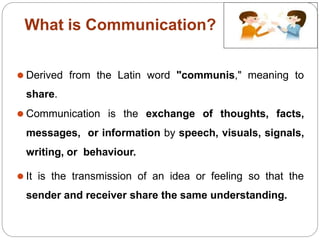
What is Communication?
⚫ Derived from the Latin word "communis," meaning to
share.
⚫ Communication is the exchange of thoughts, facts,
messages, or information by speech, visuals, signals,
writing, or behaviour.
⚫ It is the transmission of an idea or feeling so that the
sender and receiver share the same understanding.
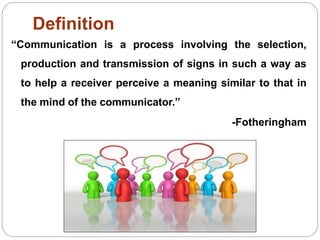
Definition
“Communication is a process involving the selection,
production and transmission of signs in such a way as
to help a receiver perceive a meaning similar to that in
the mind of the communicator.”
-Fotheringham
Business Communication -
Definition
⚫ Business communication is the sharing of information
between
performed
people within an organization
for the commercial benefit
that is
of the
organization.
Characteristics
•It involves at least two persons
•Message is must.
•It is a two way process
•Continuous Process
•It may be written or oral.
Importance
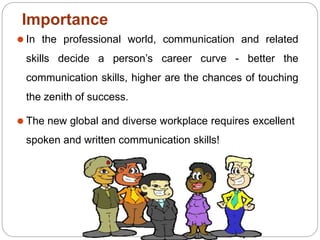
⚫ In the professional world, communication and related
skills decide a person’s career curve - better the
communication skills, higher are the chances of touching
the zenith of success.
⚫ The new global and diverse workplace requires excellent
spoken and written communication skills!
Importance Continued……
Efficient working of business
Means of coordination
Planning becomes easy
Aids in decision Making
Communication failure can be costly
Building human relations
Maintaining relations
Boost your moral and motivation
Purpose of Communication
To convey the right message
To advice
To receive suggestion
To persuade people :- like sales people
To motivate
To counselling
To instruct
To integrate different activities
To inform
To evaluate
To direct
To teach
To influence
To build image
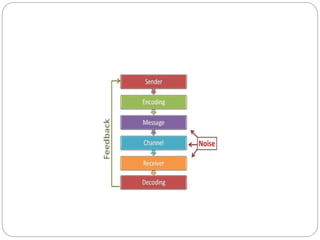
Process of communication
Communications is a continuous process that mainly
involves three elements viz. sender, message, and
receiver. The elements involved in the communication
process are explained below in detail:
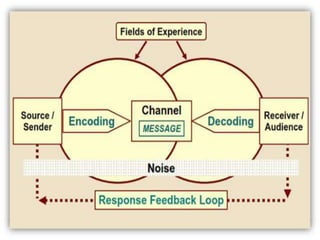
1. Sender: The sender or the communicator generates
the message and conveys it to the receiver. He is the
source and the one who starts the communication
2. Message: It is the idea, information, view, fact,
feeling, etc. that is generated by the sender and is then
intended to be communicated further.
3. Encoding: The message generated by the sender is
encoded symbolically such as in the form of words,
pictures, gestures, etc. before it is being conveyed.
Continued…..
4. Media: It is the manner in which the encoded
message is transmitted. The message may be
transmitted orally or in writing. The medium of
communication includes telephone, internet, post, fax, e-
mail, etc. The choice of medium is decided by the
sender.
5. Decoding: It is the process of converting the symbols
encoded by the sender. After decoding the message is
received by the receiver.
6. Receiver: He is the person who is last in the chain
and for whom the message was sent by the sender.
Once the receiver receives the message and
understands it in proper perspective and acts according
to the message, only then the purpose of
communication is successful.
Continued….
7. Feedback: Once the receiver confirms to the sender
that he has received the message and understood it, the
process of communication is complete.
8. Noise: It refers to any obstruction that is caused by
the sender, message or receiver during the process of
communication. For example, bad telephone
connection, faulty encoding, faulty decoding, inattentive
receiver, poor understanding of message due to
prejudice or inappropriate gestures, etc.
Components of Communication
 Sender - Initiates the communication process by
developing an idea into a message known as encoding.
 Channel - The sender transmits the message through
a channel, or a method of delivery; eg. e-mail, phone
conversations, instant messages, face-to-face discussion
or even a text message.
 Receiver –
channel to
This message then moves through the
the receiver, who completes the
communication process by interpreting and assigning
meaning to the message known as decoding.
 Feedback - This is a critical component in the
communication process as it ensures a message was
properly received and interpreted.
Types
•One-way , Two-way
•Verbal(Oral & Written), Non-verbal
•Formal, Informal(Grapevine)
•Upward, Downward, Lateral
•Interpersonal, Intrapersonal, Organizational,
Mass Communication
One way Communication
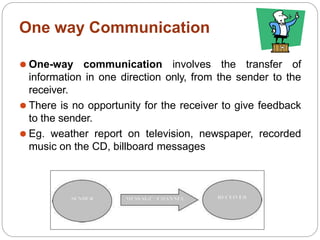
⚫ One-way communication involves the transfer of
information in one direction only, from the sender to the
receiver.
⚫ There is no opportunity for the receiver to give feedback
to the sender.
⚫ Eg. weather report on television, newspaper, recorded
music on the CD, billboard messages
Two-way Communication
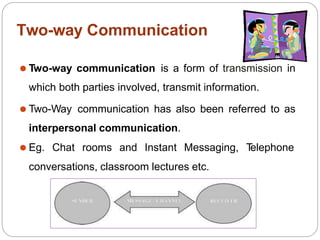
⚫ Two-way communication is a form of transmission in
which both parties involved, transmit information.
⚫ Two-Way communication has also been referred to as
interpersonal communication.
⚫ Eg. Chat rooms and Instant Messaging, T
elephone
conversations, classroom lectures etc.
Verbal Communication
uses
In this type of communication the professional
language as a vehicle of communication.
⚫ Oral communication – A face-to-face interaction
between the sender and the receiver.
Eg. Making presentations and appearing for interviews
 Written Communication – The sender uses the written
mode to transmit his/her messages.
Eg. Writing reports and emails.
Non Verbal Communication
When a message is communicated without using a word,
the process requires non-verbal cues to be transmitted
and received.
Eg. facial expressions, posture, eye contact, walk,
person’s voice, sign language, body language volume,
pitch, voice modulation etc.
Communication includes both verbal and non-verbal
forms.
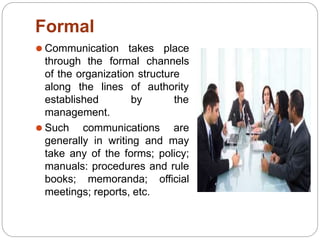
Formal
⚫ Communication takes place
through the formal channels
of the organization structure
of authority
by the
along the lines
established
management.
⚫ Such communications are
generally in writing and may
take any of the forms; policy;
manuals: procedures and rule
books; memoranda; official
meetings; reports, etc.
Informal
⚫ Communication arising out of all those channels of
communication that fall outside the formal channels is
known as informal communication.
⚫ Informal communication does not follow lines of authority
as is the case of formal communication.
⚫ Such communication is usually oral and may be covered
even by simple glance, gesture or smile or silence.
⚫ Eg. Talking with friends
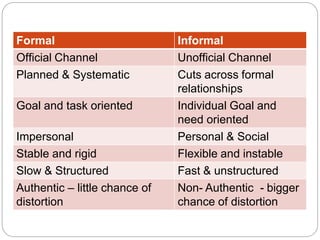
Formal Informal
Official Channel Unofficial Channel
Planned & Systematic Cuts across formal
relationships
Goal and task oriented Individual Goal and
need oriented
Impersonal Personal & Social
Stable and rigid Flexible and instable
Slow & Structured Fast & unstructured
Authentic – little chance of
distortion
Non- Authentic - bigger
chance of distortion
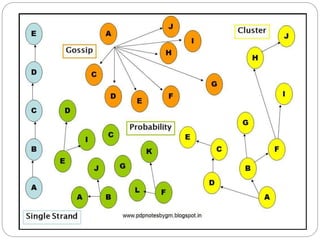
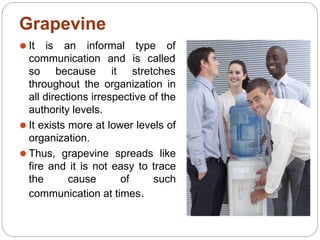
Grapevine
⚫ It is an informal type of
communication
so because
and is called
it stretches
throughout the organization in
all directions irrespective of the
authority levels.
⚫ It exists more at lower levels of
organization.
⚫ Thus, grapevine spreads like
fire and it is not easy to trace
the cause of such
communication at times.
Example of Grapevine Network of Communication
Suppose the profit amount of a company is known.
Rumor is spread that this much profit is there and on
that basis bonus is declared.
CEO may be in relation to the Production Manager.
They may have friendly relations with each other.
Advantages
•Grapevine channels carry information rapidly.
•The managers get to know the reactions of their
subordinates on their policies.
•Grapevine helps in developing group cohesiveness.
•The grapevine serves as an emotional supportive
value.
•The grapevine is a supplement in those cases where
formal communication does not work.
•Grapevine links the whole organization very quickly.
•This is the primary source of information as well as the
reliable channel to communicate about the facts and
events within the firm.
•3. t is more flexible than formal channels.
Disadvantages
•The grapevine carries partial information at times as it
is more based on rumors. Thus, it does not clearly
depicts the complete state of affairs.
•The grapevine is not trustworthy always as it does not
follows official path of communication and is spread
more by gossips and unconfirmed report.
•The productivity of employees may be hampered as
they spend more time talking rather than working.
•The grapevine leads to making hostility against the
executives.
•The grapevine may hamper the goodwill of the
organization as it may carry false negative information
about the high level people of the organization.
Types of Business Communication
Downward
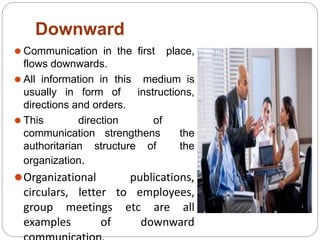
⚫ Communication in the first place,
flows downwards.
⚫ All information in this medium is
usually in form of instructions,
directions and orders.
⚫ This direction of
communication strengthens the
authoritarian structure of the
organization.
⚫Organizational publications,
circulars, letter to employees,
group meetings etc are all
examples of downward
Purpose
Downward communication is used by the managers
for the following purposes –
•Providing feedback on employees’ performance.
•Giving job instructions.
•Providing a complete understanding of the
employees’ job as well as to communicate them
how their job is related to other jobs in the
organization.
•Communicating the organizations mission and
vision to the employees.
•Highlighting the areas of attention.
Upward
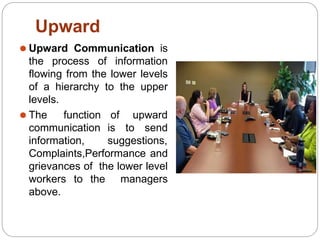
⚫ Upward Communication is
the process of information
flowing from the lower levels
of a hierarchy to the upper
levels.
⚫ The function
communication
information,
of upward
is to send
suggestions,
Complaints,Performance and
grievances of the lower level
workers to the managers
above.
The managers get to know about the employees’
feelings towards their jobs, peers, supervisor and
organization in general. Managers can thus accordingly
take actions for improving things.
Grievance Redressal System, Complaint and
Suggestion Box, Job Satisfaction surveys etc all help in
improving upward communication. Other examples are -
performance reports made by low level management for
reviewing by higher level management, employee
attitude surveys, letters from employees, employee-
manager discussions etc.
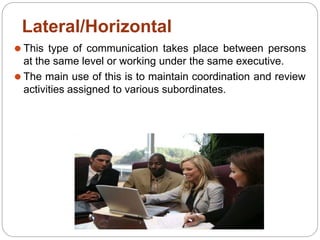
Lateral/Horizontal
⚫ This type of communication takes place between persons
at the same level or working under the same executive.
⚫ The main use of this is to maintain coordination and review
activities assigned to various subordinates.
Advantages
It is time saving.
It facilitates co-ordination of the task.
It facilitates co-operation among team members.
It provides emotional and social assistance to the
organizational members.
It helps in solving various organizational problems.
It is a means of information sharing.
It can also be used for resolving conflicts of a
department with other department or conflicts within a
department.
Diagonal or crosswise communication
Communication that takes place between a manager
and employees of other workgroups is called diagonal
communication. It generally does not appear on
organizational chart.
For instance - To design a training module a training
manager interacts with an Operations personnel to
enquire about the way they perform their task. The
Accounts people of an organization visiting different
employees in various departments for their IT
calculation, bonus for workers etc. fall under diagonal
communication.
External communication
External communication is any communication that
leaves the office and deals with customers, prospects,
vendors or partners. It could also involve regulatory
agencies or city offices. Sales presentations or
marketing letters need to be exciting to generate interest
from the customer but they also need to be factually
based. When corresponding to outside entities for
partnerships or other business administration needs,
state the purpose and be concise in communication,
whether oral or written. Respect people's time by getting
to the point and stating your request.
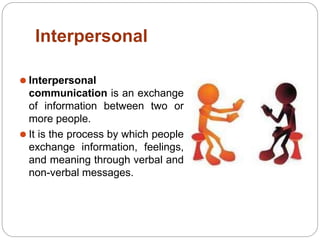
Interpersonal
⚫ Interpersonal
communication is an exchange
of information between two or
more people.
⚫ It is the process by which people
exchange information, feelings,
and meaning through verbal and
non-verbal messages.
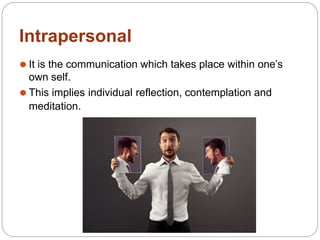
Intrapersonal
⚫ It is the communication which takes place within one’s
own self.
⚫ This implies individual reflection, contemplation and
meditation.
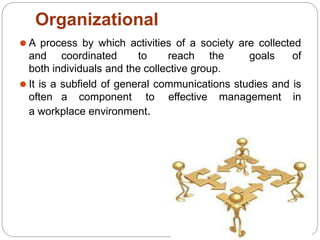
Organizational
⚫ A process by which activities of a society are collected
and coordinated to reach the goals of
both individuals and the collective group.
⚫ It is a subfield of general communications studies and is
often a component to effective management in
a workplace environment.
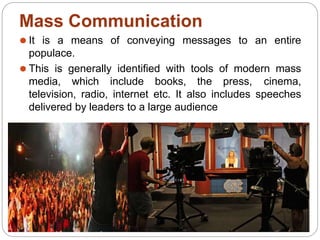
Mass Communication
⚫ It is a means of conveying messages to an entire
populace.
⚫ This is generally identified with tools of modern mass
media, which include books, the press, cinema,
television, radio, internet etc. It also includes speeches
delivered by leaders to a large audience
Channels of Communication
The communication channels further can be
categorized as:
1. Formal channels
It is an official way of communicating. A formal
communication channel transmits information such as
the goals, policies and procedures of an organization.
Messages in this type of communication channel follow
a chain of command. This means information flows from
a manager to his subordinates and they in turn pass on
the information to the next level of staff. Some
examples include company newsletters, business
plans, instructions, annual reports, agreements,
company-wide communications, board presentations
etc.
2. Informal channels
It is also an official way of communicating, with
somewhat relaxed norms. There may not be a need for
a chain of command or hierarchy in this kind of
communication. There will be immense official
communication where such hierarchy or command is not
needed, but they happen within the official framework.
Some examples will include conversations on the work
floor addressing queries of team members, lunch time
conversations, many of the emails where formal
command is not needed such as someone is seeking
some quick information etc.
Under the official environment, both formal and informal
channels are used as needed.
3. Unofficial channels
There exists an unofficial mode of communication as
well. The employees communicate outside work
environment on topics not related to work. General
social, sports, political and personal communication are
unofficial channels. But a manager needs to be aware
about the existence of such a channel and information
flowing in them. Many times rumors and gossips also
provide very important information which otherwise will
not be available.
SMRC Model of
Communication
SMCR MODEL
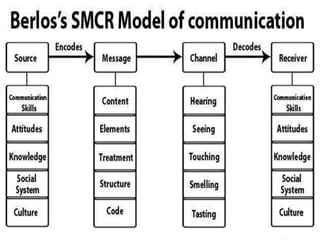
⚫ The SMCR (Source-Message-Channel-Receiver)
Model is a standard in communication studies.
⚫ This model was originally developed by Claude
Shannon and Warren Weaver, and then altered by
David Berlo, but the latest credit has been given
to Wilbur Schramm for his interactive interpretation
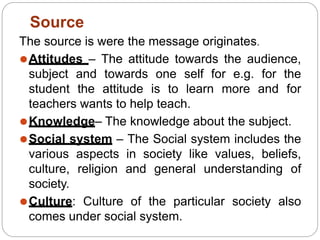
The source is were the message originates.
⚫Attitudes – The attitude towards the audience,
subject and towards one self for e.g. for the
student the attitude is to learn more and for
teachers wants to help teach.
⚫Knowledge– The knowledge about the subject.
⚫Social system – The Social system includes the
various aspects in society like values, beliefs,
culture, religion and general understanding of
society.
⚫Culture: Culture of the particular society also
comes under social system.
Source
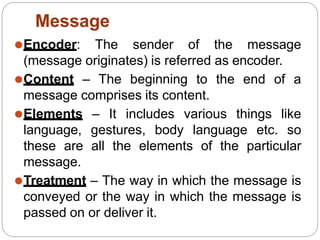
⚫Encoder: The sender of the message
(message originates) is referred as encoder.
⚫Content – The beginning to the end of a
message comprises its content.
⚫Elements – It includes various things like
language, gestures, body language etc. so
these are all the elements of the particular
message.
⚫Treatment – The way in which the message is
conveyed or the way in which the message is
passed on or deliver it.
Message
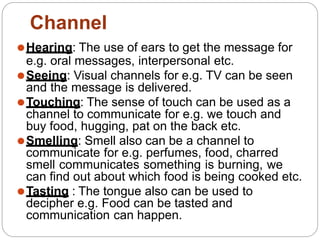
⚫Hearing: The use of ears to get the message for
e.g. oral messages, interpersonal etc.
⚫Seeing: Visual channels for e.g. TV can be seen
and the message is delivered.
⚫Touching: The sense of touch can be used as a
channel to communicate for e.g. we touch and
buy food, hugging, pat on the back etc.
⚫Smelling: Smell also can be a channel to
communicate for e.g. perfumes, food, charred
smell communicates something is burning, we
can find out about which food is being cooked etc.
⚫Tasting : The tongue also can be used to
decipher e.g. Food can be tasted and
communication can happen.
Channel
⚫Decoder : Who receives the message and
decodes it is referred to as decoder.
⚫Receiver: The receiver needs to have all the
things like the source.
This model believes that for an effective
communication to take place the source and the
receiver needs to be in the same level, only if
the source and receiver are on the same level
communication will happen or take place
properly. So source and receiver should be
similar
Criticism of Berlo’s SMCR
model of communication:
⚫No feedback / don’t know about the effect
⚫Does not mention barriers to communication
⚫No room for noise
⚫Needs people to be on same level for
communication to occur but not true in real
life.
⚫The model omits the usage of sixth sense as
a channel which is actually a gift to the
human beings (thinking, understanding,
analyzing etc).
Shannon Weaver Model of
Communication
Shannon- Weaver Model
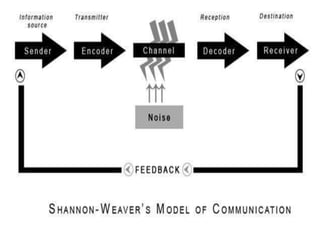
⚫ The Shannon–Weaver model of
communication has been called the "mother of all
models.“
⚫ It embodies the concepts of information
source, message, transmitter, signal, channel, noise,
receiver, information destination, probability of
error, encoding, decoding, information rate, channel
capacity, etc.
Elements of the Model
⚫ Sender : The originator of message or the information
source selects desired message
⚫ Encoder : The transmitter which converts the message
into signals
For example: In telephone the voice is converted into
wave signals and it transmits through cables
⚫ Decoder : The reception place of the signal which
converts signals into message. A reverse process of
encode
⚫ Receiver : The destination of the message from
sender
⚫ Noise: The messages are transferred from encoder
to decoder through channel. During this process the
messages may distracted or affected by physical
noise like horn sounds, thunder and crowd noise or
encoded signals may distract in the channel during
the transmission process which affect the
communication flow or the receiver may not receive
the correct message
Barriers to Communication
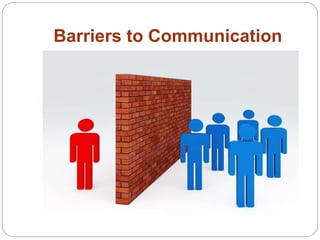
⚫When there is a problem which might cause
our communication to be distorted or
problematic, it is known as a barrier to
effective communication.
There are 4 types of barriers to communication
1. Physical barriers
2. Psychological barriers
3. Semantic blocks
4. Organizational Barriers
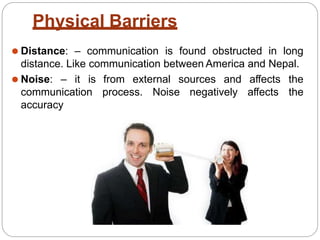
Physical Barriers
⚫ Distance: – communication is found obstructed in long
distance. Like communication between America and Nepal.
from external sources
process. Noise negatively
and affects the
affects the
⚫ Noise: – it is
communication
accuracy
Psychological Barriers
⚫Perception: – it is the process of accepting and
interpreting the information by the receiver.
People receive things differently for a various
number of reasons.
⚫Filtering: –In this process, knowingly or
unknowingly some valuable information may be
disposed.
⚫Emotions: – emotion also creates barriers to
effective communication like anger, hate,
mistrust, jealousy etc.
⚫Viewpoint: – it also creates
barriers to effective
communication. It the receiver
doesn’t clear the message and
ignore without hearing, the
message may create
obstructions.
⚫Defensiveness: – if the receiver
receives the message as threat
and interprets that message in
the same way, it creates barriers
to effective communication.
Semantic Barriers
⚫The use of difficult and multiple use of languages,
words, figures, symbols create semantic barriers.
⚫Language: – A meaning sent by the sender can be
quite different from the meaning understood by the
receiver. Long and complex sentences create
problem in communication process.
⚫Jargons: – Technical or unfamiliar language
creates barriers. The message should be simple
and condensed as far as possible so that no
confusion is created.
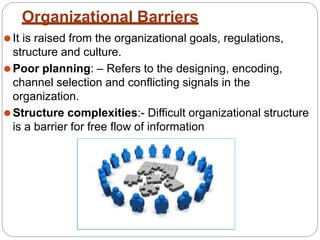
Organizational Barriers
⚫It is raised from the organizational goals, regulations,
structure and culture.
⚫Poor planning: – Refers to the designing, encoding,
channel selection and conflicting signals in the
organization.
⚫Structure complexities:- Difficult organizational structure
is a barrier for free flow of information
⚫Status differences: – Superior provides
information to the subordinate about plans and
policies. Different information is provided by
different subordinates who create barrier in
communication.
⚫Organizational distance:- Distance between
sender and receiver.
⚫Information overload: – If superior provides too
much information to the subordinate in short period
receiver suffers from information overload which
creates barriers to effective communication.
⚫Timing: – Communication can be obstructed if the
information is not provided in time.
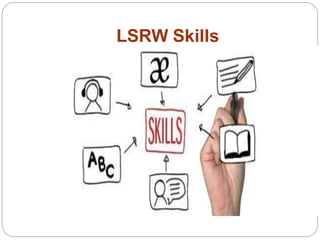
LSRW Skills
Listening Skills
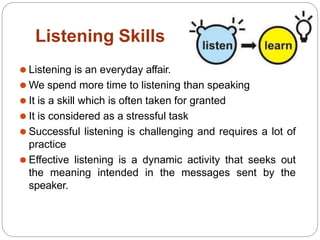
⚫ Listening is an everyday affair.
⚫ We spend more time to listening than speaking
⚫ It is a skill which is often taken for granted
⚫ It is considered as a stressful task
⚫ Successful listening is challenging and requires a lot of
practice
⚫ Effective listening is a dynamic activity that seeks out
the meaning intended in the messages sent by the
speaker.
Listening Vs Hearing
⚫ Hearing is an involuntary act that happens
automatically. Eg. A truck rolling by on the road in front
of our house.
⚫ Listening –
 voluntary activity,
 demands perfect coordination between the ears &
the brain
 very creative
 Interactive and interpretive process.
Techniques for Effective Listening
⚫ You should have an open mind.
⚫ You should sit alert and look the speaker in the eye with a
view to establish your interest in him/her.
⚫ Do not prejudge the speaker or his message.
⚫ Summarize what the speaker is saying
⚫ Take down notes
⚫ Link what you are listening to what you already know.
⚫ Do not interrupt the speaker unnecessarily.
⚫ Ask relevant questions to yourself for clarity in your
understanding.
Reading Skills
Skimming
⚫ Skimming is used to quickly gather the most important
information, or 'gist'.
⚫ Run your eyes over the text, noting important information.
⚫ Use skimming to quickly get up to speed on a current
business situation.
Examples of Skimming:
⚫ The Newspaper (quickly to get the general news of the
day)
⚫ Magazines (quickly to discover which articles you would
like to read in more detail)
⚫ Business and Travel Brochures (quickly to get informed)
Reading Skills
Scanning
⚫ Scanning is used to find a particular piece of information.
⚫ Run your eyes over the text looking for the specific piece
of information you need.
⚫ Use scanning on schedules, meeting plans, etc. in order
to find the specific details you require.
⚫ If you see words or phrases that you don't understand,
don't worry when scanning.
Examples of Scanning
⚫ The "What's on TV" section of your newspaper.
⚫ A train / airplane schedule
⚫ A conference guide
Reading Skills
Extensive reading
⚫Extensive reading is used to obtain a general
understanding of a subject and includes reading
longer texts for pleasure, as well as business books.
⚫Use extensive reading skills to improve your general
knowledge of business procedures.
⚫Do not worry if you understand each word.
Examples of Extensive Reading
⚫The latest marketing strategy book
⚫A novel you read before going to bed
⚫Magazine articles that interest you
Intensive reading
⚫Intensive reading is used on shorter texts in order
to extract specific information.
⚫ It includes very close accurate reading for detail.
⚫Use intensive reading skills to grasp the details of
a specific situation.
⚫In this case, it is important that you understand
each word, number or fact.
Examples of Intensive Reading
⚫An insurance claim
⚫A contract of employment
Reading Skills
Critical reading
⚫This is a form of language analysis that does not
take the given text at face value, but involves a
deeper examination of supporting points and
possible counter arguments.
⚫ Critical readers thus recognize not only what a text
says, but also how that text portrays the subject
matter.
⚫What a text means – interpretation — analyze the
text and assert a meaning for the text as a whole
Reading Skills
Speaking Skills
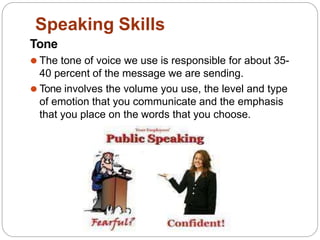
Tone
⚫ The tone of voice we use is responsible for about 35-
40 percent of the message we are sending.
⚫ Tone involves the volume you use, the level and type
of emotion that you communicate and the emphasis
that you place on the words that you choose.
Pitch
⚫ Pitch refers to the rise and fall in human voice. It plays a
crucial role in communication.
⚫ Questions, for example, should end on a higher note.
⚫ Affirmative statements should end in a level or slightly
lower pitch. The ending of statements on a high pitch can
create doubt in your listeners.
⚫ Vary your pitch throughout your presentation to establish
and reinforce your message.
Speaking Skills
Rhythm
⚫Rhythm is the pattern of the sounds you produce.
⚫Stressing and de-stressing syllables and words gives
us rhythm in English.
⚫Rhythm is the music of English Language –
the ups and downs and the linking of words, which
together, change how we say sentences.
⚫Use rhythm to carry meaning.
⚫Slow the pace to emphasize certain ideas.
⚫Quicken the pace to show excitement or humor.
⚫Pause to give listeners time to absorb a complex
idea. Pause also when you're about to transition to
another idea.
Speaking Skills
⚫ Stressing means to emphasize a sound and make
certain syllables and words:
⚫ louder
⚫ longer
⚫ higher in pitch
⚫ Every word in English has at least one syllable with a
primary stress or emphasis.
⚫ It is not only essential to stress certain syllables and
words, but we must also de-stress other syllables
and words.
Examples:
⚫ English –> [ING glish] (1st syllable is stressed; 2nd
syllable is slightly de-stressed)
Speaking Skills
Intonation
⚫Correct intonation and stress are the key to
speaking English fluently with good
pronunciation.
⚫The entire variation of pitch while speaking is
called intonation.
⚫Words that are stressed are key to
understanding and using the correct intonation
brings out the meaning.
⚫English spends more time on specific stressed
words while quickly gliding over the other, less
important, words.
Speaking Skills
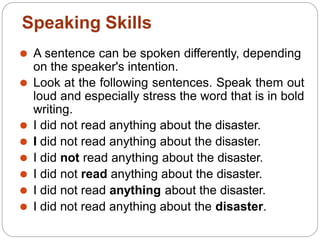
⚫ A sentence can be spoken differently, depending
on the speaker's intention.
⚫ Look at the following sentences. Speak them out
loud and especially stress the word that is in bold
writing.
⚫ I did not read anything about the disaster.
Speaking Skills
⚫ Effective writing is not a gift that you’re born with, rather it
is a skill that you cultivate. Clear writing means clear
thinking.
⚫ Think before you write: Before you put pen to paper or
hands to keyboard, consider what you want to say.
⚫ Ask yourself: What should my audience know or think
after reading this email, proposal, or report?
Writing Skills
Steps to Improve your Writing Skills
Be direct
⚫Make your point right up front.
⚫ By concisely presenting your main idea first,
you save your reader time and sharpen your
argument before diving into the bulk of your
writing.
⚫ If your opener is no good, then the whole
piece of writing will be no good.
Avoid jargons
⚫ Business writing is full of industry-specific
buzzwords and acronyms.
⚫And while these terms are sometimes
unavoidable and can occasionally be helpful as
shorthand, they often indicate lazy or cluttered
thinking.
⚫You should also avoid using grandiose words.
⚫Writers often mistakenly believe in using a big
word when a simple one will do.
Read what you write
⚫Put yourself in your reader’s shoes.
⚫Is your point clear and well structured?
⚫Are the sentences straightforward and
concise?
⚫Don’t be afraid to ask a colleague or friend
to edit your work.
⚫Welcome their feedback; don’t resent it.
Practice every day
⚫Writing is a skill, and skills improve with
practice.
⚫Read well-written material every day, and
be attentive to word choice, sentence
structure, and flow.
⚫Most importantly, build time into your
schedule for editing and revising.
Coherence
⚫ Coherence in writing is the "logical glue"
that allows readers to move easily and
clearly from one idea to the next.
⚫Coherence in writing is much more
difficult to sustain than coherent speech
because writers have no nonverbal clues
to inform them if their message is clear or
not.
business communication.pptx

business communication.pptx

  • 1.
    “You can haveall the great ideas in the world and if you can’t communicate, nobody will hear them.” -Kara Blackburn Business Communication
  • 2.
    Topics • Communication -Meaning • Business Communication - Definition • Importance • Process • Types – One-way/Two-way, Verbal/Non- Verbal, Oral/Written, Formal/Informal, Upward, Downward, Lateral, Intrapersonal, Interpersonal, Organizational, Mass Communication • Models – SMCR, Shannon Weaver • Language Skills-Listening, Speaking, Reading, Writing
  • 3.
    What is Communication? ⚫Derived from the Latin word "communis," meaning to share. ⚫ Communication is the exchange of thoughts, facts, messages, or information by speech, visuals, signals, writing, or behaviour. ⚫ It is the transmission of an idea or feeling so that the sender and receiver share the same understanding.
  • 4.
    Definition “Communication is aprocess involving the selection, production and transmission of signs in such a way as to help a receiver perceive a meaning similar to that in the mind of the communicator.” -Fotheringham
  • 5.
    Business Communication - Definition ⚫Business communication is the sharing of information between performed people within an organization for the commercial benefit that is of the organization.
  • 6.
    Characteristics •It involves atleast two persons •Message is must. •It is a two way process •Continuous Process •It may be written or oral.
  • 7.
    Importance ⚫ In theprofessional world, communication and related skills decide a person’s career curve - better the communication skills, higher are the chances of touching the zenith of success. ⚫ The new global and diverse workplace requires excellent spoken and written communication skills!
  • 8.
    Importance Continued…… Efficient workingof business Means of coordination Planning becomes easy Aids in decision Making Communication failure can be costly Building human relations Maintaining relations Boost your moral and motivation
  • 9.
    Purpose of Communication Toconvey the right message To advice To receive suggestion To persuade people :- like sales people To motivate To counselling To instruct To integrate different activities To inform To evaluate To direct To teach To influence To build image
  • 10.
    Process of communication Communicationsis a continuous process that mainly involves three elements viz. sender, message, and receiver. The elements involved in the communication process are explained below in detail: 1. Sender: The sender or the communicator generates the message and conveys it to the receiver. He is the source and the one who starts the communication 2. Message: It is the idea, information, view, fact, feeling, etc. that is generated by the sender and is then intended to be communicated further. 3. Encoding: The message generated by the sender is encoded symbolically such as in the form of words, pictures, gestures, etc. before it is being conveyed.
  • 11.
    Continued….. 4. Media: Itis the manner in which the encoded message is transmitted. The message may be transmitted orally or in writing. The medium of communication includes telephone, internet, post, fax, e- mail, etc. The choice of medium is decided by the sender. 5. Decoding: It is the process of converting the symbols encoded by the sender. After decoding the message is received by the receiver. 6. Receiver: He is the person who is last in the chain and for whom the message was sent by the sender. Once the receiver receives the message and understands it in proper perspective and acts according to the message, only then the purpose of communication is successful.
  • 12.
    Continued…. 7. Feedback: Oncethe receiver confirms to the sender that he has received the message and understood it, the process of communication is complete. 8. Noise: It refers to any obstruction that is caused by the sender, message or receiver during the process of communication. For example, bad telephone connection, faulty encoding, faulty decoding, inattentive receiver, poor understanding of message due to prejudice or inappropriate gestures, etc.
  • 14.
    Components of Communication Sender - Initiates the communication process by developing an idea into a message known as encoding.  Channel - The sender transmits the message through a channel, or a method of delivery; eg. e-mail, phone conversations, instant messages, face-to-face discussion or even a text message.
  • 15.
     Receiver – channelto This message then moves through the the receiver, who completes the communication process by interpreting and assigning meaning to the message known as decoding.  Feedback - This is a critical component in the communication process as it ensures a message was properly received and interpreted.
  • 17.
    Types •One-way , Two-way •Verbal(Oral& Written), Non-verbal •Formal, Informal(Grapevine) •Upward, Downward, Lateral •Interpersonal, Intrapersonal, Organizational, Mass Communication
  • 18.
    One way Communication ⚫One-way communication involves the transfer of information in one direction only, from the sender to the receiver. ⚫ There is no opportunity for the receiver to give feedback to the sender. ⚫ Eg. weather report on television, newspaper, recorded music on the CD, billboard messages
  • 19.
    Two-way Communication ⚫ Two-waycommunication is a form of transmission in which both parties involved, transmit information. ⚫ Two-Way communication has also been referred to as interpersonal communication. ⚫ Eg. Chat rooms and Instant Messaging, T elephone conversations, classroom lectures etc.
  • 20.
    Verbal Communication uses In thistype of communication the professional language as a vehicle of communication. ⚫ Oral communication – A face-to-face interaction between the sender and the receiver. Eg. Making presentations and appearing for interviews  Written Communication – The sender uses the written mode to transmit his/her messages. Eg. Writing reports and emails.
  • 21.
    Non Verbal Communication Whena message is communicated without using a word, the process requires non-verbal cues to be transmitted and received. Eg. facial expressions, posture, eye contact, walk, person’s voice, sign language, body language volume, pitch, voice modulation etc. Communication includes both verbal and non-verbal forms.
  • 22.
    Formal ⚫ Communication takesplace through the formal channels of the organization structure of authority by the along the lines established management. ⚫ Such communications are generally in writing and may take any of the forms; policy; manuals: procedures and rule books; memoranda; official meetings; reports, etc.
  • 23.
    Informal ⚫ Communication arisingout of all those channels of communication that fall outside the formal channels is known as informal communication. ⚫ Informal communication does not follow lines of authority as is the case of formal communication. ⚫ Such communication is usually oral and may be covered even by simple glance, gesture or smile or silence. ⚫ Eg. Talking with friends
  • 24.
    Formal Informal Official ChannelUnofficial Channel Planned & Systematic Cuts across formal relationships Goal and task oriented Individual Goal and need oriented Impersonal Personal & Social Stable and rigid Flexible and instable Slow & Structured Fast & unstructured Authentic – little chance of distortion Non- Authentic - bigger chance of distortion
  • 25.
    Grapevine ⚫ It isan informal type of communication so because and is called it stretches throughout the organization in all directions irrespective of the authority levels. ⚫ It exists more at lower levels of organization. ⚫ Thus, grapevine spreads like fire and it is not easy to trace the cause of such communication at times.
  • 26.
    Example of GrapevineNetwork of Communication Suppose the profit amount of a company is known. Rumor is spread that this much profit is there and on that basis bonus is declared. CEO may be in relation to the Production Manager. They may have friendly relations with each other.
  • 27.
    Advantages •Grapevine channels carryinformation rapidly. •The managers get to know the reactions of their subordinates on their policies. •Grapevine helps in developing group cohesiveness. •The grapevine serves as an emotional supportive value. •The grapevine is a supplement in those cases where formal communication does not work. •Grapevine links the whole organization very quickly. •This is the primary source of information as well as the reliable channel to communicate about the facts and events within the firm. •3. t is more flexible than formal channels.
  • 28.
    Disadvantages •The grapevine carriespartial information at times as it is more based on rumors. Thus, it does not clearly depicts the complete state of affairs. •The grapevine is not trustworthy always as it does not follows official path of communication and is spread more by gossips and unconfirmed report. •The productivity of employees may be hampered as they spend more time talking rather than working. •The grapevine leads to making hostility against the executives. •The grapevine may hamper the goodwill of the organization as it may carry false negative information about the high level people of the organization.
  • 30.
    Types of BusinessCommunication
  • 31.
    Downward ⚫ Communication inthe first place, flows downwards. ⚫ All information in this medium is usually in form of instructions, directions and orders. ⚫ This direction of communication strengthens the authoritarian structure of the organization. ⚫Organizational publications, circulars, letter to employees, group meetings etc are all examples of downward
  • 32.
    Purpose Downward communication isused by the managers for the following purposes – •Providing feedback on employees’ performance. •Giving job instructions. •Providing a complete understanding of the employees’ job as well as to communicate them how their job is related to other jobs in the organization. •Communicating the organizations mission and vision to the employees. •Highlighting the areas of attention.
  • 33.
    Upward ⚫ Upward Communicationis the process of information flowing from the lower levels of a hierarchy to the upper levels. ⚫ The function communication information, of upward is to send suggestions, Complaints,Performance and grievances of the lower level workers to the managers above.
  • 34.
    The managers getto know about the employees’ feelings towards their jobs, peers, supervisor and organization in general. Managers can thus accordingly take actions for improving things. Grievance Redressal System, Complaint and Suggestion Box, Job Satisfaction surveys etc all help in improving upward communication. Other examples are - performance reports made by low level management for reviewing by higher level management, employee attitude surveys, letters from employees, employee- manager discussions etc.
  • 35.
    Lateral/Horizontal ⚫ This typeof communication takes place between persons at the same level or working under the same executive. ⚫ The main use of this is to maintain coordination and review activities assigned to various subordinates.
  • 36.
    Advantages It is timesaving. It facilitates co-ordination of the task. It facilitates co-operation among team members. It provides emotional and social assistance to the organizational members. It helps in solving various organizational problems. It is a means of information sharing. It can also be used for resolving conflicts of a department with other department or conflicts within a department.
  • 37.
    Diagonal or crosswisecommunication Communication that takes place between a manager and employees of other workgroups is called diagonal communication. It generally does not appear on organizational chart. For instance - To design a training module a training manager interacts with an Operations personnel to enquire about the way they perform their task. The Accounts people of an organization visiting different employees in various departments for their IT calculation, bonus for workers etc. fall under diagonal communication.
  • 38.
    External communication External communicationis any communication that leaves the office and deals with customers, prospects, vendors or partners. It could also involve regulatory agencies or city offices. Sales presentations or marketing letters need to be exciting to generate interest from the customer but they also need to be factually based. When corresponding to outside entities for partnerships or other business administration needs, state the purpose and be concise in communication, whether oral or written. Respect people's time by getting to the point and stating your request.
  • 39.
    Interpersonal ⚫ Interpersonal communication isan exchange of information between two or more people. ⚫ It is the process by which people exchange information, feelings, and meaning through verbal and non-verbal messages.
  • 40.
    Intrapersonal ⚫ It isthe communication which takes place within one’s own self. ⚫ This implies individual reflection, contemplation and meditation.
  • 41.
    Organizational ⚫ A processby which activities of a society are collected and coordinated to reach the goals of both individuals and the collective group. ⚫ It is a subfield of general communications studies and is often a component to effective management in a workplace environment.
  • 42.
    Mass Communication ⚫ Itis a means of conveying messages to an entire populace. ⚫ This is generally identified with tools of modern mass media, which include books, the press, cinema, television, radio, internet etc. It also includes speeches delivered by leaders to a large audience
  • 43.
    Channels of Communication Thecommunication channels further can be categorized as: 1. Formal channels It is an official way of communicating. A formal communication channel transmits information such as the goals, policies and procedures of an organization. Messages in this type of communication channel follow a chain of command. This means information flows from a manager to his subordinates and they in turn pass on the information to the next level of staff. Some examples include company newsletters, business plans, instructions, annual reports, agreements, company-wide communications, board presentations etc.
  • 44.
    2. Informal channels Itis also an official way of communicating, with somewhat relaxed norms. There may not be a need for a chain of command or hierarchy in this kind of communication. There will be immense official communication where such hierarchy or command is not needed, but they happen within the official framework. Some examples will include conversations on the work floor addressing queries of team members, lunch time conversations, many of the emails where formal command is not needed such as someone is seeking some quick information etc. Under the official environment, both formal and informal channels are used as needed.
  • 45.
    3. Unofficial channels Thereexists an unofficial mode of communication as well. The employees communicate outside work environment on topics not related to work. General social, sports, political and personal communication are unofficial channels. But a manager needs to be aware about the existence of such a channel and information flowing in them. Many times rumors and gossips also provide very important information which otherwise will not be available.
  • 48.
  • 49.
    SMCR MODEL ⚫ TheSMCR (Source-Message-Channel-Receiver) Model is a standard in communication studies. ⚫ This model was originally developed by Claude Shannon and Warren Weaver, and then altered by David Berlo, but the latest credit has been given to Wilbur Schramm for his interactive interpretation
  • 51.
    The source iswere the message originates. ⚫Attitudes – The attitude towards the audience, subject and towards one self for e.g. for the student the attitude is to learn more and for teachers wants to help teach. ⚫Knowledge– The knowledge about the subject. ⚫Social system – The Social system includes the various aspects in society like values, beliefs, culture, religion and general understanding of society. ⚫Culture: Culture of the particular society also comes under social system. Source
  • 52.
    ⚫Encoder: The senderof the message (message originates) is referred as encoder. ⚫Content – The beginning to the end of a message comprises its content. ⚫Elements – It includes various things like language, gestures, body language etc. so these are all the elements of the particular message. ⚫Treatment – The way in which the message is conveyed or the way in which the message is passed on or deliver it. Message
  • 53.
    ⚫Hearing: The useof ears to get the message for e.g. oral messages, interpersonal etc. ⚫Seeing: Visual channels for e.g. TV can be seen and the message is delivered. ⚫Touching: The sense of touch can be used as a channel to communicate for e.g. we touch and buy food, hugging, pat on the back etc. ⚫Smelling: Smell also can be a channel to communicate for e.g. perfumes, food, charred smell communicates something is burning, we can find out about which food is being cooked etc. ⚫Tasting : The tongue also can be used to decipher e.g. Food can be tasted and communication can happen. Channel
  • 54.
    ⚫Decoder : Whoreceives the message and decodes it is referred to as decoder. ⚫Receiver: The receiver needs to have all the things like the source. This model believes that for an effective communication to take place the source and the receiver needs to be in the same level, only if the source and receiver are on the same level communication will happen or take place properly. So source and receiver should be similar
  • 55.
    Criticism of Berlo’sSMCR model of communication: ⚫No feedback / don’t know about the effect ⚫Does not mention barriers to communication ⚫No room for noise ⚫Needs people to be on same level for communication to occur but not true in real life. ⚫The model omits the usage of sixth sense as a channel which is actually a gift to the human beings (thinking, understanding, analyzing etc).
  • 56.
    Shannon Weaver Modelof Communication
  • 58.
    Shannon- Weaver Model ⚫The Shannon–Weaver model of communication has been called the "mother of all models.“ ⚫ It embodies the concepts of information source, message, transmitter, signal, channel, noise, receiver, information destination, probability of error, encoding, decoding, information rate, channel capacity, etc.
  • 59.
    Elements of theModel ⚫ Sender : The originator of message or the information source selects desired message ⚫ Encoder : The transmitter which converts the message into signals For example: In telephone the voice is converted into wave signals and it transmits through cables ⚫ Decoder : The reception place of the signal which converts signals into message. A reverse process of encode
  • 60.
    ⚫ Receiver :The destination of the message from sender ⚫ Noise: The messages are transferred from encoder to decoder through channel. During this process the messages may distracted or affected by physical noise like horn sounds, thunder and crowd noise or encoded signals may distract in the channel during the transmission process which affect the communication flow or the receiver may not receive the correct message
  • 61.
  • 62.
    Barriers to Communication ⚫Whenthere is a problem which might cause our communication to be distorted or problematic, it is known as a barrier to effective communication. There are 4 types of barriers to communication 1. Physical barriers 2. Psychological barriers 3. Semantic blocks 4. Organizational Barriers
  • 63.
    Physical Barriers ⚫ Distance:– communication is found obstructed in long distance. Like communication between America and Nepal. from external sources process. Noise negatively and affects the affects the ⚫ Noise: – it is communication accuracy
  • 64.
    Psychological Barriers ⚫Perception: –it is the process of accepting and interpreting the information by the receiver. People receive things differently for a various number of reasons. ⚫Filtering: –In this process, knowingly or unknowingly some valuable information may be disposed. ⚫Emotions: – emotion also creates barriers to effective communication like anger, hate, mistrust, jealousy etc.
  • 65.
    ⚫Viewpoint: – italso creates barriers to effective communication. It the receiver doesn’t clear the message and ignore without hearing, the message may create obstructions. ⚫Defensiveness: – if the receiver receives the message as threat and interprets that message in the same way, it creates barriers to effective communication.
  • 66.
    Semantic Barriers ⚫The useof difficult and multiple use of languages, words, figures, symbols create semantic barriers. ⚫Language: – A meaning sent by the sender can be quite different from the meaning understood by the receiver. Long and complex sentences create problem in communication process. ⚫Jargons: – Technical or unfamiliar language creates barriers. The message should be simple and condensed as far as possible so that no confusion is created.
  • 67.
    Organizational Barriers ⚫It israised from the organizational goals, regulations, structure and culture. ⚫Poor planning: – Refers to the designing, encoding, channel selection and conflicting signals in the organization. ⚫Structure complexities:- Difficult organizational structure is a barrier for free flow of information
  • 68.
    ⚫Status differences: –Superior provides information to the subordinate about plans and policies. Different information is provided by different subordinates who create barrier in communication. ⚫Organizational distance:- Distance between sender and receiver. ⚫Information overload: – If superior provides too much information to the subordinate in short period receiver suffers from information overload which creates barriers to effective communication. ⚫Timing: – Communication can be obstructed if the information is not provided in time.
  • 69.
  • 70.
    Listening Skills ⚫ Listeningis an everyday affair. ⚫ We spend more time to listening than speaking ⚫ It is a skill which is often taken for granted ⚫ It is considered as a stressful task ⚫ Successful listening is challenging and requires a lot of practice ⚫ Effective listening is a dynamic activity that seeks out the meaning intended in the messages sent by the speaker.
  • 71.
    Listening Vs Hearing ⚫Hearing is an involuntary act that happens automatically. Eg. A truck rolling by on the road in front of our house. ⚫ Listening –  voluntary activity,  demands perfect coordination between the ears & the brain  very creative  Interactive and interpretive process.
  • 72.
    Techniques for EffectiveListening ⚫ You should have an open mind. ⚫ You should sit alert and look the speaker in the eye with a view to establish your interest in him/her. ⚫ Do not prejudge the speaker or his message. ⚫ Summarize what the speaker is saying ⚫ Take down notes ⚫ Link what you are listening to what you already know. ⚫ Do not interrupt the speaker unnecessarily. ⚫ Ask relevant questions to yourself for clarity in your understanding.
  • 73.
    Reading Skills Skimming ⚫ Skimmingis used to quickly gather the most important information, or 'gist'. ⚫ Run your eyes over the text, noting important information. ⚫ Use skimming to quickly get up to speed on a current business situation. Examples of Skimming: ⚫ The Newspaper (quickly to get the general news of the day) ⚫ Magazines (quickly to discover which articles you would like to read in more detail) ⚫ Business and Travel Brochures (quickly to get informed)
  • 74.
    Reading Skills Scanning ⚫ Scanningis used to find a particular piece of information. ⚫ Run your eyes over the text looking for the specific piece of information you need. ⚫ Use scanning on schedules, meeting plans, etc. in order to find the specific details you require. ⚫ If you see words or phrases that you don't understand, don't worry when scanning. Examples of Scanning ⚫ The "What's on TV" section of your newspaper. ⚫ A train / airplane schedule ⚫ A conference guide
  • 75.
    Reading Skills Extensive reading ⚫Extensivereading is used to obtain a general understanding of a subject and includes reading longer texts for pleasure, as well as business books. ⚫Use extensive reading skills to improve your general knowledge of business procedures. ⚫Do not worry if you understand each word. Examples of Extensive Reading ⚫The latest marketing strategy book ⚫A novel you read before going to bed ⚫Magazine articles that interest you
  • 76.
    Intensive reading ⚫Intensive readingis used on shorter texts in order to extract specific information. ⚫ It includes very close accurate reading for detail. ⚫Use intensive reading skills to grasp the details of a specific situation. ⚫In this case, it is important that you understand each word, number or fact. Examples of Intensive Reading ⚫An insurance claim ⚫A contract of employment Reading Skills
  • 77.
    Critical reading ⚫This isa form of language analysis that does not take the given text at face value, but involves a deeper examination of supporting points and possible counter arguments. ⚫ Critical readers thus recognize not only what a text says, but also how that text portrays the subject matter. ⚫What a text means – interpretation — analyze the text and assert a meaning for the text as a whole Reading Skills
  • 78.
    Speaking Skills Tone ⚫ Thetone of voice we use is responsible for about 35- 40 percent of the message we are sending. ⚫ Tone involves the volume you use, the level and type of emotion that you communicate and the emphasis that you place on the words that you choose.
  • 79.
    Pitch ⚫ Pitch refersto the rise and fall in human voice. It plays a crucial role in communication. ⚫ Questions, for example, should end on a higher note. ⚫ Affirmative statements should end in a level or slightly lower pitch. The ending of statements on a high pitch can create doubt in your listeners. ⚫ Vary your pitch throughout your presentation to establish and reinforce your message. Speaking Skills
  • 80.
    Rhythm ⚫Rhythm is thepattern of the sounds you produce. ⚫Stressing and de-stressing syllables and words gives us rhythm in English. ⚫Rhythm is the music of English Language – the ups and downs and the linking of words, which together, change how we say sentences. ⚫Use rhythm to carry meaning. ⚫Slow the pace to emphasize certain ideas. ⚫Quicken the pace to show excitement or humor. ⚫Pause to give listeners time to absorb a complex idea. Pause also when you're about to transition to another idea. Speaking Skills
  • 81.
    ⚫ Stressing meansto emphasize a sound and make certain syllables and words: ⚫ louder ⚫ longer ⚫ higher in pitch ⚫ Every word in English has at least one syllable with a primary stress or emphasis. ⚫ It is not only essential to stress certain syllables and words, but we must also de-stress other syllables and words. Examples: ⚫ English –> [ING glish] (1st syllable is stressed; 2nd syllable is slightly de-stressed) Speaking Skills
  • 82.
    Intonation ⚫Correct intonation andstress are the key to speaking English fluently with good pronunciation. ⚫The entire variation of pitch while speaking is called intonation. ⚫Words that are stressed are key to understanding and using the correct intonation brings out the meaning. ⚫English spends more time on specific stressed words while quickly gliding over the other, less important, words. Speaking Skills
  • 83.
    ⚫ A sentencecan be spoken differently, depending on the speaker's intention. ⚫ Look at the following sentences. Speak them out loud and especially stress the word that is in bold writing. ⚫ I did not read anything about the disaster. ⚫ I did not read anything about the disaster. ⚫ I did not read anything about the disaster. ⚫ I did not read anything about the disaster. ⚫ I did not read anything about the disaster. ⚫ I did not read anything about the disaster. Speaking Skills
  • 84.
    ⚫ Effective writingis not a gift that you’re born with, rather it is a skill that you cultivate. Clear writing means clear thinking. ⚫ Think before you write: Before you put pen to paper or hands to keyboard, consider what you want to say. ⚫ Ask yourself: What should my audience know or think after reading this email, proposal, or report? Writing Skills
  • 85.
    Steps to Improveyour Writing Skills Be direct ⚫Make your point right up front. ⚫ By concisely presenting your main idea first, you save your reader time and sharpen your argument before diving into the bulk of your writing. ⚫ If your opener is no good, then the whole piece of writing will be no good.
  • 86.
    Avoid jargons ⚫ Businesswriting is full of industry-specific buzzwords and acronyms. ⚫And while these terms are sometimes unavoidable and can occasionally be helpful as shorthand, they often indicate lazy or cluttered thinking. ⚫You should also avoid using grandiose words. ⚫Writers often mistakenly believe in using a big word when a simple one will do.
  • 87.
    Read what youwrite ⚫Put yourself in your reader’s shoes. ⚫Is your point clear and well structured? ⚫Are the sentences straightforward and concise? ⚫Don’t be afraid to ask a colleague or friend to edit your work. ⚫Welcome their feedback; don’t resent it.
  • 88.
    Practice every day ⚫Writingis a skill, and skills improve with practice. ⚫Read well-written material every day, and be attentive to word choice, sentence structure, and flow. ⚫Most importantly, build time into your schedule for editing and revising.
  • 89.
    Coherence ⚫ Coherence inwriting is the "logical glue" that allows readers to move easily and clearly from one idea to the next. ⚫Coherence in writing is much more difficult to sustain than coherent speech because writers have no nonverbal clues to inform them if their message is clear or not.