Communication Process


By Muhammad Bilal Amjad (CIIT LAHORE)    bilalamjad78633@yahoo.com
                                        www.facebook.com/bilal.amjad
What is communication process?


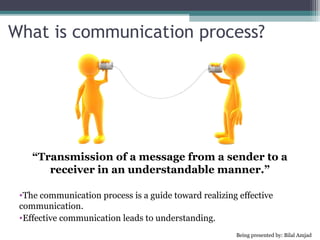
    “Transmission of a message from a sender to a
       receiver in an understandable manner.”

 •The communication process is a guide toward realizing effective
 communication.
 •Effective communication leads to understanding.
                                                       Being presented by: Bilal Amjad
Components of Communication

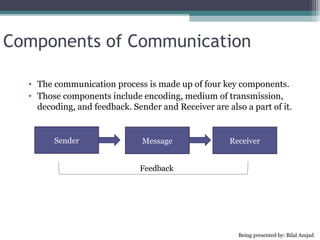
  • The communication process is made up of four key components.
  • Those components include encoding, medium of transmission,
    decoding, and feedback. Sender and Receiver are also a part of it.


        Sender                 Message               Receiver


                              Feedback


                                                        Being presented by: Bilal Amjad
Importance of understanding communication
process
  "If I went back to college again, I'd concentrate on two areas: learning to
  write and to speak before an audience. Nothing in life is more important
                 than the ability to communicate effectively."
                                -- Gerald R. Ford

  • Communication is only successful when both the sender and the receiver
    understand the same information as a result of the communication.
  Importance of Communication in Business:
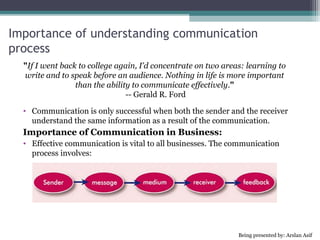
  • Effective communication is vital to all businesses. The communication
    process involves:
Importance of understanding communication
process -cont


  Importance of Communication in the Workplace
  •Communication is important in a workplace setting because people must
  interact with one another in ways that will get the job done quickly and
  effectively.

  "Communication is really all anyone ever gets paid for ultimately...and if you cannot
  effectively communicate...you will PAY...not get paid..." -- Doug Firebaugh


  Importance of Communication in Leadership
  •It is simply impossible to become a great leader without being a great communicator.
         "The art of communication is the language of leadership." — James Humes
  •Good Leaders, Good Communicators.
Importance of understanding communication process -cont


  Significance of Communication in Relationships
  •Definitely, communication plays the main role in establishing
  relationships. Communication is important in relationships as it
  allows us to share interests, aspirations and concerns, to support each
  other, to organize our lives and make decisions, and to work together.
Types of Communication

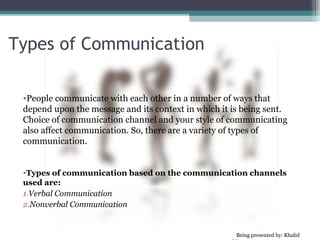
 •People communicate with each other in a number of ways that
 depend upon the message and its context in which it is being sent.
 Choice of communication channel and your style of communicating
 also affect communication. So, there are a variety of types of
 communication.


 •Types of communication based on the communication channels
 used are:
 1.Verbal Communication
 2.Nonverbal Communication
Verbal Communication
•    Verbal communication refers to the form of communication in which message is transmitted
     verbally; communication is done by word of mouth and a piece of writing. Objective of every
     communication is to have people understand what we are trying to convey. In verbal
     communication remember the acronym KISS(keep it short and simple).

• Verbal Communication is further divided into:
   1. Oral Communication
   2. Written Communication


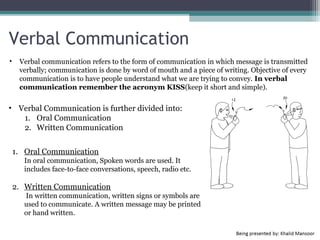
    1. Oral Communication
      In oral communication, Spoken words are used. It
      includes face-to-face conversations, speech, radio etc.

    2. Written Communication
      In written communication, written signs or symbols are
      used to communicate. A written message may be printed
      or hand written.
Non Verbal Communication
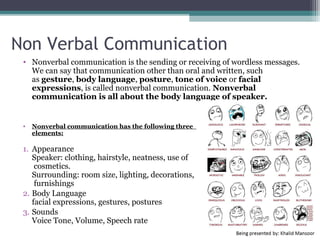
 • Nonverbal communication is the sending or receiving of wordless messages.
   We can say that communication other than oral and written, such
   as gesture, body language, posture, tone of voice or facial
   expressions, is called nonverbal communication. Nonverbal
   communication is all about the body language of speaker.


 •   Nonverbal communication has the following three
     elements:

 1. Appearance
    Speaker: clothing, hairstyle, neatness, use of
     cosmetics.
    Surrounding: room size, lighting, decorations,
     furnishings
 2. Body Language
    facial expressions, gestures, postures
 3. Sounds
    Voice Tone, Volume, Speech rate
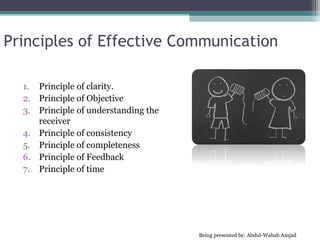
Principles of Effective Communication

  1. Principle of clarity.
  2. Principle of Objective
  3. Principle of understanding the
     receiver
  4. Principle of consistency
  5. Principle of completeness
  6. Principle of Feedback
  7. Principle of time
Barriers in Communication
  • Communicating is straightforward. What
    makes it complex, difficult, and frustrating are
    the barriers we put in the way.

  • Top Barriers :

  •   EXPECTATIONS       •   CONFLICT AVOIDANCE
  •   AVOIDANCE              (CHAOS)
  •   FIXING             •   EXCLUSION
  •   SCAPEGOATING       •   BOUNDARY OR BARRIER
  •   PROBING            •   Information overload
  •   SPEAKING IN CODE   •   Trust and credibility
  •   CONTROL            •   Time
  •   BLAMING            •   Emotions
                         •   Message congruency


      Objective : thoughts and goals
      Subjective : feelings
7 C’s of Communication
References
•   http://www.mbaknol.com/business-communication/principles-of-effective-communication/
•   http://businesscasestudies.co.uk/building-societies-association/the-importance-of-effective-
    communication/the-communication-process.html#ixzz2FnJbjNxZ
•
•   http://www.mindtools.com/CommSkll/CommunicationIntro.htm
•
•   http://www.enotes.com/business/q-and-a/understand-why-communication-important-work-
    220459
•
•   http://www.forbes.com/sites/mikemyatt/2012/04/04/10-communication-secrets-of-great-
    leaders/
•   http://www.betterhealth.vic.gov.au/bhcv2/bhcarticles.nsf/pages/Relationships_and_communic
    ation
That’s All
Thanks For Your Concentration

Communication process (effective)

  • 1.
    Communication Process By MuhammadBilal Amjad (CIIT LAHORE) bilalamjad78633@yahoo.com www.facebook.com/bilal.amjad
  • 2.
    What is communicationprocess? “Transmission of a message from a sender to a receiver in an understandable manner.” •The communication process is a guide toward realizing effective communication. •Effective communication leads to understanding. Being presented by: Bilal Amjad
  • 3.
    Components of Communication • The communication process is made up of four key components. • Those components include encoding, medium of transmission, decoding, and feedback. Sender and Receiver are also a part of it. Sender Message Receiver Feedback Being presented by: Bilal Amjad
  • 4.
    Importance of understandingcommunication process "If I went back to college again, I'd concentrate on two areas: learning to write and to speak before an audience. Nothing in life is more important than the ability to communicate effectively." -- Gerald R. Ford • Communication is only successful when both the sender and the receiver understand the same information as a result of the communication. Importance of Communication in Business: • Effective communication is vital to all businesses. The communication process involves:
  • 5.
    Importance of understandingcommunication process -cont Importance of Communication in the Workplace •Communication is important in a workplace setting because people must interact with one another in ways that will get the job done quickly and effectively. "Communication is really all anyone ever gets paid for ultimately...and if you cannot effectively communicate...you will PAY...not get paid..." -- Doug Firebaugh Importance of Communication in Leadership •It is simply impossible to become a great leader without being a great communicator. "The art of communication is the language of leadership." — James Humes •Good Leaders, Good Communicators.
  • 6.
    Importance of understandingcommunication process -cont Significance of Communication in Relationships •Definitely, communication plays the main role in establishing relationships. Communication is important in relationships as it allows us to share interests, aspirations and concerns, to support each other, to organize our lives and make decisions, and to work together.
  • 7.
    Types of Communication •People communicate with each other in a number of ways that depend upon the message and its context in which it is being sent. Choice of communication channel and your style of communicating also affect communication. So, there are a variety of types of communication. •Types of communication based on the communication channels used are: 1.Verbal Communication 2.Nonverbal Communication
  • 8.
    Verbal Communication • Verbal communication refers to the form of communication in which message is transmitted verbally; communication is done by word of mouth and a piece of writing. Objective of every communication is to have people understand what we are trying to convey. In verbal communication remember the acronym KISS(keep it short and simple). • Verbal Communication is further divided into: 1. Oral Communication 2. Written Communication 1. Oral Communication In oral communication, Spoken words are used. It includes face-to-face conversations, speech, radio etc. 2. Written Communication In written communication, written signs or symbols are used to communicate. A written message may be printed or hand written.
  • 9.
    Non Verbal Communication • Nonverbal communication is the sending or receiving of wordless messages. We can say that communication other than oral and written, such as gesture, body language, posture, tone of voice or facial expressions, is called nonverbal communication. Nonverbal communication is all about the body language of speaker. • Nonverbal communication has the following three elements: 1. Appearance Speaker: clothing, hairstyle, neatness, use of cosmetics. Surrounding: room size, lighting, decorations, furnishings 2. Body Language facial expressions, gestures, postures 3. Sounds Voice Tone, Volume, Speech rate
  • 10.
    Principles of EffectiveCommunication 1. Principle of clarity. 2. Principle of Objective 3. Principle of understanding the receiver 4. Principle of consistency 5. Principle of completeness 6. Principle of Feedback 7. Principle of time
  • 11.
    Barriers in Communication • Communicating is straightforward. What makes it complex, difficult, and frustrating are the barriers we put in the way. • Top Barriers : • EXPECTATIONS • CONFLICT AVOIDANCE • AVOIDANCE (CHAOS) • FIXING • EXCLUSION • SCAPEGOATING • BOUNDARY OR BARRIER • PROBING • Information overload • SPEAKING IN CODE • Trust and credibility • CONTROL • Time • BLAMING • Emotions • Message congruency Objective : thoughts and goals Subjective : feelings
  • 12.
    7 C’s ofCommunication
  • 13.
    References • http://www.mbaknol.com/business-communication/principles-of-effective-communication/ • http://businesscasestudies.co.uk/building-societies-association/the-importance-of-effective- communication/the-communication-process.html#ixzz2FnJbjNxZ • • http://www.mindtools.com/CommSkll/CommunicationIntro.htm • • http://www.enotes.com/business/q-and-a/understand-why-communication-important-work- 220459 • • http://www.forbes.com/sites/mikemyatt/2012/04/04/10-communication-secrets-of-great- leaders/ • http://www.betterhealth.vic.gov.au/bhcv2/bhcarticles.nsf/pages/Relationships_and_communic ation
  • 14.
    That’s All Thanks ForYour Concentration