K.SATHISH KUMAR
M.ED
ALAGAPPA UNIVERSITY
Communication modes,
Barriers and Process,
Multimedia Approach,
Mass Media Approach,
Flander‘s Interaction Analysis
COMMUNICATION
From Latin
communicare, meaning "to share"
The process by which messages or information is sent
from one place or person to another.
There are Three Modes
Interpretive
Interpersonal
Presentational
Interpretive:
They read, listen to and/or view information
about the topic.
Interpersonal:
They talk with others about the topic in
meaningful ways.
Presentational:
They have the opportunity to share what they
have learned through writing or speaking with an
audience.
BARRIERS AND PROCESS
There are two types of barriers—
Internal and External.
Examples of internal barriers are
Fatigue,
Poor listening skills,
Attitude toward the sender ,
Lack of interest in the message,
Mistrust,
Negative attitude,
Problems at home.
Examples of external barriers include
Noise,
Distractions,
E-mail not working,
Bad phone connections,
Sender used too many technical,
words for the audience.
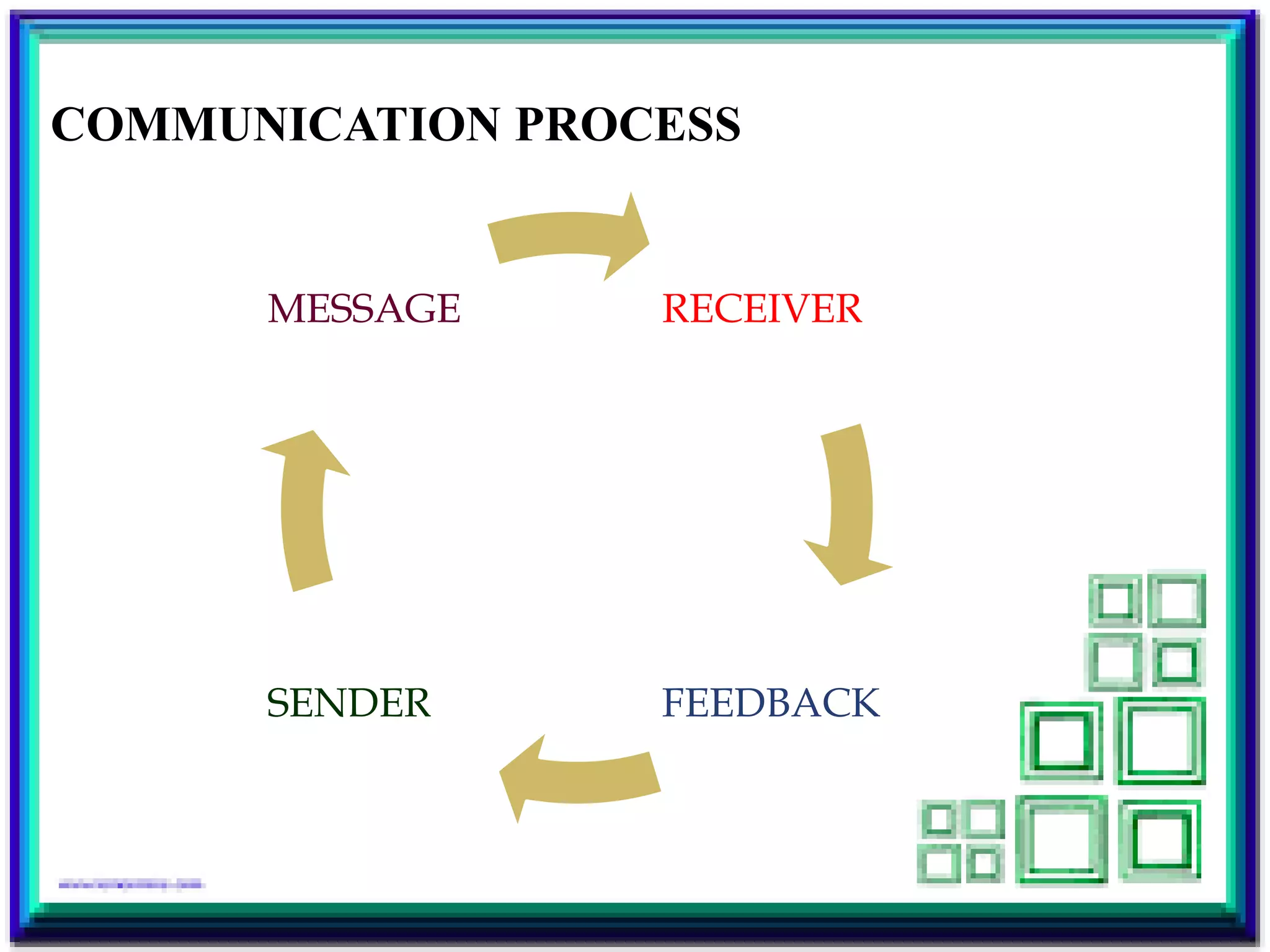
COMMUNICATION PROCESS
RECEIVER
FEEDBACKSENDER
MESSAGE
Sender :
The communicator or sender is the person who is
sending the message.
Message :
A communication in writing, in speech, or by signals.
Receiver :
The receiver is simply the person receiving the
message, making sense of it, or understanding and translating
it into meaning.
Feed back :
Feedback is that reaction I just
mentioned. It can be a verbal or nonverbal
reaction or response.
MULTIMEDIAAPPROACH TO
TEACHING LEARNING PROCESS
Multimedia - Definition
Digital integration of Text,
Graphics,
Animation,
Audio,
Still images,
Motion Video.
Nature of Multimedia Approach
Multi –Many, Media - Techniques or methods
Multimedia approach uses a number of media, devices, and
techniques in the teaching learning process.
Multimedia approach can convey vast information.
Multimedia approach will improve the teaching learning
process.
Advantages of the multimedia Approach
•Can develop a positive attitude among the learners .
•Multimedia Approach allows for self-pacing.
•Helps in development of higher order thinking skills.
•Multimedia approach provides flexibility of 'any where',
'any time' learning.
•Helps in developing group and interpersonal skills.
•Multimedia approach can bridge language barriers.
MASS MEDIA
The mass media is a
diversified collection of media technologies
that reach a large audience via
mass communication.
The technologies through which this
Communication takes place include a variety
of outlets.
FORMS OF MASS MEDIA
•Broad cast
•Film
•Video games
•Audio recording and
reproduction
•Internet
•Mobile.
In the late 20th century, mass media could be classified into eight mass media industries:
Books,
The Internet,
Magazines,
Movies,
Newspapers,
Radio,
Recordings, and
Television.
In the late 20th century, mass
media could be classified into eight
mass media industries:
 Books,
 The Internet,
 Magazines,
 Movies,
 Newspapers,
 Radio,
 Recordings, and
 Television.
Flanders Interaction Analysis
Technique
The teaching-learning
situations in the class-room involve
interaction between the teacher and
the students.
Precautions in the use of Flander’s
Interaction Analysis:
•Trained observers
•Avoiding value judgments
•Two observers
•Inspecting the matrix table
•Class-room recording
Limitations of Flander’s System of Interaction Analysis:
•Not useful for non-verbal behavior
•Narrow structure of teaching behavior
•No balance in categories
•No information about content
•No place for pupil-pupil interaction
•No place for recording reactions
CONCLUSION
Effective communication is a major part
in achieving your educational goals.
Effectively communicating with your
teachers and peers is essential when it comes
to your learning.
Communication

Communication

  • 1.
  • 3.
    Communication modes, Barriers andProcess, Multimedia Approach, Mass Media Approach, Flander‘s Interaction Analysis
  • 4.
    COMMUNICATION From Latin communicare, meaning"to share" The process by which messages or information is sent from one place or person to another.
  • 5.
    There are ThreeModes Interpretive Interpersonal Presentational
  • 6.
    Interpretive: They read, listento and/or view information about the topic. Interpersonal: They talk with others about the topic in meaningful ways. Presentational: They have the opportunity to share what they have learned through writing or speaking with an audience.
  • 7.
  • 9.
    There are twotypes of barriers— Internal and External. Examples of internal barriers are Fatigue, Poor listening skills, Attitude toward the sender , Lack of interest in the message, Mistrust, Negative attitude, Problems at home.
  • 10.
    Examples of externalbarriers include Noise, Distractions, E-mail not working, Bad phone connections, Sender used too many technical, words for the audience.
  • 11.
  • 12.
    Sender : The communicatoror sender is the person who is sending the message. Message : A communication in writing, in speech, or by signals. Receiver : The receiver is simply the person receiving the message, making sense of it, or understanding and translating it into meaning. Feed back : Feedback is that reaction I just mentioned. It can be a verbal or nonverbal reaction or response.
  • 13.
    MULTIMEDIAAPPROACH TO TEACHING LEARNINGPROCESS Multimedia - Definition Digital integration of Text, Graphics, Animation, Audio, Still images, Motion Video.
  • 14.
    Nature of MultimediaApproach Multi –Many, Media - Techniques or methods Multimedia approach uses a number of media, devices, and techniques in the teaching learning process. Multimedia approach can convey vast information. Multimedia approach will improve the teaching learning process.
  • 15.
    Advantages of themultimedia Approach •Can develop a positive attitude among the learners . •Multimedia Approach allows for self-pacing. •Helps in development of higher order thinking skills. •Multimedia approach provides flexibility of 'any where', 'any time' learning. •Helps in developing group and interpersonal skills. •Multimedia approach can bridge language barriers.
  • 16.
    MASS MEDIA The massmedia is a diversified collection of media technologies that reach a large audience via mass communication. The technologies through which this Communication takes place include a variety of outlets.
  • 17.
    FORMS OF MASSMEDIA •Broad cast •Film •Video games •Audio recording and reproduction •Internet •Mobile.
  • 18.
    In the late20th century, mass media could be classified into eight mass media industries: Books, The Internet, Magazines, Movies, Newspapers, Radio, Recordings, and Television. In the late 20th century, mass media could be classified into eight mass media industries:  Books,  The Internet,  Magazines,  Movies,  Newspapers,  Radio,  Recordings, and  Television.
  • 19.
    Flanders Interaction Analysis Technique Theteaching-learning situations in the class-room involve interaction between the teacher and the students.
  • 20.
    Precautions in theuse of Flander’s Interaction Analysis: •Trained observers •Avoiding value judgments •Two observers •Inspecting the matrix table •Class-room recording
  • 21.
    Limitations of Flander’sSystem of Interaction Analysis: •Not useful for non-verbal behavior •Narrow structure of teaching behavior •No balance in categories •No information about content •No place for pupil-pupil interaction •No place for recording reactions
  • 22.
    CONCLUSION Effective communication isa major part in achieving your educational goals. Effectively communicating with your teachers and peers is essential when it comes to your learning.