Improving Your Communication Skills
Having good communication skills is at the heart ofbeing an effective teacher.
Goldstein and Brooks “Ten Steps to Effective Communication”Begin on the first day of school:  set guidelines and opportunities for students to communicateBe proactive:  schedule communication time (e.g. office hours, appointments’ etc.).Become an active listener:  understand the verbal/non-verbal messages conveyed by your students
Make sure you say, “I heard you”:  validate what students’ say and confirm they have been heardDo unto others:  be empathic and engage in discussions with studentsUse non-judgmental and non-accusatory communication:  minimize accusatory messages like “Try harder” and “You could do better if you wanted to”Choose an alternative to possibly judgmental commentsCommunicate clearly and briefly:  keep it short, simple and focusedServe as a model of honesty and dignityAccept repetition Make humor an integral part of your Communication
Identifying and Defining Good Communication   Plan Your Message:  figure out what you want to say and                                                  why
   Understand Your Objective
   Who is Your Audience?
Use KISS ( “Keep It Simple and Straightforward”) principle
  Encoding- Create a Clear, Well-Crafted Message (how you will say it) and consider the other person’s perspectiveSteps of the Communication Process• Anticipate the other person’s reaction to your message Choosing the Right Channel:  communicate face to face, by phone, e-mailsDecoding-Receiving and Interpreting a Message:  be an active, empathic listener
Feedback:  ask questions and listen carefully
Use of body language (facial expressions, gestures and the posture of the person you are speaking to can give clues as to how they are receiving you)
Give specific, clear, descriptive verbal or written feedbackUsing culturally sensitive communication
Self-knowledge on the teacher’s part about second language experience and how it is connected to teaching minority students
Knowledge about your own particular students
Continuing teacher- parent communication
Keeping parents informed:  sharing information on regular basis and presenting information in a calm, professional manner  when dealing with parents’ criticisms and confrontationHow is it Used?
Steps for Implementation:  How to Improve Your Relationships With Effective Communication SkillsStay FocusedListen Carefully Try and See the Point of View of the Person you are Speaking WithRespond to Criticism With EmpathyOwn What’s YoursUse “I” MessagesLook For CompromisesTake a Time-Out if You Need OneDon’t Give Up if You Aren’t Successful the First TimeAsk for Help if You Need it

Improving your communication skills

  • 1.
  • 2.
    Having good communicationskills is at the heart ofbeing an effective teacher.
  • 3.
    Goldstein and Brooks“Ten Steps to Effective Communication”Begin on the first day of school: set guidelines and opportunities for students to communicateBe proactive: schedule communication time (e.g. office hours, appointments’ etc.).Become an active listener: understand the verbal/non-verbal messages conveyed by your students
  • 4.
    Make sure yousay, “I heard you”: validate what students’ say and confirm they have been heardDo unto others: be empathic and engage in discussions with studentsUse non-judgmental and non-accusatory communication: minimize accusatory messages like “Try harder” and “You could do better if you wanted to”Choose an alternative to possibly judgmental commentsCommunicate clearly and briefly: keep it short, simple and focusedServe as a model of honesty and dignityAccept repetition Make humor an integral part of your Communication
  • 5.
    Identifying and DefiningGood Communication Plan Your Message: figure out what you want to say and why
  • 6.
    Understand Your Objective
  • 7.
    Who is Your Audience?
  • 8.
    Use KISS (“Keep It Simple and Straightforward”) principle
  • 9.
    Encoding-Create a Clear, Well-Crafted Message (how you will say it) and consider the other person’s perspectiveSteps of the Communication Process• Anticipate the other person’s reaction to your message Choosing the Right Channel: communicate face to face, by phone, e-mailsDecoding-Receiving and Interpreting a Message: be an active, empathic listener
  • 10.
    Feedback: askquestions and listen carefully
  • 11.
    Use of bodylanguage (facial expressions, gestures and the posture of the person you are speaking to can give clues as to how they are receiving you)
  • 12.
    Give specific, clear,descriptive verbal or written feedbackUsing culturally sensitive communication
  • 13.
    Self-knowledge on theteacher’s part about second language experience and how it is connected to teaching minority students
  • 14.
    Knowledge about yourown particular students
  • 15.
  • 16.
    Keeping parents informed: sharing information on regular basis and presenting information in a calm, professional manner when dealing with parents’ criticisms and confrontationHow is it Used?
  • 17.
    Steps for Implementation: How to Improve Your Relationships With Effective Communication SkillsStay FocusedListen Carefully Try and See the Point of View of the Person you are Speaking WithRespond to Criticism With EmpathyOwn What’s YoursUse “I” MessagesLook For CompromisesTake a Time-Out if You Need OneDon’t Give Up if You Aren’t Successful the First TimeAsk for Help if You Need it
  • 18.
    Advantages and Disadvantages:Disadvantage:Makinga good first impression usually takes place in just a quick glance, maybe three seconds, for someone to evaluate you when you meet for the first time. In this short time, the other person forms an opinion about you based on your appearance, your body language, your demeanor, your mannerisms, and how you are dressed. You are at a disadvantage if you don’t carry yourself in a manner that gives off a good first impression.
  • 19.
    Advantages and Disadvantages:Advantage: In a recent survey of recruiters from companies with more than 50,000 employees, communication skills were cited as the single most important decisive factor in choosing managers. The survey, conducted by the University of Pittsburgh’s Katz Business School, points out that communication skills, including written and oral presentations, as well as an ability to work with others, are the main factor s in contributing to job success.How Does it Work?Problems can arise when trying to effectively communicate.
  • 20.
    To be aneffective communicator and to get your point across without misunderstanding and confusion, your goal should be to lessen the frequency of problems that may arise with clear, concise, accurate, well-planned communications.
  • 21.
    Effective communication isall about conveying your messages to other people clearly and unambiguously. It's also about receiving information that others are sending to you, with as little distortion as possible.How Does it Work?To communicate effectively, you must understand what your message is, what audience you are sending it to, and how it will be perceived. You must also weigh-in the circumstances surrounding your communications, such as situational and cultural context.
  • 22.
    As the sourceof the message, you need to be clear about why you're communicating, and what you want to communicate. You also need to be confident that the information you're communicating is useful and accurate.Does it Work?Communication is only successful when both the sender and the receiver understand the same information as a result of the communication.
  • 23.
    In spite ofthe increasing importance placed on communication skills, many individuals continue to struggle, unable to communicate their thoughts and ideas effectively – whether in verbal or written format. This inability makes it nearly impossible for them to compete effectively in the workplace, and stands in the way of career progression.How Can You Bring it to the Classroom?Icebreaking activities can be an effective way of getting everyone to contribute to classroom communication.
  • 24.
    If an icebreaker session is well-designed and well-facilitated, it can really help get things off to a great start.
  • 25.
    As a facilitator,the secret of a successful icebreaking session is to keep it simple: Design the session with specific objectives in mind and make sure the session is appropriate and comfortable for everyone involved. .Resources:http://www.mindtools.com/page8.htmlhttp://www.mindtools.com/CommSkll/CommunicationIntro.htmhttp://www.mindtools.com/CommSkll/FirstImpressions.htmhttp://www.mindtools.com/CommSkll/PublicSpeaking.htmhttp://www.mindtools.com/CommSkll/SpeakingToAnAudience.htmhttp://www.mindtools.com/CommSkll/PresentationPlanningChecklist.htmhttp://www.mindtools.com/pages/article/newTMC_88.htm
  • 26.
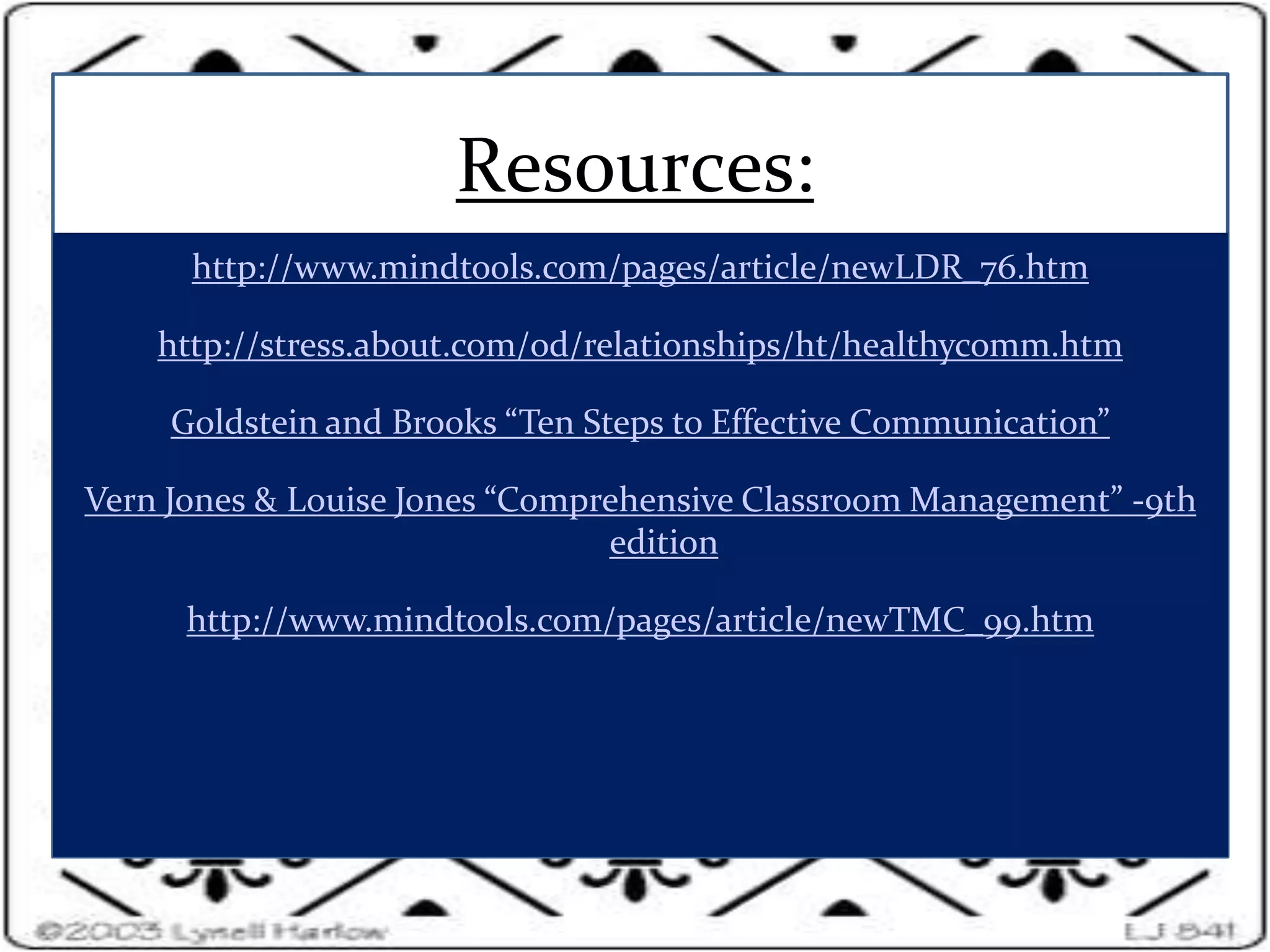
    .Resources:http://www.mindtools.com/pages/article/newLDR_76.htmhttp://stress.about.com/od/relationships/ht/healthycomm.htmGoldstein and Brooks“Ten Steps to Effective Communication”Vern Jones & Louise Jones “Comprehensive Classroom Management” -9th editionhttp://www.mindtools.com/pages/article/newTMC_99.htm