Mudasiru Olalere YUSUF (PhD)
Department of Educational Technology
University of Ilorin
Quotes
Developing excellent communication skills is
absolutely essential to effective leadership. The leader
must be able to share knowledge and ideas to transmit
a sense of urgency and enthusiasm to others. If a
leader can't get a message across clearly and motivate
others to act on it, then having a message doesn't even
matter
Gilbert Amelio

If you improve a teacher's selfesteem, confidence, communication skills or stress
levels, you improve that teacher's overall
effectiveness across the curriculum
Elaine MacDonald
Objectives
At the end of this lecture, you should be able to:
• Define the term communication and its
importance in classroom instruction.
• List and discuss the components / elements of
communication.
• Distinguish among the five forms of
communication.
• Apply the communication principles in
facilitating learners of different learning styles
(Visual
Learners,
Auditory
Learners, Reading/Writing Preference Learners
and Kinesthetic Learners).
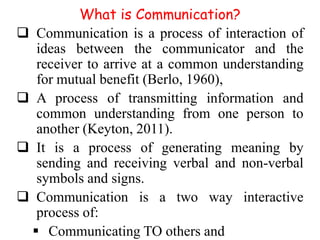
What is Communication?
 Communication is a process of interaction of
ideas between the communicator and the
receiver to arrive at a common understanding
for mutual benefit (Berlo, 1960),
 A process of transmitting information and
common understanding from one person to
another (Keyton, 2011).
 It is a process of generating meaning by
sending and receiving verbal and non-verbal
symbols and signs.
 Communication is a two way interactive
process of:
 Communicating TO others and
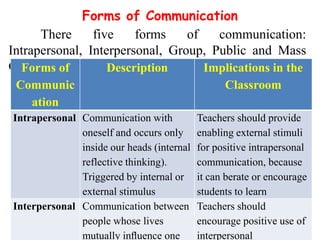
Forms of Communication
There
five
forms
of
communication:
Intrapersonal, Interpersonal, Group, Public and Mass
Communication Description
Forms of
Implications in the
Communic
ation
Intrapersonal Communication with
oneself and occurs only
inside our heads (internal
reflective thinking).
Triggered by internal or
external stimulus
Interpersonal Communication between
people whose lives
mutually influence one

Classroom
Teachers should provide
enabling external stimuli
for positive intrapersonal
communication, because
it can berate or encourage
students to learn
Teachers should
encourage positive use of
interpersonal
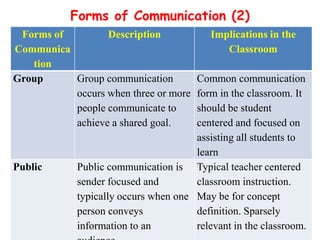
Forms of Communication (2)
Forms of
Description
Communica
tion
Group
Group communication
occurs when three or more
people communicate to
achieve a shared goal.

Public

Implications in the
Classroom

Common communication
form in the classroom. It
should be student
centered and focused on
assisting all students to
learn
Public communication is Typical teacher centered
sender focused and
classroom instruction.
typically occurs when one May be for concept
person conveys
definition. Sparsely
information to an
relevant in the classroom.
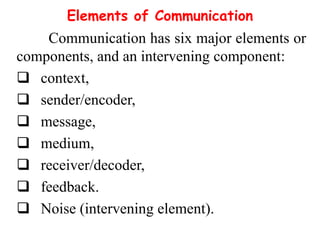
Elements of Communication

Communication has six major elements or
components, and an intervening component:
 context,
 sender/encoder,
 message,
 medium,
 receiver/decoder,
 feedback.
 Noise (intervening element).
Elements of Communication (Context)

• Culture which relates to a setting which
determines the way communication takes
place
• External stimulus, what can motivate
students to respond in oral or written form.
• Internal stimuli like opinion, attitude, likes,
dislikes,
emotions,
experience,
competence, and confidence which can
influence communication.
Elements of Communication (1)
Context
• Culture which relates to a setting which
determines the way communication takes place
• External stimulus, what can motivate students to
respond in oral or written form.
• Internal
stimuli
like
opinion, attitude, likes, dislikes, emotions, experie
nce, competence, and confidence which can
influence communication.
Sender/Encoder
The person who sends message. In classroom oral
communication, the encoder is teacher, and in
written communication writer is the encoder.
Teacher
uses
combination
of
words, gestures, symbols, graphs and pictures
Elements of Communication (2)
Message
The information shared between sender and
receiver. For good communication, the central
idea of the message must be clear. Thus, the
teacher must decide what to communicate keeping
in mind the context and how the receiver
(students) will interpret the message.
Medium / Channel
The sensory route through which encoder will
communicate his message to the decoder. The
medium can be print, electronic, or sound. The
choice of medium may be dependent on
contextual factors, relationship between the sender
Elements of Communication (3)
Receiver/Decoder
The person to whom the message is being sent.
Receiver (student) may be a listener or a reader
depending on the choice of medium by sender
(teacher) to transmit the instructional contents.
Feedback
The response or reaction of the receiver to a
message. Communication is effective only when
it receives some feedback as it completes the
loop of communication.
Noise
Anything that can distort the message. These
include physical discomfort, perceptions of the
message,
language
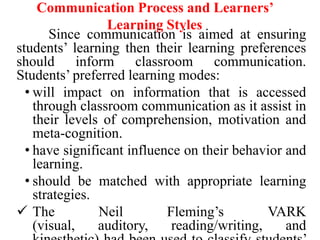
Communication Process and Learners’
Learning Styles
Since communication is aimed at ensuring
students’ learning then their learning preferences
should inform classroom communication.
Students’ preferred learning modes:
• will impact on information that is accessed
through classroom communication as it assist in
their levels of comprehension, motivation and
meta-cognition.
• have significant influence on their behavior and
learning.
• should be matched with appropriate learning
strategies.
 The
Neil
Fleming’s
VARK
(visual,
auditory,
reading/writing,
and
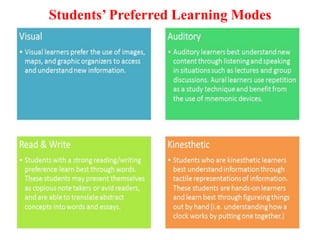
Students’ Preferred Learning Modes
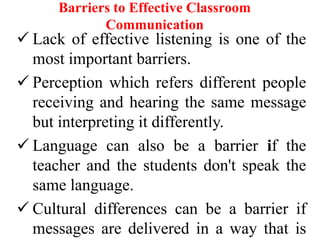
Barriers to Effective Classroom
Communication

 Lack of effective listening is one of the
most important barriers.
 Perception which refers different people
receiving and hearing the same message
but interpreting it differently.
 Language can also be a barrier if the
teacher and the students don't speak the
same language.
 Cultural differences can be a barrier if
messages are delivered in a way that is
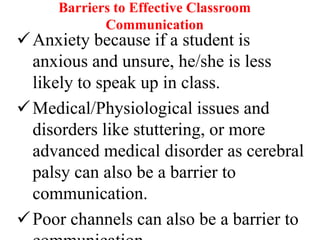
Barriers to Effective Classroom
Communication

 Anxiety because if a student is
anxious and unsure, he/she is less
likely to speak up in class.
 Medical/Physiological issues and
disorders like stuttering, or more
advanced medical disorder as cerebral
palsy can also be a barrier to
communication.
 Poor channels can also be a barrier to
Barriers to Effective Classroom
Communication

 Jumbled messages (contradictory
messages or mixing an intended message
with unnecessary issues) can also be a
barrier to communication.
 Emotional states (depression, mood
swings, anxiety, low self-esteem, effects
of a traumatic event) can also be a barrier
to communication.
 Lack of credibility can also be a barrier
to communication.
Communication Models
 Models of communication refers to the
conceptual model on basic conception of
communication as the process of sending and
receiving messages or transferring information
from one part (sender) to another (receiver).
 We will discuss three models of communication
and their implications for classroom
instruction.
• Linear model
• Interactive model
• Transactional model
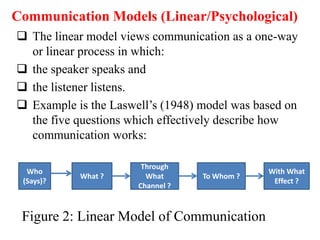
Communication Models (Linear/Psychological)
 The linear model views communication as a one-way
or linear process in which:
 the speaker speaks and
 the listener listens.
 Example is the Laswell’s (1948) model was based on
the five questions which effectively describe how
communication works:
Who
(Says)?

What ?

Through
What
Channel ?

To Whom ?

Figure 2: Linear Model of Communication

With What
Effect ?
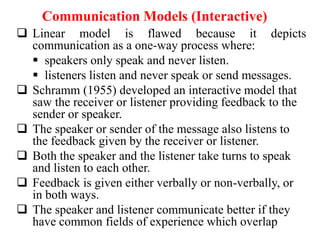
Communication Models (Interactive)
 Linear model is flawed because it depicts
communication as a one-way process where:
 speakers only speak and never listen.
 listeners listen and never speak or send messages.
 Schramm (1955) developed an interactive model that
saw the receiver or listener providing feedback to the
sender or speaker.
 The speaker or sender of the message also listens to
the feedback given by the receiver or listener.
 Both the speaker and the listener take turns to speak
and listen to each other.
 Feedback is given either verbally or non-verbally, or
in both ways.
 The speaker and listener communicate better if they
have common fields of experience which overlap
Communication Models (Interactive [2])
Source’s Field of Experience

Decoder
Source
Encoder

Receiver's Field of Experience

Message
Feedbac
k

Decoder
Source
Encoder

Figure 2: Common Fields of Experience in Interactive
Model
Communication Models (Transactional)
 The drawback in the interactive model is that
it does not indicate that communicators can
both
send
and
receive
messages
simultaneously, and fails to show that
communication is a dynamic process.
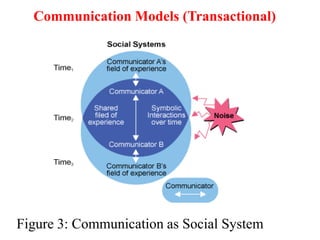
 The transactional model (Wood, 2009) shows
that the elements in communication are
interdependent.
 Each person in the communication act is both
a speaker and a listener, and can be
simultaneously sending and receiving
messages.
Communication Models (Transactional)

Figure 3: Communication as Social System
Communication Models (Transactional)
Implications of the transactional model
 “Transactional” means that communication is
an ongoing and continuously changing process
(Teachers, students, and environment are
changing
 Each element in transactional process, exists in
relation
to
all
the
other
elements
(interdependence - no source without a receiver
and no message without a source).
 Each participant in the communication process
reacts depending on factors such as their
background, prior experiences, attitudes,
cultural beliefs and self-esteem.
The mediocre teacher tells. The good
teacher explains. The superior teacher
demonstrates. The great teacher
inspires
William Arthur Ward
Communication in the classroom

Communication in the classroom

  • 1.
    Mudasiru Olalere YUSUF(PhD) Department of Educational Technology University of Ilorin
  • 2.
    Quotes Developing excellent communicationskills is absolutely essential to effective leadership. The leader must be able to share knowledge and ideas to transmit a sense of urgency and enthusiasm to others. If a leader can't get a message across clearly and motivate others to act on it, then having a message doesn't even matter Gilbert Amelio If you improve a teacher's selfesteem, confidence, communication skills or stress levels, you improve that teacher's overall effectiveness across the curriculum Elaine MacDonald
  • 3.
    Objectives At the endof this lecture, you should be able to: • Define the term communication and its importance in classroom instruction. • List and discuss the components / elements of communication. • Distinguish among the five forms of communication. • Apply the communication principles in facilitating learners of different learning styles (Visual Learners, Auditory Learners, Reading/Writing Preference Learners and Kinesthetic Learners).
  • 4.
    What is Communication? Communication is a process of interaction of ideas between the communicator and the receiver to arrive at a common understanding for mutual benefit (Berlo, 1960),  A process of transmitting information and common understanding from one person to another (Keyton, 2011).  It is a process of generating meaning by sending and receiving verbal and non-verbal symbols and signs.  Communication is a two way interactive process of:  Communicating TO others and
  • 5.
    Forms of Communication There five forms of communication: Intrapersonal,Interpersonal, Group, Public and Mass Communication Description Forms of Implications in the Communic ation Intrapersonal Communication with oneself and occurs only inside our heads (internal reflective thinking). Triggered by internal or external stimulus Interpersonal Communication between people whose lives mutually influence one Classroom Teachers should provide enabling external stimuli for positive intrapersonal communication, because it can berate or encourage students to learn Teachers should encourage positive use of interpersonal
  • 6.
    Forms of Communication(2) Forms of Description Communica tion Group Group communication occurs when three or more people communicate to achieve a shared goal. Public Implications in the Classroom Common communication form in the classroom. It should be student centered and focused on assisting all students to learn Public communication is Typical teacher centered sender focused and classroom instruction. typically occurs when one May be for concept person conveys definition. Sparsely information to an relevant in the classroom.
  • 7.
    Elements of Communication Communicationhas six major elements or components, and an intervening component:  context,  sender/encoder,  message,  medium,  receiver/decoder,  feedback.  Noise (intervening element).
  • 8.
    Elements of Communication(Context) • Culture which relates to a setting which determines the way communication takes place • External stimulus, what can motivate students to respond in oral or written form. • Internal stimuli like opinion, attitude, likes, dislikes, emotions, experience, competence, and confidence which can influence communication.
  • 9.
    Elements of Communication(1) Context • Culture which relates to a setting which determines the way communication takes place • External stimulus, what can motivate students to respond in oral or written form. • Internal stimuli like opinion, attitude, likes, dislikes, emotions, experie nce, competence, and confidence which can influence communication. Sender/Encoder The person who sends message. In classroom oral communication, the encoder is teacher, and in written communication writer is the encoder. Teacher uses combination of words, gestures, symbols, graphs and pictures
  • 10.
    Elements of Communication(2) Message The information shared between sender and receiver. For good communication, the central idea of the message must be clear. Thus, the teacher must decide what to communicate keeping in mind the context and how the receiver (students) will interpret the message. Medium / Channel The sensory route through which encoder will communicate his message to the decoder. The medium can be print, electronic, or sound. The choice of medium may be dependent on contextual factors, relationship between the sender
  • 11.
    Elements of Communication(3) Receiver/Decoder The person to whom the message is being sent. Receiver (student) may be a listener or a reader depending on the choice of medium by sender (teacher) to transmit the instructional contents. Feedback The response or reaction of the receiver to a message. Communication is effective only when it receives some feedback as it completes the loop of communication. Noise Anything that can distort the message. These include physical discomfort, perceptions of the message, language
  • 12.
    Communication Process andLearners’ Learning Styles Since communication is aimed at ensuring students’ learning then their learning preferences should inform classroom communication. Students’ preferred learning modes: • will impact on information that is accessed through classroom communication as it assist in their levels of comprehension, motivation and meta-cognition. • have significant influence on their behavior and learning. • should be matched with appropriate learning strategies.  The Neil Fleming’s VARK (visual, auditory, reading/writing, and
  • 13.
  • 14.
    Barriers to EffectiveClassroom Communication  Lack of effective listening is one of the most important barriers.  Perception which refers different people receiving and hearing the same message but interpreting it differently.  Language can also be a barrier if the teacher and the students don't speak the same language.  Cultural differences can be a barrier if messages are delivered in a way that is
  • 15.
    Barriers to EffectiveClassroom Communication  Anxiety because if a student is anxious and unsure, he/she is less likely to speak up in class.  Medical/Physiological issues and disorders like stuttering, or more advanced medical disorder as cerebral palsy can also be a barrier to communication.  Poor channels can also be a barrier to
  • 16.
    Barriers to EffectiveClassroom Communication  Jumbled messages (contradictory messages or mixing an intended message with unnecessary issues) can also be a barrier to communication.  Emotional states (depression, mood swings, anxiety, low self-esteem, effects of a traumatic event) can also be a barrier to communication.  Lack of credibility can also be a barrier to communication.
  • 17.
    Communication Models  Modelsof communication refers to the conceptual model on basic conception of communication as the process of sending and receiving messages or transferring information from one part (sender) to another (receiver).  We will discuss three models of communication and their implications for classroom instruction. • Linear model • Interactive model • Transactional model
  • 18.
    Communication Models (Linear/Psychological) The linear model views communication as a one-way or linear process in which:  the speaker speaks and  the listener listens.  Example is the Laswell’s (1948) model was based on the five questions which effectively describe how communication works: Who (Says)? What ? Through What Channel ? To Whom ? Figure 2: Linear Model of Communication With What Effect ?
  • 19.
    Communication Models (Interactive) Linear model is flawed because it depicts communication as a one-way process where:  speakers only speak and never listen.  listeners listen and never speak or send messages.  Schramm (1955) developed an interactive model that saw the receiver or listener providing feedback to the sender or speaker.  The speaker or sender of the message also listens to the feedback given by the receiver or listener.  Both the speaker and the listener take turns to speak and listen to each other.  Feedback is given either verbally or non-verbally, or in both ways.  The speaker and listener communicate better if they have common fields of experience which overlap
  • 20.
    Communication Models (Interactive[2]) Source’s Field of Experience Decoder Source Encoder Receiver's Field of Experience Message Feedbac k Decoder Source Encoder Figure 2: Common Fields of Experience in Interactive Model
  • 21.
    Communication Models (Transactional) The drawback in the interactive model is that it does not indicate that communicators can both send and receive messages simultaneously, and fails to show that communication is a dynamic process.  The transactional model (Wood, 2009) shows that the elements in communication are interdependent.  Each person in the communication act is both a speaker and a listener, and can be simultaneously sending and receiving messages.
  • 22.
    Communication Models (Transactional) Figure3: Communication as Social System
  • 23.
    Communication Models (Transactional) Implicationsof the transactional model  “Transactional” means that communication is an ongoing and continuously changing process (Teachers, students, and environment are changing  Each element in transactional process, exists in relation to all the other elements (interdependence - no source without a receiver and no message without a source).  Each participant in the communication process reacts depending on factors such as their background, prior experiences, attitudes, cultural beliefs and self-esteem.
  • 24.
    The mediocre teachertells. The good teacher explains. The superior teacher demonstrates. The great teacher inspires William Arthur Ward