


K.SATHISH
KUMAR,
2017741006,
ALAGAPPA
MANAGEMENT
• The term
"management" is refer
to those people who
manage an
organization.
• Management is the
administration of an
organization, whether
it is a business, a not-
for-profit organization,
or government body.
RESOURCE
MANAGEMENT
• A resource management is the efficient and
effective development of an organization's resources
when they are needed.
• Such resources may include financial resources,
inventory, human skills, production resources, or IT.
• Nowadays, there is lots of educational technology
resources emerging as we can't avoid technology as
a part of our everyday routines and because it's very
useful.
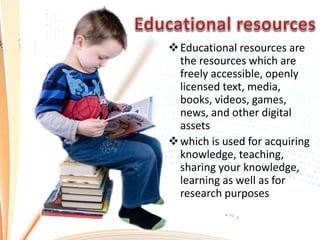
Educational resources are
the resources which are
freely accessible, openly
licensed text, media,
books, videos, games,
news, and other digital
assets
which is used for acquiring
knowledge, teaching,
sharing your knowledge,
learning as well as for
research purposes
Concept & Nature of Education Resources
• Education resources refer to all human, material, non-
material, audio-visual school environment and
community materials available in an academic
environment to facilitate school administration and
simplify the teaching-learning process.
• Education resources include the teachers in the school,
human beings in the community, real objects, specimen
or models, chalk and display boards, school buildings
and layout, the community at large and other
fundamental materials like pencils, pens, exercise books
etc which the learners are expected to have at any point
in time to facilitate learning (NOUN, 2009).
Need For Resource Management in
Education:
• Resources may include financial
resources, inventory, human skills,
production resources, or information
technology (IT).
• Resource management is a key
element to activity resource
estimating and project human
resource management.
• Both are essential components of a
comprehensive project management
plan to execute and monitor a
project successfully.
• Material/Physical Resources
• Financial Resources
• Time Resources
• Human Resources
• ICT Resources
• Community Resources
• Fundamental /Supporting Resources
Material/Physical Resources
The physical resources include the structure, the
machines, raw materials, vehicles, and other
tools, which can facilitate organizations activities
and processes.
In educational system, the physical resources
would include the classrooms/lecture rooms,
staff offices, vehicles, health centers, library,
laboratory, and etc.,
Material/Physical Resource Management in School
Preventive maintenance
 Routine maintenance
Emergency Repairs
Predictive Maintenance
(b) Financial Resources
• Financial resources are the funds required for the
smooth operations of a school.
• In school administration, funds are necessary for
the procurement of facilities, equipment,
electronics and communication gadget needed for
effective performance.
• Apart from this, funds are needed to pay the
salaries of administrative, academic and non-
academic staff.
• Plan and policy implementation are responsive to
funds availability.
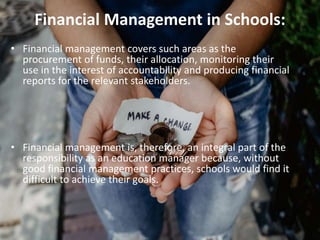
Financial Management in Schools:
• Financial management covers such areas as the
procurement of funds, their allocation, monitoring their
use in the interest of accountability and producing financial
reports for the relevant stakeholders.
• Financial management is, therefore, an integral part of the
responsibility as an education manager because, without
good financial management practices, schools would find it
difficult to achieve their goals.
Role of School Administrators in
Financial Management:
• Allocate funds to various activities in accordance
with the budget.
• Authorize the disbursement of school funds.
• Administer school funds both lawfully and
morally.
• Determine a school budget in consultation with
other stakeholders such as heads of department,
senior teachers.
• Ensure that the school has the funds it needs and
that those funds are used effectively and
efficiently.
Time Resources:
• Time is a unique resource.
• Time is the most expensive of all resources due to its non-
recoverable nature.
• The use of time is one of the parameters to measure an
effective school administration.
• In a school system, time is managed through the use of a
time table.
• Consequently, time management stands as an effective tool
necessary for the organizations effectiveness in realization
of set out objectives and goals (Ugwulashi, 2012).
Significance of Time Management in
School Administration:
(i) Setting Priorities and Goals
(ii) General Life Improvement
(iii) Reducing Stress and Negativity
(iv)Productivity and Performance.
(v)Developing Employees
(d) Human Resources
• Human resource constitutes a vital vein of any
institution.
• The human resource in the school system
includes teachers, support staff in the school,
students, parents, community members and a
host of other interest and social groups.
• Human resources is responsible for planning,
organizing, coordinating, controlling,
manipulating and maintaining other forms of
resources, its administrative and forecasting
ability placed it ahead of other forms of
resources.
DEFINITION
‘’All activities of any institution
are initiated by the persons that
make up that institution’’.
-Likert (1969)
Human resource management
objectives:
1.Supply of staff at low cost
2.Environment and develop the talents.
3.Maintaining of competent personnel good and
create of relations between them.
4. Providing material and spiritual needs of staff
satisfaction that to be created necessary
alignment between their personal goals and
objectives of the organization
Relevance of Human Resources
Management (HRM) in School
Administration:
(i.) Recruitment and Training:
(ii.) Performance Appraisals:
(iii). Maintaining Work Atmosphere:
(iv.) Managing Disputes:
(v.) Developing Public Relations:
Relevance of ICT Resources in School
Administration:
(i) The use of ICTs help improve the quality of
education
(ii) Sharing knowledge
(iii) ICTs help prepare individuals for the
workplace:
(iv) Access to remote learning resources
(v) Processing knowledge
(f) Community Resources:
• Community resources are both human and non-
human materials that are within the
geographical milieu of teachers and learners.
• The human community resources include
teachers, learners, curriculum developers,
parents and other members of the society.
• Every community no matter how large of small
holds cultural, natural, human and technological
resources that can be utilized by the students
and teachers.
(g) Fundamental /Supporting
Resources
• Fundamental resources may appear trivial, but
their non availability can wreck havoc in a school
system.
• They include: calendars, journals, periodicals,
reference books, year planner, consumable items,
cabinets, files, etc.
• All of these combine to influence effective
performance of administrators on daily basis.
• They include electricity, which generates power
for most machines and electronics, water,
refrigerator, fans, cars, etc.
Problems Associated with Resources
Availability and Utilization in School
Administration:
Shortage of Fund
Political Issues
Misuse of the School Facilities
Poor Management
Ineffective school leadership
Supply of sub standard educational resources
Inadequate facilities
Low staff morale
IDENTIFICATION OF RESOURCE
• In-service training and refreshing courses should be
organized on regular basis for school’s administrators and
personnel in all the institutions.
• Individual personnel in the school should develop a positive
attitude in the use of the physical facilities provided for the
Schools.
• Government at various levels, educational administrators
and planners should mount special campaigns presumably
through special appeal or the use of the press to create
awareness of the importance and the need for proper
utilization and maintenance of school resources.
Conclusion
• It is about life not just happening but happening
in an orderly way.
• Humans are constantly seeking answers, making
plans, and pursuing goals that bring desired
results.
• Each day presents new challenges, new questions
about how life should be and can be.
• The greatest future challenge for the field will be
the continued integration of management with
other theories to address socially relevant issues
as life becomes more complex and diverse.

Resource management

  • 1.
  • 3.
    MANAGEMENT • The term "management"is refer to those people who manage an organization. • Management is the administration of an organization, whether it is a business, a not- for-profit organization, or government body.
  • 4.
    RESOURCE MANAGEMENT • A resourcemanagement is the efficient and effective development of an organization's resources when they are needed. • Such resources may include financial resources, inventory, human skills, production resources, or IT. • Nowadays, there is lots of educational technology resources emerging as we can't avoid technology as a part of our everyday routines and because it's very useful.
  • 5.
    Educational resources are theresources which are freely accessible, openly licensed text, media, books, videos, games, news, and other digital assets which is used for acquiring knowledge, teaching, sharing your knowledge, learning as well as for research purposes
  • 6.
    Concept & Natureof Education Resources • Education resources refer to all human, material, non- material, audio-visual school environment and community materials available in an academic environment to facilitate school administration and simplify the teaching-learning process. • Education resources include the teachers in the school, human beings in the community, real objects, specimen or models, chalk and display boards, school buildings and layout, the community at large and other fundamental materials like pencils, pens, exercise books etc which the learners are expected to have at any point in time to facilitate learning (NOUN, 2009).
  • 7.
    Need For ResourceManagement in Education: • Resources may include financial resources, inventory, human skills, production resources, or information technology (IT). • Resource management is a key element to activity resource estimating and project human resource management. • Both are essential components of a comprehensive project management plan to execute and monitor a project successfully.
  • 8.
    • Material/Physical Resources •Financial Resources • Time Resources • Human Resources • ICT Resources • Community Resources • Fundamental /Supporting Resources
  • 9.
    Material/Physical Resources The physicalresources include the structure, the machines, raw materials, vehicles, and other tools, which can facilitate organizations activities and processes. In educational system, the physical resources would include the classrooms/lecture rooms, staff offices, vehicles, health centers, library, laboratory, and etc.,
  • 10.
    Material/Physical Resource Managementin School Preventive maintenance  Routine maintenance Emergency Repairs Predictive Maintenance
  • 11.
    (b) Financial Resources •Financial resources are the funds required for the smooth operations of a school. • In school administration, funds are necessary for the procurement of facilities, equipment, electronics and communication gadget needed for effective performance. • Apart from this, funds are needed to pay the salaries of administrative, academic and non- academic staff. • Plan and policy implementation are responsive to funds availability.
  • 12.
    Financial Management inSchools: • Financial management covers such areas as the procurement of funds, their allocation, monitoring their use in the interest of accountability and producing financial reports for the relevant stakeholders. • Financial management is, therefore, an integral part of the responsibility as an education manager because, without good financial management practices, schools would find it difficult to achieve their goals.
  • 13.
    Role of SchoolAdministrators in Financial Management: • Allocate funds to various activities in accordance with the budget. • Authorize the disbursement of school funds. • Administer school funds both lawfully and morally. • Determine a school budget in consultation with other stakeholders such as heads of department, senior teachers. • Ensure that the school has the funds it needs and that those funds are used effectively and efficiently.
  • 14.
    Time Resources: • Timeis a unique resource. • Time is the most expensive of all resources due to its non- recoverable nature. • The use of time is one of the parameters to measure an effective school administration. • In a school system, time is managed through the use of a time table. • Consequently, time management stands as an effective tool necessary for the organizations effectiveness in realization of set out objectives and goals (Ugwulashi, 2012).
  • 15.
    Significance of TimeManagement in School Administration: (i) Setting Priorities and Goals (ii) General Life Improvement (iii) Reducing Stress and Negativity (iv)Productivity and Performance. (v)Developing Employees
  • 16.
    (d) Human Resources •Human resource constitutes a vital vein of any institution. • The human resource in the school system includes teachers, support staff in the school, students, parents, community members and a host of other interest and social groups. • Human resources is responsible for planning, organizing, coordinating, controlling, manipulating and maintaining other forms of resources, its administrative and forecasting ability placed it ahead of other forms of resources.
  • 17.
    DEFINITION ‘’All activities ofany institution are initiated by the persons that make up that institution’’. -Likert (1969)
  • 18.
    Human resource management objectives: 1.Supplyof staff at low cost 2.Environment and develop the talents. 3.Maintaining of competent personnel good and create of relations between them. 4. Providing material and spiritual needs of staff satisfaction that to be created necessary alignment between their personal goals and objectives of the organization
  • 19.
    Relevance of HumanResources Management (HRM) in School Administration: (i.) Recruitment and Training: (ii.) Performance Appraisals: (iii). Maintaining Work Atmosphere: (iv.) Managing Disputes: (v.) Developing Public Relations:
  • 20.
    Relevance of ICTResources in School Administration: (i) The use of ICTs help improve the quality of education (ii) Sharing knowledge (iii) ICTs help prepare individuals for the workplace: (iv) Access to remote learning resources (v) Processing knowledge
  • 21.
    (f) Community Resources: •Community resources are both human and non- human materials that are within the geographical milieu of teachers and learners. • The human community resources include teachers, learners, curriculum developers, parents and other members of the society. • Every community no matter how large of small holds cultural, natural, human and technological resources that can be utilized by the students and teachers.
  • 22.
    (g) Fundamental /Supporting Resources •Fundamental resources may appear trivial, but their non availability can wreck havoc in a school system. • They include: calendars, journals, periodicals, reference books, year planner, consumable items, cabinets, files, etc. • All of these combine to influence effective performance of administrators on daily basis. • They include electricity, which generates power for most machines and electronics, water, refrigerator, fans, cars, etc.
  • 23.
    Problems Associated withResources Availability and Utilization in School Administration: Shortage of Fund Political Issues Misuse of the School Facilities Poor Management Ineffective school leadership Supply of sub standard educational resources Inadequate facilities Low staff morale
  • 24.
    IDENTIFICATION OF RESOURCE •In-service training and refreshing courses should be organized on regular basis for school’s administrators and personnel in all the institutions. • Individual personnel in the school should develop a positive attitude in the use of the physical facilities provided for the Schools. • Government at various levels, educational administrators and planners should mount special campaigns presumably through special appeal or the use of the press to create awareness of the importance and the need for proper utilization and maintenance of school resources.
  • 25.
    Conclusion • It isabout life not just happening but happening in an orderly way. • Humans are constantly seeking answers, making plans, and pursuing goals that bring desired results. • Each day presents new challenges, new questions about how life should be and can be. • The greatest future challenge for the field will be the continued integration of management with other theories to address socially relevant issues as life becomes more complex and diverse.