MULTIMEDIA APPROACH
Submitted by
Soumya S R
Natural Science
MTTC, Pathanapuram
MULTIMEDIA
Multi : means many
Medium: means an intervening substance through which
something is transmitted or carried on.ie, means of mass
communication
MULTIMEDIA APPROACH
 The Multimedia approach consisting of the use of many
appropriate and carefully selected devices, techniques
and media in such a combination as to yield in the most
effective realization of the teaching –learning objectives
in a best possible way.
 The term multimedia approach to teaching – learning
process carried out through a number of media is termed
as multimedia approach to education. It aims at
providing meaningful learning experience and thus
improves the process of teaching- learning.
Definition
Multimedia can have many definitions
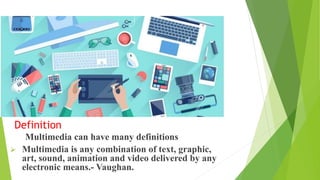
 Multimedia is any combination of text, graphic,
art, sound, animation and video delivered by any
electronic means.- Vaughan.
 “Multimedia is the exciting combination of computer
hardware and software that allows you to integrate video,
animation, audio, graphics and test resources to develop
effective presentations on an affordable desktop computer”-
(Fenrich, 1997)
 The term multimedia approach to teaching –learning may be
referred to the use appropriate and carefully selected varieties of
learning experiences which , when presented to the learner
through selected teaching strategies, will reinforce and
strengthen one another in such a way that the learner will
achieve predetermined objectives.- (Pakiam, 1986).
Need of Multimedia
 The need of Multimedia depends on the
Problem/Requirement of the User/Audience
 From a Student perspective
• A lecture can be better understood by using a Powerpoint
presentation.
• An experiment can be better explained using Simulation
through animation.
 From a Customer perspective,
• Video demo of the working of a Printer, will help the
Customer do Online purchase of a Printer better .
• Story-telling through Interactive Animations or
Customized Touch-Screen Kiosks
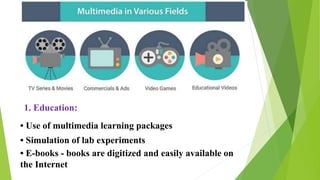
Areas of Use of Multimedia
Multimedia has been used in many areas like:
1. Education
2. Entertainment
3. Electronic shopping
4. Engineering applications
5. Medicine
1. Education:
• Use of multimedia learning packages
• Simulation of lab experiments
• E-books - books are digitized and easily available on
the Internet
• Digital Library – Online access of Books, Journals,
Magazines through Digital Libraries
• Interactive encyclopedia
• Live Presentations like speeches, webinars, lectures
• eLearning Programs like online and blended training
2. Entertainment
• Movie making - Special effects in movie, is
created by using multimedia technology.
• Video games are one of the most interesting
creations of multimedia technology, attracting
children and adults.
• Animated films
• Story-telling
• Cartoons
• Audio and video on demand
3. Electronic shopping:
• Multimedia technology has created a virtual arena for the
e-commerce.
• Customized presentation of a selected product can be
viewed by customers, which helps them to minimize the
time spent on purchase, in addition to availability of
increased choice of products.
4. Engineering Applications:
• CAD/CAM are used for designing mechanical, electrical
and electronic parts
5. Medicine:
• Archives of X-ray images, CT scans, Ultra-sonography
images.
• Multimedia technologies are used to prepare high
quality magnetic resonance 3D images of human bodies.
THE TYPE OF MEDIA USED IN
MULTI-MEDIAAPPROACH
a) Classification of Media in terms of
the method and strategic of teaching
 Methods • Strategies
• Lecture method
• Demonstration method
• Discussion method
• Lecture –demonstration method
• Heuristic method
• Project method
• Problem - Solving Method
• Inductive – Deductive Method
• Laboratory method
• Analytic synthetic Method
• Question – answer Method
• Assignment Method
• Team teaching
• Microteaching
• Simulated teaching
• Workshops
• Group discussion
• seminars
• Symposia
• Conferences
• Brainstorming
• Counselling
• Buzz groups
• Providing practical experiences
b) Classification of media in terms of
auto Instruction.
Modules
Computer Assisted Instruction
Programmed Instruction
Personalized System of Instruction
Self learning materials
Assignments
c) Classification of Media as a means
of Mass Communication
Radio
Television
Newspaper
Magazines
Films
Internet
Pamphlets
d) Classification of Media in terms of
the Audio Visual material and
equipments
Non-projected aids
Audio aids
1. Radio
2. Mobile
3. Walkman
4. Tape-recorder
3D Aids
1. Models
2. Specimens
3. Puppets
4. Living and non living object
5. Diorama
6. Mockups
Two dimensional aids
1. Graphs
2. Charts
3. Flash cards
4. Posters
5. Diagrams
6. Maps
7. Pictures
8. Photographs
9. Cartoons
10. Comics
 Projective Devices
1. Episcope
2. Diascope
3. Epidiascope
4. Television
5. Slides and slide Projectors
6. Film strips and Motion picture
7. OHP
8. LCD projector
e) Classification of media in terms of
gaining living experience.
Activity aids
Field trips
Nature Calendar
Aquarium
Exhibitions
Demonstrations
Dramatizations
Planetarium
f) Classification of media in term of
Reading /Teaching material.
Books
Journals
Teachers Notes
Internet
Role of Teacher in Multimedia Approach
The teacher has to adopt a number of methods and
techniques.
Teacher has to aware of the different available media and
their availability.
Teacher should be physically competent to use and
demonstrate the use of the different media.
Teacher should be skillful enough to make a judicious choice
of media and be competent enough to mix them sequentially
and in an orderly manner.
Teacher’s role is that of facilitator or manager of activities.
Teacher has to lead his student for independent,
The teacher should provide experience such that students can
link practice and theory and integrate them
Teacher should play a constructive role in making students learn
things in a practical way by going through concrete and living
experiences
Procedure For Adopting
Multimedia Approach
The following are the six steps to be followed while adopting
the Multimedia Approach
First Stage
In this stage the teacher initiates the teaching – learning
activities.
Teacher deliver a well prepared lesson based on the objectives
formulated. Teacher could use a variety of media for his
presentation.
Second Stage
Teacher demonstrates a specific and specialized unit using a mix of media.
The teacher may provide learner with programmed learning materials, cassettes,
CD's etc.
Third Stage
This is a preparatory stage for the learner before he stars independent learning.
The student discusses with peer students and teachers his plan of action.
Fourth Stage
In this stage the learner actively participates.
He uses variety of media and materials in his self-study.
Fifth Stage
In this stage the learner integrates theory and practice.
Sixth Stage
In this stage learner finds that teaching – learning activities
have to be organized on a higher level. The student involved in
critical analysis, critical evaluation and exchange of ideas.
MEDIA SELECTION METHOD
Combining the plus point of the available media
It is usually done by considering two media at a time
Positive points are needed in effective teaching and
achievement of the desired object
Identifying media for the objectives looking for availability
and selecting cheapest as shown
Advantages of the Multimedia Approach
• Can arouse the curiosity among the learner and provide them
vivid impression.
• Multimedia can take into account different learning styles-
some pupil learn by interpreting text, while others require more
graphical representations.
• Can develop a positive attitude among the learners towards the
teaching-learning process
• Enables the student to represent information using several
different media.
• Allows for self-pacing and discovery.
• Technique of stimulation can be effectively applied through the
multimedia approach
• Helps in development of higher order thinking skills
• Helps in developing group and interpersonal skills
• Effective remediation programmes can be implemented
through the multimedia approach
• Provides the student the flexibility of ‘any where’, ‘any
time’ learning.
• Can bridge language barriers since audio is not the only
means of communication
• Better communication between students via e-mail, chat
sessions etc., can encourage collaborative learning and
enhance student-teacher interaction.
• Multimedia helps students to learn the content in a given
discipline.
It helps students to think effectively, practice problem
solving and decision making.
Disadvantage of the Multimedia Approach
• Requires highly sophisticated infrastructure facilities,
which may lead to heavy financial burden.
• Expertise and skill are required to operate the
multimedia devices, which will lead to the problem of
non-availability of human resources.
• Not feasible in all topics of study.
THANK YOU

MULTIMEDIA PPT

  • 1.
    MULTIMEDIA APPROACH Submitted by SoumyaS R Natural Science MTTC, Pathanapuram
  • 2.
    MULTIMEDIA Multi : meansmany Medium: means an intervening substance through which something is transmitted or carried on.ie, means of mass communication
  • 3.
    MULTIMEDIA APPROACH  TheMultimedia approach consisting of the use of many appropriate and carefully selected devices, techniques and media in such a combination as to yield in the most effective realization of the teaching –learning objectives in a best possible way.  The term multimedia approach to teaching – learning process carried out through a number of media is termed as multimedia approach to education. It aims at providing meaningful learning experience and thus improves the process of teaching- learning.
  • 4.
    Definition Multimedia can havemany definitions  Multimedia is any combination of text, graphic, art, sound, animation and video delivered by any electronic means.- Vaughan.
  • 5.
     “Multimedia isthe exciting combination of computer hardware and software that allows you to integrate video, animation, audio, graphics and test resources to develop effective presentations on an affordable desktop computer”- (Fenrich, 1997)  The term multimedia approach to teaching –learning may be referred to the use appropriate and carefully selected varieties of learning experiences which , when presented to the learner through selected teaching strategies, will reinforce and strengthen one another in such a way that the learner will achieve predetermined objectives.- (Pakiam, 1986).
  • 6.
    Need of Multimedia The need of Multimedia depends on the Problem/Requirement of the User/Audience  From a Student perspective • A lecture can be better understood by using a Powerpoint presentation. • An experiment can be better explained using Simulation through animation.
  • 7.
     From aCustomer perspective, • Video demo of the working of a Printer, will help the Customer do Online purchase of a Printer better . • Story-telling through Interactive Animations or Customized Touch-Screen Kiosks Areas of Use of Multimedia Multimedia has been used in many areas like: 1. Education 2. Entertainment 3. Electronic shopping 4. Engineering applications 5. Medicine
  • 8.
    1. Education: • Useof multimedia learning packages • Simulation of lab experiments • E-books - books are digitized and easily available on the Internet
  • 9.
    • Digital Library– Online access of Books, Journals, Magazines through Digital Libraries • Interactive encyclopedia • Live Presentations like speeches, webinars, lectures • eLearning Programs like online and blended training 2. Entertainment • Movie making - Special effects in movie, is created by using multimedia technology. • Video games are one of the most interesting creations of multimedia technology, attracting children and adults. • Animated films • Story-telling • Cartoons • Audio and video on demand
  • 10.
    3. Electronic shopping: •Multimedia technology has created a virtual arena for the e-commerce. • Customized presentation of a selected product can be viewed by customers, which helps them to minimize the time spent on purchase, in addition to availability of increased choice of products. 4. Engineering Applications: • CAD/CAM are used for designing mechanical, electrical and electronic parts 5. Medicine: • Archives of X-ray images, CT scans, Ultra-sonography images. • Multimedia technologies are used to prepare high quality magnetic resonance 3D images of human bodies.
  • 11.
    THE TYPE OFMEDIA USED IN MULTI-MEDIAAPPROACH a) Classification of Media in terms of the method and strategic of teaching  Methods • Strategies • Lecture method • Demonstration method • Discussion method • Lecture –demonstration method • Heuristic method • Project method • Problem - Solving Method • Inductive – Deductive Method • Laboratory method • Analytic synthetic Method • Question – answer Method • Assignment Method • Team teaching • Microteaching • Simulated teaching • Workshops • Group discussion • seminars • Symposia • Conferences • Brainstorming • Counselling • Buzz groups • Providing practical experiences
  • 12.
    b) Classification ofmedia in terms of auto Instruction. Modules Computer Assisted Instruction Programmed Instruction Personalized System of Instruction Self learning materials Assignments c) Classification of Media as a means of Mass Communication Radio Television Newspaper Magazines Films Internet Pamphlets
  • 13.
    d) Classification ofMedia in terms of the Audio Visual material and equipments Non-projected aids Audio aids 1. Radio 2. Mobile 3. Walkman 4. Tape-recorder 3D Aids 1. Models 2. Specimens 3. Puppets 4. Living and non living object 5. Diorama 6. Mockups Two dimensional aids 1. Graphs 2. Charts 3. Flash cards 4. Posters 5. Diagrams 6. Maps 7. Pictures 8. Photographs 9. Cartoons 10. Comics
  • 14.
     Projective Devices 1.Episcope 2. Diascope 3. Epidiascope 4. Television 5. Slides and slide Projectors 6. Film strips and Motion picture 7. OHP 8. LCD projector e) Classification of media in terms of gaining living experience. Activity aids Field trips Nature Calendar Aquarium Exhibitions Demonstrations Dramatizations Planetarium
  • 15.
    f) Classification ofmedia in term of Reading /Teaching material. Books Journals Teachers Notes Internet Role of Teacher in Multimedia Approach The teacher has to adopt a number of methods and techniques. Teacher has to aware of the different available media and their availability. Teacher should be physically competent to use and demonstrate the use of the different media. Teacher should be skillful enough to make a judicious choice of media and be competent enough to mix them sequentially and in an orderly manner. Teacher’s role is that of facilitator or manager of activities. Teacher has to lead his student for independent,
  • 16.
    The teacher shouldprovide experience such that students can link practice and theory and integrate them Teacher should play a constructive role in making students learn things in a practical way by going through concrete and living experiences Procedure For Adopting Multimedia Approach The following are the six steps to be followed while adopting the Multimedia Approach First Stage In this stage the teacher initiates the teaching – learning activities. Teacher deliver a well prepared lesson based on the objectives formulated. Teacher could use a variety of media for his presentation.
  • 17.
    Second Stage Teacher demonstratesa specific and specialized unit using a mix of media. The teacher may provide learner with programmed learning materials, cassettes, CD's etc. Third Stage This is a preparatory stage for the learner before he stars independent learning. The student discusses with peer students and teachers his plan of action. Fourth Stage In this stage the learner actively participates. He uses variety of media and materials in his self-study. Fifth Stage In this stage the learner integrates theory and practice.
  • 18.
    Sixth Stage In thisstage learner finds that teaching – learning activities have to be organized on a higher level. The student involved in critical analysis, critical evaluation and exchange of ideas. MEDIA SELECTION METHOD Combining the plus point of the available media It is usually done by considering two media at a time Positive points are needed in effective teaching and achievement of the desired object Identifying media for the objectives looking for availability and selecting cheapest as shown
  • 20.
    Advantages of theMultimedia Approach • Can arouse the curiosity among the learner and provide them vivid impression. • Multimedia can take into account different learning styles- some pupil learn by interpreting text, while others require more graphical representations. • Can develop a positive attitude among the learners towards the teaching-learning process • Enables the student to represent information using several different media. • Allows for self-pacing and discovery. • Technique of stimulation can be effectively applied through the multimedia approach
  • 21.
    • Helps indevelopment of higher order thinking skills • Helps in developing group and interpersonal skills • Effective remediation programmes can be implemented through the multimedia approach • Provides the student the flexibility of ‘any where’, ‘any time’ learning. • Can bridge language barriers since audio is not the only means of communication • Better communication between students via e-mail, chat sessions etc., can encourage collaborative learning and enhance student-teacher interaction. • Multimedia helps students to learn the content in a given discipline. It helps students to think effectively, practice problem solving and decision making.
  • 22.
    Disadvantage of theMultimedia Approach • Requires highly sophisticated infrastructure facilities, which may lead to heavy financial burden. • Expertise and skill are required to operate the multimedia devices, which will lead to the problem of non-availability of human resources. • Not feasible in all topics of study.
  • 23.