This study investigated sex determination in the dioecious plant species Salix viminalis (basket willow). Crosses between 4 female and 4 male parents resulted in 13 offspring crosses, of which 6 were female-biased and 2 were male-biased in their sex ratios. A germination experiment found most crosses had high germination rates, indicating fitness differences did not cause the biased sex ratios. As no hermaphrodites or sex changing plants were observed, sexual lability also did not explain the biases. Meiotic drive or gametic selection could potentially cause the variation, but were deemed unlikely as biases existed among both same-father and same-mother crosses. The skewed ratios were also not due to cytoplas
Overview of biological sex-determination systems, genetic implications, and historical references.
Discusses evolutionary advantages of sex, including genetic variation and adaptation.
Illustrates different modes of sexuality in flowering plants that contribute to reproduction.
Explains various mechanisms like environmental, chromosomal, and genic factors in sex determination.
Describes how environmental conditions influence the sex determination in various plants.
Chronicles discoveries related to X and Y chromosomes and their roles in sex determination.
Distinguishes heteromorphic from homomorphic sex chromosomes and their genetic implications.
Examines sex determination governed by single or multiple gene loci in certain plants.
Outlines the impact of sex determination on flower development in maize and related species.Details an experiment on sex ratios in Salix viminalis with methods and findings regarding skewed ratios.
Explains methodology for determining sex in F2 papaya plants utilizing RAPD markers.Describes the results of sex determination in Simarouba glauca using RAPD markers.
Summarizes complexity of sex determination in plants and the importance of molecular markers for breeding.
Introduction
Sex-determination systemis a biological
system that determines the development of
sexual characteristics in an organism.
In many cases, sex determination is genetic:
males and females have different alleles or
even different genes that specify their sexual
morphology
Camerarius (1694) gave first description of
reproductive organs in plants (maize)
3.
Why does sexexist?
What evolutionary benefit do organisms gain by
developing diploidy and sexual processes?
-Adjusting to a changing environment.
-sexually reproduction allow much more variation.
What is better about the combining of gametes to
produce a new generation of offspring?
-Combining beneficial mutations.
-Removing deleterious mutations.
4
Mechanisms
Environmental
Chromosomal
1.homomorphic chromosomes
Heterogametic male (XX, XY)
Heterogametic female(XY,XX)
2. heteromorphic chromosomes
XX, XY (activeY)
XX, XY1Y2 (X/autosome balance)
X1X1X2X2, X1X2Y1Y2
Genic
Single locus
Multiple loci
6
6.
Environmental sex determination
Sex determination is either due to the environment or it is
greatly affected by the environment.
In Equisetum plants,
Optimum condition – female adverse condition – male
7
7.
In cucumber,melons, cannabis etc. the sex of flowers is
affected by many environmental factors
Temperature, day length, ethylene, gibberellic acid and some
ions etc. usually, a treatment with ethylene or gibberellic acid
promotes production of female flower
In Cannabis- GA3 induces the development of only female
flowers..
8
Contd…
8.
Chromosomal sex determination
It was first noted that the X chromosome
was special in 1890 by Hermann Henking
in Leipzig of firebug testicles.
It was first suggested that the X
chromosome was involved in sex
determination by Clarence Erwin
McClung in 1901 after comparing his
work on locusts with Henking's and
others.
Y chromosomes was discovered and
named by Stevens (1908) in drosophila.
9
9.
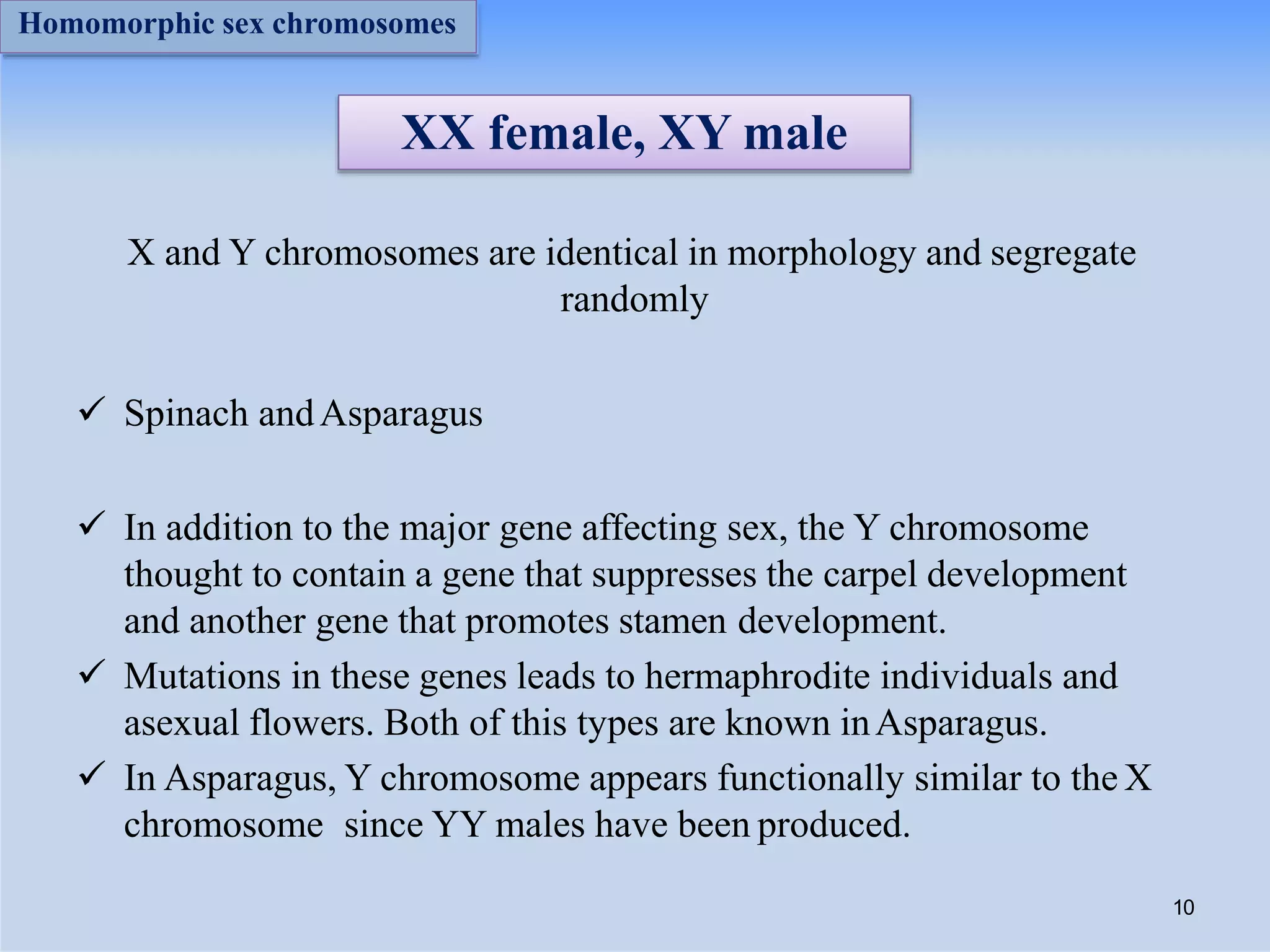
XX female, XYmale
X and Y chromosomes are identical in morphology and segregate
randomly
Spinach andAsparagus
In addition to the major gene affecting sex, the Y chromosome
thought to contain a gene that suppresses the carpel development
and another gene that promotes stamen development.
Mutations in these genes leads to hermaphrodite individuals and
asexual flowers. Both of this types are known inAsparagus.
In Asparagus, Y chromosome appears functionally similar to the X
chromosome since YY males have been produced.
10
Homomorphic sex chromosomes
10.
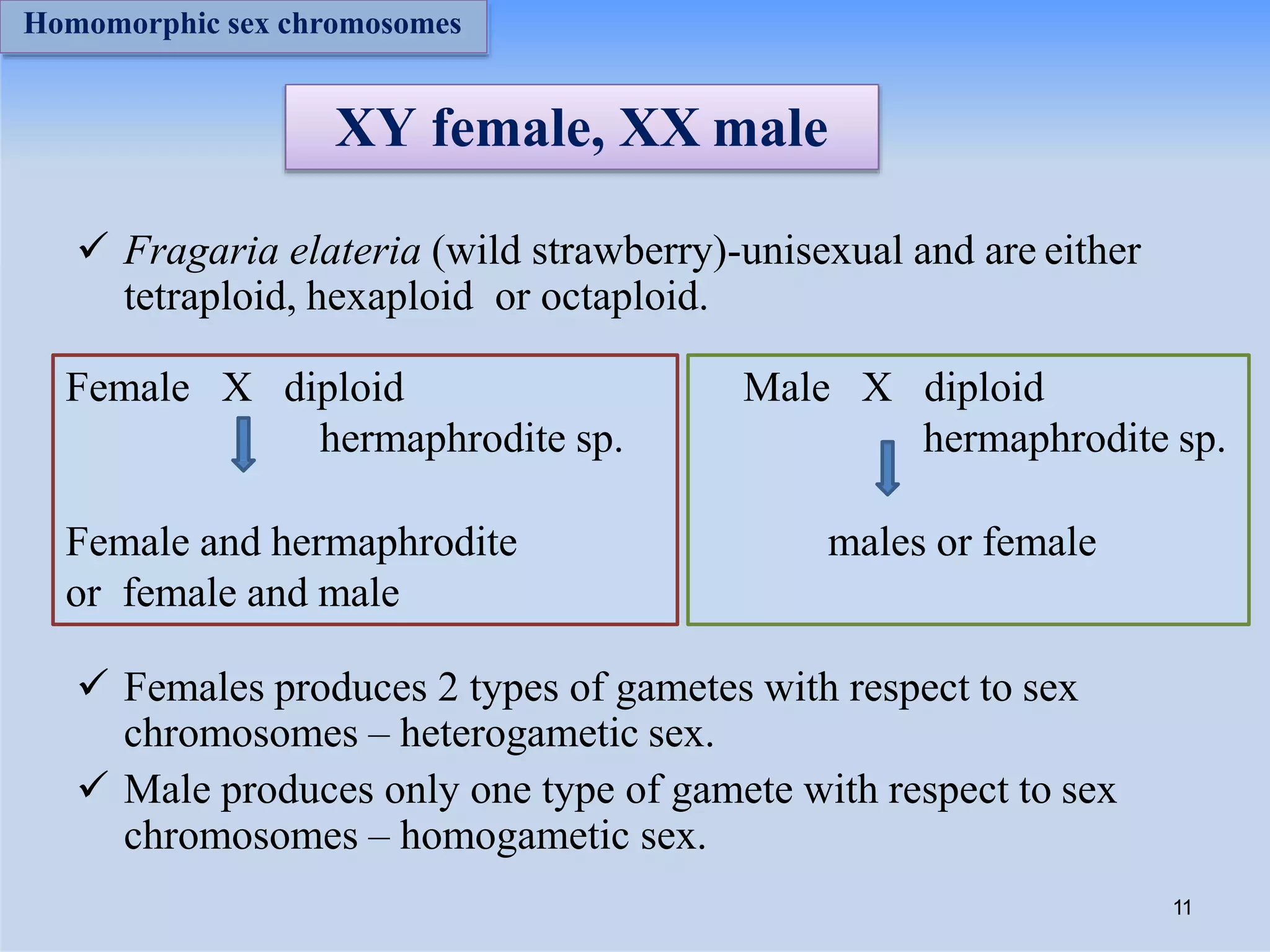
XY female, XXmale
Fragaria elateria (wild strawberry)-unisexual and are either
tetraploid, hexaploid or octaploid.
Females produces 2 types of gametes with respect to sex
chromosomes – heterogametic sex.
Male produces only one type of gamete with respect to sex
chromosomes – homogametic sex.
Male X diploid
hermaphrodite sp.
males or female
Female X diploid
hermaphrodite sp.
Female and hermaphrodite
or female and male
11
Homomorphic sex chromosomes
11.
Heteromorphic sex chromosomes
X and Y chromosomes are distinct in theirmorphology.
Generally, they are unable to pair over a significant portion of
their length.
Silene, Rumex hastatulus, Rumex acetosa and Humulus
japonicus
12
12.
XX female, XYmale
Found in Cannabis, Silene (white campion), Rumex hastatulus.
Egg cells have one X chromosome. Half of the pollen grains have
one X and remaining half have a Y chromosome.
Random union of these gametes produces 50% of XX(female ) and
50% of XY(male) progenies.
Operates in same manner as that found in mammals.
13
Heteromorphic sex chromosomes
13.
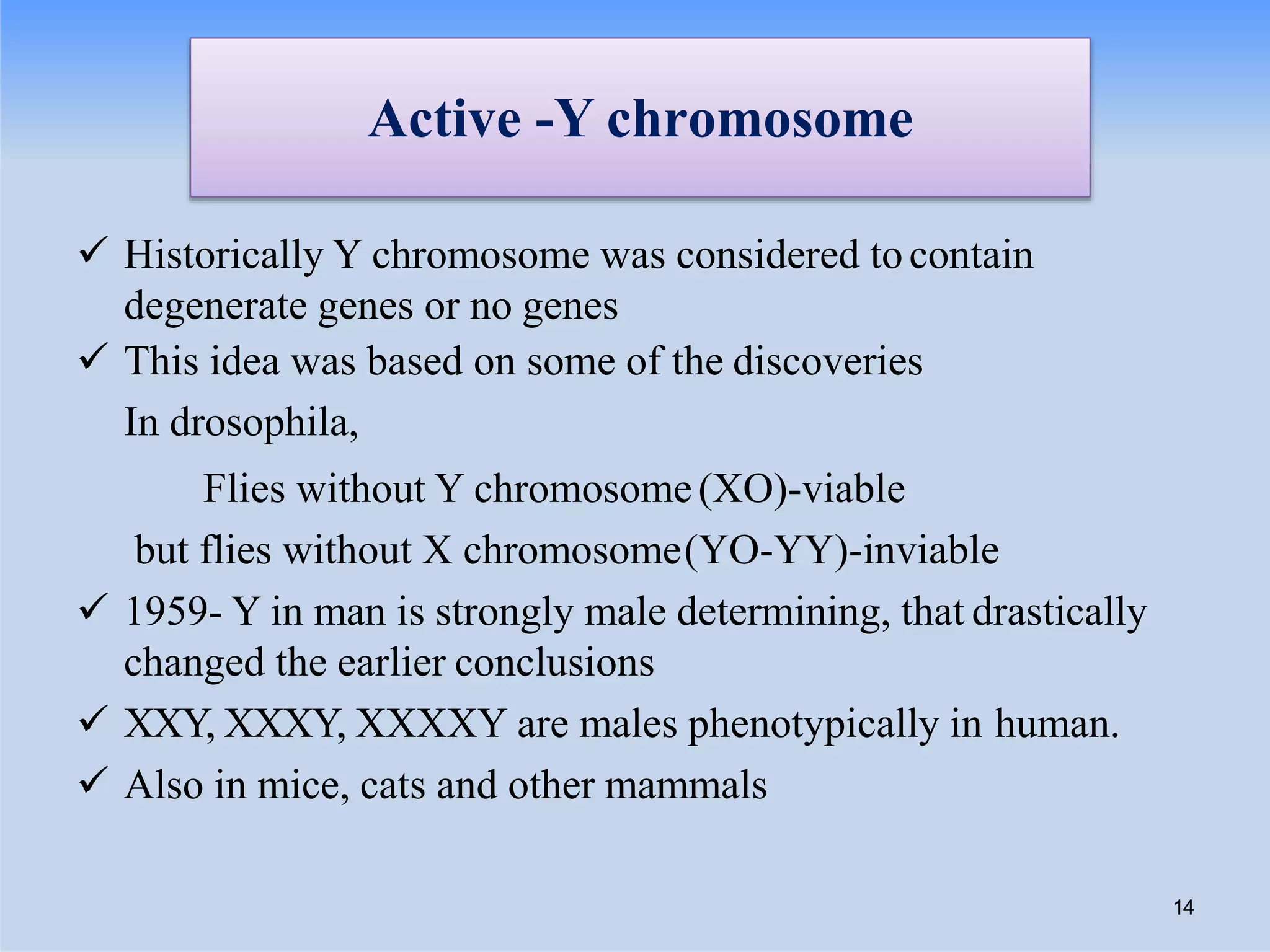
Active -Y chromosome
Historically Y chromosome was considered to contain
degenerate genes or no genes
This idea was based on some of the discoveries
In drosophila,
Flies without Y chromosome(XO)-viable
but flies without X chromosome(YO-YY)-inviable
1959- Y in man is strongly male determining, that drastically
changed the earlier conclusions
XXY, XXXY, XXXXY are males phenotypically in human.
Also in mice, cats and other mammals
14
14.
In plants,Y chromosome tends to be large
The presence of a single Y chromosome can suppressfemale
development when three X chromosomes are present.
X to Autosome ratios have no profound effects on the sex
determining factors present on the Ychromosome
15
Contd…
X1X1X2X2 female ,X1X2Y1Y2 male
Found in some strains of Humulus lupulus
Eggs have X1X2 chromosome constitution
Males produces X1X2 and Y1Y2 pollen grains
17
Heteromorphic sex chromosomes
17.
Genic sex determination
Found both in monoecious and dioecious
Sex of an individual is governed by genes
Single locus - a single gene plays major role in sex
determination
Multiple loci – two or more genes
Operating in maize, papaya, mercury, etc.
18
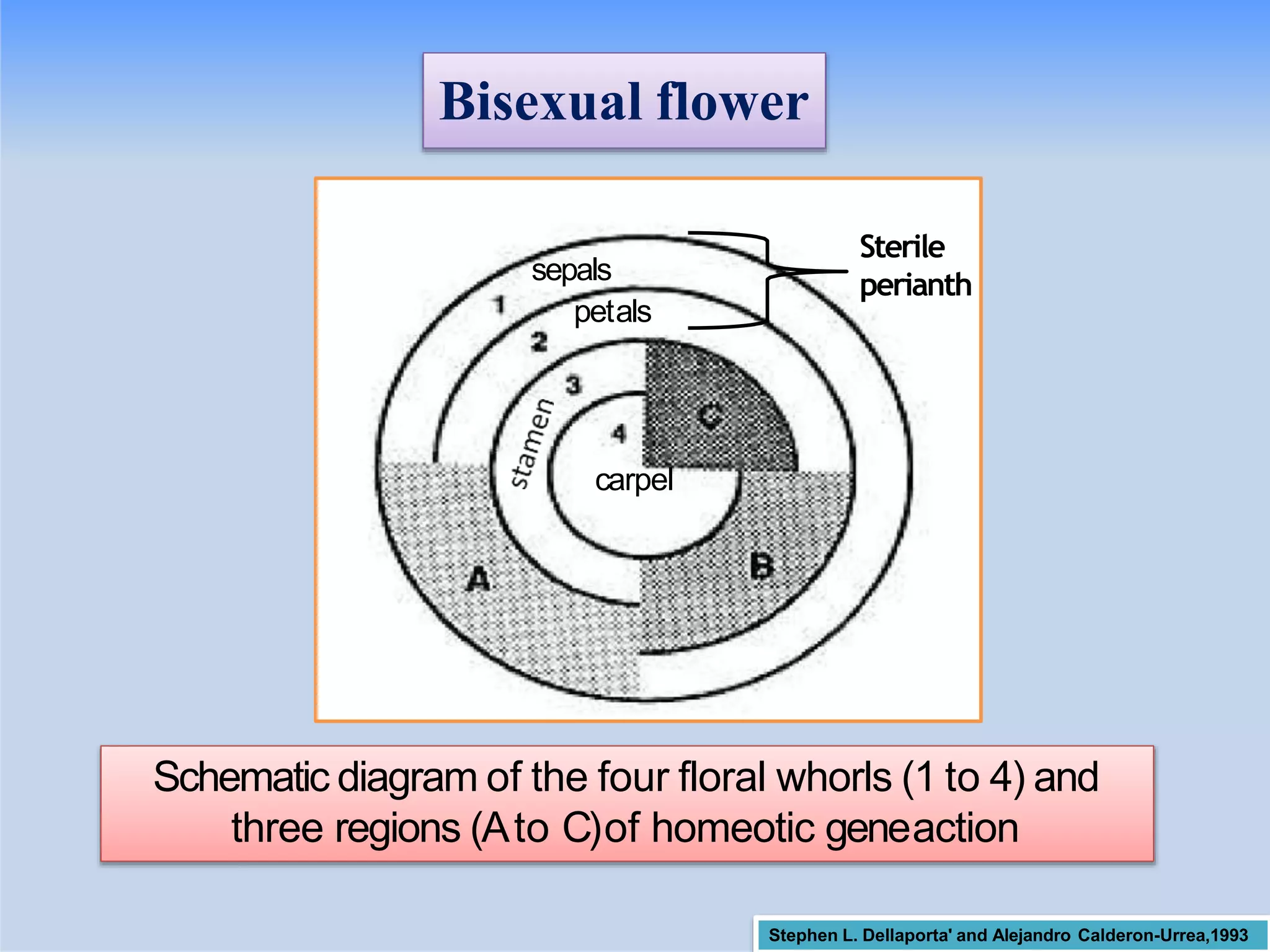
It ispossible that sex determination genes might selectively
affect the action of homeotic genes in one whorl.
ex: stamen development is altered, without secondary effects
on carpel formation.
In Arabidopsis homeotic mutation, flo70 replaces stamens
with carpels,
Unisexual flowers often pass through a “bisexual stage” in
which all floral organs are initiated.
20
Contd…
20.
Developmental steps affectedby sex
determination process in maize
21
Sexualdevelopment of male and female florets inthe
inflorescences of maize
Stephen L. Dellaporta' and Alejandro Calderon-Urrea,1993
21.
Developmental steps inmaize.
• lnitiation of branch meristems orspikelet intials
on the inflorescencemeristem.
• Spikelet initials bifurcate to form two spikelets
• Eachfloral primordium initiates an outer lemma
and an inner palea, three stamen initials and a
central gynoecium composed of three fused
carpels . Up to this point, floral development in
both ear and tassel inflorescences is nearly
identical. Theaction of sexdetermination genes
causesselective abortion of preformed floral
organs.
22
22.
Objective :To understandsex biasness in the absence of ecological disturbance
in dioecious species ‘Salix viminalis’ .
Experimental Material - Salix viminalis [Basket willow]
These are multi stemmed shrub growing to between 3 and 6 m.
Male and female catkins are borne on separate plants.
Commonly used in basketry. Other uses: effluent treatment in wastewater
gardens, and for water purification.
Case Study-1
23.
Materials and methods:Thefour females and four males used as
parents in thebreeding population were selected basedon earlier crosses
between them which had led to varyingsexratios
4female
×4male
Sex
determination
experiment
13
crosses
6 crosses were
female biased.
2 crosseswere
male biased.
5 crosseswere
intermediate
•Sex determination experiment:
Crosses first grown in pots , and seedlings were transferred to the field.
Next year during flowering, sex ratio was observed.
Result
24.
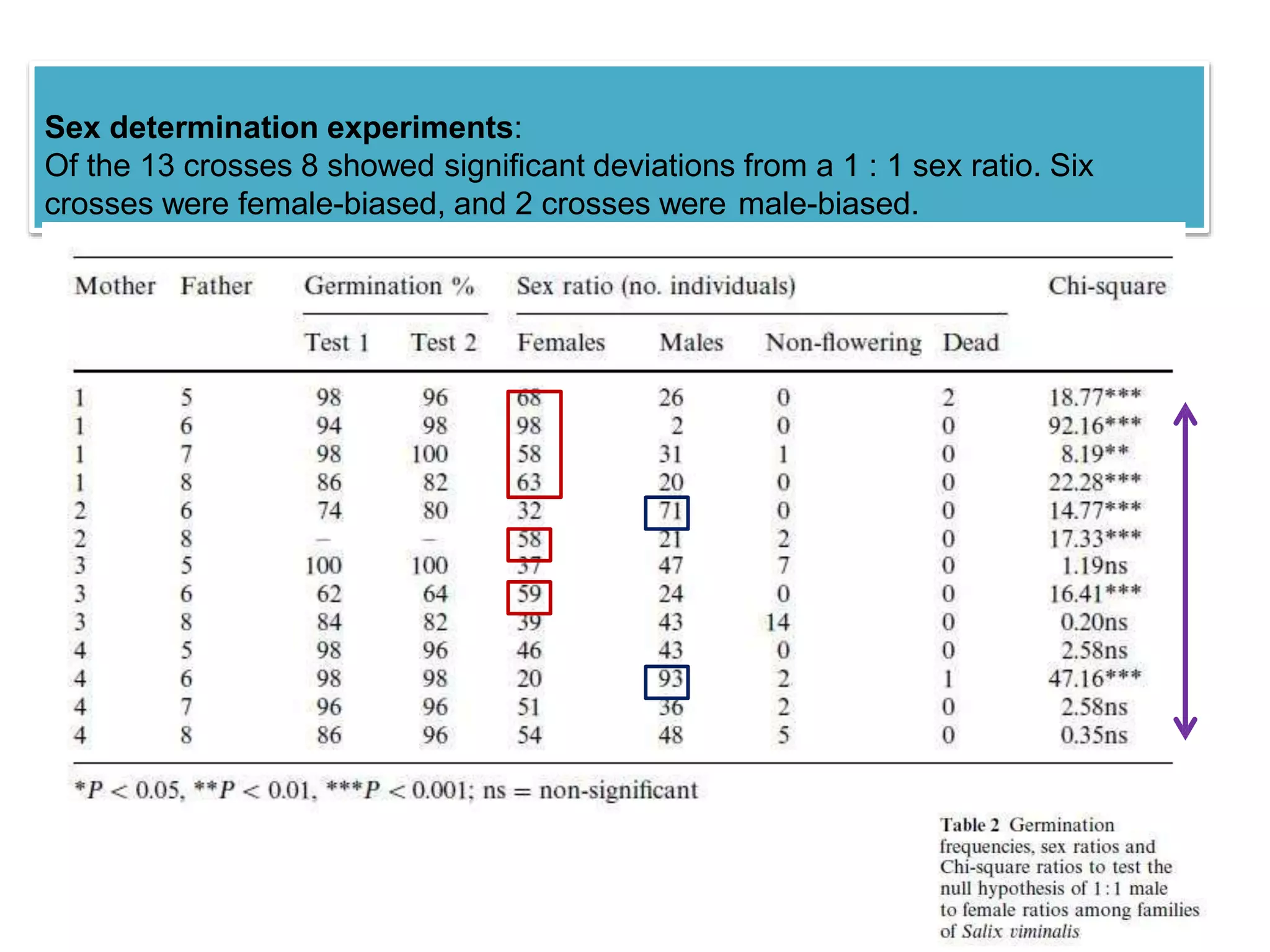
Sex determination experiments:
Ofthe 13 crosses 8 showed significant deviations from a 1 : 1 sex ratio. Six
crosses were female-biased, and 2 crosses were male-biased.
25.
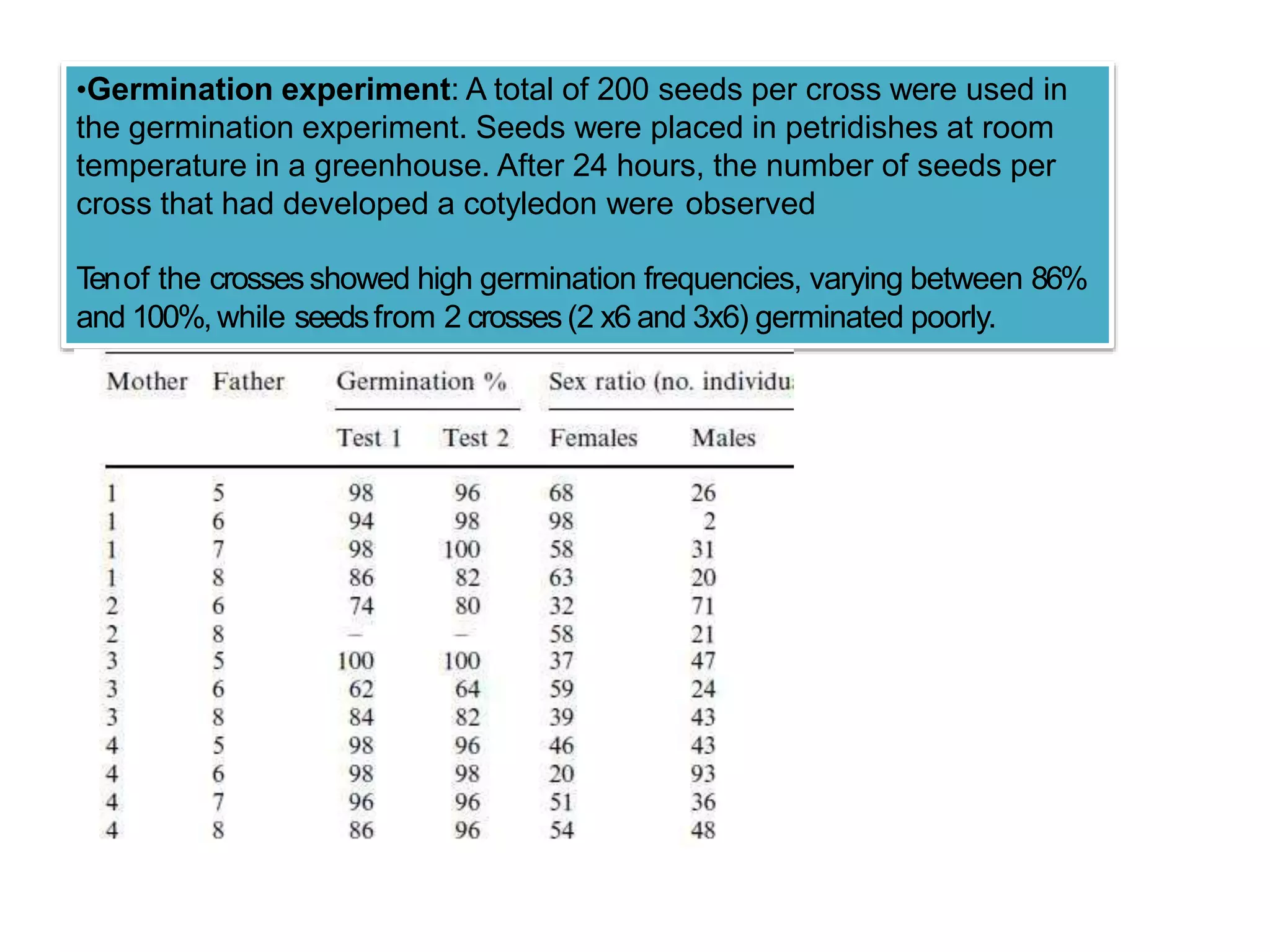
•Germination experiment: Atotal of 200 seeds per cross were used in
the germination experiment. Seeds were placed in petridishes at room
temperature in a greenhouse. After 24 hours, the number of seeds per
cross that had developed a cotyledon were observed
Tenof the crossesshowed high germination frequencies, varying between 86%
and 100%,while seedsfrom 2 crosses(2 x6 and 3x6) germinated poorly.
26.
In specieswith sexchromosomes,the following reasons have been suggestedaspossible
explanations of biased sexratios
•Fitness differences between males and females,
•Sexual Lability,
•Gametic Viability Selection,
•Meiotic Drive and,
• Cytoplasmic sexratio disorders
Discussion and Conclusions from thestudy:
In the current study, overall germination and survival frequencies were high, andno
trend in favor of one sexwas observed. therefore Fitness variation is not the likely
major causeof the observed deviations from balanced sexratios.
In our experiment none of the plants appeared to be hermaphrodites and/or have
labile sexexpression. Moreover, no sexchange, from male to female or theconverse,
was observed.
Becausedistortion does not take place during germination or flowering, the skewedsex
ratios obtained in this study were not distorted during the diploid phase.
27.
Meiotic drive, whichis the differential production of X-andY-chromosome-bearing
gametes by the heterogametic sex,hasbeen shown to distort the sexratio.
Thesexratio canalso be distorted asaresult of gametic selection, the differential
successof X-and Y-chromosome-bearing gametes in accomplishingfertilisation.
If it is assumed that females are heterogametic with respect tosexchromosomes,
meiotic drive and gametic selection
would both lead to variation in the sexratio of the offspring among crosses sharing the
same father,
while no suchvariation would be expected among crossessharing the samemother.
If males are heterogametic, the opposite would beexpected.
In this study, that variation in the sexratio of the offspring exists both among crosses
sharing the samefather and among crossessharing the samemother , making gametic
selection unlikely in S.viminalis.
28.
If cytoplasmic sexratiodisorder are assumedto be responsible for sex biasness
Thiswould involve several cytoplasmic factors and nuclear restorer loci.
If sexratio modifers are nuclear a minimum of two loci independent of
the sexchromosomes are necessaryto explain the sexratios of crosses1X6and
4X6.
In conclusion, the skewed sexratios in this study may not be explained solely bysex
chromosomes.
Environmental, nuclear-cytoplasmic or multi-locus sexdetermination mayprovide
explanations to theresults.
29.
Objective: Sexdetermination ofF2papaya plants by using RAPDbasedSCARprimers.
Materials:
500 RAPDprimers(10bp)
Papayacultivars; a) Kohopo
b) Sunrise
SCARprimers
Case study 2
30.
Methods
F2 plants from
crossbetween
Sunrise’ and UH
Line 365
25 plants
(hermaphrodite)
25 female
plants
Bulked
DNA
DNA
isolation
Bulked
DNA
Random amplification
with 500 RAPD
primers
Identification of
Primers giving
reproducible and
sex linked bands
Purification,
Cloning and
sequencing of
polymorphic
bands
Designing
SCAR
primers
Sex
determination
31.
Of the500 RAPD primers: 3 primers viz T1, T12 and W11 gave
reproducible and sex linked band in hermaphrodite and female plants
Those three RAPD products was cloned and a portion of their DNA
was sequenced and SCAR primers were design
SCAR primers were used for PCR in genomic DNA of hermaphrodite
and female plants
Results
32.
SCAR T12and
products
SCAR W11
inproduced
hermaphrodite and SCAR T1
produce product in all the plants
regardless of plants sex
SCAR T1 was used as positive
control in sex determination by
SCAR T12 and SCAR W11
33.
Objective: Determination ofsex in Simarouba glauca by RAPD markers
Materials:
Simarouba glauca plants
a. Male
b. Female
c. Hermaphrodite
85 RAPD 10 bp primers
3
Conclusion
• Sex determinationin plants is a complex mechanism
involving various factors.
• For crop improvement, a crop to be used in a breeding
program, the determination of sex in seedling stage will
reduced the time as well as input cost.
• Morphological markers like flower type etc. for
confirming sex of the plants requires tedious work and
large area to select sufficient no. of plants.
• Therefore, molecular marker are playing important role in
determining sex in early stages of the plants.