Common Stock
Valuation
10-1
10-2
Fundamental Analysis
 Present value approach
– Capitalization of expected income
– Intrinsic value based on the discounted value
of the expected stream of cash flows
 Multiple of earnings approach
– Valuation relative to a financial performance
measure
– Justified P/E ratio
10-3
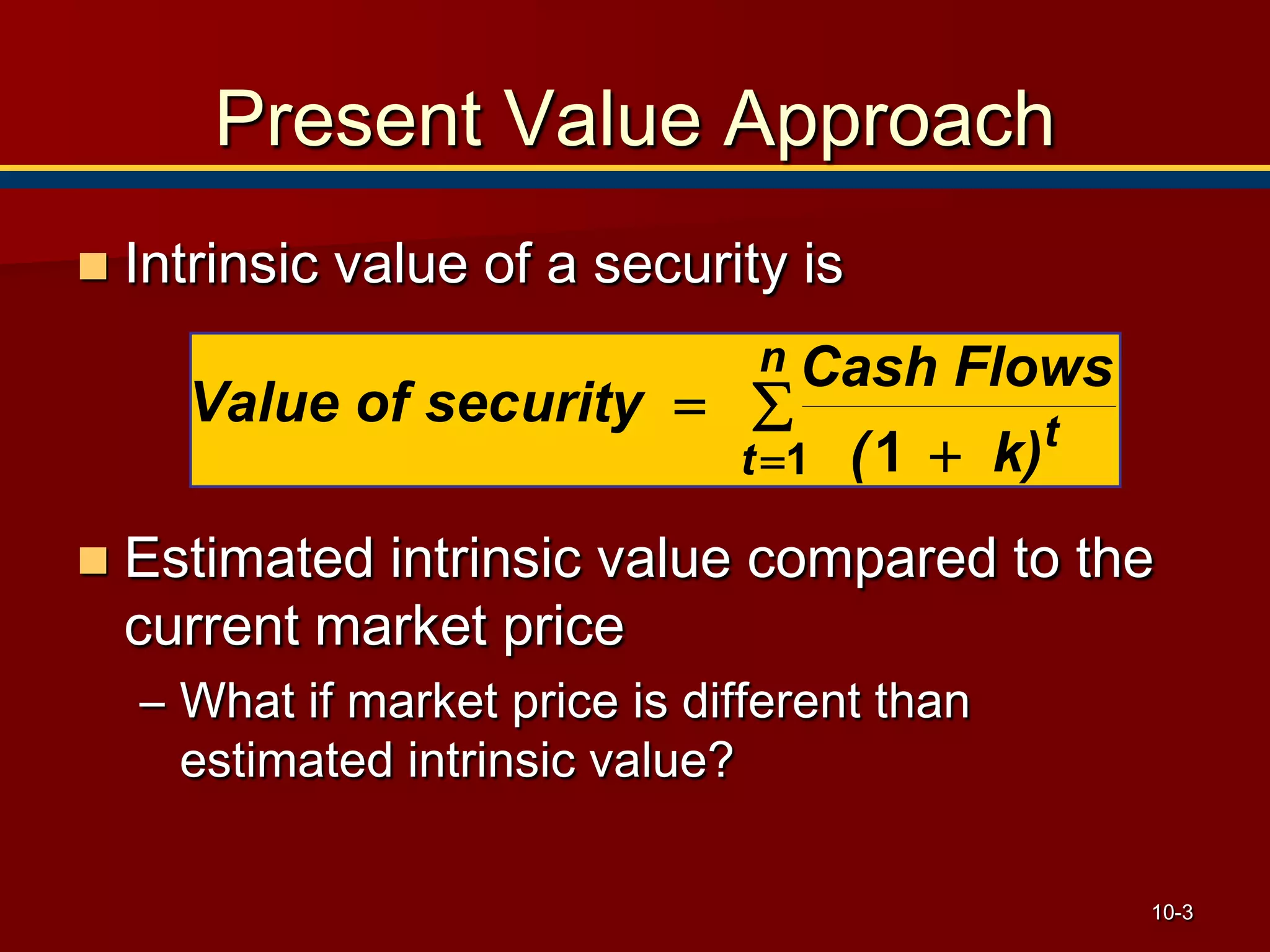
 Intrinsic value of a security is
 Estimated intrinsic value compared to the
current market price
– What if market price is different than
estimated intrinsic value?
∑
+
=
=
n
t
t
k)(
Cash Flows
uritysecValue of
1 1
Present Value Approach
10-4
Required Inputs
 Discount rate
– Required rate of return: minimum expected
rate to induce purchase
– The opportunity cost of dollars used for
investment
 Expected cash flows
– Stream of dividends or other cash payouts
over the life of the investment
10-5
Required Inputs
 Expected cash flows
– Dividends paid out of earnings
 Earnings important in valuing stocks
– Retained earnings enhance future earnings
and ultimately dividends
 Retained earnings imply growth and future
dividends
 Produces similar results as current dividends in
valuation of common shares
10-6
 Current value of a share of stock is the
discounted value of all future dividends
∑
+
=
+
++
+
+
+
=
∞
=
∞
∞
1
2
2
1
1
1
111
t
t
cs
t
cscscs
cs
)k(
D
)k(
D
...
)k(
D
)k(
D
P
Dividend Discount Model
10-7
Dividend Discount Model
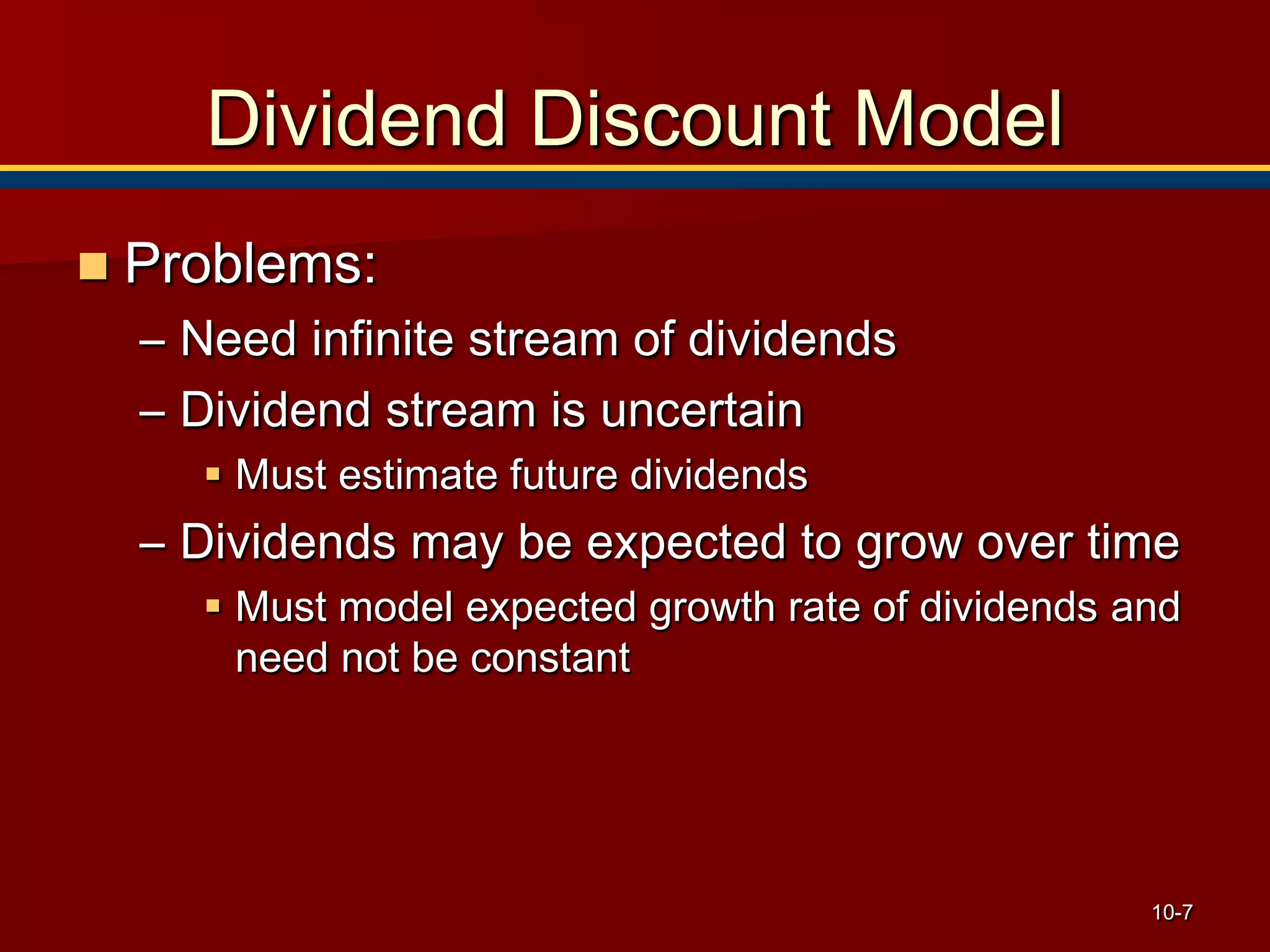
 Problems:
– Need infinite stream of dividends
– Dividend stream is uncertain
 Must estimate future dividends
– Dividends may be expected to grow over time
 Must model expected growth rate of dividends and
need not be constant
10-8
 Assume no growth in dividends
– Fixed dollar amount of dividends reduces the
security to a perpetuity
– Similar to preferred stock because dividend
remains unchanged
csk
D
P 0
0 =
Dividend Discount Model
10-9
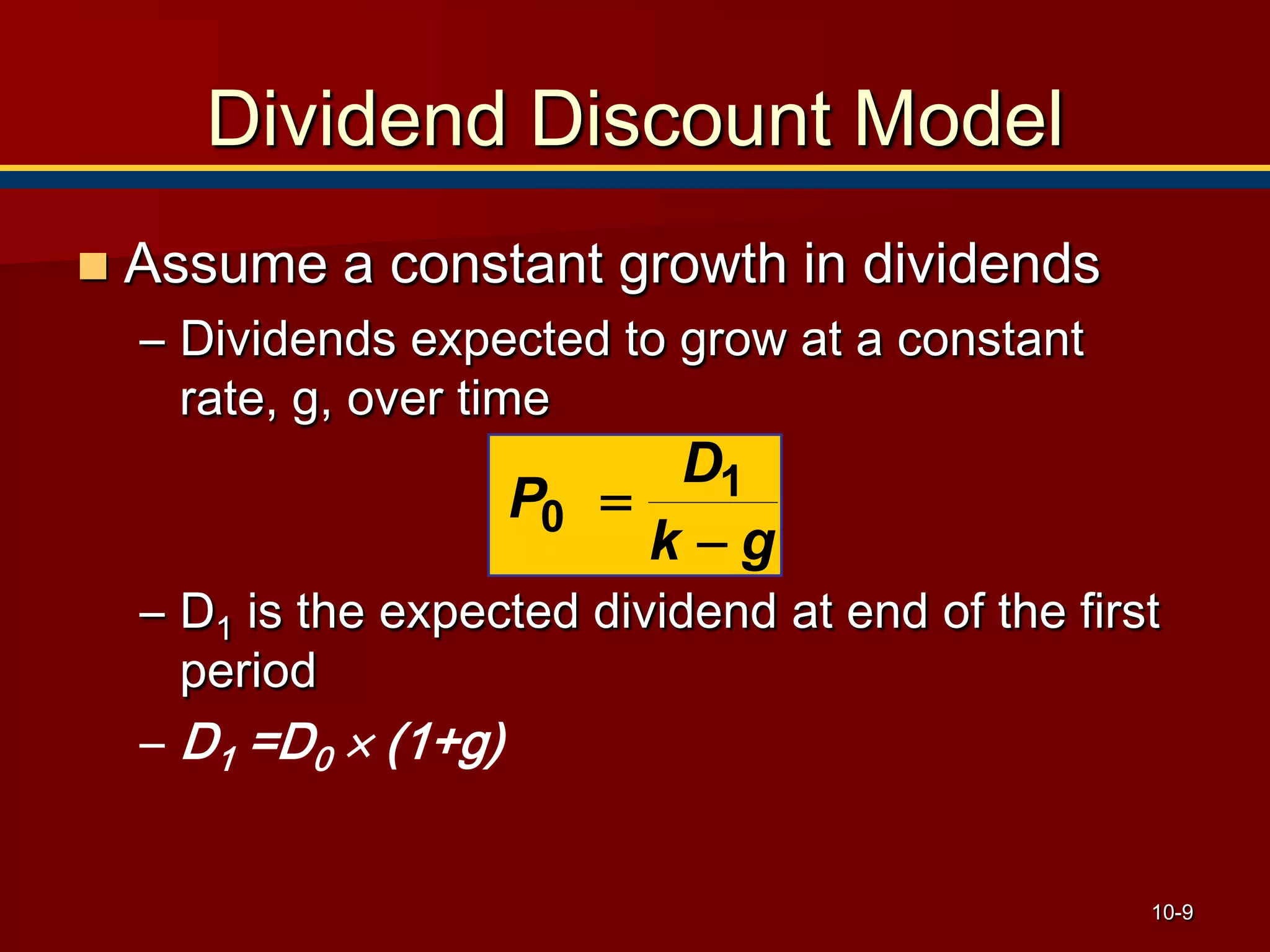
 Assume a constant growth in dividends
– Dividends expected to grow at a constant
rate, g, over time
– D1 is the expected dividend at end of the first
period
– D1 =D0 × (1+g)
gk
D
P
−
= 1
0
Dividend Discount Model
10-10
Dividend Discount Model
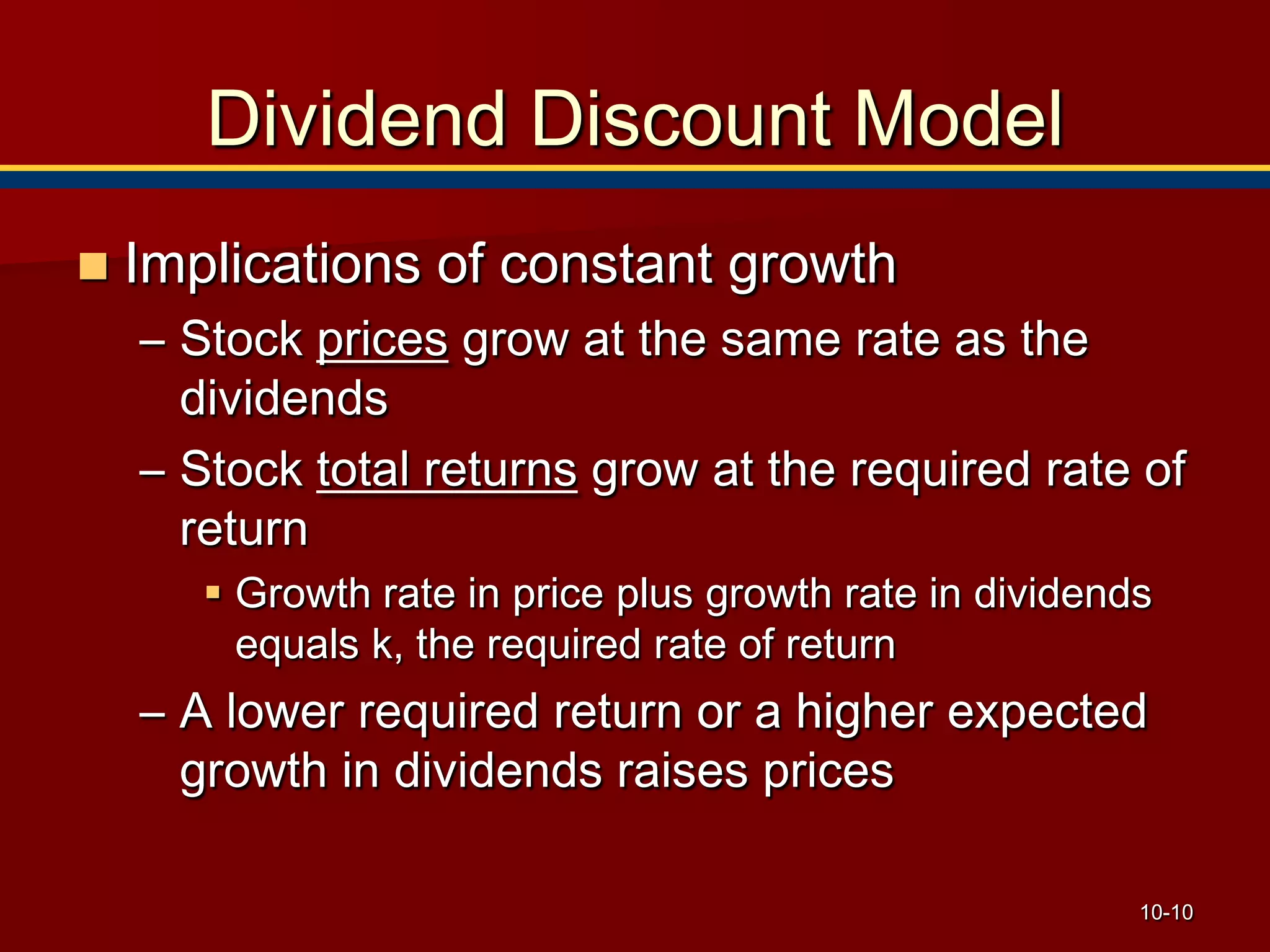
 Implications of constant growth
– Stock prices grow at the same rate as the
dividends
– Stock total returns grow at the required rate of
return
 Growth rate in price plus growth rate in dividends
equals k, the required rate of return
– A lower required return or a higher expected
growth in dividends raises prices
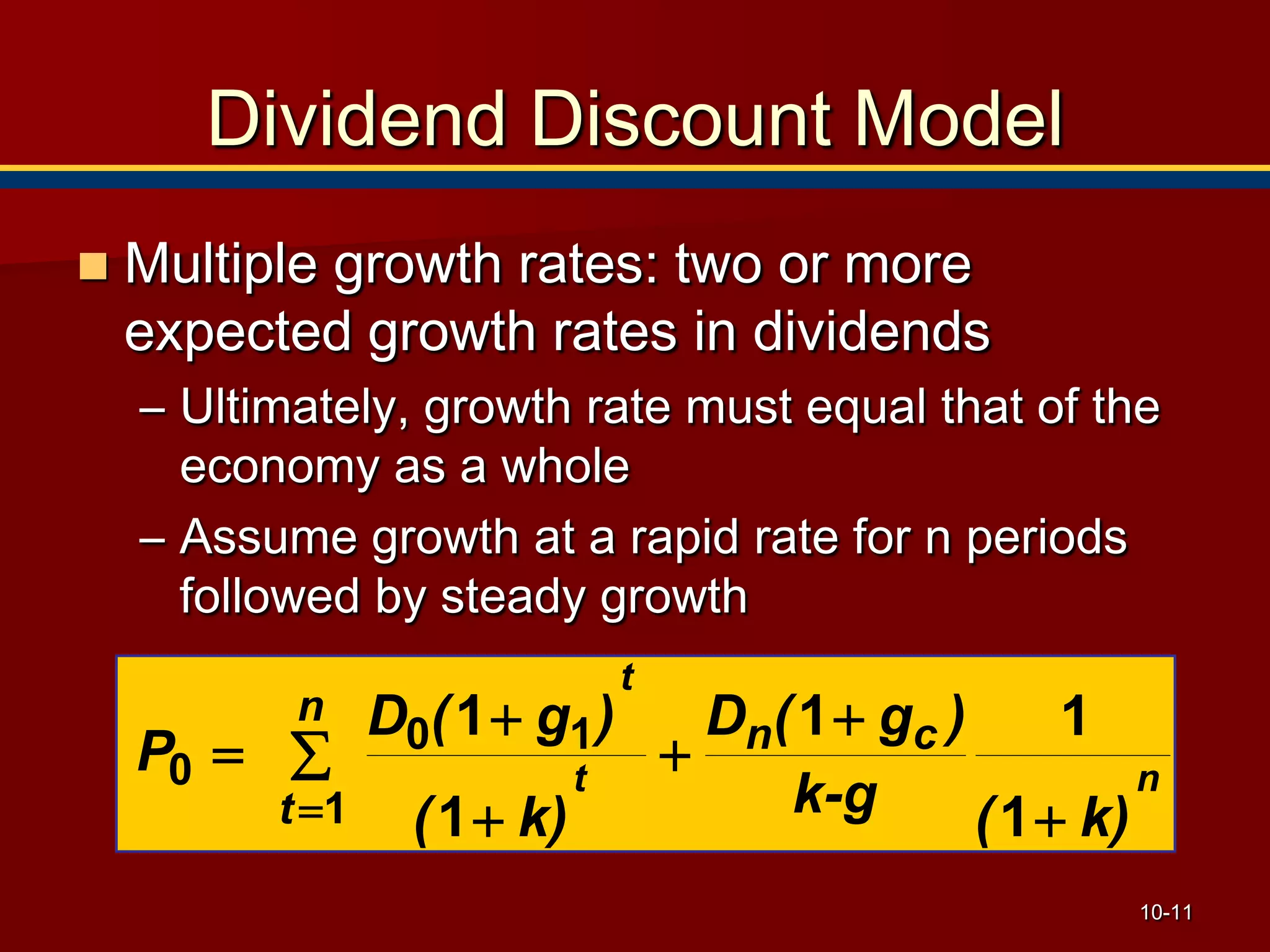
10-11
nt
t
k)(k-g
)g(D
k)(
)g(D
P cn
n
t +
+
+∑
+
+
=
= 1
11
1
1
1
10
0
Dividend Discount Model
 Multiple growth rates: two or more
expected growth rates in dividends
– Ultimately, growth rate must equal that of the
economy as a whole
– Assume growth at a rapid rate for n periods
followed by steady growth
10-12
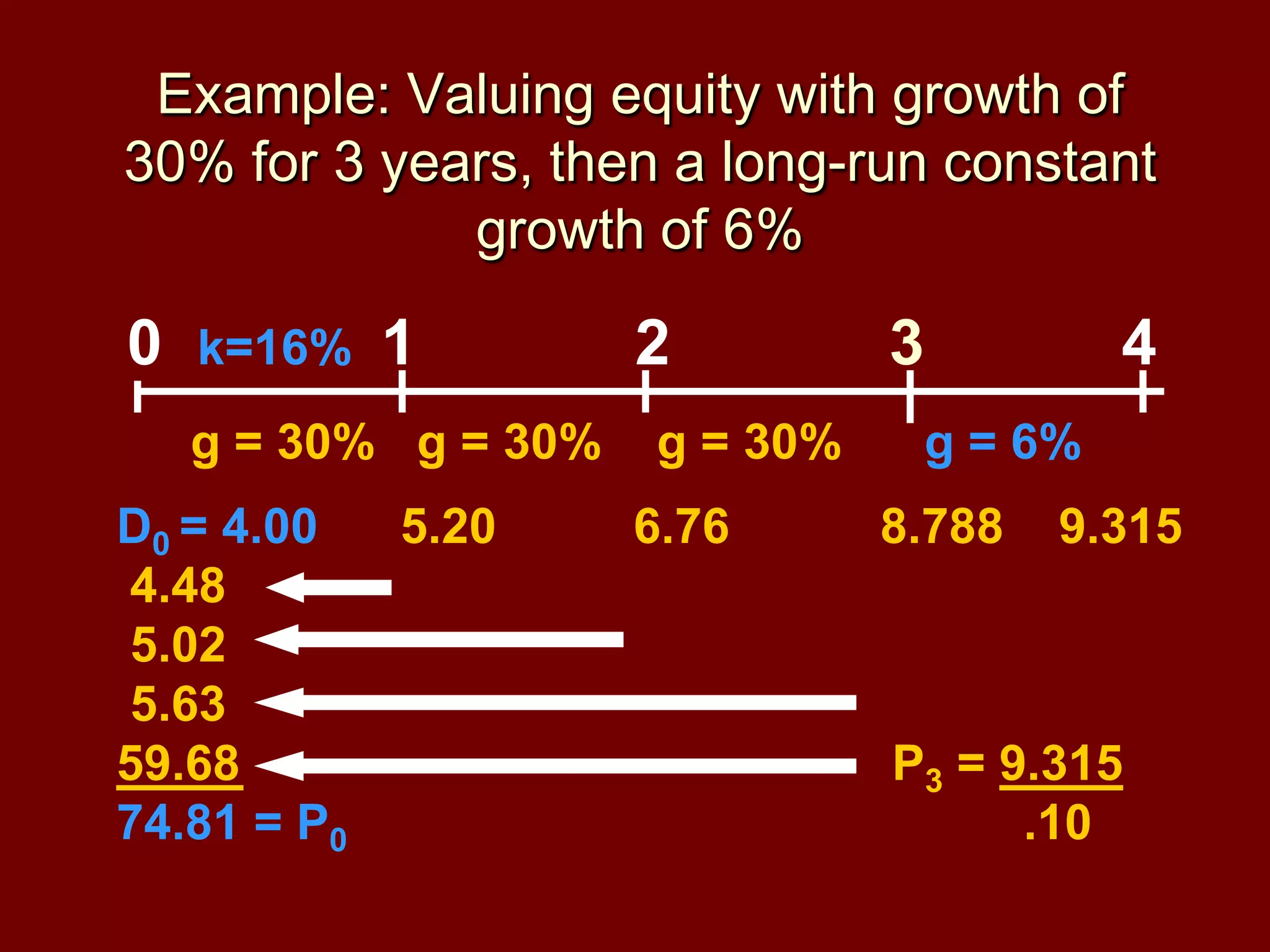
Dividend Discount Model
 Multiple growth rates
– First present value covers the period of super-
normal (or sub-normal) growth
– Second present value covers the period of
stable growth
 Expected price uses constant-growth model as of
the end of super- (sub-) normal period
 Value at n must be discounted to time period zero
0 k=16% 1 2 3 4
g = 30% g = 30% g = 30% g = 6%
D0 = 4.00 5.20 6.76 8.788 9.315
4.48
5.02
5.63
59.68 P3 = 9.315
74.81 = P0 .10
Example: Valuing equity with growth of
30% for 3 years, then a long-run constant
growth of 6%
10-14
What About Capital Gains?
 Is the dividend discount model only
capable of handling dividends?
– Capital gains are also important
 Price received in future reflects
expectations of dividends from that point
forward
– Discounting dividends or a combination of
dividends and price produces same results
10-15
Intrinsic Value
 “Fair” value based on the capitalization of
income process
– The objective of fundamental analysis
 If intrinsic value >(<) current market price,
hold or purchase (avoid or sell) because
the asset is undervalued (overvalued)
– Decision will always involve estimates
10-16
P/E Ratio or
Earnings Multiplier Approach
 Alternative approach often used by
security analysts
 P/E ratio is the strength with which
investors value earnings as expressed in
stock price
– Divide the current market price of the stock by
the latest 12-month earnings
– Price paid for each $1 of earnings
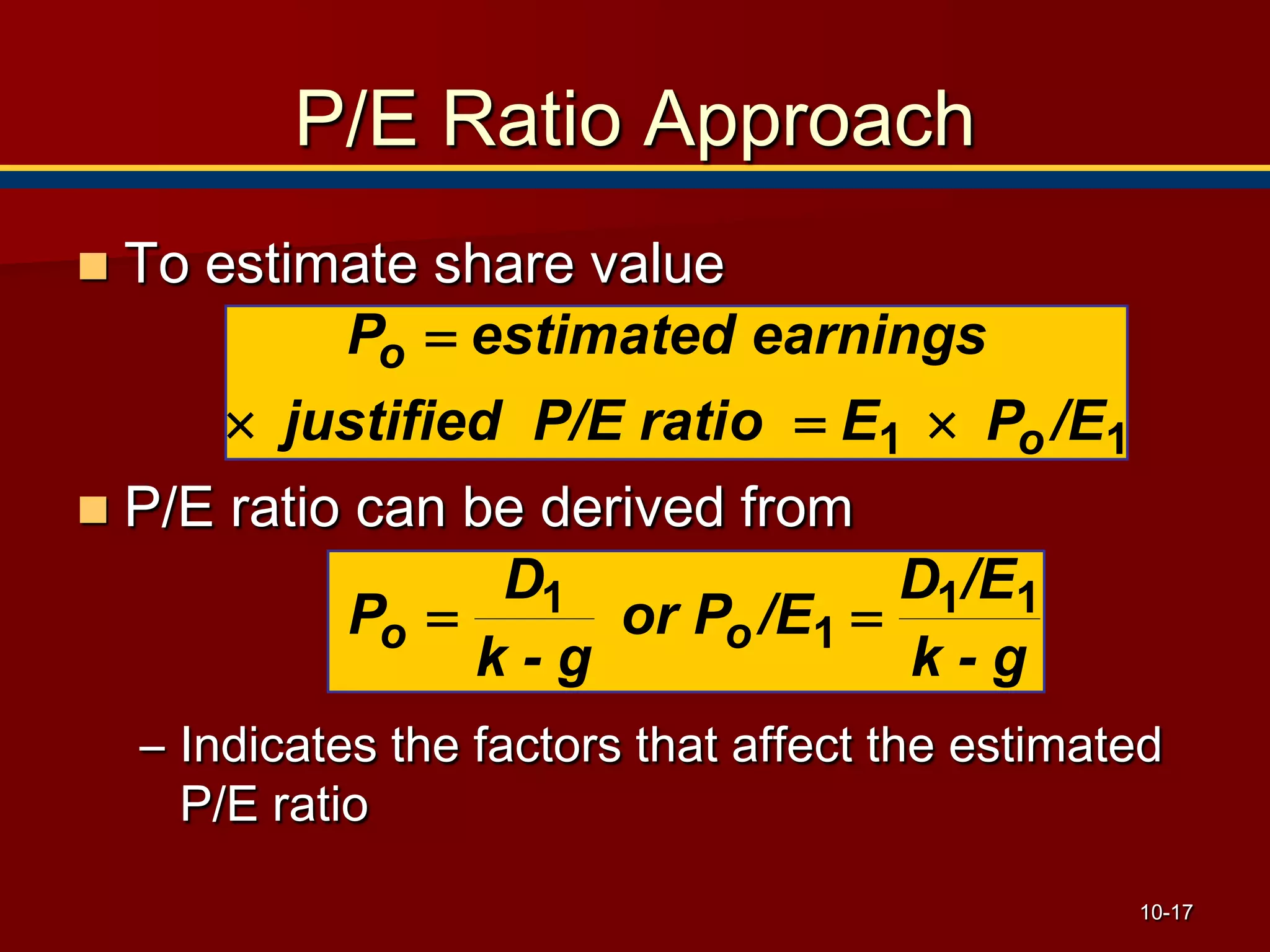
10-17
 To estimate share value
 P/E ratio can be derived from
– Indicates the factors that affect the estimated
P/E ratio
11 /EPEoP/E ratijustified
earningsestimatedP
o
o
×=×
=
k - g
/ED
/Eor P
k - g
D
P oo
11
1
1 ==
P/E Ratio Approach
10-18
P/E Ratio Approach
 The higher the payout ratio, the higher the
justified P/E
– Payout ratio is the proportion of earnings that
are paid out as dividends
 The higher the expected growth rate, g,
the higher the justified P/E
 The higher the required rate of return, k,
the lower the justified P/E
10-19
Understanding the P/E Ratio
 Can firms increase payout ratio to increase
market price?
– Will future growth prospects be affected?
 Does rapid growth affect the riskiness of
earnings?
– Will the required return be affected?
– Are some growth factors more desirable than
others?
 P/E ratios reflect expected growth and risk
10-20
P/E Ratios and Interest Rates
 A P/E ratio reflects investor optimism and
pessimism
– Related to the required rate of return
 As interest rates increase, required rates
of return on all securities generally
increase
 P/E ratios and interest rates are indirectly
related
10-21
Which Approach Is Best?
 Best estimate is probably the present
value of the (estimated) dividends
– Can future dividends be estimated with
accuracy?
– Investors like to focus on capital gains not
dividends
 P/E multiplier remains popular for its ease
in use and the objections to the dividend
discount model
10-22
Which Approach Is Best?
 Complementary approaches?
– P/E ratio can be derived from the constant-
growth version of the dividend discount model
– Dividends are paid out of earnings
– Using both increases the likelihood of
obtaining reasonable results
 Dealing with uncertain future is always
subject to error
10-23
Other Multiples
 Price-to-book value ratio
– Ratio of share price to stockholder equity as
measured on the balance sheet
– Price paid for each $1 of equity
 Price-to-sales ratio
– Ratio of a company’s total market value (price
times number of shares) divided by sales
– Market valuation of a firm’s revenues

Common stock evaluation

  • 1.
  • 2.
    10-2 Fundamental Analysis  Presentvalue approach – Capitalization of expected income – Intrinsic value based on the discounted value of the expected stream of cash flows  Multiple of earnings approach – Valuation relative to a financial performance measure – Justified P/E ratio
  • 3.
    10-3  Intrinsic valueof a security is  Estimated intrinsic value compared to the current market price – What if market price is different than estimated intrinsic value? ∑ + = = n t t k)( Cash Flows uritysecValue of 1 1 Present Value Approach
  • 4.
    10-4 Required Inputs  Discountrate – Required rate of return: minimum expected rate to induce purchase – The opportunity cost of dollars used for investment  Expected cash flows – Stream of dividends or other cash payouts over the life of the investment
  • 5.
    10-5 Required Inputs  Expectedcash flows – Dividends paid out of earnings  Earnings important in valuing stocks – Retained earnings enhance future earnings and ultimately dividends  Retained earnings imply growth and future dividends  Produces similar results as current dividends in valuation of common shares
  • 6.
    10-6  Current valueof a share of stock is the discounted value of all future dividends ∑ + = + ++ + + + = ∞ = ∞ ∞ 1 2 2 1 1 1 111 t t cs t cscscs cs )k( D )k( D ... )k( D )k( D P Dividend Discount Model
  • 7.
    10-7 Dividend Discount Model Problems: – Need infinite stream of dividends – Dividend stream is uncertain  Must estimate future dividends – Dividends may be expected to grow over time  Must model expected growth rate of dividends and need not be constant
  • 8.
    10-8  Assume nogrowth in dividends – Fixed dollar amount of dividends reduces the security to a perpetuity – Similar to preferred stock because dividend remains unchanged csk D P 0 0 = Dividend Discount Model
  • 9.
    10-9  Assume aconstant growth in dividends – Dividends expected to grow at a constant rate, g, over time – D1 is the expected dividend at end of the first period – D1 =D0 × (1+g) gk D P − = 1 0 Dividend Discount Model
  • 10.
    10-10 Dividend Discount Model Implications of constant growth – Stock prices grow at the same rate as the dividends – Stock total returns grow at the required rate of return  Growth rate in price plus growth rate in dividends equals k, the required rate of return – A lower required return or a higher expected growth in dividends raises prices
  • 11.
    10-11 nt t k)(k-g )g(D k)( )g(D P cn n t + + +∑ + + = =1 11 1 1 1 10 0 Dividend Discount Model  Multiple growth rates: two or more expected growth rates in dividends – Ultimately, growth rate must equal that of the economy as a whole – Assume growth at a rapid rate for n periods followed by steady growth
  • 12.
    10-12 Dividend Discount Model Multiple growth rates – First present value covers the period of super- normal (or sub-normal) growth – Second present value covers the period of stable growth  Expected price uses constant-growth model as of the end of super- (sub-) normal period  Value at n must be discounted to time period zero
  • 13.
    0 k=16% 12 3 4 g = 30% g = 30% g = 30% g = 6% D0 = 4.00 5.20 6.76 8.788 9.315 4.48 5.02 5.63 59.68 P3 = 9.315 74.81 = P0 .10 Example: Valuing equity with growth of 30% for 3 years, then a long-run constant growth of 6%
  • 14.
    10-14 What About CapitalGains?  Is the dividend discount model only capable of handling dividends? – Capital gains are also important  Price received in future reflects expectations of dividends from that point forward – Discounting dividends or a combination of dividends and price produces same results
  • 15.
    10-15 Intrinsic Value  “Fair”value based on the capitalization of income process – The objective of fundamental analysis  If intrinsic value >(<) current market price, hold or purchase (avoid or sell) because the asset is undervalued (overvalued) – Decision will always involve estimates
  • 16.
    10-16 P/E Ratio or EarningsMultiplier Approach  Alternative approach often used by security analysts  P/E ratio is the strength with which investors value earnings as expressed in stock price – Divide the current market price of the stock by the latest 12-month earnings – Price paid for each $1 of earnings
  • 17.
    10-17  To estimateshare value  P/E ratio can be derived from – Indicates the factors that affect the estimated P/E ratio 11 /EPEoP/E ratijustified earningsestimatedP o o ×=× = k - g /ED /Eor P k - g D P oo 11 1 1 == P/E Ratio Approach
  • 18.
    10-18 P/E Ratio Approach The higher the payout ratio, the higher the justified P/E – Payout ratio is the proportion of earnings that are paid out as dividends  The higher the expected growth rate, g, the higher the justified P/E  The higher the required rate of return, k, the lower the justified P/E
  • 19.
    10-19 Understanding the P/ERatio  Can firms increase payout ratio to increase market price? – Will future growth prospects be affected?  Does rapid growth affect the riskiness of earnings? – Will the required return be affected? – Are some growth factors more desirable than others?  P/E ratios reflect expected growth and risk
  • 20.
    10-20 P/E Ratios andInterest Rates  A P/E ratio reflects investor optimism and pessimism – Related to the required rate of return  As interest rates increase, required rates of return on all securities generally increase  P/E ratios and interest rates are indirectly related
  • 21.
    10-21 Which Approach IsBest?  Best estimate is probably the present value of the (estimated) dividends – Can future dividends be estimated with accuracy? – Investors like to focus on capital gains not dividends  P/E multiplier remains popular for its ease in use and the objections to the dividend discount model
  • 22.
    10-22 Which Approach IsBest?  Complementary approaches? – P/E ratio can be derived from the constant- growth version of the dividend discount model – Dividends are paid out of earnings – Using both increases the likelihood of obtaining reasonable results  Dealing with uncertain future is always subject to error
  • 23.
    10-23 Other Multiples  Price-to-bookvalue ratio – Ratio of share price to stockholder equity as measured on the balance sheet – Price paid for each $1 of equity  Price-to-sales ratio – Ratio of a company’s total market value (price times number of shares) divided by sales – Market valuation of a firm’s revenues