


Introduction Finance
What is Finance?
Finance consists of providing and utilizing the money,
capital rights, credit and funds of any kind which
are employed in the operation of an enterprise.
On the other hand finance define as that
administrative area or set of administrative
function in an org. which have to do with the
management of the flow of cash so that the
organization will have the means to carry out its
objective as satisfactory as possible and at the
same time meet its obligation as they become
due.
What is Business Finance?
Business finance means finance required for promoting
and running trade, commerce or industrial
undertakings. The saving, spending, borrowing and
investing of funds are included in the meaning of
business finance.
Business finance also means rising, providing and
managing of all money capital or funds of any kind to
be used connection with business.
Scope/Major areas of Finance:
Money Market and Capital Market
Investment
Financial Management
Money Market and Capital Market: The market for short-term, highly liquid,
low-risk assets such as Treasury bills and negotiable CDs.
On the other hand, capital market, the market for long-term securities such as
bonds and stocks.
Scope/Major areas of Finance….
Investment: The commitment of funds to one or more assets that
will be held over some future time periods.
• Treasury bill: Short term discounted securities issued by Gov’t.
• Negotiable Certificate of Deposit/ Certificate of deposit: An
interest bearing security that certifies that a specified amount
of money placed in a Bank will receive a stated amount of
interest for a stated amount of time.
• Commercial Paper: It refers to unsecured promissory notes by
companies to raise short term financing.
Md. Azizur Rahman
Scope/Major areas of Finance….
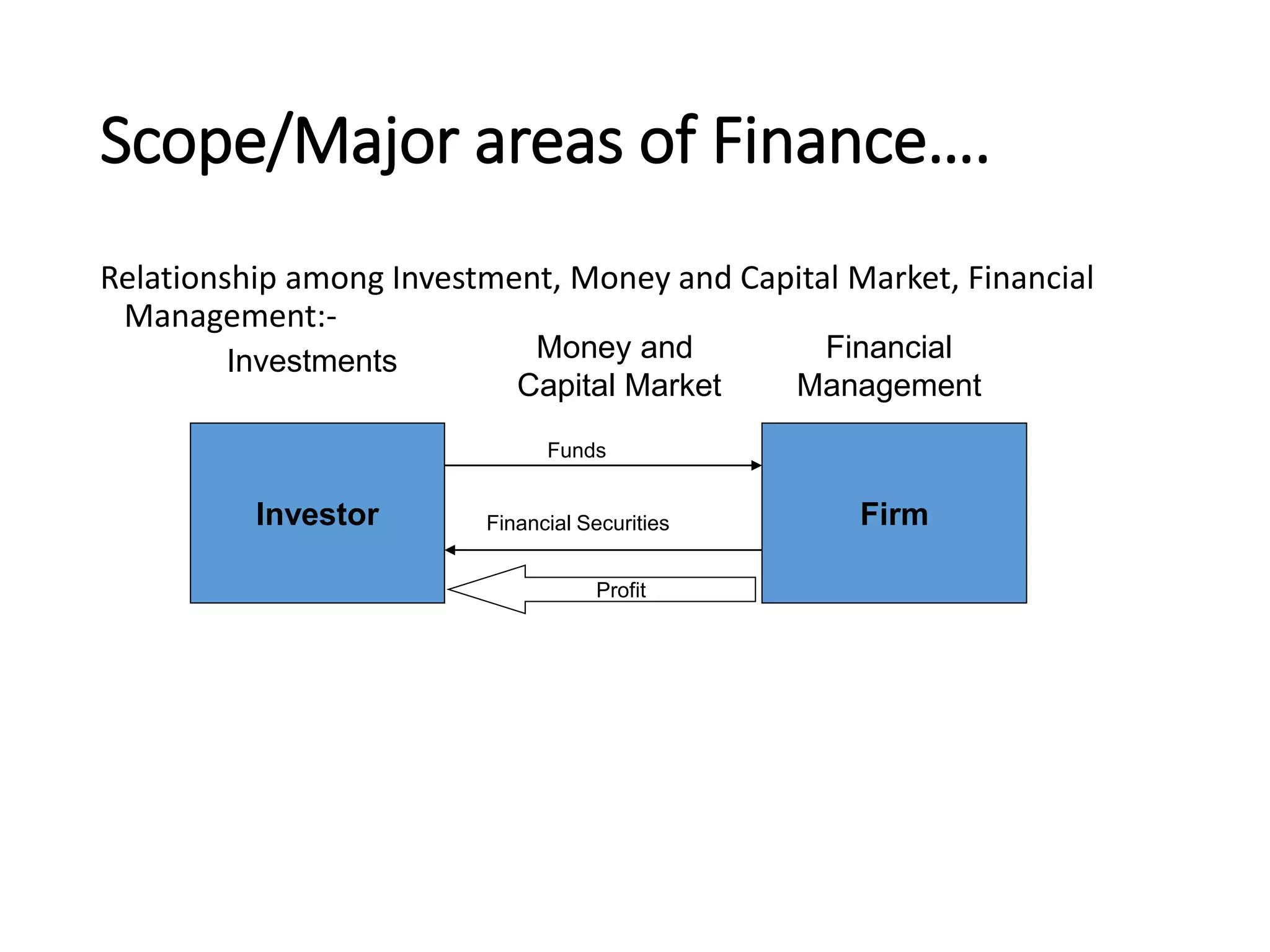
Relationship among Investment, Money and Capital Market, Financial
Management:-
Investor Firm
Investments Financial
Management
Money and
Capital Market
Profit
Funds
Financial Securities
Scope/Major areas of Finance….
Financial Management
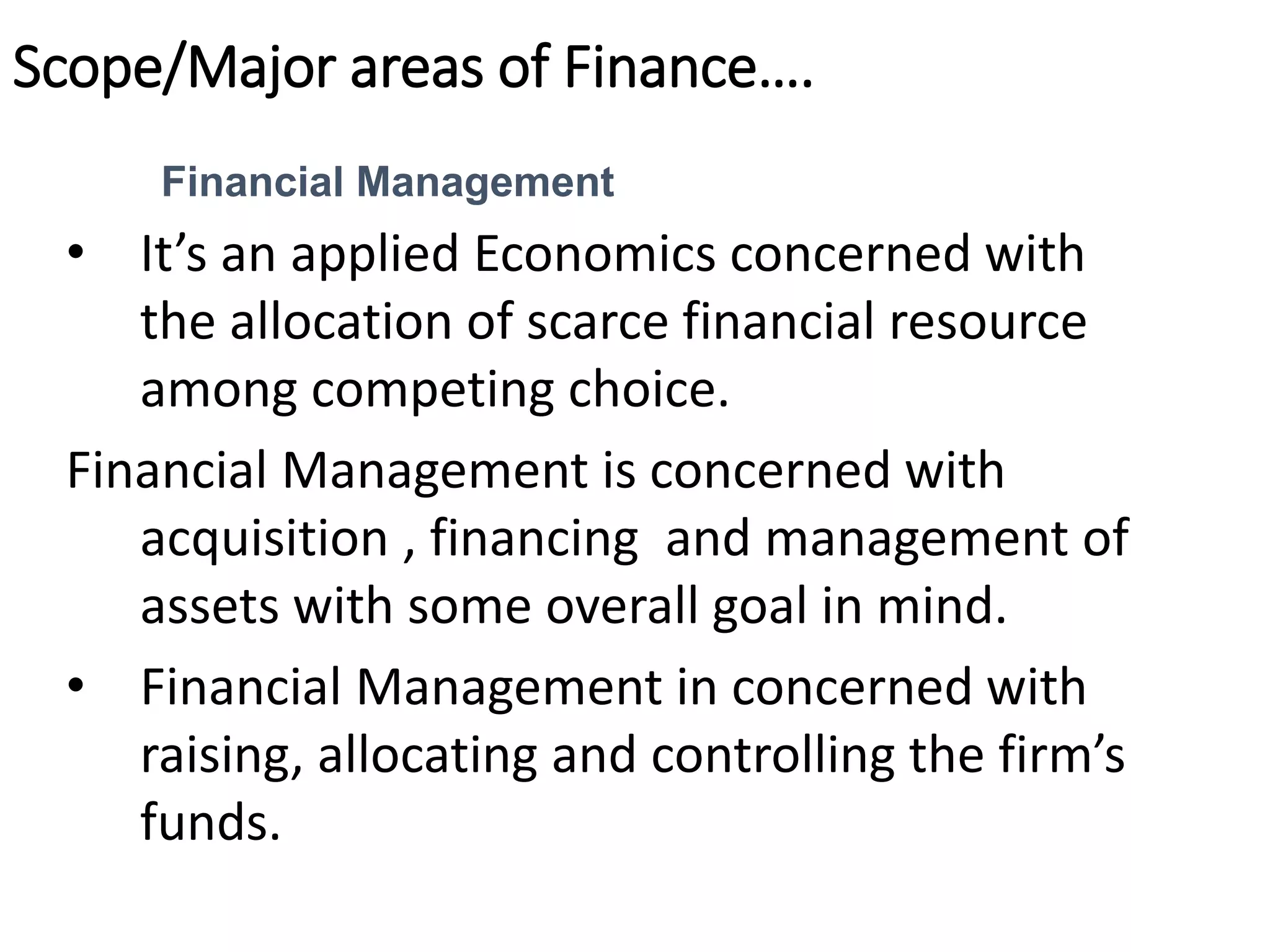
• It’s an applied Economics concerned with
the allocation of scarce financial resource
among competing choice.
Financial Management is concerned with
acquisition , financing and management of
assets with some overall goal in mind.
• Financial Management in concerned with
raising, allocating and controlling the firm’s
funds.
Categories of Business Finance…..
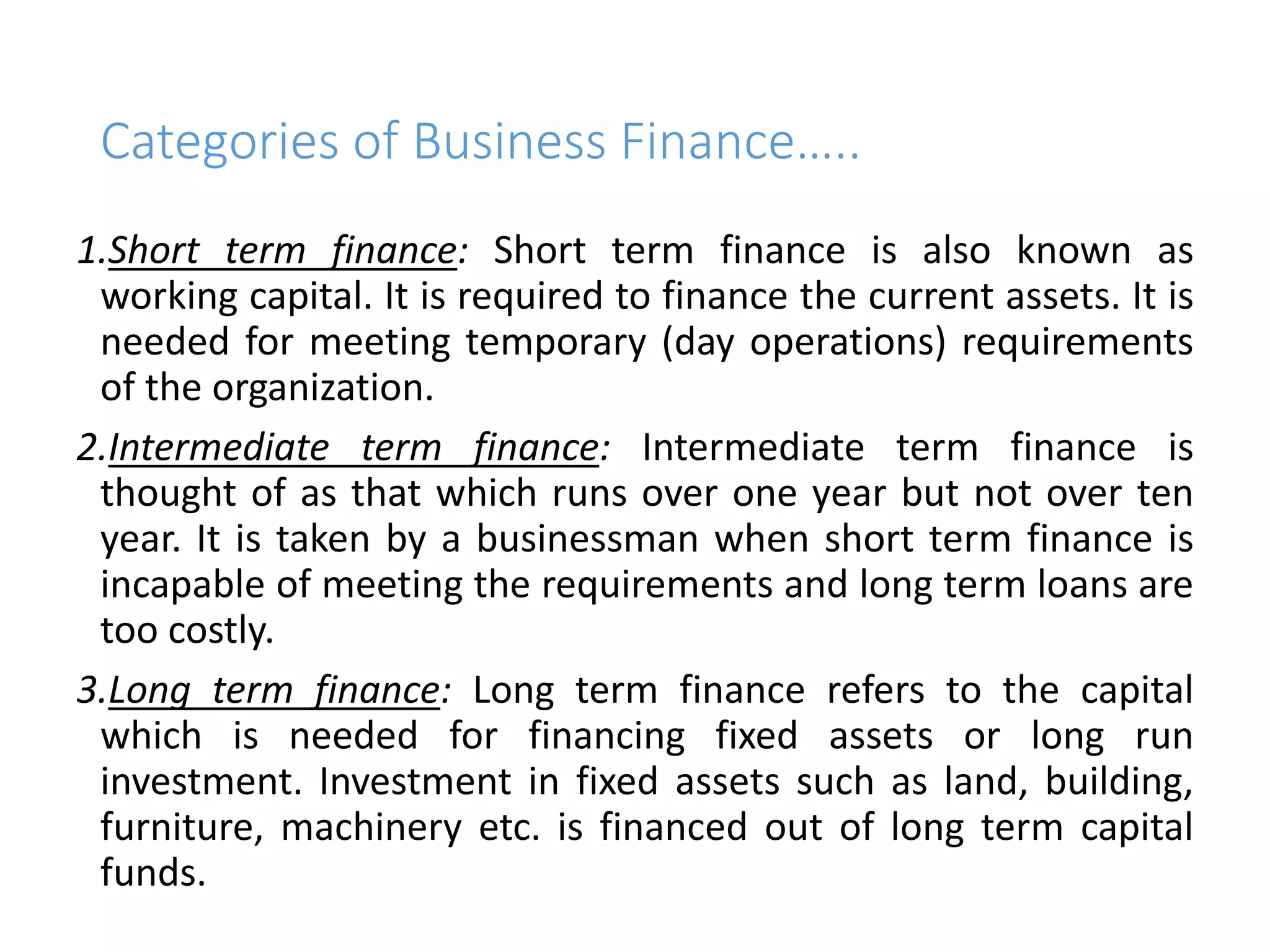
1.Short term finance: Short term finance is also known as
working capital. It is required to finance the current assets. It is
needed for meeting temporary (day operations) requirements
of the organization.
2.Intermediate term finance: Intermediate term finance is
thought of as that which runs over one year but not over ten
year. It is taken by a businessman when short term finance is
incapable of meeting the requirements and long term loans are
too costly.
3.Long term finance: Long term finance refers to the capital
which is needed for financing fixed assets or long run
investment. Investment in fixed assets such as land, building,
furniture, machinery etc. is financed out of long term capital
funds.
Categories of Business Finance…..
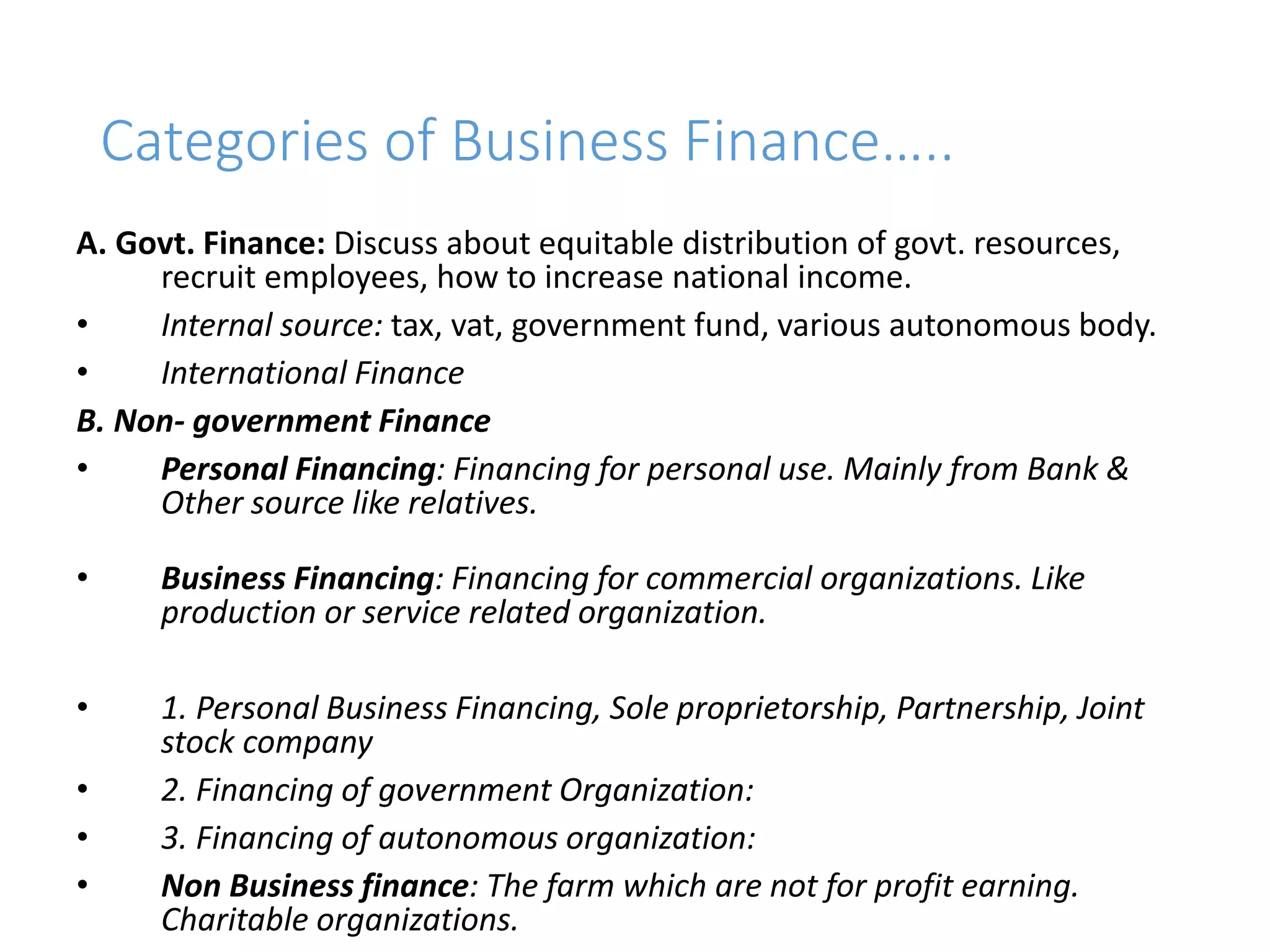
A. Govt. Finance: Discuss about equitable distribution of govt. resources,
recruit employees, how to increase national income.
• Internal source: tax, vat, government fund, various autonomous body.
• International Finance
B. Non- government Finance
• Personal Financing: Financing for personal use. Mainly from Bank &
Other source like relatives.
• Business Financing: Financing for commercial organizations. Like
production or service related organization.
• 1. Personal Business Financing, Sole proprietorship, Partnership, Joint
stock company
• 2. Financing of government Organization:
• 3. Financing of autonomous organization:
• Non Business finance: The farm which are not for profit earning.
Charitable organizations.
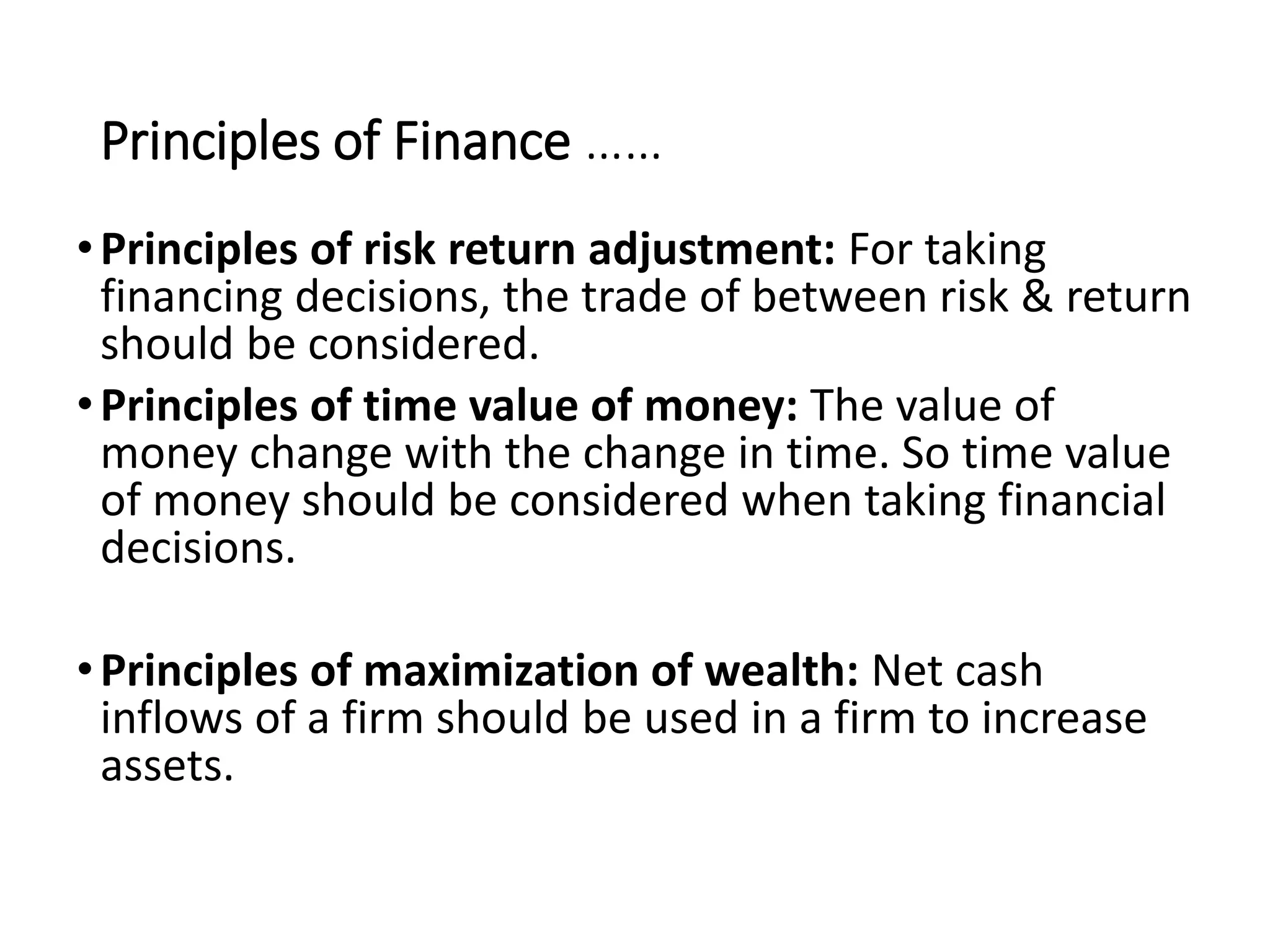
Principles of Finance ……
•Principles of risk return adjustment: For taking
financing decisions, the trade of between risk & return
should be considered.
•Principles of time value of money: The value of
money change with the change in time. So time value
of money should be considered when taking financial
decisions.
•Principles of maximization of wealth: Net cash
inflows of a firm should be used in a firm to increase
assets.
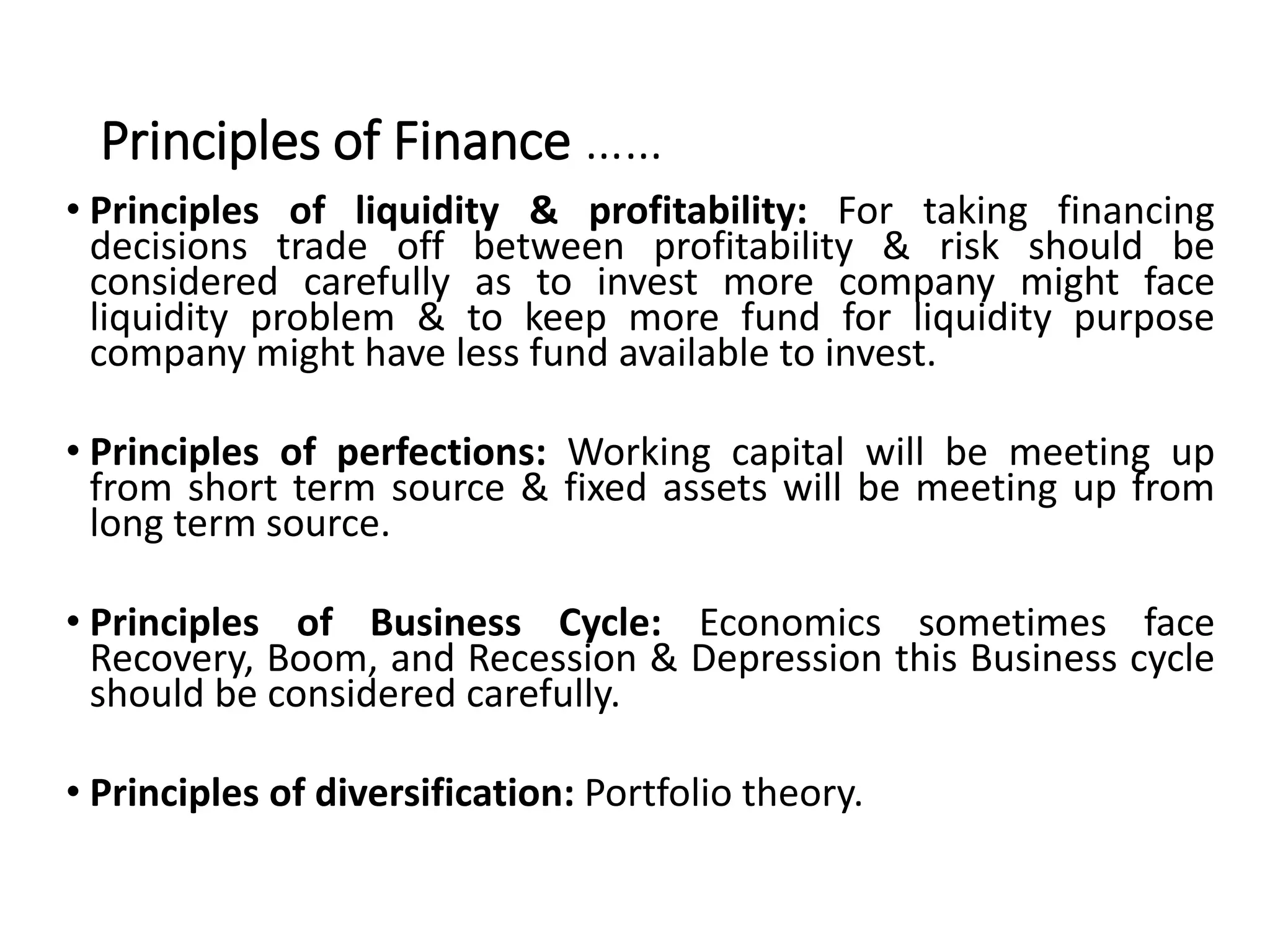
Principles of Finance ……
• Principles of liquidity & profitability: For taking financing
decisions trade off between profitability & risk should be
considered carefully as to invest more company might face
liquidity problem & to keep more fund for liquidity purpose
company might have less fund available to invest.
• Principles of perfections: Working capital will be meeting up
from short term source & fixed assets will be meeting up from
long term source.
• Principles of Business Cycle: Economics sometimes face
Recovery, Boom, and Recession & Depression this Business cycle
should be considered carefully.
• Principles of diversification: Portfolio theory.
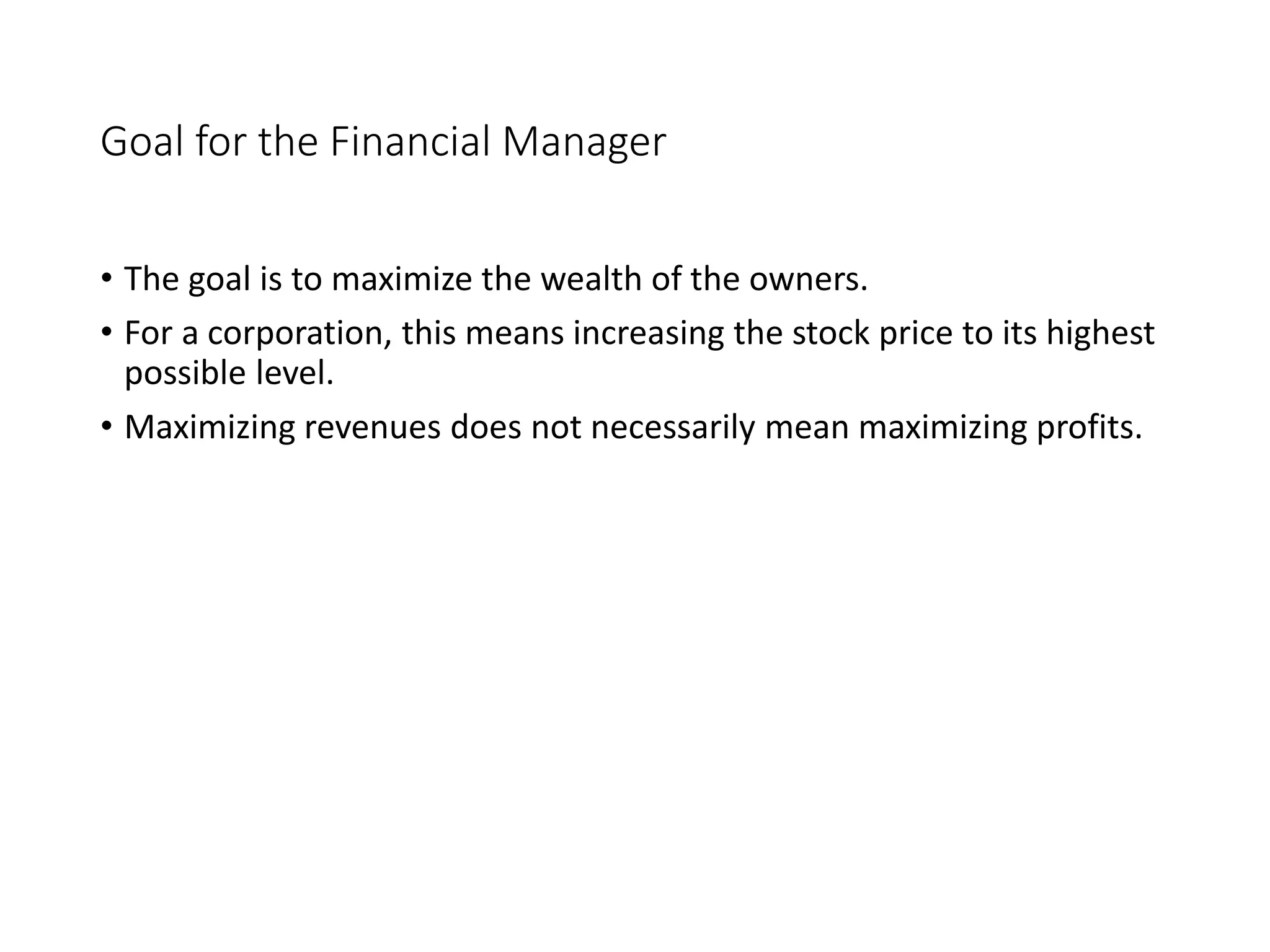
Goal for the Financial Manager
• The goal is to maximize the wealth of the owners.
• For a corporation, this means increasing the stock price to its highest
possible level.
• Maximizing revenues does not necessarily mean maximizing profits.
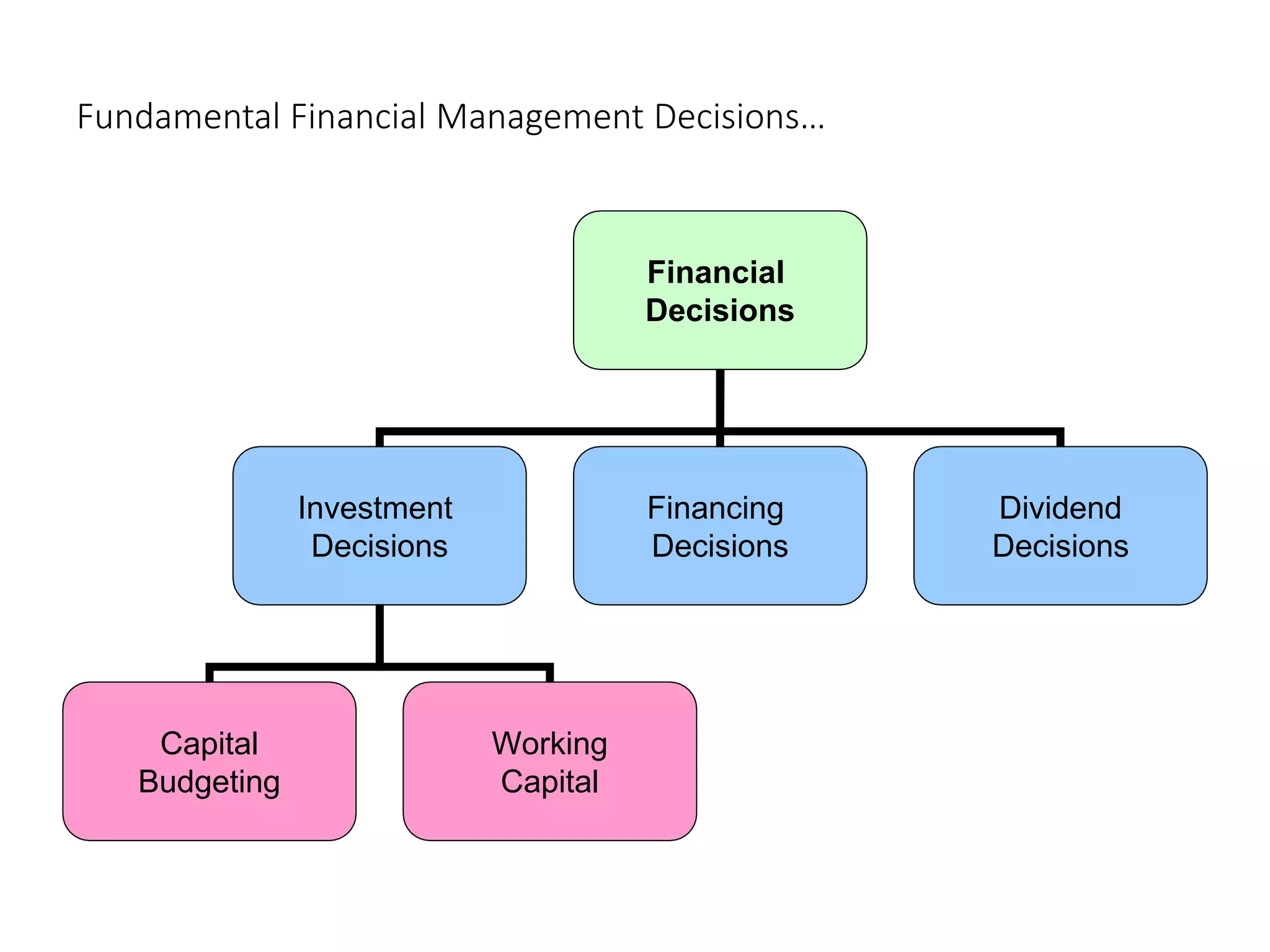
Fundamental Financial Management Decisions…
Financial
Decisions
Investment
Decisions
Financing
Decisions
Dividend
Decisions
Capital
Budgeting
Working
Capital
Key Decision of a Financial Manager
i. Investment Decision: Where invest should be made?
ii. Financing Decision: How the required fund would be
collected?
iii. Dividend Decision: How much net profit would be
distributed as dividend among the shareholders &
how much would be retained as retained earnings?
The functions of financial Manager
Financial planning
Identification of source
Raising fund
Investment of fund
Protection of fund
Distribution of profit
Management of asset
Cost control
Pricing
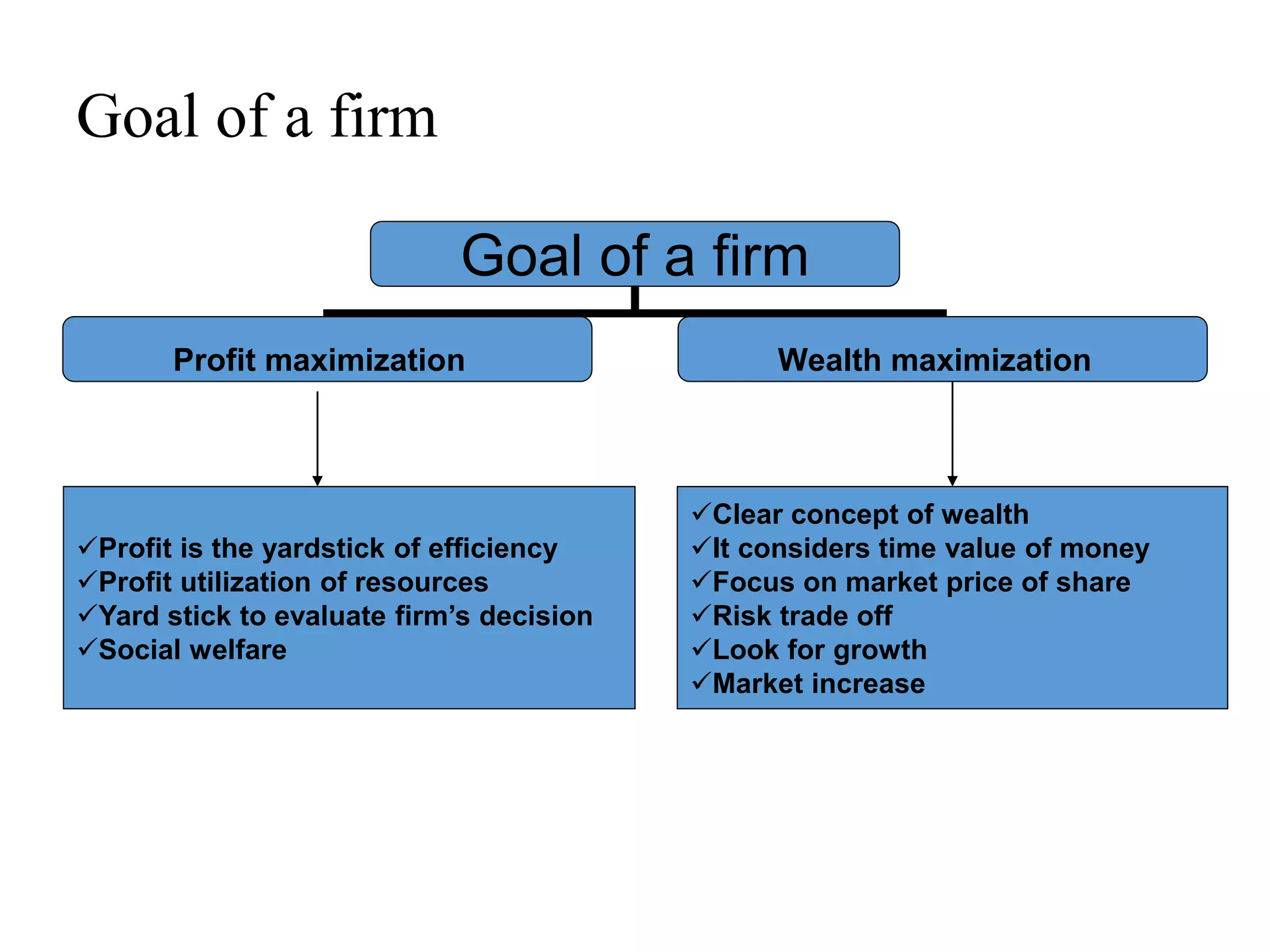
Goal of a firm
Goal of a firm
Profit maximization Wealth maximization
Profit is the yardstick of efficiency
Profit utilization of resources
Yard stick to evaluate firm’s decision
Social welfare
Clear concept of wealth
It considers time value of money
Focus on market price of share
Risk trade off
Look for growth
Market increase
Sole Proprietorship
A business owned and managed by one
individual; the business and the owner are one
and the same in the eyes of the law
Sole Proprietorship
Advantages
Simple to create
Least costly form
Profit incentive
Total decision-making
No special legal
restrictions
Easy to discontinue
Sole Proprietorship
Disadvantages
Unlimited personal
liability
Limited skills and abilities
Feelings of isolation
Limited access to capital
Lack of continuity of
business
Partnership
An association of two
or more people who
co-own a business for
the purpose of making
a profit
A partnership agreement or the Uniform Partnership Act
Partnership
Advantages
Easy to establish
Complementary skills
Division of profits
Larger pool of capital
Ability to attract limited
partners
Little governmental regulation
Flexibility
Taxation
Partnership
Disadvantages
Unlimited liability of at
least one
Difficulty in disposing of
interest
Lack of continuity
Potential for personality
and authority conflicts
Partners bound by law of
agency
Special Partnerships
•Limited partnership-composed of at least one
general partner and at least one limited partner
•Limited liability partnership-a special type of
limited partnership, in which all partners are
limited partners
•Master limited partnership-a partnership whose
shares are traded on stock exchanges, just like
corporations
Corporations
A separate legal entity apart from its owners which receives the right
to exist from the state in which in which it is incorporated
Domestic
Foreign
Alien
Publicly held
Closely held
Corporations
Certificate of Incorporation
Name
Statement of purpose
Time horizon
Names and addresses of incorporators
Place of business
Capital stock authorization’
Capital required at time of incorporation
Provisions for preemptive rights
Restrictions on transfering shares
Names and addresses of officers
By-laws
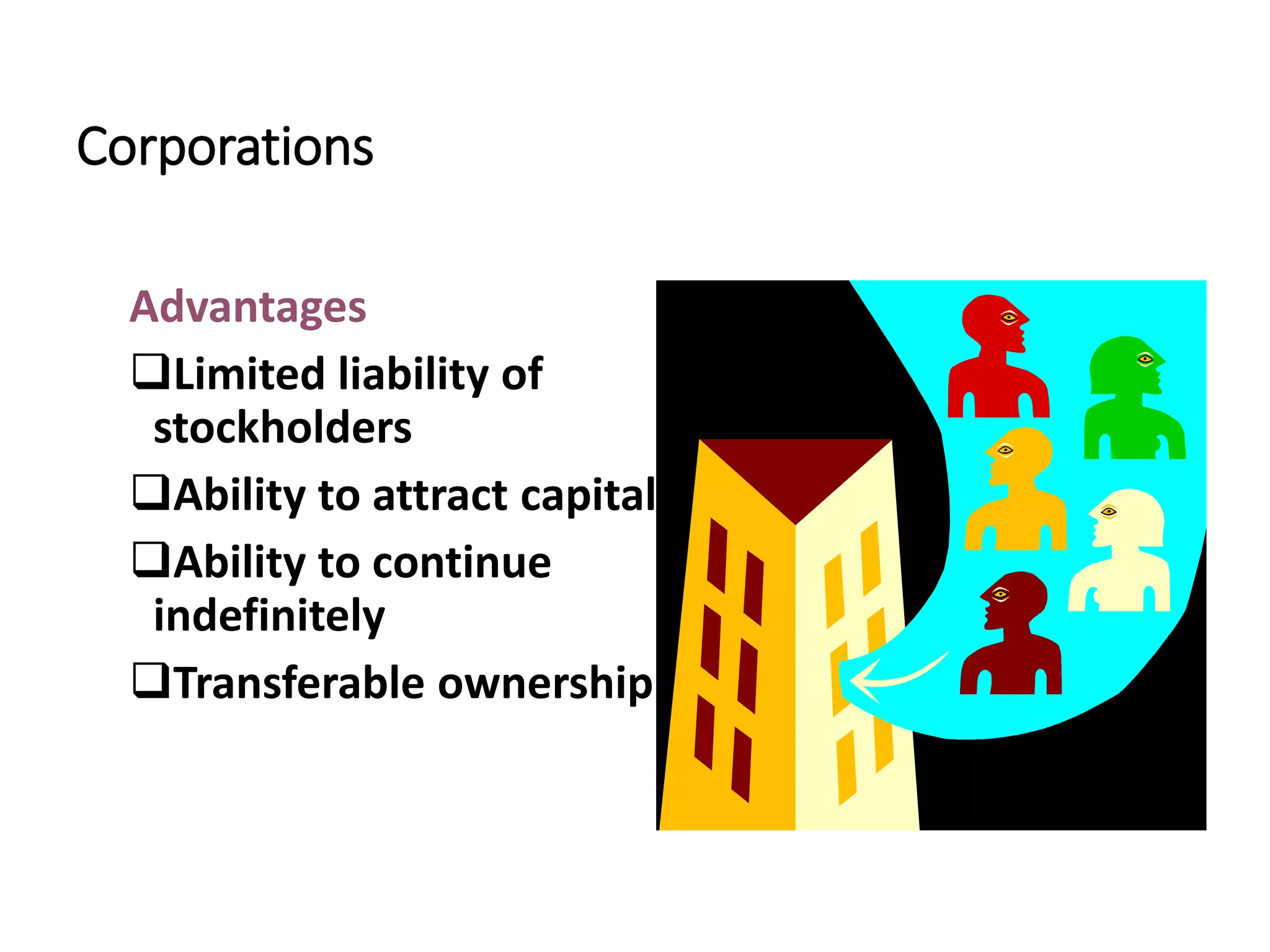
Corporations
Advantages
Limited liability of
stockholders
Ability to attract capital
Ability to continue
indefinitely
Transferable ownership
Corporations
Disadvantages
Cost and time in
incorporating
Double taxation
Potential for diminished
incentives
Legal requirements and
red tape
Potential loss of control
•Professional Corporation-lawyers,
accountants, doctors, dentists,
etc.
•Joint Venture-partnership formed
for a specific purpose
Agency Theory
A theory concerning the relationship between a
principal and an agent of the principal.
• Owners—managers
• Franchisee—franchisor
• Owners—lenders
• Agency relationships involve a principal (example: owner) and an agent
(example: manager).
Agency Cost
An internal cost which develops due to resolve the
agency problem.
1. Managerial Compensation (Incentives)
2. Shareholder Intervention
3. Threat of Takeover.
What Is an Agency Problem?
The conflict of goals between shareholders and
management because shareholders wish for
management to run the company in a way that
increases shareholder value, but management may wish
to grow the company in ways that maximize their
personal power and wealth that may not be in the best
interests of shareholders.

Introduction Finance

  • 1.
  • 2.
    What is Finance? Financeconsists of providing and utilizing the money, capital rights, credit and funds of any kind which are employed in the operation of an enterprise. On the other hand finance define as that administrative area or set of administrative function in an org. which have to do with the management of the flow of cash so that the organization will have the means to carry out its objective as satisfactory as possible and at the same time meet its obligation as they become due.
  • 3.
    What is BusinessFinance? Business finance means finance required for promoting and running trade, commerce or industrial undertakings. The saving, spending, borrowing and investing of funds are included in the meaning of business finance. Business finance also means rising, providing and managing of all money capital or funds of any kind to be used connection with business.
  • 4.
    Scope/Major areas ofFinance: Money Market and Capital Market Investment Financial Management Money Market and Capital Market: The market for short-term, highly liquid, low-risk assets such as Treasury bills and negotiable CDs. On the other hand, capital market, the market for long-term securities such as bonds and stocks.
  • 5.
    Scope/Major areas ofFinance…. Investment: The commitment of funds to one or more assets that will be held over some future time periods. • Treasury bill: Short term discounted securities issued by Gov’t. • Negotiable Certificate of Deposit/ Certificate of deposit: An interest bearing security that certifies that a specified amount of money placed in a Bank will receive a stated amount of interest for a stated amount of time. • Commercial Paper: It refers to unsecured promissory notes by companies to raise short term financing. Md. Azizur Rahman
  • 6.
    Scope/Major areas ofFinance…. Relationship among Investment, Money and Capital Market, Financial Management:- Investor Firm Investments Financial Management Money and Capital Market Profit Funds Financial Securities
  • 7.
    Scope/Major areas ofFinance…. Financial Management • It’s an applied Economics concerned with the allocation of scarce financial resource among competing choice. Financial Management is concerned with acquisition , financing and management of assets with some overall goal in mind. • Financial Management in concerned with raising, allocating and controlling the firm’s funds.
  • 8.
    Categories of BusinessFinance….. 1.Short term finance: Short term finance is also known as working capital. It is required to finance the current assets. It is needed for meeting temporary (day operations) requirements of the organization. 2.Intermediate term finance: Intermediate term finance is thought of as that which runs over one year but not over ten year. It is taken by a businessman when short term finance is incapable of meeting the requirements and long term loans are too costly. 3.Long term finance: Long term finance refers to the capital which is needed for financing fixed assets or long run investment. Investment in fixed assets such as land, building, furniture, machinery etc. is financed out of long term capital funds.
  • 9.
    Categories of BusinessFinance….. A. Govt. Finance: Discuss about equitable distribution of govt. resources, recruit employees, how to increase national income. • Internal source: tax, vat, government fund, various autonomous body. • International Finance B. Non- government Finance • Personal Financing: Financing for personal use. Mainly from Bank & Other source like relatives. • Business Financing: Financing for commercial organizations. Like production or service related organization. • 1. Personal Business Financing, Sole proprietorship, Partnership, Joint stock company • 2. Financing of government Organization: • 3. Financing of autonomous organization: • Non Business finance: The farm which are not for profit earning. Charitable organizations.
  • 10.
    Principles of Finance…… •Principles of risk return adjustment: For taking financing decisions, the trade of between risk & return should be considered. •Principles of time value of money: The value of money change with the change in time. So time value of money should be considered when taking financial decisions. •Principles of maximization of wealth: Net cash inflows of a firm should be used in a firm to increase assets.
  • 11.
    Principles of Finance…… • Principles of liquidity & profitability: For taking financing decisions trade off between profitability & risk should be considered carefully as to invest more company might face liquidity problem & to keep more fund for liquidity purpose company might have less fund available to invest. • Principles of perfections: Working capital will be meeting up from short term source & fixed assets will be meeting up from long term source. • Principles of Business Cycle: Economics sometimes face Recovery, Boom, and Recession & Depression this Business cycle should be considered carefully. • Principles of diversification: Portfolio theory.
  • 12.
    Goal for theFinancial Manager • The goal is to maximize the wealth of the owners. • For a corporation, this means increasing the stock price to its highest possible level. • Maximizing revenues does not necessarily mean maximizing profits.
  • 13.
    Fundamental Financial ManagementDecisions… Financial Decisions Investment Decisions Financing Decisions Dividend Decisions Capital Budgeting Working Capital
  • 14.
    Key Decision ofa Financial Manager i. Investment Decision: Where invest should be made? ii. Financing Decision: How the required fund would be collected? iii. Dividend Decision: How much net profit would be distributed as dividend among the shareholders & how much would be retained as retained earnings?
  • 15.
    The functions offinancial Manager Financial planning Identification of source Raising fund Investment of fund Protection of fund Distribution of profit Management of asset Cost control Pricing
  • 16.
    Goal of afirm Goal of a firm Profit maximization Wealth maximization Profit is the yardstick of efficiency Profit utilization of resources Yard stick to evaluate firm’s decision Social welfare Clear concept of wealth It considers time value of money Focus on market price of share Risk trade off Look for growth Market increase
  • 17.
    Sole Proprietorship A businessowned and managed by one individual; the business and the owner are one and the same in the eyes of the law
  • 18.
    Sole Proprietorship Advantages Simple tocreate Least costly form Profit incentive Total decision-making No special legal restrictions Easy to discontinue
  • 19.
    Sole Proprietorship Disadvantages Unlimited personal liability Limitedskills and abilities Feelings of isolation Limited access to capital Lack of continuity of business
  • 20.
    Partnership An association oftwo or more people who co-own a business for the purpose of making a profit A partnership agreement or the Uniform Partnership Act
  • 21.
    Partnership Advantages Easy to establish Complementaryskills Division of profits Larger pool of capital Ability to attract limited partners Little governmental regulation Flexibility Taxation
  • 22.
    Partnership Disadvantages Unlimited liability ofat least one Difficulty in disposing of interest Lack of continuity Potential for personality and authority conflicts Partners bound by law of agency
  • 23.
    Special Partnerships •Limited partnership-composedof at least one general partner and at least one limited partner •Limited liability partnership-a special type of limited partnership, in which all partners are limited partners •Master limited partnership-a partnership whose shares are traded on stock exchanges, just like corporations
  • 24.
    Corporations A separate legalentity apart from its owners which receives the right to exist from the state in which in which it is incorporated Domestic Foreign Alien Publicly held Closely held
  • 25.
    Corporations Certificate of Incorporation Name Statementof purpose Time horizon Names and addresses of incorporators Place of business Capital stock authorization’ Capital required at time of incorporation Provisions for preemptive rights Restrictions on transfering shares Names and addresses of officers By-laws
  • 26.
    Corporations Advantages Limited liability of stockholders Abilityto attract capital Ability to continue indefinitely Transferable ownership
  • 27.
    Corporations Disadvantages Cost and timein incorporating Double taxation Potential for diminished incentives Legal requirements and red tape Potential loss of control
  • 28.
    •Professional Corporation-lawyers, accountants, doctors,dentists, etc. •Joint Venture-partnership formed for a specific purpose
  • 29.
    Agency Theory A theoryconcerning the relationship between a principal and an agent of the principal. • Owners—managers • Franchisee—franchisor • Owners—lenders • Agency relationships involve a principal (example: owner) and an agent (example: manager).
  • 30.
    Agency Cost An internalcost which develops due to resolve the agency problem. 1. Managerial Compensation (Incentives) 2. Shareholder Intervention 3. Threat of Takeover.
  • 31.
    What Is anAgency Problem? The conflict of goals between shareholders and management because shareholders wish for management to run the company in a way that increases shareholder value, but management may wish to grow the company in ways that maximize their personal power and wealth that may not be in the best interests of shareholders.