McGraw-Hill/Irwin © 2008 The McGraw-Hill Companies, Inc., All Rights Reserved.
Equity Valuation
CHAPTER 13
13-2
13.1 VALUATION BY COMPARABLES
13-3
Fundamental Stock Analysis:
Models of Equity Valuation
Basic Types of Models
– Balance Sheet Models
– Dividend Discount Models
– Price/Earnings Ratios
Estimating Growth Rates and
Opportunities
13-4
Models of Equity Valuation
Valuation models use comparables
– Look at the relationship between price and various
determinants of value for similar firms
The internet provides a convenient way to
access firm data. Some examples are:
– EDGAR
– Finance.yahoo.com
13-5
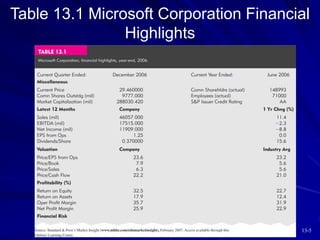
Table 13.1 Microsoft Corporation Financial
Highlights
13-6
Valuation Methods
Book value
Market value
Liquidation value
Replacement cost
13-7
13.2 INTRINSIC VALUE VERSUS
MARKET PRICE
13-8
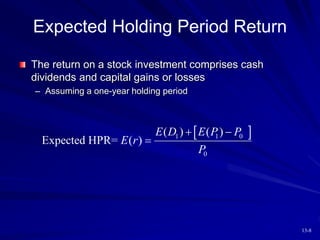
Expected Holding Period Return
The return on a stock investment comprises cash
dividends and capital gains or losses
– Assuming a one-year holding period
 
1 1 0
0
( ) ( )
Expected HPR= ( )
E D E P P
E r
P
 

13-9
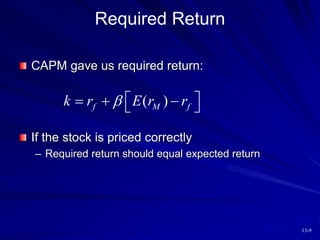
Required Return
CAPM gave us required return:
If the stock is priced correctly
– Required return should equal expected return
( )
f M f
k r E r r
  
  
 
13-10
Intrinsic Value and Market Price
Market Price
– Consensus value of all potential traders
– Current market price will reflect intrinsic value
estimates
– This consensus value of the required rate of return, k,
is the market capitalization rate
Trading Signal
– IV > MP Buy
– IV < MP Sell or Short Sell
– IV = MP Hold or Fairly Priced
13-11
13.3 DIVIDEND DISCOUNT MODELS
13-12
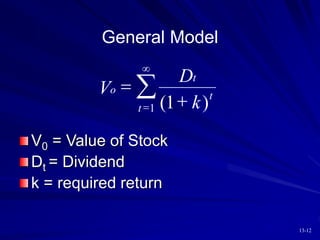
General Model
V
D
k
o
t
t
t




( )
1
1
V0 = Value of Stock
Dt = Dividend
k = required return
13-13
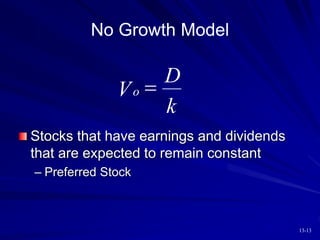
No Growth Model
V
D
k
o 
Stocks that have earnings and dividends
that are expected to remain constant
– Preferred Stock
13-14
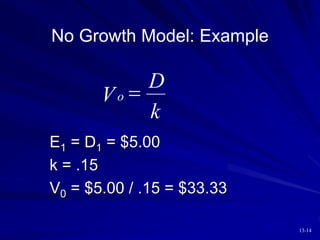
No Growth Model: Example
E1 = D1 = $5.00
k = .15
V0 = $5.00 / .15 = $33.33
V
D
k
o 
13-15
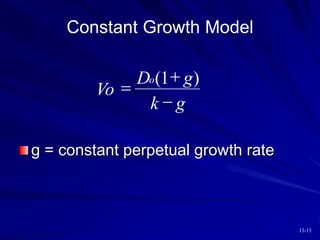
Constant Growth Model
Vo
D g
k g
o



( )
1
g = constant perpetual growth rate
13-16
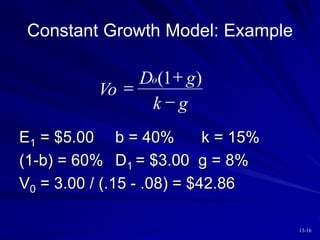
Constant Growth Model: Example
Vo
D g
k g
o



( )
1
E1 = $5.00 b = 40% k = 15%
(1-b) = 60% D1 = $3.00 g = 8%
V0 = 3.00 / (.15 - .08) = $42.86
13-17
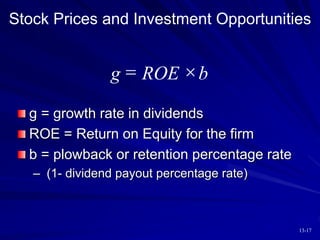
Stock Prices and Investment Opportunities
g ROE b
 
g = growth rate in dividends
ROE = Return on Equity for the firm
b = plowback or retention percentage rate
– (1- dividend payout percentage rate)
13-18
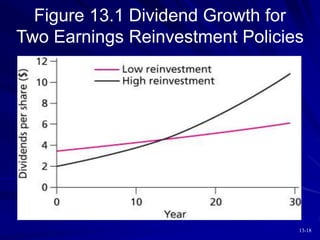
Figure 13.1 Dividend Growth for
Two Earnings Reinvestment Policies
13-19
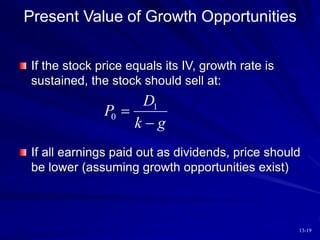
Present Value of Growth Opportunities
If the stock price equals its IV, growth rate is
sustained, the stock should sell at:
If all earnings paid out as dividends, price should
be lower (assuming growth opportunities exist)
1
0
D
P
k g


13-20
Present Value of Growth Opportunities
(cont.)
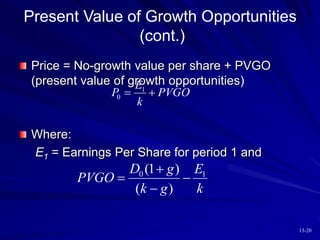
Price = No-growth value per share + PVGO
(present value of growth opportunities)
Where:
E1 = Earnings Per Share for period 1 and
1
0
E
P PVGO
k
 
0 1
(1 )
( )
D g E
PVGO
k g k

 

13-21
Partitioning Value: Example
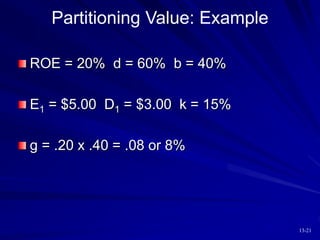
ROE = 20% d = 60% b = 40%
E1 = $5.00 D1 = $3.00 k = 15%
g = .20 x .40 = .08 or 8%
13-22
P
NGV
PVGO
o
o



 
  
3
15 08
86
5
15
33
86 33 52
(. . )
$42.
.
$33.
$42. $33. $9.
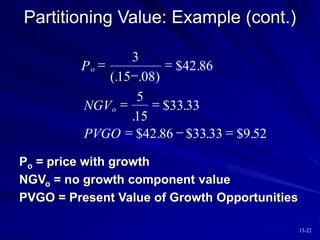
Partitioning Value: Example (cont.)
Po = price with growth
NGVo = no growth component value
PVGO = Present Value of Growth Opportunities
13-23
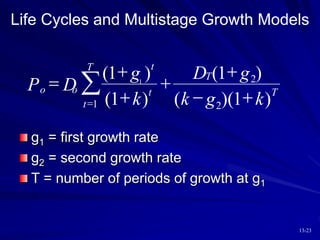
Life Cycles and Multistage Growth Models
P D
g
k
D g
k g k
o o
t
t
t
T
T
T





 

( )
( )
( )
( )( )
1
1
1
1
1
1
2
2
g1 = first growth rate
g2 = second growth rate
T = number of periods of growth at g1
13-24
Multistage Growth Rate Model: Example
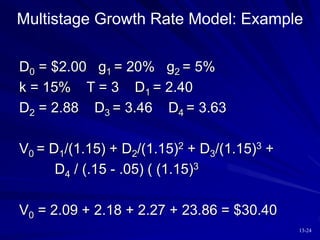
D0 = $2.00 g1 = 20% g2 = 5%
k = 15% T = 3 D1 = 2.40
D2 = 2.88 D3 = 3.46 D4 = 3.63
V0 = D1/(1.15) + D2/(1.15)2 + D3/(1.15)3 +
D4 / (.15 - .05) ( (1.15)3
V0 = 2.09 + 2.18 + 2.27 + 23.86 = $30.40
13-25
13.4 PRICE-EARNINGS RATIOS
13-26
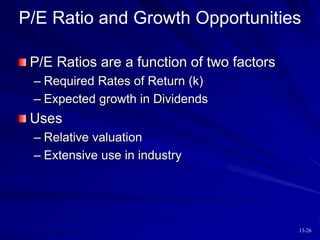
P/E Ratio and Growth Opportunities
P/E Ratios are a function of two factors
– Required Rates of Return (k)
– Expected growth in Dividends
Uses
– Relative valuation
– Extensive use in industry
13-27
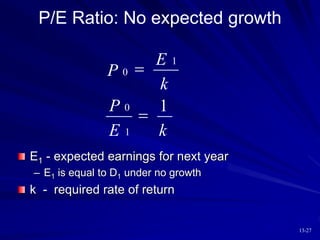
P/E Ratio: No expected growth
P
E
k
P
E k
0
1
0
1
1


E1 - expected earnings for next year
– E1 is equal to D1 under no growth
k - required rate of return
13-28
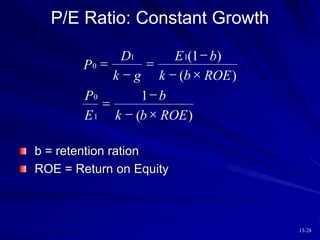
P/E Ratio: Constant Growth
P
D
k g
E b
k b ROE
P
E
b
k b ROE
0
1 1
0
1
1
1




 


 
( )
( )
( )
b = retention ration
ROE = Return on Equity
13-29
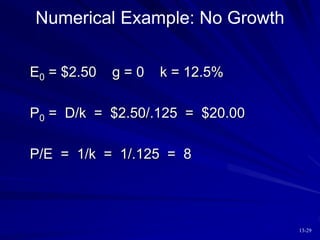
Numerical Example: No Growth
E0 = $2.50 g = 0 k = 12.5%
P0 = D/k = $2.50/.125 = $20.00
P/E = 1/k = 1/.125 = 8
13-30
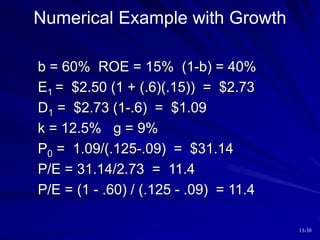
Numerical Example with Growth
b = 60% ROE = 15% (1-b) = 40%
E1 = $2.50 (1 + (.6)(.15)) = $2.73
D1 = $2.73 (1-.6) = $1.09
k = 12.5% g = 9%
P0 = 1.09/(.125-.09) = $31.14
P/E = 31.14/2.73 = 11.4
P/E = (1 - .60) / (.125 - .09) = 11.4
13-31
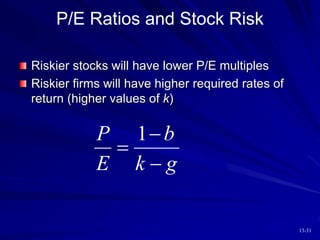
P/E Ratios and Stock Risk
Riskier stocks will have lower P/E multiples
Riskier firms will have higher required rates of
return (higher values of k)
1
P b
E k g



13-32
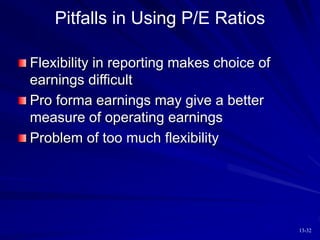
Pitfalls in Using P/E Ratios
Flexibility in reporting makes choice of
earnings difficult
Pro forma earnings may give a better
measure of operating earnings
Problem of too much flexibility
13-33
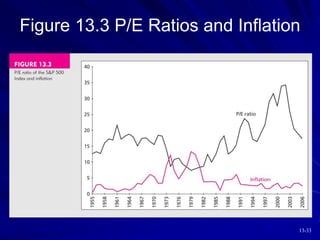
Figure 13.3 P/E Ratios and Inflation
13-34
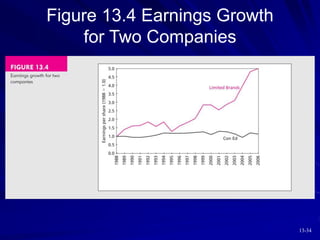
Figure 13.4 Earnings Growth
for Two Companies
13-35
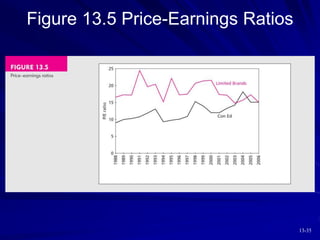
Figure 13.5 Price-Earnings Ratios
13-36
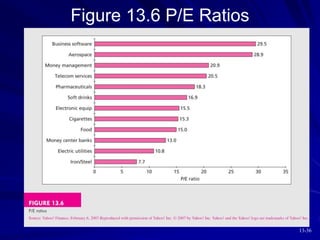
Figure 13.6 P/E Ratios
13-37
Other Comparative Valuation Ratios
Price-to-book
Price-to-cash flow
Price-to-sales
Be creative
13-38
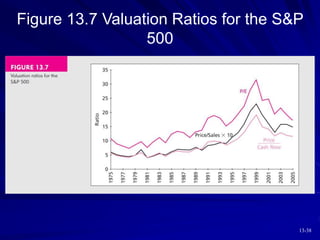
Figure 13.7 Valuation Ratios for the S&P
500
13-39
13.5 FREE CASH FLOW VALUATION
APPROACHES
13-40
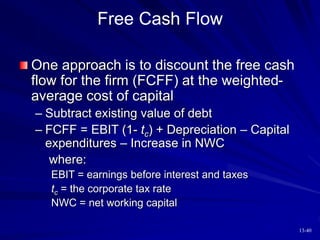
Free Cash Flow
One approach is to discount the free cash
flow for the firm (FCFF) at the weighted-
average cost of capital
– Subtract existing value of debt
– FCFF = EBIT (1- tc) + Depreciation – Capital
expenditures – Increase in NWC
where:
EBIT = earnings before interest and taxes
tc = the corporate tax rate
NWC = net working capital
13-41
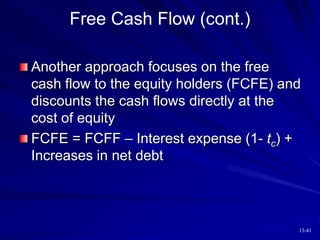
Free Cash Flow (cont.)
Another approach focuses on the free
cash flow to the equity holders (FCFE) and
discounts the cash flows directly at the
cost of equity
FCFE = FCFF – Interest expense (1- tc) +
Increases in net debt
13-42
Comparing the Valuation Models
Free cash flow approach should provide
same estimate of IV as the dividend
growth model
In practice the two approaches may differ
substantially
– Simplifying assumptions are used
13-43
13.6 THE AGGREGATE STOCK MARKET
13-44
Earnings Multiplier Approach
Forecast corporate profits for the coming
period
Derive an estimate for the aggregate P/E
ratio using long-term interest rates
Product of the two forecasts is the
estimate of the end-of-period level of the
market
13-45
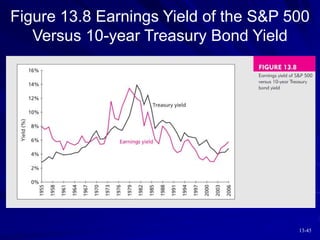
Figure 13.8 Earnings Yield of the S&P 500
Versus 10-year Treasury Bond Yield
13-46
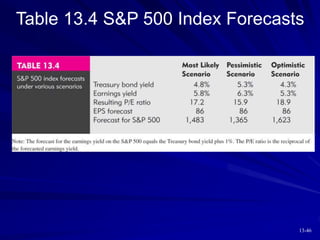
Table 13.4 S&P 500 Index Forecasts

Chapter_013.ppt

  • 1.
    McGraw-Hill/Irwin © 2008The McGraw-Hill Companies, Inc., All Rights Reserved. Equity Valuation CHAPTER 13
  • 2.
  • 3.
    13-3 Fundamental Stock Analysis: Modelsof Equity Valuation Basic Types of Models – Balance Sheet Models – Dividend Discount Models – Price/Earnings Ratios Estimating Growth Rates and Opportunities
  • 4.
    13-4 Models of EquityValuation Valuation models use comparables – Look at the relationship between price and various determinants of value for similar firms The internet provides a convenient way to access firm data. Some examples are: – EDGAR – Finance.yahoo.com
  • 5.
    13-5 Table 13.1 MicrosoftCorporation Financial Highlights
  • 6.
    13-6 Valuation Methods Book value Marketvalue Liquidation value Replacement cost
  • 7.
    13-7 13.2 INTRINSIC VALUEVERSUS MARKET PRICE
  • 8.
    13-8 Expected Holding PeriodReturn The return on a stock investment comprises cash dividends and capital gains or losses – Assuming a one-year holding period   1 1 0 0 ( ) ( ) Expected HPR= ( ) E D E P P E r P   
  • 9.
    13-9 Required Return CAPM gaveus required return: If the stock is priced correctly – Required return should equal expected return ( ) f M f k r E r r        
  • 10.
    13-10 Intrinsic Value andMarket Price Market Price – Consensus value of all potential traders – Current market price will reflect intrinsic value estimates – This consensus value of the required rate of return, k, is the market capitalization rate Trading Signal – IV > MP Buy – IV < MP Sell or Short Sell – IV = MP Hold or Fairly Priced
  • 11.
  • 12.
    13-12 General Model V D k o t t t     ( ) 1 1 V0= Value of Stock Dt = Dividend k = required return
  • 13.
    13-13 No Growth Model V D k o Stocks that have earnings and dividends that are expected to remain constant – Preferred Stock
  • 14.
    13-14 No Growth Model:Example E1 = D1 = $5.00 k = .15 V0 = $5.00 / .15 = $33.33 V D k o 
  • 15.
    13-15 Constant Growth Model Vo Dg k g o    ( ) 1 g = constant perpetual growth rate
  • 16.
    13-16 Constant Growth Model:Example Vo D g k g o    ( ) 1 E1 = $5.00 b = 40% k = 15% (1-b) = 60% D1 = $3.00 g = 8% V0 = 3.00 / (.15 - .08) = $42.86
  • 17.
    13-17 Stock Prices andInvestment Opportunities g ROE b   g = growth rate in dividends ROE = Return on Equity for the firm b = plowback or retention percentage rate – (1- dividend payout percentage rate)
  • 18.
    13-18 Figure 13.1 DividendGrowth for Two Earnings Reinvestment Policies
  • 19.
    13-19 Present Value ofGrowth Opportunities If the stock price equals its IV, growth rate is sustained, the stock should sell at: If all earnings paid out as dividends, price should be lower (assuming growth opportunities exist) 1 0 D P k g  
  • 20.
    13-20 Present Value ofGrowth Opportunities (cont.) Price = No-growth value per share + PVGO (present value of growth opportunities) Where: E1 = Earnings Per Share for period 1 and 1 0 E P PVGO k   0 1 (1 ) ( ) D g E PVGO k g k    
  • 21.
    13-21 Partitioning Value: Example ROE= 20% d = 60% b = 40% E1 = $5.00 D1 = $3.00 k = 15% g = .20 x .40 = .08 or 8%
  • 22.
    13-22 P NGV PVGO o o        3 15 08 86 5 15 33 86 33 52 (. . ) $42. . $33. $42. $33. $9. Partitioning Value: Example (cont.) Po = price with growth NGVo = no growth component value PVGO = Present Value of Growth Opportunities
  • 23.
    13-23 Life Cycles andMultistage Growth Models P D g k D g k g k o o t t t T T T         ( ) ( ) ( ) ( )( ) 1 1 1 1 1 1 2 2 g1 = first growth rate g2 = second growth rate T = number of periods of growth at g1
  • 24.
    13-24 Multistage Growth RateModel: Example D0 = $2.00 g1 = 20% g2 = 5% k = 15% T = 3 D1 = 2.40 D2 = 2.88 D3 = 3.46 D4 = 3.63 V0 = D1/(1.15) + D2/(1.15)2 + D3/(1.15)3 + D4 / (.15 - .05) ( (1.15)3 V0 = 2.09 + 2.18 + 2.27 + 23.86 = $30.40
  • 25.
  • 26.
    13-26 P/E Ratio andGrowth Opportunities P/E Ratios are a function of two factors – Required Rates of Return (k) – Expected growth in Dividends Uses – Relative valuation – Extensive use in industry
  • 27.
    13-27 P/E Ratio: Noexpected growth P E k P E k 0 1 0 1 1   E1 - expected earnings for next year – E1 is equal to D1 under no growth k - required rate of return
  • 28.
    13-28 P/E Ratio: ConstantGrowth P D k g E b k b ROE P E b k b ROE 0 1 1 0 1 1 1           ( ) ( ) ( ) b = retention ration ROE = Return on Equity
  • 29.
    13-29 Numerical Example: NoGrowth E0 = $2.50 g = 0 k = 12.5% P0 = D/k = $2.50/.125 = $20.00 P/E = 1/k = 1/.125 = 8
  • 30.
    13-30 Numerical Example withGrowth b = 60% ROE = 15% (1-b) = 40% E1 = $2.50 (1 + (.6)(.15)) = $2.73 D1 = $2.73 (1-.6) = $1.09 k = 12.5% g = 9% P0 = 1.09/(.125-.09) = $31.14 P/E = 31.14/2.73 = 11.4 P/E = (1 - .60) / (.125 - .09) = 11.4
  • 31.
    13-31 P/E Ratios andStock Risk Riskier stocks will have lower P/E multiples Riskier firms will have higher required rates of return (higher values of k) 1 P b E k g   
  • 32.
    13-32 Pitfalls in UsingP/E Ratios Flexibility in reporting makes choice of earnings difficult Pro forma earnings may give a better measure of operating earnings Problem of too much flexibility
  • 33.
    13-33 Figure 13.3 P/ERatios and Inflation
  • 34.
    13-34 Figure 13.4 EarningsGrowth for Two Companies
  • 35.
  • 36.
  • 37.
    13-37 Other Comparative ValuationRatios Price-to-book Price-to-cash flow Price-to-sales Be creative
  • 38.
    13-38 Figure 13.7 ValuationRatios for the S&P 500
  • 39.
    13-39 13.5 FREE CASHFLOW VALUATION APPROACHES
  • 40.
    13-40 Free Cash Flow Oneapproach is to discount the free cash flow for the firm (FCFF) at the weighted- average cost of capital – Subtract existing value of debt – FCFF = EBIT (1- tc) + Depreciation – Capital expenditures – Increase in NWC where: EBIT = earnings before interest and taxes tc = the corporate tax rate NWC = net working capital
  • 41.
    13-41 Free Cash Flow(cont.) Another approach focuses on the free cash flow to the equity holders (FCFE) and discounts the cash flows directly at the cost of equity FCFE = FCFF – Interest expense (1- tc) + Increases in net debt
  • 42.
    13-42 Comparing the ValuationModels Free cash flow approach should provide same estimate of IV as the dividend growth model In practice the two approaches may differ substantially – Simplifying assumptions are used
  • 43.
  • 44.
    13-44 Earnings Multiplier Approach Forecastcorporate profits for the coming period Derive an estimate for the aggregate P/E ratio using long-term interest rates Product of the two forecasts is the estimate of the end-of-period level of the market
  • 45.
    13-45 Figure 13.8 EarningsYield of the S&P 500 Versus 10-year Treasury Bond Yield
  • 46.
    13-46 Table 13.4 S&P500 Index Forecasts