




MC11-253
Muhammad NAWAZ
HAILEY COLLEGE OF COMMERCE PUNJAB UNIVERSITY LAHORE PAKISTAN
Common Stock Valuation
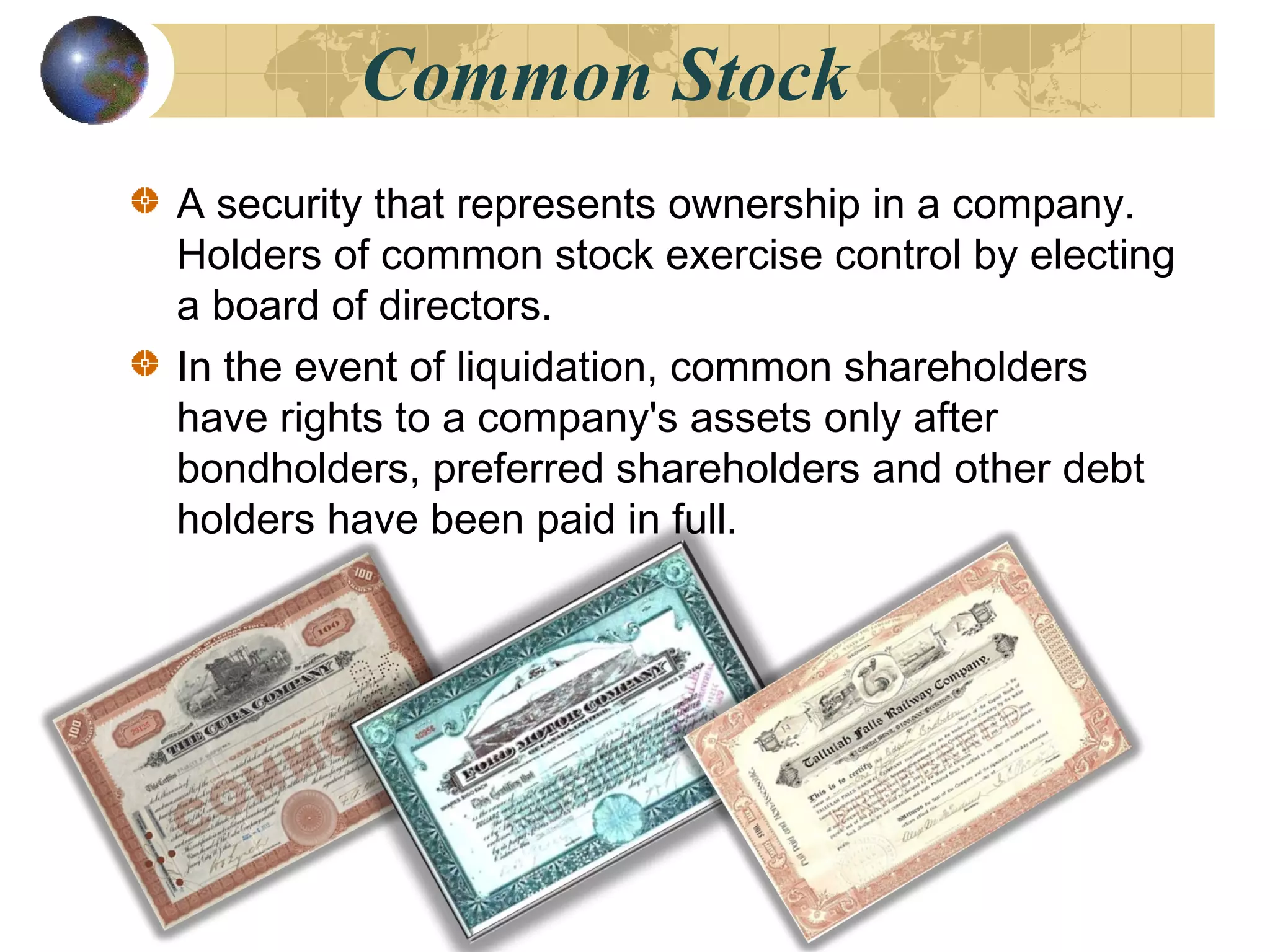
Common Stock
A security that represents ownership in a company.
Holders of common stock exercise control by electing
a board of directors.
In the event of liquidation, common shareholders
have rights to a company's assets only after
bondholders, preferred shareholders and other debt
holders have been paid in full.
What is Value
 In general, the value of an asset is the
price that a willing and able buyer pays to
a willing and able seller.
 Note that if either the buyer or seller is not
both willing and able, then an offer does
not establish the value of the asset.
Valuation of Financial Assets
Process of determining the fair market value
of a financial asset on the basis of present
value of the expected cash flows
Three step process:
1. Estimate the expected cash flows.
2. Determine the appropriate interest rate to
discount the cash flows.
3. Compute the present value of the expected cash
flows by discounted them with interest rate
determine in step 2.
Intrinsic Value
Maximum price which an investor is
ready to pay for purchase of a security.
Intrinsic value is present value and is
also called estimated value or economic
value.
Intrinsic Value
Intrinsic value is compared with market
value of security and is based on these
factors:
 Future cash inflows
 Timing of return
 Required rate of return i.e. ’’k’’
k=risk free rate of return + risk premium.
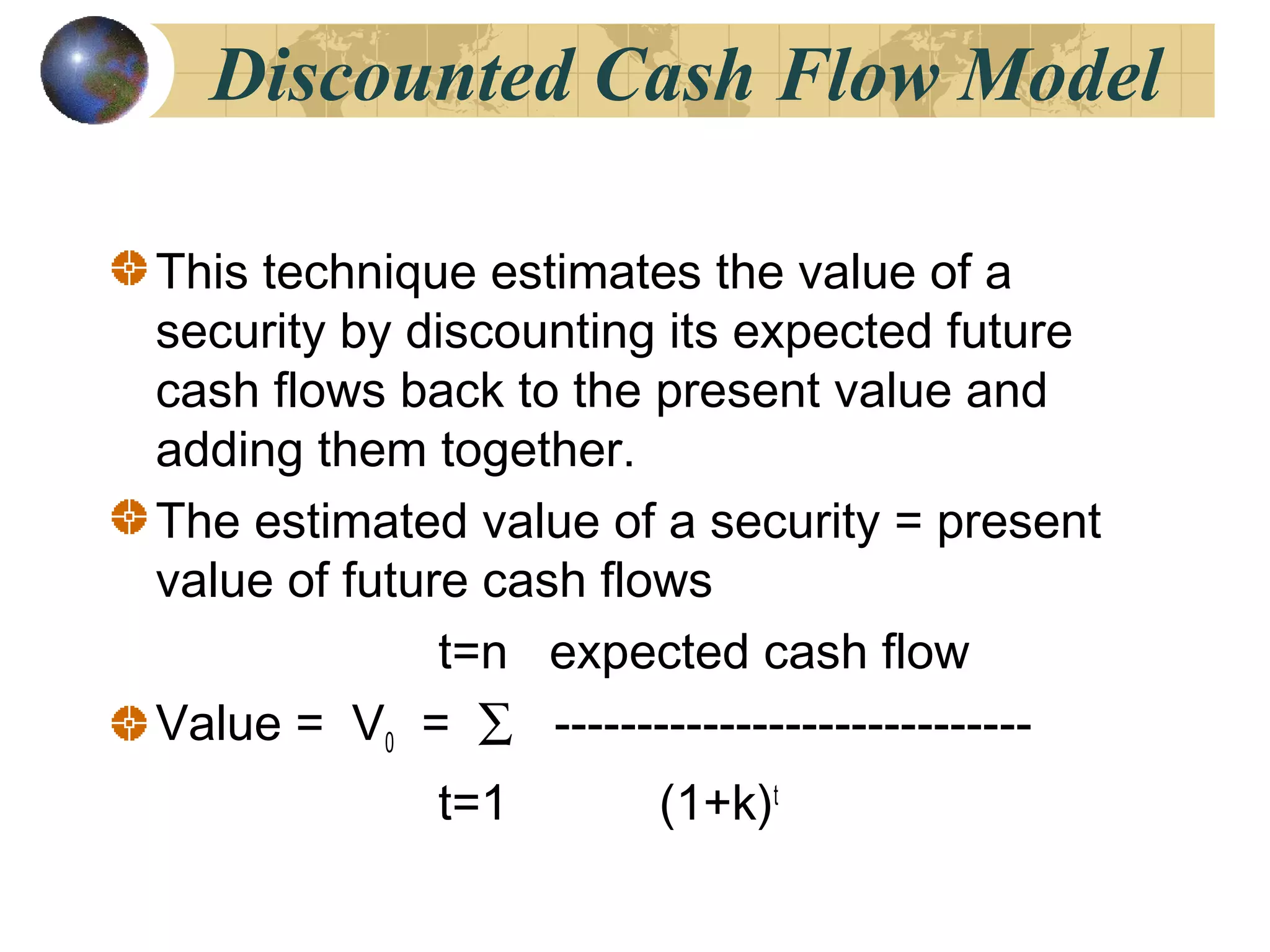
Discounted Cash Flow Model
This technique estimates the value of a
security by discounting its expected future
cash flows back to the present value and
adding them together.
The estimated value of a security = present
value of future cash flows
t=n expected cash flow
Value = V0 = ∑ -----------------------------
t=1 (1+k)t
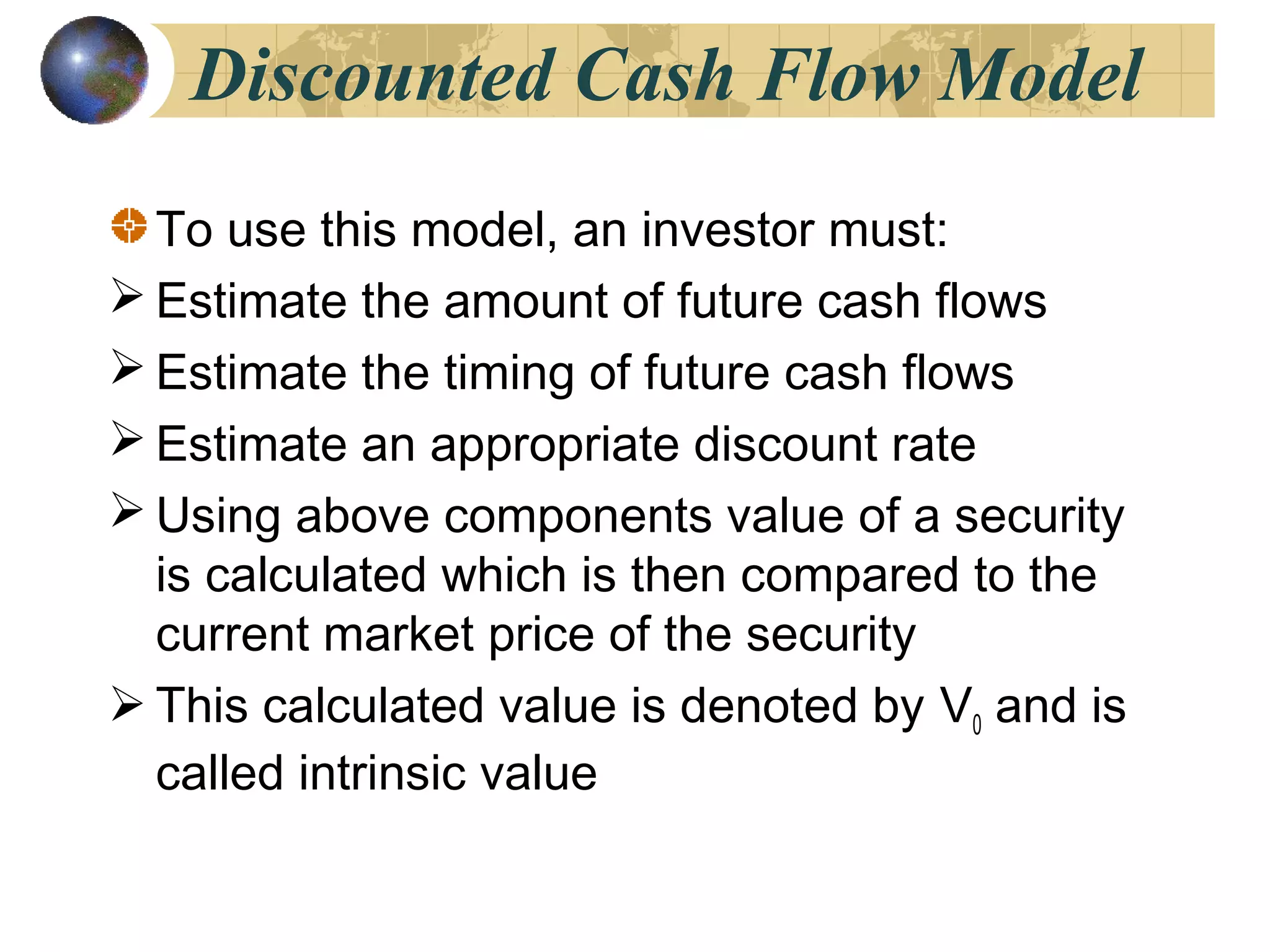
Discounted Cash Flow Model
To use this model, an investor must:
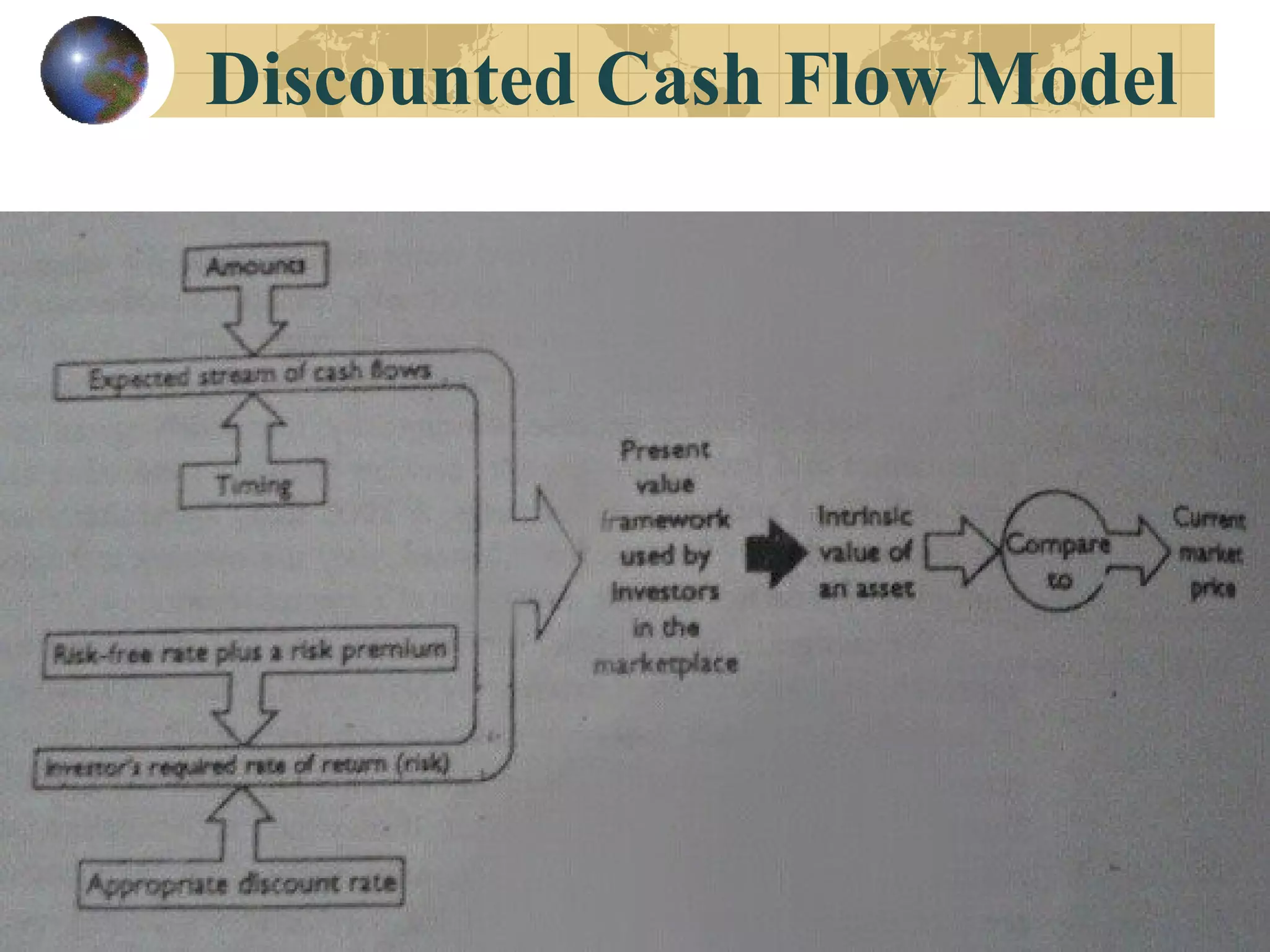
 Estimate the amount of future cash flows
 Estimate the timing of future cash flows
 Estimate an appropriate discount rate
 Using above components value of a security
is calculated which is then compared to the
current market price of the security
 This calculated value is denoted by V0 and is
called intrinsic value
Discounted Cash Flow Model
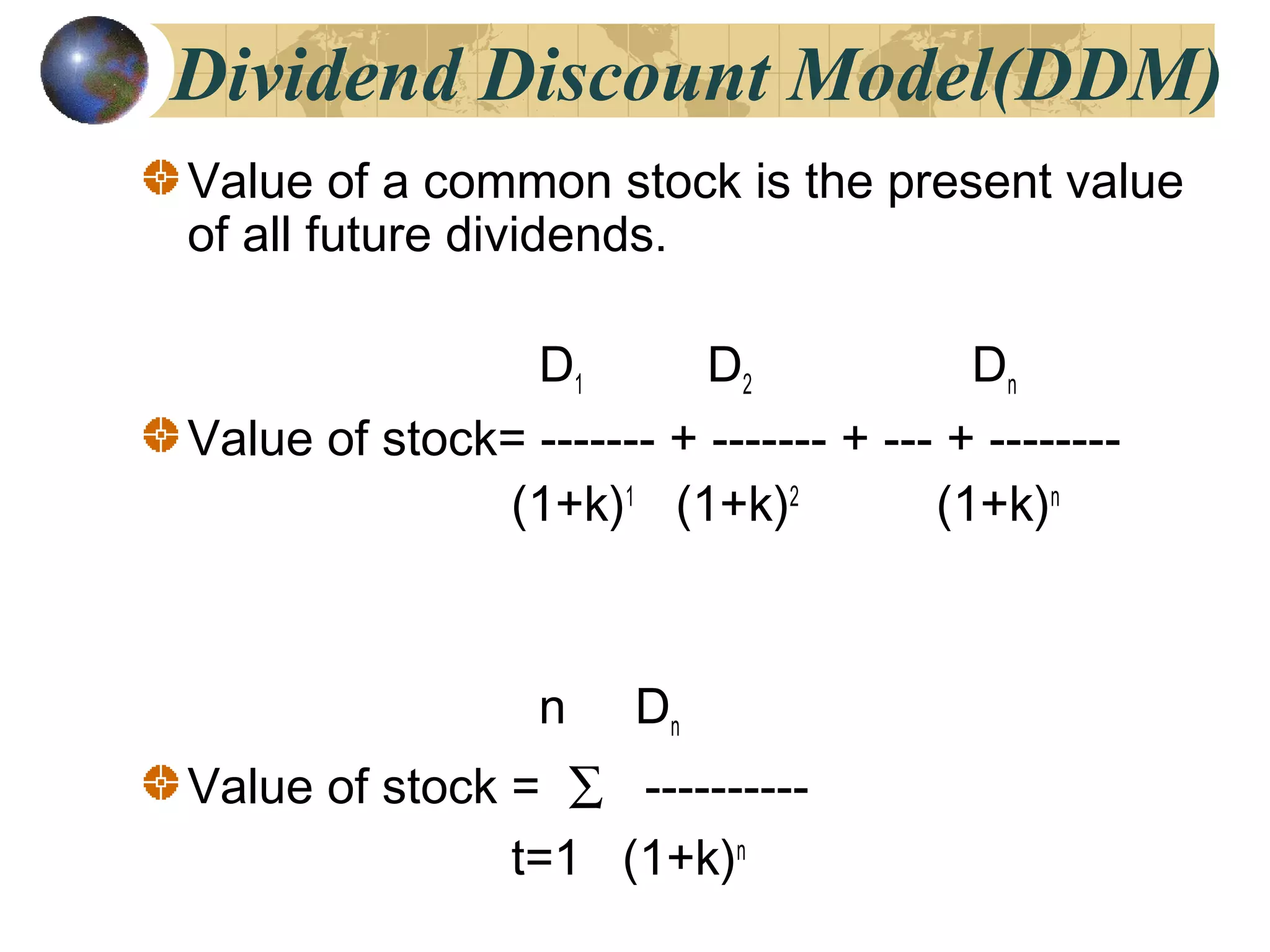
Dividend Discount Model(DDM)
Value of a common stock is the present value
of all future dividends.
D1 D2 Dn
Value of stock= ------- + ------- + --- + --------
(1+k)1
(1+k)2
(1+k)n
n Dn
Value of stock = ∑ ----------
t=1 (1+k)n
Dividend Discount Model(DDM)
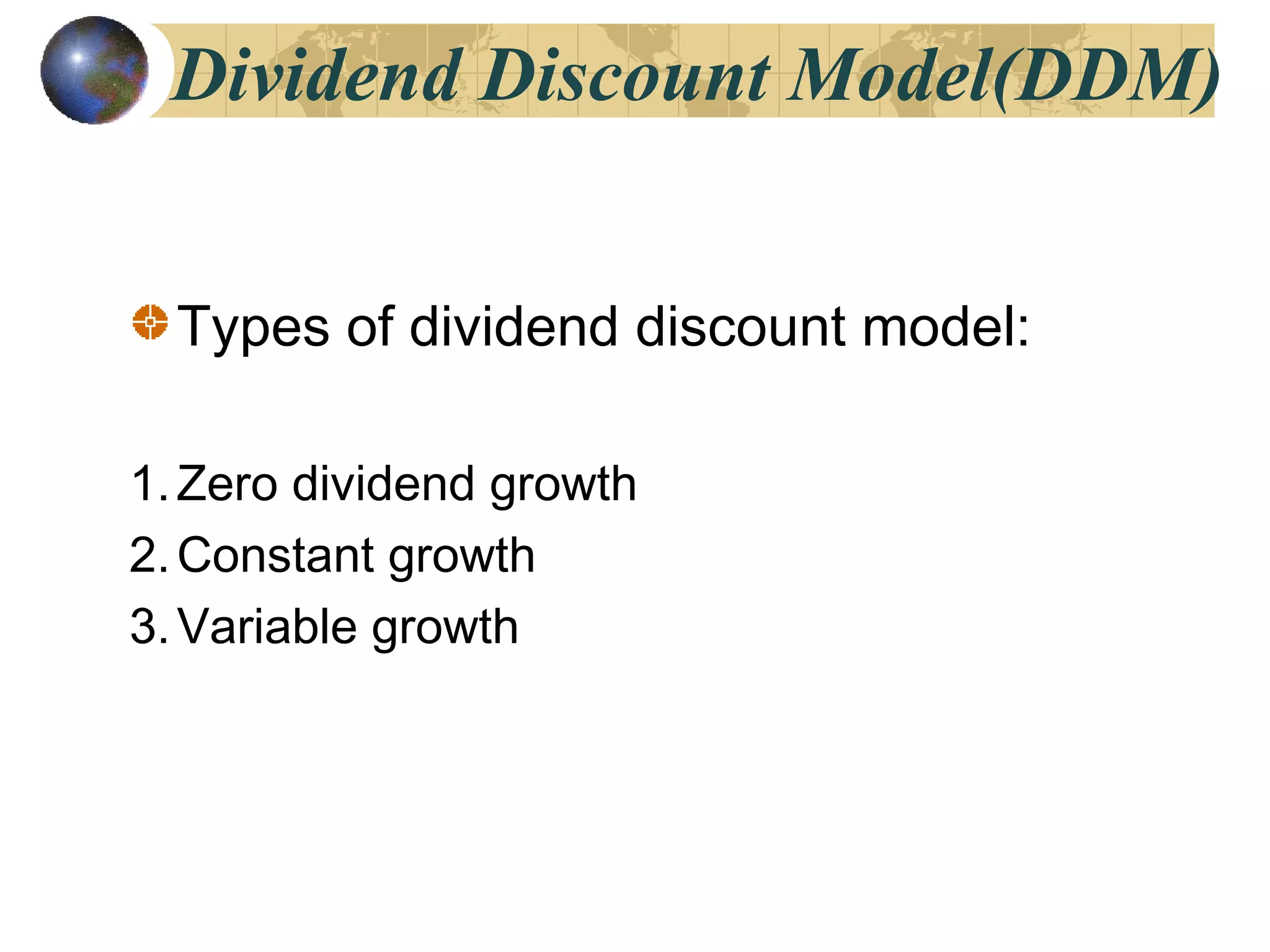
Types of dividend discount model:
1.Zero dividend growth
2.Constant growth
3.Variable growth
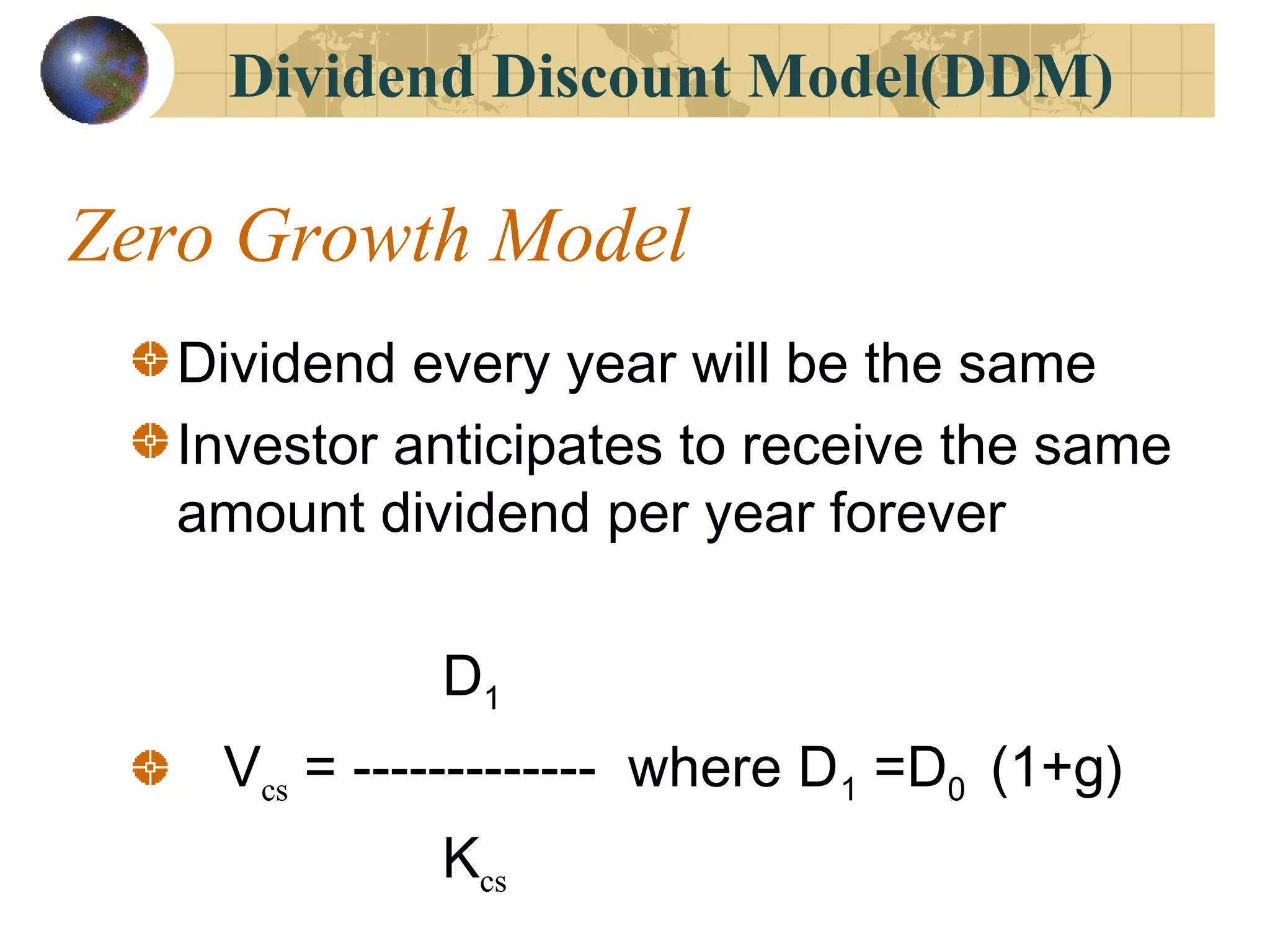
Zero Growth Model
Dividend every year will be the same
Investor anticipates to receive the same
amount dividend per year forever
D1
Vcs = ------------- where D1 =D0 (1+g)
Kcs
Dividend Discount Model(DDM)
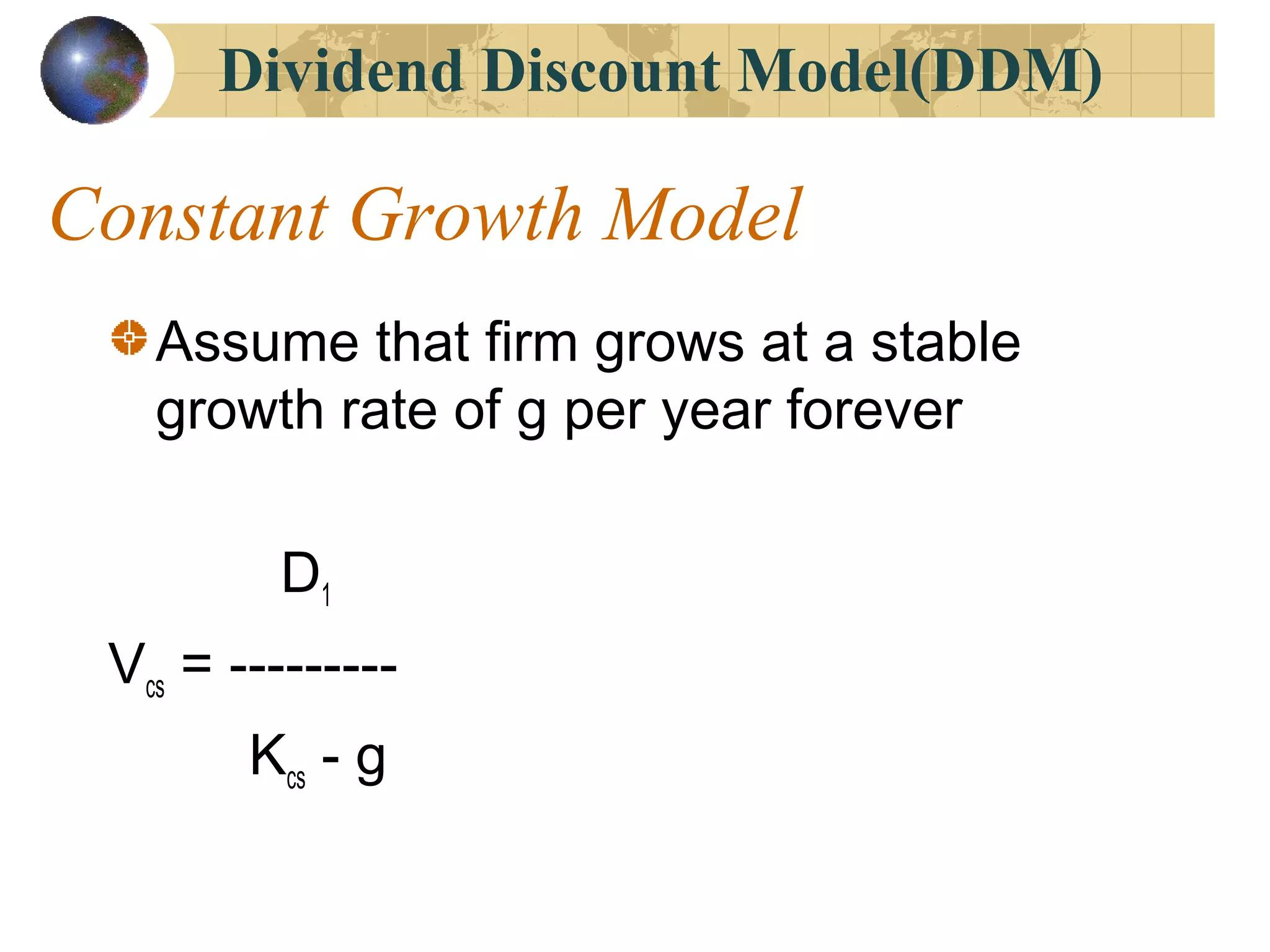
Constant Growth Model
Assume that firm grows at a stable
growth rate of g per year forever
D1
Vcs = ---------
Kcs - g
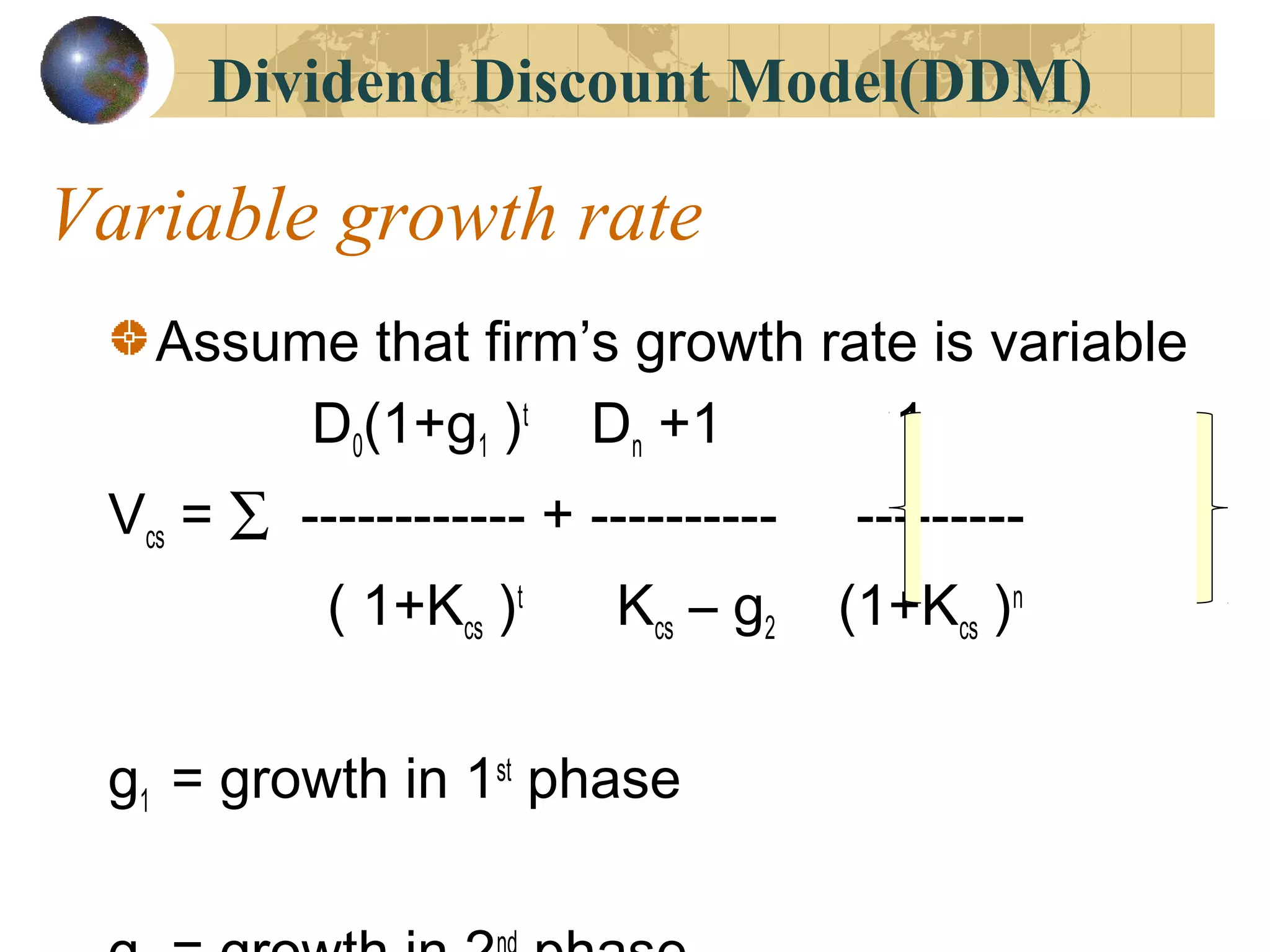
Variable growth rate
Assume that firm’s growth rate is variable
D0(1+g1 )t
Dn +1 1
Vcs = ∑ ------------ + ---------- ---------
( 1+Kcs )t
Kcs – g2 (1+Kcs )n
g1 = growth in 1st
phase
Dividend Discount Model(DDM)
10-17
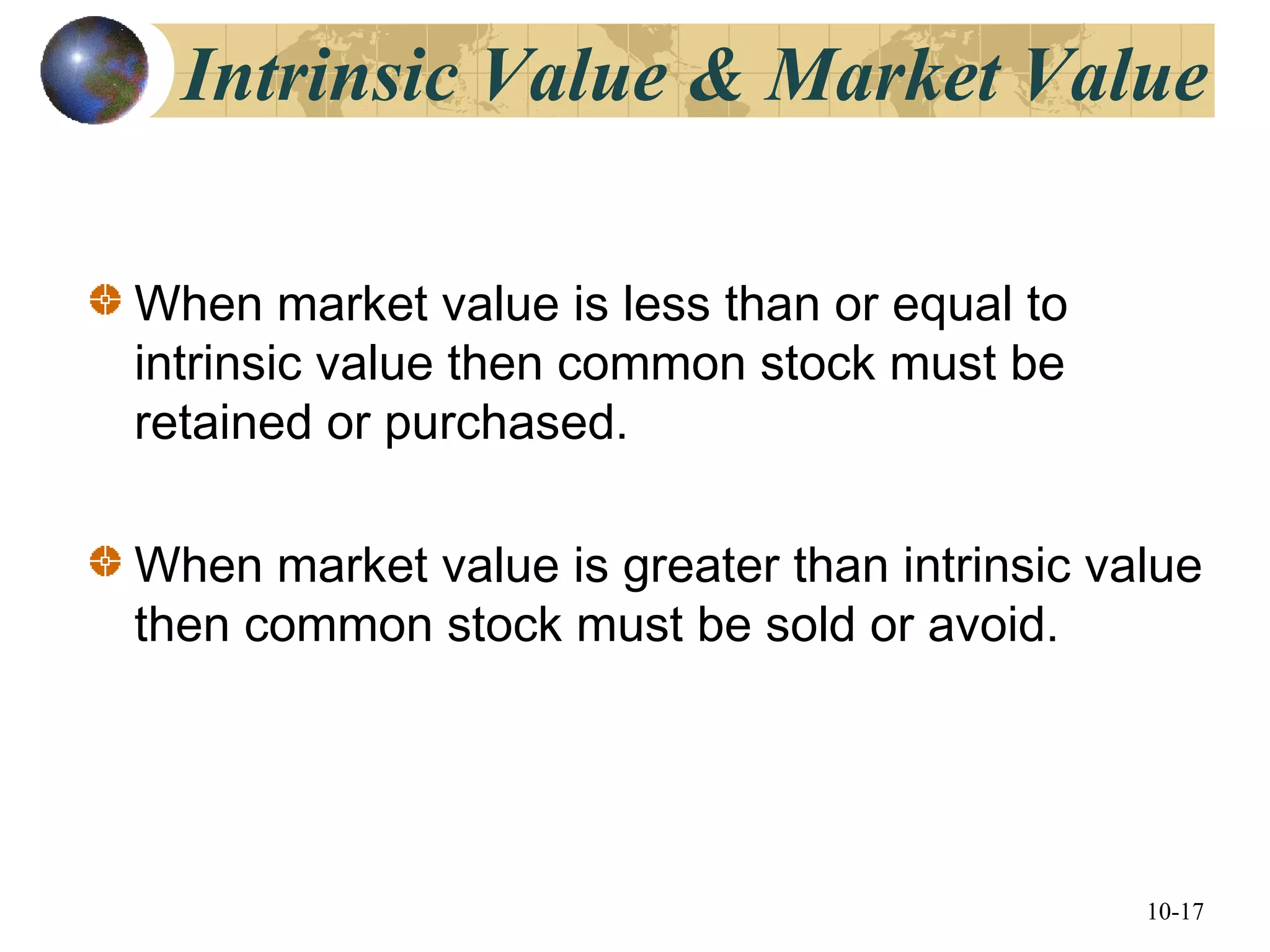
Intrinsic Value & Market Value
When market value is less than or equal to
intrinsic value then common stock must be
retained or purchased.
When market value is greater than intrinsic value
then common stock must be sold or avoid.
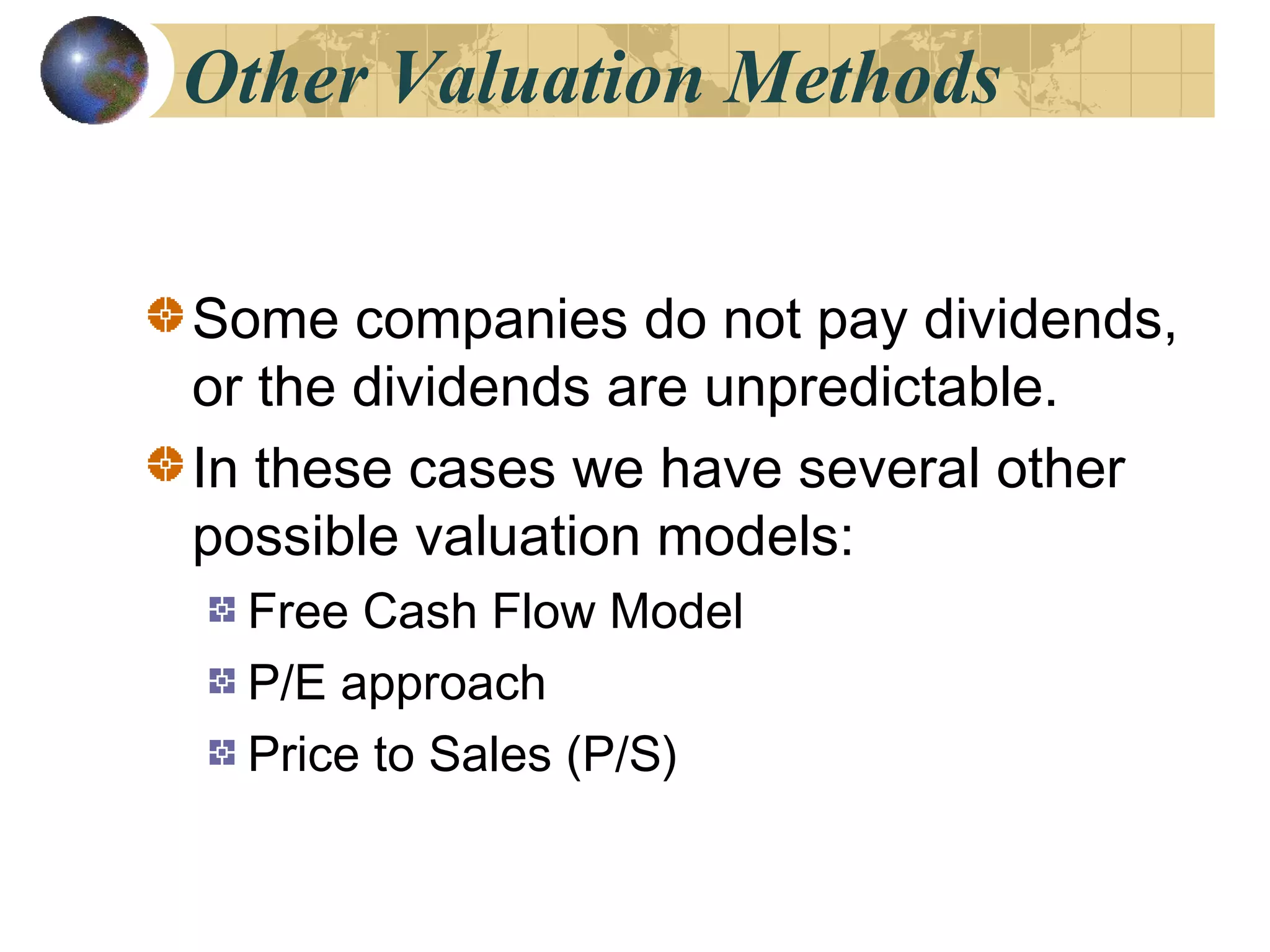
Other Valuation Methods
Some companies do not pay dividends,
or the dividends are unpredictable.
In these cases we have several other
possible valuation models:
Free Cash Flow Model
P/E approach
Price to Sales (P/S)
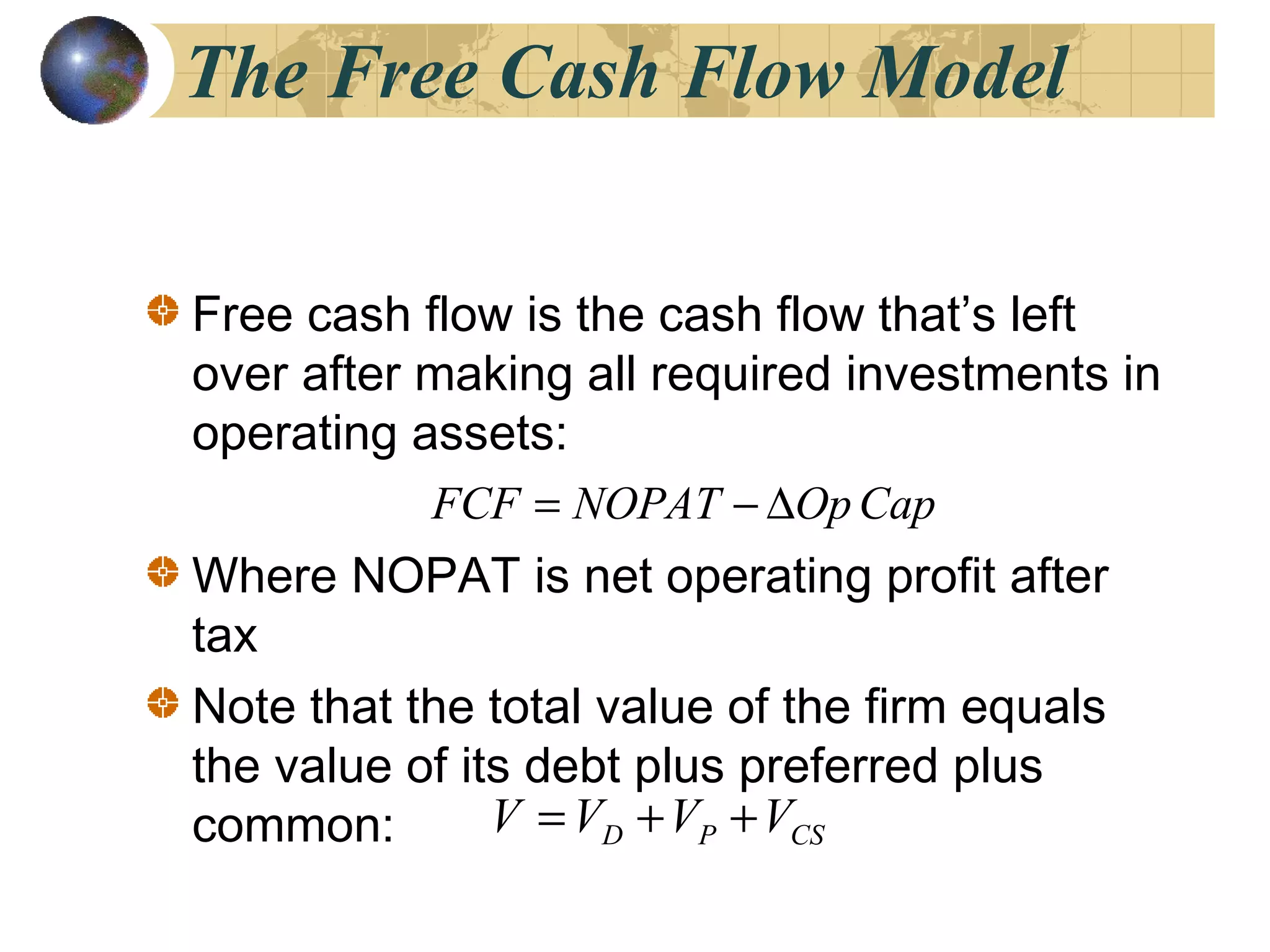
The Free Cash Flow Model
Free cash flow is the cash flow that’s left
over after making all required investments in
operating assets:
Where NOPAT is net operating profit after
tax
Note that the total value of the firm equals
the value of its debt plus preferred plus
common:
CapOpNOPATFCF ∆−=
CSPD VVVV ++=
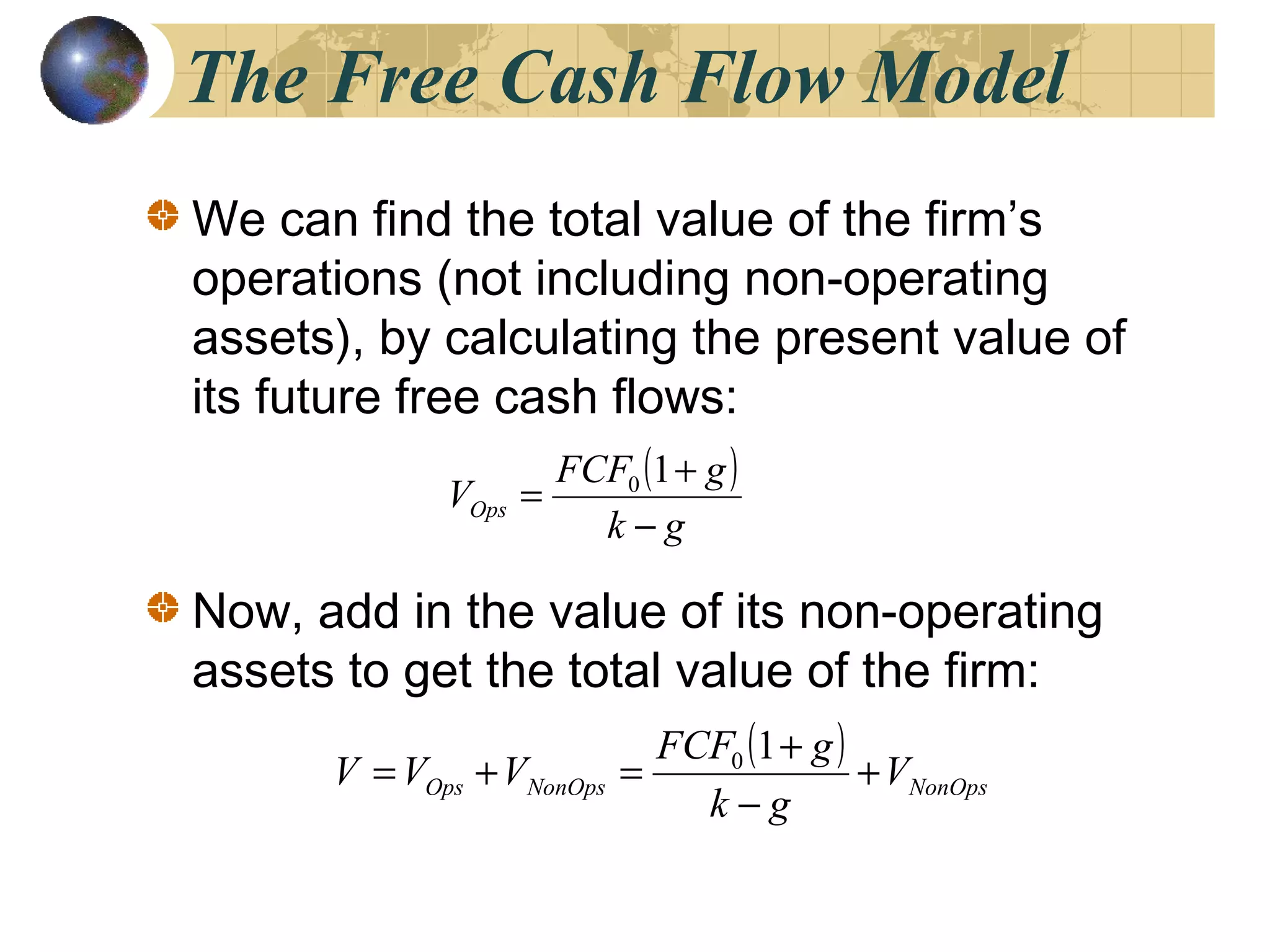
The Free Cash Flow Model
We can find the total value of the firm’s
operations (not including non-operating
assets), by calculating the present value of
its future free cash flows:
Now, add in the value of its non-operating
assets to get the total value of the firm:
( )
gk
gFCF
VOps
−
+
=
10
( )
NonOpsNonOpsOps V
gk
gFCF
VVV +
−
+
=+=
10
The Free Cash Flow Model
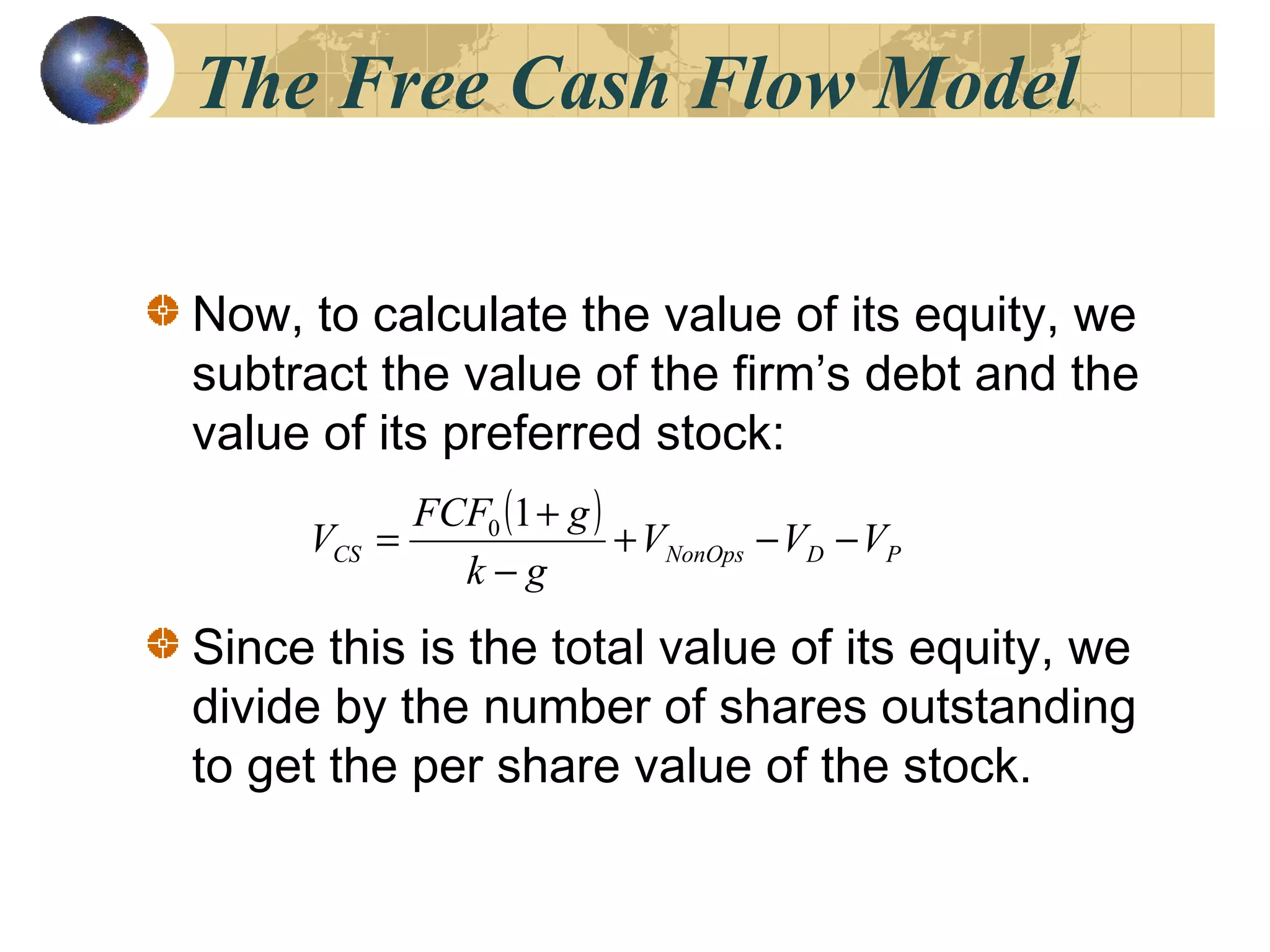
Now, to calculate the value of its equity, we
subtract the value of the firm’s debt and the
value of its preferred stock:
Since this is the total value of its equity, we
divide by the number of shares outstanding
to get the per share value of the stock.
( )
PDNonOpsCS VVV
gk
gFCF
V −−+
−
+
=
10
10-22
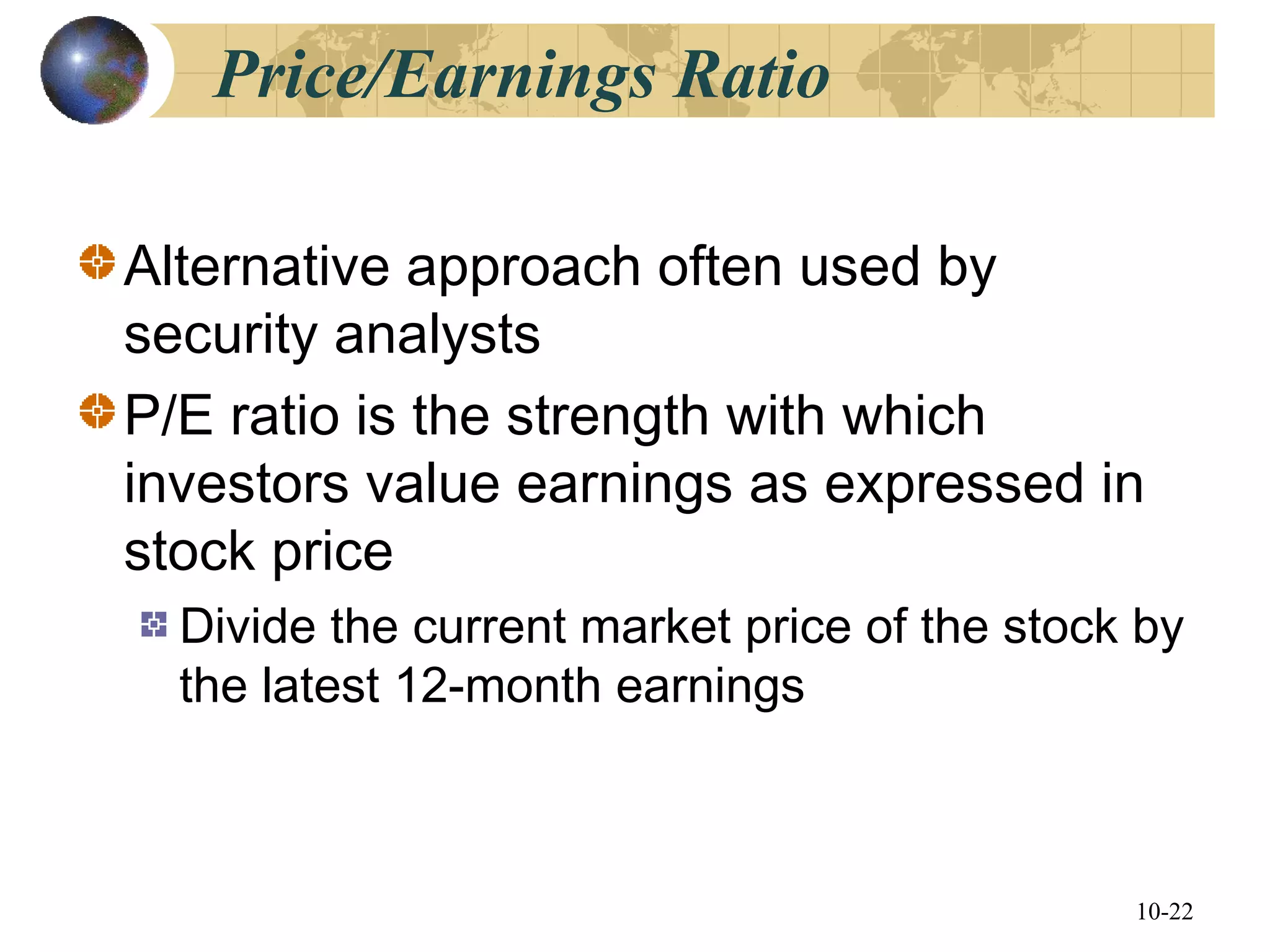
Price/Earnings Ratio
Alternative approach often used by
security analysts
P/E ratio is the strength with which
investors value earnings as expressed in
stock price
Divide the current market price of the stock by
the latest 12-month earnings
10-23
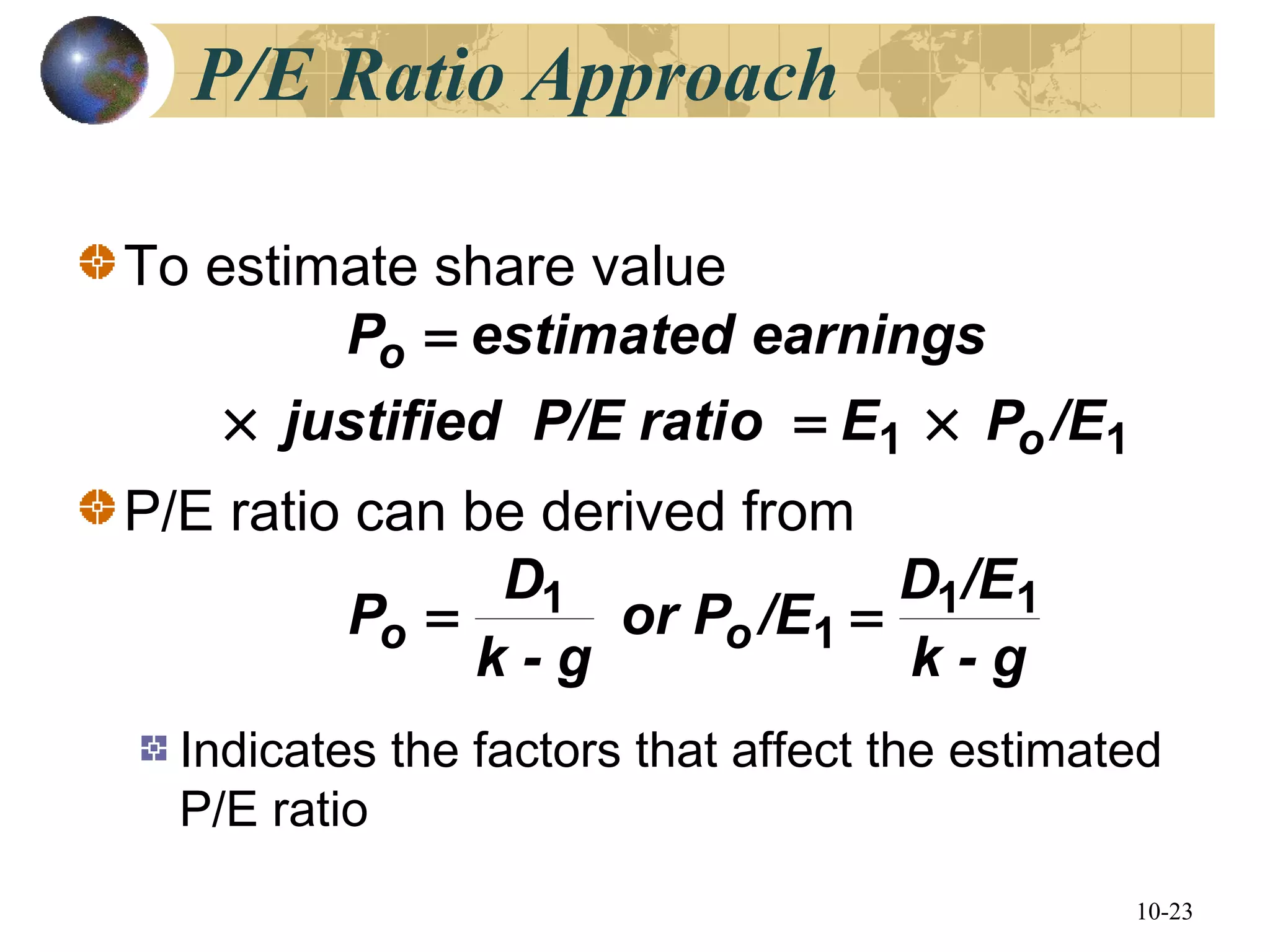
To estimate share value
P/E ratio can be derived from
Indicates the factors that affect the estimated
P/E ratio
11 /EPEoP/E ratijustified
earningsestimatedP
o
o
×=×
=
k - g
/ED
/Eor P
k - g
D
P oo
11
1
1 ==
P/E Ratio Approach
10-24
P/E Ratio Approach
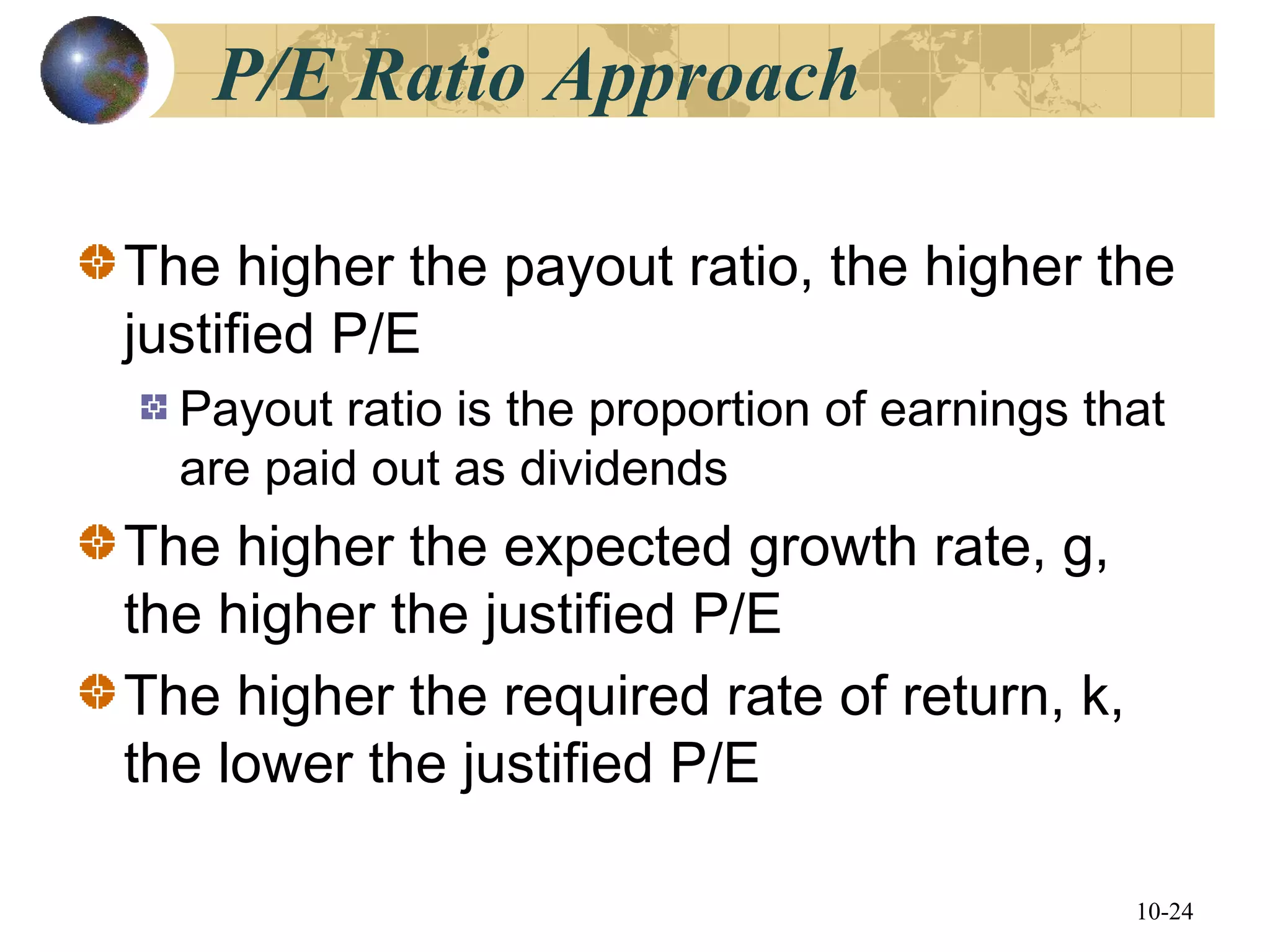
The higher the payout ratio, the higher the
justified P/E
Payout ratio is the proportion of earnings that
are paid out as dividends
The higher the expected growth rate, g,
the higher the justified P/E
The higher the required rate of return, k,
the lower the justified P/E
10-25
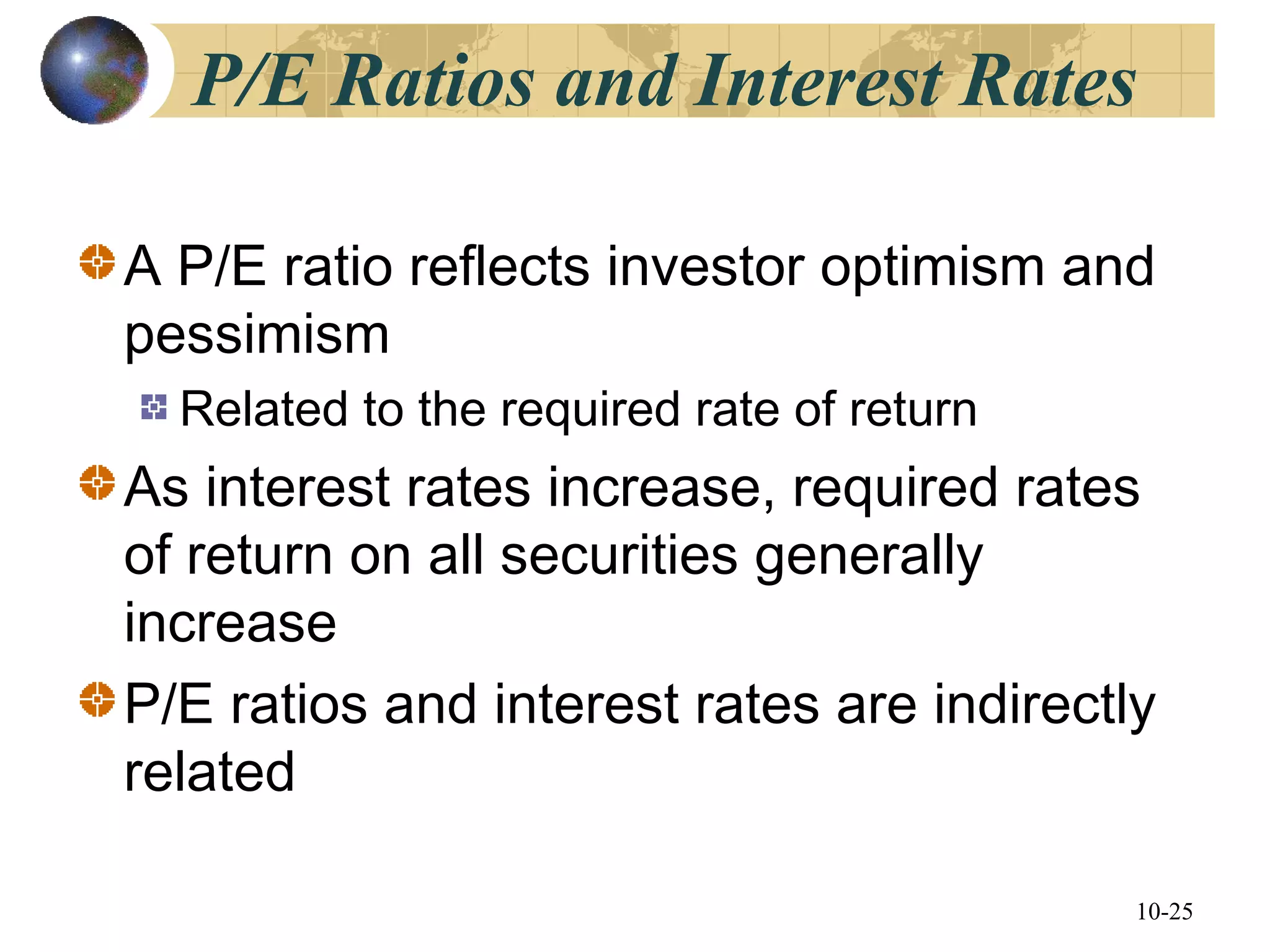
P/E Ratios and Interest Rates
A P/E ratio reflects investor optimism and
pessimism
Related to the required rate of return
As interest rates increase, required rates
of return on all securities generally
increase
P/E ratios and interest rates are indirectly
related
10-26
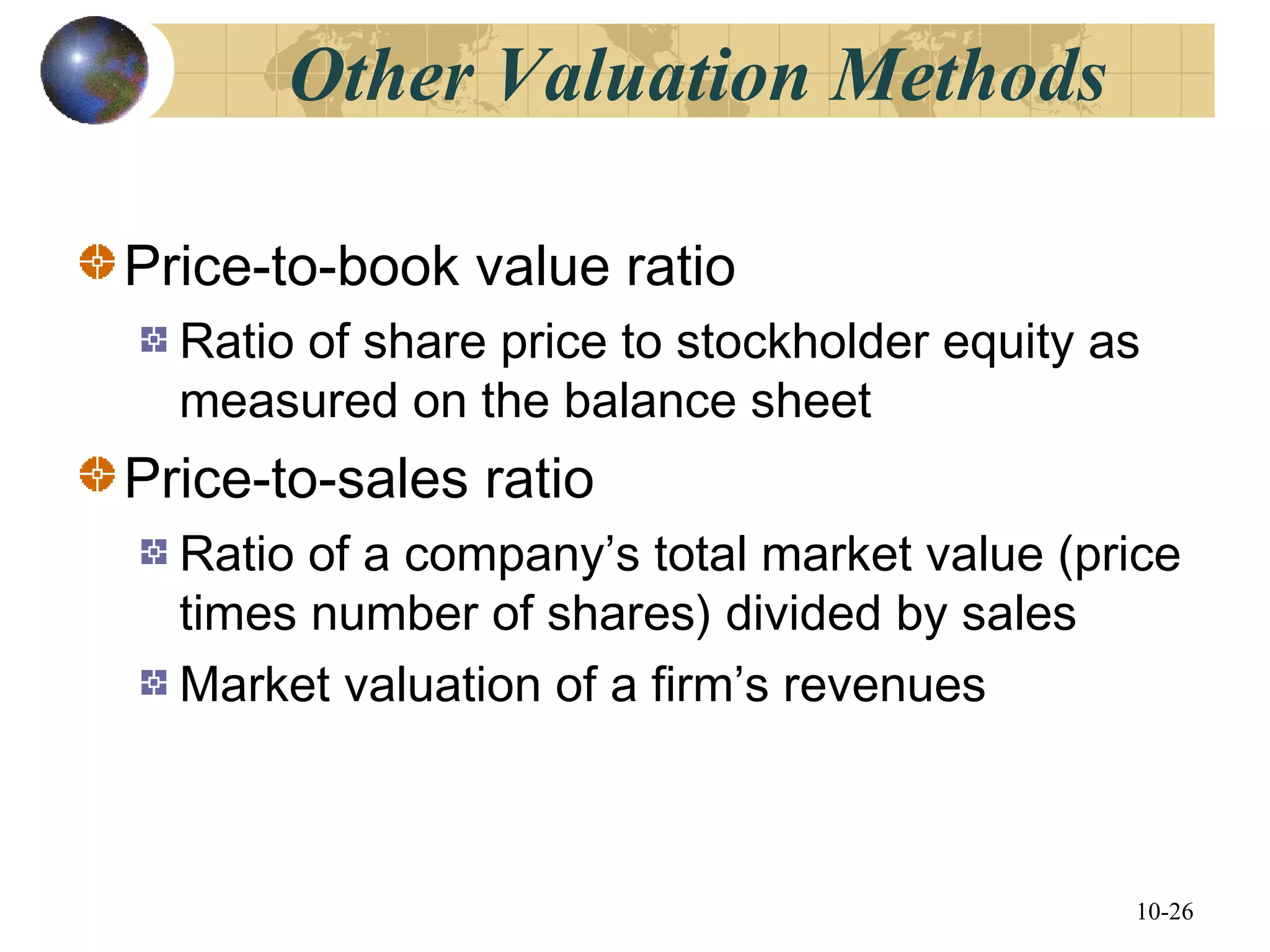
Other Valuation Methods
Price-to-book value ratio
Ratio of share price to stockholder equity as
measured on the balance sheet
Price-to-sales ratio
Ratio of a company’s total market value (price
times number of shares) divided by sales
Market valuation of a firm’s revenues
10-27
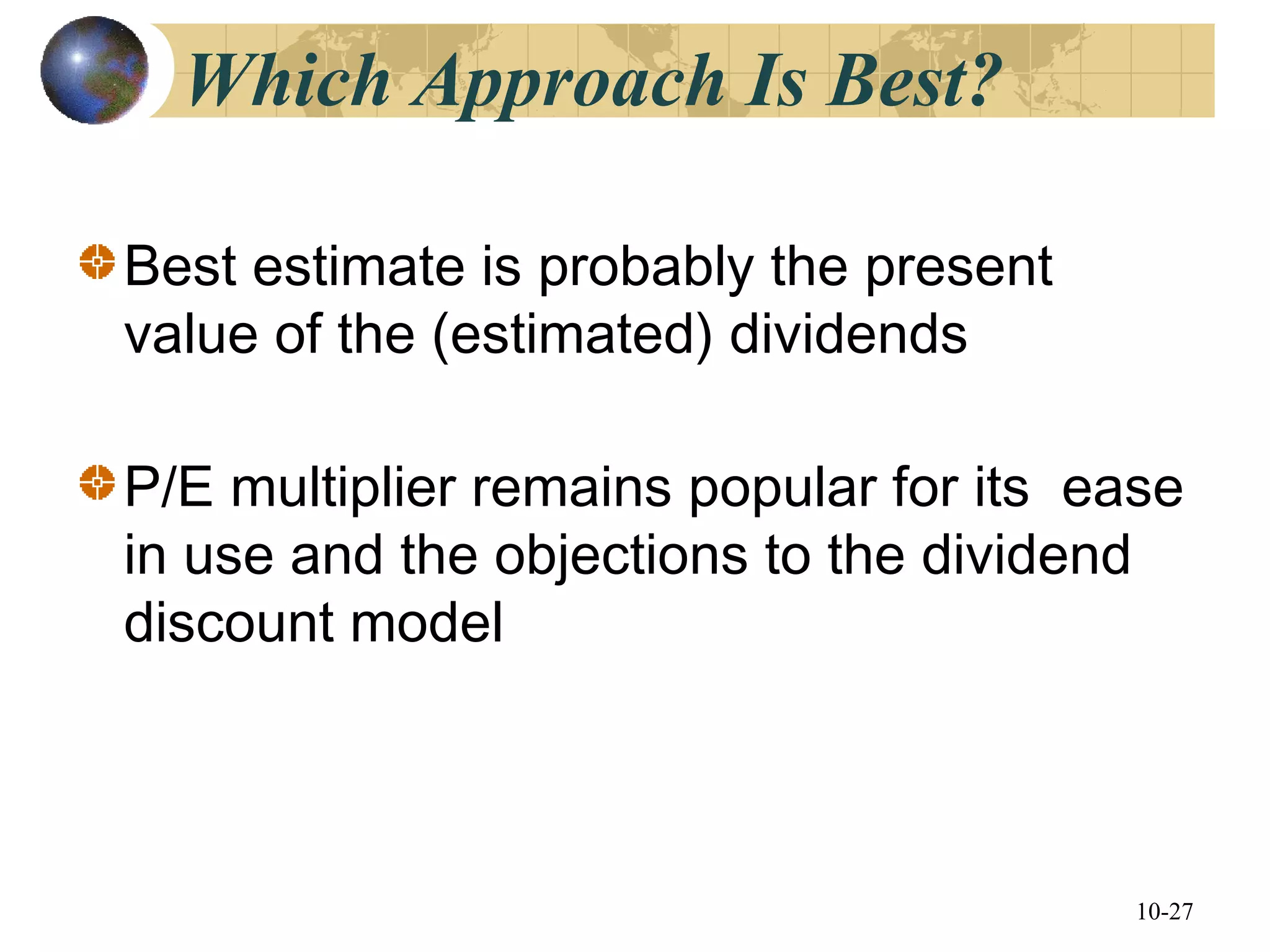
Which Approach Is Best?
Best estimate is probably the present
value of the (estimated) dividends
P/E multiplier remains popular for its ease
in use and the objections to the dividend
discount model
presentation of stock valuation

presentation of stock valuation

  • 2.
    MC11-253 Muhammad NAWAZ HAILEY COLLEGEOF COMMERCE PUNJAB UNIVERSITY LAHORE PAKISTAN
  • 3.
  • 4.
    Common Stock A securitythat represents ownership in a company. Holders of common stock exercise control by electing a board of directors. In the event of liquidation, common shareholders have rights to a company's assets only after bondholders, preferred shareholders and other debt holders have been paid in full.
  • 5.
    What is Value In general, the value of an asset is the price that a willing and able buyer pays to a willing and able seller.  Note that if either the buyer or seller is not both willing and able, then an offer does not establish the value of the asset.
  • 6.
    Valuation of FinancialAssets Process of determining the fair market value of a financial asset on the basis of present value of the expected cash flows Three step process: 1. Estimate the expected cash flows. 2. Determine the appropriate interest rate to discount the cash flows. 3. Compute the present value of the expected cash flows by discounted them with interest rate determine in step 2.
  • 7.
    Intrinsic Value Maximum pricewhich an investor is ready to pay for purchase of a security. Intrinsic value is present value and is also called estimated value or economic value.
  • 8.
    Intrinsic Value Intrinsic valueis compared with market value of security and is based on these factors:  Future cash inflows  Timing of return  Required rate of return i.e. ’’k’’ k=risk free rate of return + risk premium.
  • 9.
    Discounted Cash FlowModel This technique estimates the value of a security by discounting its expected future cash flows back to the present value and adding them together. The estimated value of a security = present value of future cash flows t=n expected cash flow Value = V0 = ∑ ----------------------------- t=1 (1+k)t
  • 10.
    Discounted Cash FlowModel To use this model, an investor must:  Estimate the amount of future cash flows  Estimate the timing of future cash flows  Estimate an appropriate discount rate  Using above components value of a security is calculated which is then compared to the current market price of the security  This calculated value is denoted by V0 and is called intrinsic value
  • 11.
  • 12.
    Dividend Discount Model(DDM) Valueof a common stock is the present value of all future dividends. D1 D2 Dn Value of stock= ------- + ------- + --- + -------- (1+k)1 (1+k)2 (1+k)n n Dn Value of stock = ∑ ---------- t=1 (1+k)n
  • 13.
    Dividend Discount Model(DDM) Typesof dividend discount model: 1.Zero dividend growth 2.Constant growth 3.Variable growth
  • 14.
    Zero Growth Model Dividendevery year will be the same Investor anticipates to receive the same amount dividend per year forever D1 Vcs = ------------- where D1 =D0 (1+g) Kcs Dividend Discount Model(DDM)
  • 15.
    Dividend Discount Model(DDM) ConstantGrowth Model Assume that firm grows at a stable growth rate of g per year forever D1 Vcs = --------- Kcs - g
  • 16.
    Variable growth rate Assumethat firm’s growth rate is variable D0(1+g1 )t Dn +1 1 Vcs = ∑ ------------ + ---------- --------- ( 1+Kcs )t Kcs – g2 (1+Kcs )n g1 = growth in 1st phase Dividend Discount Model(DDM)
  • 17.
    10-17 Intrinsic Value &Market Value When market value is less than or equal to intrinsic value then common stock must be retained or purchased. When market value is greater than intrinsic value then common stock must be sold or avoid.
  • 18.
    Other Valuation Methods Somecompanies do not pay dividends, or the dividends are unpredictable. In these cases we have several other possible valuation models: Free Cash Flow Model P/E approach Price to Sales (P/S)
  • 19.
    The Free CashFlow Model Free cash flow is the cash flow that’s left over after making all required investments in operating assets: Where NOPAT is net operating profit after tax Note that the total value of the firm equals the value of its debt plus preferred plus common: CapOpNOPATFCF ∆−= CSPD VVVV ++=
  • 20.
    The Free CashFlow Model We can find the total value of the firm’s operations (not including non-operating assets), by calculating the present value of its future free cash flows: Now, add in the value of its non-operating assets to get the total value of the firm: ( ) gk gFCF VOps − + = 10 ( ) NonOpsNonOpsOps V gk gFCF VVV + − + =+= 10
  • 21.
    The Free CashFlow Model Now, to calculate the value of its equity, we subtract the value of the firm’s debt and the value of its preferred stock: Since this is the total value of its equity, we divide by the number of shares outstanding to get the per share value of the stock. ( ) PDNonOpsCS VVV gk gFCF V −−+ − + = 10
  • 22.
    10-22 Price/Earnings Ratio Alternative approachoften used by security analysts P/E ratio is the strength with which investors value earnings as expressed in stock price Divide the current market price of the stock by the latest 12-month earnings
  • 23.
    10-23 To estimate sharevalue P/E ratio can be derived from Indicates the factors that affect the estimated P/E ratio 11 /EPEoP/E ratijustified earningsestimatedP o o ×=× = k - g /ED /Eor P k - g D P oo 11 1 1 == P/E Ratio Approach
  • 24.
    10-24 P/E Ratio Approach Thehigher the payout ratio, the higher the justified P/E Payout ratio is the proportion of earnings that are paid out as dividends The higher the expected growth rate, g, the higher the justified P/E The higher the required rate of return, k, the lower the justified P/E
  • 25.
    10-25 P/E Ratios andInterest Rates A P/E ratio reflects investor optimism and pessimism Related to the required rate of return As interest rates increase, required rates of return on all securities generally increase P/E ratios and interest rates are indirectly related
  • 26.
    10-26 Other Valuation Methods Price-to-bookvalue ratio Ratio of share price to stockholder equity as measured on the balance sheet Price-to-sales ratio Ratio of a company’s total market value (price times number of shares) divided by sales Market valuation of a firm’s revenues
  • 27.
    10-27 Which Approach IsBest? Best estimate is probably the present value of the (estimated) dividends P/E multiplier remains popular for its ease in use and the objections to the dividend discount model