Valuing Stocks
Session 3
Stock Exchange
• It is an institution, organization or association that
serves as a market for trading financial instruments
such as stocks, bonds and their related derivatives.
• Large companies arrange their stocks to be traded on
a stock exchange
• Firms that wish to raise new capital
– May borrow money or
– Bring new ‘partners’ by selling shares of
common stock

• Components for buying stocks
– Price change
– Volume
– Dividend yield
– Price-earning (P/E) ratio
Valuing a Company and Its Future
• The single most important issue in the stock
valuation process is what a stock will do in the
future.
• Value of a stock depends upon its future returns
from dividends and capital gains/losses.
• We use historical data to gain insight into the future
direction of a company and its profitability.
• Past results are not a guarantee of future results.
The Valuation Process
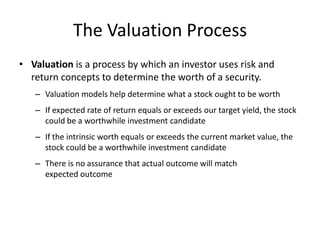
• Valuation is a process by which an investor uses risk and
return concepts to determine the worth of a security.
– Valuation models help determine what a stock ought to be worth
– If expected rate of return equals or exceeds our target yield, the stock
could be a worthwhile investment candidate
– If the intrinsic worth equals or exceeds the current market value, the
stock could be a worthwhile investment candidate
– There is no assurance that actual outcome will match
expected outcome
Required Rate of Return
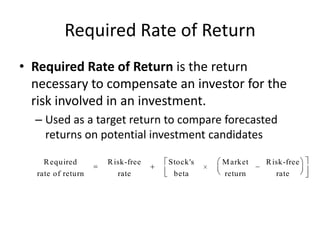
• Required Rate of Return is the return
necessary to compensate an investor for the
risk involved in an investment.
– Used as a target return to compare forecasted
returns on potential investment candidates
R equired

R isk-free

Stock's

M arket

R isk-free

rate of return

rate

beta

return

rate
Required Rate of Return (cont’d)
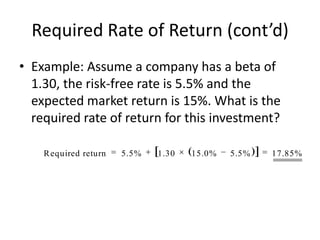
• Example: Assume a company has a beta of
1.30, the risk-free rate is 5.5% and the
expected market return is 15%. What is the
required rate of return for this investment?
R equired return

5.5%

1.30

15.0%

5.5%

17.85%
Common Stock Valuation
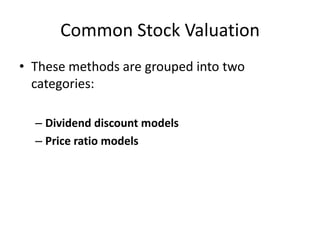
• These methods are grouped into two
categories:
– Dividend discount models
– Price ratio models
The Dividend Discount Model
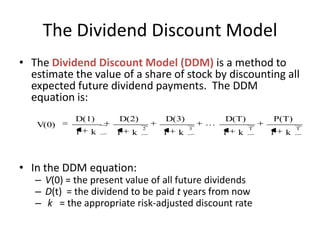
• The Dividend Discount Model (DDM) is a method to
estimate the value of a share of stock by discounting all
expected future dividend payments. The DDM
equation is:
V(0)

D(1)
1

k

D(2)
1

k

• In the DDM equation:

D(3)
2

1

k

3



D(T)
1

k

P(T)
T

– V(0) = the present value of all future dividends
– D(t) = the dividend to be paid t years from now
– k = the appropriate risk-adjusted discount rate

1

k

T
Example: The Dividend Discount Model
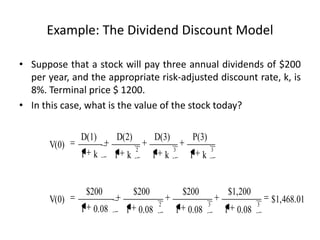
• Suppose that a stock will pay three annual dividends of $200
per year, and the appropriate risk-adjusted discount rate, k, is
8%. Terminal price $ 1200.
• In this case, what is the value of the stock today?

V(0)

D(2)

1 k

V(0)

D(1)

1 k

$200
1 0.08

D(3)
2

1 k

$200
1 0.08

P(3)
3

3

1 k

$200
2

1 0.08

$1,200
3

1 0.08

3

$1,468.01
The Dividend Discount Model:
the Constant Growth Rate Model
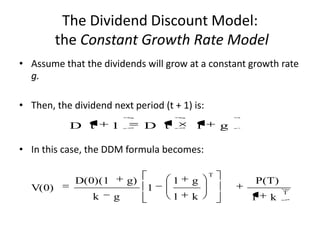
• Assume that the dividends will grow at a constant growth rate
g.
• Then, the dividend next period (t + 1) is:
D t

1

D t

1

g

• In this case, the DDM formula becomes:

V(0)

D(0)(1
k

g)
g

1

1

g

1

k

T

P(T)
1

k

T
Example: The Constant Growth Rate
Model
•

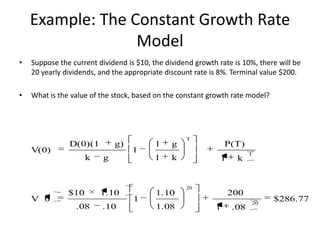
Suppose the current dividend is $10, the dividend growth rate is 10%, there will be
20 yearly dividends, and the appropriate discount rate is 8%. Terminal value $200.

•

What is the value of the stock, based on the constant growth rate model?

V(0)

D(0)(1
k

V 0

$10
.08

g)
g

1.10
.10

1

g

1

1

1

T

k

1.10
1.08

P(T)
1

20

k

T

200
1

.08

20

$286.77
The Dividend Discount Model:
the Constant Perpetual Growth Model.
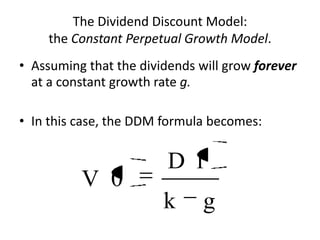
• Assuming that the dividends will grow forever
at a constant growth rate g.
• In this case, the DDM formula becomes:

V 0

D1
k

g
Example: Constant Perpetual Growth

Model
• Think about the electric utility industry.
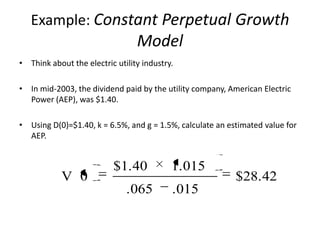
• In mid-2003, the dividend paid by the utility company, American Electric
Power (AEP), was $1.40.
• Using D(0)=$1.40, k = 6.5%, and g = 1.5%, calculate an estimated value for
AEP.

V 0

$1.40
.065

1.015
.015

$28.42
The Sustainable Growth Rate
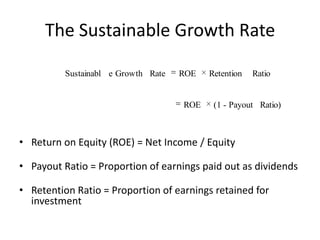
Sustainabl e Growth Rate

ROE

ROE

Retention

Ratio

(1 - Payout Ratio)

• Return on Equity (ROE) = Net Income / Equity
• Payout Ratio = Proportion of earnings paid out as dividends

• Retention Ratio = Proportion of earnings retained for
investment
Example: Calculating and Using the
Sustainable Growth Rate
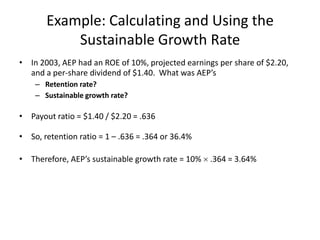
• In 2003, AEP had an ROE of 10%, projected earnings per share of $2.20,
and a per-share dividend of $1.40. What was AEP’s
– Retention rate?
– Sustainable growth rate?

• Payout ratio = $1.40 / $2.20 = .636

• So, retention ratio = 1 – .636 = .364 or 36.4%
• Therefore, AEP’s sustainable growth rate = 10% .364 = 3.64%
Example: Calculating and Using the
Sustainable Growth Rate, Cont.
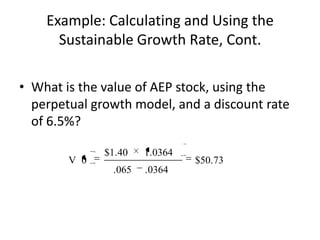
• What is the value of AEP stock, using the
perpetual growth model, and a discount rate
of 6.5%?
V 0

$1.40
.065

1.0364
.0364

$50.73
Price Ratio – P/E Ratio
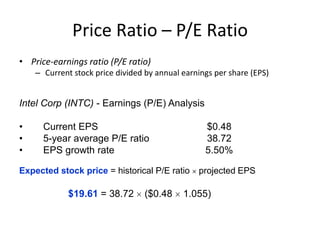
• Price-earnings ratio (P/E ratio)
– Current stock price divided by annual earnings per share (EPS)

Intel Corp (INTC) - Earnings (P/E) Analysis
•
•
•

Current EPS
5-year average P/E ratio
EPS growth rate

$0.48
38.72
5.50%

Expected stock price = historical P/E ratio

$19.61 = 38.72

($0.48

projected EPS

1.055)
Thank You

Stock valuation

  • 1.
  • 2.
    Stock Exchange • Itis an institution, organization or association that serves as a market for trading financial instruments such as stocks, bonds and their related derivatives. • Large companies arrange their stocks to be traded on a stock exchange
  • 3.
    • Firms thatwish to raise new capital – May borrow money or – Bring new ‘partners’ by selling shares of common stock • Components for buying stocks – Price change – Volume – Dividend yield – Price-earning (P/E) ratio
  • 4.
    Valuing a Companyand Its Future • The single most important issue in the stock valuation process is what a stock will do in the future. • Value of a stock depends upon its future returns from dividends and capital gains/losses. • We use historical data to gain insight into the future direction of a company and its profitability. • Past results are not a guarantee of future results.
  • 5.
    The Valuation Process •Valuation is a process by which an investor uses risk and return concepts to determine the worth of a security. – Valuation models help determine what a stock ought to be worth – If expected rate of return equals or exceeds our target yield, the stock could be a worthwhile investment candidate – If the intrinsic worth equals or exceeds the current market value, the stock could be a worthwhile investment candidate – There is no assurance that actual outcome will match expected outcome
  • 6.
    Required Rate ofReturn • Required Rate of Return is the return necessary to compensate an investor for the risk involved in an investment. – Used as a target return to compare forecasted returns on potential investment candidates R equired R isk-free Stock's M arket R isk-free rate of return rate beta return rate
  • 7.
    Required Rate ofReturn (cont’d) • Example: Assume a company has a beta of 1.30, the risk-free rate is 5.5% and the expected market return is 15%. What is the required rate of return for this investment? R equired return 5.5% 1.30 15.0% 5.5% 17.85%
  • 8.
    Common Stock Valuation •These methods are grouped into two categories: – Dividend discount models – Price ratio models
  • 9.
    The Dividend DiscountModel • The Dividend Discount Model (DDM) is a method to estimate the value of a share of stock by discounting all expected future dividend payments. The DDM equation is: V(0) D(1) 1 k D(2) 1 k • In the DDM equation: D(3) 2 1 k 3  D(T) 1 k P(T) T – V(0) = the present value of all future dividends – D(t) = the dividend to be paid t years from now – k = the appropriate risk-adjusted discount rate 1 k T
  • 10.
    Example: The DividendDiscount Model • Suppose that a stock will pay three annual dividends of $200 per year, and the appropriate risk-adjusted discount rate, k, is 8%. Terminal price $ 1200. • In this case, what is the value of the stock today? V(0) D(2) 1 k V(0) D(1) 1 k $200 1 0.08 D(3) 2 1 k $200 1 0.08 P(3) 3 3 1 k $200 2 1 0.08 $1,200 3 1 0.08 3 $1,468.01
  • 11.
    The Dividend DiscountModel: the Constant Growth Rate Model • Assume that the dividends will grow at a constant growth rate g. • Then, the dividend next period (t + 1) is: D t 1 D t 1 g • In this case, the DDM formula becomes: V(0) D(0)(1 k g) g 1 1 g 1 k T P(T) 1 k T
  • 12.
    Example: The ConstantGrowth Rate Model • Suppose the current dividend is $10, the dividend growth rate is 10%, there will be 20 yearly dividends, and the appropriate discount rate is 8%. Terminal value $200. • What is the value of the stock, based on the constant growth rate model? V(0) D(0)(1 k V 0 $10 .08 g) g 1.10 .10 1 g 1 1 1 T k 1.10 1.08 P(T) 1 20 k T 200 1 .08 20 $286.77
  • 13.
    The Dividend DiscountModel: the Constant Perpetual Growth Model. • Assuming that the dividends will grow forever at a constant growth rate g. • In this case, the DDM formula becomes: V 0 D1 k g
  • 14.
    Example: Constant PerpetualGrowth Model • Think about the electric utility industry. • In mid-2003, the dividend paid by the utility company, American Electric Power (AEP), was $1.40. • Using D(0)=$1.40, k = 6.5%, and g = 1.5%, calculate an estimated value for AEP. V 0 $1.40 .065 1.015 .015 $28.42
  • 15.
    The Sustainable GrowthRate Sustainabl e Growth Rate ROE ROE Retention Ratio (1 - Payout Ratio) • Return on Equity (ROE) = Net Income / Equity • Payout Ratio = Proportion of earnings paid out as dividends • Retention Ratio = Proportion of earnings retained for investment
  • 16.
    Example: Calculating andUsing the Sustainable Growth Rate • In 2003, AEP had an ROE of 10%, projected earnings per share of $2.20, and a per-share dividend of $1.40. What was AEP’s – Retention rate? – Sustainable growth rate? • Payout ratio = $1.40 / $2.20 = .636 • So, retention ratio = 1 – .636 = .364 or 36.4% • Therefore, AEP’s sustainable growth rate = 10% .364 = 3.64%
  • 17.
    Example: Calculating andUsing the Sustainable Growth Rate, Cont. • What is the value of AEP stock, using the perpetual growth model, and a discount rate of 6.5%? V 0 $1.40 .065 1.0364 .0364 $50.73
  • 18.
    Price Ratio –P/E Ratio • Price-earnings ratio (P/E ratio) – Current stock price divided by annual earnings per share (EPS) Intel Corp (INTC) - Earnings (P/E) Analysis • • • Current EPS 5-year average P/E ratio EPS growth rate $0.48 38.72 5.50% Expected stock price = historical P/E ratio $19.61 = 38.72 ($0.48 projected EPS 1.055)
  • 19.