How to Value Stocks – An Introduction
Introduction to Stock Valuation
Using the Stockcalc Website
Overview
 Valuation Basics – Enterprise and Equity Value
 Cost of Capital – How to
 Valuation Methods (Cash Flow, Asset, Relative)
 Examples
 Summary
3
Valuation Basics
4
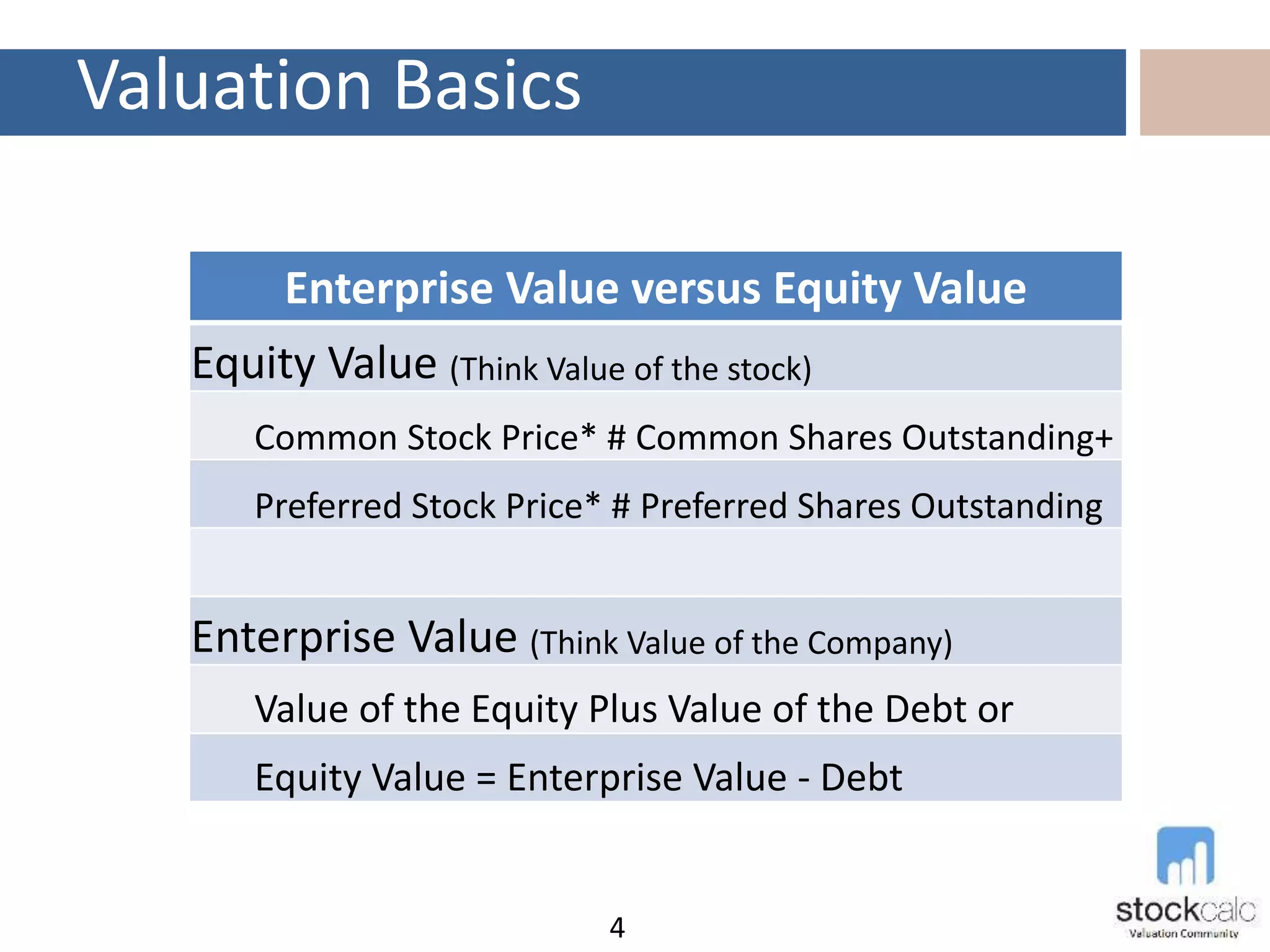
Enterprise Value versus Equity Value
Equity Value (Think Value of the stock)
Common Stock Price* # Common Shares Outstanding+
Preferred Stock Price* # Preferred Shares Outstanding
Enterprise Value (Think Value of the Company)
Value of the Equity Plus Value of the Debt or
Equity Value = Enterprise Value - Debt
Valuation Basics
5
Enterprise Value versus Equity Value
So What?
Can Determine Equity or Enterprise Value
Discount rates differ
(Equity Value per share is what we want to know)
Also note the difference between Book Value (as shown on
the Balance Sheet) and Market Value (what it would sell for)
Valuation Basics
6
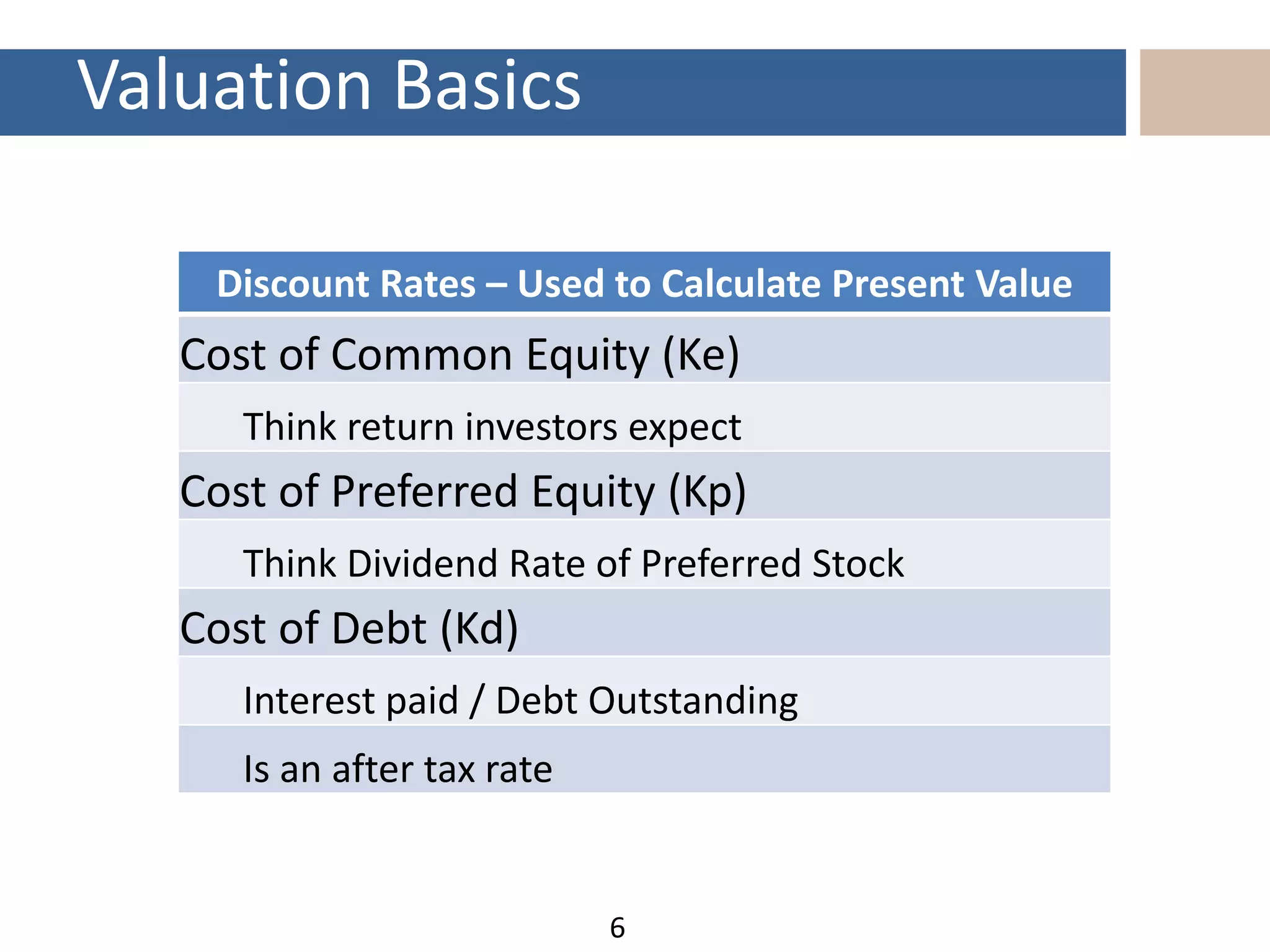
Discount Rates – Used to Calculate Present Value
Cost of Common Equity (Ke)
Think return investors expect
Cost of Preferred Equity (Kp)
Think Dividend Rate of Preferred Stock
Cost of Debt (Kd)
Interest paid / Debt Outstanding
Is an after tax rate
Valuation Basics
7
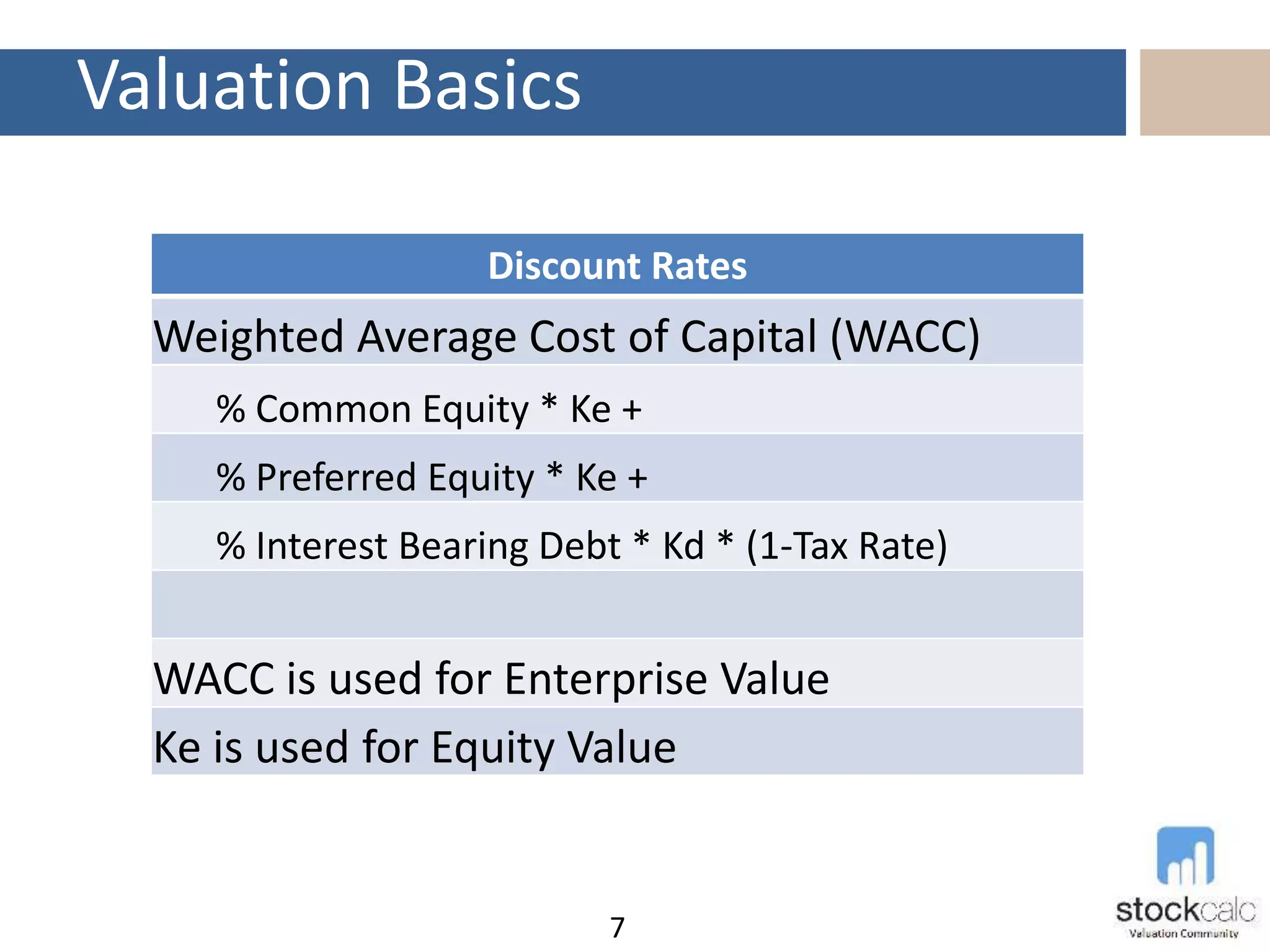
Discount Rates
Weighted Average Cost of Capital (WACC)
% Common Equity * Ke +
% Preferred Equity * Ke +
% Interest Bearing Debt * Kd * (1-Tax Rate)
WACC is used for Enterprise Value
Ke is used for Equity Value
Valuation Methods
8
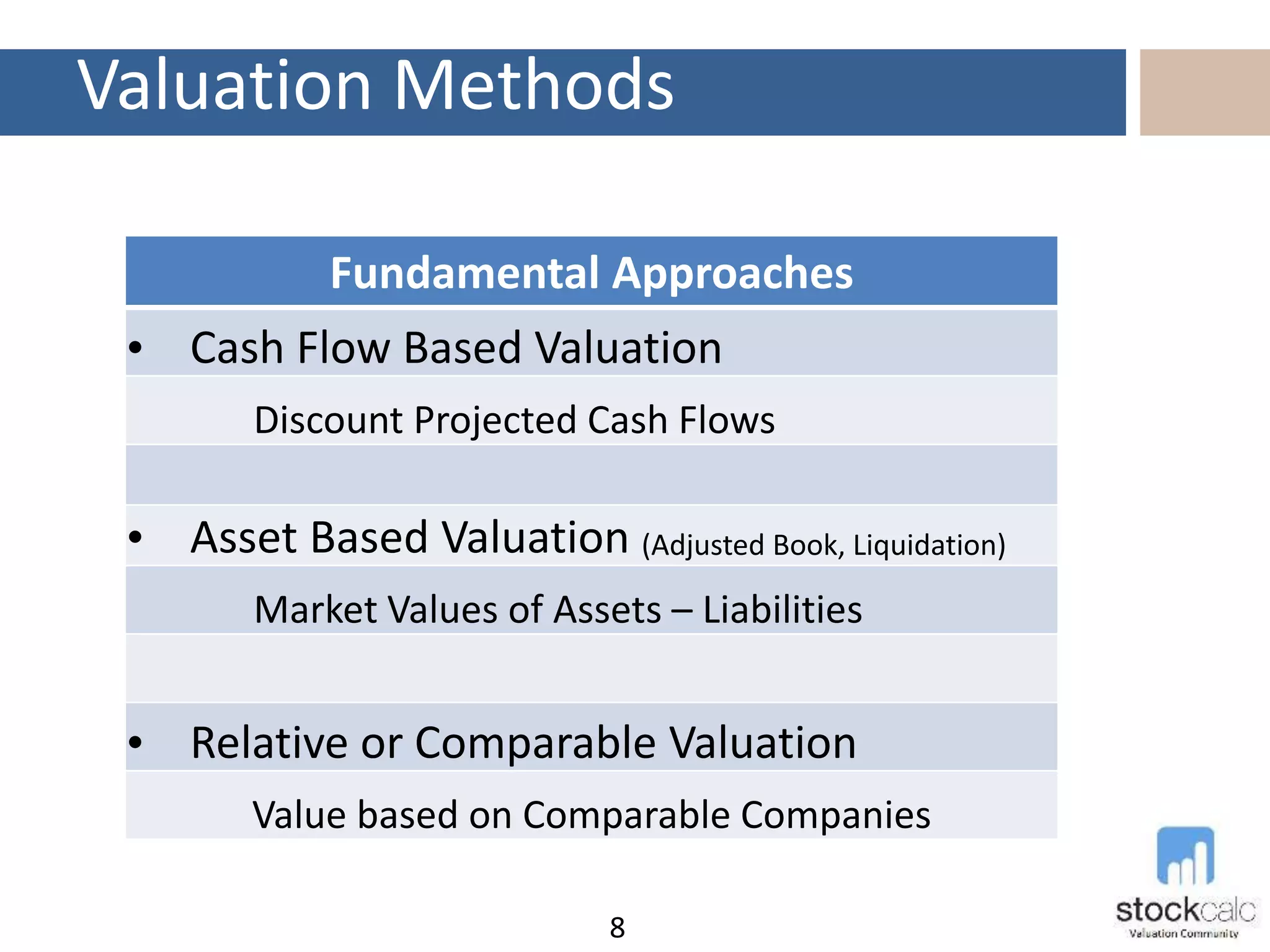
Fundamental Approaches
• Cash Flow Based Valuation
Discount Projected Cash Flows
• Asset Based Valuation (Adjusted Book, Liquidation)
Market Values of Assets – Liabilities
• Relative or Comparable Valuation
Value based on Comparable Companies
Valuation Methods
9
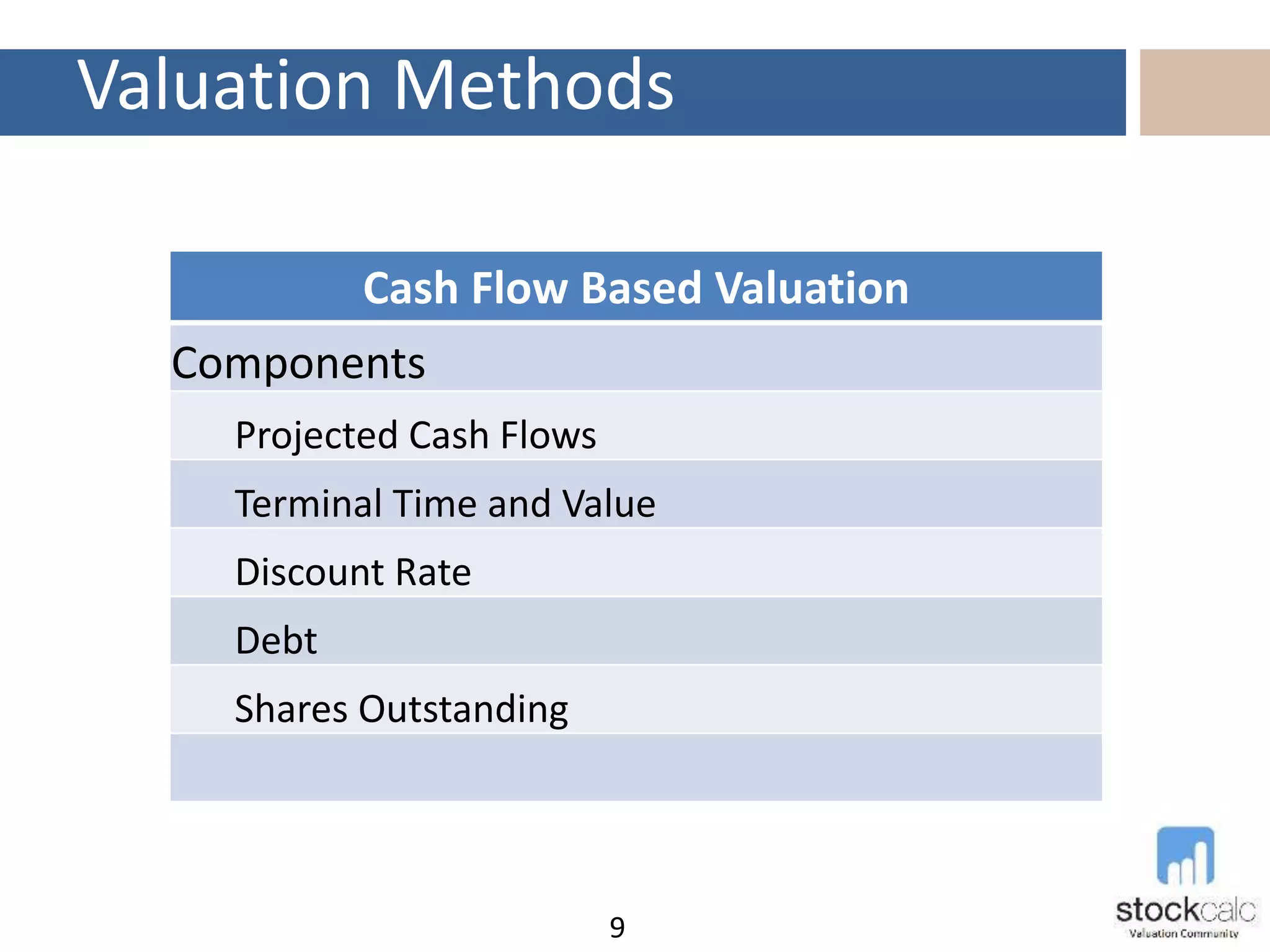
Cash Flow Based Valuation
Components
Projected Cash Flows
Terminal Time and Value
Discount Rate
Debt
Shares Outstanding
Valuation Basics
10
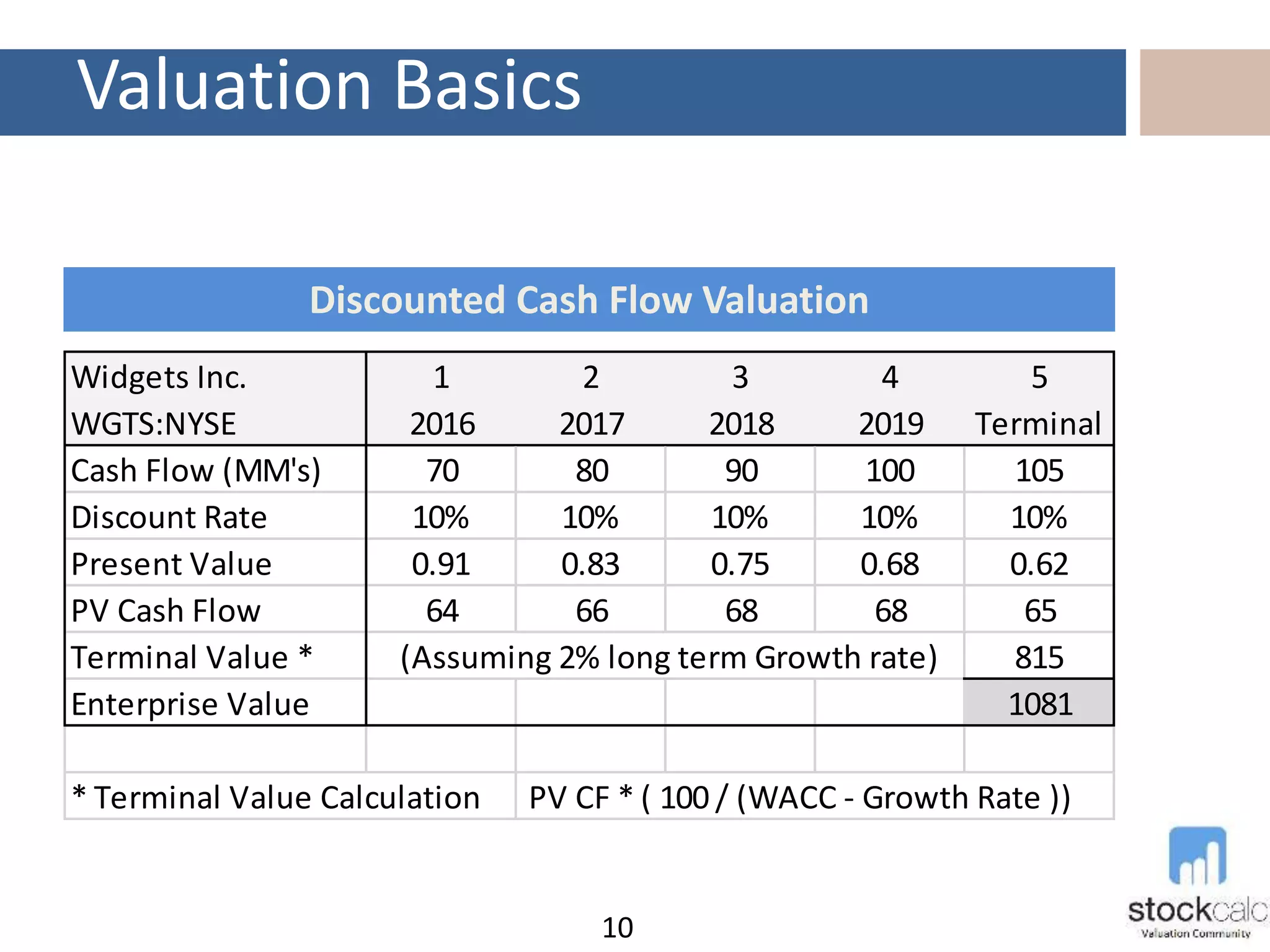
Discounted Cash Flow Valuation
Widgets Inc. 1 2 3 4 5
WGTS:NYSE 2016 2017 2018 2019 Terminal
Cash Flow (MM's) 70 80 90 100 105
Discount Rate 10% 10% 10% 10% 10%
Present Value 0.91 0.83 0.75 0.68 0.62
PV Cash Flow 64 66 68 68 65
Terminal Value * (Assuming 2% long term Growth rate) 815
Enterprise Value 1081
* Terminal Value Calculation PV CF * ( 100 / (WACC - Growth Rate ))
Valuation Basics
11
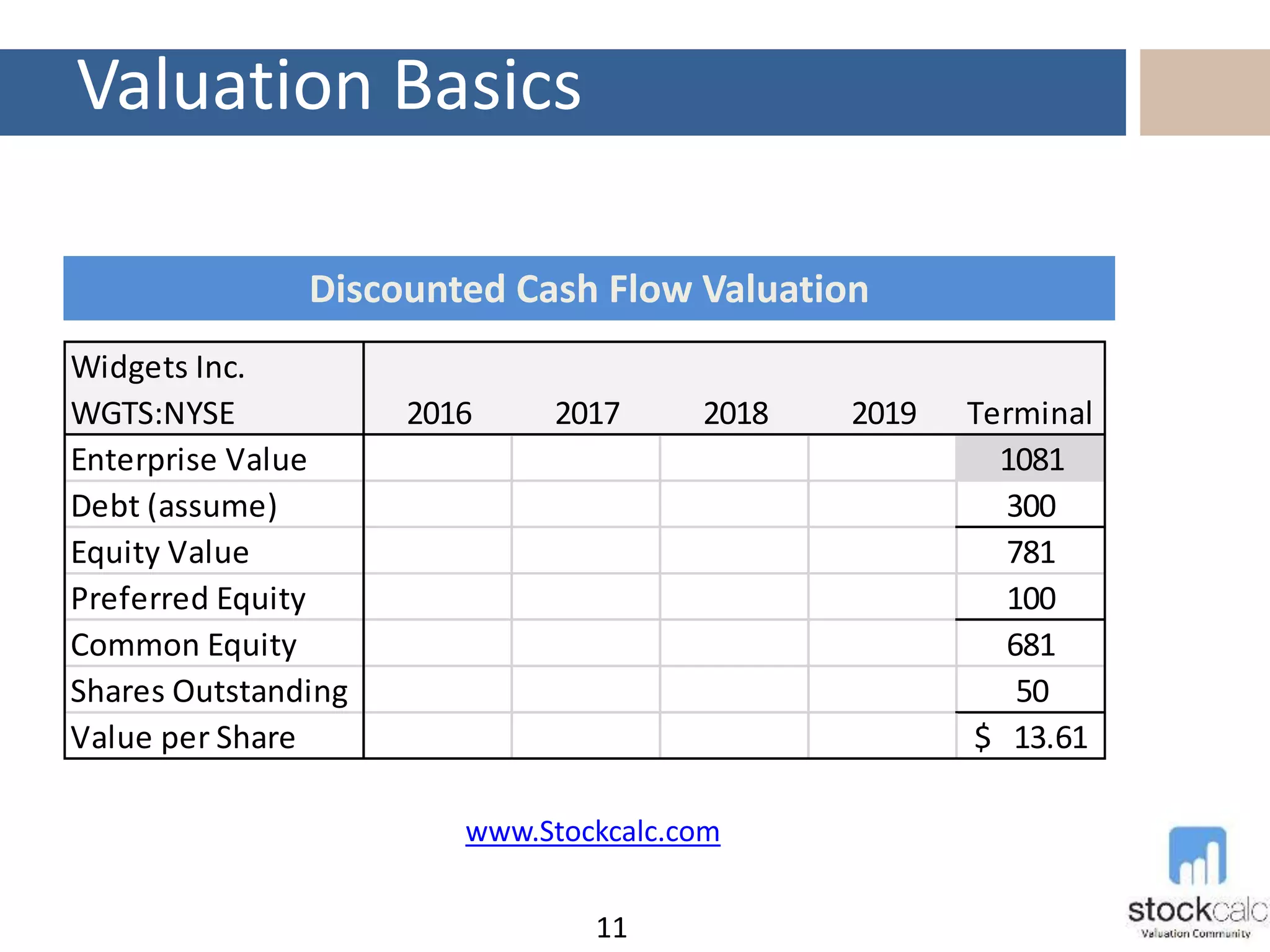
Discounted Cash Flow Valuation
Widgets Inc.
WGTS:NYSE 2016 2017 2018 2019 Terminal
Enterprise Value 1081
Debt (assume) 300
Equity Value 781
Preferred Equity 100
Common Equity 681
Shares Outstanding 50
Value per Share 13.61$
www.Stockcalc.com
Valuation Methods
12
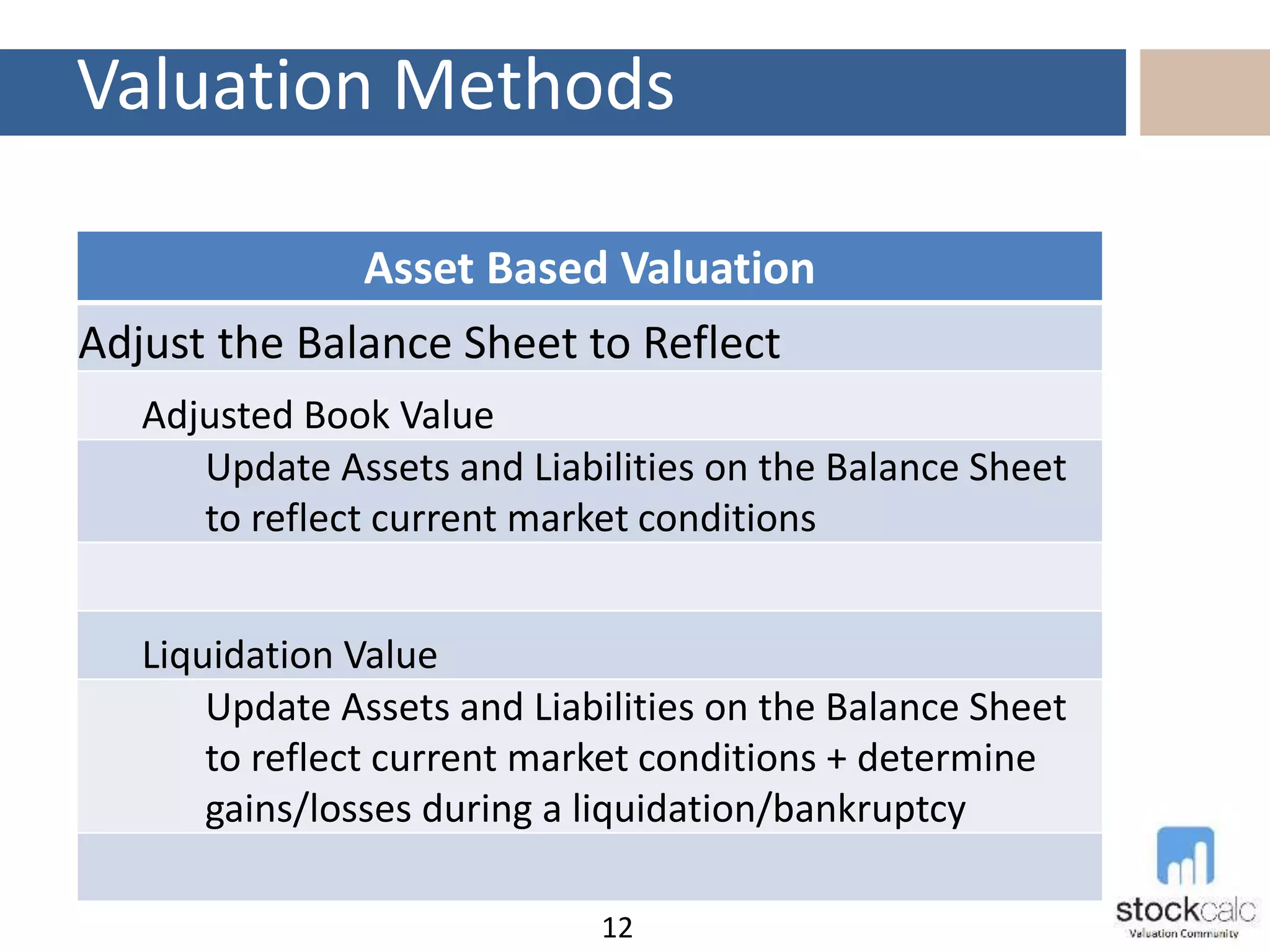
Asset Based Valuation
Adjust the Balance Sheet to Reflect
Adjusted Book Value
Update Assets and Liabilities on the Balance Sheet
to reflect current market conditions
Liquidation Value
Update Assets and Liabilities on the Balance Sheet
to reflect current market conditions + determine
gains/losses during a liquidation/bankruptcy
Valuation Basics
13
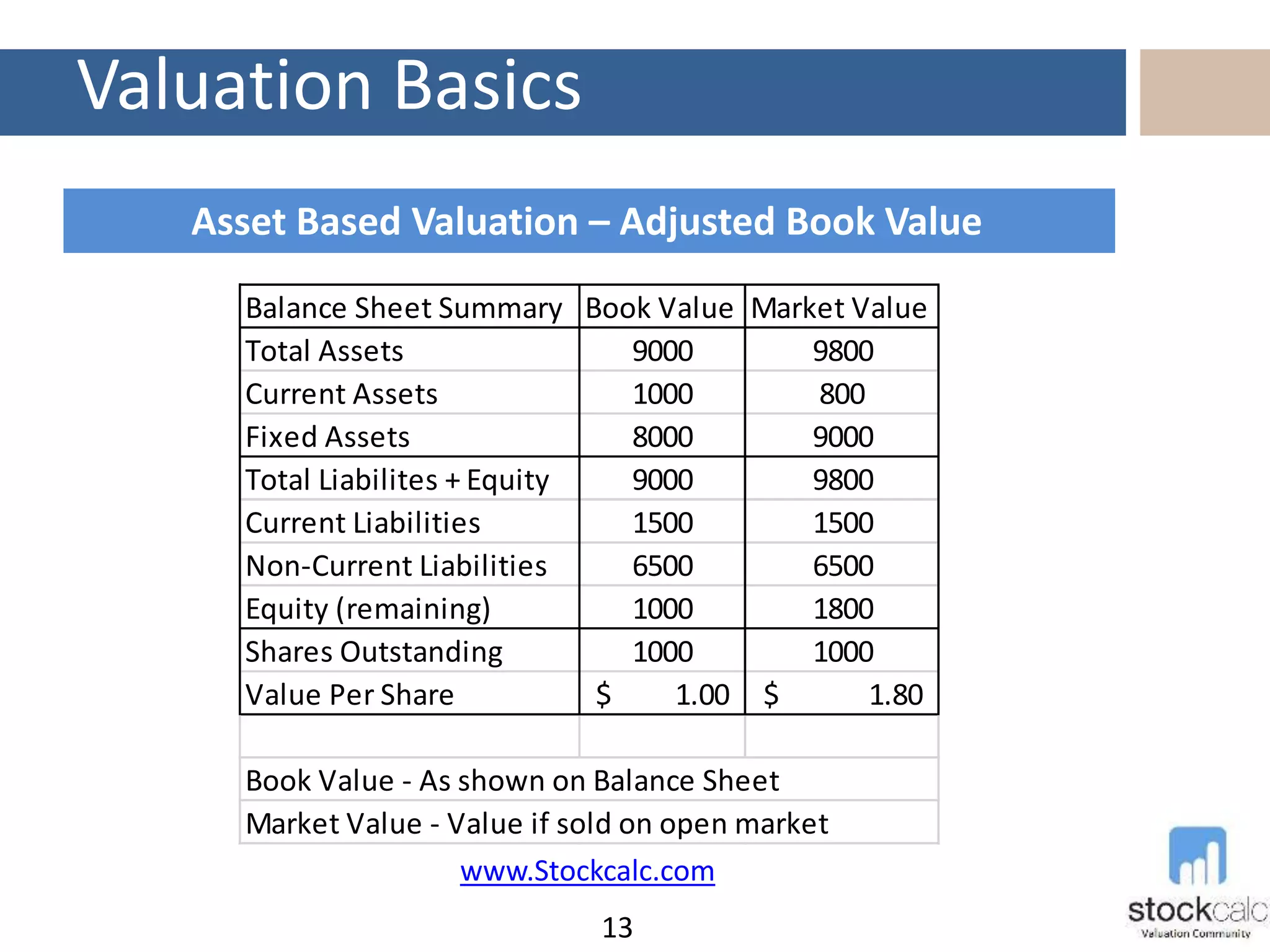
Asset Based Valuation – Adjusted Book Value
Balance Sheet Summary Book Value Market Value
Total Assets 9000 9800
Current Assets 1000 800
Fixed Assets 8000 9000
Total Liabilites + Equity 9000 9800
Current Liabilities 1500 1500
Non-Current Liabilities 6500 6500
Equity (remaining) 1000 1800
Shares Outstanding 1000 1000
Value Per Share 1.00$ 1.80$
Book Value - As shown on Balance Sheet
Market Value - Value if sold on open market
www.Stockcalc.com
Valuation Basics
14
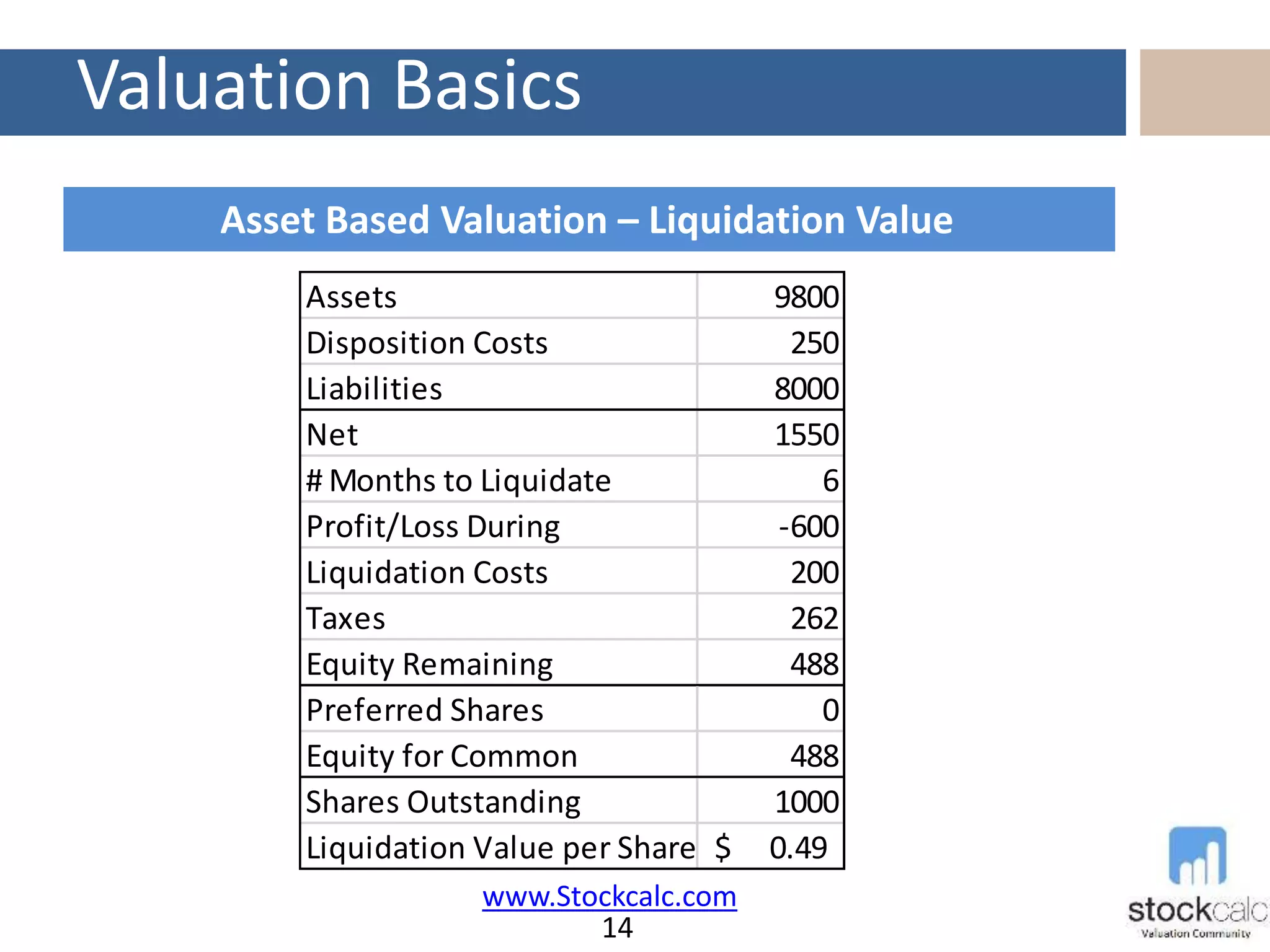
Asset Based Valuation – Liquidation Value
Assets 9800
Disposition Costs 250
Liabilities 8000
Net 1550
# Months to Liquidate 6
Profit/Loss During -600
Liquidation Costs 200
Taxes 262
Equity Remaining 488
Preferred Shares 0
Equity for Common 488
Shares Outstanding 1000
Liquidation Value per Share 0.49$
www.Stockcalc.com
Valuation Methods
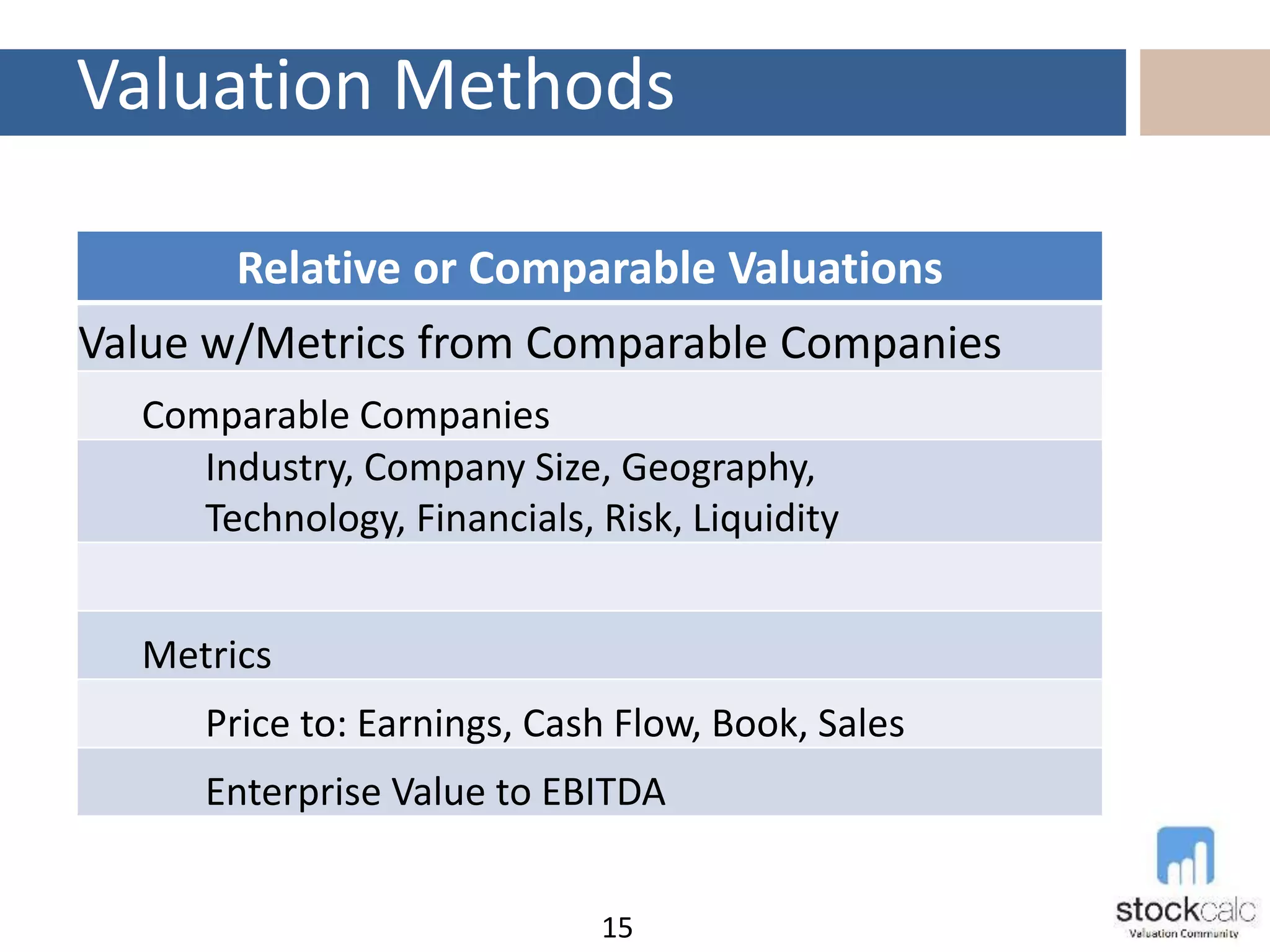
15
Relative or Comparable Valuations
Value w/Metrics from Comparable Companies
Comparable Companies
Industry, Company Size, Geography,
Technology, Financials, Risk, Liquidity
Metrics
Price to: Earnings, Cash Flow, Book, Sales
Enterprise Value to EBITDA
Valuation Basics
16
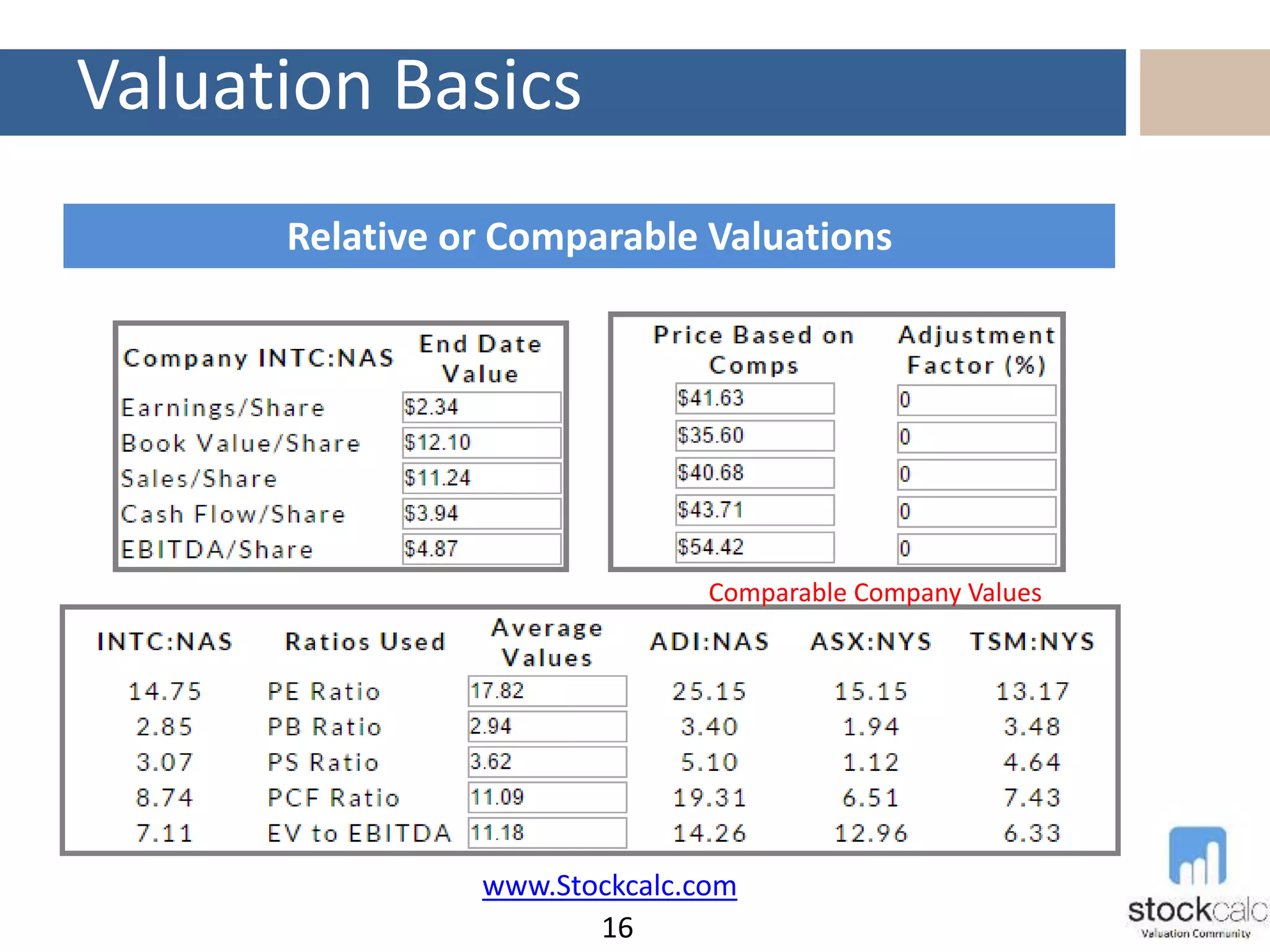
Relative or Comparable Valuations
www.Stockcalc.com
Comparable Company Values
Valuation Basics
17
Relative or Comparable Valuations
www.Stockcalc.com
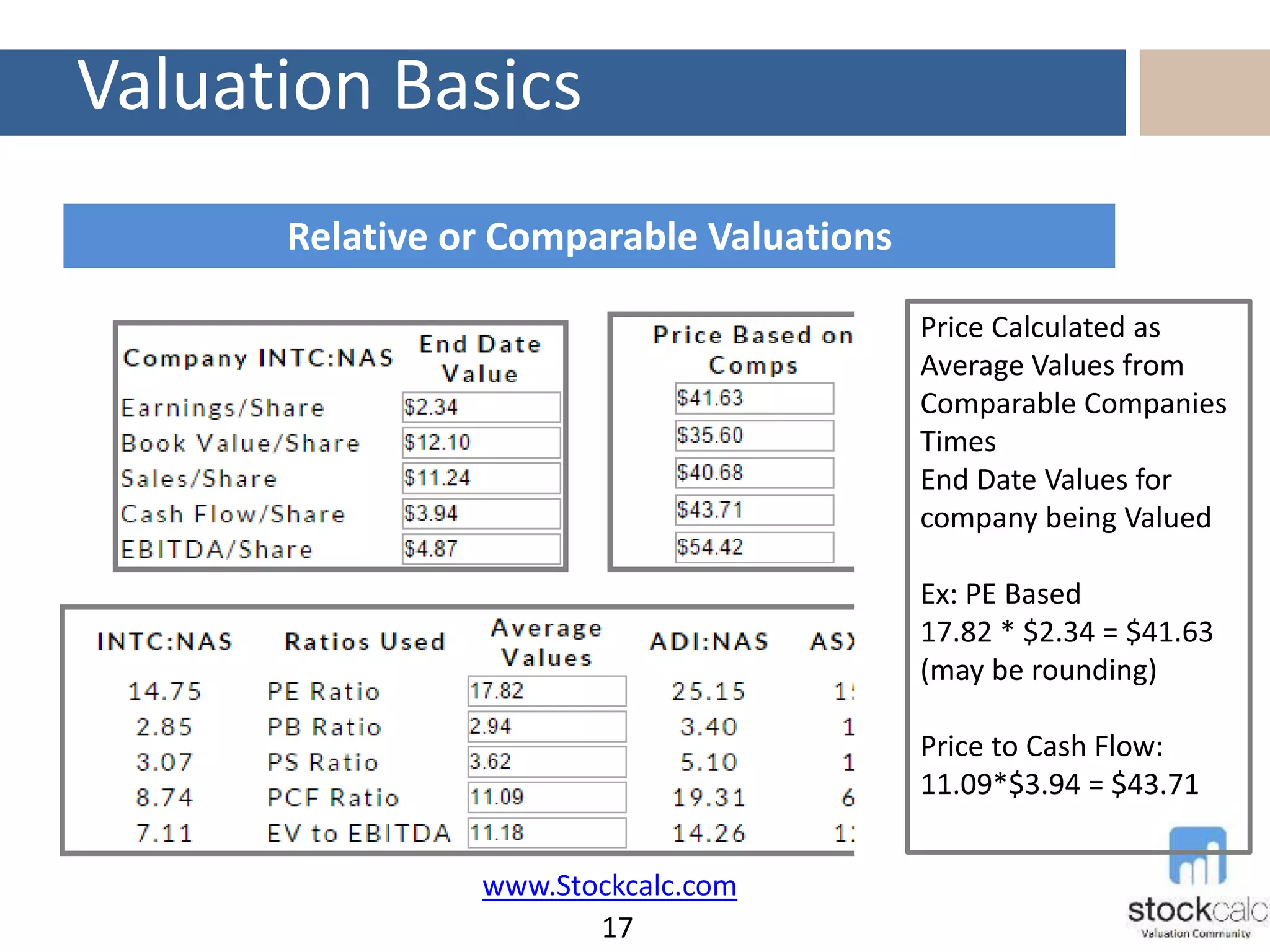
Price Calculated as
Average Values from
Comparable Companies
Times
End Date Values for
company being Valued
Ex: PE Based
17.82 * $2.34 = $41.63
(may be rounding)
Price to Cash Flow:
11.09*$3.94 = $43.71
Summary
18
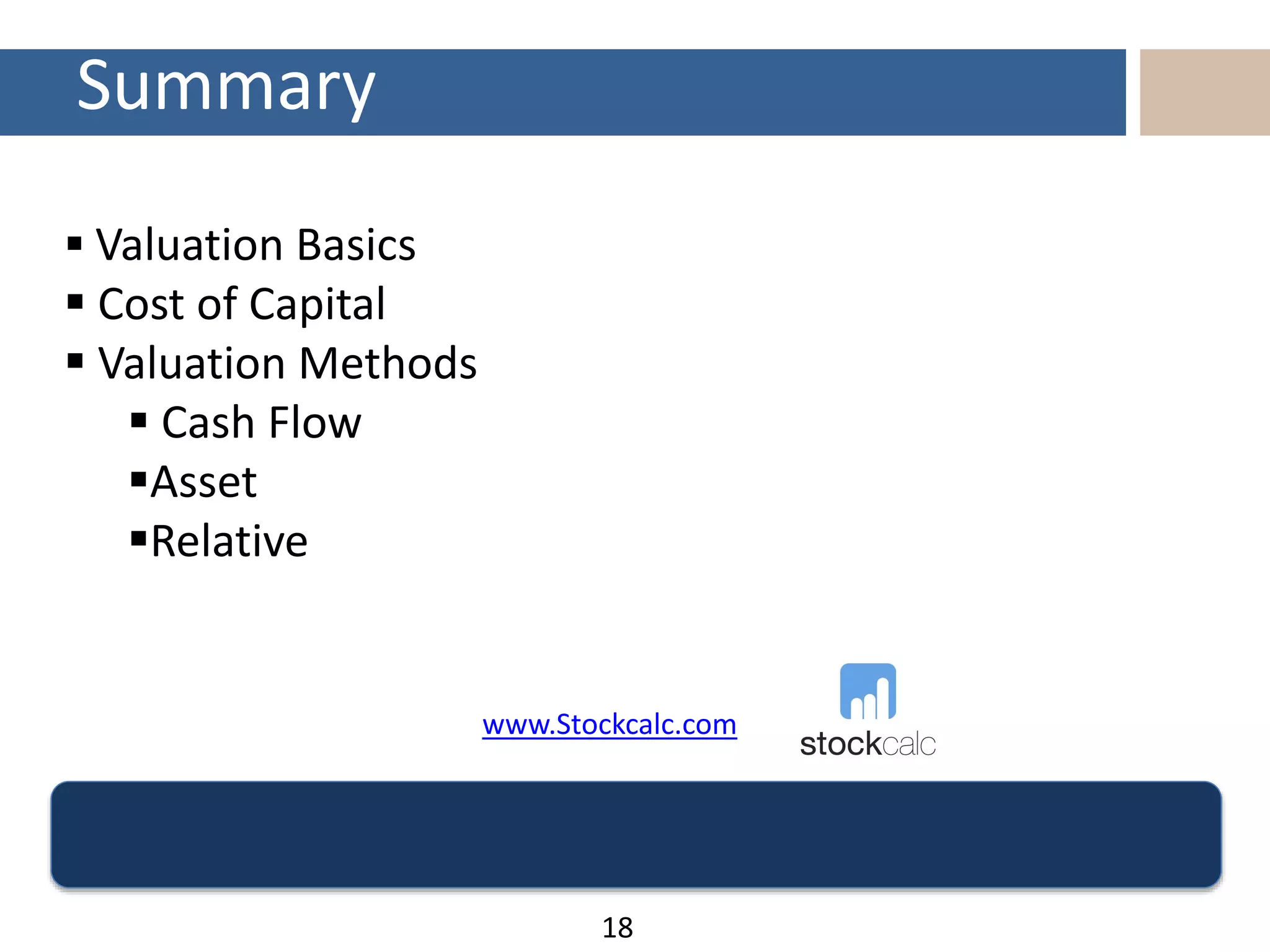
 Valuation Basics
 Cost of Capital
 Valuation Methods
 Cash Flow
Asset
Relative
www.Stockcalc.com
Stockcalc Website
19
14 Day Free Trial

Calculate Stock Value - An Introduction to Valuation

  • 1.
    How to ValueStocks – An Introduction
  • 2.
    Introduction to StockValuation Using the Stockcalc Website
  • 3.
    Overview  Valuation Basics– Enterprise and Equity Value  Cost of Capital – How to  Valuation Methods (Cash Flow, Asset, Relative)  Examples  Summary 3
  • 4.
    Valuation Basics 4 Enterprise Valueversus Equity Value Equity Value (Think Value of the stock) Common Stock Price* # Common Shares Outstanding+ Preferred Stock Price* # Preferred Shares Outstanding Enterprise Value (Think Value of the Company) Value of the Equity Plus Value of the Debt or Equity Value = Enterprise Value - Debt
  • 5.
    Valuation Basics 5 Enterprise Valueversus Equity Value So What? Can Determine Equity or Enterprise Value Discount rates differ (Equity Value per share is what we want to know) Also note the difference between Book Value (as shown on the Balance Sheet) and Market Value (what it would sell for)
  • 6.
    Valuation Basics 6 Discount Rates– Used to Calculate Present Value Cost of Common Equity (Ke) Think return investors expect Cost of Preferred Equity (Kp) Think Dividend Rate of Preferred Stock Cost of Debt (Kd) Interest paid / Debt Outstanding Is an after tax rate
  • 7.
    Valuation Basics 7 Discount Rates WeightedAverage Cost of Capital (WACC) % Common Equity * Ke + % Preferred Equity * Ke + % Interest Bearing Debt * Kd * (1-Tax Rate) WACC is used for Enterprise Value Ke is used for Equity Value
  • 8.
    Valuation Methods 8 Fundamental Approaches •Cash Flow Based Valuation Discount Projected Cash Flows • Asset Based Valuation (Adjusted Book, Liquidation) Market Values of Assets – Liabilities • Relative or Comparable Valuation Value based on Comparable Companies
  • 9.
    Valuation Methods 9 Cash FlowBased Valuation Components Projected Cash Flows Terminal Time and Value Discount Rate Debt Shares Outstanding
  • 10.
    Valuation Basics 10 Discounted CashFlow Valuation Widgets Inc. 1 2 3 4 5 WGTS:NYSE 2016 2017 2018 2019 Terminal Cash Flow (MM's) 70 80 90 100 105 Discount Rate 10% 10% 10% 10% 10% Present Value 0.91 0.83 0.75 0.68 0.62 PV Cash Flow 64 66 68 68 65 Terminal Value * (Assuming 2% long term Growth rate) 815 Enterprise Value 1081 * Terminal Value Calculation PV CF * ( 100 / (WACC - Growth Rate ))
  • 11.
    Valuation Basics 11 Discounted CashFlow Valuation Widgets Inc. WGTS:NYSE 2016 2017 2018 2019 Terminal Enterprise Value 1081 Debt (assume) 300 Equity Value 781 Preferred Equity 100 Common Equity 681 Shares Outstanding 50 Value per Share 13.61$ www.Stockcalc.com
  • 12.
    Valuation Methods 12 Asset BasedValuation Adjust the Balance Sheet to Reflect Adjusted Book Value Update Assets and Liabilities on the Balance Sheet to reflect current market conditions Liquidation Value Update Assets and Liabilities on the Balance Sheet to reflect current market conditions + determine gains/losses during a liquidation/bankruptcy
  • 13.
    Valuation Basics 13 Asset BasedValuation – Adjusted Book Value Balance Sheet Summary Book Value Market Value Total Assets 9000 9800 Current Assets 1000 800 Fixed Assets 8000 9000 Total Liabilites + Equity 9000 9800 Current Liabilities 1500 1500 Non-Current Liabilities 6500 6500 Equity (remaining) 1000 1800 Shares Outstanding 1000 1000 Value Per Share 1.00$ 1.80$ Book Value - As shown on Balance Sheet Market Value - Value if sold on open market www.Stockcalc.com
  • 14.
    Valuation Basics 14 Asset BasedValuation – Liquidation Value Assets 9800 Disposition Costs 250 Liabilities 8000 Net 1550 # Months to Liquidate 6 Profit/Loss During -600 Liquidation Costs 200 Taxes 262 Equity Remaining 488 Preferred Shares 0 Equity for Common 488 Shares Outstanding 1000 Liquidation Value per Share 0.49$ www.Stockcalc.com
  • 15.
    Valuation Methods 15 Relative orComparable Valuations Value w/Metrics from Comparable Companies Comparable Companies Industry, Company Size, Geography, Technology, Financials, Risk, Liquidity Metrics Price to: Earnings, Cash Flow, Book, Sales Enterprise Value to EBITDA
  • 16.
    Valuation Basics 16 Relative orComparable Valuations www.Stockcalc.com Comparable Company Values
  • 17.
    Valuation Basics 17 Relative orComparable Valuations www.Stockcalc.com Price Calculated as Average Values from Comparable Companies Times End Date Values for company being Valued Ex: PE Based 17.82 * $2.34 = $41.63 (may be rounding) Price to Cash Flow: 11.09*$3.94 = $43.71
  • 18.
    Summary 18  Valuation Basics Cost of Capital  Valuation Methods  Cash Flow Asset Relative www.Stockcalc.com
  • 19.