Financial
Management
Lecture 9-Week 9
by
Dr. Sehrish Gul
Week 9: Securities and Markets
 Learning Objectives:
 Stocks valuation Models
Types of Common Stock
 Although most firms have only one type of common stock,
in some instances, classified stock is used to meet special
needs. Generally, when special classifications are used, one
type is designated Class A, another Class B, and so forth.
 The key difference is that the Class B stock has 10 votes per
share while the Class A stock has 1 vote per share. Google’s
Class B shares are predominantly held by the company’s
two founders and its current CEO.
 The use of classified stock enables the company’s founders
to maintain control over the company without having to
own a majority of the common stock. For this reason, Class
B stock of this type is sometimes called founders’ shares.
Stock Price versus Intrinsic
Value
 The stock price is simply the current
market price, and it is easily observed
for publicly traded companies.
 By contrast, intrinsic value, which
represents the “true” value of the
company’s stock, cannot be directly
observed and must instead be
estimated.
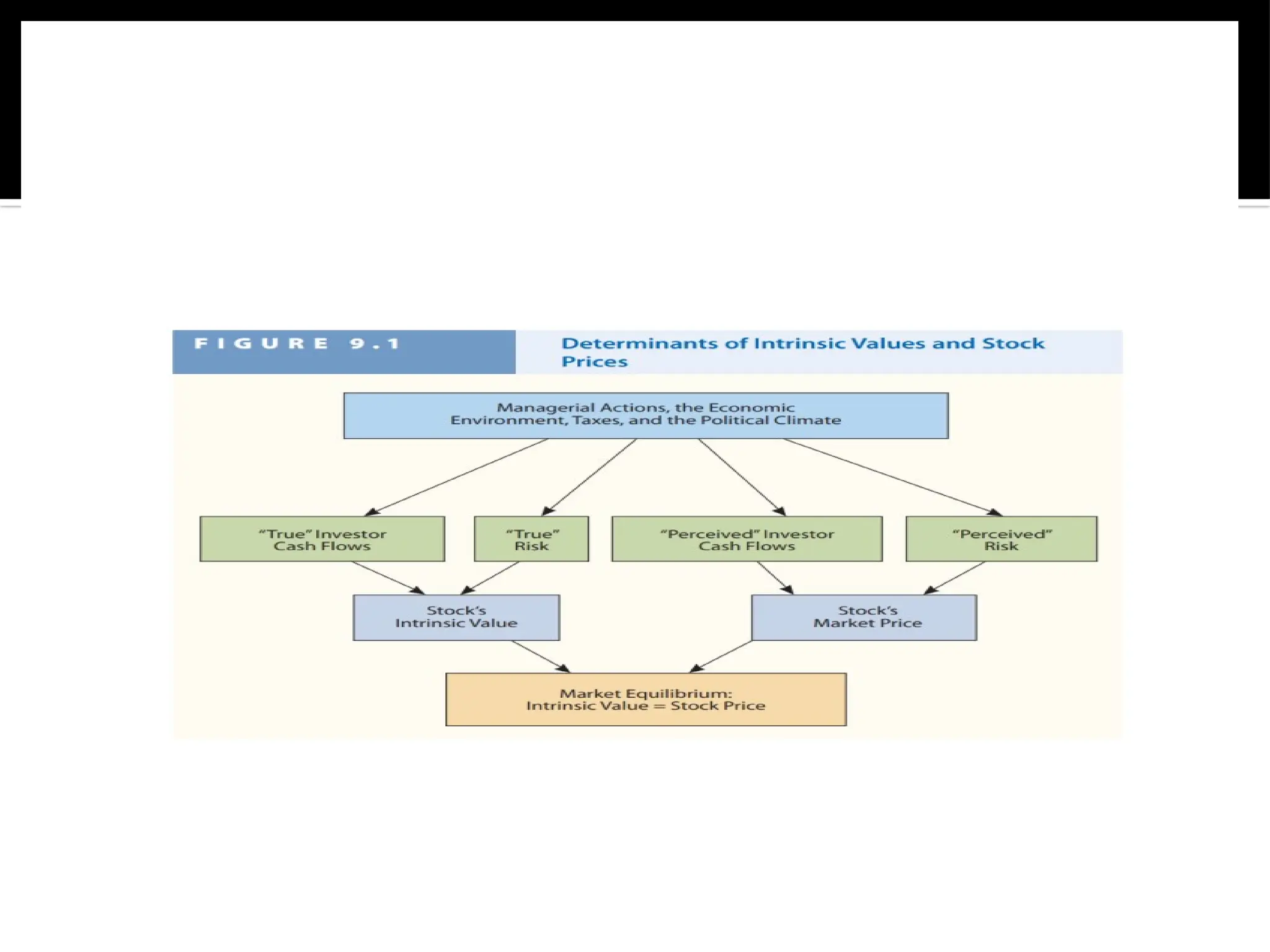
 If the stock market is reasonably
efficient, gaps between the stock price
and intrinsic value should not be very
large, and they should not persist for
very long.
 However, in some cases, an individual
company’s stock may trade for an
extended period of time at a price much
higher or lower than its intrinsic value.
 When investing in common stocks,
one’s goal for investors is to purchase
stocks that are undervalued (i.e., the
price is below the stock’s intrinsic value)
and avoid stocks that are overvalued.
 Managers should consider whether
their stock is significantly undervalued
or overvalued before making certain
decisions.
Models for Stock’s valaution
 Two basic models are used to estimate
intrinsic values: the discounted
dividend model and the corporate
valuation model.
 The dividend model focuses on
dividends, while the corporate model
goes beyond dividends and focuses on
sales, costs, and free cash flows.
The Discounted Dividend
Model
 The value of a share of common stock
depends on the cash flows it is
expected to provide, and those cash
flows consist of two elements:
 (1) the dividends the investor receives
each year while he or she holds the
stock and
 (2) the price received when the stock is
sold.
The Discounted Dividend Model…
 The following terms are used in our analysis:
 Dt = the dividend a stockholder expects to receive at the end
of each Year t.
 D0 is the last dividend the company paid. Because it has
already been paid, a buyer of the stock will not receive D0 .
 The first dividend a new buyer will receive is D1 , which is
paid at the end of Year 1.
 D2 is the dividend expected at the end of Year 2; D3 , at the
end of Year 3; and so forth. D0 is known with certainty, but
D1 , D2 , and all other future dividends are expected values,
and different investors can have different expectations.
Share Price (Actual & Expected)
 Market Price, P0 The price at which a stock sells in
the market.
 P0 is known with certainty, but predicted future
prices are subject to uncertainty.
 P^t both the expected price and the expected
intrinsic value of the stock at the end of each Year t
(pronounced “P hat t”) as seen by the investor
doing the analysis.
 P^ t is based on the investor’s estimates of the
dividend stream and the riskiness of that stream.
Expected growth rate (g)
 g = expected growth rate g in dividends
as predicted by an investor.
 If dividends are expected to grow at a
constant rate, g should also equal the
expected growth rate in earnings and
the stock’s price.
Required, or minimum acceptable
rate of return (rs )
 rs = required, or minimum acceptable,
rate of return on the stock considering
its riskiness and the returns available
on other investments.
 The determinants of rs include factors
the real rate of return, expected
inflation, and risk.
Expected rate of return (r^s)
 r^s = expected rate of return (pronounced “r
hat s”) that an investor believes the stock will
provide in the future.
 The expected return can be above or below
the required return, but a rational investor will
buy the stock if r^s exceeds rs , sell the stock if
r^s is less than rs , and simply hold the stock if
these returns are equal.
 Stock is at equilibrium when rs and r^s are
equal.
Actual, or realized Return
 rs = actual, or realized, after-the-fact
rate of return, pronounced “r bar s.”
You can expect to obtain a return of rs 5
10% if you buy a stock today, but if the
market declines, you may earn an
actual realized return that is much
lower, perhaps even negative.
Dividend yield
 The expected dividend divided by the
current price of a share of stock.
 D1 /P0 = dividend yield expected during
the coming year.
 If Company X’s stock is expected to pay a
dividend of D1 = $1 during the next 12
months and if X’s current price is P0 = $20,
the expected dividend yield will be $1/$20
= 0.05 = 5%.
Capital gains yield
 Capital Gains Yield The capital gain during a
given year divided by the beginning price.
 (P^1 - P0)/P0 = expected capital gains yield
on the stock during the coming year.
 If the stock sells for $20.00 today and if it is
expected to rise to $21.00 by the end of the
year, the expected capital gain will be (P^1 -
P0) = $21.00 - $20.00 = $1.00 and the
expected capital gains yield will be
$1.00/$20.00 = 0.05 = 5%.
Expected Total Return
 The sum of the expected dividend yield
and the expected capital gains yield.
 Expected total return = r^s = expected
dividend yield (D1 /P0 ) plus expected
capital gains yield f(P^1-P0)/P0.
 In our example, the expected total
return = 5% + 5% = 10%.
Dividend Discount Model
Constant Growth Stocks
Zero Growth Stock
 Zero Growth Stock
 A common stock whose future
dividends are not expected to grow at
all; that is, g= 0.
Problem (Solution on next
slide)
 Firm A is expected to pay a dividend of
$1.00 at the end of the year. The
required rate of return is rs = 11%.
Other things held constant, what would
the stock’s price be if the growth rate
was 5%? What if g was 0%?
 ($16.67, $9.09)
Solution
Preferred Stock
 Preferred Stock
 A preferred stock entitles its owners to
regular, fixed dividend payments. If the
payments last forever, the issue is a
perpetuity whose value, Vp, is found as
follows:
PREFERRED STOCK VALUATION
Full Solution on next slide
 Example Question
 Earley Corporation issued perpetual preferred stock with
an 8% annual dividend. The stock currently yields 7%,
and its par value is $100. a. What is the stock’s value?
 we can solve for the expected rate of return on preferred
stock as follows:
 Dividend= 0.08* 100= 8$
 Rearrange the formula to find Vp
 Vp= 8/0.07= 114.28 Ans
Solution
PREFERRED STOCK RETURNS
Solution on Next Slide
 Example Question
 Avondale Aeronautics has perpetual
preferred stock outstanding with a par
value of $100. The stock pays a
quarterly dividend of $1.00 and its
current price is $45. What is its nominal
annual rate of return?
 rp = Dp/ Vp
Solution
Homework
 CONSTANT GROWTH STOCK VALUATION
Fletcher Company’s current stock price
is $36.00, its last dividend was $2.40,
and its required rate of return is 12%. If
dividends are expected to grow at a
constant rate, g, in the future, and if rs
is expected to remain at 12%, what is
Fletcher’s expected stock price 5 years
from now?
Remaining Solution on Next Slide
Homework
 CONSTANT GROWTH VALUATION
 Holtzman Clothiers’s stock currently
sells for $38.00 a share. It just paid a
dividend of $2.00 a share (i.e., D0 =
$2.00). The dividend is expected to
grow at a constant rate of 5% a year.
What stock price is expected 1 year
from now? What is the required rate of
return?
Solution (Part 1)
Solution (Part 2)
Solution (Part 3)
Short Solution without
explanation
Homework
 CONSTANT GROWTH VALUATION
 Tresnan Brothers is expected to pay a
$1.80 per share dividend at the end of
the year (i.e., D1 = $1.80). The dividend
is expected to grow at a constant rate
of 4% a year. The required rate of return
on the stock, rs , is 10%. What is the
stock’s current value per share?
Solution
Valuing Non-constant Growth
Stocks
 For many companies, it is not appropriate to
assume that dividends will grow at a constant rate.
 Indeed, most firms go through life cycles where
they experience different growth rates during
different parts of the cycle.
 In their early years, most firms grow much faster
than the economy as a whole; then they match the
economy’s growth; and finally they grow at a
slower rate than the economy.
 Microsoft & Google
Valuing Non-constant Growth
Stocks
Thank You

Stocks Valuation Learning Objectives: Stocks valuation : Models pptx

  • 1.
  • 2.
    Week 9: Securitiesand Markets  Learning Objectives:  Stocks valuation Models
  • 3.
    Types of CommonStock  Although most firms have only one type of common stock, in some instances, classified stock is used to meet special needs. Generally, when special classifications are used, one type is designated Class A, another Class B, and so forth.  The key difference is that the Class B stock has 10 votes per share while the Class A stock has 1 vote per share. Google’s Class B shares are predominantly held by the company’s two founders and its current CEO.  The use of classified stock enables the company’s founders to maintain control over the company without having to own a majority of the common stock. For this reason, Class B stock of this type is sometimes called founders’ shares.
  • 4.
    Stock Price versusIntrinsic Value  The stock price is simply the current market price, and it is easily observed for publicly traded companies.  By contrast, intrinsic value, which represents the “true” value of the company’s stock, cannot be directly observed and must instead be estimated.
  • 5.
     If thestock market is reasonably efficient, gaps between the stock price and intrinsic value should not be very large, and they should not persist for very long.  However, in some cases, an individual company’s stock may trade for an extended period of time at a price much higher or lower than its intrinsic value.
  • 7.
     When investingin common stocks, one’s goal for investors is to purchase stocks that are undervalued (i.e., the price is below the stock’s intrinsic value) and avoid stocks that are overvalued.  Managers should consider whether their stock is significantly undervalued or overvalued before making certain decisions.
  • 8.
    Models for Stock’svalaution  Two basic models are used to estimate intrinsic values: the discounted dividend model and the corporate valuation model.  The dividend model focuses on dividends, while the corporate model goes beyond dividends and focuses on sales, costs, and free cash flows.
  • 9.
    The Discounted Dividend Model The value of a share of common stock depends on the cash flows it is expected to provide, and those cash flows consist of two elements:  (1) the dividends the investor receives each year while he or she holds the stock and  (2) the price received when the stock is sold.
  • 10.
    The Discounted DividendModel…  The following terms are used in our analysis:  Dt = the dividend a stockholder expects to receive at the end of each Year t.  D0 is the last dividend the company paid. Because it has already been paid, a buyer of the stock will not receive D0 .  The first dividend a new buyer will receive is D1 , which is paid at the end of Year 1.  D2 is the dividend expected at the end of Year 2; D3 , at the end of Year 3; and so forth. D0 is known with certainty, but D1 , D2 , and all other future dividends are expected values, and different investors can have different expectations.
  • 11.
    Share Price (Actual& Expected)  Market Price, P0 The price at which a stock sells in the market.  P0 is known with certainty, but predicted future prices are subject to uncertainty.  P^t both the expected price and the expected intrinsic value of the stock at the end of each Year t (pronounced “P hat t”) as seen by the investor doing the analysis.  P^ t is based on the investor’s estimates of the dividend stream and the riskiness of that stream.
  • 12.
    Expected growth rate(g)  g = expected growth rate g in dividends as predicted by an investor.  If dividends are expected to grow at a constant rate, g should also equal the expected growth rate in earnings and the stock’s price.
  • 13.
    Required, or minimumacceptable rate of return (rs )  rs = required, or minimum acceptable, rate of return on the stock considering its riskiness and the returns available on other investments.  The determinants of rs include factors the real rate of return, expected inflation, and risk.
  • 14.
    Expected rate ofreturn (r^s)  r^s = expected rate of return (pronounced “r hat s”) that an investor believes the stock will provide in the future.  The expected return can be above or below the required return, but a rational investor will buy the stock if r^s exceeds rs , sell the stock if r^s is less than rs , and simply hold the stock if these returns are equal.  Stock is at equilibrium when rs and r^s are equal.
  • 15.
    Actual, or realizedReturn  rs = actual, or realized, after-the-fact rate of return, pronounced “r bar s.” You can expect to obtain a return of rs 5 10% if you buy a stock today, but if the market declines, you may earn an actual realized return that is much lower, perhaps even negative.
  • 16.
    Dividend yield  Theexpected dividend divided by the current price of a share of stock.  D1 /P0 = dividend yield expected during the coming year.  If Company X’s stock is expected to pay a dividend of D1 = $1 during the next 12 months and if X’s current price is P0 = $20, the expected dividend yield will be $1/$20 = 0.05 = 5%.
  • 17.
    Capital gains yield Capital Gains Yield The capital gain during a given year divided by the beginning price.  (P^1 - P0)/P0 = expected capital gains yield on the stock during the coming year.  If the stock sells for $20.00 today and if it is expected to rise to $21.00 by the end of the year, the expected capital gain will be (P^1 - P0) = $21.00 - $20.00 = $1.00 and the expected capital gains yield will be $1.00/$20.00 = 0.05 = 5%.
  • 18.
    Expected Total Return The sum of the expected dividend yield and the expected capital gains yield.  Expected total return = r^s = expected dividend yield (D1 /P0 ) plus expected capital gains yield f(P^1-P0)/P0.  In our example, the expected total return = 5% + 5% = 10%.
  • 19.
  • 20.
  • 21.
    Zero Growth Stock Zero Growth Stock  A common stock whose future dividends are not expected to grow at all; that is, g= 0.
  • 22.
    Problem (Solution onnext slide)  Firm A is expected to pay a dividend of $1.00 at the end of the year. The required rate of return is rs = 11%. Other things held constant, what would the stock’s price be if the growth rate was 5%? What if g was 0%?  ($16.67, $9.09)
  • 23.
  • 24.
    Preferred Stock  PreferredStock  A preferred stock entitles its owners to regular, fixed dividend payments. If the payments last forever, the issue is a perpetuity whose value, Vp, is found as follows:
  • 25.
    PREFERRED STOCK VALUATION FullSolution on next slide  Example Question  Earley Corporation issued perpetual preferred stock with an 8% annual dividend. The stock currently yields 7%, and its par value is $100. a. What is the stock’s value?  we can solve for the expected rate of return on preferred stock as follows:  Dividend= 0.08* 100= 8$  Rearrange the formula to find Vp  Vp= 8/0.07= 114.28 Ans
  • 26.
  • 27.
    PREFERRED STOCK RETURNS Solutionon Next Slide  Example Question  Avondale Aeronautics has perpetual preferred stock outstanding with a par value of $100. The stock pays a quarterly dividend of $1.00 and its current price is $45. What is its nominal annual rate of return?  rp = Dp/ Vp
  • 28.
  • 29.
    Homework  CONSTANT GROWTHSTOCK VALUATION Fletcher Company’s current stock price is $36.00, its last dividend was $2.40, and its required rate of return is 12%. If dividends are expected to grow at a constant rate, g, in the future, and if rs is expected to remain at 12%, what is Fletcher’s expected stock price 5 years from now?
  • 30.
  • 32.
    Homework  CONSTANT GROWTHVALUATION  Holtzman Clothiers’s stock currently sells for $38.00 a share. It just paid a dividend of $2.00 a share (i.e., D0 = $2.00). The dividend is expected to grow at a constant rate of 5% a year. What stock price is expected 1 year from now? What is the required rate of return?
  • 33.
  • 34.
  • 35.
  • 36.
  • 37.
    Homework  CONSTANT GROWTHVALUATION  Tresnan Brothers is expected to pay a $1.80 per share dividend at the end of the year (i.e., D1 = $1.80). The dividend is expected to grow at a constant rate of 4% a year. The required rate of return on the stock, rs , is 10%. What is the stock’s current value per share?
  • 38.
  • 39.
    Valuing Non-constant Growth Stocks For many companies, it is not appropriate to assume that dividends will grow at a constant rate.  Indeed, most firms go through life cycles where they experience different growth rates during different parts of the cycle.  In their early years, most firms grow much faster than the economy as a whole; then they match the economy’s growth; and finally they grow at a slower rate than the economy.  Microsoft & Google
  • 40.
  • 45.

Editor's Notes

  • #3 Note that “Class A,” “Class B,” and so forth have no standard meanings. Most firms have no classified shares, but a firm that does could designate its Class B shares as founders’ shares and its Class A shares as those sold to the public.
  • #14 we know that if the stock is in equilibrium, the required rate of return must equal the expected rate of return, which is the expected dividend yield plus an expected capital gains yield.
  • #19 Above is a generalized stock valuation model in the sense that the time pattern of Dt can be anything: Dt can be rising, falling, or fluctuating randomly, or it can be zero for several years.
  • #20 For many companies it is reasonable to predict that dividends will grow at a constant rate. In this case, model will be as given above. This is the constant growth, or Gordon, model, named after Myron J. Gordon, who did much to develop and popularize it. The term rs in Equation is the required rate of return, which is a riskless rate plus a risk premium. However, we know that if the stock is in equilibrium, the required rate of return must equal the expected rate of return, which is the expected dividend yield plus an expected capital gains yield.
  • #21 it is simply the current dividend divided by the required rate of return. where the dividend is expected to remain constant over time. If g = 0
  • #22 D1= 1$ rs= 11% g= 5% If g= 0% P1=? In constant growth model P1= D1/ rs- g = 1$/ 0.11- 0.05 =1/0.06 P1=16.67$ If g=0% P1= D1/ rs-g P1= 1$/ 0.11-0 P1= 9.09$
  • #25 Dividend=Dp= 8% of face vlalue(1000= 0.08* 100= 8$ rp= 7% Vp=? Vp= Dp/rp Vp= 8/0.07= 114.28 Ans
  • #27 P0= $45 Dp= 1$ rp = ? rp = Dp/ Vp rp = 1/ 45= 0.022 OR 2.22% Ans
  • #29 Po= 36$ D0= 2.40$ rs= 12% g = not given P5= ? The first step is to solve for g, the unknown variable, in the constant growth equation. Because D1 is unknown, but D0 is known, substitute D1=D0 (1+ g) for D1 as follows: Since P0= D1/ rs – g P0= D0 (1+g)/ rs-g 36$ = 2.40(1+g)/ 0.12- g 36* (0.12-g)= 2.40 (1+ g) 4.32- 36g = 2.40+ 2.40g 4.32-2.40= 2.40g + 36g 1.92= 38.4g g= 38.4/1.92 g= 0.05 or 5% P^= D1/ rs –g P5= D1/ rs –g = D0(1+g)^6 / rs - g = 2.40( 1+0.05) ^6 / 0.12- 0.05 =3.22/ 0.07 =46
  • #32 Solution: Po= 38$ D0= 2$ g = 5% P1=? rs =? rs= D1/Po + g D1= D0(1+g)= 2(1+ 0.05)= 2.1 rs= 2.1/38+ 0.05 = 0.055+0.05= 0.105=10.5% rs = 10.5% P1= D1/ rs-g = 2.1/ (0.105 – 0.05) P1= 38.18 rs = 10.5% P1= 38.18$
  • #37 Solution: D1= 1.80$ g= 4% rs= 10% Po=? In Constant growth model Po= D1/ rs-g = 1.80/ (0.10- 0.04) = 1.80/ 0.06 Po = 30$ Ans