COLOUR
PHYSICAL THEORIE OF COLOUR
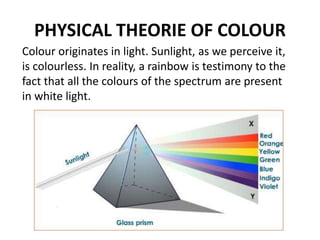
Colour originates in light. Sunlight, as we perceive it,
is colourless. In reality, a rainbow is testimony to the
fact that all the colours of the spectrum are present
in white light.
PHYSICAL THEORIE OF COLOUR
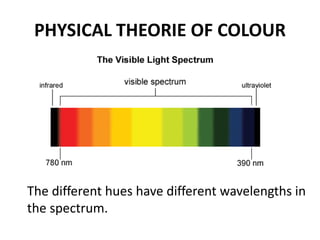
The different hues have different wavelengths in
the spectrum.
How the Eye Sees Colour
"Colour is the visual effect that is
caused by the spectral composition
of the light emitted, transmitted, or
reflected by objects.“
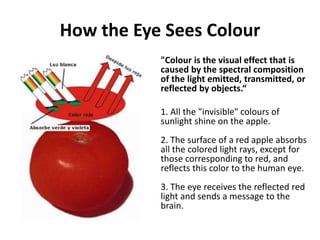
1. All the "invisible" colours of
sunlight shine on the apple.
2. The surface of a red apple absorbs
all the colored light rays, except for
those corresponding to red, and
reflects this color to the human eye.
3. The eye receives the reflected red
light and sends a message to the
brain.
Additive and subtractive
Color System
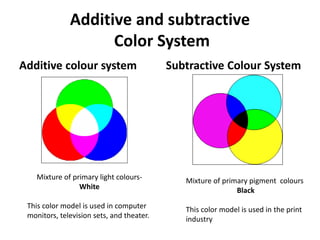
Additive colour system Subtractive Colour System
Mixture of primary light colours-
White
This color model is used in computer
monitors, television sets, and theater.
Mixture of primary pigment colours
Black
This color model is used in the print
industry
Additive Color System
Red - Green - Blue (RGB)
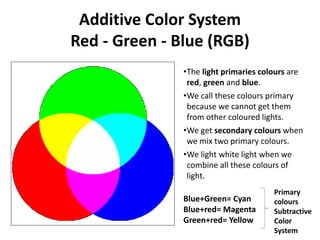
•The light primaries colours are
red, green and blue.
•We call these colours primary
because we cannot get them
from other coloured lights.
•We get secondary colours when
we mix two primary colours.
•We light white light when we
combine all these colours of
light.
Blue+Green= Cyan
Blue+red= Magenta
Green+red= Yellow
Primary
colours
Subtractive
Color
System
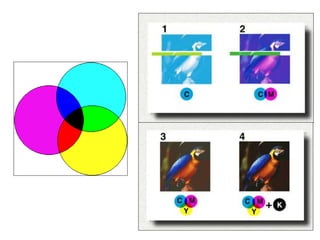
Subtractive Color System (CMYK )
Cyan - Magenta - Yellow - Black
They painst we use are made of
coloured power mixed with
different subsances. (Pigment+
Binder)
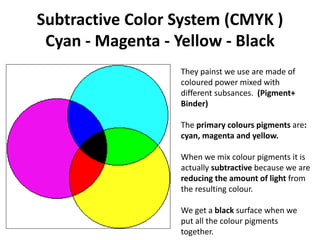
The primary colours pigments are:
cyan, magenta and yellow.
When we mix colour pigments it is
actually subtractive because we are
reducing the amount of light from
the resulting colour.
We get a black surface when we
put all the colour pigments
together.
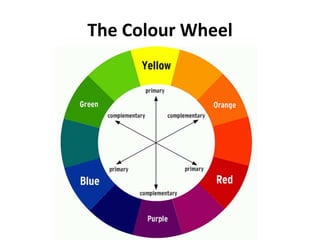
The Colour Wheel
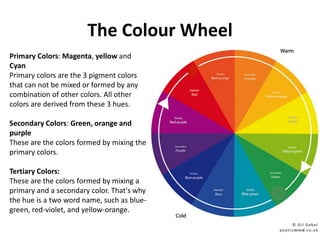
The Colour Wheel
Primary Colors: Magenta, yellow and
Cyan
Primary colors are the 3 pigment colors
that can not be mixed or formed by any
combination of other colors. All other
colors are derived from these 3 hues.
Secondary Colors: Green, orange and
purple
These are the colors formed by mixing the
primary colors.
Tertiary Colors:
These are the colors formed by mixing a
primary and a secondary color. That's why
the hue is a two word name, such as blue-
green, red-violet, and yellow-orange.
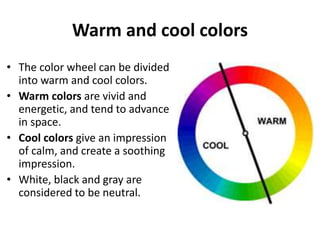
Warm and cool colors
• The color wheel can be divided
into warm and cool colors.
• Warm colors are vivid and
energetic, and tend to advance
in space.
• Cool colors give an impression
of calm, and create a soothing
impression.
• White, black and gray are
considered to be neutral.
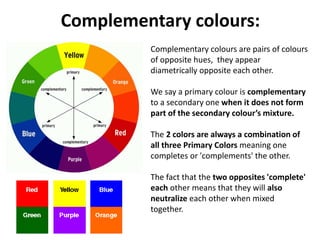
Complementary colours:
Complementary colours are pairs of colours
of opposite hues, they appear
diametrically opposite each other.
We say a primary colour is complementary
to a secondary one when it does not form
part of the secondary colour’s mixture.
The 2 colors are always a combination of
all three Primary Colors meaning one
completes or 'complements' the other.
The fact that the two opposites 'complete'
each other means that they will also
neutralize each other when mixed
together.
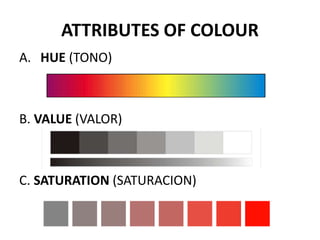
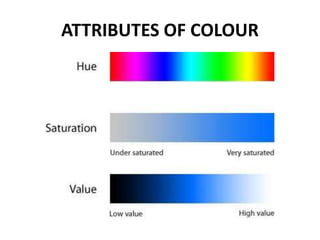
ATTRIBUTES OF COLOUR
A. HUE (TONO)
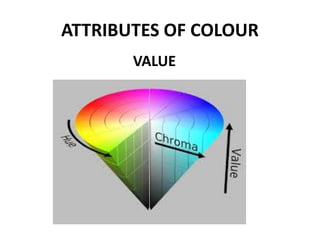
B. VALUE (VALOR)
C. SATURATION (SATURACION)
ATTRIBUTES OF COLOUR
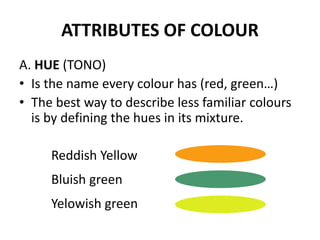
A. HUE (TONO)
• Is the name every colour has (red, green…)
• The best way to describe less familiar colours
is by defining the hues in its mixture.
Reddish Yellow
Bluish green
Yelowish green
ATTRIBUTES OF COLOUR
VALUE
ATTRIBUTES OF COLOUR
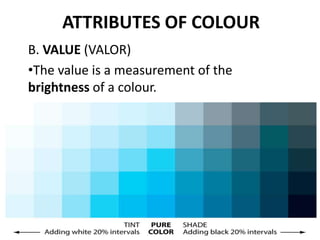
B. VALUE (VALOR)
•The value is a measurement of the
brightness of a colour.
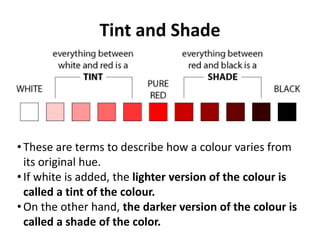
Tint and Shade
• These are terms to describe how a colour varies from
its original hue.
• If white is added, the lighter version of the colour is
called a tint of the colour.
• On the other hand, the darker version of the colour is
called a shade of the color.
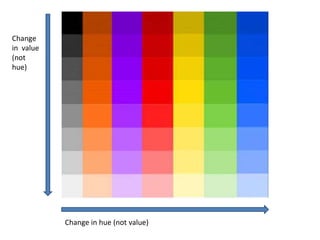
Change
in value
(not
hue)
Change in hue (not value)
ATTRIBUTES OF COLOUR
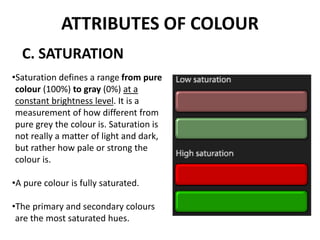
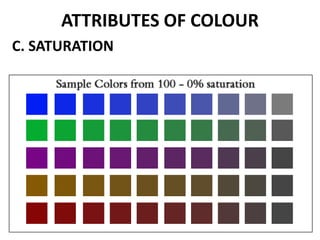
C. SATURATION
•Saturation defines a range from pure
colour (100%) to gray (0%) at a
constant brightness level. It is a
measurement of how different from
pure grey the colour is. Saturation is
not really a matter of light and dark,
but rather how pale or strong the
colour is.
•A pure colour is fully saturated.
•The primary and secondary colours
are the most saturated hues.
ATTRIBUTES OF COLOUR
C. SATURATION
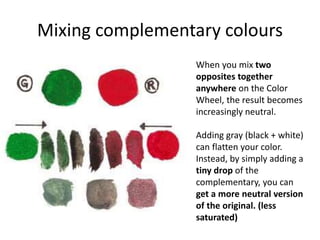
Mixing complementary colours
When you mix two
opposites together
anywhere on the Color
Wheel, the result becomes
increasingly neutral.
Adding gray (black + white)
can flatten your color.
Instead, by simply adding a
tiny drop of the
complementary, you can
get a more neutral version
of the original. (less
saturated)
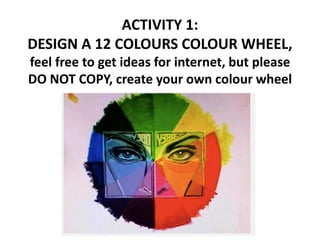
ACTIVITY 1:
DESIGN A 12 COLOURS COLOUR WHEEL,
feel free to get ideas for internet, but please
DO NOT COPY, create your own colour wheel
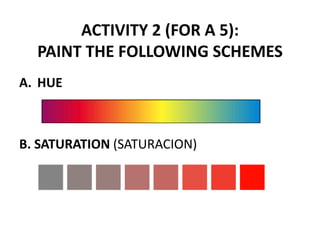
ACTIVITY 2 (FOR A 5):
PAINT THE FOLLOWING SCHEMES
A. HUE
B. SATURATION (SATURACION)
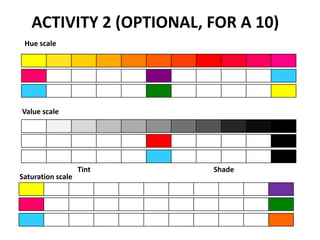
ACTIVITY 2 (OPTIONAL, FOR A 10)
Hue scale
Value scale
Saturation scale
Tint Shade
ACTIVITY 3:
VIEWFINDER
Select a work of art (from any of the art
movements we study in class) print it, bring it to
class and choose an area. You will reproduce that
area in your artbook.
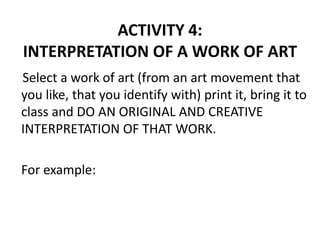
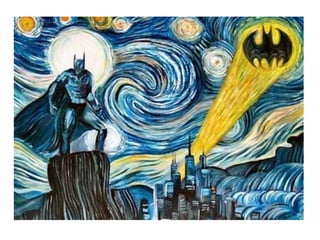
ACTIVITY 4:
INTERPRETATION OF A WORK OF ART
Select a work of art (from an art movement that
you like, that you identify with) print it, bring it to
class and DO AN ORIGINAL AND CREATIVE
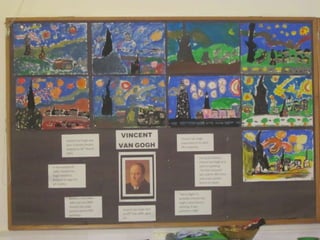
INTERPRETATION OF THAT WORK.
For example:
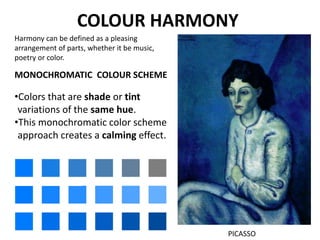
COLOUR HARMONY
MONOCHROMATIC COLOUR SCHEME
•Colors that are shade or tint
variations of the same hue.
•This monochromatic color scheme
approach creates a calming effect.
PICASSO
Harmony can be defined as a pleasing
arrangement of parts, whether it be music,
poetry or color.
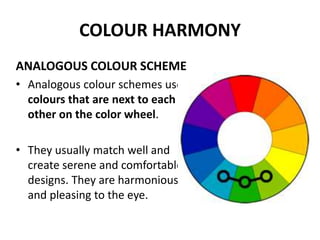
COLOUR HARMONY
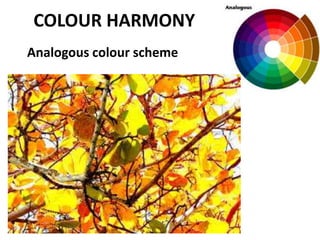
ANALOGOUS COLOUR SCHEME
• Analogous colour schemes use
colours that are next to each
other on the color wheel.
• They usually match well and
create serene and comfortable
designs. They are harmonious
and pleasing to the eye.
Analogous colour scheme
COLOUR HARMONY
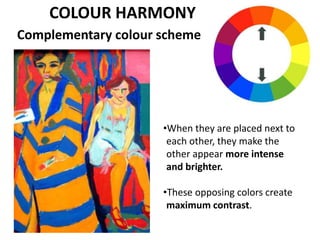
Complementary colour scheme
•When they are placed next to
each other, they make the
other appear more intense
and brighter.
•These opposing colors create
maximum contrast.
COLOUR HARMONY
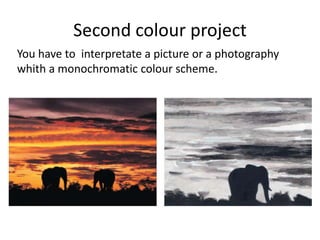
Second colour project
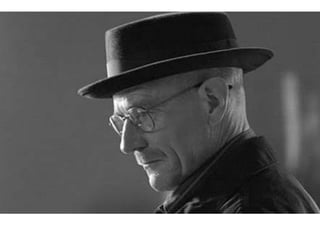
You have to interpretate a picture or a photography
whith a monochromatic colour scheme.
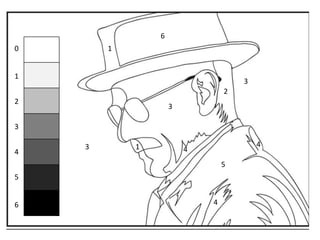
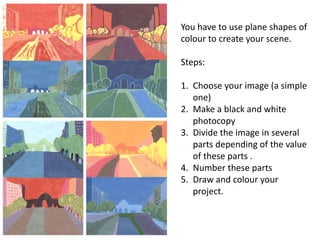
You have to use plane shapes of
colour to create your scene.
Steps:
1. Choose your image (a simple
one)
2. Make a black and white
photocopy
3. Divide the image in several
parts depending of the value
of these parts .
4. Number these parts
5. Draw and colour your
project.
6
1
2
1
3
5
3
3
4
4
4
1
2
3
4
5
6
0
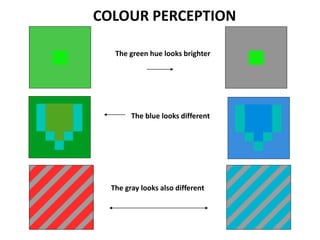
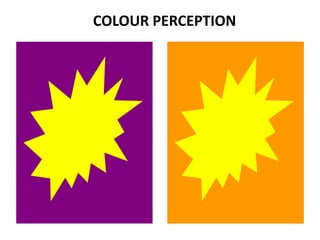
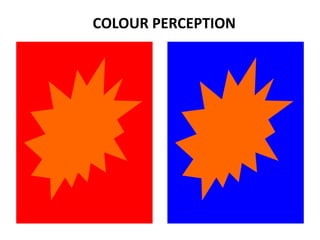
COLOUR PERCEPTION
The green hue looks brighter
The blue looks different
The gray looks also different
COLOUR PERCEPTION
COLOUR PERCEPTION
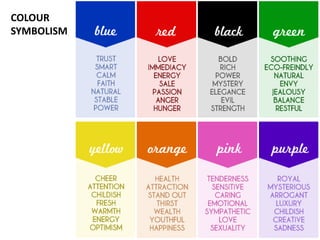
COLOUR
SYMBOLISM
Colour theory II
Colour theory II
Colour theory II
Colour theory II
Colour theory II

Colour theory II

  • 1.
  • 2.
    PHYSICAL THEORIE OFCOLOUR Colour originates in light. Sunlight, as we perceive it, is colourless. In reality, a rainbow is testimony to the fact that all the colours of the spectrum are present in white light.
  • 3.
    PHYSICAL THEORIE OFCOLOUR The different hues have different wavelengths in the spectrum.
  • 4.
    How the EyeSees Colour "Colour is the visual effect that is caused by the spectral composition of the light emitted, transmitted, or reflected by objects.“ 1. All the "invisible" colours of sunlight shine on the apple. 2. The surface of a red apple absorbs all the colored light rays, except for those corresponding to red, and reflects this color to the human eye. 3. The eye receives the reflected red light and sends a message to the brain.
  • 5.
    Additive and subtractive ColorSystem Additive colour system Subtractive Colour System Mixture of primary light colours- White This color model is used in computer monitors, television sets, and theater. Mixture of primary pigment colours Black This color model is used in the print industry
  • 6.
    Additive Color System Red- Green - Blue (RGB) •The light primaries colours are red, green and blue. •We call these colours primary because we cannot get them from other coloured lights. •We get secondary colours when we mix two primary colours. •We light white light when we combine all these colours of light. Blue+Green= Cyan Blue+red= Magenta Green+red= Yellow Primary colours Subtractive Color System
  • 7.
    Subtractive Color System(CMYK ) Cyan - Magenta - Yellow - Black They painst we use are made of coloured power mixed with different subsances. (Pigment+ Binder) The primary colours pigments are: cyan, magenta and yellow. When we mix colour pigments it is actually subtractive because we are reducing the amount of light from the resulting colour. We get a black surface when we put all the colour pigments together.
  • 9.
  • 10.
    The Colour Wheel PrimaryColors: Magenta, yellow and Cyan Primary colors are the 3 pigment colors that can not be mixed or formed by any combination of other colors. All other colors are derived from these 3 hues. Secondary Colors: Green, orange and purple These are the colors formed by mixing the primary colors. Tertiary Colors: These are the colors formed by mixing a primary and a secondary color. That's why the hue is a two word name, such as blue- green, red-violet, and yellow-orange.
  • 11.
    Warm and coolcolors • The color wheel can be divided into warm and cool colors. • Warm colors are vivid and energetic, and tend to advance in space. • Cool colors give an impression of calm, and create a soothing impression. • White, black and gray are considered to be neutral.
  • 12.
    Complementary colours: Complementary coloursare pairs of colours of opposite hues, they appear diametrically opposite each other. We say a primary colour is complementary to a secondary one when it does not form part of the secondary colour’s mixture. The 2 colors are always a combination of all three Primary Colors meaning one completes or 'complements' the other. The fact that the two opposites 'complete' each other means that they will also neutralize each other when mixed together.
  • 13.
    ATTRIBUTES OF COLOUR A.HUE (TONO) B. VALUE (VALOR) C. SATURATION (SATURACION)
  • 14.
  • 15.
    ATTRIBUTES OF COLOUR A.HUE (TONO) • Is the name every colour has (red, green…) • The best way to describe less familiar colours is by defining the hues in its mixture. Reddish Yellow Bluish green Yelowish green
  • 16.
  • 17.
    ATTRIBUTES OF COLOUR B.VALUE (VALOR) •The value is a measurement of the brightness of a colour.
  • 18.
    Tint and Shade •These are terms to describe how a colour varies from its original hue. • If white is added, the lighter version of the colour is called a tint of the colour. • On the other hand, the darker version of the colour is called a shade of the color.
  • 19.
  • 20.
    ATTRIBUTES OF COLOUR C.SATURATION •Saturation defines a range from pure colour (100%) to gray (0%) at a constant brightness level. It is a measurement of how different from pure grey the colour is. Saturation is not really a matter of light and dark, but rather how pale or strong the colour is. •A pure colour is fully saturated. •The primary and secondary colours are the most saturated hues.
  • 21.
  • 24.
    Mixing complementary colours Whenyou mix two opposites together anywhere on the Color Wheel, the result becomes increasingly neutral. Adding gray (black + white) can flatten your color. Instead, by simply adding a tiny drop of the complementary, you can get a more neutral version of the original. (less saturated)
  • 25.
    ACTIVITY 1: DESIGN A12 COLOURS COLOUR WHEEL, feel free to get ideas for internet, but please DO NOT COPY, create your own colour wheel
  • 26.
    ACTIVITY 2 (FORA 5): PAINT THE FOLLOWING SCHEMES A. HUE B. SATURATION (SATURACION)
  • 27.
    ACTIVITY 2 (OPTIONAL,FOR A 10) Hue scale Value scale Saturation scale Tint Shade
  • 28.
    ACTIVITY 3: VIEWFINDER Select awork of art (from any of the art movements we study in class) print it, bring it to class and choose an area. You will reproduce that area in your artbook.
  • 29.
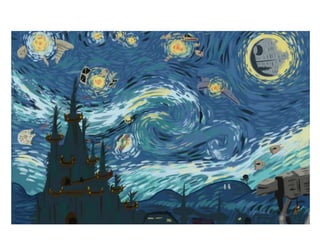
    ACTIVITY 4: INTERPRETATION OFA WORK OF ART Select a work of art (from an art movement that you like, that you identify with) print it, bring it to class and DO AN ORIGINAL AND CREATIVE INTERPRETATION OF THAT WORK. For example:
  • 33.
    COLOUR HARMONY MONOCHROMATIC COLOURSCHEME •Colors that are shade or tint variations of the same hue. •This monochromatic color scheme approach creates a calming effect. PICASSO Harmony can be defined as a pleasing arrangement of parts, whether it be music, poetry or color.
  • 34.
    COLOUR HARMONY ANALOGOUS COLOURSCHEME • Analogous colour schemes use colours that are next to each other on the color wheel. • They usually match well and create serene and comfortable designs. They are harmonious and pleasing to the eye.
  • 35.
  • 36.
    Complementary colour scheme •Whenthey are placed next to each other, they make the other appear more intense and brighter. •These opposing colors create maximum contrast. COLOUR HARMONY
  • 37.
    Second colour project Youhave to interpretate a picture or a photography whith a monochromatic colour scheme.
  • 38.
    You have touse plane shapes of colour to create your scene. Steps: 1. Choose your image (a simple one) 2. Make a black and white photocopy 3. Divide the image in several parts depending of the value of these parts . 4. Number these parts 5. Draw and colour your project.
  • 40.
  • 41.
    COLOUR PERCEPTION The greenhue looks brighter The blue looks different The gray looks also different
  • 42.
  • 43.
  • 44.