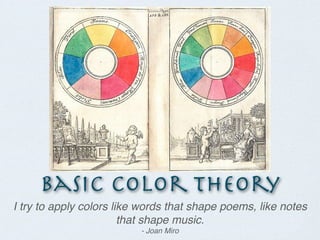
Basic Color Theory
I try to apply colors like words that shape poems, like notes
                        that shape music.
                          - Joan Miro
What is Color?
Color is what we see when light reflects off of an
object.

WHITE = Reflection of all light/color wavelengths.
  When you see something that is white, you are
  seeing all the colors being reflected at you.

BLACK = Absorption or absence of light/color
wavelengths.
   When you see something that is black, you are not
   seeing any colors at all.
Color Spectrum

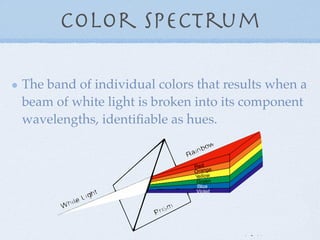
The band of individual colors that results when a
beam of white light is broken into its component
wavelengths, identifiable as hues.
Local Color


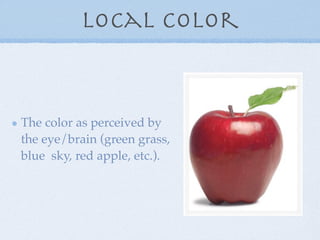
The color as perceived by
the eye/brain (green grass,
blue sky, red apple, etc.).
Properties of Color
Hue = the actual color (ex. red, green, etc.)

Value = the lightness/darkness of a color.
    High-Key Color: Any color that has a value level of
    middle grey or lighter.
    Low-key Color: Any color that has a value level of
    middle grey or darker

Intensity/Chroma = the saturation or purity of a color. A
vivid color is of high intensity/chroma (like blood red),
and a dull color is of low intensity/chroma (like green-
grey).
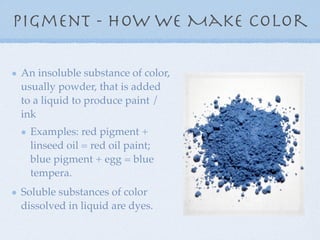
Pigment - How We Make Color

An insoluble substance of color,
usually powder, that is added
to a liquid to produce paint /
ink
  Examples: red pigment +
  linseed oil = red oil paint;
  blue pigment + egg = blue
  tempera.
Soluble substances of color
dissolved in liquid are dyes.
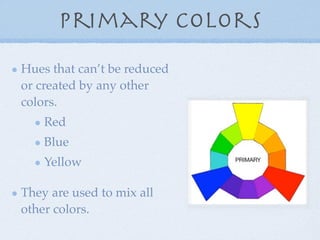
Primary Colors
Hues that can’t be reduced
or created by any other
colors.
    Red
    Blue
    Yellow

They are used to mix all
other colors.
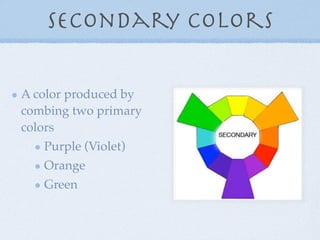
Secondary Colors

A color produced by
combing two primary
colors
   Purple (Violet)
   Orange
   Green
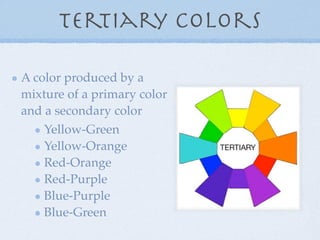
Tertiary Colors

A color produced by a
mixture of a primary color
and a secondary color
    Yellow-Green
    Yellow-Orange
    Red-Orange
    Red-Purple
    Blue-Purple
    Blue-Green
Color Schemes
The choice of colors used in design.

Are used to create style and appeal.

A basic color scheme will use two colors that look
appealing together. More advanced color schemes
involve several colors in combination, usually based
around a single color.

Can also contain different shades of a single color; for
example, a color scheme that mixes different shades of
green, ranging from very light (almost white) to very
dark.
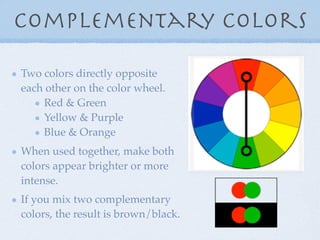
Complementary Colors

Two colors directly opposite
each other on the color wheel.
    Red & Green
    Yellow & Purple
    Blue & Orange
When used together, make both
colors appear brighter or more
intense.
If you mix two complementary
colors, the result is brown/black.
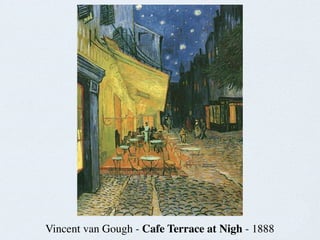
Vincent van Gough - Cafe Terrace at Nigh - 1888
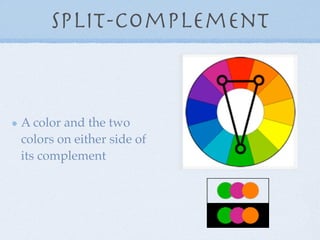
Split-Complement


A color and the two
colors on either side of
its complement
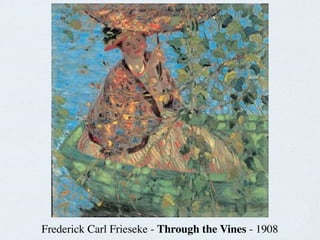
Frederick Carl Frieseke - Through the Vines - 1908
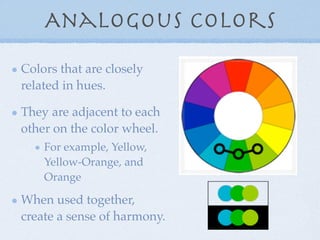
Analogous Colors
Colors that are closely
related in hues.

They are adjacent to each
other on the color wheel.
    For example, Yellow,
    Yellow-Orange, and
    Orange

When used together,
create a sense of harmony.
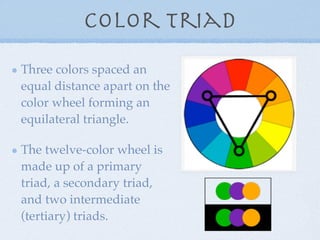
Color Triad
Three colors spaced an
equal distance apart on the
color wheel forming an
equilateral triangle.

The twelve-color wheel is
made up of a primary
triad, a secondary triad,
and two intermediate
(tertiary) triads.
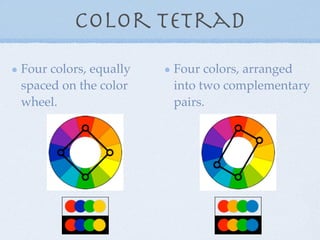
Color Tetrad
Four colors, equally   Four colors, arranged
spaced on the color    into two complementary
wheel.                 pairs.
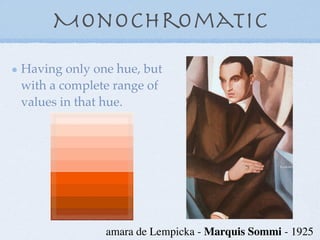
Monochromatic
Having only one hue, but
with a complete range of
values in that hue.


              amara de Lempicka - Marquis Sommi - 1925
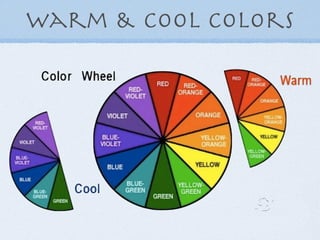
Warm & Cool Colors
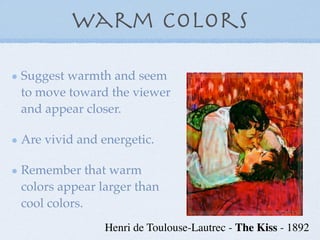
Warm Colors

Suggest warmth and seem
to move toward the viewer
and appear closer.

Are vivid and energetic.

Remember that warm
colors appear larger than
cool colors.
               Henri de Toulouse-Lautrec - The Kiss - 1892
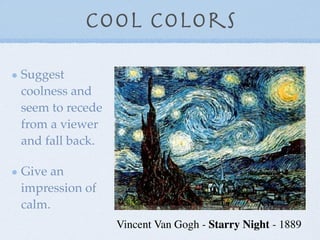
Cool Colors

Suggest
coolness and
seem to recede
from a viewer
and fall back.

Give an
impression of
calm.
                 Vincent Van Gogh - Starry Night - 1889
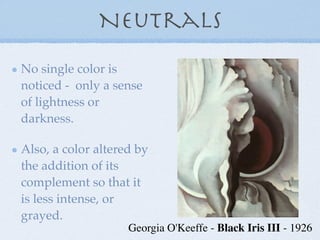
Neutrals
No single color is
noticed - only a sense
of lightness or
darkness.

Also, a color altered by
the addition of its
complement so that it
is less intense, or
grayed.
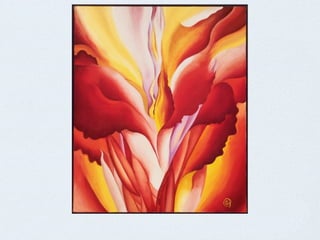
                    Georgia O'Keeffe - Black Iris III - 1926
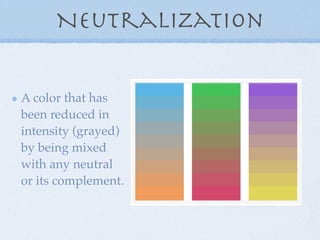
Neutralization


A color that has
been reduced in
intensity (grayed)
by being mixed
with any neutral
or its complement.
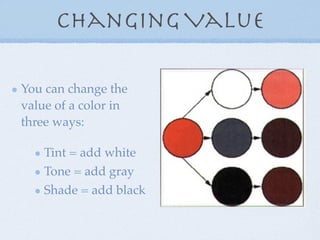
Changing Value

You can change the
value of a color in
three ways:

    Tint = add white
    Tone = add gray
    Shade = add black
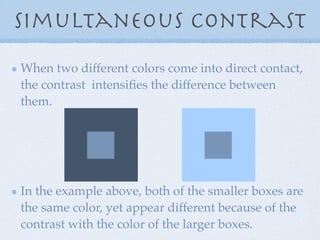
Simultaneous Contrast
When two different colors come into direct contact,
the contrast intensifies the difference between
them.


In the example above, both of the smaller boxes are
the same color, yet appear different because of the
contrast with the color of the larger boxes.

Color Theory

  • 1.
    Basic Color Theory Itry to apply colors like words that shape poems, like notes that shape music. - Joan Miro
  • 2.
    What is Color? Coloris what we see when light reflects off of an object. WHITE = Reflection of all light/color wavelengths. When you see something that is white, you are seeing all the colors being reflected at you. BLACK = Absorption or absence of light/color wavelengths. When you see something that is black, you are not seeing any colors at all.
  • 3.
    Color Spectrum The bandof individual colors that results when a beam of white light is broken into its component wavelengths, identifiable as hues.
  • 4.
    Local Color The coloras perceived by the eye/brain (green grass, blue sky, red apple, etc.).
  • 5.
    Properties of Color Hue= the actual color (ex. red, green, etc.) Value = the lightness/darkness of a color. High-Key Color: Any color that has a value level of middle grey or lighter. Low-key Color: Any color that has a value level of middle grey or darker Intensity/Chroma = the saturation or purity of a color. A vivid color is of high intensity/chroma (like blood red), and a dull color is of low intensity/chroma (like green- grey).
  • 6.
    Pigment - HowWe Make Color An insoluble substance of color, usually powder, that is added to a liquid to produce paint / ink Examples: red pigment + linseed oil = red oil paint; blue pigment + egg = blue tempera. Soluble substances of color dissolved in liquid are dyes.
  • 7.
    Primary Colors Hues thatcan’t be reduced or created by any other colors. Red Blue Yellow They are used to mix all other colors.
  • 8.
    Secondary Colors A colorproduced by combing two primary colors Purple (Violet) Orange Green
  • 9.
    Tertiary Colors A colorproduced by a mixture of a primary color and a secondary color Yellow-Green Yellow-Orange Red-Orange Red-Purple Blue-Purple Blue-Green
  • 10.
    Color Schemes The choiceof colors used in design. Are used to create style and appeal. A basic color scheme will use two colors that look appealing together. More advanced color schemes involve several colors in combination, usually based around a single color. Can also contain different shades of a single color; for example, a color scheme that mixes different shades of green, ranging from very light (almost white) to very dark.
  • 11.
    Complementary Colors Two colorsdirectly opposite each other on the color wheel. Red & Green Yellow & Purple Blue & Orange When used together, make both colors appear brighter or more intense. If you mix two complementary colors, the result is brown/black.
  • 12.
    Vincent van Gough- Cafe Terrace at Nigh - 1888
  • 13.
    Split-Complement A color andthe two colors on either side of its complement
  • 14.
    Frederick Carl Frieseke- Through the Vines - 1908
  • 15.
    Analogous Colors Colors thatare closely related in hues. They are adjacent to each other on the color wheel. For example, Yellow, Yellow-Orange, and Orange When used together, create a sense of harmony.
  • 17.
    Color Triad Three colorsspaced an equal distance apart on the color wheel forming an equilateral triangle. The twelve-color wheel is made up of a primary triad, a secondary triad, and two intermediate (tertiary) triads.
  • 18.
    Color Tetrad Four colors,equally Four colors, arranged spaced on the color into two complementary wheel. pairs.
  • 19.
    Monochromatic Having only onehue, but with a complete range of values in that hue. amara de Lempicka - Marquis Sommi - 1925
  • 20.
  • 21.
    Warm Colors Suggest warmthand seem to move toward the viewer and appear closer. Are vivid and energetic. Remember that warm colors appear larger than cool colors. Henri de Toulouse-Lautrec - The Kiss - 1892
  • 22.
    Cool Colors Suggest coolness and seemto recede from a viewer and fall back. Give an impression of calm. Vincent Van Gogh - Starry Night - 1889
  • 23.
    Neutrals No single coloris noticed - only a sense of lightness or darkness. Also, a color altered by the addition of its complement so that it is less intense, or grayed. Georgia O'Keeffe - Black Iris III - 1926
  • 24.
    Neutralization A color thathas been reduced in intensity (grayed) by being mixed with any neutral or its complement.
  • 25.
    Changing Value You canchange the value of a color in three ways: Tint = add white Tone = add gray Shade = add black
  • 26.
    Simultaneous Contrast When twodifferent colors come into direct contact, the contrast intensifies the difference between them. In the example above, both of the smaller boxes are the same color, yet appear different because of the contrast with the color of the larger boxes.