COLOR
COLOR
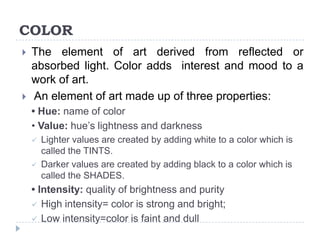
   The element of art derived from reflected or
    absorbed light. Color adds interest and mood to a
    work of art.
   An element of art made up of three properties:
    • Hue: name of color
    • Value: hue’s lightness and darkness
       Lighter values are created by adding white to a color which is
        called the TINTS.
       Darker values are created by adding black to a color which is
        called the SHADES.
    • Intensity: quality of brightness and purity
     High intensity= color is strong and bright;
     Low intensity=color is faint and dull
COLOR WHEEL


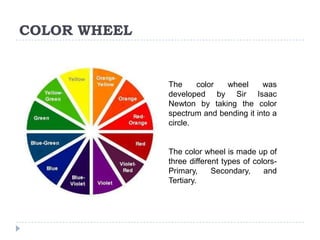
              The     color  wheel      was
              developed by Sir Isaac
              Newton by taking the color
              spectrum and bending it into a
              circle.


              The color wheel is made up of
              three different types of colors-
              Primary,     Secondary,     and
              Tertiary.
PRIMARY COLORS


               The     primary    colors   are
                red, yellow, and blue. They are
                called primary for a couple of
                reasons.
                   First, no two colors can be
                    mixed to create a primary
                    color. In other words, primary
                    colors can only be created
                    through the use of natural
                    pigments.
                   Secondly, all other colors found
                    on the color wheel can be
                    created by mixing primary colors
                    together.
EXAMPLES


 1. Relational Painting No. 64, 1953 by Fritz Glarner
 2. Stepping Out by Roy Lichtenstein
The secondary colors are           Tertiary colors are created by mixing
orange, green, and                 equal parts of a secondary color and a
purple. Secondary colors are       primary color together.
created by mixing equal parts of
any two primary colors.            YELLOW + ORANGE = YELLOW-
                                   ORANGE
YELLOW + RED = ORANGE              RED + ORANGE = RED-ORANGE
RED + BLUE = VIOLET / PURPLE       RED + VIOLET / PURPLE = RED-PURPLE
BLUE + YELLOW = GREEN              BLUE + VIOLET / PURPLE = BLUE-
                                   PURPLE
                                   BLUE + GREEN = BLUE-GREEN
                                   YELLOW + GREEN = YELLOW-GREEN
Color Harmonies


Complementary               Monochromatic harmony — is             Analogous harmony —
harmony — is achieved       otherwise referred to as one-mode      means a combination of
by a combination of any     or one hue harmony. It combines        two or more neigh boring
opposite colors in the      different intensities or values -      colors in the color chart.
color wheel. Blue and       lightness and darkness or
violet, for instance, are   brightness and dullness - of one
complementary colors.       color only. Examples are blue, light
                            blue, dark blue.
Color Harmonies


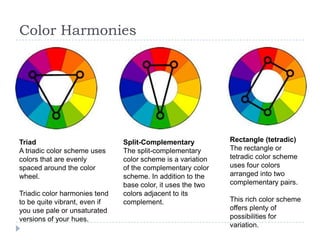
Triad                          Split-Complementary           Rectangle (tetradic)
A triadic color scheme uses    The split-complementary       The rectangle or
colors that are evenly         color scheme is a variation   tetradic color scheme
spaced around the color        of the complementary color    uses four colors
wheel.                         scheme. In addition to the    arranged into two
                               base color, it uses the two   complementary pairs.
Triadic color harmonies tend   colors adjacent to its
to be quite vibrant, even if   complement.                   This rich color scheme
you use pale or unsaturated                                  offers plenty of
versions of your hues.                                       possibilities for
                                                             variation.
   Warm colors- colors that are usually associated with warm
    things.
    Ex. Red, yellow, orange


   Cool colors- colors that are usually associated with cool
    things.
   Ex. Blue, purple, green
NEUTRAL COLORS
EXAMPLES


Morning on the Seine near   Woman Rocking a Cradle
Giverny by Claude Monet     by Vincent van Gogh

Analogous Painting          Complementary Painting
THE RGB MODEL
             Red, green, and blue are the
              primary stimuli for human color
              perception and are the primary
              additive colors.
             The      secondary       colors    of
              RGB,      cyan,     magenta,     and
              yellow, are formed by the mixture of
              two of the primaries and the
              exclusion of the third. Red and
              green      combine        to    make
              yellow, green and blue make
              cyan, blue and red make magenta.
             The combination of red, green, and
              blue in full intensity makes white.
              White light is created when all
              colors of the EM spectrum
              converge in full intensity.
THE CMYK MODEL
(Cyan-Magenta-Yellow-Black)

                   It is a subtractive color model, used in color
                   printing,. Cyan, magenta, and yellow
                   correspond roughly to the primary colors in
                   art production: red, blue, and yellow. Black
                   results from a full combination of colored
                   inks

                   The CMYK model works by partially or
                   entirely masking colors on a lighter, usually
                   white, background. The ink reduces the
                   light that would otherwise be reflected.
                   Such a model is called subtractive because
                   inks "subtract" brightness from white.
DIFFERENCE

Color

  • 1.
  • 2.
    COLOR  The element of art derived from reflected or absorbed light. Color adds interest and mood to a work of art.  An element of art made up of three properties: • Hue: name of color • Value: hue’s lightness and darkness  Lighter values are created by adding white to a color which is called the TINTS.  Darker values are created by adding black to a color which is called the SHADES. • Intensity: quality of brightness and purity  High intensity= color is strong and bright;  Low intensity=color is faint and dull
  • 3.
    COLOR WHEEL The color wheel was developed by Sir Isaac Newton by taking the color spectrum and bending it into a circle. The color wheel is made up of three different types of colors- Primary, Secondary, and Tertiary.
  • 4.
    PRIMARY COLORS  The primary colors are red, yellow, and blue. They are called primary for a couple of reasons.  First, no two colors can be mixed to create a primary color. In other words, primary colors can only be created through the use of natural pigments.  Secondly, all other colors found on the color wheel can be created by mixing primary colors together.
  • 5.
    EXAMPLES 1. RelationalPainting No. 64, 1953 by Fritz Glarner 2. Stepping Out by Roy Lichtenstein
  • 6.
    The secondary colorsare Tertiary colors are created by mixing orange, green, and equal parts of a secondary color and a purple. Secondary colors are primary color together. created by mixing equal parts of any two primary colors. YELLOW + ORANGE = YELLOW- ORANGE YELLOW + RED = ORANGE RED + ORANGE = RED-ORANGE RED + BLUE = VIOLET / PURPLE RED + VIOLET / PURPLE = RED-PURPLE BLUE + YELLOW = GREEN BLUE + VIOLET / PURPLE = BLUE- PURPLE BLUE + GREEN = BLUE-GREEN YELLOW + GREEN = YELLOW-GREEN
  • 7.
    Color Harmonies Complementary Monochromatic harmony — is Analogous harmony — harmony — is achieved otherwise referred to as one-mode means a combination of by a combination of any or one hue harmony. It combines two or more neigh boring opposite colors in the different intensities or values - colors in the color chart. color wheel. Blue and lightness and darkness or violet, for instance, are brightness and dullness - of one complementary colors. color only. Examples are blue, light blue, dark blue.
  • 8.
    Color Harmonies Triad Split-Complementary Rectangle (tetradic) A triadic color scheme uses The split-complementary The rectangle or colors that are evenly color scheme is a variation tetradic color scheme spaced around the color of the complementary color uses four colors wheel. scheme. In addition to the arranged into two base color, it uses the two complementary pairs. Triadic color harmonies tend colors adjacent to its to be quite vibrant, even if complement. This rich color scheme you use pale or unsaturated offers plenty of versions of your hues. possibilities for variation.
  • 9.
    Warm colors- colors that are usually associated with warm things.  Ex. Red, yellow, orange  Cool colors- colors that are usually associated with cool things.  Ex. Blue, purple, green
  • 10.
  • 11.
    EXAMPLES Morning on theSeine near Woman Rocking a Cradle Giverny by Claude Monet by Vincent van Gogh Analogous Painting Complementary Painting
  • 12.
    THE RGB MODEL  Red, green, and blue are the primary stimuli for human color perception and are the primary additive colors.  The secondary colors of RGB, cyan, magenta, and yellow, are formed by the mixture of two of the primaries and the exclusion of the third. Red and green combine to make yellow, green and blue make cyan, blue and red make magenta.  The combination of red, green, and blue in full intensity makes white. White light is created when all colors of the EM spectrum converge in full intensity.
  • 13.
    THE CMYK MODEL (Cyan-Magenta-Yellow-Black) It is a subtractive color model, used in color printing,. Cyan, magenta, and yellow correspond roughly to the primary colors in art production: red, blue, and yellow. Black results from a full combination of colored inks The CMYK model works by partially or entirely masking colors on a lighter, usually white, background. The ink reduces the light that would otherwise be reflected. Such a model is called subtractive because inks "subtract" brightness from white.
  • 14.