The Element ofColor
Art I
Color
 Color immediately attracts attention. It is one of the first things
we see.
 Very young children will group objects by color instead of size or
shape.
 An interior designer may use rose-red walls to increase emotional
warmth or use blue walls in a daycare to encourage calm.
 BrightYellow and Magenta may make an poster more eye-catching
with contrast.
 Color is a very complex but powerful Element of Art & Design .
Color theory
 Color theory is the art and science of color interaction and
effects.
 In The Art of Color, Johannes Itten lists the following approaches to
color theory.
 Physics
 Chemistry
 Physiology
 Psychology
Approaches to
ColorTheory
 The physicist studies electromagnetic wavelength in order to
measure and classify color.
 The chemist works with the molecular structure of dyes and
pigments, and seeks to produced highly permanent colors and
excellent paint consistency.
 The physiologist investigates the effects of color and light on our
eyes and brain
 The psychologist studies the expressive effect of color on our
mind and spirit.
 .
Artist
Application of
Color
 The artist needs to take all of the approaches into consideration
when using color.
 Like the physicist, the artist uses color wavelengths to create
various effects
 Like the chemist, the artist must be aware of the safety and
permanence of dyes and pigments.
 When using color to create the illusion of space, the artist puts into
practice theories developed by physiologist.
 Communication and Expression are strongly affected by the
psychological effects of color
The Psychology
ofColor in Logo
Design
Infographic by LogoCompany
ColorSystems
The two major color systems we use are:
 Additive Colors (RGB)
 Created using beams of light
 Subtractive colors (RYB)
 Created when white light is reflected off a
pigmented or dyed surface
Additive color
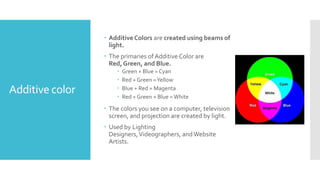
 Additive Colors are created using beams of
light.
 The primaries of Additive Color are
Red, Green, and Blue.
 Green + Blue = Cyan
 Red + Green =Yellow
 Blue + Red = Magenta
 Red + Green + Blue = White
 The colors you see on a computer, television
screen, and projection are created by light.
 Used by Lighting
Designers,Videographers, andWebsite
Artists.
PrimaryColors of Light
Mixing
BokoPhysics
Subtractive
color (RGB)
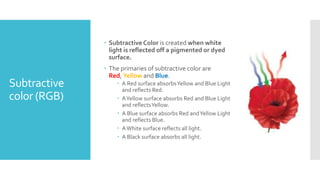
 Subtractive Color is created when white
light is reflected off a pigmented or dyed
surface.
 The primaries of subtractive color are
Red, Yellow and Blue.
 A Red surface absorbsYellow and Blue Light
and reflects Red.
 AYellow surface absorbs Red and Blue Light
and reflectsYellow.
 A Blue surface absorbs Red andYellow Light
and reflects Blue.
 AWhite surface reflects all light.
 A Black surface absorbs all light.
Subtractive
color (RGB)
 Used by Painters, Printmakers, and Illustrators in various media –
acrylic paint, oil paint, pastels, ink, etc.
 Each pigment or dye used to make these materials are unique.
 Can be transparent or opaque – will affect blending and layering
 Adding color overtones and values will increase varieties of color.
 ColorOvertones are a secondary hue bias in the primary color.
 For example, Alizarin Crimson is a red with violet overtones, while
scarlet is a Red with orange overtones.
 Achromatic elements, such as Black andWhite, (non-colors) add
value to colors.
Process colors
(CMYK)
 Process colors are a subtractive color system that we use in
print media.
 The Primaries of Process colors are Cyan (Blue), Magenta
(Red), Yellow, and Black
 The process color system is typically used for mass production.
 Each color is laid down on the paper through a separate roller.
 The final image is created as the colors overlap.
Cyan Magenta Yellow Black
Color
Separationin
CMYK Printing
Dots of cyan, magenta, yellow, and
black are layered to create a full
color image.
Color
interaction
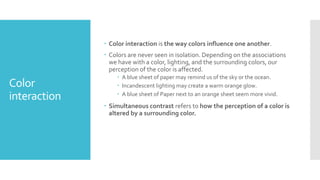
 Color interaction is the way colors influence one another.
 Colors are never seen in isolation. Depending on the associations
we have with a color, lighting, and the surrounding colors, our
perception of the color is affected.
 A blue sheet of paper may remind us of the sky or the ocean.
 Incandescent lighting may create a warm orange glow.
 A blue sheet of Paper next to an orange sheet seem more vivid.
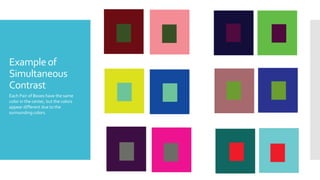
 Simultaneous contrast refers to how the perception of a color is
altered by a surrounding color.
Exampleof
Simultaneous
Contrast
Each Pair of Boxes have the same
color in the center, but the colors
appear different due to the
surrounding colors.
Defining colors
(onthe colorwheel)
 Hue is the name of a color, determined by its wavelength.
 This excludes non-color (black/white)
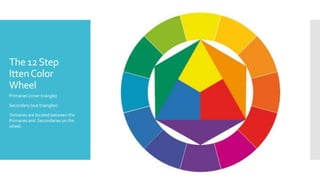
 In the Johannes Itten ColorWheel (for subtractive colors)
 Primary colors are Red,Yellow, and Blue
 They cannot be created by mixing.
 Secondary Colors are Orange, Green, andViolet
 They are created by mixing two primary colors.
 Tertiary Colors are Red-Violet, Red-Orange,Yellow-Orange,Yellow
Green, Blue-green, and blue-violet
 They are created by mixing a primary color and a secondary color that
are next to each other on the color wheel.
 The names are a combination of both colors.
 The Primary color’s name always comes first!
The 12Step
IttenColor
Wheel
Primaries (inner triangle)
Secondary (out triangles)
Tertiaries are located between the
Primaries and Secondaries on the
wheel.
Color
Temperature
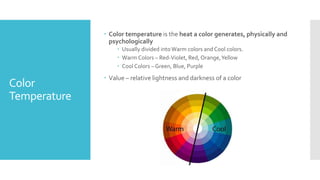
 Color temperature is the heat a color generates, physically and
psychologically
 Usually divided intoWarm colors and Cool colors.
 Warm Colors – Red-Violet, Red, Orange,Yellow
 Cool Colors – Green, Blue, Purple
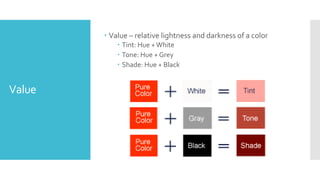
 Value – relative lightness and darkness of a color
Value
 Value – relative lightness and darkness of a color
 Tint: Hue +White
 Tone: Hue + Grey
 Shade: Hue + Black
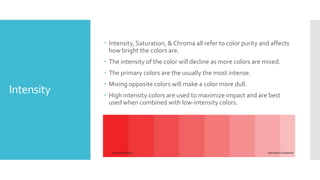
Intensity
 Intensity, Saturation, & Chroma all refer to color purity and affects
how bright the colors are.
 The intensity of the color will decline as more colors are mixed.
 The primary colors are the usually the most intense.
 Mixing opposite colors will make a color more dull.
 High intensity colors are used to maximize impact and are best
used when combined with low-intensity colors.

Color theory

  • 1.
  • 2.
    Color  Color immediatelyattracts attention. It is one of the first things we see.  Very young children will group objects by color instead of size or shape.  An interior designer may use rose-red walls to increase emotional warmth or use blue walls in a daycare to encourage calm.  BrightYellow and Magenta may make an poster more eye-catching with contrast.  Color is a very complex but powerful Element of Art & Design .
  • 3.
    Color theory  Colortheory is the art and science of color interaction and effects.  In The Art of Color, Johannes Itten lists the following approaches to color theory.  Physics  Chemistry  Physiology  Psychology
  • 4.
    Approaches to ColorTheory  Thephysicist studies electromagnetic wavelength in order to measure and classify color.  The chemist works with the molecular structure of dyes and pigments, and seeks to produced highly permanent colors and excellent paint consistency.  The physiologist investigates the effects of color and light on our eyes and brain  The psychologist studies the expressive effect of color on our mind and spirit.  .
  • 5.
    Artist Application of Color  Theartist needs to take all of the approaches into consideration when using color.  Like the physicist, the artist uses color wavelengths to create various effects  Like the chemist, the artist must be aware of the safety and permanence of dyes and pigments.  When using color to create the illusion of space, the artist puts into practice theories developed by physiologist.  Communication and Expression are strongly affected by the psychological effects of color
  • 6.
    The Psychology ofColor inLogo Design Infographic by LogoCompany
  • 7.
    ColorSystems The two majorcolor systems we use are:  Additive Colors (RGB)  Created using beams of light  Subtractive colors (RYB)  Created when white light is reflected off a pigmented or dyed surface
  • 8.
    Additive color  AdditiveColors are created using beams of light.  The primaries of Additive Color are Red, Green, and Blue.  Green + Blue = Cyan  Red + Green =Yellow  Blue + Red = Magenta  Red + Green + Blue = White  The colors you see on a computer, television screen, and projection are created by light.  Used by Lighting Designers,Videographers, andWebsite Artists.
  • 9.
  • 10.
    Subtractive color (RGB)  SubtractiveColor is created when white light is reflected off a pigmented or dyed surface.  The primaries of subtractive color are Red, Yellow and Blue.  A Red surface absorbsYellow and Blue Light and reflects Red.  AYellow surface absorbs Red and Blue Light and reflectsYellow.  A Blue surface absorbs Red andYellow Light and reflects Blue.  AWhite surface reflects all light.  A Black surface absorbs all light.
  • 11.
    Subtractive color (RGB)  Usedby Painters, Printmakers, and Illustrators in various media – acrylic paint, oil paint, pastels, ink, etc.  Each pigment or dye used to make these materials are unique.  Can be transparent or opaque – will affect blending and layering  Adding color overtones and values will increase varieties of color.  ColorOvertones are a secondary hue bias in the primary color.  For example, Alizarin Crimson is a red with violet overtones, while scarlet is a Red with orange overtones.  Achromatic elements, such as Black andWhite, (non-colors) add value to colors.
  • 12.
    Process colors (CMYK)  Processcolors are a subtractive color system that we use in print media.  The Primaries of Process colors are Cyan (Blue), Magenta (Red), Yellow, and Black  The process color system is typically used for mass production.  Each color is laid down on the paper through a separate roller.  The final image is created as the colors overlap. Cyan Magenta Yellow Black
  • 13.
    Color Separationin CMYK Printing Dots ofcyan, magenta, yellow, and black are layered to create a full color image.
  • 14.
    Color interaction  Color interactionis the way colors influence one another.  Colors are never seen in isolation. Depending on the associations we have with a color, lighting, and the surrounding colors, our perception of the color is affected.  A blue sheet of paper may remind us of the sky or the ocean.  Incandescent lighting may create a warm orange glow.  A blue sheet of Paper next to an orange sheet seem more vivid.  Simultaneous contrast refers to how the perception of a color is altered by a surrounding color.
  • 15.
    Exampleof Simultaneous Contrast Each Pair ofBoxes have the same color in the center, but the colors appear different due to the surrounding colors.
  • 16.
    Defining colors (onthe colorwheel) Hue is the name of a color, determined by its wavelength.  This excludes non-color (black/white)  In the Johannes Itten ColorWheel (for subtractive colors)  Primary colors are Red,Yellow, and Blue  They cannot be created by mixing.  Secondary Colors are Orange, Green, andViolet  They are created by mixing two primary colors.  Tertiary Colors are Red-Violet, Red-Orange,Yellow-Orange,Yellow Green, Blue-green, and blue-violet  They are created by mixing a primary color and a secondary color that are next to each other on the color wheel.  The names are a combination of both colors.  The Primary color’s name always comes first!
  • 17.
    The 12Step IttenColor Wheel Primaries (innertriangle) Secondary (out triangles) Tertiaries are located between the Primaries and Secondaries on the wheel.
  • 18.
    Color Temperature  Color temperatureis the heat a color generates, physically and psychologically  Usually divided intoWarm colors and Cool colors.  Warm Colors – Red-Violet, Red, Orange,Yellow  Cool Colors – Green, Blue, Purple  Value – relative lightness and darkness of a color
  • 19.
    Value  Value –relative lightness and darkness of a color  Tint: Hue +White  Tone: Hue + Grey  Shade: Hue + Black
  • 20.
    Intensity  Intensity, Saturation,& Chroma all refer to color purity and affects how bright the colors are.  The intensity of the color will decline as more colors are mixed.  The primary colors are the usually the most intense.  Mixing opposite colors will make a color more dull.  High intensity colors are used to maximize impact and are best used when combined with low-intensity colors.