COLOR THEORY
COLOR
COLOR is the byproduct of the spectrum of light, as it is reflected or
obsorbed, as received by the human eye and processed by the human
brain.
With colors you can set a mood, attract attention, or make a
statement. You can use color to energize, or to cool down. By
selecting the right color you can create an ambiance of elegance,
warmth or tranquility, or you can convey an image of playful
youthfulness. Color can be your most powerful design element if you
learn to use it effectively.
COLOR THEORY
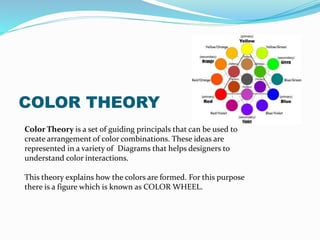
Color Theory is a set of guiding principals that can be used to
create arrangement of color combinations. These ideas are
represented in a variety of Diagrams that helps designers to
understand color interactions.
This theory explains how the colors are formed. For this purpose
there is a figure which is known as COLOR WHEEL.
COLOR WHEEL
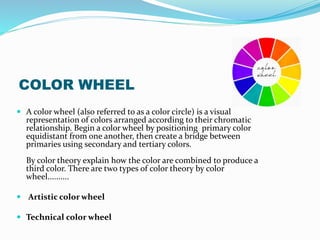
 A color wheel (also referred to as a color circle) is a visual
representation of colors arranged according to their chromatic
relationship. Begin a color wheel by positioning primary color
equidistant from one another, then create a bridge between
primaries using secondary and tertiary colors.
By color theory explain how the color are combined to produce a
third color. There are two types of color theory by color
wheel..........
 Artistic color wheel
 Technical color wheel
ARTISTIC COLOR WHEEL
In daily life people use a color combination in their
dressing sense to look descent and attractive. Same
way when a colorful design is created the
combination of these colors should be matching.
For this purpose a color wheel guides how to
combine the colors with each other to create an
attractive output.
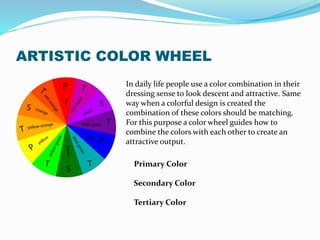
Primary Color
Secondary Color
Tertiary Color
Primary Color – RED, BLUE, YELLOW are the primary colors.
Secondary Color - Colors formed by mixing two primary
colors are secondary colors. orange, Purple, and green.
Yellow + Red = ORANGE
Red + Blue = VIOLET or PURPLE
Blue + Yellow = GREEN
PRIMARY
COLORS
SECONDARY
COLORS
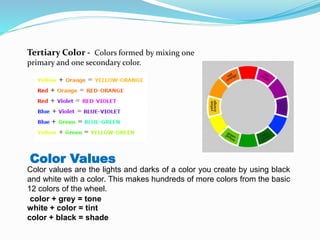
Tertiary Color - Colors formed by mixing one
primary and one secondary color.
Color Values
Color values are the lights and darks of a color you create by using black
and white with a color. This makes hundreds of more colors from the basic
12 colors of the wheel.
white + color = tint
color + black = shade
color + grey = tone
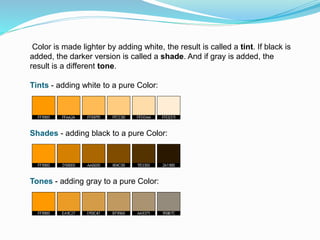
Color is made lighter by adding white, the result is called a tint. If black is
added, the darker version is called a shade. And if gray is added, the
result is a different tone.
Tints - adding white to a pure Color:
Shades - adding black to a pure Color:
Tones - adding gray to a pure Color:
COLOR SCHEME
Color scheme is the choice of colors used in design for a range of media.
It is used to create style and appeal. Color scheme involves two or more
colors based around a single color to create a design
• Monochromatic
• Complementary
• Analogous
• Warm
• Cool
Monochromatic color scheme:
It consists of different values of a single color
Analogous color scheme:
Colors those are adjacent to each other on the color wheel.
Yellow and red are adjacent to orange
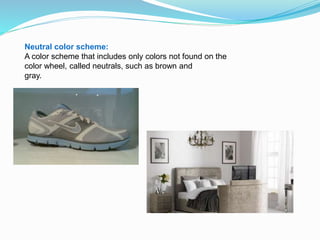
Neutral color scheme:
A color scheme that includes only colors not found on the
color wheel, called neutrals, such as brown and
gray.
Warm Color Schemes:
This color scheme contains red, yellow and orange color .As
these colors can be related with fire they are
warm color.
Cool Color Schemes:
This color scheme contains green, violet, blue colors.
Complementary colors:
The color which lies opposite to each other on the wheel is
complementary colors. E.g. Green and Red
TECHNICAL COLOR WHEEL
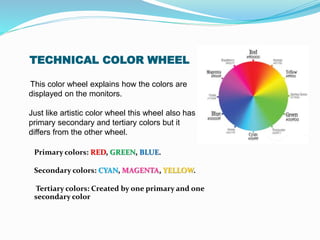
Primary colors: RED, GREEN, BLUE.
Secondary colors: CYAN, MAGENTA, YELLOW.
Tertiary colors: Created by one primary and one
secondary color
This color wheel explains how the colors are
displayed on the monitors.
Just like artistic color wheel this wheel also has
primary secondary and tertiary colors but it
differs from the other wheel.
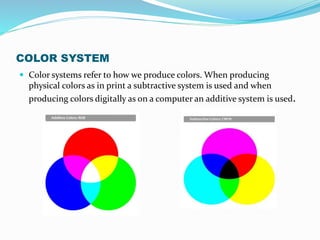
COLOR SYSTEM
 Color systems refer to how we produce colors. When producing
physical colors as in print a subtractive system is used and when
producing colors digitally as on a computer an additive system is used.
The phosphors in the crt monitors are of red, green and blue colors.
When all the three colors glow at the maximum intensity white color is
formed, When they does not glow black is fromed and when they glow in
between the maximum and minimum value also the RGB values are equal
they create gray.
A printer has two ink cartridge slots,one for black and other for colored
ink.The colored cartridge has three colors CYAN, MAGENTA and
YELLOW.In printing the process to form colors is reversed.
CYAN+ MAGENDA=BLUE
MAGENDA+YELLOW=RED
CYAN+YELLOW=GREEN
MONITORS INTERNAL MECHANISM
The device connected to a computer that displays information on a screen. Also
known as visual display unit. With the advancement in time and change in
technology the following generations of monitor were made: CRT, TFT LCD.
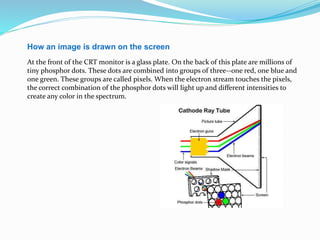
How an image is drawn on the screen
At the front of the CRT monitor is a glass plate. On the back of this plate are millions of
tiny phosphor dots. These dots are combined into groups of three--one red, one blue and
one green. These groups are called pixels. When the electron stream touches the pixels,
the correct combination of the phosphor dots will light up and different intensities to
create any color in the spectrum.
Behind the LCD monitor's face but in front of the liquid crystal is an enclosed matrix of
transistors connected to pixels on the screen's face. This matrix is so thin that it appears to
be transparent. But when a varying current runs through it, the same current as the one
manipulating the liquid crystal, it causes certain pixels to light up, adding definition to the
overall color passing through from the backlight.
When a pixel is zoomed up to microscopic level
following arrangement is seen inside it. The appearance varies in different monitors.
Now there is a common feature in every image that they contain only three
colors red, green, and blue.
In short…..when electricity is supplied to a monitor these red green blue
colors starts glowing and thus shows
the colors on the screen.
Below is an example:
PIXEL
A wall is build up by arranging many bricks similarly when a digital
image is zoomed up it can be seen that the image is made up by
arranging small colored blocks .Each individual block is termed as a
pixel. Pixel is also termed as PEL i.e. Picture element.
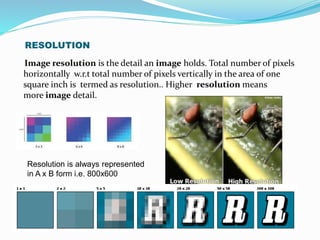
RESOLUTION
Image resolution is the detail an image holds. Total number of pixels
horizontally w.r.t total number of pixels vertically in the area of one
square inch is termed as resolution.. Higher resolution means
more image detail.
Resolution is always represented
in A x B form i.e. 800x600
ASPECT RATIO
The ratio between length and width of any image or screen is known as
aspect ratio. Aspect ratio is always represented in A : B form .e.g.: 4:3, 16:9.
x : y is aspect ratio
THANK YOU
DIPJOY ROUTH
T3 Trainee

color-theory for beginners

  • 1.
  • 2.
    COLOR COLOR is thebyproduct of the spectrum of light, as it is reflected or obsorbed, as received by the human eye and processed by the human brain. With colors you can set a mood, attract attention, or make a statement. You can use color to energize, or to cool down. By selecting the right color you can create an ambiance of elegance, warmth or tranquility, or you can convey an image of playful youthfulness. Color can be your most powerful design element if you learn to use it effectively.
  • 3.
    COLOR THEORY Color Theoryis a set of guiding principals that can be used to create arrangement of color combinations. These ideas are represented in a variety of Diagrams that helps designers to understand color interactions. This theory explains how the colors are formed. For this purpose there is a figure which is known as COLOR WHEEL.
  • 4.
    COLOR WHEEL  Acolor wheel (also referred to as a color circle) is a visual representation of colors arranged according to their chromatic relationship. Begin a color wheel by positioning primary color equidistant from one another, then create a bridge between primaries using secondary and tertiary colors. By color theory explain how the color are combined to produce a third color. There are two types of color theory by color wheel..........  Artistic color wheel  Technical color wheel
  • 5.
    ARTISTIC COLOR WHEEL Indaily life people use a color combination in their dressing sense to look descent and attractive. Same way when a colorful design is created the combination of these colors should be matching. For this purpose a color wheel guides how to combine the colors with each other to create an attractive output. Primary Color Secondary Color Tertiary Color
  • 6.
    Primary Color –RED, BLUE, YELLOW are the primary colors. Secondary Color - Colors formed by mixing two primary colors are secondary colors. orange, Purple, and green. Yellow + Red = ORANGE Red + Blue = VIOLET or PURPLE Blue + Yellow = GREEN PRIMARY COLORS SECONDARY COLORS
  • 7.
    Tertiary Color -Colors formed by mixing one primary and one secondary color. Color Values Color values are the lights and darks of a color you create by using black and white with a color. This makes hundreds of more colors from the basic 12 colors of the wheel. white + color = tint color + black = shade color + grey = tone
  • 8.
    Color is madelighter by adding white, the result is called a tint. If black is added, the darker version is called a shade. And if gray is added, the result is a different tone. Tints - adding white to a pure Color: Shades - adding black to a pure Color: Tones - adding gray to a pure Color:
  • 9.
    COLOR SCHEME Color schemeis the choice of colors used in design for a range of media. It is used to create style and appeal. Color scheme involves two or more colors based around a single color to create a design • Monochromatic • Complementary • Analogous • Warm • Cool
  • 10.
    Monochromatic color scheme: Itconsists of different values of a single color
  • 11.
    Analogous color scheme: Colorsthose are adjacent to each other on the color wheel. Yellow and red are adjacent to orange
  • 12.
    Neutral color scheme: Acolor scheme that includes only colors not found on the color wheel, called neutrals, such as brown and gray.
  • 13.
    Warm Color Schemes: Thiscolor scheme contains red, yellow and orange color .As these colors can be related with fire they are warm color.
  • 14.
    Cool Color Schemes: Thiscolor scheme contains green, violet, blue colors.
  • 15.
    Complementary colors: The colorwhich lies opposite to each other on the wheel is complementary colors. E.g. Green and Red
  • 16.
    TECHNICAL COLOR WHEEL Primarycolors: RED, GREEN, BLUE. Secondary colors: CYAN, MAGENTA, YELLOW. Tertiary colors: Created by one primary and one secondary color This color wheel explains how the colors are displayed on the monitors. Just like artistic color wheel this wheel also has primary secondary and tertiary colors but it differs from the other wheel.
  • 17.
    COLOR SYSTEM  Colorsystems refer to how we produce colors. When producing physical colors as in print a subtractive system is used and when producing colors digitally as on a computer an additive system is used.
  • 18.
    The phosphors inthe crt monitors are of red, green and blue colors. When all the three colors glow at the maximum intensity white color is formed, When they does not glow black is fromed and when they glow in between the maximum and minimum value also the RGB values are equal they create gray. A printer has two ink cartridge slots,one for black and other for colored ink.The colored cartridge has three colors CYAN, MAGENTA and YELLOW.In printing the process to form colors is reversed. CYAN+ MAGENDA=BLUE MAGENDA+YELLOW=RED CYAN+YELLOW=GREEN
  • 19.
    MONITORS INTERNAL MECHANISM Thedevice connected to a computer that displays information on a screen. Also known as visual display unit. With the advancement in time and change in technology the following generations of monitor were made: CRT, TFT LCD.
  • 20.
    How an imageis drawn on the screen At the front of the CRT monitor is a glass plate. On the back of this plate are millions of tiny phosphor dots. These dots are combined into groups of three--one red, one blue and one green. These groups are called pixels. When the electron stream touches the pixels, the correct combination of the phosphor dots will light up and different intensities to create any color in the spectrum.
  • 21.
    Behind the LCDmonitor's face but in front of the liquid crystal is an enclosed matrix of transistors connected to pixels on the screen's face. This matrix is so thin that it appears to be transparent. But when a varying current runs through it, the same current as the one manipulating the liquid crystal, it causes certain pixels to light up, adding definition to the overall color passing through from the backlight. When a pixel is zoomed up to microscopic level following arrangement is seen inside it. The appearance varies in different monitors.
  • 22.
    Now there isa common feature in every image that they contain only three colors red, green, and blue. In short…..when electricity is supplied to a monitor these red green blue colors starts glowing and thus shows the colors on the screen. Below is an example:
  • 23.
    PIXEL A wall isbuild up by arranging many bricks similarly when a digital image is zoomed up it can be seen that the image is made up by arranging small colored blocks .Each individual block is termed as a pixel. Pixel is also termed as PEL i.e. Picture element.
  • 24.
    RESOLUTION Image resolution isthe detail an image holds. Total number of pixels horizontally w.r.t total number of pixels vertically in the area of one square inch is termed as resolution.. Higher resolution means more image detail. Resolution is always represented in A x B form i.e. 800x600
  • 25.
    ASPECT RATIO The ratiobetween length and width of any image or screen is known as aspect ratio. Aspect ratio is always represented in A : B form .e.g.: 4:3, 16:9. x : y is aspect ratio
  • 26.