johannes itten
ART 251
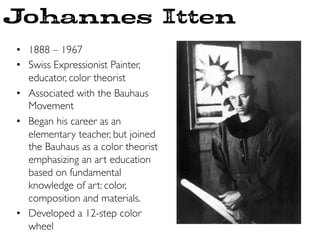
Johannes Itten
•  1888 – 1967	

•  Swiss Expressionist Painter,
educator, color theorist	

•  Associated with the Bauhaus
Movement	

•  Began his career as an
elementary teacher, but joined
the Bauhaus as a color theorist
emphasizing an art education
based on fundamental
knowledge of art: color,
composition and materials.	

•  Developed a 12-step color
wheel
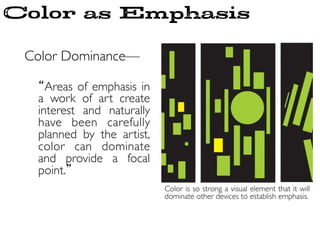
Color as Emphasis
Color Dominance—	


“Areas of emphasis in
a work of art create
interest and naturally
have been carefully
planned by the artist,
color can dominate
and provide a focal
point.”	

Color is so strong a visual element that it will
dominate other devices to establish emphasis.
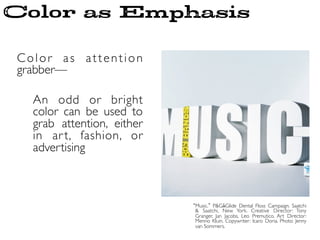
Color as attention
grabber—	


An odd or bright
color can be used to
grab attention, either
in art, fashion, or
advertising	

Music. P&GムGlide Dental Floss Campaign. Saatchi
& Saatchi, New York. Creative Director: Tony
Granger, Jan Jacobs, Leo Premutico. Art Director:
Menno Kluin. Copywriter: Icaro Doria. Photo: Jenny
van Sommers.	

Color as Emphasis
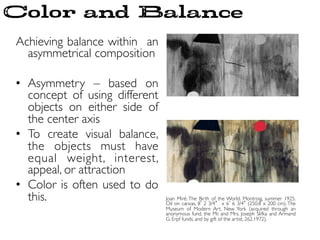
Achieving balance within an
asymmetrical composition	


•  Asymmetry – based on
concept of using different
objects on either side of
the center axis	

•  To create visual balance,
the objects must have
equal weight, interest,
appeal, or attraction	

•  Color is often used to do
this.	

 Joan Miré. The Birth of the World. Montroig, summer 1925.
Oil on canvas, 8 2 3/4 x 6 6 3/4 (250.8 x 200 cm). The
Museum of Modern Art, New York (acquired through an
anonymous fund, the Mr. and Mrs. Joseph Slifka and Armand
G. Erpf funds, and by gift of the artist, 262.1972).	

Color and Balance
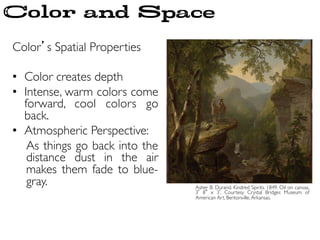
Color’s Spatial Properties	


•  Color creates depth	

•  Intense, warm colors come
forward, cool colors go
back. 	

•  Atmospheric Perspective:	

As things go back into the
distance dust in the air
makes them fade to blue-
gray.	

 Asher B. Durand. Kindred Spirits. 1849. Oil on canvas,
3 8 x 3 . Courtesy Crystal Bridges Museum of
American Art, Bentonville,Arkansas. 	

Color and Space
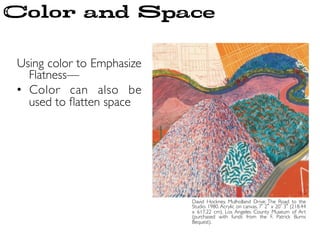
Using color to Emphasize
Flatness—	

•  Color can also be
used to flatten space	

David Hockney. Mulholland Drive: The Road to the
Studio. 1980. Acrylic on canvas, 7 2 x 20 3 (218.44
x 617.22 cm). Los Angeles County Museum of Art
(purchased with funds from the F. Patrick Burns
Bequest). 	

Color and Space
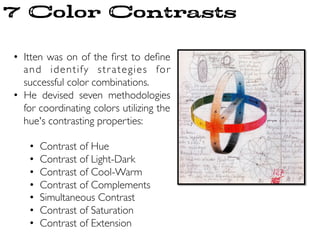
•  Itten was on of the first to define
and identify strategies for
successful color combinations.	

•  He devised seven methodologies
for coordinating colors utilizing the
hue's contrasting properties:	

•  Contrast of Hue	

•  Contrast of Light-Dark	

•  Contrast of Cool-Warm	

•  Contrast of Complements	

•  Simultaneous Contrast	

•  Contrast of Saturation	

•  Contrast of Extension	

7 Color Contrasts
When a composition is
made with more colors
than pure black and
white, other dynamic
forces come into play.
J o h a n n e s I t t e n
described these forces
a s t h e s e v e n c o l o r
contrasts.
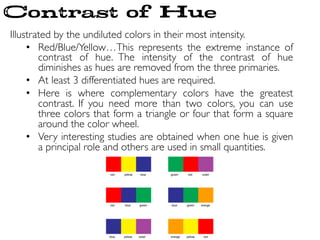
Illustrated by the undiluted colors in their most intensity.	

•  Red/Blue/Yellow…This represents the extreme instance of
contrast of hue. The intensity of the contrast of hue
diminishes as hues are removed from the three primaries.	

•  At least 3 differentiated hues are required.	

•  Here is where complementary colors have the greatest
contrast. If you need more than two colors, you can use
three colors that form a triangle or four that form a square
around the color wheel.	

•  Very interesting studies are obtained when one hue is given
a principal role and others are used in small quantities.	


Contrast of Hue
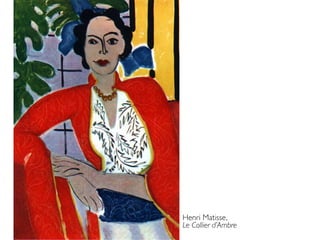
Henri Matisse, 
Le Collier d’Ambre
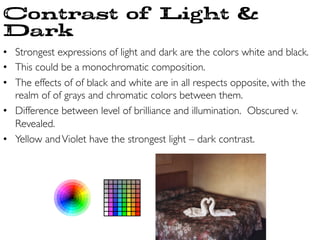
•  Strongest expressions of light and dark are the colors white and black.	

•  This could be a monochromatic composition.	

•  The effects of of black and white are in all respects opposite, with the
realm of of grays and chromatic colors between them.	

•  Difference between level of brilliance and illumination.  Obscured v.
Revealed.	

•  Yellow andViolet have the strongest light – dark contrast.	

Contrast of Light 
Dark
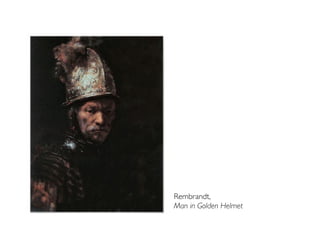
Rembrandt, 	

Man in Golden Helmet
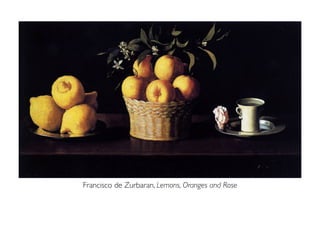
Francisco de Zurbaran, Lemons, Oranges and Rose
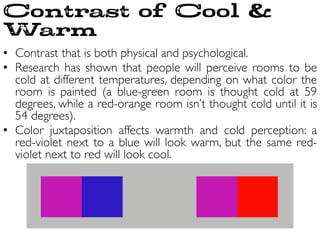
•  Contrast that is both physical and psychological.	

•  Research has shown that people will perceive rooms to be
cold at different temperatures, depending on what color the
room is painted (a blue-green room is thought cold at 59
degrees, while a red-orange room isn’t thought cold until it is
54 degrees).	

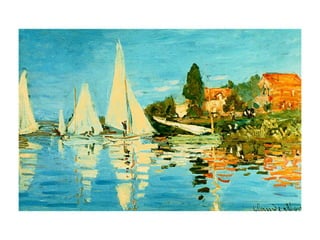
•  Color juxtaposition affects warmth and cold perception: a
red-violet next to a blue will look warm, but the same red-
violet next to red will look cool.	

Contrast of Cool 
Warm
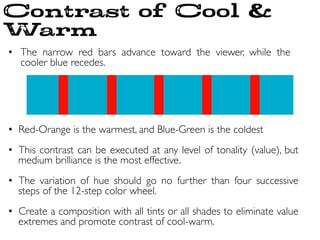
•  The narrow red bars advance toward the viewer, while the
cooler blue recedes.	


•  Red-Orange is the warmest, and Blue-Green is the coldest	


•  This contrast can be executed at any level of tonality (value), but
medium brilliance is the most effective.	

•  The variation of hue should go no further than four successive
steps of the 12-step color wheel.	

•  Create a composition with all tints or all shades to eliminate value
extremes and promote contrast of cool-warm.	

Contrast of Cool 
Warm
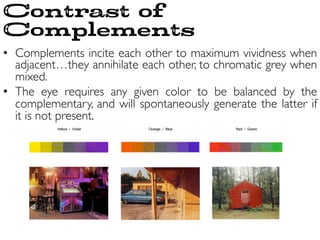
•  Complements incite each other to maximum vividness when
adjacent…they annihilate each other, to chromatic grey when
mixed.	

•  The eye requires any given color to be balanced by the
complementary, and will spontaneously generate the latter if
it is not present.	

Contrast of
Complements
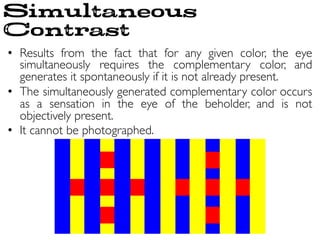
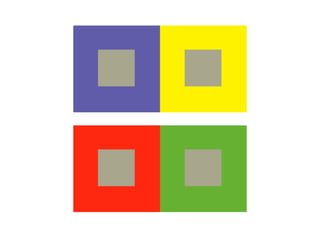
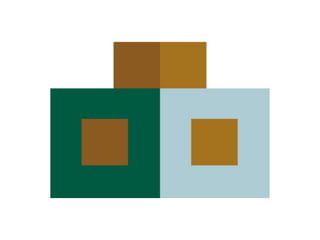
•  Results from the fact that for any given color, the eye
simultaneously requires the complementary color, and
generates it spontaneously if it is not already present.	

•  The simultaneously generated complementary color occurs
as a sensation in the eye of the beholder, and is not
objectively present.	

•  It cannot be photographed.	

Simultaneous
Contrast
•  Contrast between pure, intense colors and dull, diluted
colors.	


1. Mixed with White…color appears somewhat colder.	

2. Mixed with Black	

3. Mixed with White and Black	

4. Mixed with its Complementary Color	


•  The effect of “dull-vivid” contrast is relative. A color may
appear vivid beside a dull tone, and dull beside a more vivid
tone (Simultaneous Contrast) 	

•  You MUST eliminate light-dark contrast!	

Contrast of Saturation
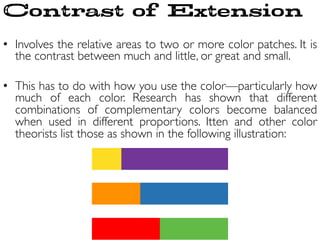
•  Involves the relative areas to two or more color patches. It is
the contrast between much and little, or great and small.	


•  This has to do with how you use the color—particularly how
much of each color. Research has shown that different
combinations of complementary colors become balanced
when used in different proportions. Itten and other color
theorists list those as shown in the following illustration:	

Contrast of Extension
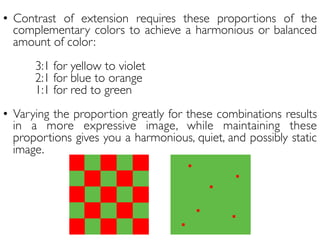
•  Contrast of extension requires these proportions of the
complementary colors to achieve a harmonious or balanced
amount of color:
	

3:1 for yellow to violet	

2:1 for blue to orange	

1:1 for red to green	


•  Varying the proportion greatly for these combinations results
in a more expressive image, while maintaining these
proportions gives you a harmonious, quiet, and possibly static
image.
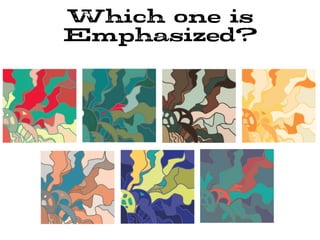
Which one is
Emphasized?
Other Things to
Ponder…
•  The more you understand about what you are trying to say
within an artwork, the quicker you understand how to make
Itten’s rules work for you.	


•  Contrast = Drama/Conflict	

•  The more “conflicting” elements there are in your color
choices the more your eyes will continue to bounce
repeatedly off of that surface. It creates tension, movement,
and excitement. 	

•  If you are looking to make a quiet piece– stick to a more
harmonious palette.
Even More Things to
Ponder…
•  To evaluate a design’s contrast while it’s still in the design stage, use
an image manipulation tool, such as Photoshop, and view the
design in grayscale versus RGB/CMYK.	

•  Type must always contrast sharply with background colors to be
readable, but not too sharp to ease the impact on readers eyes.	

•  The specific definition of color contrasts are not as important as
making sure you include appropriate  contrast as part of your
design process. This will allow viewers, no matter how they
interpret colors, to read and enjoy your design. Just as choosing the
correct color combinations when you were a child would help
your picture stand out in a sea of your classmates’ work, choosing
correct color combinations when you design will allow your work
to stand out in the world of graphic design.

Johannes Itten

  • 1.
  • 2.
    Johannes Itten •  1888– 1967 •  Swiss Expressionist Painter, educator, color theorist •  Associated with the Bauhaus Movement •  Began his career as an elementary teacher, but joined the Bauhaus as a color theorist emphasizing an art education based on fundamental knowledge of art: color, composition and materials. •  Developed a 12-step color wheel
  • 3.
    Color as Emphasis ColorDominance— “Areas of emphasis in a work of art create interest and naturally have been carefully planned by the artist, color can dominate and provide a focal point.” Color is so strong a visual element that it will dominate other devices to establish emphasis.
  • 4.
    Color as attention grabber— Anodd or bright color can be used to grab attention, either in art, fashion, or advertising Music. P&GムGlide Dental Floss Campaign. Saatchi & Saatchi, New York. Creative Director: Tony Granger, Jan Jacobs, Leo Premutico. Art Director: Menno Kluin. Copywriter: Icaro Doria. Photo: Jenny van Sommers. Color as Emphasis
  • 5.
    Achieving balance withinan asymmetrical composition •  Asymmetry – based on concept of using different objects on either side of the center axis •  To create visual balance, the objects must have equal weight, interest, appeal, or attraction •  Color is often used to do this. Joan Miré. The Birth of the World. Montroig, summer 1925. Oil on canvas, 8 2 3/4 x 6 6 3/4 (250.8 x 200 cm). The Museum of Modern Art, New York (acquired through an anonymous fund, the Mr. and Mrs. Joseph Slifka and Armand G. Erpf funds, and by gift of the artist, 262.1972). Color and Balance
  • 6.
    Color’s Spatial Properties • Color creates depth •  Intense, warm colors come forward, cool colors go back. •  Atmospheric Perspective: As things go back into the distance dust in the air makes them fade to blue- gray. Asher B. Durand. Kindred Spirits. 1849. Oil on canvas, 3 8 x 3 . Courtesy Crystal Bridges Museum of American Art, Bentonville,Arkansas. Color and Space
  • 7.
    Using color toEmphasize Flatness— •  Color can also be used to flatten space David Hockney. Mulholland Drive: The Road to the Studio. 1980. Acrylic on canvas, 7 2 x 20 3 (218.44 x 617.22 cm). Los Angeles County Museum of Art (purchased with funds from the F. Patrick Burns Bequest). Color and Space
  • 8.
    •  Itten wason of the first to define and identify strategies for successful color combinations. •  He devised seven methodologies for coordinating colors utilizing the hue's contrasting properties: •  Contrast of Hue •  Contrast of Light-Dark •  Contrast of Cool-Warm •  Contrast of Complements •  Simultaneous Contrast •  Contrast of Saturation •  Contrast of Extension 7 Color Contrasts
  • 9.
    When a compositionis made with more colors than pure black and white, other dynamic forces come into play. J o h a n n e s I t t e n described these forces a s t h e s e v e n c o l o r contrasts.
  • 10.
    Illustrated by theundiluted colors in their most intensity. •  Red/Blue/Yellow…This represents the extreme instance of contrast of hue. The intensity of the contrast of hue diminishes as hues are removed from the three primaries. •  At least 3 differentiated hues are required. •  Here is where complementary colors have the greatest contrast. If you need more than two colors, you can use three colors that form a triangle or four that form a square around the color wheel. •  Very interesting studies are obtained when one hue is given a principal role and others are used in small quantities. Contrast of Hue
  • 12.
    Henri Matisse, LeCollier d’Ambre
  • 13.
    •  Strongest expressionsof light and dark are the colors white and black. •  This could be a monochromatic composition. •  The effects of of black and white are in all respects opposite, with the realm of of grays and chromatic colors between them. •  Difference between level of brilliance and illumination.  Obscured v. Revealed. •  Yellow andViolet have the strongest light – dark contrast. Contrast of Light Dark
  • 14.
    Rembrandt, Man inGolden Helmet
  • 15.
    Francisco de Zurbaran,Lemons, Oranges and Rose
  • 16.
    •  Contrast thatis both physical and psychological. •  Research has shown that people will perceive rooms to be cold at different temperatures, depending on what color the room is painted (a blue-green room is thought cold at 59 degrees, while a red-orange room isn’t thought cold until it is 54 degrees). •  Color juxtaposition affects warmth and cold perception: a red-violet next to a blue will look warm, but the same red- violet next to red will look cool. Contrast of Cool Warm
  • 17.
    •  The narrowred bars advance toward the viewer, while the cooler blue recedes. •  Red-Orange is the warmest, and Blue-Green is the coldest •  This contrast can be executed at any level of tonality (value), but medium brilliance is the most effective. •  The variation of hue should go no further than four successive steps of the 12-step color wheel. •  Create a composition with all tints or all shades to eliminate value extremes and promote contrast of cool-warm. Contrast of Cool Warm
  • 19.
    •  Complements inciteeach other to maximum vividness when adjacent…they annihilate each other, to chromatic grey when mixed. •  The eye requires any given color to be balanced by the complementary, and will spontaneously generate the latter if it is not present. Contrast of Complements
  • 20.
    •  Results fromthe fact that for any given color, the eye simultaneously requires the complementary color, and generates it spontaneously if it is not already present. •  The simultaneously generated complementary color occurs as a sensation in the eye of the beholder, and is not objectively present. •  It cannot be photographed. Simultaneous Contrast
  • 23.
    •  Contrast betweenpure, intense colors and dull, diluted colors. 1. Mixed with White…color appears somewhat colder. 2. Mixed with Black 3. Mixed with White and Black 4. Mixed with its Complementary Color •  The effect of “dull-vivid” contrast is relative. A color may appear vivid beside a dull tone, and dull beside a more vivid tone (Simultaneous Contrast) •  You MUST eliminate light-dark contrast! Contrast of Saturation
  • 24.
    •  Involves therelative areas to two or more color patches. It is the contrast between much and little, or great and small. •  This has to do with how you use the color—particularly how much of each color. Research has shown that different combinations of complementary colors become balanced when used in different proportions. Itten and other color theorists list those as shown in the following illustration: Contrast of Extension
  • 25.
    •  Contrast ofextension requires these proportions of the complementary colors to achieve a harmonious or balanced amount of color: 3:1 for yellow to violet 2:1 for blue to orange 1:1 for red to green •  Varying the proportion greatly for these combinations results in a more expressive image, while maintaining these proportions gives you a harmonious, quiet, and possibly static image.
  • 26.
  • 27.
    Other Things to Ponder… • The more you understand about what you are trying to say within an artwork, the quicker you understand how to make Itten’s rules work for you. •  Contrast = Drama/Conflict •  The more “conflicting” elements there are in your color choices the more your eyes will continue to bounce repeatedly off of that surface. It creates tension, movement, and excitement. •  If you are looking to make a quiet piece– stick to a more harmonious palette.
  • 28.
    Even More Thingsto Ponder… •  To evaluate a design’s contrast while it’s still in the design stage, use an image manipulation tool, such as Photoshop, and view the design in grayscale versus RGB/CMYK. •  Type must always contrast sharply with background colors to be readable, but not too sharp to ease the impact on readers eyes. •  The specific definition of color contrasts are not as important as making sure you include appropriate  contrast as part of your design process. This will allow viewers, no matter how they interpret colors, to read and enjoy your design. Just as choosing the correct color combinations when you were a child would help your picture stand out in a sea of your classmates’ work, choosing correct color combinations when you design will allow your work to stand out in the world of graphic design.