Colorimetry
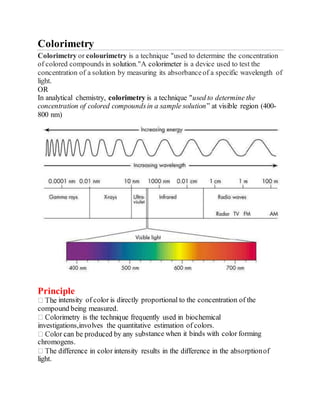
Colorimetry or colourimetry is a technique "used to determine the concentration
of colored compounds in solution."A colorimeter is a device used to test the
concentration of a solution by measuring its absorbanceof a specific wavelength of
light.
OR
In analytical chemistry, colorimetry is a technique "used to determine the
concentration of colored compoundsin a sample solution” at visible region (400-
800 nm)
Principle
intensity of color is directly proportional to the concentration of the
compound being measured.
investigations,involves the quantitative estimation of colors.
bstance when it binds with color forming
chromogens.
light.
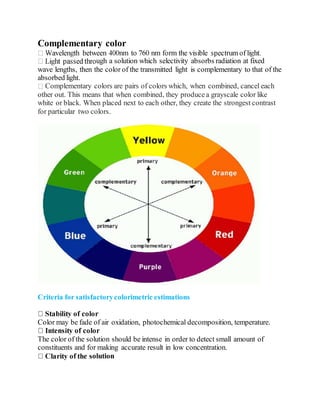
Complementary color
ugh a solution which selectivity absorbs radiation at fixed
wave lengths, then the color of the transmitted light is complementary to that of the
absorbed light.
Complementary colors are pairs of colors which, when combined, cancel each
other out. This means that when combined, they producea grayscale color like
white or black. When placed next to each other, they create the strongest contrast
for particular two colors.
Criteria for satisfactorycolorimetric estimations
Color may be fade of air oxidation, photochemical decomposition, temperature.
The color of the solution should be intense in order to detect small amount of
constituents and for making accurate result in low concentration.
olution
Substanceunder investigation should be completely soluble in the solvent, since
turbid solution, suspention or colloidal solution absorb as well as scatter light.
The intensity of the colored solution must be reproducible. The effect of order of
adding reagent, pH and other variable should be clearly studied.
Color produced should be specific for the desired constituent. If other constituents
interfere with color reaction they be removed or prevented from or prevented from
functioning through appropriate treatment like use of other coloring agent, altering
the oxidation state.
The intensity of color should be proportional to concentration. It can be easily
assessed byplotting absorbanceVs concentration, where a straight line passing
through origin should be obtained.
Types
Colorimetric analysis is two types
Visual colorimetry
-electric colorimetry
Visual colorimetry is one of the oldest form of color measuring technique
which is not used now day, natural or artificial light is used as light is used as light
sourceand determinations are made with a colorimetry or color comparator where
human eye is used as detector.
Photoelectric colorimetry
Progress in the development of colorimetric method has resulted largly due to the
application of photoelectric cell, which eliminates the difficultes of complicated
visual comparition. In this method human eye is replaced by suitable photoelectric
cell, to afford a direct measure of the light intensity.
Instruments employing photoelectric cell measure the light absorption and not
color of substance.
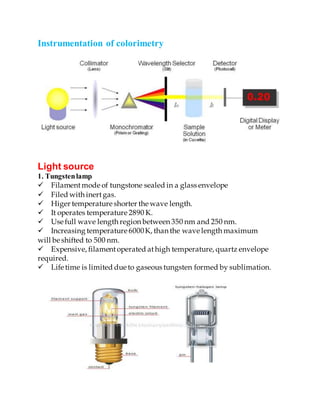
Instrumentation of colorimetry
Light source
1. Tungstenlamp
Filamentmode of tungstone sealed in a glass envelope
Filed with inertgas.
Higer temperature shorter the wave length.
It operates temperature 2890 K.
Use full wave length region between 350 nm and 250 nm.
Increasing temperature 6000K, than the wave length maximum
will be shifted to 500 nm.
Expensive, filamentoperated athigh temperature, quartz envelope
required.
Life time is limited due to gaseous tungsten formed by sublimation.
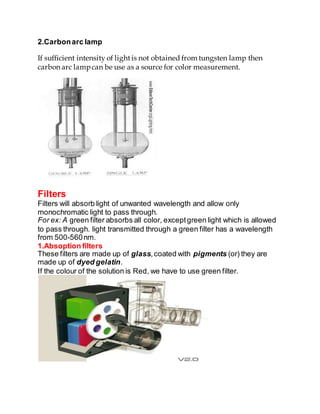
2.Carbonarc lamp
If sufficient intensity of lightis not obtained from tungsten lamp then
carbon arc lampcan be use as a source for color measurement.
Filters
Filters will absorb light of unwanted wavelength and allow only
monochromatic light to pass through.
For ex: A green filter absorbs all color, exceptgreen light which is allowed
to pass through. light transmitted through a green filter has a wavelength
from 500-560nm.
1.Absoption filters
These filters are made up of glass,coated with pigments (or) they are
made up of dyed gelatin.
If the colour of the solution is Red, we have to use green filter.
2. Interference filter (or) Fabry-perotfilter
It has dielectricspacer film made up of CaF2, MgF2 or SiO, between
parallel reflectingsilver films.
The thickness of dielectricspacer film can be 1/2 λ. The mechanism is that,
the radiation reflected by the second film and incoming radiation
undergoes constructive interference to give a monochromaticradiation.
Prisms
In a spectrophotometer, light from the source is directed
through a convergent lens into a entrance slit at the focal point of
the lens, then through a prism and a second convergent lens.
The dispersion of radiation involves angularly separating the
different frequencies in a wavefront. The mechanism involved is the
process of refraction by prisma.
Sample Holder
Cuvette are rectangular cell , square cell or circular one.
Made up of optical glass for visible wavelength.
Common one is square,rectangular to avoid refraction
artefacts.
Dimension of cuvette is 1cm.
Detectors
Detectors are the transducers, which convert lightenergy to
electrical energy . A detector should be possess following characteristics
1. Should be sensitive
2. Should have linear response
3. Its noise level should be low
4. Should have short response time
5. Should stable
Barrier layer cell
Photomultiplyer tube
Barrier Layer cell (BLC)
It consists of an iron plate A, upon which a thin layer of
semiconductor selenium is deposited.
This in turn covered by a thin film of transparentsilver layer,
which is lacquered except for portion of collecting ring for electrical
contact.
The iron plate act as anode and silver layeracts as cathode.
 Photomultiplier tubes:
 These are incorporated in expensive instruments like spectrofluorimeter. Its
sensitivity is high due to measuring weak intensity of light.
 The principle employed in this detector Is that, multiplication of
photoelectrons by secondaryemission of electrons.
 This is achieved by using a photo cathodeand a series of anodes
(Dyanodes). Up to 10 dyanodes are used. Each dyanode is maintained at 75-
100V higher than the preceding one.
 At each stage, the electron emission is multiplied by a factor of 4 to 5 due to
secondaryemission of electrons and hence an overall factor of 106 is
achieved.
 PMT can detect very weak signals, even 200 times weaker than that could
be done using photovoltaic cell. Hence it is useful in fluorescence
measurements.
 PMT should be shielded from stray light in order to have accurate results.
Application of colorimeter•
 Itis widely used in hospital& laboratory for estimation of biochemical
samples , like plasma, serum, cerebrospinalfluid ( CSF ) , urine.
 • Itis also used to quantitative estimation of serumcomponents as well as
glucose, proteins and other various biochemical compound.
 They are used by the food industry and by manufacturers of paints and
textiles.
 They are used to test for water quality, by screening for chemicals such as
chlorine, fluoride, cyanide, dissolved oxygen, iron, molybdenum, zinc and
hydrazine.
 They are also used to determine the concentrations of plant nutrients (such
as phosphorus, nitrateand ammonia) in the soil or hemoglobin in the blood
and to identify substandard and counterfeit drugs
Reference
Instrumental method of chemical analysis,chatwal.
Instrumental method of analysis, N.Grey, M.Calvin.
Pharmaceutical analysis, Ashutoshkar.
Instrumental method of analysis, B.K.Sharma
Principles and application of ultaviolet and visible spectroscopy,
A.Rajasekaran.
WWW.Pharmatwiter.com
WWW.Pharmainfo.in

Colorimetry kk

  • 1.
    Colorimetry Colorimetry or colourimetryis a technique "used to determine the concentration of colored compounds in solution."A colorimeter is a device used to test the concentration of a solution by measuring its absorbanceof a specific wavelength of light. OR In analytical chemistry, colorimetry is a technique "used to determine the concentration of colored compoundsin a sample solution” at visible region (400- 800 nm) Principle intensity of color is directly proportional to the concentration of the compound being measured. investigations,involves the quantitative estimation of colors. bstance when it binds with color forming chromogens. light.
  • 2.
    Complementary color ugh asolution which selectivity absorbs radiation at fixed wave lengths, then the color of the transmitted light is complementary to that of the absorbed light. Complementary colors are pairs of colors which, when combined, cancel each other out. This means that when combined, they producea grayscale color like white or black. When placed next to each other, they create the strongest contrast for particular two colors. Criteria for satisfactorycolorimetric estimations Color may be fade of air oxidation, photochemical decomposition, temperature. The color of the solution should be intense in order to detect small amount of constituents and for making accurate result in low concentration. olution
  • 3.
    Substanceunder investigation shouldbe completely soluble in the solvent, since turbid solution, suspention or colloidal solution absorb as well as scatter light. The intensity of the colored solution must be reproducible. The effect of order of adding reagent, pH and other variable should be clearly studied. Color produced should be specific for the desired constituent. If other constituents interfere with color reaction they be removed or prevented from or prevented from functioning through appropriate treatment like use of other coloring agent, altering the oxidation state. The intensity of color should be proportional to concentration. It can be easily assessed byplotting absorbanceVs concentration, where a straight line passing through origin should be obtained. Types Colorimetric analysis is two types Visual colorimetry -electric colorimetry Visual colorimetry is one of the oldest form of color measuring technique which is not used now day, natural or artificial light is used as light is used as light sourceand determinations are made with a colorimetry or color comparator where human eye is used as detector. Photoelectric colorimetry Progress in the development of colorimetric method has resulted largly due to the application of photoelectric cell, which eliminates the difficultes of complicated visual comparition. In this method human eye is replaced by suitable photoelectric cell, to afford a direct measure of the light intensity. Instruments employing photoelectric cell measure the light absorption and not color of substance.
  • 4.
    Instrumentation of colorimetry Lightsource 1. Tungstenlamp Filamentmode of tungstone sealed in a glass envelope Filed with inertgas. Higer temperature shorter the wave length. It operates temperature 2890 K. Use full wave length region between 350 nm and 250 nm. Increasing temperature 6000K, than the wave length maximum will be shifted to 500 nm. Expensive, filamentoperated athigh temperature, quartz envelope required. Life time is limited due to gaseous tungsten formed by sublimation.
  • 5.
    2.Carbonarc lamp If sufficientintensity of lightis not obtained from tungsten lamp then carbon arc lampcan be use as a source for color measurement. Filters Filters will absorb light of unwanted wavelength and allow only monochromatic light to pass through. For ex: A green filter absorbs all color, exceptgreen light which is allowed to pass through. light transmitted through a green filter has a wavelength from 500-560nm. 1.Absoption filters These filters are made up of glass,coated with pigments (or) they are made up of dyed gelatin. If the colour of the solution is Red, we have to use green filter.
  • 6.
    2. Interference filter(or) Fabry-perotfilter It has dielectricspacer film made up of CaF2, MgF2 or SiO, between parallel reflectingsilver films. The thickness of dielectricspacer film can be 1/2 λ. The mechanism is that, the radiation reflected by the second film and incoming radiation undergoes constructive interference to give a monochromaticradiation. Prisms In a spectrophotometer, light from the source is directed through a convergent lens into a entrance slit at the focal point of the lens, then through a prism and a second convergent lens. The dispersion of radiation involves angularly separating the different frequencies in a wavefront. The mechanism involved is the process of refraction by prisma.
  • 7.
    Sample Holder Cuvette arerectangular cell , square cell or circular one. Made up of optical glass for visible wavelength. Common one is square,rectangular to avoid refraction artefacts. Dimension of cuvette is 1cm. Detectors Detectors are the transducers, which convert lightenergy to electrical energy . A detector should be possess following characteristics 1. Should be sensitive 2. Should have linear response 3. Its noise level should be low 4. Should have short response time 5. Should stable Barrier layer cell Photomultiplyer tube Barrier Layer cell (BLC) It consists of an iron plate A, upon which a thin layer of semiconductor selenium is deposited. This in turn covered by a thin film of transparentsilver layer, which is lacquered except for portion of collecting ring for electrical contact. The iron plate act as anode and silver layeracts as cathode.
  • 8.
     Photomultiplier tubes: These are incorporated in expensive instruments like spectrofluorimeter. Its sensitivity is high due to measuring weak intensity of light.  The principle employed in this detector Is that, multiplication of photoelectrons by secondaryemission of electrons.  This is achieved by using a photo cathodeand a series of anodes (Dyanodes). Up to 10 dyanodes are used. Each dyanode is maintained at 75- 100V higher than the preceding one.  At each stage, the electron emission is multiplied by a factor of 4 to 5 due to secondaryemission of electrons and hence an overall factor of 106 is achieved.  PMT can detect very weak signals, even 200 times weaker than that could be done using photovoltaic cell. Hence it is useful in fluorescence measurements.  PMT should be shielded from stray light in order to have accurate results.
  • 9.
    Application of colorimeter• Itis widely used in hospital& laboratory for estimation of biochemical samples , like plasma, serum, cerebrospinalfluid ( CSF ) , urine.  • Itis also used to quantitative estimation of serumcomponents as well as glucose, proteins and other various biochemical compound.  They are used by the food industry and by manufacturers of paints and textiles.  They are used to test for water quality, by screening for chemicals such as chlorine, fluoride, cyanide, dissolved oxygen, iron, molybdenum, zinc and hydrazine.  They are also used to determine the concentrations of plant nutrients (such as phosphorus, nitrateand ammonia) in the soil or hemoglobin in the blood and to identify substandard and counterfeit drugs Reference Instrumental method of chemical analysis,chatwal. Instrumental method of analysis, N.Grey, M.Calvin. Pharmaceutical analysis, Ashutoshkar. Instrumental method of analysis, B.K.Sharma Principles and application of ultaviolet and visible spectroscopy, A.Rajasekaran. WWW.Pharmatwiter.com WWW.Pharmainfo.in