FIRST AID
DEPARTMENT OF PHARMACY
Dr. B. R. AMBEDKAR UNIVERSITY,
AGRA- 282002
Submitted by: Submitted to:
Krishna Kumar Mrs. Sonam Pushkar
B. Pharm VII Sem. (Assistant Professor)
Roll No. 168287365004
 The human body is designed to work best at, or close to, a
temp. of 37degree C (98.6F).
 To maintain this temp., the body possesses mechanism that
generate and conserve heat when the enviornment is cold
and conversely, that lose heat when it is hot.
The dangers of extreme temperatures
 The harmful effects of extreme heat or cold can be
localized, as is the case with frostbite and sunburn, or
generalised, as with hypothermia, heat exhaustion, and
heatstroke.
 The generalised effects of temp. occur more often in the
very young and the very old.
The First Aider Should
 Remove , or protect, the casualty from
excessively hot or cold surroundings.
 Restore normal body temperature: if the
condition has been rapid is onset (e.g.- heat
exhaustion), reverse it rapidly; if it has
developed slowly.
 Obtain appropriate medical attention.
The Body Temperature
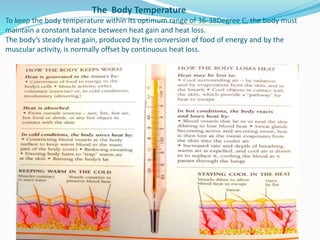
To keep the body temperature within its optimum range of 36-38Degree C, the body must
maintain a constant balance between heat gain and heat loss.
The body’s steady heat gain, produced by the conversion of food of energy and by the
muscular activity, is normally offset by continuous heat loss.
EFFECT OF EXTREME COLD
 The body reacts to cold by shutting down blood vessels in the
skin to stop “core heat” escaping .
 When deprived of warm blood ,extremities such as fingers or
toes may freeze in severe conditions causing frostbit .
 If the body’s core temperature becomes dangerously low , bodily
functions slow down cause Hypothermia.
Treatment
1. Very gently removes gloves, rings, and any other constrictions, such as boots. Warm
the affected part with your hands, in your lap, or in the casualty’s armpit.
2. Avoid rubbing because it can damage skin and tissues.
3. Move the casualty into warmth before you thaw the affected part: carry her if
possible when the feet are affected.
4. Place the affected part in the warm water. Dry carefully, and apply a light dressing
of fluffed-up dry gauze bandage.
5. Raise and support the limb to reduce swelling. An adult casulty may take two
paracetamol tablets for intense pain. Take or send her to hospital, if necessary.
Foreign Bodies
 Any object, large or small ,that find its way into the
body either through a wound in the skin or via one of
the body’s orifices, such as the ear , nose, eye, vagina,
or rectum, is called a “foreign body” .
Foreign Bodies in the skin :-
 Small foreign bodies such as wood splinters or shards
of glass usually cause miner puncture wounds with
little or no bleeding.
 Foreign bodies in wounds are often contaminated with
bacteria and dirt.
Foreign Bodies in the Eye, Ear
In Eye
A speck of dust, loose eyelash, or
even a contact lens can literally float
on the white of the eye, and is
usually easily removed.
In Ear
If an object lodged in the ear, it
can cause temporary deafness by
blocking the ear canal, or may
damage the ear drum.
Some problems creates in eye:
 Blurred vision
 Pain or discomfort
 Redness and watering of the
eye
 Eyelids screwed up in spasm
Some problems creates in ear:
 Temporary deafness
 May damage the ear drum
 Ear buzzing
What Is A Poison?
 A poison is a substance which ,if taken into the
body in sufficient quantity ,may cause
temporary or permanent damage .
 Poisons may be swallowed ,inhaled, absorbed
through the skin, splashed into the eye, or
injected.
 Natural poisons (toxins) are those which
originate from bacteria or certain plants, and
animals such as snakes.
Household Poisons
 Almost every household contain potentially
poisonous substances, such as bleach,
dishwasher detergent, paint stripper, and
weedkiller.
 These can be spilled , resulting in chemical
burns, or swallowed, causing poisoning.
 Children in particular are at risk from
poisoning by household products.
How To Prevent Poisoning
 Keep toxic chemicals out of children’s reach
and sight (not under the sink).
 Keep medicines in a locked cupboard.
 Leave poisonous household substances in
their original containers.
 Buy medicines and household substances in
child-resistant containers.
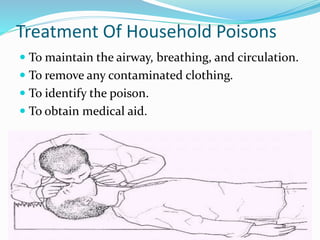
Treatment Of Household Poisons
 To maintain the airway, breathing, and circulation.
 To remove any contaminated clothing.
 To identify the poison.
 To obtain medical aid.
Drug Poisoning
 This condition can result from an accidental or deliberate
overdose of prescribed or over-the-counter drugs, or from
drug abuse.
 The signs and symptoms of drug poisoning very depending
on the type of drug taken and the method of entry into the
body.
 Example:- Aspirin, paracetamol, morphine etc.
Treatment Of Drug Poisoning
 To remove the casualty from danger.
 To maintain an open airway.
 To arrange removal to hospital.
Industrial Poisons
 Poisoning can occur in the workplace as a result of a
leak, failure of a chemical plant, or a major accident;
or in a public place following a road accident.
 Most cases of industrial poisoning involve poisonous
gases.
 Spillage of corrosive chemical can also result in
burns.
 Factories using potentially dangerous chemicals or
gases may keep oxygen equipment, and must display
notices indicating the emergency procedures.
Food Poisoning
 This may be caused by eating food that is
contaminated by bacteria or by toxins produced by
bacteria that were already in the food.
Type of food poisoning
1.Bacterial food poisoning is often caused by the
salmonella group of bacteria.
2.Toxic food poisoning is frequently caused by toxins
produced by the bacteria group of
staphylococcus.
Bites And Stings
 Most animas and insects do not usually attack
unless injured or otherwise provoked, and
common sense can prevent many bites and stings.
First-Aid-Priorities
 Make sure that you are in no danger, then remove the
casualty from further danger.
 Treat any visible wound or painful symptoms, and
minimise the risk of further injury and infection.
 Obtain medical attention if necessary.
Animal Bites
 Bites from sharp, pointed teeth cause deep
puncture wounds that can carry germ far into the
tissues.
 Human bites also crush the tissues.
 Any bite that breaks the skin causes a wound very
vulnerable to infection; it needs prompt first aid
and medical attention.
Treatment
 To control bleeding.
 To minimise the risk of infection , both to the
casualty and yourself.
 To obtain medical attention.
Krishna ppt first aid

Krishna ppt first aid

  • 1.
    FIRST AID DEPARTMENT OFPHARMACY Dr. B. R. AMBEDKAR UNIVERSITY, AGRA- 282002 Submitted by: Submitted to: Krishna Kumar Mrs. Sonam Pushkar B. Pharm VII Sem. (Assistant Professor) Roll No. 168287365004
  • 2.
     The humanbody is designed to work best at, or close to, a temp. of 37degree C (98.6F).  To maintain this temp., the body possesses mechanism that generate and conserve heat when the enviornment is cold and conversely, that lose heat when it is hot. The dangers of extreme temperatures  The harmful effects of extreme heat or cold can be localized, as is the case with frostbite and sunburn, or generalised, as with hypothermia, heat exhaustion, and heatstroke.  The generalised effects of temp. occur more often in the very young and the very old.
  • 3.
    The First AiderShould  Remove , or protect, the casualty from excessively hot or cold surroundings.  Restore normal body temperature: if the condition has been rapid is onset (e.g.- heat exhaustion), reverse it rapidly; if it has developed slowly.  Obtain appropriate medical attention.
  • 4.
    The Body Temperature Tokeep the body temperature within its optimum range of 36-38Degree C, the body must maintain a constant balance between heat gain and heat loss. The body’s steady heat gain, produced by the conversion of food of energy and by the muscular activity, is normally offset by continuous heat loss.
  • 5.
    EFFECT OF EXTREMECOLD  The body reacts to cold by shutting down blood vessels in the skin to stop “core heat” escaping .  When deprived of warm blood ,extremities such as fingers or toes may freeze in severe conditions causing frostbit .  If the body’s core temperature becomes dangerously low , bodily functions slow down cause Hypothermia. Treatment 1. Very gently removes gloves, rings, and any other constrictions, such as boots. Warm the affected part with your hands, in your lap, or in the casualty’s armpit. 2. Avoid rubbing because it can damage skin and tissues. 3. Move the casualty into warmth before you thaw the affected part: carry her if possible when the feet are affected. 4. Place the affected part in the warm water. Dry carefully, and apply a light dressing of fluffed-up dry gauze bandage. 5. Raise and support the limb to reduce swelling. An adult casulty may take two paracetamol tablets for intense pain. Take or send her to hospital, if necessary.
  • 6.
    Foreign Bodies  Anyobject, large or small ,that find its way into the body either through a wound in the skin or via one of the body’s orifices, such as the ear , nose, eye, vagina, or rectum, is called a “foreign body” . Foreign Bodies in the skin :-  Small foreign bodies such as wood splinters or shards of glass usually cause miner puncture wounds with little or no bleeding.  Foreign bodies in wounds are often contaminated with bacteria and dirt.
  • 7.
    Foreign Bodies inthe Eye, Ear In Eye A speck of dust, loose eyelash, or even a contact lens can literally float on the white of the eye, and is usually easily removed. In Ear If an object lodged in the ear, it can cause temporary deafness by blocking the ear canal, or may damage the ear drum. Some problems creates in eye:  Blurred vision  Pain or discomfort  Redness and watering of the eye  Eyelids screwed up in spasm Some problems creates in ear:  Temporary deafness  May damage the ear drum  Ear buzzing
  • 8.
    What Is APoison?  A poison is a substance which ,if taken into the body in sufficient quantity ,may cause temporary or permanent damage .  Poisons may be swallowed ,inhaled, absorbed through the skin, splashed into the eye, or injected.  Natural poisons (toxins) are those which originate from bacteria or certain plants, and animals such as snakes.
  • 9.
    Household Poisons  Almostevery household contain potentially poisonous substances, such as bleach, dishwasher detergent, paint stripper, and weedkiller.  These can be spilled , resulting in chemical burns, or swallowed, causing poisoning.  Children in particular are at risk from poisoning by household products.
  • 10.
    How To PreventPoisoning  Keep toxic chemicals out of children’s reach and sight (not under the sink).  Keep medicines in a locked cupboard.  Leave poisonous household substances in their original containers.  Buy medicines and household substances in child-resistant containers.
  • 11.
    Treatment Of HouseholdPoisons  To maintain the airway, breathing, and circulation.  To remove any contaminated clothing.  To identify the poison.  To obtain medical aid.
  • 12.
    Drug Poisoning  Thiscondition can result from an accidental or deliberate overdose of prescribed or over-the-counter drugs, or from drug abuse.  The signs and symptoms of drug poisoning very depending on the type of drug taken and the method of entry into the body.  Example:- Aspirin, paracetamol, morphine etc. Treatment Of Drug Poisoning  To remove the casualty from danger.  To maintain an open airway.  To arrange removal to hospital.
  • 13.
    Industrial Poisons  Poisoningcan occur in the workplace as a result of a leak, failure of a chemical plant, or a major accident; or in a public place following a road accident.  Most cases of industrial poisoning involve poisonous gases.  Spillage of corrosive chemical can also result in burns.  Factories using potentially dangerous chemicals or gases may keep oxygen equipment, and must display notices indicating the emergency procedures.
  • 14.
    Food Poisoning  Thismay be caused by eating food that is contaminated by bacteria or by toxins produced by bacteria that were already in the food. Type of food poisoning 1.Bacterial food poisoning is often caused by the salmonella group of bacteria. 2.Toxic food poisoning is frequently caused by toxins produced by the bacteria group of staphylococcus.
  • 15.
    Bites And Stings Most animas and insects do not usually attack unless injured or otherwise provoked, and common sense can prevent many bites and stings. First-Aid-Priorities  Make sure that you are in no danger, then remove the casualty from further danger.  Treat any visible wound or painful symptoms, and minimise the risk of further injury and infection.  Obtain medical attention if necessary.
  • 16.
    Animal Bites  Bitesfrom sharp, pointed teeth cause deep puncture wounds that can carry germ far into the tissues.  Human bites also crush the tissues.  Any bite that breaks the skin causes a wound very vulnerable to infection; it needs prompt first aid and medical attention. Treatment  To control bleeding.  To minimise the risk of infection , both to the casualty and yourself.  To obtain medical attention.